

Key Takeaways
Courage isn't fearlessness; it's moving into the unknown while afraid
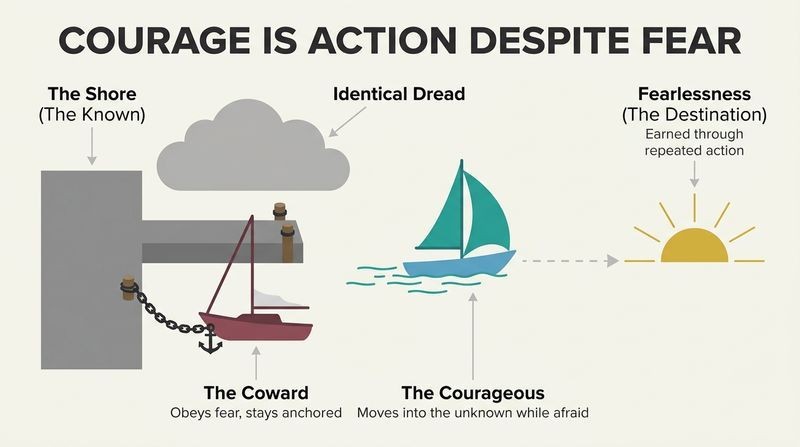
The coward and the courageous share the same fear. Osho insists there is no meaningful difference between them at the starting line. Both tremble. The coward obeys the fear and stays on the familiar shore. The courageous person feels the identical dread, sets it aside, and sails into uncharted water anyway, like Columbus leaving the safety of known coastlines.
Fearlessness is a destination, not a starting point. It arrives only after repeated acts of courage, as a fragrance that appears once courage becomes absolute. Every time you accept the challenge of the unfamiliar, the fears shrink a little and your intelligence sharpens. Osho frames courage as gambling: risking the known for the unknown, the comfortable for the arduous, with no guarantee you will arrive.
This reframing aligns tightly with modern psychology. Susan Jeffers built an entire practice around "feel the fear and do it anyway," and exposure therapy works precisely because avoidance feeds anxiety while approach dissolves it. Osho's claim that fearlessness is earned rather than innate matches research on courage as a trainable trait, not a fixed temperament. What's worth questioning is his romance of the gambler. Behavioral economics shows humans systematically misjudge risk, and not every leap into the unknown ends in growth. The wisdom lies in distinguishing generative risk from reckless self-destruction, a line Osho blurs but experienced practitioners must draw carefully.
The word courage means heart; weaklings retreat into the head
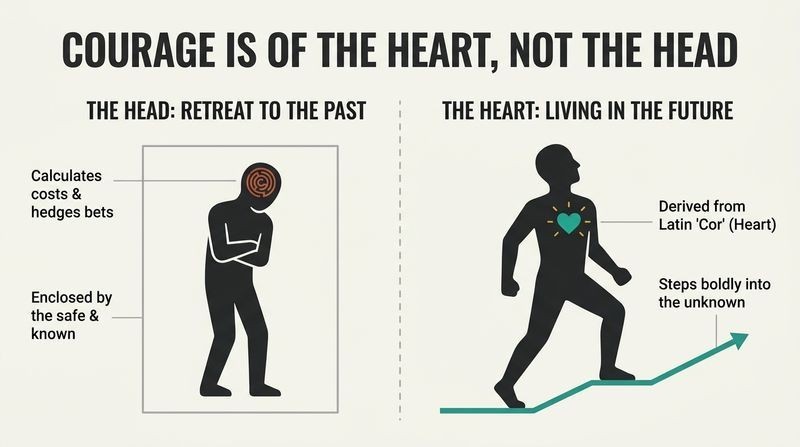
Etymology as philosophy. Osho points out that courage descends from the Latin cor, meaning heart. To be courageous is literally to live from the heart rather than the calculating head. The head is a businessman who tallies costs and hedges bets. The heart is a gambler that risks everything for the possibility of meaning.
Mind is the accumulated past; heart is the open future. The head can only rearrange what it already knows, chewing what has already been chewed. It cannot meet the genuinely new. The heart listens for the unknown and dreams forward. Osho's prescription is blunt: stop consulting scriptures and inherited rules, listen to your own heart even when it leads you astray, because going astray is part of ripening.
The etymology is real, and Osho leverages it well, though he overstates the head-heart split into a near-Manichean opposition. Contemporary neuroscience complicates this: Antonio Damasio's work on patients with damaged emotional centers showed they became paralyzed decision-makers, proving reason without feeling is useless. So the heart is not the enemy of good choices; it is their precondition. Osho's deeper point survives the critique. A life governed purely by risk-averse calculation forecloses the experiences that give existence texture. His advice to commit many mistakes but never the same one twice is essentially a lesson in iterative learning, echoing how scientific discovery and skill acquisition actually proceed.
Yield like grass, not resist like the oak, and you cannot be defeated
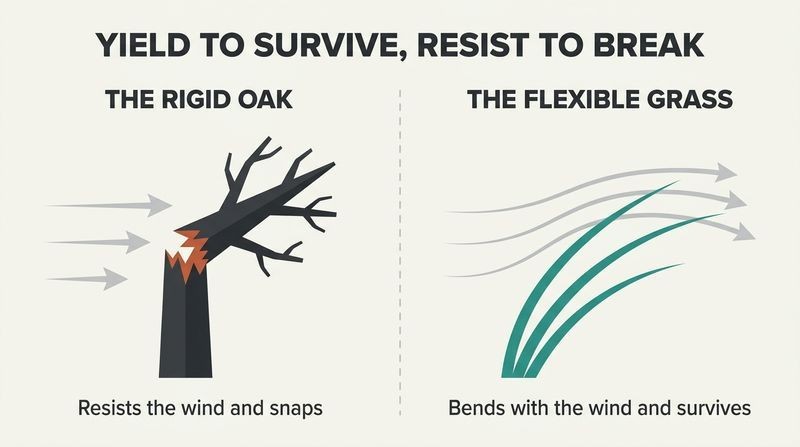
The storm topples the mighty tree but spares the grass. Osho retells the Taoist image: a three-thousand-year-old tree stands rigid against the storm and is broken, while the humble grass bends, gets a cleansing bath, and dances again once the wind passes. Darwin's fittest lose; Lao Tzu's yielding survive. Hitlers, Napoleons, and Alexanders are strong trees destined to fall.
The sannyasin Dandamis disarms Alexander. When Alexander the Great arrived with a naked sword to abduct an Indian mystic, Dandamis simply said the sword could only cut a body he had already abandoned. Alexander, for the first time, obeyed another man. Osho's lesson: it is your fear that enslaves you, and it is fear that drives you to enslave others first. A person beyond fear neither dominates nor submits.
The grass-and-oak parable has migrated across cultures because it captures something engineers now formalize as resilience versus rigidity. Nassim Taleb's concept of antifragility extends it: some systems do not merely survive shocks but grow stronger from them. Yet Osho's celebration of pure yielding has limits worth naming. History also records that unresisted aggressors conquer, and Gandhi's nonviolence succeeded partly because it exploited a specific adversary's conscience and press coverage. The Dandamis story works as spiritual instruction about inner freedom, less as geopolitical strategy. Its enduring insight is psychological: the person with nothing to protect, including their own self-image, becomes strangely unassailable.
Fear is not love's opposite; it is love's absence, like darkness is light's
You cannot fight darkness directly. Osho argues fear has no independent existence. Like darkness, it is merely the absence of something real. You cannot beat back darkness with a sword; you exhaust yourself and conclude darkness is powerful when in fact it is nothing. Bring light, and darkness simply is not there. Fear works identically: stop battling it and instead cultivate love, and fear vanishes without a fight.
Love flows in four layers, from sex to samadhi. Osho maps an ascent: bodily orgasm dissolves fear from the body; unconditional love dissolves fear from the mind; spontaneous prayer dissolves fear of death from the spirit; meditation dissolves even fearlessness itself into pure silence. He warns that bravery is not the goal, since the brave are merely cowards in armor, fear well-defended rather than dissolved.
The darkness-light analogy is elegant but philosophically slippery. Fear is not simply an absence; it is an evolved, adaptive signal with measurable neural correlates in the amygdala, and it kept our ancestors alive. Treating it as mere negation risks dismissing legitimate warnings. Osho himself concedes elsewhere that some fear is realistic. Still, his core therapeutic instinct is sound and prefigures approaches like loving-kindness meditation, which research links to reduced anxiety and increased vagal tone. The insight that you dissolve a negative state by cultivating its positive counterpart, rather than wrestling the negative, is a genuinely useful reframe for anyone stuck fighting their own anxiety.
Trust your own experience over inherited beliefs, even against the whole world
Belief is borrowed; trust is grown. Osho draws a sharp line. Belief is social, handed to you by parents and priests, and it shatters the moment your business fails or a loved one dies. Trust is personal, discovered within, and once present nothing can destroy it. He calls a world full of "religious" people simultaneously irreligious, because their trust is cultivated imitation, not lived knowing.
The politics of numbers keeps you a sheep. Society validates itself through sheer headcount; millions agreeing feels like proof. Osho tells of Ramakrishna, an illiterate mystic, defeating the Western-educated skeptic Vivekananda not with argument but by touching his chest and throwing him into a three-hour trance. Afterward Vivekananda knew God through his own "inner sense," the sixth sense that reports on your own being and cannot be shown to anyone else.
Osho's distinction between belief and trust anticipates the psychological literature on intrinsic versus extrinsic motivation and on epistemic autonomy. Beliefs held on borrowed authority are indeed brittle; research on attitude change shows convictions grounded in personal experience resist persuasion far better. His "politics of numbers" is essentially a critique of Asch-style conformity, where subjects denied the evidence of their own eyes to match a group. The caution here: radical trust in one's inner sense, untested against outside feedback, is also how delusion and grandiosity flourish. The healthiest stance combines Osho's inner grounding with a willingness to falsify, the very calibration that separates the mystic's insight from the crank's certainty.
Let intellect carry the heart, like blind man and legless man escaping fire
Two beggars survive a forest fire together. In Osho's Eastern fable, a blind man has legs but no direction; a legless man has eyes but cannot run. As fire engulfs the forest, these lifelong rivals strike a deal: the legless rides the blind man's shoulders, lending eyes while borrowing legs. Together they escape what would have killed either alone.
Intelligence is intellect in tune with heart. The intellect is the blind runner: fast, capable, but directionless, which is why intellectuals declare life meaningless. The heart sees and feels but cannot move on its own. Wisdom emerges only when intellect accepts the heart on its shoulders and follows its directions. Osho distinguishes this living intelligence from mere intellect, which he calls a decorated corpse, and from knowledge, which he considers mediocre and secondhand.
This is one of Osho's most balanced formulations, and it corrects the anti-intellectual drift elsewhere in his thought. Rather than dismissing reason, he assigns it a role subordinate to but partnered with feeling. The model maps neatly onto dual-process theory in cognitive science, where fast intuitive System 1 and slow deliberate System 2 must cooperate. It also echoes Damasio's somatic marker hypothesis: good decisions require emotional signals to guide rational analysis toward what matters. The fable's beauty is that neither faculty is disposable. What Osho adds beyond the science is the insistence on hierarchy: the heart chooses the destination, the intellect merely navigates the terrain.
You arrived innocent, then traded your integrity for society's cheap toys
The child bargains away his soul. Osho says every person is born innocent, a blank slate with only a future, carrying one priceless possession: authenticity, integrity, self-respect. The grown-up world offers glittering toys, respectability, and identity in exchange, and the child, not knowing his integrity outweighs the entire world, trades it away. He discovers the loss only when the toys deliver no joy.
Mulla Nasruddin's stolen bag. A miserable rich man seeks peace of mind. The trickster-sage Mulla snatches his bag of diamonds and sprints off. After a frantic, weeping chase, the exhausted man recovers his own bag and clutches it in ecstasy. The lesson: you already possess what you seek; you only take it for granted until threatened with loss. Osho adds that families should learn from children rather than rushing to mold them into paupers like themselves.
The romantic notion of innocent childhood corrupted by society runs from Rousseau through the Romantics, and Osho inherits it wholesale. Developmental psychology complicates the picture; children are not blank slates but arrive with temperament, and socialization also builds empathy, language, and cooperation, not just neurosis. Yet the Nasruddin parable lands a durable behavioral truth now called hedonic adaptation: we normalize what we have and only feel its value when loss looms. Loss aversion, documented by Kahneman and Tversky, is the engine of the joke. Osho's practical takeaway, that peace is recovered by reclaiming what you already own rather than acquiring more, is quietly radical in a consumption-driven culture.
Live dangerously by refusing to reduce lovers to spouses and work to routine
Security is a comfortable grave. Osho divides humanity into two camps: those who want to live comfortably, who are really seeking a well-appointed death, and those who want to live, who choose danger because vitality only flowers in insecurity. He points to mountaineers and surfers who feel most alive hanging between life and death, the present moment sharp as a flame.
Concrete rebellions against deadness. Osho gets specific about daily life:
1. Love a person without assuming they will still be available tomorrow.
2. Refuse to reduce a woman to "wife" or a man to "husband," which he calls ugly possession.
3. Marry to satisfy society if you must, but never possess the other's being.
4. Make play, not work, the center of life, with work merely serving play.
Expect nothing, be ready for everything.
Osho's warning against possession in relationships prefigures a great deal of contemporary relationship psychology. Esther Perel's work on desire argues that mystery and autonomy, not merger and certainty, keep erotic aliveness intact, precisely Osho's point about not reducing a lover to a predictable spouse. His elevation of play echoes Stuart Brown's research linking play deprivation to depression and rigidity. The tension is practical: institutions like marriage and stable work exist because humans also need security to raise children and build lives, and constant novelty-seeking can become its own trap of restlessness. The mature reading treats Osho as a corrective for the over-secured, not a blanket prescription for everyone.
The known is a corpse; clinging to it takes more courage than leaving
Dropping the familiar needs no courage at all. Osho makes a counterintuitive move: since everything you know is already dead, part of a graveyard of past experience, letting it go should be effortless. The real energy is wasted clinging to a corpse. The man of understanding dies to his past every moment and is reborn to the future, treating each present as a resurrection.
Meet the new like a child. When something new knocks, your whole past is at stake, which is why you tremble. Osho says you cannot manufacture the new through effort, because effort comes from the old past. You can only act spontaneously, without will or direction from memory, abandoning yourself to the moment. He ties fear of the new to the ego, which is nothing but accumulated memory, artificially afraid of its own dissolution.
The instruction to "die to the past every moment" resonates with Buddhist impermanence and with the Stoic practice of viewing each day as a complete life. Modern parallels abound: psychological flexibility, the core of Acceptance and Commitment Therapy, is precisely the capacity to release rigid attachment to old self-concepts and respond freshly to present demands. Osho's identification of ego with memory anticipates neuroscientific views of the self as a narrative construction rather than a fixed entity. The provocation worth wrestling with is his claim that no courage is needed, only clarity. In practice, seeing the known as dead is itself the hardest cognitive shift, which is arguably courage by another name.
You are responsible for your own misery, which is the first great courage
Blaming others is how misery survives. Osho observes that people have deep investment in their unhappiness, clinging to it like the oldest companion in a long marriage. The miserable person always locates the cause outside: the spouse, the parents, society, fate, God. This is the trick that keeps misery alive, because if someone else is responsible, you are helpless. Accept total responsibility and you can change everything this very moment.
Blissfulness is the harder achievement. Counterintuitively, Osho argues misery requires no effort at all; any fool manages it. Bliss is the uphill task demanding real courage. He connects this to karma, meaning simply "doing": you did it, so you can undo it, with no need to wait for time or external rescue. The great courage is to divorce misery, the human mind's longest and most familiar habit.
This is Osho at his most aligned with cognitive-behavioral and Stoic traditions. Epictetus taught that we are disturbed not by events but by our judgments about them, and CBT operationalizes exactly this: change the interpretation and you change the emotional outcome. The concept of learned helplessness, Seligman's discovery that perceived lack of control breeds depression, gives empirical teeth to Osho's claim that blame perpetuates suffering. Where nuance is needed: trauma, chemistry, and genuine oppression are real, and "you chose your misery" can curdle into victim-blaming. The generous reading targets not external hardship but our habitual relationship to it, the one domain where responsibility genuinely does return agency to the sufferer.
Every fear is really the fear of death, cured only by meditation
All fears are branches of one tree. Bankruptcy, loneliness, rejection: Osho reduces them all to a single root, the fear of death and annihilation. Money and power are unconscious insurance policies against mortality, and workaholism is a drug that keeps a curtain between you and the abyss. No external possession can insure against death.
Only experiencing deathless consciousness dissolves it. Osho insists you were never born and never die; forms change while the essential life-source persists, having evolved through countless shapes. He tells of a ninety-year-old Zen monk who, told he had minutes to live, walked to the cemetery, dug his own grave, lay down, and died on his own terms rather than being dragged. Meditation, not scripture or secondhand assurance, brings the direct experience that ends the fear, because a doubt that survives argument cannot survive realization.
Terror Management Theory, one of social psychology's most tested frameworks, provides remarkable empirical support for Osho's central claim. Researchers have shown that reminders of mortality drive people toward money, status, nationalism, and rigid worldviews, exactly the "insurance policies" Osho names. Ernest Becker's Pulitzer-winning The Denial of Death argued the same decades of civilization are elaborate defenses against death-awareness. Where Osho goes beyond the evidence is the metaphysical claim of a deathless self reincarnating across forms, which rests on personal experience rather than verification. One need not accept the reincarnation to keep the psychological gold: naming death as the hidden driver behind scattered anxieties lets you address the root instead of endlessly firefighting symptoms.
Your fear of the dark abyss is only six inches deep
The man clinging to the branch all night. Osho's closing parable: a man slips off a rock in darkness, grabs a hanging branch, and dangles in terror above what he believes is a bottomless valley. He shouts into the void, his hands freeze, he suffers a night of pure nightmare. At dawn he looks down and laughs. A solid rock sits just six inches below his feet. He could have slept soundly all night.
Enter fear instead of escaping it. Rather than repressing fear with the hypothesis of a protective God, Osho urges going silently into it to find its true depth. The deeper you descend, the less there is. At the rock bottom you simply laugh, because there was nothing to fear. What remains is innocence, which he calls the only real miracle and the essence of a genuinely religious person.
The parable is a near-perfect illustration of how catastrophic imagination inflates threat, a mechanism central to anxiety disorders. Exposure-based therapies rest on the identical principle: approached rather than avoided, feared situations reveal themselves as far less dangerous than the mind forecast, and the terror deflates. Osho's instruction to descend into fear rather than cap it with religious consolation is bracing and largely sound, though the six-inch metaphor risks minimizing fears that are genuinely bottomless for some, such as those rooted in real danger or clinical trauma. As a general orientation, though, the message that investigation shrinks fear while avoidance feeds it is both spiritually and scientifically robust.
Analysis
Courage is not a treatise but a transcribed collection of Osho's spoken discourses, which shapes both its power and its problems. The register is aphoristic, circular, and deliberately provocative, built to jolt listeners out of mental habits rather than to argue positions. Osho's central move is inversion: fearlessness is not the absence of fear but its ripened fruit; the strong tree loses while the yielding grass survives; misery is effortless while bliss demands courage; the known is dead while the unknown is alive. These paradoxes function less as logical claims than as koan-like disruptions of the security-seeking mind.
The book's intellectual spine is a sustained assault on borrowed certainty. Osho collapses religion, nationalism, family, and social convention into a single mechanism: institutions that manufacture fear to manufacture obedience. His prescription is radical self-trust grounded in direct experience, which he calls the inner sense, and which he distinguishes sharply from inherited belief. This anticipates and overlaps with a striking range of later empirical work: Terror Management Theory on death-driven behavior, learned helplessness on blame and depression, exposure therapy on approaching fear, and hedonic adaptation on the emptiness of acquisition.
The weaknesses are equally clear. Osho romanticizes childhood innocence and risk-taking, dismisses reason too readily despite his own better formulations, and grounds crucial claims about deathless consciousness and past lives in unverifiable personal authority. His stories, though vivid, are illustrative rather than evidentiary. His radical-responsibility stance, powerful as agency-restoration, can shade into blaming those crushed by circumstance.
Read well, the book is a meditation manual disguised as philosophy. Its recurring instruction, repeated across every theme, is to stop fighting negative states and instead cultivate their positive counterparts: replace fear with love, belief with trust, misery with responsibility, the corpse of the known with the aliveness of the unknown. Courage, in the end, is Osho's name for the willingness to live without guarantees.
Review Summary
Courage: The Joy of Living Dangerously receives mostly positive reviews, with readers praising Osho's insights on fear, love, and self-discovery. Many find the book inspiring and life-changing, appreciating its simple yet profound messages. Critics note repetitive content and questionable ideas, while some express concerns about Osho's controversial past. The book's encouragement to embrace uncertainty and live authentically resonates with many readers, who describe it as thought-provoking and transformative.
People Also Read





FAQ
What's "Courage: The Joy of Living Dangerously" about?
- Exploration of Courage: The book delves into the concept of courage, emphasizing living life with a sense of adventure and embracing the unknown.
- Living Dangerously: Osho encourages readers to live dangerously, not in a reckless sense, but by stepping out of comfort zones and embracing life's uncertainties.
- Inner Transformation: It focuses on inner transformation, suggesting that true courage comes from within and involves self-awareness and acceptance.
- Philosophical Insights: The book combines philosophical insights with practical advice on how to live a fulfilling and fearless life.
Why should I read "Courage: The Joy of Living Dangerously"?
- Personal Growth: The book offers insights into overcoming fear and embracing change, which are essential for personal growth.
- Unique Perspective: Osho provides a unique perspective on courage, blending Eastern philosophy with practical advice.
- Inspiration: It serves as an inspiration to live life fully and authentically, encouraging readers to break free from societal norms.
- Practical Advice: The book includes practical meditations and exercises to help readers cultivate courage and live more freely.
What are the key takeaways of "Courage: The Joy of Living Dangerously"?
- Embrace Uncertainty: Life is inherently uncertain, and embracing this uncertainty is a form of courage.
- Live Authentically: True courage involves living authentically and being true to oneself, rather than conforming to societal expectations.
- Transform Fear: Fear is a natural part of life, but it can be transformed into freedom through acceptance and awareness.
- Inner Journey: Courage is an inner journey that involves self-discovery and the willingness to face one's own vulnerabilities.
How does Osho define courage in "Courage: The Joy of Living Dangerously"?
- Not Fearlessness: Courage is not the absence of fear but the willingness to move forward despite it.
- Going into the Unknown: It involves venturing into the unknown and taking risks, even when afraid.
- Inner Strength: True courage comes from inner strength and the ability to trust oneself and the process of life.
- State of Being: Osho describes courage as a state of being, where one is open to life's experiences without resistance.
What is the "Way of the Heart" according to Osho?
- Living with the Heart: The "Way of the Heart" involves living with love and trust, rather than logic and fear.
- Openness and Vulnerability: It requires openness and vulnerability, allowing oneself to be touched by life.
- Non-Calculative Approach: This path is non-calculative, focusing on spontaneity and living in the moment.
- Connection with Existence: It emphasizes a deep connection with existence, where one feels at home in the universe.
How does Osho suggest transforming fear into love?
- Acceptance of Fear: Accept fear as a natural part of life and do not fight it; acceptance leads to transformation.
- Love More: Engage in acts of love, as love dispels fear and brings about a sense of security and connection.
- Meditative Practices: Use meditation to explore and understand fear, allowing it to dissolve naturally.
- Trust in Life: Develop trust in life and its processes, which helps in overcoming fear and embracing love.
What is the significance of "Living Dangerously" in Osho's philosophy?
- Embracing Risk: Living dangerously means embracing risk and uncertainty as a path to growth and self-discovery.
- Beyond Comfort Zones: It involves stepping beyond comfort zones and challenging oneself to experience life fully.
- Dynamic Living: Life is dynamic and ever-changing; living dangerously aligns with this natural flow.
- Spiritual Growth: It is a path to spiritual growth, where one learns to let go of control and trust the unknown.
What are the best quotes from "Courage: The Joy of Living Dangerously" and what do they mean?
- "Don’t call it uncertainty—call it wonder." This quote encourages seeing life's uncertainties as opportunities for wonder and exploration.
- "Fear is nothing but absence of love." It suggests that fear arises from a lack of love and can be transformed by embracing love.
- "Life is a mystery to be lived, not a problem to be solved." This emphasizes living life with curiosity and openness rather than trying to control or solve it.
- "Courage is risking the known for the unknown." It highlights the essence of courage as the willingness to step into the unknown.
How does Osho address the concept of fear in "Courage: The Joy of Living Dangerously"?
- Natural Emotion: Fear is presented as a natural emotion that everyone experiences.
- Acceptance Over Repression: Osho advises accepting fear rather than repressing it, as acceptance leads to freedom.
- Fear as a Teacher: Fear can be a teacher, guiding individuals to explore their inner selves and grow.
- Transformative Power: By understanding and embracing fear, it can be transformed into a source of strength and courage.
What meditation techniques does Osho recommend for overcoming fear?
- Meditation for Fear of Emptiness: Sit in silence, embrace the feeling of emptiness, and allow fear to surface without resistance.
- Meditation for Dissolving Old Patterns: Confront habitual patterns of fear by consciously choosing to act differently in fear-inducing situations.
- Meditation for Trust: Relive past experiences to unburden the mind and cultivate trust in oneself and life.
- Transforming Fear into Love: Use specific postures and breathing techniques to shift energy from fear to love.
How does Osho's concept of "The Way of Intelligence" relate to courage?
- Openness and Vulnerability: Intelligence involves being open and vulnerable, which requires courage.
- Functioning Without Conclusions: It means functioning without preconceived notions, embracing uncertainty with courage.
- Individual Exploration: Intelligence is about individual exploration and the courage to make mistakes and learn from them.
- Beyond Logic: True intelligence goes beyond logic and embraces the mystery of life, which requires courage.
What role does trust play in "Courage: The Joy of Living Dangerously"?
- Foundation of Courage: Trust is foundational to courage, as it involves trusting oneself and the process of life.
- Overcoming Doubt: Trust helps overcome doubt and fear, allowing one to embrace the unknown.
- Inner Confidence: It builds inner confidence, enabling individuals to take risks and live authentically.
- Connection with Existence: Trust fosters a deep connection with existence, where one feels supported and guided.
About the Author
Other books by Osho







Download PDF
Download EPUB
.epub digital book format is ideal for reading ebooks on phones, tablets, and e-readers.








































