


Key Takeaways
Intimacy fails because you can't drop the masks you hide behind
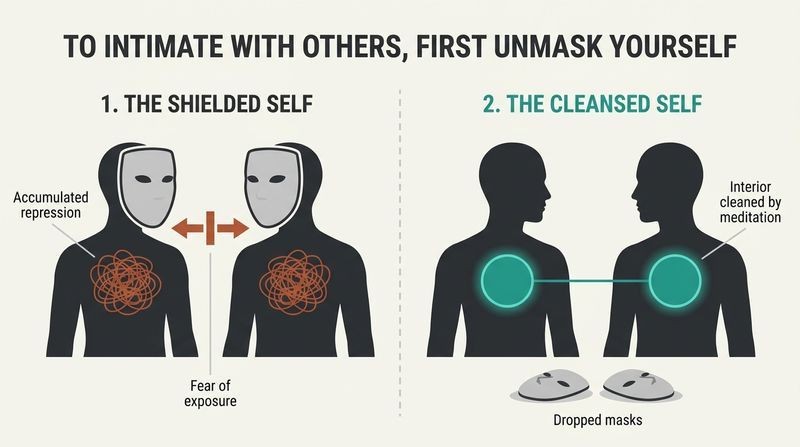
Everyone craves closeness yet fears it. Osho opens with a paradox: intimacy means exposing yourself to a stranger, and everyone remains a stranger, even a spouse of forty years. To be intimate you must drop your defenses, masks, and the thousand things you hide, not only from others but from yourself. The fear is that once exposed, someone will exploit your weaknesses.
The blockage is accumulated repression. Religions, cultures, and parents install taboos and inhibitions that become festering wounds. You cannot open a heart stuffed with suppressed sexuality and perversions. Only someone who has cleaned house through meditation can allow intimacy without terror, because there is nothing left to conceal. First you clean yourself, then closeness becomes joyous rather than dangerous.
Osho's diagnosis anticipates modern attachment research: Brené Brown's work on vulnerability frames the same tension, that connection requires exposure people are wired to avoid. What's distinctive here is locating the barrier not in past relationships but in internalized shame from cultural conditioning. The claim that meditation must precede intimacy is debatable. Attachment theory suggests intimacy itself, through a responsive partner, can heal wounds that solo practice cannot. Osho leans toward self-work first; relational therapists argue repair happens in connection. Both may be true: a minimum of self-acceptance likely enables the vulnerability that then deepens through another's acceptance.
You cannot love another until you first love yourself
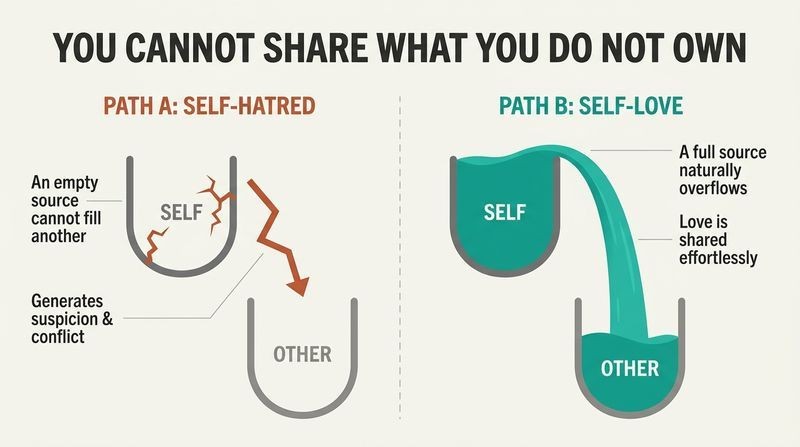
Society deliberately destroys self-trust. Osho argues a slave society needs dependent people, so it teaches trust in parents, church, and state while sabotaging the one foundation that matters: trust in yourself. A child who trusts himself is uncontrollable, so his confidence is made to tremble. Condemned from birth, most people learn self-hatred, then cannot believe anyone could genuinely love them.
Self-hatred poisons every relationship. When someone loves a person who hates himself, that person suspects a trick and fights to prove he is unworthy. This, Osho says, is what quietly wrecks marriages: both partners cannot accept love because neither accepts himself. He cites Hillel, the Jewish mystic: if you are not for yourself, who will be, yet if you are only for yourself, what meaning has your life? Self-love is the seed; overflowing love for others is the flower.
This maps onto the self-compassion research of Kristin Neff, who found that treating oneself with kindness predicts healthier relationships and lower anxiety. Osho's framing sharpens a common cliche by naming the mechanism: the self-hater actively repels love to defend a familiar identity. There is nuance to add. Narcissism research shows grandiose self-regard is not self-love but its compensation, and Osho anticipates this by distinguishing being self-full from being a self-obsessed Narcissus. The genuinely useful move is his reframe of selfishness as prerequisite generosity, echoing the airplane oxygen-mask logic that altruism from an empty vessel merely spreads misery.
Never promise forever; love only lives in this moment
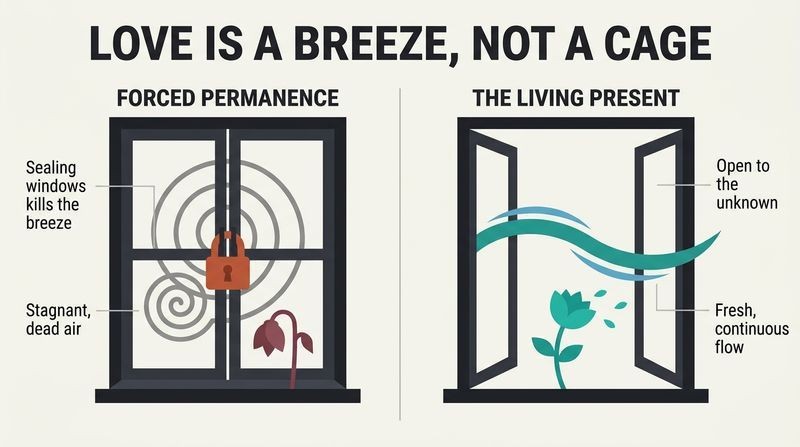
Permanence is a lie lovers tell. Osho insists you cannot honestly promise lifelong love because you cannot be certain of tomorrow. The only truthful statement is: I love you totally this moment, and about the next I know nothing. False promises breed the frustration, distance, and drawn-out misery that follow most honeymoons.
Security kills the thing it protects. A relationship made completely secure loses all charm, like capturing a cool breeze by sealing every window only to be left with stale air. A husband is a dead lover, a wife a dead lover, because the past now dictates the future. Osho's counsel: if you want to love someone, love them here, now, because the next moment may never come. Paradoxically, loving totally today makes the person more likely to stay tomorrow.
Osho's rejection of permanence collides with data showing committed, secure attachment correlates with wellbeing and longevity. Yet his deeper point survives the critique: it is presence, not the promise, that keeps love alive. Research on couples by John Gottman finds that daily responsiveness, small bids for connection answered now, predicts durability far better than vows. The Buddhist notion of impermanence underlies his argument that clinging to security produces stagnation. The tension worth holding: structure and freedom need not be enemies. A secure base, in Bowlby's sense, can be precisely what frees partners to keep meeting each other freshly rather than as museum pieces.
Respond fresh to this moment instead of reacting from old scripts
Reaction is dead; response is alive. Osho distinguishes reaction, which replays past patterns automatically, from response, which meets the actual present. When someone insulted the Buddha by spitting on his face, Buddha simply asked, what next, treating the man and moment as entirely new. His disciples, who reacted with rage, offended him more, because they knew him yet still ran their old machinery.
The person before you is never the same person. Osho urges you to look again at your spouse, parent, or friend with fresh eyes, as at a stranger. Like a river, they have flowed and changed; the woman you married exists nowhere now. Most people stop truly looking, filing loved ones under old labels. To respond is to be totally alive here, sensitive to what is rather than to what was.
This is the practical core of mindfulness translated into relationship. Cognitive science supports it: the brain runs on predictive models, filling in the expected rather than perceiving the actual, which is efficient but corrosive to intimacy. The Buddha parable illustrates non-reactivity that modern therapy calls the pause between stimulus and response, a space Viktor Frankl identified as the locus of freedom. One caveat: pure present-moment response can underweight legitimate pattern recognition. Repeated betrayal is data, not merely a stale label. The skill is discernment, distinguishing a genuinely changed person from a stubbornly consistent one, without collapsing into reflexive defense.
Trade the security of the graveyard for the aliveness of insecurity
Only corpses are perfectly safe. Osho argues life is insecurity by its very nature, and every protective wall you build, through money, marriage, respectability, or belonging to a herd, is a smaller prison cell. Total protection exists only in the grave. He observes that soldiers at the front, once death is fully accepted, become oddly joyous and relaxed, playing cards and dancing, because fear loses its sting when the worst is acknowledged as certain.
Accept death and you can finally dance. Since death is unavoidable, creating security against it is wasted energy that could have become a song. The alive person treats love like a breeze: relishes it fully while it lasts, feels no despair when it goes, and waits with patience for it to return. Drop defenses, accept life as it is, and live each moment so totally that if the next never comes, there is no complaint.
The soldier observation echoes terror management theory, which finds that confronting mortality can either drive rigid defensiveness or, when integrated, produce greater authenticity and presence. Stoic philosophy reached the same conclusion through memento mori: rehearsing death to intensify life. Osho's claim that all security-seeking is disguised death-seeking is provocative and overstated; some security enables risk, as a stable home base lets children explore boldly. Still, the psychological insight is sound. Studies of hospice patients and near-death survivors repeatedly report a post-crisis shift toward valuing presence and connection over accumulation, exactly the reorientation Osho prescribes without requiring the near-death experience.
Stop chasing ideals; you are already what you seek
Chuang Tzu's man ran from his own shadow. In the parable Osho unpacks, a man so disturbed by his shadow and footsteps tried to outrun them, going faster and faster until he dropped dead. He never realized that stepping into shade dissolves the shadow and sitting still ends the footsteps. Your anger, greed, and sexuality are shadows: not solid enemies to fight but the mere absence of a blissful, lit-up life.
Fighting or fleeing both feed the problem. The mind offers only two moves against any inner trouble, suppress it or escape it, and both keep you entangled. Suppress anger and it sinks to your roots and colors everything. The exit is neither: light the candle and darkness simply vanishes. Celebrate life this moment as if you were already whole, and the wrong dissolves on its own rather than through willpower.
Osho's darkness-as-absence metaphor prefigures a key insight of acceptance-based therapies: struggling against unwanted thoughts amplifies them, a phenomenon Daniel Wegner demonstrated experimentally with ironic process theory, where trying not to think of a white bear guarantees you will. The behavioral alternative, cultivating a positive state so the negative loses oxygen, resembles positive psychology's broaden-and-build model. The challenge to Osho: some shadows are not mere absences but real trauma requiring active processing, not just candle-lighting. Yet as a corrective to the endless self-improvement treadmill, the parable is potent. The runner's fatal error, running faster, is the perfect image of effortful self-optimization defeating itself.
Loyalty is counterfeit love, manufactured to make you a slave
Society swapped wild love for tame loyalty. Osho draws a sharp line between the two. Love is wild, unpredictable, and uncontrollable, arriving and departing like a breeze with no guarantee. Society cannot build on something so unreliable, so it invented loyalty, a trained, formal substitute that goes through love's gestures while the heart stays absent. A slave is loyal out of fear, not joy.
Loyalty destroys intelligence. The Indian custom of widows burning on their husbands' pyres, never reciprocated by husbands, exposes the double standard. The soldier who bombed Hiroshima followed orders because army drills, endless pointless parades, are designed to kill the capacity to question. Osho's new human being replaces loyalty with intelligence and the power to say no. Love given freely lifts consciousness; love demanded enslaves. Unless you can say no, your yes means nothing.
Osho's love-versus-loyalty distinction resonates with Erich Fromm's argument in The Art of Loving that mature love is an active capacity, not a passive dependency or social contract. His analysis of military conditioning aligns with Stanley Milgram's obedience experiments and Hannah Arendt's banality of evil, both showing how ordinary people commit atrocities through trained deference. The critique to weigh: loyalty and commitment are not identical, and Osho risks conflating institutional coercion with the genuine virtue of steadfastness. Chosen fidelity, freely renewed, differs from imposed loyalty. Still, his core provocation stands: any bond that forbids the question why has already curdled into control.
Stay soft and weak, because rigidity is the signature of death
Lao Tzu's law of the living. Osho builds on the Tao Te Ching: the newborn is tender and supple, the corpse hard and stiff; living plants bend, dead ones are brittle. Therefore softness accompanies life and rigidity accompanies death. The storm snaps the mighty oak but the grass bends and springs back, freshened. Weakness has the beauty of grace, of the rose that lasts a morning versus the plastic flower that lasts forever precisely because it is unreal.
Surrender to the flow rather than fighting upstream. The ego seeks strength by resisting the current, becoming hard, isolated, a windowless cell. To be soft is to stay rooted in the river of life, unafraid, letting the whole carry you. Live each moment so totally that you carry no unsolved puzzles from the past, and you remain supple as a child to the very end.
The soft-overcomes-hard principle is Taoism's central paradox, and Osho renders it viscerally with the oak and grass. Modern parallels abound: psychological flexibility, measured in acceptance and commitment therapy, predicts resilience better than rigid grit. Materials science even offers a literal analogue, as ductile materials absorb stress that shatters brittle ones. The plastic-flower image is a sharp critique of a culture prizing permanence and invulnerability. Where caution is warranted: softness misread as passivity can enable exploitation, and Osho's counsel to bend with every storm could disarm legitimate resistance. The Taoist ideal is not spinelessness but responsiveness, water that yields yet carves canyons.
A public life with no private self is slow suicide
The word intimacy means your innermost core. From the Latin intimum, intimacy is inviting another into your deepest interior, letting them see you as you see yourself. But you can only share an inside if you have cultivated one. Osho warns that becoming wholly public hollows you out.
Marilyn Monroe had everything and nothing. Beautiful, adored, loved even by a president, she addressed Kennedy as Mr. President, as if making love to an institution. Nothing remained private; asked what she wore posing nude, she answered, the radio. Osho reads her suicide as the one act left she could do entirely alone. The lesson: keep half your book open to everyone and half a sealed mystery only rare guests may enter. Intimate things, like seeds, sprout only in darkness and privacy, never in the glare of the marketplace.
Osho's seed metaphor captures something developmental psychology confirms: identity formation requires a protected inner space, what Winnicott called the capacity to be alone in the presence of another. The Monroe reading is speculative biography, but it illustrates a real modern pathology now amplified beyond anything he foresaw. In the age of continuous self-broadcasting, the collapse of the private self he warned about has become structural. Research on social media links performative self-exposure to anxiety and identity diffusion. The prescription, keeping chapters sealed, is not secrecy for its own sake but preserving the soil where a real self can root before it faces the light.
Master silence, the deepest language love eventually speaks
Words run out as closeness grows. With strangers you chatter endlessly because nothing matters. With true intimacy, every word carries weight, so gaps of silence naturally open. Most people panic in these gaps, feeling they must say something or the other will think something is wrong. Osho reframes this discomfort entirely: the silence is not a failure of connection but its evolution.
Silence is a higher medium, not a void. Language is a primary-school tool for people who cannot yet communicate; as maturity deepens, nonverbal presence takes over, heart to heart. Nothing is missing when words fall away; something new has arrived that the old pattern cannot hold, like a child outgrowing clothes. Two lovers can sit gazing, holding hands, simply being, and their presences meet and merge in a communion that is sacred and pure, known only to them.
Osho inverts a common anxiety, that conversational lulls signal incompatibility, into a marker of depth. This finds empirical footing: studies on comfortable silence show that couples and close friends tolerate and even value quiet, while strangers rush to fill it. The developmental framing, language as scaffolding eventually outgrown, parallels how expert collaborators communicate in shorthand and glances. Attachment researchers describe co-regulation, where nervous systems synchronize through mere presence, no words required. One limit worth noting: silence can also mask avoidance and unspoken resentment, the stonewalling Gottman flags as toxic. The distinction lies in whether the quiet is full and connected or empty and defended.
Be authentic by obeying your inner voice over every salesman
Authenticity rests on three disciplines. Osho lays out a practical method for being true.
1. Listen only to your inner voice, never the crowd of parents, teachers, and society all peddling their agendas like salesmen in a supermarket.
2. Never wear a mask; if you are angry, be angry, because suppressing real feeling jams the whole mechanism so you cannot even smile when you want to.
3. Stay in the present, since all falseness leaks in from past or future.
The Nobel surgeon who wanted to dance. Osho tells of a prize-winning surgeon who confessed he always longed to be a dancer; his success became a burden because he had betrayed his inner voice. Better to be a poet-beggar fulfilled than a rich engineer forever hungry. Truth is not a logical conclusion but the authenticity of being, changing moment to moment, because only lies stay consistent.
The three disciplines resemble Carl Rogers's concept of congruence, the alignment of inner experience and outer expression that Rogers found essential to psychological health and genuine relationship. Osho's warning against suppressing emotion anticipates findings on expressive suppression, which James Gross's research links to worse memory, higher stress, and impaired connection compared to healthy emotional expression. The surgeon parable dramatizes what psychologists call authenticity costs of external motivation. A useful tension: the inner voice is not always trustworthy, as impulses and conditioning can masquerade as authentic self. Osho's answer, that authenticity is a felt state of non-pretense rather than obedience to every whim, keeps the concept from becoming mere self-indulgence.
Analysis
Intimacy is a compilation of Osho's spoken discourses, edited into thematic chapters rather than a single argued treatise. This anthology structure is both its strength and its difficulty to summarize: ideas circle back, restate, and contradict deliberately, since Osho prized paradox over system. The through-line is clear enough. Intimacy fails not because of technique but because of a self too fragmented, ashamed, and mask-bound to be seen. The remedy is a sequence: self-acceptance, self-trust, self-love, then authentic exposure to another, culminating in a love that is a state of being rather than a possessive contract.
Osho's method is syncretic, weaving Chuang Tzu, Lao Tzu, the Buddha, Sufi mystics like Rabia, Hasidic teachers, and Western figures from Freud to Marilyn Monroe into a single tapestry. He is a provocateur by design, redefining loaded words: selfishness becomes prerequisite generosity, weakness becomes aliveness, loyalty becomes disguised slavery. This inversion technique is rhetorically powerful and occasionally slippery, since he rarely engages counterarguments.
The book's blind spots are worth naming. Osho's near-total hostility to marriage, society, and institutions is sweeping; he treats all structure as imprisonment, underweighting how secure commitment can enable rather than smother growth, a point attachment science strongly supports. His claim that meditation must precede love risks putting relationship permanently on hold. His biographical readings, especially of Monroe and Freud, are interpretive projections presented as fact.
Yet the core psychology is remarkably durable and prescient. Decades before vulnerability, self-compassion, mindfulness, and emotional-suppression research entered the mainstream, Osho articulated their relational stakes with unusual vividness. His central provocation, that you cannot be intimate with anyone until you stop running from yourself, lands harder in an age of curated self-presentation than it did when first spoken. The reader's task is to extract the enduring insight from the anti-institutional excess.
Review Summary
Intimacy by Osho receives mostly positive reviews, with readers praising its insights on self-acceptance, relationships, and living authentically. Many find the book thought-provoking and helpful for personal growth. Some appreciate Osho's radical perspective on love and intimacy, while others note contradictions or disagree with certain ideas. Several readers mention the book's relevance to their lives and its potential to change one's outlook. A few criticize the repetitive nature of Osho's writings or question the accuracy of translated works.
People Also Read






FAQ
What's "Intimacy: Trusting Oneself and the Other" by Osho about?
- Exploration of Intimacy: The book delves into the concept of intimacy, emphasizing the importance of being open and vulnerable with oneself and others.
- Trust and Authenticity: Osho discusses the necessity of trusting oneself and being authentic as foundational steps towards achieving true intimacy.
- Overcoming Fear: It addresses the common fear of intimacy and how it stems from societal conditioning and personal insecurities.
- Path to Fulfillment: The book suggests that intimacy is essential for personal fulfillment and healing, as it allows individuals to connect deeply with others and themselves.
Why should I read "Intimacy: Trusting Oneself and the Other" by Osho?
- Personal Growth: The book offers insights into personal development by encouraging readers to embrace vulnerability and authenticity.
- Improved Relationships: It provides guidance on how to cultivate deeper, more meaningful relationships by overcoming fears and societal barriers.
- Spiritual Insight: Osho's teachings blend Eastern spirituality with practical advice, offering a unique perspective on living a fulfilled life.
- Practical Techniques: The book includes meditation techniques and exercises to help readers practice and experience intimacy in their daily lives.
What are the key takeaways of "Intimacy: Trusting Oneself and the Other" by Osho?
- Authenticity is Crucial: Being true to oneself is the first step towards genuine intimacy with others.
- Fear of Intimacy: Recognizing and overcoming the fear of being vulnerable is essential for personal and relational growth.
- Trust Yourself First: Trusting oneself is foundational to trusting others and building intimate connections.
- Intimacy as Healing: Intimacy allows for the opening and healing of emotional wounds, leading to personal transformation.
How does Osho define intimacy in "Intimacy: Trusting Oneself and the Other"?
- Exposing Vulnerability: Intimacy involves exposing one's true self, including weaknesses and vulnerabilities, to others.
- Dropping Defenses: It requires dropping all defenses and masks, allowing for genuine connection and understanding.
- Essential Need: Osho views intimacy as an essential human need, necessary for healing and personal fulfillment.
- Beyond Physical: Intimacy is not limited to physical closeness but includes emotional and spiritual connection.
What are the best quotes from "Intimacy: Trusting Oneself and the Other" and what do they mean?
- "Everybody is afraid of intimacy." This quote highlights the universal fear of being vulnerable and exposed, which Osho argues is a barrier to true connection.
- "The truth is, existence does not believe in the superior and the inferior." Osho emphasizes equality and acceptance, suggesting that true intimacy arises from recognizing the inherent value in all beings.
- "Say only that which you mean." This encourages authenticity and honesty, which are crucial for building trust and intimacy.
- "If you are ready to be intimate, you will encourage the other person also to be intimate." This quote underscores the reciprocal nature of intimacy, where openness invites openness in return.
How does Osho suggest overcoming the fear of intimacy in "Intimacy: Trusting Oneself and the Other"?
- Self-Acceptance: Begin by accepting yourself fully, including your flaws and vulnerabilities, to reduce fear of judgment from others.
- Meditation Practices: Engage in meditation to cultivate self-awareness and inner peace, which can help dissolve fears and insecurities.
- Embrace Vulnerability: Practice being open and vulnerable in safe environments to gradually build confidence in intimate settings.
- Trust the Process: Trust that intimacy is a natural and necessary part of human experience, and allow yourself to be guided by this understanding.
What role does trust play in "Intimacy: Trusting Oneself and the Other" by Osho?
- Foundation of Intimacy: Trust is the foundation upon which intimacy is built, both with oneself and with others.
- Self-Trust First: Osho emphasizes that trusting oneself is crucial before one can genuinely trust others.
- Overcoming Societal Conditioning: Trust helps overcome societal conditioning that often instills fear and insecurity regarding intimacy.
- Encourages Openness: Trust encourages openness and vulnerability, allowing for deeper connections and understanding.
What meditation techniques does Osho recommend in "Intimacy: Trusting Oneself and the Other"?
- Active Meditations: Osho suggests active meditations that involve movement and expression to release stress and facilitate relaxation.
- Silence and Stillness: Techniques that focus on silence and stillness help cultivate inner peace and self-awareness.
- Empathy Exercises: Practices that encourage feeling the consciousness of others as your own to foster deeper connections.
- Daily Practice: Regular meditation practice is recommended to maintain a state of openness and receptivity.
How does Osho address the concept of self-acceptance in "Intimacy: Trusting Oneself and the Other"?
- Total Acceptance: Osho advocates for total acceptance of oneself, including all perceived flaws and imperfections.
- Rejecting Societal Norms: He encourages rejecting societal norms and expectations that lead to self-condemnation.
- Path to Freedom: Self-acceptance is seen as a path to freedom, allowing individuals to live authentically and joyfully.
- Foundation for Intimacy: Accepting oneself is foundational for building intimate relationships with others.
What is the relationship between love and freedom in "Intimacy: Trusting Oneself and the Other" by Osho?
- Interconnected Values: Love and freedom are interconnected, with love being a stepping-stone towards achieving true freedom.
- Non-Possessive Love: True love is non-possessive and allows for the freedom of both partners to grow and evolve.
- Freedom as Ultimate Goal: Freedom is the ultimate goal, with love serving as a means to reach this state of being.
- Love Without Fear: Love that is free from fear and possessiveness leads to deeper intimacy and connection.
How does Osho's "Intimacy: Trusting Oneself and the Other" relate to personal transformation?
- Healing Through Intimacy: Intimacy is seen as a powerful tool for healing emotional wounds and facilitating personal transformation.
- Awareness and Growth: The book encourages self-awareness and growth through the practice of intimacy and vulnerability.
- Letting Go of the Past: Personal transformation involves letting go of past conditioning and embracing the present moment.
- Path to Enlightenment: Intimacy and self-acceptance are steps on the path to enlightenment and spiritual awakening.
What are the pitfalls to avoid in achieving intimacy according to "Intimacy: Trusting Oneself and the Other" by Osho?
- Habit of Reaction: Avoid reacting from past patterns and instead respond to the present moment with awareness.
- Stuck on Security: Let go of the need for security and embrace the uncertainty and vulnerability of intimacy.
- Shadowboxing: Stop fighting with your own shadows and accept yourself fully to allow for genuine connection.
- False Values: Avoid societal false values like loyalty over love, which can hinder true intimacy and connection.
About the Author
Other books by Osho





Download PDF
Download EPUB
.epub digital book format is ideal for reading ebooks on phones, tablets, and e-readers.








































