

Key Takeaways
Attraction is verbal engineering, not luck, looks, or a bank balance
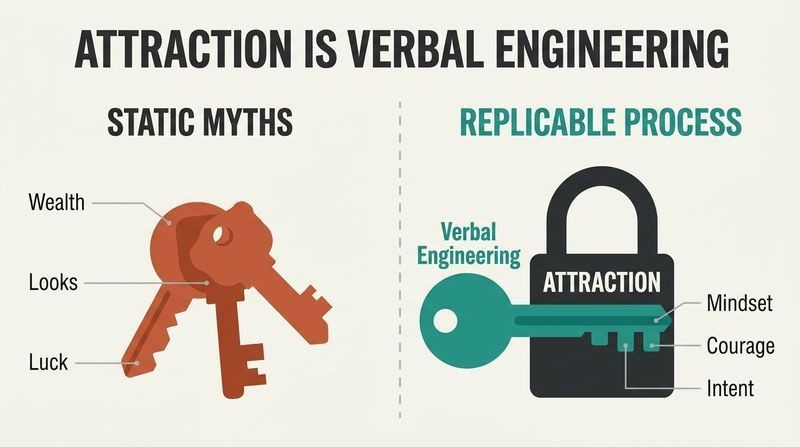
The core promise is replicability. Perrotta opens with the familiar sting of watching an ordinary-looking man captivate a beautiful woman within minutes at a bar, then walks away with her number while you invent reasons (he's rich, they must already know each other). His thesis: those men aren't magic, they run repeatable patterns you can learn.
He credits his own transformation. A childhood stutterer once suspected of Asperger's, terrified of speaking, he studied naturally charming men in a Boston pickup community, mirrored them through hundreds of awkward attempts, and eventually outperformed them. His conclusion: you don't need wealth, height, or a great job to attract women. You need the right mindset, the courage to start conversations, and the ability to communicate with sexual intent. Words, he argues, are how you make a woman feel something.
The claim that charm is a learnable skill rather than innate charisma aligns with deliberate-practice research from Anders Ericsson: expert performance across domains comes from structured repetition, not talent. What's worth flagging is selection bias in the underlying data. Perrotta studied men who succeeded and reverse-engineered their behavior, but survivorship bias means he can't see the equally confident men who repeatedly failed. Still, the reframe is psychologically healthy. It shifts locus of control from fixed traits (looks, money) to trainable behaviors, which mirrors Carol Dweck's growth mindset. The risk is treating a person as a puzzle to solve rather than a human to meet.
Your beliefs about women silently script every conversation you have
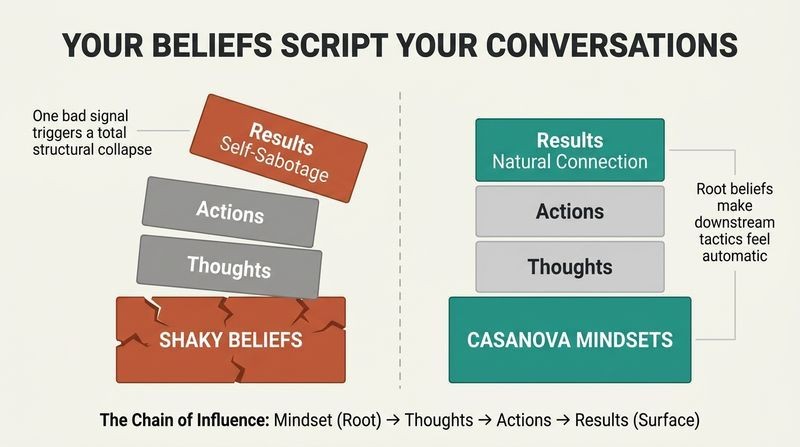
Mindsets are the foundation. Perrotta argues that four internal beliefs, which he calls the Casanova Mindsets, determine your words before you speak them. A shaky belief system is a house of cards: one unanswered text triggers a spiral of insecurity, defensive lashing out, and self-sabotage. A solid one lets you shrug off bad signals and keep leading.
The four mindsets:
1. I am responsible for my life and circumstances
2. I am enough and need no one's approval to feel complete
3. Women are not my top priority; I have a mission beyond them
4. All women are attracted to me until proven otherwise
His chain: mindsets drive thoughts, thoughts drive actions, actions drive results. Fix the root belief and the tactics downstream become almost automatic.
This is essentially cognitive behavioral therapy repackaged for dating. The chain (belief to thought to action) restates the CBT premise that interpretation, not events, generates emotion. Perrotta's insistence that you address beliefs before tactics is sound sequencing: research on self-efficacy (Bandura) shows that expectation of success predicts persistence better than skill alone. The weaker link is mindset four, which borders on motivated reasoning. Assuming universal attraction can build confidence but also breed entitlement and blindness to genuine disinterest. The healthier reading is that these are performance postures, not literal truths, useful scaffolding to quiet anxiety rather than metaphysical facts about the world.
Reverse your risk math: silence costs more than rejection
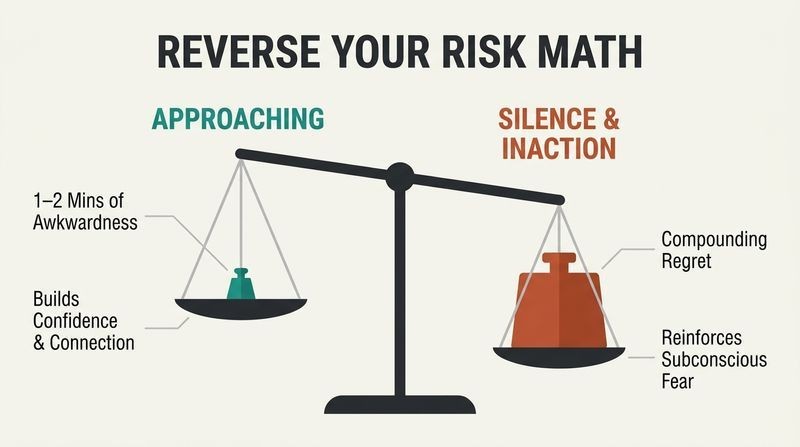
Reframe the fear of approaching. Most men calculate approaching as high risk (rejection, embarrassment) and inaction as zero risk (ego intact). Perrotta flips the ledger. The real cost of approaching is one to two minutes of possible awkwardness with a stranger you'll never see again. The real cost of doing nothing is a missed connection plus a subconscious signal that avoidance is acceptable, which compounds into a lifetime of missed chances.
His four antidotes when fear strikes:
1. Treat conquering the fear itself as the reward
2. Reframe the risk so inaction becomes the dangerous option
3. Stop waiting for the perfect moment; move toward her immediately
4. Focus on what you find attractive about her, converting nervous fear into nervous excitement
Hesitation, he warns, only inflates the fear as your brain rehearses disaster.
The immediacy rule (approach within seconds, not minutes) is backed by behavioral science on the amygdala. The longer a threat stimulus is contemplated, the more anticipatory anxiety compounds, which is why exposure therapists push rapid action before catastrophizing sets in. The risk-reversal framing echoes Jeff Bezos's regret-minimization: project forward and weigh the ache of never trying. One nuance Perrotta underweights: cold approaches in public spaces carry real social costs for women, who cannot always tell benign interest from threat. The ethical version of this advice requires reading context and exit cues, not just overriding one's own hesitation.
Slow everything down: your speech, your walk, your eyes
First impressions are physical before verbal. Perrotta argues the smoothest line dies on delivery if your body screams insecurity. Nervous men rush their words into an unintelligible blur, make jittery movements, dart their eyes, slouch, and pitch their voice high from the throat. Each signals low status.
His corrections:
1. Slow your speech until it feels too slow, then slow it more
2. Move deliberately; confident men walk unhurried with straight posture
3. Aim for a half-smile showing little teeth, not a wide goofy grin
4. Hold steady eye contact, focusing on one eye
5. Speak from the belly using deep breathing for a deeper pitch
He cites a 1989 study on mutual gaze finding sustained eye contact can generate feelings of romantic love, and invokes mirror neurons to explain why your calm demeanor becomes contagious.
The emphasis on tempo is the strongest practical insight here. Speaking slowly signals that you expect to be listened to, a marker of status documented in linguistics research on conversational floor-holding. The gaze study Perrotta cites (Kellerman, Lewis, and Laird, 1989) is real, though its sample was small and its effect modest, so treating prolonged eye contact as a love potion overstates it. Mirror neurons remain scientifically contested as an explanation for emotional contagion, but the observable phenomenon (calm begets calm) holds regardless of mechanism. The through-line is elegant: anxiety leaks through the body faster than words, so regulate the body first.
Flirt through implication, not declaration; hint, never announce
Sexual intent, subtly delivered, is the engine. Perrotta separates friendly flirting (innocent, platonic, friendzone-bound) from sexual flirting (charged undertones). Most men fail by being too blunt, too forward, or too safe. He recounts torpedoing a promising night in a Boston club by telling a woman crudely what he planned to do later; the mood evaporated because she could no longer rationalize the encounter as harmless fun.
The fix is intent plus subtlety. Saying I love women who love lingerie beats I bet you look great in lingerie because implication preserves mystery and signals standards. He adds two tools:
1. Agree and exaggerate when tested (She says you say that to everyone; you say guilty, they usually don't notice)
2. Position yourself as the prize by accusing her of trying to seduce you
The distinction between implication and declaration maps neatly onto psychological research on curiosity and the Zeigarnik effect: unresolved tension holds attention better than closure. By hinting rather than stating, the flirt keeps an open loop running in the other person's mind. The prize-reframe (accusing her of pursuing you) is a status inversion that can be charming when playful and obnoxious when forced. Perrotta's own cautionary anecdote is the most valuable part, because it demonstrates that crudeness kills what he calls plausible deniability, the psychological cover people need to say yes without feeling judged. This respects a real feature of human decision-making around intimacy.
Communicate with intent or you're just a confused tourist
Intent is the invisible ingredient. Perrotta watched a friend in Mexico ask a woman polite questions about her hometown and sound exactly like a lost backpacker despite being attracted to her. The words weren't the problem; the missing sexual intent was. When a man approaches out of desire but communicates like a friendly stranger, he creates dissonance. The woman senses the mismatch and wonders why he's even talking to her.
Intent surfaces through delivery: strong eye contact, slower speech, a knowing smile. Underneath runs a private inner narrative (I find her attractive, she's into me, I choose who enters my life). Even a mundane line like asking for directions should carry the subtext I think you're intriguing. Intent, he argues, is what separates being desired from being tolerated.
This is the book's sharpest conceptual move: locating attraction not in content but in congruence between desire and expression. It resonates with communication research showing that when verbal and nonverbal channels conflict, listeners trust the nonverbal. A man saying friendly words while feeling desire produces exactly that incongruence, which registers as inauthenticity. The concept also overlaps with what therapists call owning your desire, the idea that suppressed wanting leaks out as awkwardness. The caution is calibration. Intent without attunement to the other person's comfort becomes pressure. The best reading treats intent as honesty (stop hiding that you're interested) rather than as a manipulation lever.
Tease to connect, never to wound; absurdify, don't insult
Teasing is playful, not cruel. Perrotta learned teasing from his comedian father, who works a crowd like Don Rickles while keeping everyone laughing with him. The danger is that most men, believing they must act like jerks, tease about things that genuinely sting.
What to avoid: jabs at physical features, weight, intelligence, family, or her tastes; passive-aggressive critiques; nonstop clowning; and self-deprecation that undercuts you.
What works instead:
1. Absurdify: take something ordinary and exaggerate it playfully (she's from Pennsylvania, ask if she's from Amish country)
2. Bring yourself into the joke for a we're-in-this-together vibe
3. Stereotype her region lightheartedly
4. Playfully disagree and mock-walk away
5. Accuse her of hitting on you
The rule: stay self-amused and warm, aiming to connect rather than to prove your wit.
The neuroscience of teasing supports Perrotta's tightrope. Affectionate teasing between people activates bonding by signaling intimacy (only friends can joke like this), but the same words without established warmth register as aggression. Psychologist Dacher Keltner's research on teasing distinguishes prosocial teasing (which strengthens bonds) from hostile teasing precisely along the axis Perrotta draws: does the target feel included or diminished. His instruction to bring yourself into the joke is the key mechanism, because shared vulnerability converts a potential put-down into collaborative play. The banned-topics list (weight, family, intelligence) is well chosen, as these touch identity and shame rather than surface preferences.
Escape small talk by mining her emotions, not her facts
The more she talks, the more connected she feels. Perrotta cites a 2012 study finding that disclosing information about ourselves activates the same brain reward centers as food and money. So the fastest route to connection is getting her to talk about herself while you listen and relate back.
The method: pair short-answer questions (what do you do) with open-ended follow-ups (what made you get into that, what do you love about it) that force reflection and surface emotion. Then actively listen and relate rather than firing off questions like an interviewer. He offers five emotional territories worth exploring:
1. Her experiences
2. Her dreams
3. What she loves to do
4. Her passions
5. Her motivations
Avoid contentious opinions, clinging to a dead topic, and monologuing, all of which mark you as an outsider she can't relate to.
The self-disclosure study (Tamir and Mitchell, 2012) is legitimate and genuinely striking: people will forgo money to talk about themselves. Perrotta operationalizes it well by pushing past factual questions toward emotional ones, which parallels Arthur Aron's famous 36-questions experiment, where escalating self-disclosure generated intimacy between strangers in under an hour. His concept of the other (being seen as same versus alien) borrows from social identity theory and is a useful lens. One tension: the technique can slide into instrumental listening, where questions are bait rather than genuine curiosity. The research actually suggests the reverse works best, since authentic interest is harder to fake than to feel.
Women bond with dominance, sociability, and altruism, not your resume
Facts don't attract; qualities do. Perrotta argues men wrongly lead with job, money, and looks, which read as bragging. Women connect through emotion, and three demonstrated qualities matter most:
1. Dominance: knowing what you want and leading, so she can relax
2. Sociability: ease with people, signaling an abundant life
3. Altruism: genuine care with no ulterior motive
He cites a 2016 Evolutionary Psychology study finding women prefer an average-looking altruistic man over a handsome selfish one for serious relationships. Secondary attractive qualities include adventurousness, appreciation of beauty, and humor. Crucially, you demonstrate these through short stories, not claims. Rather than announcing you're generous, tell a brief tale about handing out shoes to poor kids in Colombia, letting the quality emerge from the narrative.
The show-don't-tell principle is storytelling 101 applied to courtship, and it's psychologically shrewd: self-reported virtues trigger skepticism, while inferred ones feel discovered and therefore credible. The altruism study Perrotta cites (Farrelly et al., 2016) does exist and fits a broader evolutionary literature suggesting altruism functions as a costly, hard-to-fake signal of good partner quality. The framing of dominance deserves scrutiny. Perrotta means decisiveness and leadership, not domineering control, but the word invites misreading. Modern relationship research (Gottman) finds that men who share power and accept influence have far more stable relationships, so dominance is best understood as confident initiative, not authority over a partner.
Bait curiosity with open loops instead of dumping your life story
Make her dig for who you are. Perrotta warns against being an open book. The man who volunteers his entire biography unprompted is exhausting. Instead, bait interest so she puts in effort, which makes you more intriguing.
Three baiting tools:
1. Intriguing statements: instead of I'm a stockbroker, say I analyze businesses but I also own the salsa floor
2. Reciprocity (borrowed from Robert Cialdini's Influence): after she's shared deeply about her career, she feels social pressure to ask about yours
3. Open loops: mention Spain is a favorite country, then immediately pivot to a question about her, planting the unspoken question of where else you've traveled
Structure your self-talk as a hero story: a younger you with a goal, obstacles faced, early wins, ultimate triumph, delivered playfully with self-poking humor, never as a highlight reel.
The open-loop technique exploits the Zeigarnik effect, the mind's tendency to fixate on unfinished business, the same mechanism cliffhanger television uses. Perrotta's borrowing of Cialdini's reciprocity is accurate and clever: disclosure genuinely does create pressure to disclose back, which is why the listener who goes deep first often gets asked about themselves. The hero-story structure mirrors Joseph Campbell's monomyth in miniature and taps research showing that narratives of overcoming adversity are more persuasive and memorable than lists of achievements. The subtle ethical line is that curated mystery can shade into strategic withholding. The most durable connection comes when the loops eventually close honestly rather than remaining permanent tactics.
Build a mission beyond women or your neediness will sabotage you
Purpose is the antidote to neediness. Perrotta warns that a man without a driving goal makes women his entire world, and they sense it instantly. He recounts abandoning a secure accounting career he hated, learning online skills, and moving to Vietnam to chase freedom and creativity, values that were authentically his rather than his parents' preference for stability.
Men chasing validation, he argues, never find the missing piece: land the date and you crave the bedroom, then the bragging rights, then the next woman. The loop never closes. A man with purpose brushes off a bad conversation, doesn't collapse when a text goes unanswered, and can genuinely love women because he isn't demanding they complete him. To find your purpose, he suggests recalling moments you felt most alive and energized, then doing more of that.
This closing insight is arguably the book's most durable, because it inverts the entire premise: the best dating strategy is to become someone whose happiness doesn't depend on dating. This aligns with self-determination theory (Deci and Ryan), which identifies autonomy and intrinsic goals as the foundation of well-being, and with the paradox that pursuing validation directly tends to repel it. Attachment research adds nuance: what Perrotta calls neediness resembles anxious attachment, and purpose alone won't rewire it, though it helps. The framing does risk instrumentalizing purpose (find a mission so women want you), when the deeper truth is that a meaningful life is worth building for its own sake, with attraction as a byproduct.
Analysis
Conversation Casanova is a tactical dating manual dressed in memoir. Structurally it moves inside-out: four foundational mindsets, then the mechanics of approaching, flirting, connecting, captivating, and finally loving women. Perrotta's authority rests on personal transformation rather than credentials, a former stutterer once suspected of autism who reverse-engineered charm by studying a Boston pickup community. That origin story is both the book's strength and its blind spot. It makes the advice credible and hard-won, but it also filters everything through survivorship bias and the norms of a subculture optimized for volume rather than depth.
The book's genuine intellectual value lies in a handful of transferable principles that outrun the pickup framing. The primacy of intent over content, the show-don't-tell approach to demonstrating character, the self-disclosure engine of connection, and the counterintuitive insistence that purpose outside of dating is the real prerequisite, these apply to sales, leadership, networking, and friendship. Perrotta is at his best when he cites actual research (the Tamir-Mitchell self-disclosure study, the Farrelly altruism findings, Cialdini's reciprocity) and grounds tactics in psychology rather than swagger.
The weaknesses are the genre's weaknesses. The framework treats women as a somewhat homogeneous class to be decoded, occasionally sliding from confidence-building into objectification. Terms like dominance and prize invite misreading, and the ethics of cold-approach pressure are underexamined; the burden of reading discomfort falls almost entirely on the man's self-serving optimism. The claim that all women are attracted to you until proven otherwise is useful as anxiety management but epistemically hollow.
Read charitably, this is a social-anxiety intervention wearing a seduction costume. Its most humane thread, that you cannot authentically connect while starving for validation, quietly undermines the transactional scaffolding around it. The reader who keeps the psychology and the self-work while discarding the scorekeeping walks away with something genuinely useful.
Review Summary
Conversation Casanova receives mixed reviews, with an average rating of 3.86 out of 5. Positive reviews praise the book for its practical advice on improving communication skills and confidence when interacting with women. Critics argue it oversimplifies relationships and promotes shallow techniques. Some readers find it helpful for beginners, while others consider it too basic. The book's approach to mindset and self-improvement is appreciated, but some reviewers feel it lacks depth in addressing women's psychology. Overall, opinions vary widely on its effectiveness and appropriateness.
People Also Read










Glossary
Casanova Mindsets
Four beliefs underpinning attractionPerrotta's four foundational internal beliefs he says must precede any tactic: (1) I am responsible for my life and circumstances, (2) I am enough and need no external approval, (3) women are not my top priority because I have a mission beyond them, and (4) all women are attracted to me until proven otherwise. He frames these as the psychological foundation that makes downstream conversation skills work.
Communicating with intent
Signaling sexual interest through deliveryThe practice of letting genuine attraction show through delivery (slow speech, strong eye contact, a knowing smile) and private self-talk, rather than masking desire behind friendly, platonic conversation. Perrotta argues that words matter less than the intent behind them, and that mismatched signals (interested motive, friendly delivery) create dissonance that repels women.
Friendly vs. sexual flirting
Platonic banter versus charged undertonesPerrotta's distinction between innocent, risk-free interaction that lands a man in the friendzone (friendly flirting) and interaction carrying unmistakable romantic or sexual undertones (sexual flirting). He argues most men default to the former and must deliberately adopt the latter, delivered subtly, to build attraction.
Agree and exaggerate
Amplify a tease instead of defendingA flirting response to a woman's verbal test or jab in which the man playfully agrees and inflates the accusation rather than defending himself. Example: told you say that to everyone, he replies that they usually don't catch on. It demonstrates humor and non-neediness.
Positioning yourself as the prize
Framing her as pursuerA flirting technique where the man playfully twists a woman's words or actions to imply she is trying to seduce or pursue him, reversing the conventional dynamic in which the man chases. Meant to be delivered with a smile and used sparingly to signal confidence and high self-worth.
The other
Being perceived as alienPerrotta's adaptation of the psychological same-versus-other distinction. He argues people instinctively sort others into those who understand them (same) and those who don't (other). Stating contentious opinions, clinging to one topic, or monologuing marks a man as the other, whereas emphasizing commonalities makes him relatable and connected.
Baiting
Making her curious about youTechniques for getting a woman to put effort into discovering who you are rather than volunteering your biography. Includes intriguing statements (vague, interesting self-descriptions), reciprocity (deep questions about her create pressure to ask about you), and open loops (dropping a curiosity-provoking detail then pivoting away).
Hero story
Self-narrative of overcoming adversityA short autobiographical story structured to convey attractive qualities: a younger self with a goal, obstacles faced, early setbacks, and eventual triumph, delivered playfully with self-deprecating touches. Used to talk about yourself through emotion and narrative rather than reciting impressive facts.
Learn 3 things habit
Approach aiming to discover herA daily practice Perrotta gives clients: enter every conversation intending to learn three things about the other person, ideally emotional (a passion, a motivation, a feeling about a place) rather than factual. Designed to shift focus off self-conscious impression-management and onto genuine engagement, building connection skills through repetition.
FAQ
What's "Conversation Casanova" about?
- Overview: "Conversation Casanova" by Dave Perrotta is a guide for men on how to start conversations and flirt effectively with women. It aims to transform the reader's dating life by improving their conversational skills.
- Structure: The book is divided into six parts, covering mindsets, initiating conversations, flirting, connecting, captivating, and final conversation strategies.
- Purpose: It provides actionable advice and techniques to help men overcome social anxiety, make great first impressions, and build deeper connections with women.
- Target Audience: The book is primarily aimed at men who struggle with dating and want to improve their social skills and confidence in interactions with women.
Why should I read "Conversation Casanova"?
- Practical Advice: The book offers practical, actionable steps to improve conversation skills, making it useful for anyone looking to enhance their social interactions.
- Comprehensive Guide: It covers a wide range of topics from mindset shifts to specific conversation techniques, providing a holistic approach to improving dating success.
- Personal Growth: Beyond dating, the book encourages personal development by promoting self-awareness and responsibility for one's actions and circumstances.
- Author's Experience: Dave Perrotta shares his personal journey from shyness to confidence, offering relatable insights and motivation for readers facing similar challenges.
What are the key takeaways of "Conversation Casanova"?
- Mindset is Crucial: The book emphasizes the importance of adopting the right mindsets, such as taking responsibility for one's life and overcoming the need for validation.
- Effective Flirting: It highlights the significance of subtlety, exaggeration, and positioning oneself as the prize in flirting, rather than being too blunt or forward.
- Connection Over Small Talk: The book advises moving beyond small talk by asking open-ended questions and focusing on emotional topics to build deeper connections.
- Non-Verbal Communication: It stresses the importance of non-verbal cues like eye contact, proximity, and physical touch in creating a flirtatious and engaging interaction.
How does Dave Perrotta suggest overcoming the fear of approaching women?
- Focus on Fear: Perrotta suggests confronting the fear of approaching women by focusing on the reward of overcoming it, rather than the fear itself.
- Shift Perspective: He advises viewing the risk of not approaching as greater than the risk of rejection, to motivate action.
- Immediate Action: The book recommends taking immediate steps towards the woman you want to talk to, rather than waiting for the perfect moment.
- Appreciate Her Beauty: By focusing on what you find attractive about her, you can cultivate excitement and reduce fear.
What are the "Casanova Mindsets" in "Conversation Casanova"?
- Responsibility: The first mindset is taking responsibility for your life and circumstances, which empowers you to make positive changes.
- Self-Worth: Overcoming the need for validation and believing that you are enough without external approval is crucial.
- Purpose: Having a mission outside of women ensures that they are not your sole focus, which is attractive to women.
- Assume Attraction: The mindset that all women are attracted to you until proven otherwise helps in approaching and interacting with confidence.
How does "Conversation Casanova" define effective flirting?
- Intent: Effective flirting involves communicating with intent, making it clear that you are a sexual being interested in the woman.
- Subtlety and Exaggeration: Using subtlety and exaggeration in conversation creates intrigue and keeps the interaction playful and engaging.
- Non-Verbal Cues: Flirting is not just about words; it includes non-verbal cues like eye contact, body language, and physical touch.
- Avoiding Friendzone: The book emphasizes the importance of sexual flirting over friendly flirting to avoid being placed in the friendzone.
What are some conversation starters recommended by Dave Perrotta?
- Direct Approach: Simply stating your interest, such as "I thought you were cute and had to say hi," is a straightforward way to start a conversation.
- Situational Opener: Using something in the environment to initiate conversation, like commenting on a street performer, can be effective.
- Simple Introduction: A basic "Hey, how's it going?" works well in social settings, provided it's delivered with confidence.
- Unique Opener: The "Seahorse vs Octopus" question is a fun and unexpected way to engage a group of women in conversation.
How does "Conversation Casanova" suggest making a great first impression?
- Slow Down: Speaking slowly and deliberately conveys confidence and helps captivate the listener.
- Body Language: Moving slowly and maintaining good posture signals confidence and sexual appeal.
- Eye Contact: Strong, steady eye contact builds connection and trust, making you appear more confident.
- Voice Tone: Speaking from your belly with a deeper voice is more attractive and engaging than a high-pitched tone.
What are the common conversation mistakes highlighted in "Conversation Casanova"?
- Contentious Opinions: Avoid stating contentious opinions that can alienate the other person and create a divide.
- Over-Focusing on a Topic: Don't get stuck on a single topic; instead, weave multiple topics into the conversation to keep it dynamic.
- Talking Too Much About Yourself: Focus the conversation on the other person to make them feel valued and connected.
- Ignoring Emotional Topics: Engage in emotional topics like dreams and passions to build a deeper connection.
How does Dave Perrotta recommend talking about yourself attractively?
- Highlight Qualities: Focus on conveying qualities like dominance, sociability, and altruism through your stories.
- Baiting: Use intriguing statements and open loops to make her curious and encourage her to ask more about you.
- Hero Story: Share stories that showcase overcoming challenges and achieving goals, which are inherently attractive.
- Balance: Keep the conversation balanced by turning it back to her after sharing about yourself, maintaining intrigue.
What are some go-to conversation topics for connecting with women in "Conversation Casanova"?
- Experiences: Discussing past experiences can lead to emotional storytelling and deeper connections.
- Dreams and Aspirations: Talking about dreams allows for a conversation filled with hope and excitement.
- Passions: Exploring what she is passionate about can reveal a lot about her personality and values.
- Motivations: Understanding her motivations provides insight into her character and helps build rapport.
What are the best quotes from "Conversation Casanova" and what do they mean?
- "Once your mindset changes, everything on the outside will change along with it." This quote emphasizes the power of mindset in transforming your external circumstances and interactions.
- "You must assume attraction from all women until proven otherwise." This mindset encourages confidence and proactive behavior in social interactions.
- "The more she talks about herself, the more connected she’ll feel to you." It highlights the importance of listening and engaging the other person to build a connection.
- "Women care more about the way you make them feel than your 'stats' and accomplishments." This underscores the significance of emotional connection over material or superficial attributes.
Download PDF
Download EPUB
.epub digital book format is ideal for reading ebooks on phones, tablets, and e-readers.








































