

Key Takeaways
People buy for themselves, so sell benefits, never features
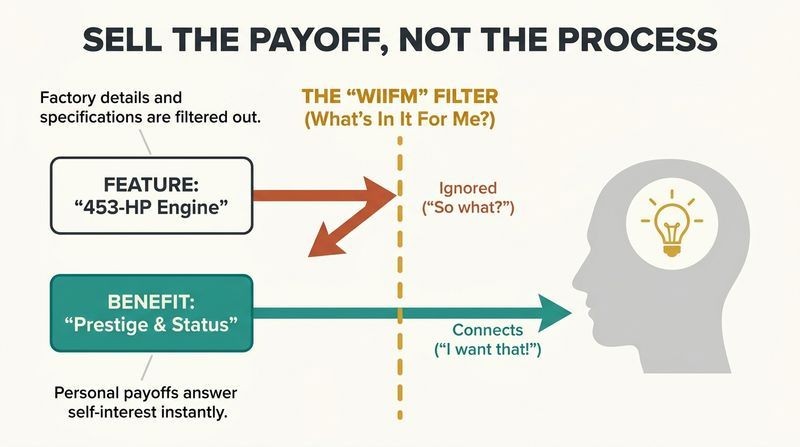
The customer's only question is "What's in it for me?" Whitman opens with pioneer researcher Daniel Starch, who shocked 1920s advertisers by proving their factory photos and camera angles were ignored by over half of readers. People care about themselves, full stop. A feature is a component (a car's 453-horsepower engine); a benefit is what that component delivers (the feeling that you have arrived).
Translate every feature into a payoff. In Whitman's workshop exercise, a seller names a feature and the prospect shouts "Big deal, what's in it for me?" until the seller reframes it. An inkjet printer's "multiple ink tanks" becomes "you save money because you replace only the empty color." Prospects run a nonstop internal loop asking how your product improves their life. Answer it or lose them.
This echoes Theodore Levitt's marketing maxim that people don't want a quarter-inch drill, they want a quarter-inch hole. The insight is old but perennially violated because founders fall in love with their own craftsmanship. What's striking is how it maps onto self-determination theory: humans are motivated by outcomes tied to autonomy, competence, and relatedness, not technical specifications. One caution: in genuinely technical B2B markets (semiconductors, enterprise software), specs often ARE the benefit, because the buyer's benefit is defensible procurement. The smartest framing usually pairs both, leading with the emotional payoff and backing it with the feature that makes it credible.
Every human buys to satisfy eight hardwired biological desires
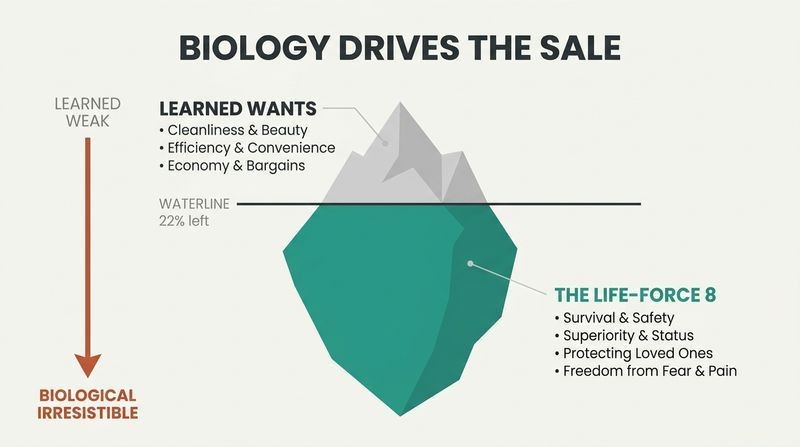
The Life-Force 8 drive more sales than everything else combined. Whitman argues eight desires are wired into us by biology: survival and life extension, enjoyment of food and drink, freedom from fear and pain, sexual companionship, comfortable living, being superior and keeping up with rivals, protecting loved ones, and winning social approval. You cannot suppress these the way you can ignore learned wants.
Contrast them with nine learned wants (being informed, cleanliness, efficiency, convenience, dependability, beauty, economy, bargains, curiosity). These matter, but they lack biological urgency. Whitman's proof: 1920s mail-order king Haldeman-Julius sold books by changing only their titles. "Art of Controversy" sold zero; retitled "How to Argue Logically" (appealing to superiority) it sold 30,000. Tapping a desire you cannot shake is like jumping onto a moving train.
The Life-Force 8 is essentially evolutionary psychology repackaged for copywriters, overlapping heavily with Maslow's hierarchy and Robert Cialdini's later work. The title-swap experiment is a beautiful natural A/B test decades before Silicon Valley claimed the method. What deserves scrutiny is the claim that these drives are purely biological and universal. Cross-cultural research complicates "keeping up with the Joneses," which is far stronger in individualist Western cultures than in some collectivist societies. Still, the practical power is real: anchoring a pitch to a primal drive reliably outperforms appealing to abstract virtues like efficiency, because emotion precedes and often overrides deliberation, as neuroscientist Antonio Damasio's somatic-marker research demonstrates.
Write so a chimpanzee gets it: short words, short sentences
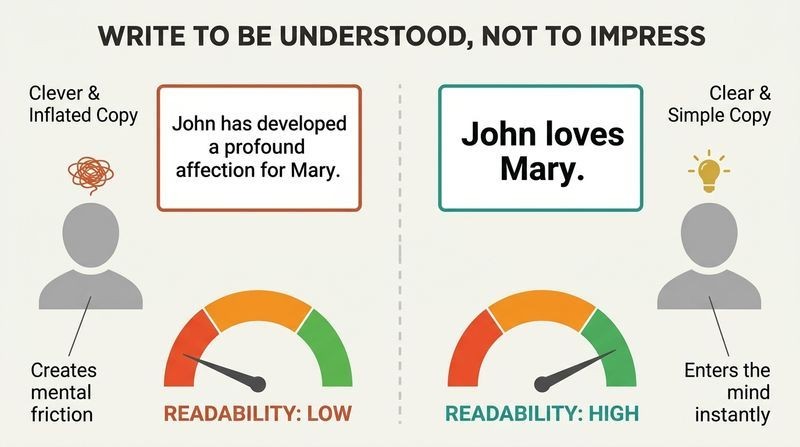
Clarity beats cleverness every time. Whitman leans on Dr. Rudolf Flesch's Reading Ease formula (built into Microsoft Word) to score readability. Aim for sentences around 11 words, keep 70 to 80 percent of words to a single syllable, and refer to people by name or pronoun often. "John loves Mary" scores 92 (very easy). Bloat it into "John has developed a profound affection for Mary" and the score collapses toward legalese.
Four prescriptions:
1. Use short, simple words (tired, not enervated).
2. Keep sentences short, one idea each.
3. Use tiny paragraphs to pull the eye down the page.
4. Load copy with pronouns, especially "you" and "I."
Most people write with inflated vocabulary because school trained them to. Effective ads read like a warm human talking, not a constipated law professor.
This is the Plain Language movement applied to persuasion, and it is empirically robust. Readability research consistently shows comprehension drops sharply above a ninth-grade level, and even highly educated readers prefer simpler prose when skimming, a finding replicated in Daniel Oppenheimer's Princeton study wryly titled "Consequences of Erudite Vernacular." The counterintuitive part is that simple writing signals competence, not stupidity. One nuance worth adding: readability formulas measure mechanics, not meaning, so they can be gamed. A pile of choppy three-word sentences scores well yet reads like a ransom note. The real target is natural rhythm, varying length so the ear stays engaged.
Your headline is 90 percent of the money you spend
Sixty percent of readers read only the headline. So Whitman's rule, borrowed from David Ogilvy, is absolute: put your single biggest benefit in the headline, and make it select the right audience. A lamp store's clever "Brighten Up Your Life" wastes the slot; the blunt "Need Lamps?" perfectly filters for buyers.
Say the payoff, not the vague promise. Don't write "Louise Designs Homes of Distinction." Write that she turns your house into a gorgeous model home for less than you dreamed. Shorter headlines get read by more people (a Saturday Evening Post study found headlines of three words or fewer scored 87 percent readership versus 78 percent for 13-plus), yet well-crafted long headlines can outsell short ones. The resolution: always lead with the benefit, then trim for brevity where you can.
The headline-first discipline anticipates modern attention economics. Eye-tracking studies by the Nielsen Norman Group confirm the F-shaped scanning pattern, where users read the top and left before abandoning. Whitman's tension between short and long headlines is honest and unresolved because the real variable is relevance, not length, a point later systematized in the "jobs to be done" and message-match literature of conversion optimization. The "Need Lamps?" example is a small masterpiece of audience qualification, embodying the direct-response principle that a smaller, better-targeted audience beats broad eyeballs. Vague brand headlines persist mainly because they win creative awards, which Whitman rightly treats as vanity rather than commerce.
Install mental movies using specific, sensory words
The first use of any product happens inside the mind. Whitman argues persuasion begins when your words make the prospect vividly imagine using your product. Compare "go somewhere and do something" (a blank screen) with a description of pulling a bubbling, wood-fired, buffalo-mozzarella pizza from a 750-degree oven. The specific version hijacks the reader's imagination.
Engage all five senses (V-A-K-O-G): visual, auditory, kinesthetic, olfactory, gustatory. These "internal representations" are the raw material of experience and memory. Facts alone create few of them, which is why a bare product spec sheet does not sell. His pool-cleaner example transforms dry specs into a playful email naming the device "Squidly," describing its chuga-chuga sound and the Caribbean-clear water. Powerful visual adjectives (PVAs) do the heavy lifting: not "juicy apples" but "mouth-watering, sugar-sweet, handpicked apples."
This is grounded in real cognitive science that Whitman only gestures at. Mental simulation research by Gabriel Blajenkova and others shows imagining product use increases purchase intent, and neuroimaging reveals that reading sensory-rich language activates the same sensory cortices as the actual experience, a phenomenon called embodied cognition. Barbara Fredrickson and marketing scholars have shown vividness raises perceived likelihood of ownership. The borrowing from NLP (the V-A-K-O-G labels) is the weakest scaffolding, since NLP lacks empirical support, but the underlying advice survives independently. The practical risk: overwrought PVAs can tip into parody, as Whitman's own hair-pulling soap dialogue half-admits. Vividness must stay believable.
Fear sells only when you hand people an escape route
A scare without a solution just paralyzes. Whitman shows fear moving product everywhere: dust mites in your pillow (10 percent of a two-year-old pillow's weight is dead mites and feces), germs on money, the groomer's noose choking your dog. But citing Pratkanis and Aronson's research, he insists fear works only when four ingredients are present:
1. It genuinely scares people.
2. It offers a specific way to overcome the threat.
3. That action is seen as effective.
4. The person believes they can do it.
Tap existing fears, don't invent them. GOJO turned hand germs into a national anxiety and made Purell the top sanitizer. Listerine weaponized the word "halitosis" in 1900 and captured 53 percent market share. Too much fear backfires, freezing the prospect like a deer in headlights.
This is textbook Protection Motivation Theory, and Whitman's four-part recipe closely tracks the academic consensus that fear appeals require high perceived efficacy to work, a finding confirmed in Kim Witte's meta-analyses of public-health messaging. Anti-smoking and seatbelt campaigns validate it: graphic warnings paired with concrete quit-lines outperform pure horror. The ethical tension is unavoidable and Whitman waves it away by insisting the product must offer a real solution. That's a convenient boundary, since manufactured anxieties (the pillow-mite panic) blur the line between informing and exploiting. Behavioral economists would add that loss aversion, Kahneman and Tversky's finding that losses hurt about twice as much as equivalent gains feel good, is the deeper engine here.
Borrow credibility from authorities your prospect already trusts
Transfer means credibility by osmosis. Attach your product to a respected person, institution, or symbol and their authority flows onto you. The white lab coat, the Good Housekeeping Seal (trusted since 1909), a police union's endorsement on a ballot measure, Jessica Simpson vouching for Proactiv, Wilford Brimley's plainspoken pitch reversing Quaker Oats' five-year decline. People use a peripheral, shortcut style of thinking, so a symbol of authority makes them question your sales argument less.
It works even when the badge means little. Whitman put the official-looking logo of the National Guild of Hypnotists on a client's postcard. Fewer than 1 in 100 recipients had heard of the group, yet the logo still boosted confidence. The lesson: identify who or what your market reveres, then earn their endorsement or association.
This is Cialdini's authority principle plus the classic "halo effect" first documented by Edward Thorndike in 1920, where one positive trait bleeds into unrelated judgments. The unsettling part Whitman states plainly is that the badge need not carry real informational value to work, which is precisely why regulators police fake endorsements and why the FTC now requires disclosure of paid influencers. The mechanism is cognitive economy: evaluating claims is effortful, so we outsource trust to proxies. The modern peril is that authority signals are now cheaply forged online (fake reviews, AI-generated experts), which is slowly eroding their power and pushing consumers toward peer proof, the subject of social validation.
Length itself persuades: long copy outsells short every time
More words mean more selling, if they stay interesting. Whitman dismantles the "nobody reads long copy" myth, quoting Gary Halbert's line that copy is never too long, only too boring. A true prospect will devour detail the way you'd sit two hours with a great salesperson rather than ten minutes. Long copy serves both the buyer who needs every fact and the one ready to order after the headline.
This rides the Length-Implies-Strength heuristic. Sheer volume signals substance: a brochure of 101 testimonials convinces even before you read it, a list of 22 reasons to buy overwhelms objections, a politician's numbered "200 flip-flops" damns an opponent though few check the facts. Even online, tests show longer pages lift conversions. The mind reasons, "Look how much is here, it must be true."
The long-versus-short debate never dies because both camps are half right. Direct-response history strongly supports Whitman: split-tests from Ogilvy to modern landing-page firms like MarketingExperiments repeatedly favor longer copy for considered purchases. But the Length-Implies-Strength heuristic cuts both ways. Petty and Cacioppo's Elaboration Likelihood Model shows that argument quantity persuades mainly when motivation is low and people aren't scrutinizing; a motivated, skeptical reader counts weak arguments against you. So length works best for peripheral processors and genuinely interested prospects, not universally. The honest synthesis: write as much as you need to make the sale and not one boring word more, letting relevance, not word count, govern.
Six mental shortcuts do your persuading for you
Robert Cialdini went undercover for three years to map how people say yes, distilling six "weapons of influence" Whitman labels CLARCCS:
1. Comparison: everyone's doing it, so you should too.
2. Liking: we buy from people we like and find attractive.
3. Authority: we defer to experts and official figures.
4. Reciprocation: a free gift makes us feel obligated to give back.
5. Commitment/consistency: once we take a stand, we act to stay consistent.
6. Scarcity: we crave what we might not be able to have.
These are peripheral-route triggers. Reciprocation explains why a survey arrives with a dollar bill and why a free oil change turns a mover into a loyal customer. Scarcity explains the 1983 Cabbage Patch riots, where parents stormed stores for dolls Coleco couldn't keep in stock. Deadlines and "only while supplies last" weaponize the same fear of loss.
Cialdini's framework is among the most replicated in social psychology, though the replication crisis has dented some specifics; commitment and scarcity hold up robustly, while certain reciprocity studies show smaller effects than first claimed. Whitman's real contribution is operational: he shows the humble mechanics (a stapled dollar, a signed petition, a stated seat limit) that fire each trigger. The consistency principle deserves emphasis because Jonathan Freedman's foot-in-the-door experiments proved that small commitments dramatically raise compliance with larger later requests. A sharp modern caveat: consumers are increasingly wise to fake scarcity (countdown timers that reset), and detected manipulation triggers reactance, the backfire effect where people do the opposite to reassert freedom.
Match your persuasion route to how hard the choice is
The Elaboration Likelihood Model gives two roads to yes. The central route uses logic, facts, evidence, and reasoning. The peripheral route uses pleasant images, cues, celebrities, and good feelings. Which to use depends entirely on your product. A $928,000 house triggers slow, deliberate central-route thinking; a can of beans gets the instant peripheral "Yum, beans!"
Central-route attitudes last and resist competitors. Whitman notes the crucial payoff: when you make someone think hard and reach their own conclusion, they defend that decision like a brainchild, immune to rival pitches. Peripheral attitudes feel good but wash away fast, which is why yesterday's must-have brand is forgotten today. Practical rule: for expensive or high-relevance purchases, pour on evidence, testimonials, and case studies; for cheap impulse items, lead with color, warmth, and celebrity.
Petty and Cacioppo's ELM is one of persuasion science's crown jewels, and Whitman applies it cleanly. The durability point is the underappreciated gem: brands built on emotional cues alone are perpetually vulnerable to the next shiny campaign, whereas brands that give buyers reasons create what marketers call "commitment through cognition." This explains why Apple pairs lifestyle imagery (peripheral) with spec-heavy comparison pages (central), covering both processors. One refinement modern research adds: the routes aren't a binary switch but a continuum, and the same ad can hit both simultaneously for different readers. The skill is knowing your buyer's involvement level, which surveys and analytics now measure far better than 1980s copywriters could.
Differentiate obsessively, because sameness kills preference
When buyers can't tell you apart, they have no reason to prefer you. Whitman's antidote is extreme specificity plus a Unique Selling Proposition (USP). His pizza-shop phone experiment exposed the problem: most owners answered "what makes you better?" with a limp "better ingredients" or "I don't know." The winners described San Marzano tomatoes, buffalo-milk mozzarella placed in chunks not shredded, dough hand-stretched and baked in a coal oven imported from Italy.
Even if rivals do the same thing, the one who says it wins. Handyman Jack's beats a generic hardware store by listing 343 kinds of fasteners and 354,000 bolts in daily inventory. The detail educates prospects and implies competitors are hiding something. Don't be the generic salt on the shelf that nobody has a favorite brand of. Build a USP and, if it isn't true yet, make it true.
This fuses Rosser Reeves' USP concept with Claude Hopkins' "preemptive claim," the tactic of stating an ordinary industry practice as if it were unique. Hopkins famously did this for Schlitz beer by describing the standard bottle-sterilization every brewery used, and Schlitz jumped from fifth to first. The specificity insight also connects to the psychology of processing fluency and credibility: concrete, quantified details are judged more truthful than round generalities, a finding in eyewitness and forensic research alike. The ethical edge Whitman flags matters, since preemptive claims can mislead by implication. The durable takeaway is that vividness and specificity aren't decoration, they are the differentiation itself in commoditized markets.
Kill inertia with deadlines, easy ordering, and long guarantees
Belief and desire aren't enough; you must force action now. Whitman's droning-salesman bit ("no rush, we'll be here whenever") shows how the absence of urgency guarantees inaction. Getting action takes two moves: make it ridiculously easy to buy, then explicitly ask. Accept every payment type, offer installments to dull the pain of spending, spell out ordering step by step, and always impose a deadline (hard dates or "limited supplies").
Guarantees tip the scale from skepticism to belief. During the Depression, Hormel offered double-your-money-back on soup; execs feared ruin, but only 12 women claimed it and sales soared. Counterintuitively, longer guarantees (a year, lifetime) produce fewer returns than 30-day ones, because short windows make buyers watch the clock and "beat the deadline." Offer the longest, strongest guarantee in your industry and flaunt it.
Every claim here has a behavioral-economics backbone. Inertia is status-quo bias, documented by Samuelson and Zeckhauser; friction reduction is why one-click checkout and default options move billions, per Thaler and Sunstein's "Nudge." The guarantee paradox is the richest insight: extending the return window lowers returns because it removes the deadline salience that keeps a product "on trial" in the buyer's mind, and because longer ownership triggers the endowment effect, where we value what we possess more highly. Retail data on generous return policies (Zappos, Costco) broadly confirms it. The one risk is adverse selection in categories prone to abuse, but Whitman's Depression-era example shows fears of mass exploitation are usually overblown.
Analysis
CA$HVERTISING is a direct-response practitioner's field manual dressed as consumer psychology. Structurally it moves from motivation (the Life-Force 8), to theory (17 principles largely borrowed from academic social psychology), to tactics (41 techniques and 101 checklist items). Its thesis is blunt: advertising exists to make people act, not to entertain or win awards, and the reliable way to trigger action is to speak to primal desires in plain language backed by credibility and urgency.
Whitman's genuine value is synthesis and operationalization. He translates Cialdini, Petty and Cacioppo, Flesch, Starch, and Ogilvy into concrete instructions a plumber or bakery owner can execute Monday morning. Where academics describe, he prescribes: staple a dollar to the letter, set your headline in initial caps, wrap the ad in white space, price at 99. This gap-bridging is the book's real contribution, and it holds up because human motivation changes far slower than media.
The weaknesses are equally clear. The citations are often loose, sometimes decades old, and occasionally lean on discredited scaffolding like NLP. The book predates the replication crisis, so some cited effects are shakier than presented. It is also relentlessly channel-bound to print and early web, though the underlying psychology ports cleanly to landing pages, email, and video.
The deepest tension is ethical. Whitman repeatedly deflects manipulation worries by asserting the product must be good, but his own examples (manufactured pillow-mite panic, meaningless authority logos, preemptive claims) reveal how thin that line is. Modern readers, armed with knowledge of reactance and eroding trust in fake scarcity and reviews, should treat the techniques as a double-edged toolkit. Used on a quality offering, they compress the distance between a good product and the people who need it. Used cynically, they teach the very tricks that have made consumers increasingly cynical.
Review Summary
Cashvertising receives high praise for its comprehensive insights into advertising psychology and techniques. Readers appreciate the actionable advice, examples, and checklists provided. Many find it invaluable for improving their marketing efforts. The book's focus on print advertising and dated references are noted as drawbacks by some. Overall, reviewers commend the author's expertise and writing style, considering it a must-read for marketers, copywriters, and anyone interested in consumer behavior. The book's practical approach and wealth of information make it a valuable resource for both beginners and experienced professionals.
People Also Read


FAQ
What's Cashvertising about?
- Focus on Advertising Psychology: Cashvertising by Drew Eric Whitman explores the psychological principles that influence consumer behavior and how advertisers can use these insights to craft effective ads.
- Practical Techniques: The book provides over 100 actionable techniques used by ad agencies to boost advertising effectiveness, making it a valuable resource for marketers and business owners.
- Consumer Desires: Whitman introduces the "Life-Force 8," a concept identifying eight fundamental human desires that drive purchasing decisions, highlighting their importance in advertising.
Why should I read Cashvertising?
- Boost Your Sales: The book offers actionable insights that can lead to immediate improvements in sales and advertising strategies.
- Learn from Experts: It compiles knowledge from top advertising professionals and psychologists, providing readers with industry secrets to enhance their marketing efforts.
- Easy to Understand: Whitman presents complex psychological concepts in a straightforward manner, making it accessible for readers at all levels of marketing experience.
What are the key takeaways of Cashvertising?
- Understanding Consumer Psychology: A major takeaway is the importance of understanding consumer psychology and its influence on buying behavior.
- Effective Advertising Techniques: The book provides numerous techniques, such as using fear as a motivator and the significance of headlines, to create more effective advertising.
- Focus on Benefits: Whitman emphasizes that advertising should focus on the benefits to the consumer rather than just the features of a product.
What are the best quotes from Cashvertising and what do they mean?
- “Ninety-nine percent of advertising doesn’t sell much of anything.”: This quote highlights the issue of ineffective advertising and sets the stage for the book's focus on what truly works.
- “People buy because of emotion and justify with logic.”: This emphasizes the emotional drivers behind purchasing decisions, suggesting that successful ads must tap into these emotions.
- “The goal of advertising is to get people to act.”: This succinctly captures the primary purpose of advertising, reinforcing the need for clear calls to action in marketing materials.
What is the "Life-Force 8" in Cashvertising?
- Eight Fundamental Desires: The "Life-Force 8" refers to eight core human desires that drive consumer behavior, including survival, enjoyment of life, and social approval.
- Biologically Programmed: These desires are hardwired into human beings, making them powerful motivators for purchasing decisions.
- Application in Advertising: Advertisers can significantly enhance their effectiveness by crafting messages that appeal directly to these innate desires.
How does Drew Eric Whitman suggest using fear in advertising?
- Fear as a Motivator: Whitman explains that fear can be a powerful motivator in advertising, prompting consumers to take action to avoid negative outcomes.
- Four-Step Recipe: He outlines a four-step recipe for inducing fear: scare the audience, offer a specific solution, ensure the solution is perceived as effective, and make the action achievable.
- Ethical Use: It's crucial that the fear appeal is ethical and that the product genuinely offers a solution to the fear being presented.
What are some proven techniques for writing effective headlines in Cashvertising?
- Biggest Benefit First: Whitman advises placing the biggest benefit of the product in the headline to immediately capture attention.
- Short and Direct: He emphasizes that shorter headlines tend to have higher readership, as they are easier to process quickly.
- Use of Curiosity: Headlines that evoke curiosity can motivate readers to continue engaging with the ad, increasing the likelihood of a purchase.
What is the "Means-End Chain" concept in Cashvertising?
- Future Objectives: The Means-End Chain suggests that consumers often make purchases not just for immediate satisfaction but for future benefits.
- Core Benefits Focus: Advertisers should focus on the ultimate value or benefit that the product provides, rather than just its features.
- Example Application: For instance, when selling a car, the focus should be on how it enhances the buyer's lifestyle or status, not just its technical specifications.
How can I apply the principles from Cashvertising to my own advertising?
- Identify Consumer Desires: Start by identifying which of the Life-Force 8 desires your product satisfies and tailor your messaging accordingly.
- Use Psychological Techniques: Implement techniques such as fear appeals, scarcity, and social proof to enhance the effectiveness of your ads.
- Focus on Benefits: Always communicate the benefits of your product clearly and prominently, ensuring that potential customers understand what they stand to gain.
What are some common mistakes in advertising that Cashvertising addresses?
- Ignoring Consumer Psychology: Many advertisers fail to consider the psychological factors that influence buying behavior, leading to ineffective campaigns.
- Focusing on Features Over Benefits: A common mistake is emphasizing product features rather than the benefits those features provide to the consumer.
- Lack of Clarity: Whitman stresses the importance of clear and simple messaging; overly complex ads can confuse potential customers and reduce engagement.
What is the "Ogilvy Layout Principle" mentioned in Cashvertising?
- Two-Thirds/One-Third Rule: The principle suggests that the top two-thirds of an ad should feature a large image, while the bottom third contains the headline and body copy.
- Captivating Attention: This layout is effective because it captures the reader's attention with a striking visual before guiding them to the text.
- Increased Readership: Following this layout can significantly increase the likelihood that readers will engage with the ad, as studies show that more people read captions than body copy.
What is the significance of "Psychological Pricing" in Cashvertising?
- Odd-Even Pricing: The book explains that prices ending in odd numbers (like $9.99) are perceived as better deals compared to rounded prices (like $10.00).
- Prestige Pricing: Conversely, rounded prices can convey higher quality, making them suitable for luxury items.
- Consumer Perception: Understanding how consumers perceive prices can help businesses set prices that maximize sales and appeal to their target market.
About the Author
Other books by Drew Eric Whitman
Download PDF
Download EPUB
.epub digital book format is ideal for reading ebooks on phones, tablets, and e-readers.








































