
Key Takeaways
Motivation is garbage — seek suffering to rewire your brain
“Even the best pep talk or self-help hack is nothing but a temporary fix. It won't rewire your brain.”
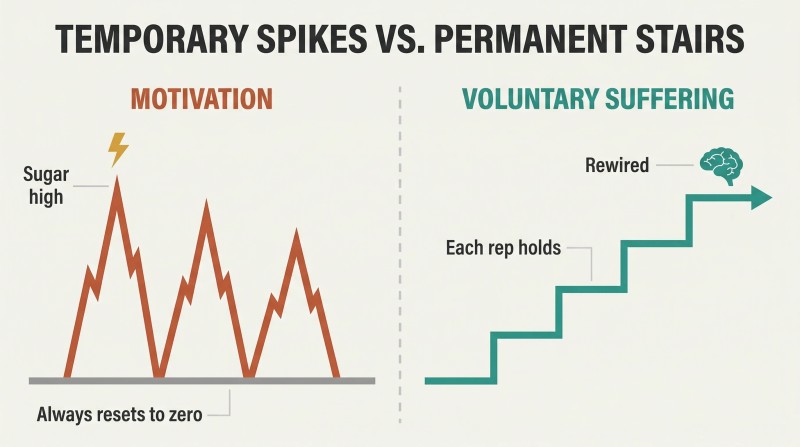
A 297-pound exterminator became a SEAL. David Goggins sprayed cockroaches in fast-food kitchens at midnight. He'd quit Air Force Pararescue out of fear, ballooned on chocolate shakes and Hostess doughnuts, and was drifting through a dead-end marriage. One morning, after watching a Navy SEAL documentary, he decided to lose 106 pounds in under three months and become a SEAL — with no running base, no education, and no plan.
His contrarian premise: inspiration fades. Pep talks and life hacks are sugar highs that change nobody. The only way to rewire your brain is through repeated, voluntary suffering — grueling physical training, studying when you'd rather quit, choosing discomfort daily. Goggins transformed by running when it rained, studying six hours after his tutor left, and completing three Navy SEAL Hell Weeks in a single year.
Tape your ugly truths to your mirror and stare them down
“I had to own it in the raw because the only way we can change is to be real with ourselves.”
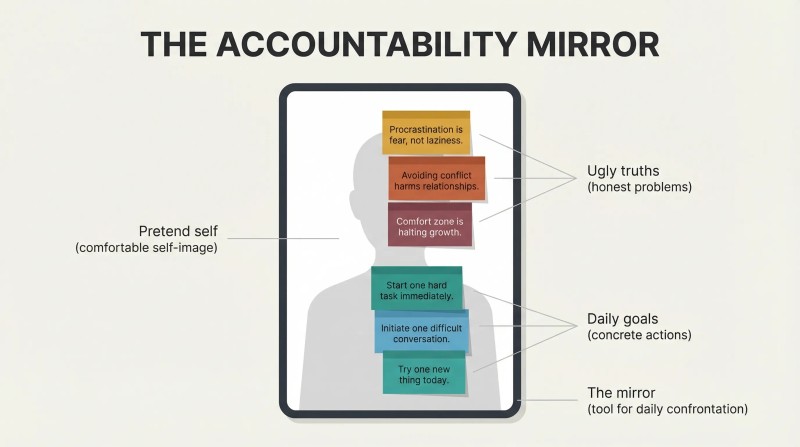
Goggins invented the Accountability Mirror after his high school warned he'd fail to graduate — he'd missed a quarter of the year with a D average. That night, he shaved his head, stared at his reflection, and delivered a profanity-laced intervention: "You read like a third grader. You're a fucking joke." Then he wrote brutally honest goals on Post-It notes and taped them to the glass.
Each day, the mirror held him accountable. If you're fat, say you're fat. If you're uneducated, admit it and get to work. Over six months, his reading level jumped from fourth grade to twelfth. He passed the military entrance exam on his third try. The ritual wasn't about self-love — it was about abolishing the gap between who you pretend to be and who you actually are.
Your suffering is a training ground, not a life sentence
“I stopped seeing myself as the victim of bad circumstance, and saw my life as the ultimate training ground instead.”
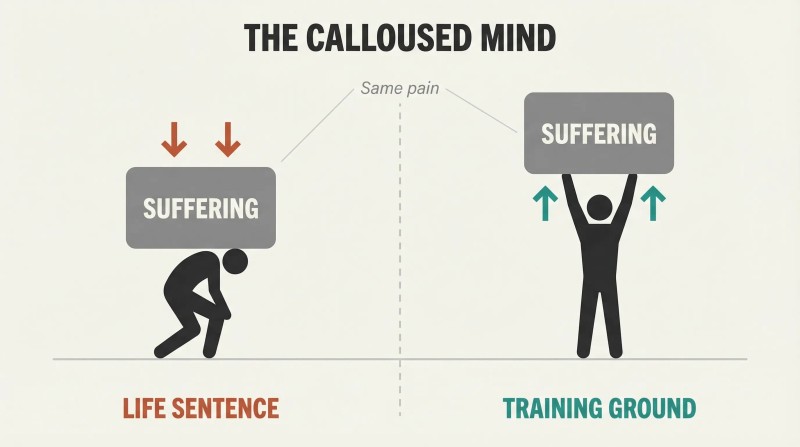
Goggins calls this a Calloused Mind — mental armor built from enduring and metabolizing pain, the way calluses form on palms from gripping steel bars thousands of times. His abusive father beat him with belts, pointed a gun between his eyes at age eight, and worked him in child labor from age six. Racism in rural Indiana delivered death threats, spray-painted slurs, and a gun aimed at his head on a country road.
But the callus only protects if you stay open. During an underwater knot-tying drill where instructor "Psycho Pete" was tormenting him — treading water on one working leg, oxygen-starved, near blackout — Goggins flipped his perspective: every horror he'd survived had prepared him for that exact moment. The pain receded. He finished the drill and outlasted his tormentor.
Your first wall of pain is your governor, not your limit
“Even when we feel like we've reached our absolute limit, we still have 60 percent more to give!”
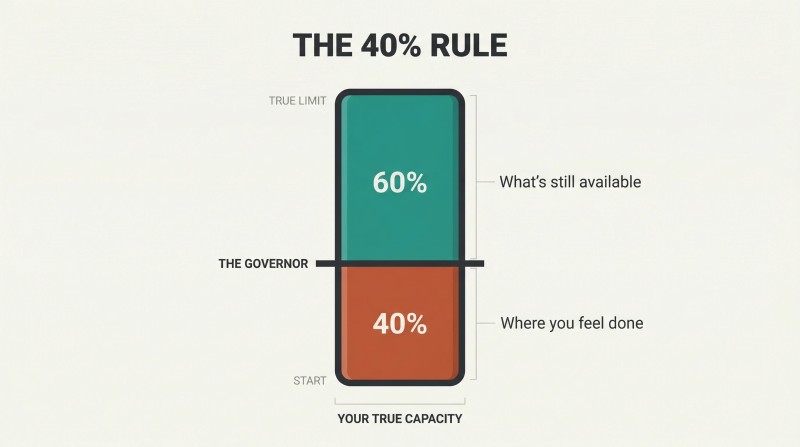
Goggins compares the mind to a car's The Governor — a device that caps speed to protect the engine. Our mental governor uses pain, fear, and self-doubt to shut us down well before true capacity. He calls this The 40% Rule: when you feel completely finished, you've only tapped roughly 40 percent of your potential.
The proof is absurd. Goggins ran 101 miles in under 19 hours with zero running training, having not run more than a mile in six months. He bled, lost toenails, and defecated on himself — but he finished. The trick isn't ignoring pain. It's recognizing that your first wall of exhaustion is the governor talking, then pushing 5 – 10 percent further each time. That incremental override shifts your baseline permanently upward.
Face the cracks in your foundation or success crumbles on top
“Most of us sweep our failures and evil secrets under the rug, but when we run into problems, that rug gets lifted up, and our darkness re-emerges.”
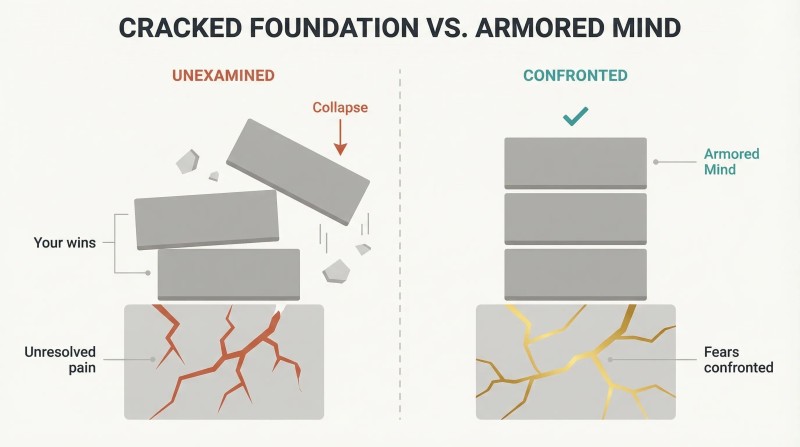
Achievements stacked on unresolved trauma collapse. After his second Hell Week, Goggins sat on his mother's couch and realized his victories were built on a cracked foundation. He'd been rejecting his father — lying to people that the man had died — instead of integrating that pain. He calls the deeper fix an Armored Mind: bulletproof not from pushing through pain, but from confronting the source of your deepest fears.
Shawn Dobbs proved the danger. An elite BUD/S candidate who dominated early evolutions, Dobbs talked trash about weaker classmates — then mentally disintegrated by Monday night of Hell Week. "I was an insecure person with low self esteem trying to grind an axe," Dobbs admitted. His cracked foundation couldn't hold the weight. He quit. Only by accepting your darkness can you use it as fuel.
Stock a mental Cookie Jar of victories for when you're breaking
“We all need small sparks, small accomplishments in our lives to fuel the big ones.”
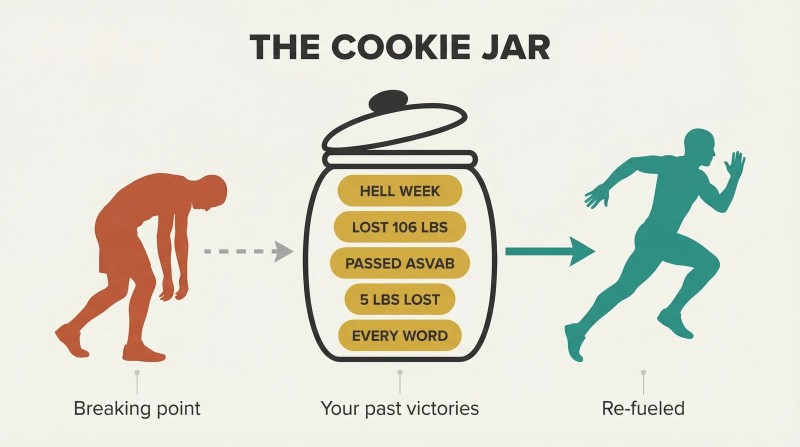
At mile 81, Goggins was shattered. Bloody feet, stress fractures, blurred vision — and his wife told him his pace wouldn't make the cutoff. That's when he invented the Cookie Jar: a mental bank of past victories you reach into when pain threatens to end you.
He pulled out cookies one by one: graduating high school against the odds, passing the ASVAB, losing 106 pounds, conquering his fear of water, finishing Hell Week. Each memory wasn't just a flashback — he re-entered the emotional state of that triumph, triggering adrenaline that drowned out the suffering. His pace picked up. He swung his arms, lengthened his stride, and finished with 101 miles. Even small wins count: understanding every word in a paragraph, losing five pounds in a week. Those are kindling for the bonfire.
Outwork your tormentor until you occupy their mind
“The ticket to victory often comes down to bringing your very best when you feel your worst.”
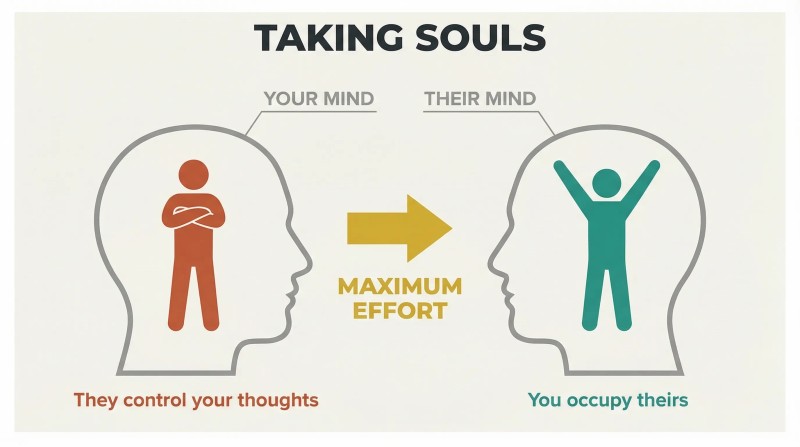
Goggins calls this Taking Souls. During Hell Week's worst night, his Boat Crew Two was demolished — bodies chafed, zombie-eyed, barely lifting their boat. Instead of collapsing, Goggins told his crew to throw the 200-pound boat overhead with explosive force. They chanted "You can't hurt Boat Crew Two!" and moved at lightning speed. The instructors' mouths fell open.
Taking Souls means gaining a tactical advantage through maximum effort at your lowest point. It applies beyond the military:
1. Ace the exam your teacher expected you to fail
2. Outwork the boss who underestimates you
3. Stay composed when a bully tries to break you
Second winds are real — pushing through the quit impulse floods your system with adrenaline. Pain fades. Energy returns. Your opponent watches in disbelief.
Dissect every failure like a crime scene, then attack again
“Your entitled mind is dead weight. Cut it loose.”
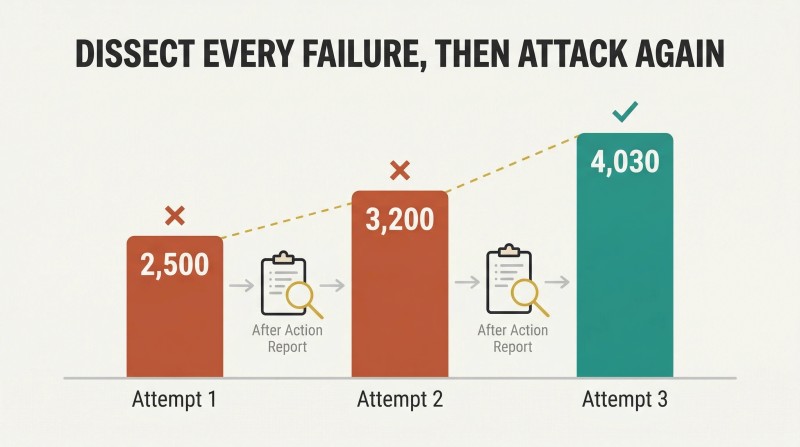
Goggins failed the pull-up world record twice before breaking it. First attempt on The Today Show: 2,500 reps — loose bar, wrong environment, too many selfie-seekers. Second attempt in Nashville: 3,200 reps before his palms filleted to the dermis. Each time, he ran a military-style After Action Report: listing what went well, analyzing his mindset during execution, and conducting a tactical review.
Between attempts he adjusted everything: custom foam pads for his palms, protein and banana nutrition instead of carbs-only, four-minute break maximum, and a dungeon CrossFit gym with a bolted-down bar. Third attempt: 4,030 pull-ups in 17 hours — lifting the equivalent of 846,030 pounds. Failure isn't an endpoint. It's an intelligence-gathering operation revealing exactly where to strike next.
Talent is the excuse — obsessive work ethic is the actual engine
“I had a fucking hole in my heart!”
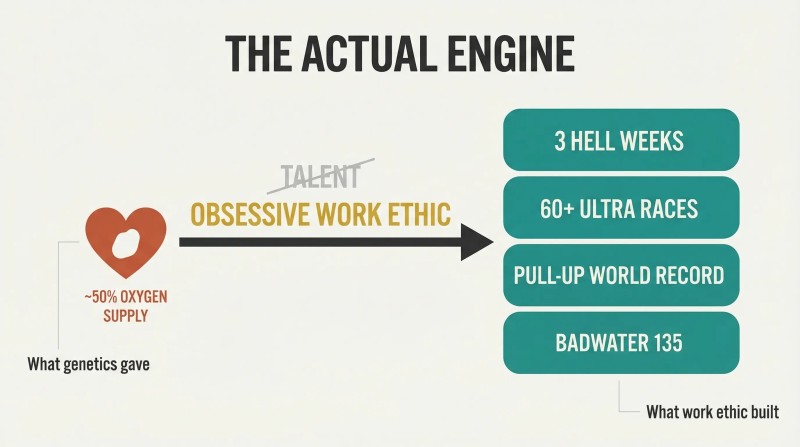
At thirty-three, doctors discovered Goggins was born with an Atrial Septal Defect — a hole between his heart chambers that mixed oxygenated and deoxygenated blood. He'd been operating on roughly half the oxygen supply his muscles needed. Three Hell Weeks, 60-plus ultra races, Badwater 135 through Death Valley, a pull-up world record — all accomplished with a heart defect that should have grounded him before basic training.
Nothing about Goggins was gifted. He taught himself to swim from a book called Swimming for Dummies. He couldn't read past a third-grade level until age seventeen. He cheated through school for eight years because studying was so painful. Every skill was brute-forced through repetition, memorization, and refusal to accept limitation. His broken heart is the ultimate proof: work ethic built everything genetics didn't provide.
Reset to zero every morning — greatness evaporates overnight
“Greatness is not something that if you meet it once it stays with you forever. That shit evaporates like a flash of oil in a hot pan.”
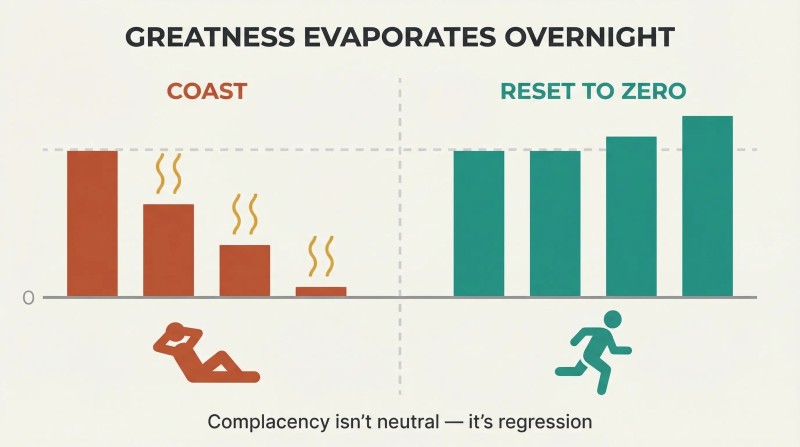
After graduating BUD/S, most SEALs wanted to coast. When Goggins pushed his second platoon with brutal PT, they told him to back off: "We aren't in BUD/S anymore." He was disappointed but later admitted his own leadership was flawed — he bullied rather than inspired. Still, his core insight holds: the moment you feel you've "made it," decay begins.
Goggins calls this starting at zero. No matter the achievement — Ranger School Enlisted Honor Man, Badwater finisher, pull-up record holder — he wakes as if it's day one of BUD/S. He volunteered for Ranger School, screened for DEVGRU, attempted Delta Selection twice, became a wildland firefighter, and at forty-three ran faster than at thirty-three. Complacency isn't neutral. It's regression wearing a comfortable mask.
Analysis
Goggins' book occupies an unusual position in the self-help canon — it's simultaneously the most extreme and the most honest entry in the genre. Where most self-improvement authors present sanitized frameworks backed by psychology studies, Goggins offers his own mutilated body as evidence. The result is less about 'hacking' your way to success and more about accepting that the path to self-mastery runs directly through suffering you'd rather avoid.
The intellectual architecture is more sophisticated than its profanity-laced surface suggests. The 40% Rule functions as a cognitive reframing device: by convincing readers they have massive untapped reserves, it creates a self-fulfilling prophecy where pushing through pain becomes easier simply because you believe you can. This aligns with research on perceived exertion by sports scientists like Samuele Marcora, showing that mental fatigue — not muscular failure — is the primary limiter of endurance performance. Goggins reverse-engineered the finding through his own body without ever reading the research.
The book's deepest insight arrives not in its shock-and-awe suffering chapters but in the distinction between a Calloused Mind and an Armored Mind. A calloused mind can push through pain. An armored mind has gone to the source of its fears and integrated them. This mirrors Carl Jung's concept of shadow integration — you cannot become whole by ignoring your darkness. Goggins' pivot from rejecting his father to accepting him as part of himself is essentially individuation in combat boots.
The most common criticism — that Goggins' approach is unsustainable and self-destructive — is addressed in the final chapter, where his body nearly shuts down and stretching, not more suffering, saves him. This quiet coda undermines the book's macho surface narrative and reveals something unexpectedly nuanced: the same relentlessness that builds greatness can destroy you if you never pause to maintain what you've built. The strongman, it turns out, was saved by flexibility.
Review Summary
Can't Hurt Me received mixed reviews. Many praised Goggins' inspiring journey of overcoming adversity and pushing physical limits. Readers found his mental toughness techniques motivating. However, some criticized his extreme approach as unhealthy and potentially dangerous. The audiobook format with added commentary was well-received. Critics noted the frequent use of profanity and perceived misogynistic language. Overall, the book resonated with those seeking to challenge themselves, but others found Goggins' methods too extreme or psychologically concerning.
People Also Read
 Immersive
 Immersive
 Immersive
 Immersive
 Immersive
 Immersive
Glossary
Accountability Mirror
Mirror ritual for brutal self-honestyA daily practice of standing before your bathroom mirror, writing brutally honest assessments of your weaknesses and specific goals on Post-It notes, and taping them to the glass. Each day you confront the truth about where you are and hold yourself accountable to the steps required to change. The tone must be raw and unflinching, not affirming.
The 40% Rule
Your perceived limit is 40%Goggins' principle that when you feel you've reached your absolute physical or mental limit, you've actually only tapped about 40 percent of your true capability. The remaining 60 percent is accessible by pushing through the mental governor's signals of pain, exhaustion, and self-doubt. Applied by incrementally extending effort 5–10 percent beyond your perceived stopping point until your baseline permanently shifts upward.
Calloused Mind
Mind toughened by processed hardshipMental toughness developed through enduring negative experiences while remaining open to growth—analogous to calluses that form on palms from repeated grip work on steel bars. Unlike resentment, which also forms from hardship but makes you brittle and fearful of change, a calloused mind converts past suffering into resilience that can be deployed under pressure. Built through sustained exposure to discomfort.
Armored Mind
Bulletproof mindset from confronting fearsA deeper level of mental fortification beyond the Calloused Mind, achieved by going to the source of your deepest fears and insecurities—childhood abuse, self-rejection, shame—and accepting them as part of your identity rather than hiding from them. Only by making peace with your cracked foundation can you build an unbreakable psychological structure on top of it.
Cookie Jar
Mental bank of past victoriesA mental repository where you store memories of past accomplishments—large and small—that you can reach into during moments of extreme suffering or self-doubt. The technique involves not just recalling the event but re-entering the emotional state of that victory, which triggers a sympathetic nervous system response (adrenaline, endorphins) that temporarily overrides pain and fatigue.
Taking Souls
Outperforming to steal opponent's energyA competitive strategy of bringing maximum effort at the precise moment your opponent expects you to break, thereby gaining a tactical and psychological advantage. Named for its effect: when you perform at your peak during your lowest point, it demoralizes competitors and can trigger a second wind. Applicable to sports, workplace competition, or any scenario with an adversary—including your own self-doubt.
The Governor
Mental limiter on human performanceGoggins' analogy comparing the brain's self-protective mechanisms to a car's governor—a device that caps engine speed to prevent damage. The mental governor uses pain, fear, exhaustion, and self-doubt to encourage you to stop well before true physical or mental capacity. Unlike a mechanical governor, it can be overridden through deliberate practice, mental toughness, and refusing to obey its signals.
Backstops
Pre-planned course-correction markersBorrowed from military navigation, backstops are predetermined checkpoints built into a plan that alert you when you've gone off course. In navigation, they're terrain features past a planned turn. Goggins applies them to race strategy, daily scheduling, and life planning—for example, setting split-time markers during a race or calendar alerts during a workday that signal when one task has bled into another's allotted time.
FAQ
What's Can't Hurt Me about?
- David Goggins' Journey: The book details Goggins' transformation from a troubled childhood to becoming a Navy SEAL and ultra-endurance athlete, overcoming racism, abuse, and self-doubt.
- Mental Toughness Focus: Goggins emphasizes mental resilience, arguing that most people only use a fraction of their potential and that growth comes from embracing discomfort.
- Callousing the Mind: A central concept where Goggins explains that facing life's challenges strengthens the mind, similar to how physical training toughens the body.
Why should I read Can't Hurt Me?
- Inspiration and Motivation: Goggins' story is a powerful reminder that overcoming adversity is possible through hard work and determination.
- Practical Advice: The book offers actionable advice and challenges to help readers confront their limitations and grow personally.
- Unique Perspective: Goggins provides a raw, unfiltered look at his life, making it relatable for anyone facing struggles.
What are the key takeaways of Can't Hurt Me?
- Embrace Discomfort: Growth occurs outside comfort zones, and Goggins challenges readers to use discomfort as a tool for development.
- Accountability Mirror: A strategy where Goggins confronts himself with harsh truths to stay focused and accountable.
- Taking Souls: Using others' negativity as motivation to excel, turning adversity into fuel for success.
What is the concept of "callousing the mind" in Can't Hurt Me?
- Building Resilience: Mental calluses protect the mind from failure and adversity, built by facing challenges head-on.
- Overcoming Adversity: Embracing discomfort and using past struggles as motivation for future success.
- Long-Term Growth: A continuous process where regular challenges strengthen mental fortitude.
How does Goggins suggest we confront our fears in Can't Hurt Me?
- Face Your Fears: Confront fears directly to diminish their power and learn to thrive despite them.
- Use Fear as Fuel: Channel fears into motivation for personal growth, pushing through obstacles to achieve goals.
- Visualize Success: Picturing success and preparing for challenges builds confidence and resilience.
What is the 40% Rule in Can't Hurt Me?
- Unlocking Hidden Potential: Suggests individuals only tap into 40% of their potential, encouraging them to push beyond this threshold.
- Mindset Shift: Prompts a mindset shift to challenge limits and redefine possibilities.
- Practical Application: Provides examples of applying the rule in daily life to develop a stronger mental framework.
What is the Cookie Jar concept in Can't Hurt Me?
- Metaphor for Past Successes: A mental reservoir of past victories to draw upon during tough times.
- Emotional Connection: Emphasizes feeling the emotions associated with past successes to provide strength.
- Practical Application: Encourages creating a personal Cookie Jar by writing down achievements to reinforce a positive mindset.
How does Goggins define mental toughness in Can't Hurt Me?
- Ability to Endure Pain: Enduring physical and emotional pain without giving in is key to mental toughness.
- Self-Discipline and Focus: Maintaining focus and discipline, especially in challenging situations, is essential.
- Embracing Adversity: Developed through facing and embracing adversity, building resilience and fortitude.
How does Goggins' childhood influence his philosophy in Can't Hurt Me?
- Traumatic Experiences: His abusive childhood and experiences with racism shaped his understanding of pain and resilience.
- Turning Pain into Power: Transformed past traumas into motivation for success, empowering individuals to overcome challenges.
- Defying the Odds: His journey exemplifies the belief that anyone can defy the odds through perseverance and determination.
What role does physical fitness play in Can't Hurt Me?
- Physical Training as a Tool: Physical fitness is crucial for mental toughness, pushing the body strengthens the mind.
- Endurance and Resilience: Ultra-endurance experiences demonstrate the connection between physical endurance and mental resilience.
- Daily Discipline: Incorporating physical challenges into daily routines builds strength and fosters perseverance.
How does Goggins view failure in Can't Hurt Me?
- Learning Opportunity: Failure is a crucial part of growth, providing valuable lessons for future success.
- Emotional Resilience: Developing emotional resilience in the face of failure builds a stronger mindset.
- Empowerment Through Adversity: Embracing failure empowers individuals to take risks and pursue goals without fear.
What role does accountability play in Can't Hurt Me?
- Self-Reflection and Growth: Accountability is crucial for personal growth, encouraging reflection on actions and decisions.
- Journaling as a Tool: Keeping a journal helps track progress and reinforce commitment to personal goals.
- Support Systems: Having a support system fosters a culture of growth and resilience, maintaining accountability.
About the Author
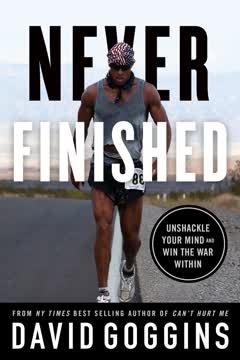
Other books by David Goggins
Download PDF
Download EPUB
.epub digital book format is ideal for reading ebooks on phones, tablets, and e-readers.








































