

Key Takeaways
Caffeine doesn't give energy, it borrows it at brutal interest
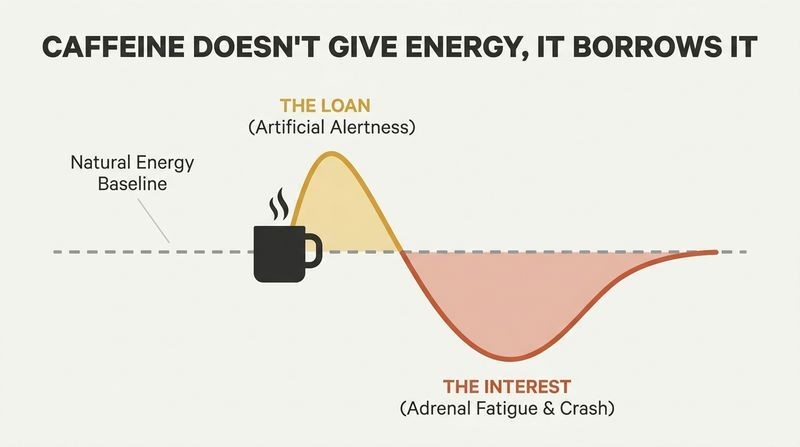
The central deception unraveled. Cherniske argues caffeine provides zero actual energy. It merely triggers your adrenal glands to dump stress hormones (epinephrine, cortisol) into your blood, creating an artificial emergency state that feels like alertness. He compares it to taking a loan at 75% interest: the borrowed vigor comes from your adrenals and liver, and repayment eventually means adrenal exhaustion, or metabolic bankruptcy.
Try the fist experiment. Clench your fist tight for thirty seconds. First it feels strong, then it aches and weakens. That is caffeine on your whole body: it creates tension, and tension always ends in fatigue. This is why the drug people reach for to fight tiredness is itself a leading cause of chronic tiredness, a paradox running through every chapter of the book.
The reframe is genuinely useful: caffeine redistributes energy across time rather than creating it, front-loading alertness and back-loading depletion. Modern adenosine research partly supports this. Caffeine blocks adenosine receptors that signal fatigue, so tiredness accumulates unfelt then crashes. However, the book overstates the case. Controlled meta-analyses show modest genuine performance benefits on vigilance and endurance, especially in the sleep-deprived. The honest synthesis is that caffeine masks fatigue and mobilizes reserves rather than manufacturing energy from nothing, which is close to Cherniske's point without his absolutism. His loan metaphor is memorable precisely because it captures the intertemporal tradeoff economists call discounting.
You're likely drinking triple the caffeine you think you are
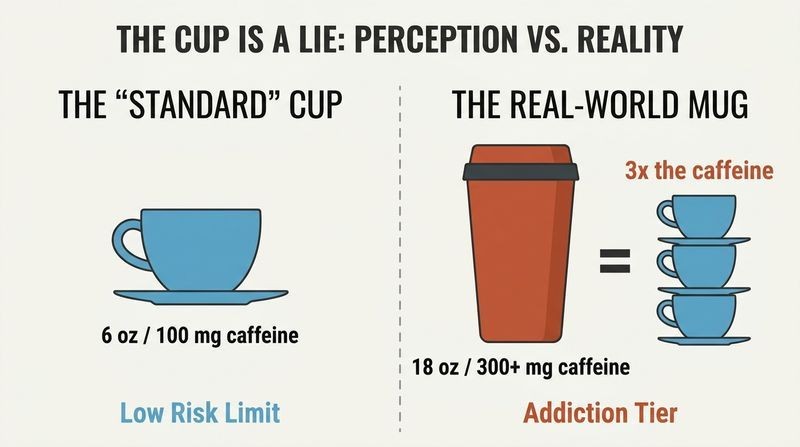
The cup is a lie. Researchers and the industry define a standard cup as five to six ounces, but real people drink from fourteen-ounce mugs, twenty-ounce shop cups, and thirty-two-ounce convenience-store barrels. One client who swore he drank one cup a day was actually consuming nearly 500 milligrams of caffeine on an empty stomach during his commute. A large twenty-ounce coffee equals more than three official cups.
Brewing method compounds the gap. Six ounces of drip coffee holds about 100 milligrams, percolated 120, and European boiled 160. Manufacturers add caffeine to sodas, painkillers, and even fruit drinks without disclosing amounts. Cherniske's caffeine quotient tiers: under 100 milligrams daily is low risk, 300 to 600 means likely addiction, and 900-plus means near-certain dependence with elevated risk across heart, stroke, and gastrointestinal disease.
The measurement critique remains the book's most durable contribution, and it has aged well. The Starbucks era arrived after 1998 and vindicated the warning: a sixteen-ounce brewed coffee can exceed 300 milligrams, more than an entire day's intake by the industry's own thresholds. Behavioral economists would note the framing trap here. People anchor on the word cup as a fixed unit while the physical vessel silently triples, a classic units-of-measurement illusion. The practical move is dose tracking in milligrams, not cups. One caveat: Cherniske's tier labels blur physical dependence with pathology, treating any dependence as disease, which overreaches the evidence.
Caffeine keeps stress hormones flooding your body eighteen hours a day
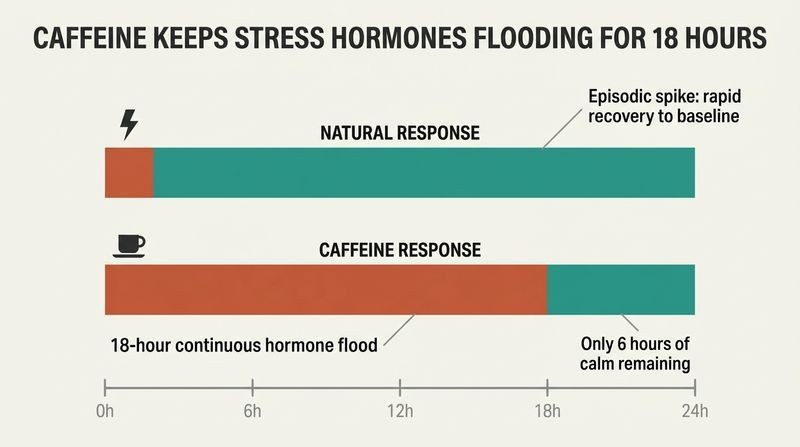
The fight-or-flight machinery, always on. A single 250-milligram dose (about two and a half small cups) raises adrenaline by over 200%. The problem is that this survival response evolved for episodic emergencies (a predator, then escape), not the chronic drip of modern deadlines. Sitting at a desk while your body dumps sugar and fat into the blood means that fuel goes unused, clogging arteries rather than powering muscles.
Cortisol is the silent long burn. Unlike adrenaline, cortisol lingers. Heavy consumers can carry elevated cortisol for eighteen of every twenty-four hours. Cherniske frames caffeine plus stress as multiplicative, not additive: caffeine lowers your stress threshold so ordinary annoyances tip into distress. Studies he cites show habitual drinkers develop no tolerance to this neuroendocrine reactivity, debunking the comforting idea that regular users are immune.
This maps onto Robert Sapolsky's work on why zebras don't get ulcers: the stress response is superbly designed for acute threats and corrosive when chronically activated. Cherniske's contribution is naming caffeine as a threshold-lowering amplifier rather than a standalone stressor, which is subtle and important. The strongest evidence he marshals is that habituation does not blunt cortisol and blood-pressure reactivity, contradicting industry claims. Where caution is warranted: cortisol dynamics vary enormously by individual, time of day, and genetics, and the eighteen-hour figure applies to heavy consumers under stress, not everyone. The multiplicative stress model, though, is a genuinely useful mental frame.
Caffeine sabotages deep sleep even when you fall asleep fine
Insomnia is not the real problem. Cherniske distinguishes sleep quantity from sleep quality. Tolerance may let habitual drinkers fall asleep, but caffeine shortens total sleep, and often eliminates Stage 4 deep sleep, the phase when the body mass-produces new cells, rebuilds immunity, and repairs the nervous system. You wake tired, reach for coffee, and the cycle locks.
Timing offers no safety. In one Zurich study, subjects given 200 milligrams at 7 a.m. still showed disrupted deep sleep at 11 p.m., after blood caffeine had fallen more than 80%. The elderly are hit hardest because they detoxify caffeine slowly. Cherniske ties this to the fibromyalgia case of Amy, whose long commute cut sleep, drove up coffee intake, wrecked her Stage 4 repair, and left her in chronic pain from unrepaired muscle microtrauma.
The quality-versus-quantity distinction is the sharpest sleep insight here and predates its mainstream popularity by decades. Contemporary sleep science, notably Matthew Walker's synthesis, confirms caffeine's roughly six-hour half-life fragments architecture and suppresses slow-wave sleep even when subjective sleep onset feels normal. The self-deception element is crucial: without an EEG, people cannot perceive lost deep sleep, so they misattribute daytime fatigue to age or workload. Cherniske's causal loop (poor sleep to more caffeine to worse sleep) is a textbook positive-feedback trap. The morning-dose finding is provocative and, if robust, argues that even breakfast coffee carries a cost, though individual metabolic variation is large.
The lift you chase is really just dodging withdrawal
Relief masquerades as benefit. Cherniske's most disorienting claim: caffeine is not a mood elevator. The pleasant morning lift is mostly the reversal of overnight withdrawal. Deprive a habitual drinker for even a few hours and depression, fatigue, irritability, and headache set in. The drug feels good chiefly because it relieves the misery it created, the same logic no one disputes about cigarettes.
Dependence starts shockingly low. Johns Hopkins research he cites found withdrawal in people drinking as little as one fourteen-ounce mug daily, with 100% of subjects affected at low doses. Symptoms include headache, flu-like feelings, muscle stiffness, and nausea. The rebound depression traces to dopamine: caffeine raises dopamine similarly to amphetamines, and once those receptors fire out, a metabolic letdown follows until stores replenish.
This is the book's most philosophically interesting move, borrowing the logic of opponent-process theory: every drug high provokes a compensatory low, and chronic use shifts the baseline so that consumption merely restores normalcy. The cigarette analogy is rhetorically devastating and largely fair. The dopamine parallel to amphetamines is real but a matter of degree, and Cherniske occasionally elides that difference for effect. Worth noting: some studies suggest genuine mood and cognitive benefits in non-dependent occasional users, implying the withdrawal-relief model explains habitual drinking better than first exposure. Still, the reframe that most coffee pleasure is escape from self-inflicted deprivation is a powerful lens.
Caffeine's heart risk hides in six factors beyond cholesterol
The debate was rigged too narrow. Because coffee's effects on cholesterol and blood pressure look small in isolation, industry dismissed it as a cardiac risk. Cherniske argues the real danger is cumulative across many pathways. Coffee (even decaf) raises cholesterol via diterpenes cafestol and kahweol, and it elevates homocysteine, a compound that damages artery walls and rivals smoking as a risk factor.
Vasospasm, arrhythmia, magnesium, clotting. Caffeine constricts blood vessels (vascular resistance), can trigger coronary artery spasm even in clear arteries, depletes magnesium (raising spasm and arrhythmia risk), and accelerates blood clotting through the stress response. He notes people are more than 50% likelier to have heart attacks on Monday, when weekend abstinence leaves morning caffeine levels lowest and the first cups spike blood pressure hardest.
The multifactorial argument is methodologically sophisticated and anticipates modern systems thinking about disease: reductionist single-variable studies can each show small effects while the interacting whole is dangerous. The homocysteine and diterpene points have held up reasonably in later research, and unfiltered boiled coffee genuinely raises LDL. The Monday-morning heart-attack correlation is intriguing but confounded by workweek stress, and attributing it primarily to caffeine overreaches available causal evidence. Large modern cohort studies actually associate moderate coffee with lower cardiovascular mortality, complicating Cherniske's picture. The fair takeaway is that vulnerable subgroups (hypertensive, arrhythmia-prone, high homocysteine) face real risk that population averages obscure.
Women detoxify caffeine slower and pay a steeper biological price
The gender blind spot. Roughly 75% of caffeine research was done on men, yet women clear the drug more slowly, and birth-control pills roughly double the detox time. During the two weeks before menstruation, a cup's half-life stretches to about seven hours. Caffeine intensifies premenstrual syndrome (heavy tea drinkers in one China study were nearly ten times likelier to suffer PMS), and it slashes iron absorption from a meal by up to 75%.
Bones, breasts, babies. Caffeine accelerates urinary calcium loss, raising osteoporosis and hip-fracture risk. In Dr. Minton's research, 82% of women who quit caffeine saw fibrocystic breast lumps disappear. Consuming over 300 milligrams before pregnancy nearly doubled fetal-loss risk in a JAMA study, and maternal caffeine is linked to low birth weight, withdrawal in newborns, and elevated SIDS risk.
The sex-difference critique was ahead of its time and remains valid: pharmacology long defaulted to male subjects, and caffeine metabolism genuinely varies by hormonal state and oral contraceptive use. The iron-absorption and fibrocystic findings are among the book's better-supported claims. The reproductive warnings are where evidence is most contested. Later large studies confirm dose-dependent miscarriage and low-birth-weight associations, supporting caution, but causation is hard to disentangle from nausea (healthier pregnancies suppress coffee craving, a reverse-causation trap). Current obstetric guidance permits about 200 milligrams daily, gentler than Cherniske's abstinence stance, yet his precautionary logic for prospective mothers is defensible given asymmetric stakes.
Soft drinks are engineered caffeine-delivery systems aimed at kids
The perfect addictive product. Cherniske dismantles the industry's claim that caffeine is a mere flavoring. It is bitter, requiring extra sweetener to mask, and caffeine-free colas taste identical yet barely sell. Only about 10% of a cola's caffeine comes from the required kola extract; manufacturers add the other 90%, largely as a byproduct of decaffeinating coffee. A child weighing sixty pounds drinking three colas and candy can ingest the equivalent of eight strong coffees for a grown man.
Marketed to the young, sold in schools. Peak consumption spikes at ages three, thirteen, and seventeen. Cash-strapped schools signed exclusive multimillion-dollar vending contracts, plastering logos across campuses. Guatemalan children taken off caffeine for five months gained 22% more length and 46% more weight than those still drinking it.
The consumer-behavior argument is airtight on its own terms: a bitter additive that requires masking sweetener, whose removal does not hurt sales of flavor-identical alternatives, is hard to defend as flavoring. This anticipates later reckonings over sugar and ultra-processed foods marketed to children. The addiction-by-design framing echoes tobacco-industry document revelations. Where readers should apply nuance: the Guatemala growth figures are striking but from a single small study, and confounders like overall nutrition loom large. The school-contract critique proved prophetic, as public pressure later forced soda removal from many US schools, suggesting Cherniske correctly identified an exploitation that society eventually recognized.
Quit by weaning gradually so blood levels never crash
The headache is a withdrawal signal, not a verdict. Cherniske's core cessation insight is that withdrawal symptoms are triggered by rapid drops in blood caffeine, so quitting cold turkey guarantees the worst suffering. His Off the Bean method blends regular coffee with a caffeine-free substitute over about two weeks, steadily shifting the ratio (three-quarters regular to fully substitute) so levels taper smoothly and the brain's constricted vessels re-dilate without the throbbing rebound headache.
Rebuild real energy alongside. Because people quit to regain vitality, he pairs weaning with what he calls bioenergetic nutrients (CoQ10, alpha ketoglutaric acid, B-6, chromium, magnesium aspartate) plus walking, deep sleep, and yoga. He reports over 80% of clients stuck with the program, far above the sub-30% compliance he saw for diet or exercise changes, because relief comes fast and painlessly.
The taper logic is pharmacologically sound and mirrors evidence-based protocols for other dependencies: gradual dose reduction minimizes withdrawal by avoiding steep concentration gradients. The practical genius is preserving the ritual (brewing, mug, warmth) while swapping the drug, which respects the behavioral scaffolding around the habit, a principle habit researchers like Wendy Wood emphasize. The bioenergetic supplement stack is the book's weakest, most dated section, leaning on small studies and the author's commercial interests, so skepticism is warranted there. But the central behavioral prescription, taper rather than abstain abruptly and replace the ritual, is genuinely actionable and consistent with how people successfully exit chemical dependencies.
Your body still runs on 25,000-year-old hardware
Evolutionary mismatch is the unifying lens. Cherniske's recurring argument is that human genes have barely changed while our chemistry has transformed completely. The stress response that once let us flee predators now fires at traffic jams and deadlines, with no physical discharge for the mobilized sugar and fat. Our digestive tract, built for whole foods and pure water, now processes caffeine, refined sugar, and chemicals it never evolved to handle.
Caffeine as Trojan horse. He frames the drug as a gift that smuggles in adrenal stress, low blood sugar, mood swings, malnutrition, and broken sleep. The remedy, in his view, is duplicating ancestral conditions as closely as possible: whole foods, clean water, full-night sleep, and daily movement, while using modern tools like nutrition science and exercise physiology to do it better.
The evolutionary-mismatch framework is intellectually respectable and shared by serious researchers in evolutionary medicine, from Daniel Lieberman on physical activity to work on discordance-driven chronic disease. It gives the book coherence, tying disparate harms to one principle. The danger is that mismatch reasoning can become an unfalsifiable naturalistic fallacy, treating everything ancestral as good and everything novel as bad, which ignores that agriculture, cooking, and modern medicine also depart from Paleolithic norms while extending life. Coffee itself has been consumed for centuries in some cultures with mixed outcomes. The frame is best used as a hypothesis generator, not a moral verdict on every modern substance.
Analysis
Caffeine Blues is a thesis-driven health polemic disguised as a science review, written in 1998 by nutritional biochemist Stephen Cherniske. Its structure is cumulative: a personal awakening (a coffee-soaked flight that spiraled into a panic-like episode and withdrawal), followed by systematic organ-by-organ indictments, then a cessation program. What makes it hard to summarize is density (over 700 footnotes, hundreds of studies) welded to a single insistent argument, so the challenge is separating durable insight from advocacy and dated commercial content.
The book's intellectual spine is strong and, in places, prescient. Its measurement critique (that cup is a meaningless unit and real doses are triple industry estimates) was vindicated by the espresso-chain era. Its distinction between sleep quantity and quality anticipated mainstream sleep science by two decades. Its insistence on multifactorial rather than single-variable disease causation reflects sophisticated systems thinking. Its sex-differences argument flagged a real bias in pharmacology.
The weaknesses are equally clear. Cherniske argues like a prosecutor, not a judge: he foregrounds studies confirming harm and treats every dependence as pathology. He rarely engages the large modern literature associating moderate coffee with reduced mortality from cardiovascular disease, Parkinson's, type 2 diabetes, and liver disease. His supplement recommendations blur into commercial promotion, and his absolutism (no study shows caffeine is good) reads as motivated rather than measured.
The honest synthesis a modern reader should carry: caffeine is a genuine psychoactive drug with genuine costs, especially for the stressed, sleep-deprived, pregnant, arrhythmia-prone, anxiety-prone, and iron-deficient. Dose and individual variation matter enormously, and self-experimentation (a caffeine-free trial period) is sound advice regardless of where one lands. Cherniske overstates uniformity of harm, but his core reframes (caffeine borrows energy rather than creating it, relief masquerades as benefit, and hidden dosing prevents informed choice) remain valuable correctives to a culture that treats the world's most popular drug as harmless.
Review Summary
Caffeine Blues receives mostly positive reviews, with readers praising its eye-opening information on caffeine's effects. Many report successfully quitting caffeine after reading, experiencing improved sleep and mood. The book is lauded for its thorough research and persuasive arguments against caffeine consumption. Some critics find it overly zealous or poorly edited. Readers appreciate the detailed explanations of caffeine's impact on stress, addiction, and various health issues. While some found it life-changing, others felt it was biased or fear-mongering. Overall, it's seen as an informative read for those considering reducing caffeine intake.
People Also Read



Glossary
Caffeinism
Chronic caffeine toxicity syndromeA state of chronic toxicity from excess caffeine consumption, combining physical dependence with debilitating effects: anxiety, irritability, mood swings, sleep disturbance, depression, and, ironically, fatigue. Cherniske cites estimates that it may affect roughly one in ten people. It is often misdiagnosed as psychiatric illness because doctors rarely ask about caffeine intake.
Off the Bean program
Gradual caffeine-weaning methodCherniske's clinically tested cessation protocol that reduces caffeine over about two weeks by progressively blending regular coffee with caffeine-free substitutes, so blood caffeine never drops sharply enough to trigger withdrawal headaches. It pairs the taper with energy-rebuilding steps: nutritional supplements, walking, improved sleep, and stress management, aiming to restore natural vitality rather than merely remove the drug.
Bioenergetic nutrients
Supplements for cellular energy productionCherniske's term for a group of vitamins, minerals, and coenzymes he claims enhance the body's own energy production, including coenzyme Q10, alpha ketoglutaric acid, vitamin B-6, chromium, and potassium-magnesium aspartate. He recommends them during caffeine withdrawal to help the body generate real energy metabolically instead of relying on stimulant-induced stress.
Adrenopause
Age-related adrenal hormone declineThe endocrinologists' term Cherniske adopts for the decline in adrenal DHEA production with age. He argues this decline is not inevitable aging but reflects worn-out adrenals, worsened by caffeine and stress, which elevate cortisol and thereby suppress DHEA, the vitality hormone linked to immunity, energy, and repair.
Caffeine quotient
Your total daily caffeine doseCherniske's self-assessment tool: total daily caffeine in milligrams tallied across coffee, tea, soft drinks, chocolate, and medications. He assigns risk tiers, under 100 milligrams (low risk), 100 to 300 (danger zone), 300 to 600 (likely addiction), and 900-plus (severe addiction with elevated disease risk), to make invisible consumption visible and quantifiable.
Vascular resistance
Caffeine-induced blood vessel constrictionPart of the stress response in which peripheral blood vessels constrict, reducing blood flow. Cherniske identifies caffeine as a trigger. It once minimized blood loss from injury but today mainly raises blood pressure, cools the extremities, reduces cerebral blood flow, and, during exercise, can push blood pressure to dangerous levels.
FAQ
What's Caffeine Blues about?
- Focus on Dangers: Caffeine Blues by Stephen Cherniske delves into the hidden dangers of caffeine, highlighting its status as America's most widely consumed drug.
- Health Implications: The book discusses caffeine's impact on both physical and mental health, linking it to conditions like anxiety, depression, and chronic fatigue.
- Personal Narrative: Cherniske shares his own experiences with caffeine addiction and withdrawal, providing a personal touch to the scientific claims presented.
Why should I read Caffeine Blues?
- Empowerment Through Knowledge: The book empowers readers to make informed decisions about caffeine consumption by presenting extensive research and case studies.
- Practical Solutions: It offers practical advice and alternatives to caffeine, aiding readers in transitioning away from dependency without withdrawal symptoms.
- Comprehensive Resource: Covering a wide range of topics related to caffeine, it serves as a valuable resource for those looking to improve their health and well-being.
What are the key takeaways of Caffeine Blues?
- Caffeine is Addictive: The book emphasizes caffeine as a drug that can lead to physical dependence, with withdrawal symptoms like headaches and fatigue.
- Health Risks: Cherniske outlines various health risks associated with caffeine, including increased blood pressure and digestive issues.
- Alternatives and Strategies: The author presents alternatives and strategies for reducing caffeine intake, such as the "Off the Bean" program.
What are the best quotes from Caffeine Blues and what do they mean?
- "Caffeine can’t provide energy...": This quote highlights the misconception that caffeine boosts energy, suggesting it only creates temporary alertness.
- "Caffeine gives the illusion...": It emphasizes that caffeine may make one feel awake but does not enhance overall mental function.
- "Knowledge is power...": Cherniske stresses the importance of understanding caffeine's effects, encapsulating the book's goal of educating readers.
How does caffeine affect the body according to Caffeine Blues?
- Increased Stress Hormones: Caffeine stimulates adrenal glands, leading to elevated stress hormones like cortisol, resulting in anxiety.
- Digestive Disruption: It can disrupt normal digestive processes, leading to conditions like gastritis and impaired nutrient absorption.
- Cardiovascular Effects: Caffeine can raise blood pressure and contribute to heart disease, especially in those with pre-existing conditions.
What is the "Off the Bean" program mentioned in Caffeine Blues?
- Gradual Reduction Strategy: The program is a structured approach to reducing caffeine intake gradually, minimizing withdrawal symptoms.
- Focus on Alternatives: It encourages the use of caffeine-free alternatives, such as herbal teas, to provide a satisfying experience.
- Holistic Health Approach: Cherniske emphasizes overall health and wellness, suggesting dietary changes and stress management techniques.
How does caffeine impact women's health specifically in Caffeine Blues?
- Hormonal Imbalances: Caffeine can disrupt hormonal balance, leading to issues like PMS and complications during pregnancy.
- Bone Health Risks: It is linked to decreased calcium absorption, increasing the risk of osteoporosis, particularly concerning for women.
- Increased Anxiety: Women may experience heightened anxiety and stress responses to caffeine, exacerbating mental health issues.
What are the withdrawal symptoms associated with caffeine as described in Caffeine Blues?
- Common Symptoms: Withdrawal can include headaches, fatigue, irritability, and difficulty concentrating, starting within hours of the last intake.
- Duration of Symptoms: Symptoms can last from a few days to several weeks, depending on caffeine consumption and sensitivity.
- Impact on Daily Life: These symptoms can significantly impact daily functioning, making preparation crucial when reducing caffeine intake.
How does caffeine contribute to anxiety and depression according to Caffeine Blues?
- Stress Hormone Elevation: Caffeine increases stress hormones, leading to heightened anxiety and irritability, creating a cycle of dependency.
- Withdrawal Effects: Withdrawal can trigger depressive symptoms, leading individuals to mistakenly believe they need caffeine to feel better.
- Long-term Mental Health Risks: Chronic caffeine consumption can contribute to long-term mental health issues, particularly in sensitive individuals.
What are the gastrointestinal effects of caffeine as outlined in Caffeine Blues?
- Irritation of the GI Tract: Caffeine can irritate the gastrointestinal lining, leading to conditions like gastritis and ulcers.
- Impaired Digestion: It disrupts normal digestive processes, leading to malabsorption of nutrients and digestive discomfort.
- Impact on Gut Health: Caffeine negatively affects gut microbiota, crucial for maintaining a healthy immune system and preventing disorders.
How does caffeine affect sleep quality according to Caffeine Blues?
- Disruption of Sleep Cycles: Caffeine interferes with natural sleep cycles, reducing deep sleep and leading to fatigue.
- Increased Sleep Latency: It makes falling asleep harder, increasing sleep latency and perpetuating a cycle of sleep deprivation.
- Long-term Sleep Issues: Chronic caffeine use can lead to long-term sleep disturbances, exacerbating other health issues.
What lifestyle changes does Caffeine Blues suggest for better health?
- Regular Exercise: Incorporating physical activity boosts energy levels and improves overall health.
- Balanced Nutrition: A diet rich in whole foods supports energy production and well-being, reducing sugar and processed foods.
- Stress Management Techniques: Practices like yoga and meditation help manage stress, restoring balance and improving mental health.
Download PDF
Download EPUB
.epub digital book format is ideal for reading ebooks on phones, tablets, and e-readers.








































