Key Takeaways
Lawyers rule America and block; engineers rule China and build
“Americans live today in the ruins of an industrial civilization, whose infrastructure is just barely maintained and rarely expanded.”
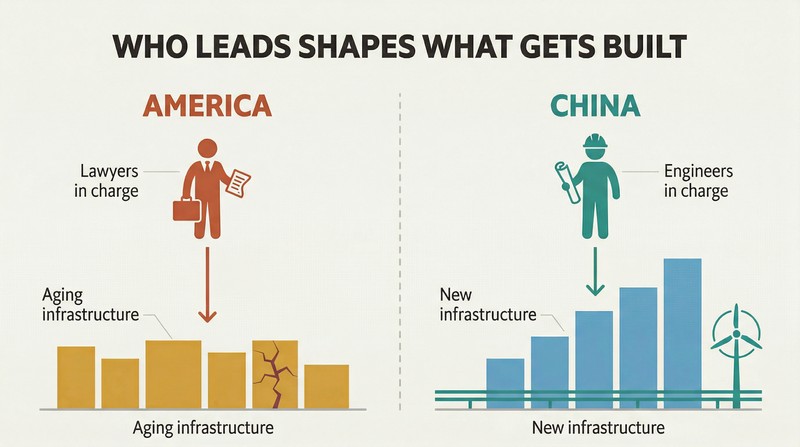
Wang's thesis splits the superpowers by who runs them. By 2002, all nine members of China's Politburo standing committee had trained as engineers — in hydraulic, thermal, and electron-tube engineering. Xi Jinping studied chemical engineering at Tsinghua. In contrast, five of the last ten US presidents attended law school, and at least half of Congress holds law degrees. America has 400 lawyers per 100,000 people — triple the European average.
The consequences are physical. Since 1980, China built highways equaling twice the US system's length, a high-speed rail network twenty times Japan's, and nearly as much solar and wind capacity as the rest of the world combined. New York's express train to New Haven takes the same two hours it did in 1915.
China's fourth-poorest province has triple New York's highway miles
“Call it propaganda of the deed, but one way to impress a billion-plus people is to pour a lot of concrete.”
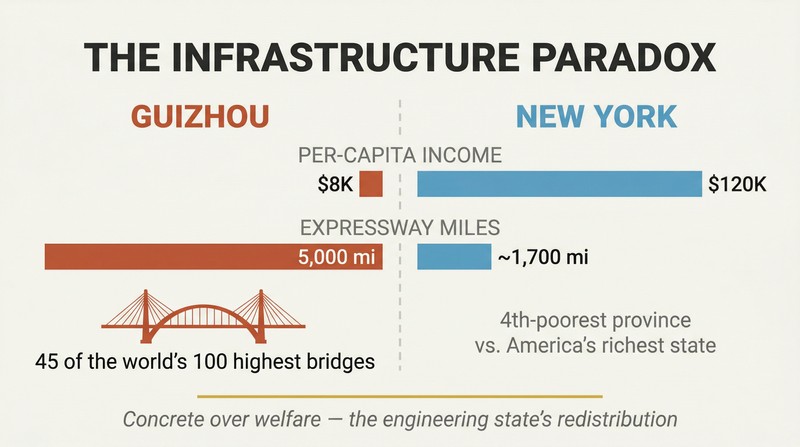
Guizhou's transformation defies belief. This mountainous province has per-capita income of $8,000 — comparable to Botswana, one-fifteenth of New York State's. Yet it has 45 of the world's 100 highest bridges, 11 airports, 5,000 miles of expressways, and functional high-speed rail. Wang cycled nearly 400 miles through Guizhou and found infrastructure that America's richest states can't match.
Building is how the engineering state redistributes. Rather than welfare transfers (China spends just 10% of GDP on social programs versus 20% in the US), it pours concrete. Locals point to bridges with genuine pride. The debt underneath is enormous — Guizhou is among China's most indebted provinces — but the roads and rail create real convenience for rural people who remember having none of it.
Technology lives in workers' hands, not in patents or blueprints
“Silicon Valley used to be like this too, but now it lacks a critical link in the chain — the manufacturing workforce.”
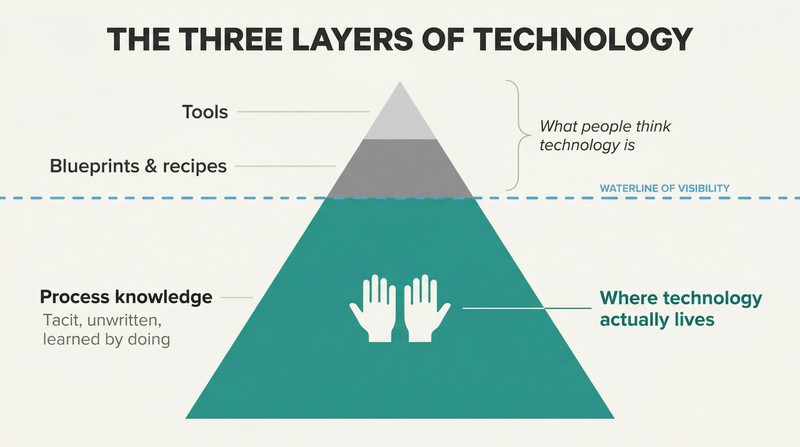
Wang redefines technology into three layers: tools (pots, ovens), explicit instruction (recipes, blueprints), and process knowledge — the proficiency gained from practical experience that can't be written down. The third matters most. Japan's Ise Jingu shrine has been completely rebuilt every twenty years since 690 AD to preserve construction craft across generations. The US, by contrast, spent $69 million relearning how to produce "Fogbank," a classified nuclear material, after everyone who knew the process retired.
Process knowledge explains manufacturing decline. When the US opened factories in China, it didn't just ship jobs — it transferred irreplaceable tacit knowledge. Chinese workers who assembled iPhones one year started drone companies the next. The knowledge migrated permanently, and American communities of engineering practice dissolved into the Rust Belt.
Shenzhen's factory floors, not labs, made China a tech superpower
“Every US factory closure represents a likely permanent loss of production skill and knowledge.”
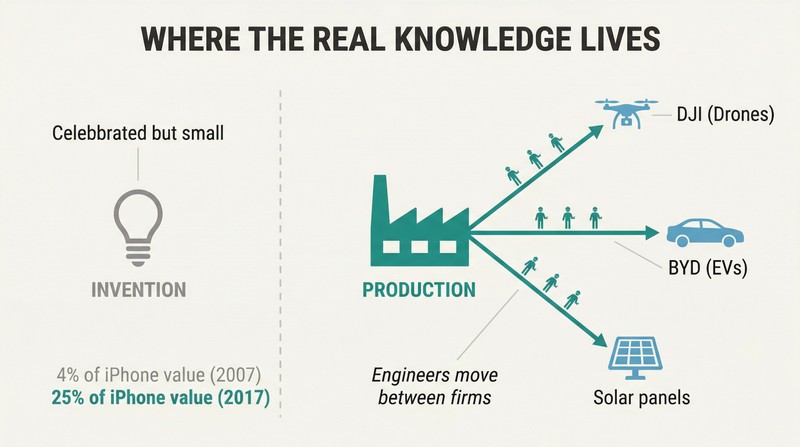
Shenzhen is a community of engineering practice. The city grew from 300,000 people in 1980 to 18 million by 2020. Apple's supply chain trained hundreds of thousands of workers annually in advanced electronics. Those skills didn't stay inside Foxconn — engineers moved between firms, starting drone-maker DJI and electric vehicle giant BYD, all leveraging the component ecosystem smartphones created.
China's tech edge is learning by doing. Chinese firms contributed just 4% of the iPhone's value in 2007; by 2017, they supplied 25%. Bell Labs invented the solar cell, but Chinese firms mastered production and now dominate the entire solar value chain. The US celebrates the moment of invention; China captures the far larger prize of mass production — and the process knowledge that comes with it.
A missile scientist's flawed math drove 321 million forced abortions
“No other country would have let a missile scientist anywhere near the design of demographic policy.”
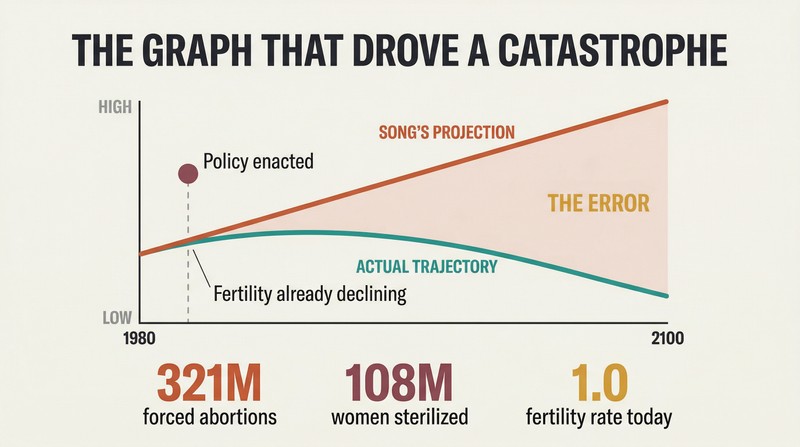
Song Jian was China's most consequential scientist. A rocket engineer trained in Soviet cybernetics, he used straight-line population projections to convince Deng Xiaoping that China must limit families to one child. His models were fundamentally flawed — he assumed population grows at an unvarying rate, ignoring that fertility was already declining. But military scientists outclassed their opponents: Song presented computer-generated graphs while skeptics drew squiggles by hand on an abacus.
The enforcement was savage. Over 35 years: 321 million abortions, 108 million women sterilized. Enforcement teams browbeat women through up to 100 visits, confiscated livestock, demolished homes. An estimated 40 million women are "missing" from sex-selective practices. China's fertility rate is now 1.0 — far below replacement — and its population is projected to halve to 700 million by 2100.
The engineering state starts impressively and ends in catastrophe
“The engineering state is characterized by peculiarly jerky rhythms, in which the decade of birth might determine whether a person stumbles into great wealth or a mass grave.”
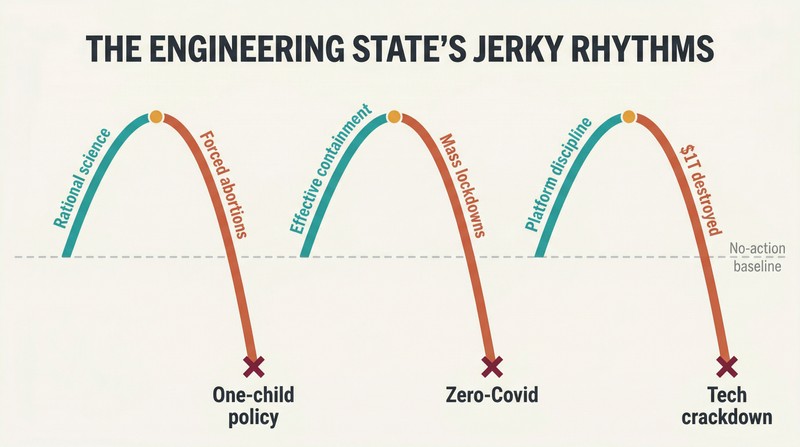
The pattern repeats across decades. The one-child policy began as rational population science and ended in forced late-term abortions. Zero-Covid started as effective containment — the US was envious in 2020 — and ended by locking 25 million Shanghainese indoors for eight weeks while people ran out of food. Xi's tech crackdown aimed to discipline unruly platforms but wiped $1 trillion in market value and killed the startup ecosystem.
Wang assigns Xi a "60 percent correct" score. Xi typically drives toward an admirable long-term goal — reining in tech monopolies, controlling a pandemic, managing developer debt — but applies such brute force that the outcome is worse than the original problem. Someone born in 1949 might stumble into famine or fortune depending entirely on a decade's political winds.
Zero-Covid proved a state can cage 25 million people with an app
“…China is the only country that denied its people fever medications during a fever-producing pandemic.”
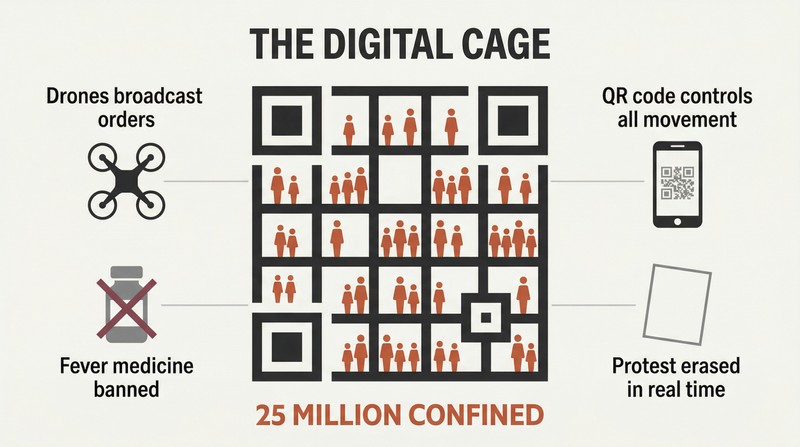
Shanghai's surprise lockdown was unprecedented. In March 2022, officials denied any plans to lock down. Days later, 25 million people were confined to their homes for eight weeks. Government food deliveries petered out within days. Parents forfeited meals for children. Trucking activity fell to 15% of normal. Contact-tracing QR codes controlled all movement, and daily PCR tests — ironically — likely spread the virus between neighbors in elevator lines.
Digital surveillance enabled enforcement at scale. Drones blasted orders at apartment windows. Children were separated from parents even when both tested positive. Pharmacies had pulled fever medications from shelves for years, fearing people might hide symptoms. When protests finally erupted — young people holding blank sheets of paper on Shanghai's Urumqi Road — censors deleted posts so fast that people put protest videos on the blockchain.
China's richest are fleeing not poverty but the engineering state
“The control neurosis of the engineers is the fundamental limit to China's power.”
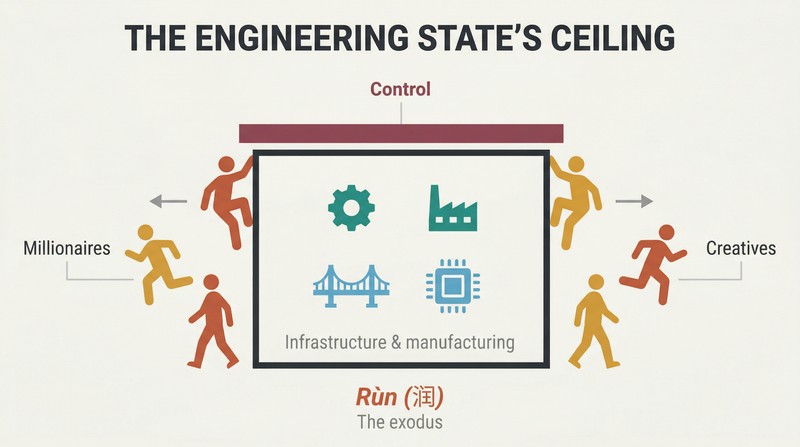
Rùn — Chinese slang for emigrating — became ubiquitous after lockdowns. An estimated 15,000 Chinese millionaires emigrated in 2024. Young creatives fled to Thailand's Chiang Mai; the wealthy bought homes in Irvine, California. Even desperate migrants trek through the Darién Gap — US border officials apprehended 38,000 Chinese nationals in 2024. Shanghai's long-term foreign population dropped 25% between 2010 and 2020, then fell further after Covid.
This exodus reveals the engineering state's ceiling. China can build stunning infrastructure and dominate manufacturing, but it cannot produce cultural products the world finds appealing, tolerate free expression that attracts creative talent, or resist the overreach that terrifies its own elites. Wang envisions China becoming "a more successful East Germany" — strong in science and tech, but fundamentally limited by its fear of its own people.
America's permitting delays are a form of climate sabotage
“There is no way to achieve large-scale decarbonization without large-scale construction…”
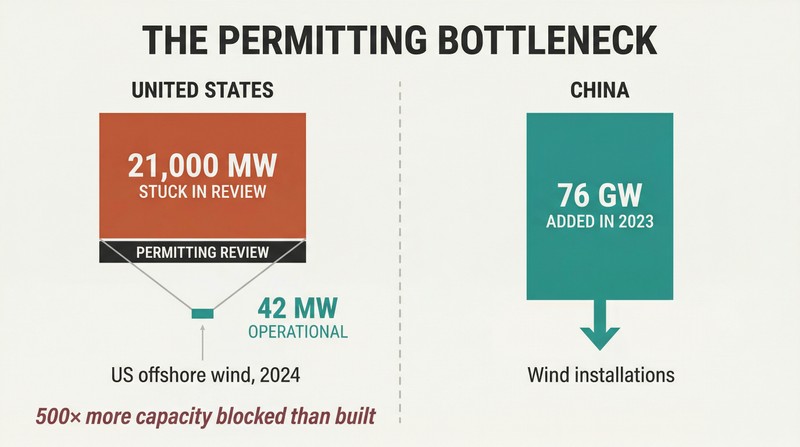
The speed gap is staggering. In 2023, China added 76 gigawatts of new wind installations; the US added 6. China built two-thirds of the world's wind and solar plants — four times more than the entire G-7. America's first offshore wind project, Cape Wind, was killed by 16 years of lawsuits from wealthy Massachusetts residents, including the Kennedy family, who enlisted a Harvard constitutional law professor.
Permitting is the bottleneck, not money. In 2024, the US had 42 megawatts of operational offshore wind and nearly 21,000 megawatts stuck in permitting review. Biden's $42 billion broadband plan connected zero homes in four years. The lawyerly society gives wealthy NIMBYs unlimited tools to block clean energy; the engineering state tolerates no such delays. If climate change is truly an emergency, the rest of the world needs to build at China's speed.
In a war with China, algorithms can't substitute for ships and shells
“No military can be powered by artificial intelligence alone; it will need drones and munitions.”
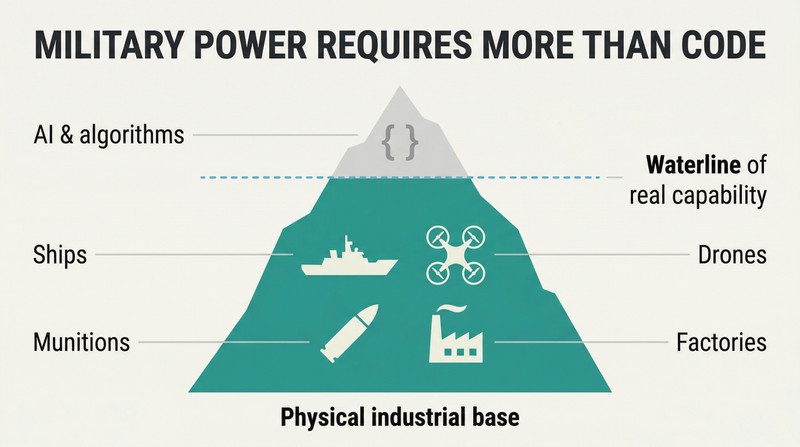
The industrial gap is stark. In 2022, China had nearly 1,800 ships under construction versus America's 5. Ukraine fires in two days what US factories produce in a month. The UN forecasts China will hold 45% of global industrial capacity by 2030 — more than all high-income countries combined. Consumer products are increasingly dual-use: DJI drones serve on Ukrainian battlefields, and smartphones contain sensors that were military-grade a decade ago.
Software supremacy isn't enough. China's manufacturing base of 100 million workers — eight times America's — gives it surge capacity the US cannot match. Wang argues that even if America achieves artificial general intelligence, it will still need to physically manufacture drones, munitions, and ships. The engineering state's relentless building has produced not just economic might but a strategic military advantage that AI alone cannot counter.
Analysis
Wang's central framework — engineering state vs. lawyerly society — is both the book's greatest asset and most vulnerable joint. As a diagnostic lens, it illuminates genuine structural differences: who staffs political elites, what gets built, whose rights matter. But it risks becoming Procrustean. Germany, Japan, and South Korea retained manufacturing prowess within democratic frameworks, suggesting the binary understates available options. Wang acknowledges this but doesn't fully grapple with the implication — that the US might fix its building deficit by adopting French permitting norms rather than importing Chinese authoritarianism.
What distinguishes Breakneck in the crowded China-analysis genre is Wang's refusal to choose a lane. Most Western commentators either catastrophize about China's threat or dismiss it as a hollow giant. Wang, having lived through both Shenzhen's dynamism and Shanghai's lockdown, offers something rarer: calibrated ambivalence. His '60 percent correct' framing of Xi is a genuine analytical contribution — it explains how the same system produces world-class solar panels and a demographic death spiral.
The book's most intellectually provocative argument redefines technology as process knowledge rather than invention. This challenges the American innovation mythology at its root. If technology is primarily embodied in communities of practice rather than patents, then the US has been systematically dismantling its technological base since the 1980s while celebrating metrics — Nobel Prizes, R&D spending — that measure only one dimension of capability. Wang essentially argues America has confused the menu for the meal.
The weakest thread is the prescription. 'Build more' is necessary but underpowered as policy guidance. The procedural morass Wang diagnoses has deep institutional roots in common law, constitutional structure, and federalism that a framework alone cannot dislodge. Still, as a lens for the defining geopolitical competition of the century, the engineer-lawyer dichotomy is sharper than tired labels like 'autocracy vs. democracy' — forcing Americans to ask what good it is to protect rights if the government cannot deliver a train.
Review Summary
Breakneck receives mostly positive reviews for its insightful analysis of China's development and comparison with the US. Readers appreciate Wang's unique perspective, balancing praise and criticism of both countries. The book's central thesis, contrasting China's "engineering state" with America's "lawyerly society," sparks interest and debate. Some reviewers find the argument oversimplified but still valuable. Many highlight the book's engaging writing style and personal anecdotes. Critics note potential inaccuracies and a lack of depth in certain areas. Overall, it's considered an important read for understanding modern China and US-China relations.
People Also Read


 Immersive

Glossary
Engineering state
China's build-first governance modelWang's term for China's governance system, defined by its leadership class of trained engineers, its compulsion to build physical infrastructure and manufacturing capacity, and its treatment of citizens as aggregates to be managed rather than individuals with rights. The engineering state maximizes state discretion and minimizes individual agency.
Lawyerly society
America's process-obsessed governance modelWang's term for the US governance system, defined by the dominance of lawyers in political leadership, an elevation of procedure over outcomes, systematic bias toward the wealthy, and an inability to build public works on reasonable timelines. Emerged as a corrective to 1960s-era abuses but has become the cause of many present problems.
Process knowledge
Expertise gained through hands-on practiceThe proficiency gained from practical experience that cannot be easily written down or communicated through blueprints and patents. Wang argues it is the most important dimension of technology. It exists in workers' heads, in their relationships with other technical workers, and in the pattern of daily problem-solving on factory floors. Once lost—through factory closures or workforce dispersal—it is extremely difficult to recover.
Communities of engineering practice
Buzzing ecosystems of tech productionWang's term for dense regional ecosystems like Shenzhen where factory owners, skilled engineers, entrepreneurs, investors, and experienced manufacturing workers mix and cross-pollinate. Their value exceeds any single company or engineer. Knowledge travels between firms as workers move, components improve, and new products emerge from the recombination of existing capabilities. Silicon Valley was once such a community but lost its manufacturing link.
Procedure fetish
Substituting process for actual outcomesTerm from University of Michigan law professor Nicholas Bagley's seminal paper describing how US federal agencies must 'conduct every conceivable study, ventilate every option, engage every identifiable stakeholder, and weather the most stringent judicial review' before any action takes effect. Wang uses it to explain why American infrastructure costs five times more and takes decades longer than comparable projects in other countries.
Industrial Party
Chinese online techno-nationalist movementA loosely affiliated group of Chinese bloggers and intellectuals who argue that nation-states ruthlessly compete, that science and technology are the decisive forces in this competition, and that the state must be organized around their pursuit. They patriotically view the Communist Party as the world's most capable organization for this mission. They set themselves against the 'Sentimental Party'—liberals, democracy advocates, and romanticists.
Rùn
Chinese slang for emigrating abroadA Chinese word meaning 'to moisten' that has been appropriated for its English phonetic meaning ('run') to express the desire to flee China. It emerged during the pandemic when lockdowns were tightest and has come to encompass both leaving big cities for freer provinces and emigrating from China altogether. Reflects broad disillusionment among creative, wealthy, and young Chinese with the direction of Xi's rule.
Catfish effect
Competition from outsider stimulates improvementTerm used by China's business community for what Tesla accomplished by entering the Chinese electric vehicle market. Beijing allowed Tesla to fully own its Shanghai plant—an unprecedented concession—betting that introducing a powerful competitor would force domestic firms to improve. BYD's sales initially dropped 11% and profits fell 42%, but the company subsequently became the world's largest EV maker. Even Communist Party media praised the effect.
Completionism
Xi's refusal to cede any industryWang's term (via Gavekal analyst Andrew Batson) for Xi Jinping's industrial stance that China should produce something in every one of the 419 UN industrial product categories and that 'not even low-end industries should move out of China.' Unlike previous leaders who talked about upgrading to higher-value industries, Xi refuses to let any manufacturing sector leave—defying the economic logic that production should shift to lower-cost countries.
FAQ
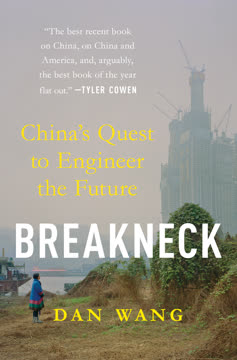
What’s Breakneck: China’s Quest to Engineer the Future by Dan Wang about?
- China’s transformation focus: The book examines China’s rapid modernization and rise as a global power, emphasizing its engineering-driven approach to governance and development.
- Engineering state vs. lawyerly society: Wang contrasts China’s “engineering state” with the United States’ “lawyerly society,” exploring how these models shape infrastructure, innovation, and social policy.
- Personal and analytical blend: Drawing on his experiences in China, the U.S., and Canada, Wang combines memoir, policy analysis, and cultural observation to provide a nuanced portrait of China’s ambitions and challenges.
- Key topics covered: The narrative addresses major policies like the one-child policy, zero-Covid strategy, tech regulation, and the country’s manufacturing boom.
Why should I read Breakneck: China’s Quest to Engineer the Future by Dan Wang?
- Unique insider perspective: Wang’s firsthand experiences living in China during pivotal moments, such as the Shanghai lockdown, offer rare insights into daily life under state policies.
- Fresh analytical framework: The book introduces the “engineering state” vs. “lawyerly society” lens, moving beyond traditional capitalist/socialist labels to explain global competition.
- Balanced critique and optimism: Wang acknowledges both China’s material achievements and its authoritarian excesses, encouraging mutual learning between China and the U.S.
- Accessible and comprehensive: The book makes complex topics like digital surveillance, manufacturing, and demographic policy understandable for a broad audience.
What are the key takeaways from Breakneck: China’s Quest to Engineer the Future by Dan Wang?
- Governance shapes outcomes: The engineering state enables rapid building and control, while the lawyerly society values process and rights, each with distinct strengths and weaknesses.
- Material progress vs. individual rights: China’s focus on infrastructure and manufacturing has driven growth but often at the expense of personal freedoms and social well-being.
- Policy consequences: Top-down policies like the one-child and zero-Covid strategies have profound, sometimes unintended, social and demographic impacts.
- Need for balance: Wang suggests that combining pluralism with effective engineering is crucial for future national success.
How does Dan Wang define the “engineering state” in Breakneck: China’s Quest to Engineer the Future?
- Technocratic governance: The engineering state prioritizes large-scale physical projects, centralized planning, and technical problem-solving over political debate.
- Measurable outcomes focus: It values tangible results—like infrastructure, manufacturing capacity, and pandemic control—often using digital surveillance and mass mobilization.
- Literal-minded enforcement: Policies are pursued with rigid, sometimes harsh, measures, with less regard for social costs or individual rights.
- Self-limiting features: While effective at building and control, the engineering state struggles with pluralism, creativity, and legal protections.
How does Dan Wang contrast China’s “engineering state” with the U.S. “lawyerly society” in Breakneck: China’s Quest to Engineer the Future?
- Engineering state traits: China’s leadership, dominated by engineers, excels at rapid construction, manufacturing, and centralized control, often suppressing dissent for efficiency.
- Lawyerly society traits: The U.S. is characterized by legalism, pluralism, and procedural safeguards, which protect rights but can impede large-scale projects.
- Strengths and weaknesses: China’s model enables physical dynamism but risks overreach and repression; the U.S. model fosters debate and rights but can lead to stagnation.
- Call for balance: Wang advocates for integrating engineering dynamism with pluralistic values to achieve effective governance.
What is the significance of Shenzhen in China’s technological rise according to Breakneck: China’s Quest to Engineer the Future by Dan Wang?
- Manufacturing powerhouse: Shenzhen evolved from a fishing village into a global center for electronics manufacturing, hosting giants like Foxconn.
- Ecosystem of innovation: The city’s dense network of suppliers, engineers, and workers enables rapid prototyping, problem-solving, and scaling of new products.
- Process knowledge hub: Shenzhen exemplifies how technological advancement relies on communities of practice and hands-on expertise, not just invention.
- Symbol of ambition: The city’s transformation reflects China’s broader strategy of learning by doing and building technological capabilities through manufacturing.
How does Breakneck: China’s Quest to Engineer the Future by Dan Wang explain the one-child policy and its consequences?
- Technocratic origins: The policy was designed by engineers and scientists using demographic modeling, aiming to prevent resource shortages through strict population control.
- Coercive enforcement: Implementation involved forced abortions, sterilizations, and heavy fines, causing widespread trauma and human rights abuses.
- Demographic challenges: The policy led to an aging population, gender imbalances, and a shrinking workforce, complicating China’s future stability.
- Enduring legacy: Despite policy reversals, low fertility rates persist, and the state now struggles to encourage births amid societal exhaustion.
What insights does Breakneck: China’s Quest to Engineer the Future by Dan Wang provide about China’s zero-Covid policy?
- Strict pandemic control: The zero-Covid strategy used mass testing, lockdowns, and digital surveillance to pursue zero infections, enforced with military-like discipline.
- Personal account: Wang describes living through the Shanghai lockdown, highlighting food shortages, medical neglect, and the role of mutual aid networks.
- Social and economic costs: The policy caused frustration, protests, and hardship, with its abrupt end leading to a massive, unprepared Covid wave.
- Model limitations: The experience exposed the engineering state’s strengths in mobilization but also its rigidity and lack of flexibility.
How does Breakneck: China’s Quest to Engineer the Future by Dan Wang describe China’s manufacturing and infrastructure capabilities?
- Global manufacturing leader: China dominates sectors like electric vehicles, solar panels, batteries, and robotics, supported by vast supply chains and skilled labor.
- Infrastructure achievements: The country has built extensive high-speed rail, highways, and ports at unmatched speed and scale, fueling economic growth.
- Resilience over efficiency: China invests in redundancies and shock buffers, prioritizing self-sufficiency in energy and food security.
- Geopolitical influence: Infrastructure expertise is exported through initiatives like Belt and Road, extending China’s global reach.
What does Breakneck: China’s Quest to Engineer the Future by Dan Wang reveal about the social and cultural impact of China’s governance model?
- Pervasive social control: Digital surveillance, contact tracing, and mass mobilization create a strong state presence, limiting privacy and freedoms.
- Cultural suppression: Political paranoia and censorship stifle creativity, humor, and dissent, with artists and comedians facing penalties for nonconformity.
- Public adaptation: Many Chinese accept or adapt to state control due to improved living standards, but exhaustion and protest are rising, especially among youth.
- Strained social fabric: The tension between material progress and individual rights is a recurring theme in Wang’s analysis.
What insights does Breakneck: China’s Quest to Engineer the Future by Dan Wang provide about China’s tech industry and regulatory crackdown?
- Rapid tech growth: China’s tech sector produced global giants like ByteDance, with a vibrant startup ecosystem.
- Regulatory storm: Under Xi Jinping, the government imposed strict regulations for antitrust, data security, and ideological conformity, curbing tech company power.
- Economic and cultural impact: The crackdown wiped out trillions in market value, dampened entrepreneurial spirit, and redirected focus to advanced manufacturing.
- Political discipline: The Communist Party’s actions reflect the engineering state’s preference for control and tangible production over digital platforms.
What lessons does Dan Wang offer for the United States in Breakneck: China’s Quest to Engineer the Future?
- Rebuild physical dynamism: The U.S. must invest in infrastructure, manufacturing, and housing to regain global competitiveness and economic vitality.
- Balance pluralism and engineering: Elevating engineers and builders alongside lawyers can help the U.S. overcome procedural gridlock and enable effective governance.
- Learn from China’s experience: By studying both the successes and failures of China’s engineering state, America can chart a path that combines innovation, pluralism, and robust infrastructure.
- Renew optimism: Wang calls for a renewed American commitment to ambitious public works and trust in institutions, moving from stagnation to transformation.
What are the best quotes from Breakneck: China’s Quest to Engineer the Future by Dan Wang and what do they mean?
- On the engineering state: “China is an engineering state, not a lawyerly society.” This encapsulates Wang’s central thesis about the country’s governance model and its implications.
- On social engineering: “The one-child policy was the world’s largest social experiment, and its consequences are still unfolding.” This highlights the far-reaching impact of technocratic policies.
- On U.S.-China comparison: “America’s problem is not that it builds too much, but that it builds too little.” Wang urges the U.S. to reclaim its tradition of ambitious development.
- On optimism and learning: “We should be curious about each other, and learn from each other’s strengths.” Wang advocates for mutual understanding and adaptation between superpowers.
Download PDF
Download EPUB
.epub digital book format is ideal for reading ebooks on phones, tablets, and e-readers.








































