

Key Takeaways
Raging hormones don't hijack teens; a remodeling brain does
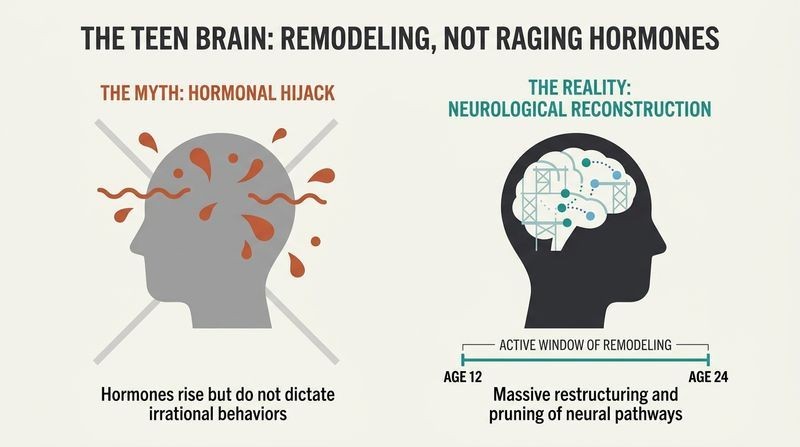
Blame the brain, not hormones. Siegel dismantles the popular myth that surging hormones turn teenagers into irrational creatures who just need to "grow up." The real story is neurological: between roughly ages 12 and 24, the brain undergoes a massive renovation. Hormones rise, yes, but they don't dictate teen behavior.
Adolescence spans 12 to 24. This is a longer window than most assume, stretching well into the mid-twenties, which is partly why car rental companies balk at drivers under 25. Siegel reframes this period not as a disorder to endure but as a purposeful developmental stage. The testing of limits and hunger for the unknown lay the groundwork for courage, adventure, and purpose that can define a whole life.
What's striking is how this reframe shifts the moral weight. If teens are "crazy," adults get to dismiss them; if teens are remodeling, adults are obligated to help. Neuroscience broadly supports Siegel here: myelination and synaptic pruning peak in adolescence. Yet the hormone-versus-brain framing is somewhat artificial, since testosterone and estrogen directly modulate the very dopamine circuits he emphasizes. The cleaner insight is that biology is not destiny and not chaos. It is construction. That construction metaphor, borrowed from developmental neuroscience, gives parents a productive stance: you don't condemn a building mid-renovation, you route around the temporary mess.
Keep adolescence's four gifts alive or your adult life goes stale
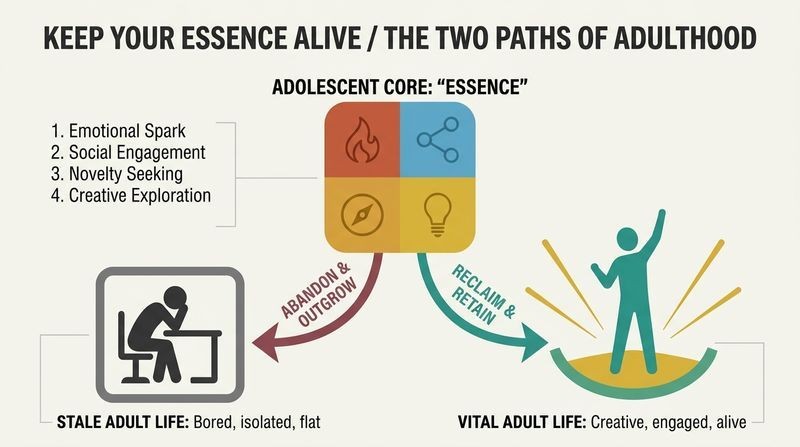
The ESSENCE framework. Siegel argues the same qualities that make teens challenging are precisely what adults need to stay vital. He packages them in the acronym ESSENCE:
1. Emotional Spark (intense feelings that create meaning)
2. Social Engagement (bonds that predict longevity and happiness)
3. Novelty seeking (the drive for fresh, engaging experience)
4. Creative Explorations (abstract, out-of-the-box thinking)
Adults quietly abandon these. Many adults he treats describe lives that feel like ruts: bored, isolated, emotionally flat, imaginatively dead. He suspects some parental irritation at teens is actually envy for the emotional fire, new friendships, and sense of adventure adults have let wither. The prescription: reclaim these four features rather than outgrow them.
This is the book's boldest reframe, converting a parenting problem into a longevity strategy. It aligns with research linking novelty and social connection to healthier aging and even to slower cognitive decline. The claim that strong relationships predict well-being echoes the Harvard Study of Adult Development, which found relationship quality the strongest predictor of late-life happiness. One caution: romanticizing adolescent traits risks glossing over why adults suppress them. Mortgages, caregiving, and institutional demands aren't just cowardice. The honest synthesis is that adults need structured outlets for spark and novelty, not a wholesale return to teenage impulsivity.
Teens know the risks; their brains just overweigh the upside
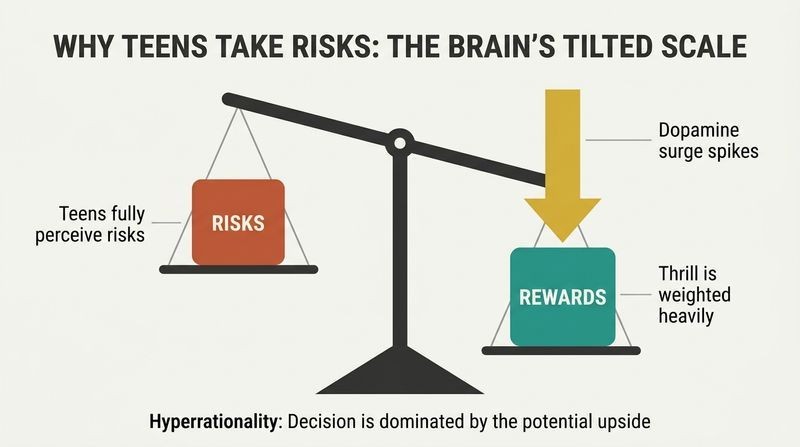
Hyperrationality, not ignorance. Siegel introduces hyperrationality: literal, concrete thinking that fixates on a decision's potential rewards while discounting its risks. Teens usually know the dangers and sometimes even overestimate them. They simply place more weight on the thrill. His patient Katey planned to smuggle tequila into the school director's own house, fully aware of the zero-tolerance policy, because the excitement outweighed the near-certain consequence.
Blame dopamine's amplifier. During adolescence, baseline dopamine drops but its release in response to experience spikes, producing boredom at rest and euphoria in action. This tilts the internal scale toward PROS over cons. The antidote is gist thinking: intuitive, big-picture judgment that develops as the brain integrates and lets gut feelings flag values like staying alive.
This distinction matters enormously for intervention design. If teens were merely ignorant, information campaigns would work. They famously don't. Siegel's account explains why the anti-smoking campaign that succeeded reframed the enemy as manipulative tobacco executives rather than lung damage: it engaged values, not fear. Behavioral economists would recognize this as a problem of decision weighting, close to prospect theory's insight that people distort probabilities. The Russian roulette example is clarifying: expected-value math can endorse catastrophic bets. Gist thinking is essentially the wisdom to reject a favorable average when one outcome is irreversible death.
Don't say "don't"; hand teens a positive value to chase
Inhibition backfires. Telling an adolescent to suppress an impulse rarely works, because the reward drive is stronger than ever. Siegel's rule is to promote a positive aim instead. The landmark example: efforts to scare teens away from cigarettes with graveyard imagery and medical facts flopped. What worked was exposing how tobacco executives were manipulating them for profit. Reframed around the value of not being someone's puppet, teen smoking rates dropped.
Channel the drive, don't dam it. When his son craved speed, Siegel didn't forbid it; he raced longboards down parking garages with helmets and gloves. When a school banned a band for stacking amplifiers, punishment escalated the rebellion until administrators returned the privilege conditionally, and the conduct problems vanished for five years.
This maps onto self-determination theory, which finds that autonomy-supportive messaging outperforms controlling messaging for durable behavior change. The pink-elephant problem, that prohibition primes the forbidden thought, is well documented in ironic-process research. Siegel's practical genius is recognizing that a waterfall cannot be stopped, only directed. There is a limit worth naming: some behaviors, like drunk driving, genuinely require hard boundaries, not just value substitution. The strongest version pairs both, offering a compelling positive identity while maintaining non-negotiable safety rails. Honoring intention, as he stresses, does not mean abandoning limits.
Build mindsight: the skill of seeing your own and others' minds
A trainable inner lens. Mindsight is Siegel's term, coined in medical school, for the ability to perceive the mind itself. It has three parts: insight (sensing your own mental life), empathy (sensing another's), and integration (linking differentiated parts into a harmonious whole). Ordinary physical sight sees surfaces; mindsight adds a third dimension, letting you see the sea inside.
Attention rewires the brain. Because of neuroplasticity, how you focus attention grows neural connections. When you name feelings rather than being flooded by them, you gain freedom: sadness becomes something you have, not all of who you are. A simple starting practice is SIFTing the mind, checking your Sensations, Images, Feelings, and Thoughts in any moment.
Mindsight essentially operationalizes metacognition and integrates it with attachment theory and affective neuroscience. The "name it to tame it" claim has empirical backing: affect labeling has been shown in fMRI studies to dampen amygdala activity while engaging prefrontal regions. Siegel's contribution is packaging these findings into teachable moves. A fair critique is that terms like "the sea inside" and abundant acronyms can feel like branding, and the causal chain from a brief practice to structural brain change is often stated more confidently than the evidence strictly warrants. Still, the core, that reflection is a trainable muscle, is sound and empowering.
Health lives between chaos and rigidity, on the river of integration
Integration is the master principle. For Siegel, well-being comes from integration: honoring the differences between parts of a system, then linking them. This applies inside one brain, between hemispheres, and between people. When integration fails, a system drifts to one of two banks: chaos (out of control, overwhelming) or rigidity (stuck, unchanging, boring).
Picture a flowing river. The healthy center channel is flexible, adaptive, coherent, energized, and stable, which he abbreviates FACES. Adolescent brain development is fundamentally a rise in neural integration, driven by pruning unused connections and myelinating the ones that remain, making them faster and more coordinated. "Flipping your lid," the sudden emotional eruption, is a momentary loss of prefrontal integration when the lower brain acts without oversight.
The chaos-rigidity spectrum is an elegant clinical heuristic that resonates with dynamical-systems models of the mind and with theories of complexity, where healthy systems balance order and flexibility. It also parallels findings that both excessive and insufficient neural connectivity mark psychiatric disorders. The hand model of the brain, fingers as cortex folding over the thumb as limbic system, is a genuinely useful teaching device that has spread widely among therapists and educators. The concept's breadth is both strength and weakness: integration explains so much that it risks becoming unfalsifiable. Its value is practical rather than predictive, giving people a shared vocabulary for naming dysregulation.
Your four attachment patterns are learned adaptations, not life sentences
Four models, all changeable. Drawing on attachment research, Siegel describes how early bonds shape internal models. Secure attachment (about half to two-thirds of people) comes from being reliably seen, safe, and soothed. Insecure forms are adaptations: avoidant (needs minimized after not being seen), ambivalent (needs amplified after inconsistent care), and disorganized (fragmentation after a caregiver was terrifying).
The four S's build security. Children need to feel Seen, Safe, and Soothed to feel Secure. Crucially, these models aren't destiny. Gail, terrified by an alcoholic father, earned security through therapy and reflection, then became a secure base for her son. Research shows that making coherent sense of your childhood, not having had a happy one, best predicts your child's security.
The "earned secure attachment" finding is one of developmental psychology's most hopeful results, and Siegel deploys it well: the strongest predictor of a child's security is the parent's narrative coherence about their own past. This flips genetic fatalism, placing agency in reflection. The framework draws directly on Mary Main's Adult Attachment Interview research. One nuance worth flagging: attachment categories are population tendencies, not fixed types, and their cross-cultural validity is debated. Siegel handles this responsibly by stressing that a person can hold multiple models activated by different relationships, which is more accurate than the pop-psychology habit of assigning someone a single attachment "type."
Avoidant leans left-brain, ambivalent leans right; rebalance to heal
Hemispheres tell the story. Siegel proposes that insecure attachment reflects imbalanced brain hemispheres. The avoidant person over-relies on the left (logical, linear, language-based, list-making) and underdevelops the right, which stores autobiographical memory, bodily sensation, and raw emotion. Their attachment interviews show little memory of childhood and insistence that relationships didn't matter.
Ambivalence floods from the right. Here the right hemisphere overwhelms the left, producing a flood of feelings and memories that intrude without logical ordering. The remedy is targeted rebalancing. Avoidant people practice sensing bodily states, reading non-verbal cues, and recalling autobiography. Ambivalent people build the left's narrating power by naming emotions and journaling, remembering that "feelings are not facts," since felt rejection activates the same circuits as physical pain.
The tidy left-equals-logic, right-equals-emotion mapping is where neuroscientists most often push back on Siegel. Decades of lesion and imaging work show emotion and language are distributed across both hemispheres, and the popular hemisphere dichotomy is largely a myth. That said, there is real evidence for right-hemisphere dominance in autobiographical memory, non-verbal processing, and interoception, so his clinical prescriptions may work even if the neuroanatomical story is oversimplified. The practical exercises, watching foreign films to read non-verbal cues, journaling to build narrative, stand on their own therapeutic merit regardless of which hemisphere gets credit.
Ruptures are inevitable; the repair is what builds trust
Play your PART. Siegel names the relational role each of us plays: Present, Attune, Resonate, and create Trust. Being present means being open to what is, rather than rushing to fix. Resonance requires letting another person's inner state change yours, which activates the social engagement system that calms distress.
Repair beats perfection. No relationship avoids ruptures. When Siegel snapped at his college-graduate son that the house wasn't his home, he felt terrible and returned the next day to apologize and reconnect. He treats such repairs as the core discipline of parenting adolescents: keep communication lines open, use "I" statements rather than "you made me," and treat conflict as an opening to rebuild integration rather than a failure to hide.
The rupture-and-repair principle is one of the most robust findings in relationship science, central to Ed Tronick's still-face experiments and to Gottman's marriage research, which found that thriving couples repair conflict rather than avoid it. Siegel's honesty about his own low-road parenting moment models the vulnerability he prescribes, which is rhetorically effective and rare in parenting books. The deeper point is developmental: children who experience rupture followed by reliable repair internalize that relationships can survive conflict, a resilience asset. The risk in popularizing this is that "repair" becomes a license for chronic rupture. The frequency and severity of ruptures still matter.
Adolescent dopamine makes this the brain's window of addiction risk
A brain primed to hook. Because the adolescent dopamine system already runs low at baseline and spikes high with stimulation, drugs that flood dopamine, alcohol, cocaine, amphetamines, land on an especially receptive circuit. The earlier the exposure, the higher the addiction risk. Siegel identifies four drivers of use: experimentation, social connection, self-medication, and addiction itself.
Addiction captures intention. Once addicted, dopamine surges fire not only when using but when planning, anticipating, or being near cues, which is why addiction consumes a life rather than being a simple choice. His patient Katey progressed from planned binge drinking to blackouts and drinking alone. He contrasts the addictive dopamine spike-and-crash with the gradual dopamine rise of genuine accomplishment and flow, which yields lasting satisfaction rather than craving.
The neurobiology here reflects mainstream addiction science, including Robert Sapolsky's observation that dopamine tracks anticipation more than reward itself, which explains why cues and planning trigger craving. Siegel's public-health point is underappreciated: adolescent-onset use is far more predictive of lifelong addiction than adult-onset, a finding with major policy implications for legal drinking and cannabis ages. His contrast between the surge-crash of substances and the slow climb of earned accomplishment offers a constructive redirection consistent with flow research. A missing nuance is that genetic and trauma histories heavily modulate individual vulnerability, so the same exposure does not carry equal risk for every teen.
Feed your brain seven daily nutrients, from focus time to play
The Healthy Mind Platter. Siegel and David Rock designed a mental analog to a food plate: seven daily activities that SNAG the brain (Stimulate Neuronal Activation and Growth), pushing it toward integration.
1. Focus Time (single-tasking that drives learning)
2. Play Time (spontaneous, non-judgmental fun)
3. Connecting Time (face-to-face bonds and nature)
4. Physical Time (aerobic movement grows the brain)
5. Time-In (reflecting inward)
6. Down Time (unstructured recharge)
7. Sleep Time (teens need 8.5 to 9.25 hours)
Balance beats intensity. Chronic multitasking, especially digital, disrupts the neuroplastic conditions needed for durable learning, so studying while texting sabotages memory. The point isn't maxing any one activity but varying them, the way a balanced diet beats overeating a single nutrient.
The platter's strength is memorability and its insistence that mental health is a portfolio, not a single hero habit. Each element has independent empirical support: sleep for memory consolidation, aerobic exercise for BDNF and neurogenesis, single-tasking for encoding. The framing anticipated later popular concern about attention fragmentation and constant connectivity. Where it overreaches is precision: the seven categories are heuristic, not derived from a controlled study showing this exact mix is optimal. Play deserves special notice, since adult life systematically strips it away, and research on play links it to creativity and stress resilience. The platter's real gift is permission to rest and goof off as brain work.
Expand identity from "me" to "MWe" for health and happiness
Integrating the self. Siegel closes with MWe, his term for integrated identity that links the individual "me" with the interconnected "we" without dissolving either. Studies he cites show the more isolated and self-focused a sense of self, the less happy and healthy a person tends to be, and that spending money on others produces more lasting happiness than spending on oneself.
Adolescence points the way. He invokes Einstein's line that seeing the self as separate is an "optical delusion." The four features of adolescence, emotional spark, social engagement, novelty, and creative exploration, are exactly the resources humanity needs to tackle collective problems like climate and hunger. His integrated life motto: savor and serve, enjoying the world while helping to heal it.
MWe risks sounding like a slogan, but the underlying claim is well-grounded: prosocial spending research (Dunn and Norton) and studies linking volunteering to longevity support the health case for self-transcendence. The move parallels developmental theories in which mature identity culminates in generativity, caring beyond the self. Siegel's framing of teens as civilizational problem-solvers rather than problems is a genuinely fresh reframe with echoes in social movements led by young people. The philosophical steelman is strong; the empirical caution is that correlation between connectedness and health can run both directions, since healthier people may find it easier to connect and give in the first place.
Analysis
Brainstorm is a hybrid: part parenting manual, part neuroscience primer, part meditation workbook, and part memoir, aimed at both teenagers and the adults around them. Its structural ambition, alternating conceptual chapters with hands-on Mindsight Tools, is also its challenge to summarize, because the payoff lives partly in doing the practices, not just grasping the ideas. Daniel Siegel, a UCLA psychiatrist and pioneer of what he calls interpersonal neurobiology, writes to overturn a single cultural script: that adolescence is a disease to be survived. His counterthesis, that the adolescent brain's remodeling is a feature engineered by evolution to push humans out of the nest and adapt the species, is genuinely reframing and largely consistent with contemporary developmental neuroscience.
The book's intellectual signature is relentless integration across levels: neurons, minds, and relationships treated as one continuous system regulated by the flow of energy and information. This is elegant and occasionally overreaching. Siegel states causal links from brief reflective practices to structural brain change more confidently than the evidence strictly supports, and his left-brain/right-brain attachment mapping simplifies a neuroscience that has largely retired the hemisphere dichotomy. His fondness for acronyms (ESSENCE, SIFT, COAL, PART, FACES, SNAG, MWe) can feel like branding. Yet the practical wisdom survives the packaging. "Name it to tame it" reflects real affect-labeling research; earned secure attachment is one of psychology's most hopeful and replicated findings; rupture-and-repair is bedrock relationship science.
What distinguishes Brainstorm from the crowded parenting shelf is its refusal of the adversarial frame. Siegel insists the generational war is optional, that adult irritation often masks envy for lost vitality, and that the traits making teens exasperating are the same ones keeping brains alive at any age. That symmetry, teens have as much to teach as to learn, is the book's most durable and radical claim. It converts a book ostensibly about managing adolescents into a book about how anyone stays fully human across a lifespan.
Review Summary
Brainstorm offers insights into adolescent brain development, reframing the teenage years positively. While some readers found it informative and helpful for understanding teens, others criticized its repetitive nature and lack of scientific depth. The book's focus on mindfulness exercises and self-help content surprised some readers expecting more neuroscience. Opinions varied on its readability and practical value, with some praising Siegel's approach and others finding it too abstract or simplistic. Overall, the book aims to improve adult-teen relationships by fostering understanding of adolescent brain changes.
People Also Read






Glossary
Mindsight
Ability to perceive the mindSiegel's coined term for the capacity to perceive one's own and others' inner mental life. It has three components: insight (sensing your own mind), empathy (sensing another's), and integration (linking differentiated parts into a harmonious whole). Siegel considers it the core skill behind both emotional and social intelligence, and one that can be strengthened at any age through focused attention.
ESSENCE
Four core adolescent qualitiesAn acronym for the four features of the adolescent mind that Siegel says should be cultivated for life: Emotional Spark, Social Engagement, Novelty seeking, and Creative Explorations. He argues these qualities, though challenging in teens, are exactly what keeps adult brains vital and prevents the boredom, isolation, and rutted living he sees in many adults.
Integration
Linking differentiated parts harmoniouslySiegel's master concept for well-being: honoring the differences between parts of a system (a brain, a relationship) and then linking them. When integration fails, systems drift toward chaos or rigidity. Integrated systems are flexible, adaptive, coherent, energized, and stable (FACES). Adolescent brain development is fundamentally a rise in neural integration.
Hyperrationality
Overweighting rewards, discounting riskLiteral, concrete thinking in which adolescents fixate on the potential rewards (PROS) of an action while downplaying its risks (cons). Teens usually know the risks and may even overestimate them, but their revved-up dopamine system biases the internal scale toward the exciting upside, producing calculated risk-taking rather than mere impulsiveness.
Gist thinking
Intuitive big-picture value judgmentThe wiser, big-picture judgment that emerges as the adolescent brain integrates. Rather than making literal probability calculations, gist thinking uses intuition and gut feeling to aim for positive values one cares about, like staying safe, letting a person reject a statistically favorable but catastrophically risky choice.
Flipping your lid
Losing prefrontal emotional controlSiegel's phrase, demonstrated with his hand model of the brain, for the sudden loss of prefrontal integration when lower brain regions (limbic and brain stem) erupt into reactivity without the calming oversight of the cortex. Produces fight, flight, freeze, or faint responses, and is more easily triggered during adolescent brain remodeling.
The Four S's
Seen, safe, soothed, secureSiegel's summary of what children need from attachment figures: to be Seen (their inner life sensed), Safe (protected and not terrified), and Soothed (comforted when distressed), which together produce a felt sense of Security. These experiences build secure attachment and the integrated brain functions associated with resilience.
Earned secure attachment
Security gained through reflectionThe research-backed finding that people with insecure or traumatic childhoods can develop secure attachment by making coherent sense of their past. What predicts a parent's ability to raise securely attached children is not having had a happy childhood but having reflected on and integrated whatever happened.
SIFT
Scan sensations, images, feelings, thoughtsA basic mindsight practice for checking one's inner world by noticing Sensations, Images, Feelings, and Thoughts in a given moment. Siegel presents it as an accessible entry point to insight, requiring no words or analysis, only awareness of what arises internally.
Wheel of Awareness
Meditation integrating consciousnessA roughly twenty-minute reflective practice Siegel devised, using the metaphor of a wheel: a central hub (the knowing of awareness), spokes (attention), and a rim divided into four segments (the five outer senses, bodily sensations, mental activities, and relational connection). Systematically moving attention around the rim integrates consciousness and strengthens the calm hub of the mind.
Healthy Mind Platter
Seven daily brain activitiesA framework Siegel created with David Rock, modeled on a nutritional food plate: seven daily mental activities that promote brain health and integration, namely Focus Time, Play Time, Connecting Time, Physical Time, Time-In, Down Time, and Sleep Time. The goal is balance across all seven rather than excess of any one.
MWe
Integrated me-and-we identitySiegel's term for an integrated identity that links the individual self (me) with the interconnected self (we) without erasing either. He argues that an overly isolated sense of self correlates with less health and happiness, and that expanding identity toward the collective is both personally fulfilling and necessary for solving shared global problems.
SNAG
Stimulate neuronal activation and growthSiegel's acronym for Stimulate Neuronal Activation and Growth, describing how certain activities and focused attention promote neuroplastic change, growing and strengthening neural connections, typically in the direction of greater integration in the brain.
FAQ
1. What is Brainstorm: The Power and Purpose of the Teenage Brain by Daniel J. Siegel about?
- Adolescent brain focus: The book explores adolescence as a transformative period, emphasizing the brain changes that drive emotional intensity, social engagement, novelty seeking, and creative exploration.
- Inside-out perspective: Siegel encourages understanding adolescence from the inside out, focusing on brain development, self-awareness, and relationships to empower both teens and adults.
- Integration and relationships: The book highlights how attachment relationships and brain integration shape mental health and identity during adolescence.
- Practical tools and stories: Through clinical stories and science, Siegel provides actionable mindsight tools to foster brain integration, emotional regulation, and secure attachments.
2. Why should I read Brainstorm by Daniel J. Siegel?
- Debunks common myths: The book challenges stereotypes about adolescence, such as the idea that "raging hormones" are to blame for teen behavior, offering a science-based, respectful perspective.
- Empowers understanding and empathy: It helps parents, teachers, and teens understand the brain changes behind adolescent behavior, improving communication and compassion across generations.
- Promotes lifelong vitality: Siegel shows how adolescent qualities—novelty seeking, social engagement, emotional spark, and creativity—are essential for lifelong well-being.
- Offers practical guidance: Readers gain evidence-based tools and reflective practices to support healthy brain development, relationships, and resilience.
3. What are the key takeaways from Brainstorm by Daniel J. Siegel?
- Adolescence as opportunity: Adolescence is a powerful period of brain remodeling, creating new capacities for creativity, social connection, and emotional depth.
- Four ESSENCE qualities: Emotional Spark, Social Engagement, Novelty, and Creative Exploration define the adolescent brain and are vital for thriving.
- Risk and reward balance: The adolescent brain’s heightened reward drive increases risk-taking but also fuels innovation and exploration.
- Integration is crucial: Developing integration in the brain—linking emotions, cognition, and social awareness—supports better decision-making and relationships.
4. What myths about adolescence does Daniel J. Siegel dispel in Brainstorm?
- Hormones vs. brain changes: Siegel clarifies that brain development, not just hormones, is the main driver of adolescent behavior.
- Not just immaturity: Adolescents are not simply immature; they are developing new abilities and potentials through essential brain changes.
- Independence redefined: Adolescence is about moving toward interdependence, not just independence from adults.
- Impact of stereotypes: Negative labels like “out of control” or “lazy” can limit teens’ potential, while positive expectations help them thrive.
5. What are the four ESSENCE qualities of the adolescent brain in Brainstorm by Daniel J. Siegel?
- Novelty seeking: Teens are driven to seek new experiences and rewards, which fuels passion and engagement but can also lead to risk-taking.
- Social engagement: Peer relationships become central, providing support and safety but also increasing susceptibility to peer pressure.
- Emotional intensity: Adolescents experience emotions more vividly, leading to mood swings but also enriching life with vitality.
- Creative exploration: Abstract thinking and questioning of norms emerge, enabling innovation but sometimes causing identity struggles.
6. How does Brainstorm by Daniel J. Siegel explain the role of dopamine in teenage decision-making?
- Dopamine and reward-seeking: Increased dopamine activity during adolescence heightens the brain’s reward system, making teens more likely to seek thrilling experiences.
- Risk assessment bias: Teens often focus on the potential rewards of actions, downplaying risks, which can lead to impulsive decisions.
- Addiction vulnerability: The dopamine surge increases susceptibility to addictive behaviors, including substance use and unhealthy habits.
- Regulatory brain growth: The prefrontal cortex develops regulatory fibers during adolescence, gradually improving impulse control and decision-making.
7. What is "mindsight" in Brainstorm by Daniel J. Siegel, and how can it help adolescents?
- Definition of mindsight: Mindsight is the ability to perceive and understand one’s own mind and the minds of others, encompassing insight, empathy, and integration.
- Three core components: Insight (self-awareness), empathy (understanding others), and integration (linking mental functions) are central to mindsight.
- Brain integration benefits: Developing mindsight strengthens neural connections, especially in the prefrontal cortex, supporting emotional regulation and social intelligence.
- Practical exercises: The book offers tools like SIFTing the mind, empathy practices, and reflective conversations to cultivate these skills.
8. What are the key concepts of attachment models in Brainstorm by Daniel J. Siegel?
- Four attachment styles: Secure, avoidant, ambivalent, and disorganized attachment models are shaped by early caregiver relationships and influence adolescent behavior.
- Brain hemispheres and attachment: Avoidant attachment relates to left-brain dominance, ambivalent to right-brain dominance, and disorganized to poor coordination between hemispheres.
- Impact on resilience: Secure attachment supports emotional balance, social engagement, and brain integration, aiding adolescent navigation.
- Attachment can change: Through reflection and new experiences, individuals can move from insecure to secure attachment, improving mental health and relationships.
9. How does Brainstorm by Daniel J. Siegel address challenges like leaving home, first love, and sexual orientation in adolescence?
- Leaving home anxiety: Mindfulness and the Wheel of Awareness help adolescents manage anxiety about separation, transforming distress into openness.
- First love complexities: The book explains the neurochemical and emotional aspects of romantic love, advising balance between individuality and connection.
- Sexual orientation acceptance: Siegel affirms that sexual orientation is a natural variation and stresses the importance of parental acceptance and presence.
- Parental support: Using mindsight, parents can overcome biases and support their children’s authentic development with openness, curiosity, acceptance, and love (COAL).
10. How does Brainstorm by Daniel J. Siegel explain adolescent drug use and addiction?
- Four motivations for use: Experimentation, social connection, self-medication, and addiction drive adolescent substance use.
- Dopamine and vulnerability: The adolescent brain’s dopamine surges increase susceptibility to addiction, especially with early exposure.
- Impact on brain and behavior: Substances like alcohol and marijuana impair memory, decision-making, and increase risky behaviors.
- Prevention and recovery: Siegel recommends awareness, self-regulation practices, supportive environments, and professional help when needed.
11. What practical mindsight tools does Daniel J. Siegel offer in Brainstorm for adolescents and adults?
- Wheel of Awareness: A mindfulness practice that helps individuals observe sensations, feelings, thoughts, and memories, promoting brain integration and emotional regulation.
- Reflective conversations: Techniques for engaging in empathetic, respectful dialogues that foster secure attachment and understanding.
- SIFTing the mind: A method for noticing Sensations, Images, Feelings, and Thoughts to increase self-awareness and manage emotions.
- Time-In practice: Regular inward reflection strengthens integrative brain circuits, improving emotional regulation and presence.
12. What are the best quotes from Brainstorm by Daniel J. Siegel and what do they mean?
- On positive expectations: “Treat people as if they were what they ought to be and you help them become what they are capable of being.” This highlights the transformative power of positive expectations for adolescents.
- On mindfulness: “The mind is like the ocean. And deep beneath the surface of the ocean, it is calm and clear.” Siegel uses this metaphor to encourage mindfulness and presence.
- On adolescence: “Adolescence is not a period of being ‘crazy’ or ‘immature.’ It is an essential time of emotional intensity, social engagement, and creativity.” This reframes adolescence as a vital, positive stage.
- On identity and connection: “Albert Einstein once said that the notion of an isolated self was ‘an optical delusion’ that leads to all sorts of problems in the world and in life.” This underscores the importance of integrating self and others for well-being.
About the Author
Other books by Daniel J. Siegel







Download PDF
Download EPUB
.epub digital book format is ideal for reading ebooks on phones, tablets, and e-readers.








































