

Key Takeaways
Draw two circles to sort what you control from what you don't
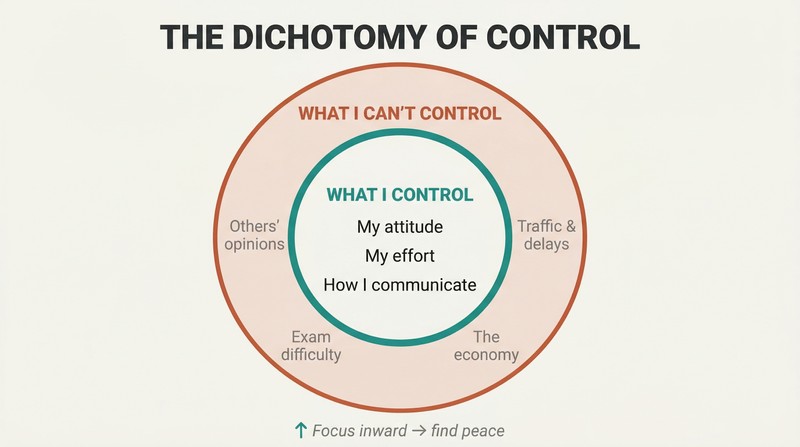
The book's foundational tool is Epictetus's dichotomy of control — the Stoic principle that inner peace comes from distinguishing what's yours to change from what isn't. Trenton turns it into a two-minute meditation: draw a large circle on paper with a smaller one inside. In the inner circle, list everything within your control (study habits, attitude, communication). In the outer circle, everything outside it (exam difficulty, others' opinions, traffic).
This visual forces clarity. A manager overwhelmed by a project delay uses this exercise to see he can communicate with stakeholders and reprioritize tasks — but can't fix the technical issues causing the delay. The shift from helpless rumination to targeted action is the core of letting go. When something is only partially under your control, do your best and leave the rest.
Describe what happened factually before you judge it
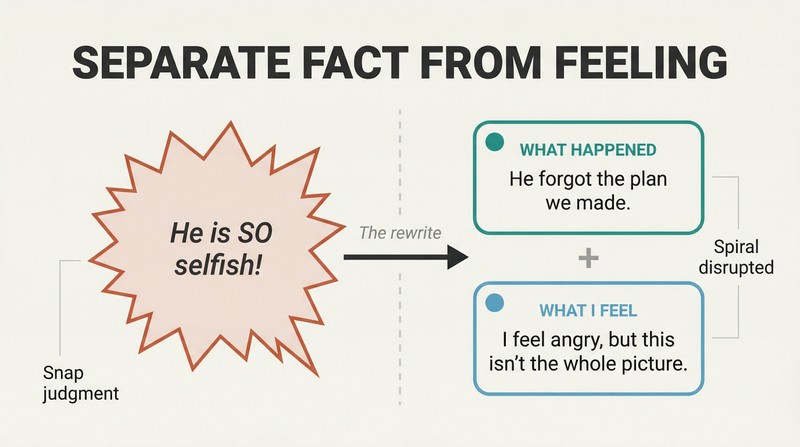
Nonjudgmental thinking — observing thoughts without labeling them good or bad — is a core skill from dialectical behavior therapy. The book offers a rewrite exercise: convert any snap judgment into factual description plus acknowledged emotion. "My boyfriend is so selfish" becomes "My boyfriend forgot the plan we made today. He doesn't always do that. I feel angry, and I'm thinking he only thinks about himself — but that's not entirely true." The reality check disrupts the spiral.
For repetitive judgments, the book adds a third step: imagine what life would look like without this judgment. A woman named Alice, paralyzed by the judgment "I'll never be brave enough to pursue singing," found that simply imagining life without that belief made her feel instantly lighter — enough to start acting differently.
Say your own name to create distance from overwhelming emotions
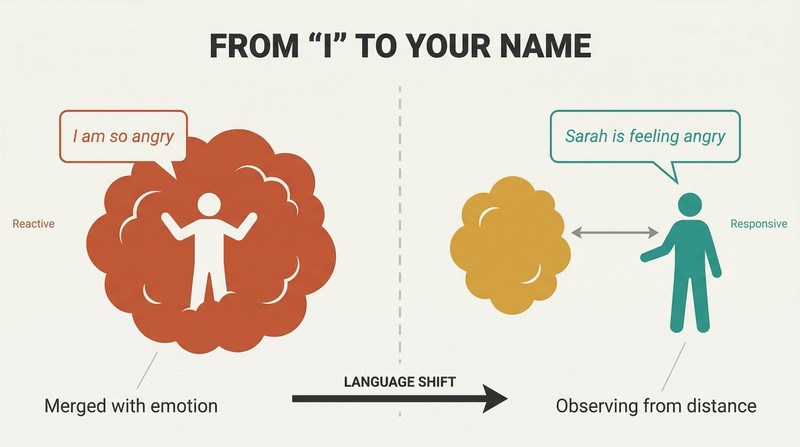
Self-distancing means creating mental space between you and an emotional trigger so you can respond rather than react. One surprisingly effective technique: switch from "I" to your own name. Instead of "I am so angry right now," say "Sarah is feeling angry." This third-person shift creates enough psychological distance to observe your feelings like a bystander rather than a hostage.
The book offers a complementary tool: watch yourself from the future. Imagine "future you" looking back on your current behavior. An impulsive spender named Andrew imagined himself at a Maldives vacation he was saving for — and from that future vantage point, his impulse purchases looked absurd. Research by Förster and colleagues confirms that abstract, distanced thinking enhances both creativity and emotional regulation.
Excellentism sets high standards without perfectionism's self-destruction
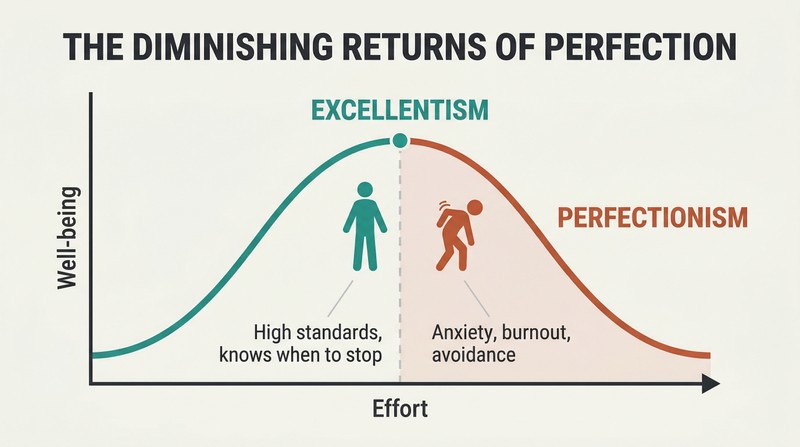
Coined by psychology professor Patrick Gaudreau, excellentism means pursuing excellence while accepting that perfection is unreachable and counterproductive. Research shows perfectionism leads to anxiety, depression, and avoidance — some perfectionists stop taking on challenges entirely because the fear of failure becomes paralyzing. Excellentists, by contrast, report higher positive well-being and greater progress on life goals without the burnout.
The practical shift is disarmingly simple. List what "perfect" looks like for an activity you obsess over — hosting dinner, writing a report. Then deliberately let go of one item. Use store-bought side dishes instead of cooking everything from scratch. Observe the result. Often, the imperfection nobody else notices produces a more relaxed, enjoyable outcome than your impossible standard ever could.
Add 'sometimes' to break every rigid 'I am' statement
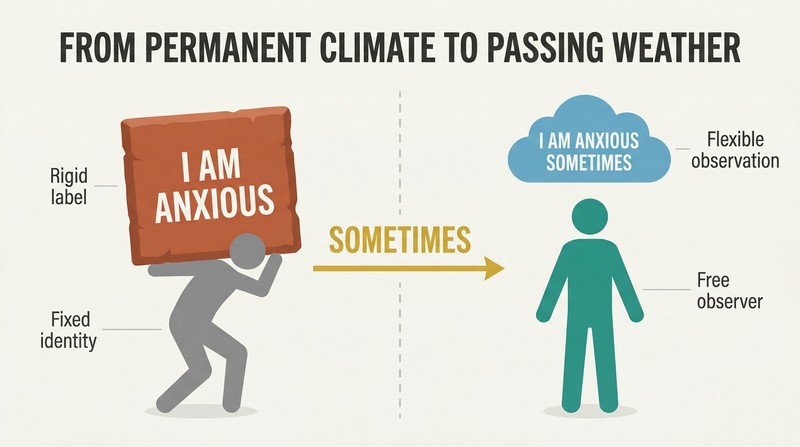
From acceptance and commitment therapy comes the distinction between self-as-content (believing your mind's fixed stories about you) and self-as-context (seeing yourself as a changing observer). The book's simplest application: when your mind declares "I am anxious" or "I can't handle pressure," append the word "sometimes." "I am anxious sometimes" immediately loosens the label's grip.
Helen, who identified as "an anxious person" for years, found this one-word addition shifted her from powerlessness to perspective — anxiety became a passing weather pattern, not a permanent climate. This is the entry point to nonattachment: releasing the need to control or cling to a fixed identity. The book notes three flavors of unhealthy attachment — material, personal, and beliefs — and all begin with rigid self-stories.
Set a ten-minute timer and dump every thought onto paper
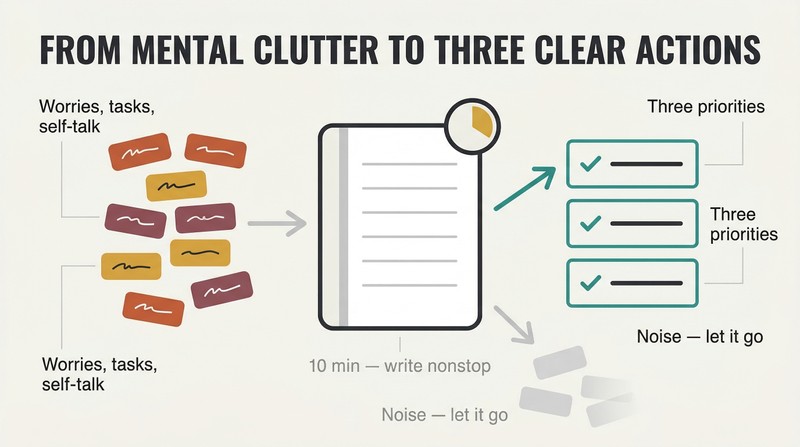
Brain dumping, popularized by productivity consultant David Allen, is a timed technique for clearing mental clutter — the accumulated worries, half-finished tasks, and negative self-talk keeping your mind in overdrive. Write a guiding sentence like "What should I be aware of right now?" Set a timer for ten minutes. Write nonstop without editing or filtering. If you stall, repeat the sentence and keep writing.
Afterward, review and identify no more than three actionable items — then tackle the most urgent one immediately. Keep a dedicated notebook and revisit it weekly to spot patterns. One person noticed their brain dumps kept circling a particular theme, which helped them refine a marketing campaign. The practice converts scattered anxiety into organized momentum, separating genuine priorities from noise.
Trace each self-criticism to its hidden mistaken belief
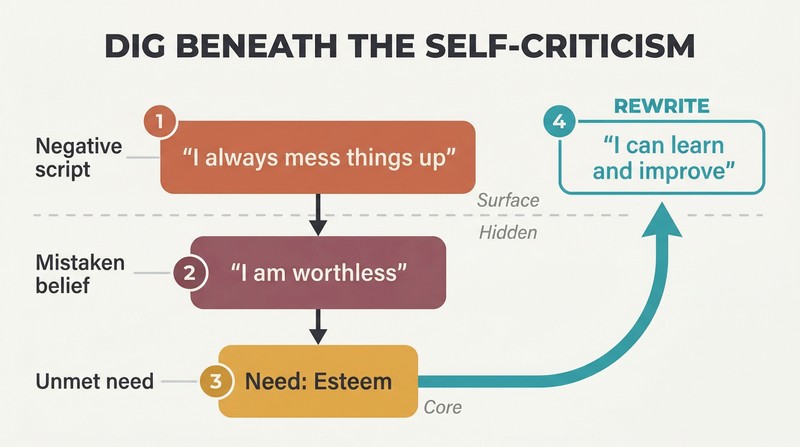
Albert Ellis called repetitive negative self-talk "stinking thinking" — unconscious scripts like "I'm not good enough" that play on loop. The book's four-step rewrite process digs beneath the surface:
1. Know your negative script ("I always mess things up")
2. Identify the mistaken belief fueling it ("I am worthless")
3. Tag the unmet basic need using Maslow's hierarchy (esteem, belonging, love)
4. Rewrite into a positive script ("I can learn from mistakes and improve")
Research confirms the approach: cognitive-behavioral interventions that challenge negative self-talk and replace it with realistic alternatives significantly reduce depression and anxiety symptoms. The key insight is that every self-criticism points to an unmet need — not a truth about who you are.
Name your anxiety like a villain — then strategize against it
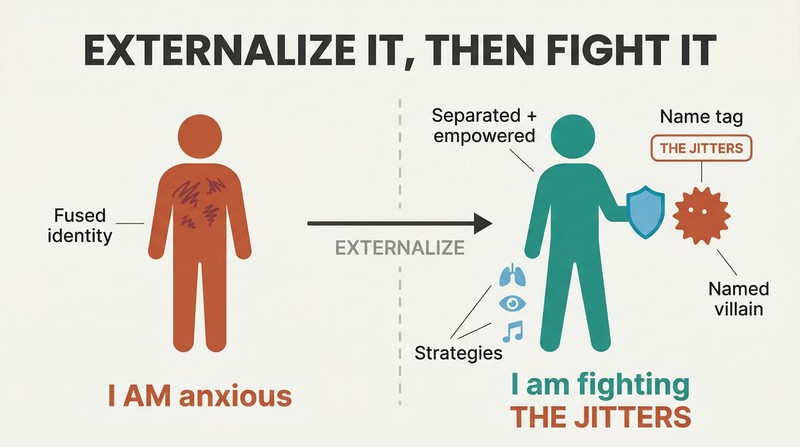
Externalization, from narrative therapy, treats your problem as a separate character rather than a core trait. Instead of "I am an anxious person," say "Anxiety is visiting me right now." The book outlines four steps: view the problem as external, give it a name, acknowledge specifically how it affects your thoughts and behavior, then imagine yourself battling it — cataloging past strategies that worked and brainstorming new ones.
A college student named Joan called her test anxiety "the jitters." That name alone reminded her the feeling was temporary, not permanent. She then mapped how the jitters disrupted her focus and listed countermeasures — deep breathing, visualizing success, calming music before exams. The shift from "I am broken" to "I am fighting the jitters" restored her sense of agency and control.
Determine the degree of distance you need from toxic people
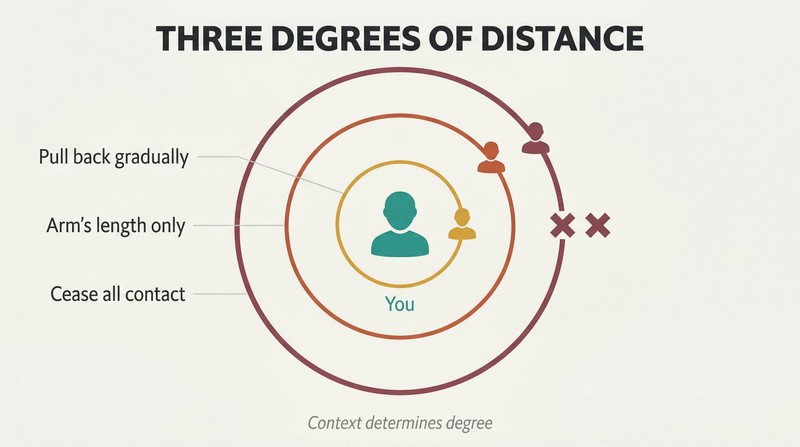
Not every toxic relationship requires a clean break. The book maps three degrees of distance:
1. Pull back gradually without formal announcement
2. Interact only at arm's length or through an intermediary
3. Cease all contact with clear communication
The right degree depends on context — a toxic colleague demands different boundaries than a toxic parent. Studies show people in chronically negative relationships face higher risk of heart disease and impaired wound healing.
Once you've drawn the line, the harder part is holding it. Toxic people cycle through comfort, remorse, and repeated harm to pull you back. Block them on social media, prepare a firm script ("This isn't a conversation I'm able to have with you right now"), and never agree to renegotiate your boundaries — that's a common toxic trap.
Forgive by deep-diving into the wound, not glossing over it
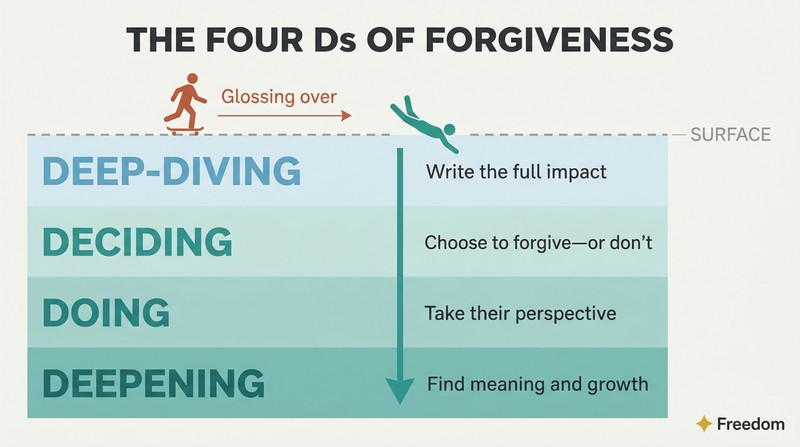
Forgiveness doesn't mean reconciliation or excusing harm. People reporting higher forgiveness levels show less depression, lower anxiety, and even reduced white blood cell counts — a physiological stress marker. The book's Four Ds of Forgiveness provide structure:
1. Deep-diving: write about the offense and its emotional, mental, and physical impact
2. Deciding: weigh what forgiveness means to you personally, then choose — or don't
3. Doing: take the transgressor's perspective to understand their motives
4. Deepening: discover meaning and growth from the experience
For self-forgiveness, a parallel framework applies — the Four Rs: responsibility, remorse, restoration, renewal. Both require honest excavation, not avoidance. Perspective-taking is the hardest step, but the book suggests practicing first with fictional characters in movies to build the empathy muscle before tackling real conflicts.
Analysis
Trenton's book sits at the intersection of several well-established therapeutic traditions — Stoic philosophy, cognitive-behavioral therapy, acceptance and commitment therapy, dialectical behavior therapy, and narrative therapy — synthesized for a lay audience. This cross-pollination is both its greatest strength and its chief vulnerability. The dichotomy of control framework borrows directly from Epictetus but gets operationalized through modern CBT-style exercises like the two-circle meditation, which is genuinely useful for readers who've never encountered Stoicism.
The concept of excellentism, drawn from Gaudreau's academic work, fills a real gap in the popular psychology lexicon. Most self-help books tell readers to 'stop being perfectionists' without offering a named alternative identity to adopt. Excellentism provides that identity — a subtle but important psychological move, since humans struggle to abandon behaviors without a replacement.
However, the book's treatment of nonattachment conflates Buddhist detachment philosophy with ACT's cognitive defusion in ways a clinician might find reductive. The 'sometimes' thinking technique is essentially simplified defusion, repackaged without the theoretical scaffolding that makes it robust in clinical settings. This works for accessibility but risks oversimplification for complex cases.
The most underrated section is the perspective-taking work using fictional characters as training ground. This is backed by solid research on narrative transportation and empathy development, and it offers a lower-stakes on-ramp to a genuinely difficult interpersonal skill. The weakest aspect is the implicit assumption that self-directed techniques are sufficient for everyone — complex trauma and attachment wounds may require professional guidance no book can replace. Structurally, the core toolkit — two-circle meditation, judgment rewriting, 'sometimes' thinking, brain dumping, externalization naming, and the Four Ds — could have been presented in half the pages with twice the impact.
Review Summary
The Art of Letting Go receives mixed reviews, with an average rating of 3.56/5. Readers appreciate its insights on forgiveness, self-awareness, and personal growth. Many find the practical advice and examples helpful, especially for those new to self-help. However, some criticize the writing style, repetitiveness, and lack of depth. The book's strengths lie in its exploration of self-forgiveness, reframing techniques, and the concept of "excellentism." While some readers find it transformative, others feel it offers little new information and can be difficult to engage with consistently.
Glossary
Dichotomy of Control
Focus only on controllable thingsA central concept from Stoic philosophy, attributed to Epictetus, that distinguishes between things within one's control (thoughts, actions, reactions) and things beyond it (external events, others' behavior). The practice involves identifying which category a stressor falls into and directing energy only toward controllable elements while accepting the rest.
Excellentism
High standards without perfectionism's harmA concept coined by psychology professor Patrick Gaudreau at the University of Ottawa. Excellentism involves setting high personal standards while accepting that perfection is unattainable. Unlike perfectionism, it embraces mistakes as learning opportunities, focuses on progress rather than flawless outcomes, and avoids the diminishing returns that come from obsessive pursuit of the perfect result.
Nonattachment
Releasing the need to clingRooted in Eastern philosophy, nonattachment is the practice of letting go of the need to control, cling to, or possess things, relationships, or identities. It does not mean detachment or indifference but rather accepting impermanence. The book identifies three forms of unhealthy attachment—material, personal, and beliefs—and frames nonattachment as returning to one's true self rather than defining oneself through external factors.
Self-as-context
Flexible, observer view of selfA concept from acceptance and commitment therapy (ACT) that views the self as a constantly changing observer rather than a fixed collection of traits. Contrasted with self-as-content, where individuals believe the stories their mind tells about who they are. Self-as-context encourages seeing oneself from multiple perspectives and understanding that identity is not permanent, enabling greater psychological flexibility.
"Sometimes" thinking
Adding 'sometimes' to self-labelsA practical nonattachment technique where individuals add the word 'sometimes' to rigid self-statements. For example, 'I am anxious' becomes 'I am anxious sometimes.' This small linguistic shift creates psychological space between the person and the label, reducing identification with fixed traits and opening the door to seeing oneself as dynamic rather than permanently defined.
Brain dumping
Timed thought-clearing onto paperA technique popularized by productivity consultant David Allen for organizing thoughts and closing mental 'open loops.' The process involves writing a guiding question, setting a ten-minute timer, and writing down every thought without editing. Afterward, the material is reviewed to identify no more than three actionable items. It functions as a method for converting mental clutter into organized, prioritized tasks.
Negative self-scripts
Repetitive pessimistic thought patternsCalled 'stinking thinking' by Albert Ellis, founder of rational-emotive-behavioral therapy. These are unconscious patterns of pessimistic self-talk that play in the background of the mind, subtly influencing perceptions and actions. They originate from mistaken beliefs formed during early experiences and are connected to unmet basic needs. The book provides a four-step process to identify and rewrite them.
Externalization
Treating problems as separate entitiesA narrative therapy technique where individuals separate their problems from their identity by viewing them as external forces rather than intrinsic character traits. The process involves four steps: viewing the issue as external, naming it (e.g., calling anxiety 'the worry monster'), acknowledging how it affects behavior, and imagining a battle strategy against it. This restores agency and emotional balance.
Four Ds of Forgiveness
Structured forgiveness frameworkA four-step approach to forgiving others: (1) Deep-diving—writing about the offense and its impacts; (2) Deciding—reflecting on what forgiveness means personally and choosing to forgive or not; (3) Doing—taking the transgressor's perspective to understand their motives; (4) Deepening—discovering meaning and personal growth from the experience. The framework emphasizes that forgiveness is about releasing oneself, not excusing harm.
Four Rs of Self-forgiveness
Steps to forgive yourselfA four-step framework for self-forgiveness: (1) Responsibility—acknowledging the mistake without excuses; (2) Remorse—feeling genuine regret for harm caused; (3) Restoration—making amends and taking steps to repair damage; (4) Renewal—committing to learning from the experience and doing better. The process distinguishes healthy guilt (acknowledging wrongdoing) from destructive shame (attacking one's worth as a person).
Emotional cycle of change
Five stages of adapting emotionallyDeveloped by psychologists Don Kelley and Daryl Connor, this model maps five emotional stages people experience during change: (1) Uninformed optimism—excitement without awareness of costs; (2) Informed pessimism—recognizing the effort required; (3) Valley of despair—the lowest point where most people quit; (4) Informed optimism—seeing progress and possibility; (5) Success and fulfillment—new behaviors become routine. Perseverance through the valley is the critical factor.
Conscious media consumption
Mindful, intentional media useA practice described by positive psychology researcher Stephanie Harrison involving deliberate attention to both what media one consumes and how one consumes it. It includes her 'Learn/Connect/Joy' rule—evaluating whether content helps you learn something, connect with others, or experience joy. The practice combats doom scrolling and involves curating feeds, setting time limits, and pausing before reflexively reaching for devices.
FAQ
What's "The Art of Letting Go" about?
- Overview: "The Art of Letting Go" by Nick Trenton is a guide to overcoming overthinking, negative spirals, and finding emotional freedom. It offers strategies to release emotional burdens and embrace new possibilities.
- Core Concepts: The book delves into self-awareness, acceptance, forgiveness, gratitude, mindfulness, compassion, and resilience, showing how these can foster inner peace and clarity.
- Psychological Techniques: It combines life experiences with psychological techniques to help readers let go of what no longer serves them and embrace a more fulfilling life.
Why should I read "The Art of Letting Go"?
- Emotional Freedom: The book provides tools to stop overthinking and negative spirals, leading to emotional freedom and a healthier mindset.
- Practical Strategies: It offers practical strategies and exercises to help readers let go of negative thoughts and behaviors.
- Personal Growth: By reading this book, you can gain insights into personal growth and learn to embrace change and new opportunities.
What are the key takeaways of "The Art of Letting Go"?
- Dichotomy of Control: Focus on what you can control and let go of what you cannot.
- Nonjudgmental Thinking: Observe your thoughts without attaching labels or opinions to them.
- Self-Distancing: Create distance between yourself and intense emotions to gain a more objective perspective.
How does the "Dichotomy of Control" work in "The Art of Letting Go"?
- Stoic Philosophy: The dichotomy of control is a central concept in Stoic philosophy, emphasizing the importance of distinguishing between things within and beyond one's control.
- Practical Application: The book provides steps to practice this concept, such as focusing on the present moment and asking whether a situation is under your control.
- Examples: It uses examples like a student preparing for an exam to illustrate how focusing on controllable aspects can reduce anxiety and improve performance.
What is "Nonjudgmental Thinking" in "The Art of Letting Go"?
- Definition: Nonjudgmental thinking involves observing and recognizing thoughts without attaching labels or opinions, allowing for a more objective view of experiences.
- Importance: This mindset is crucial for letting go, as it helps reduce emotional reactivity and fosters acceptance.
- Exercises: The book includes exercises to cultivate a nonjudgmental stance, such as rewriting negative judgments in a nonjudgmental form.
How does "Self-Distancing" help in "The Art of Letting Go"?
- Concept: Self-distancing involves creating space between oneself and a source of strong emotions or conflict, allowing for a more objective perspective.
- Benefits: It helps regulate emotions, improve decision-making, and reduce stress's negative impact on mental health.
- Techniques: The book offers techniques like taking a break, cognitive reappraisal, and using the Eisenhower matrix for self-distancing.
What is "Excellentism" according to "The Art of Letting Go"?
- Definition: Coined by Patrick Gaudreau, excellentism involves setting high standards without letting them become unattainable or detrimental to well-being.
- Comparison to Perfectionism: Unlike perfectionism, excellentism focuses on progress and learning from mistakes rather than achieving flawless outcomes.
- Mental Health Benefits: Excellentism is associated with higher levels of healthy anxiety, intrinsic motivation, and positive well-being without the negative effects of perfectionism.
How does "The Art of Letting Go" suggest practicing "Nonattachment"?
- Concept: Nonattachment involves letting go of the need to control, cling, or possess things, accepting life's transience and constant change.
- Application: The book suggests practices like "sometimes" thinking and recognizing interdependence to cultivate nonattachment.
- Benefits: Practicing nonattachment can lead to greater freedom, less distress, and a deeper understanding of oneself and the world.
What is "Conscious Media Consumption" in "The Art of Letting Go"?
- Definition: Conscious media consumption involves being mindful and intentional about what media you consume and how you consume it.
- Importance: It helps minimize exposure to negative news or content that may trigger anxiety or stress.
- Strategies: The book offers strategies like setting time limits on apps, curating positive content, and aligning media consumption with personal values.
How does "The Art of Letting Go" address "Negative Self-Scripts"?
- Definition: Negative self-scripts are pessimistic ways of thinking about oneself, others, or the world, often based on mistaken beliefs.
- Rewriting Process: The book provides steps to identify, challenge, and replace negative self-scripts with positive and realistic self-talk.
- Benefits: Rewriting negative self-scripts can improve mental health, resilience, and relationships with others.
What is "Externalization" in "The Art of Letting Go"?
- Therapeutic Technique: Externalization, or narrative therapy, involves separating oneself from negative thoughts and beliefs, viewing them as external entities.
- Purpose: It helps individuals gain a new perspective on their struggles and move toward a more positive and healthier life.
- Application: The book suggests techniques like naming anxiety and imagining oneself in a battle to externalize and manage emotions.
How does "The Art of Letting Go" suggest dealing with "Toxic People"?
- Definition: Toxic people are those who deflect responsibility, manipulate situations, and cause mental and emotional exhaustion.
- Strategies: The book offers strategies like determining the degree of distance, drawing boundaries, and choosing appropriate communication methods.
- Self-Care: Cutting off toxic people is an act of self-care and self-love, essential for maintaining mental and physical health.
About the Author
Other books by Nick Trenton


Download PDF
Download EPUB
.epub digital book format is ideal for reading ebooks on phones, tablets, and e-readers.








































