

Plot Summary
Prologue
The fallen angels, exiled in Hell, test a silent God. First they send famine — rains rot the grain, livestock die, men devour the newly buried. Then they stir war: an island king invades his neighbor, and the long bloodletting between England and France begins. When God makes no answer to either affliction, Lucifer proposes the final test.
They will murder the seed of Adam with a Great Plague. If God does not rouse Himself to save His favorite creature, His sleep is deep enough that they may storm Heaven and tear it down. The year is 1348. The pestilence falls upon the earth. And the Lord makes no answer.
The Girl in the Barn
Four starving brigands share a donkey carcass in a Norman barn when a flaxen-haired girl appears, asking for help burying her plague-dead father. Their leader, Godefroy,13 means to rape her. Thomas1 — an excommunicated knight, the oldest and strongest of them — refuses.
When Godefroy13 presses, Thomas1 kills him and one other with precise, brutal violence. The last brigand, a droopy-eyed man named Jacquot,4 drags the girl from her hiding tree. Thomas1 levels his sword at Jacquot's4 throat.
The girl steps between them and pleads for the man's life. Thomas1 lowers his blade. An angel had pointed her toward these men, though she cannot explain why. She persuades Thomas1 to bury her father. He agrees to take her as far as the next town. He does not ask her name.
The Priest's Best Wine
In the dead town of St. Martin-le-Preux, a river monster has been swallowing fishermen since the plague emptied the banks. The town's priest, Père Matthieu3 — a wine-loving Norman with woolly eyebrows, a hidden scandal, and no remaining congregation — has been sitting by the road, praying for a soldier to come down it.
Thomas1 arrives. Over the priest's last barrel of papal wine, sent from his brother Robert6 in Avignon, Matthieu3 proposes a bargain: kill the abomination and God will restore his knighthood. Thomas1 counters that he would rather have another goblet.
But the priest has seen the hollow where Thomas's1 honor used to live. Thomas1 agrees. The girl insists they are ultimately bound for Paris and Avignon — destinations revealed to her in dreams and dead men's visitations she cannot yet explain.
Thomas Fights the River
Thomas1 wades into the murky water in full chain mail, probing with a spear. The monster — twenty paces of oily blackness, white-eyed and flat-headed, with a prehensible human hand on its tail — surfaces to take a woman's severed leg.
A stout farmer follows Thomas1 in with a billhook. The creature swallows the farmer headfirst, gulping him down like a pelican taking a fish. Thomas1 hacks at it savagely. The hand grabs his face, the spined belly pierces his armor at the groin.
Underwater, tangled in its coils, he drives his sword through the creature's body and pushes through to something vital. The thing vomits him out alongside the dead farmer and a dozen eels. Thomas1 crawls from the water on three working limbs and collapses as hailstones drum his armor.
The Virgin's Broken Hand
Thomas1 is dying — envenomed by the monster's spine and burning with plague. The girl2 commands they cart him to a healing shrine at Rochelle-la-Blanche. When they arrive, a mob from a rival village attacks to seize the miracle-granting statue. The fighting turns savage.
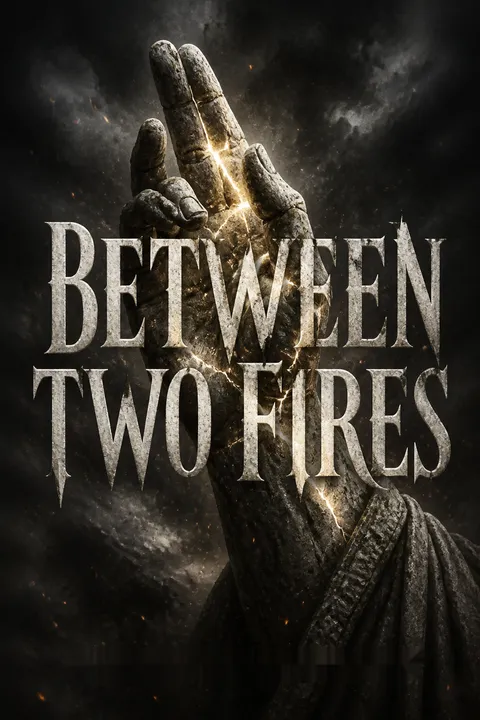
A woman from the mob takes a hammer to the beautiful white-stone Virgin, smashing it to rubble while screaming obscenities. Something invisible and dark laughs. After the massacre, the girl2 walks through twisted bodies and picks up the Virgin's broken arm — two stone fingers still extended in benediction.
She presses them against Thomas's1 forehead, precisely where a figure like St. Sebastian had pressed its thumb days before. The fishlike thing tugging Thomas1 toward death lets go. He gasps, opens his eyes, and sleeps without fever for the first time in days.
The Feast That Never Was
A castle appears on a hill, torchlit and inviting. Thomas1 insists on stopping for food; the girl2 refuses and stays in a tree. Inside, a leonine lord with black teeth hosts an obscene feast — roasted monkeys served as the Three Kings, serving girls with wandering hands, a hurdy-gurdy player whose hand the lord breaks for pausing.
Thomas1 gets drunk, sleeps with the lord's daughter, and fights in a night tournament against Théobald de Barentin. Midway through, seawater gushes from Théobald's wounds and an eel slithers from his leg armor — this knight drowned at the Battle of Sluys years before.
The lord's head warps into a lion's. At dawn, everything vanishes. Thomas1 lies in a cow field beside a rusted plow. The castle is rubble. The feast-goers are corpses in a mass grave. The girl2 brushes a leaf from her hair and asks if he is ready for Paris.
The Key That Shouldn't Fit
In plague-ravaged Paris, a woodcarver named Jehan and his wife Annette14 shelter the travelers after the girl2 sings a Norman song beneath their window. She reveals her name: Delphine.2 At a market, she insists a Jewish relic seller possesses something genuine among his obvious frauds.
The man is seized, stripped, and locked in a pillory. That night, while heavy things tread through darkened streets and men scream behind closed doors, Delphine2 runs to the square. Thomas1 follows, cursing.
She tries a brass key on the pillory — a worthless trinket from a con artist, far too small for any proper lock. It turns. The freed Jew hands her a hinged wooden tube on a hemp rope. Inside lies a pitted iron rod: the Roman spearhead that pierced Christ's side. On their way home, something knocks.
The Ones Who Knock
The knocking resolves into a baby's cry, a woman's plea. Thomas1 opens the woodcarver's door. A six-foot stone Virgin stands in the doorway holding a dead plague-infant by the ankle. It ducks inside and begins killing. It breaks Annette's14 arm, bashes in her skull, gores Jehan against the wall repeatedly.
Thomas1 batters the thing with his sword, chipping stone. When Matthieu3 touches it with the Holy Spear, the abomination recoils — the first enemy to fear this relic. It retreats into the night. A fallen candle ignites wood shavings and the house burns.
Fleeing Paris at dawn, they pass a mold-covered church where blood-mouthed stone saints assault them with psychic screams — the priest's hidden desires, Thomas's1 darkest impulses, Delphine's2 terror that everyone she loves will die because of her.
The Stained Priest Confesses
Sheltering in a barn on the road south, the priest3 asks to make confession. Thomas1 assumes Matthieu's3 scandal involved a pretty girl, but Delphine2 grasps the truth sooner. The red stockings in the moonlit river belonged to the reeve's son, Michel — not the plump girl who ran home covering her breasts.
They were caught naked under the burned bridge by the village militia. His congregation turned from him. When the plague arrived, almost nobody came to Mass — an entire parish cut off from sacraments because they despised their shepherd.
Thomas1 declares he cannot travel with a known sodomite. Matthieu3 agrees to maintain the useful fiction. But that night Delphine2 whispers to the priest that she would not leave, regardless. It is a mercy he has not received from anyone since Michel slipped from the river and ran.
Auxerre's False Resurrection
A scarred German named Rutger the Fair11 marches into Auxerre with his flagellant Penitents, scourging themselves bloody and claiming power over death. Before the cathedral, he whips three plague corpses — and they stand. The crowd erupts.
Delphine,2 who has slipped away from Thomas1 and Matthieu,3 pushes forward and kisses each risen body's hand. They collapse gratefully. She kisses the beautiful blond herald boy on the cheek, and he crumbles — dead all along. The mob seizes her, binding her arms.
An angel blinds those holding her, then pushes a building between Delphine2 and two fallen angels materializing in the square — one twelve-eyed with a mouth of fire, another lion-faced with terrible wings. They collide above the city in shapes that dwarf windmills. Thomas1 watches from the fields as a spear of moonlight dives to catch the girl mid-fall. One angel is broken.
Matthieu Lifts the Eucharist
On the Rhône, their raft hits a dam of headless corpses. Pulsing creatures — each wrapping a severed human head in a translucent bell of tendrils — surge from the water, stinging with lethal frills. Guillaume,5 their strong-armed raftmate and fellow Crécy veteran, throws salt that kills several, but tentacles from below yank the raft under. Everyone plunges in.
Matthieu3 grabs Delphine2 and wades for shore, his body a shield against each sting. Guillaume's5 heart stops; the island absorbs him. Thomas1 drags the priest and girl ashore. In a cottage, Delphine2 plays a lute she has never learned — a song all three men once loved in separate lives. Matthieu3 dies asking Thomas1 to find his brother Robert6 in Avignon. He never finishes his message.
The Scarecrow in the Dark
She slips away while he sleeps, unwilling to let another die for her. She walks barefoot toward Avignon alone, drinking from pig troughs, stealing grapes from unharvested vineyards. At a dead convent, something speaks to her in the dark — claiming sisterhood, groping for the case around her neck.
It offers Roman silver and ancient braceletry if she surrenders the spear. When she refuses, it threatens to bite her thumbs off. Delphine2 stands, opens the case, and names the thing for what it is: a scarecrow assembled from lies and the stolen arms of dead nuns, barely held together by malice.
She tells it she pities its suffering. In the morning, she finds its collapsed form — a broom, some cross-sticks, a skull crowned with gray hair. She sweeps the chapel, buries the remains, says a prayer, and walks on.
The Knight Forgives His Wife
Thomas1 follows Delphine2 south, swearing a fresh oath to a village priest whose people English routiers have slaughtered. He finds the man who stole his lands — the young Comte d'Évreux9 — and challenges him by a stream. Thomas1 is winning the duel when a squire clubs him from behind.
English archers then ambush the whole party, killing d'Évreux.9 The routier captain, recognizing Thomas1 from a bathhouse where he had spared his men, now returns the mercy. Delphine2 finds Thomas1 among the dead and leads him to the water. She asks him to forgive his wife Marguerite,10 who had shared her bed with d'Évreux9 years ago.
He resists. She tells him to go back to Picardy, then — there will be no Avignon without forgiveness. He weeps and pardons. The stream washes his face away. When he stands, he wears d'Évreux's features — his passport into the papal court.
The Devil Wears the Tiara
In Avignon, a powerful fallen angel has taken the pope's7 place. Robert Hanicotte6 — Matthieu's3 beautiful younger brother, concubine to an elderly cardinal — serves unknowingly in this corrupted court. The false pope announces a crusade to Jerusalem and orders a pogrom against the Jews.
Delphine2 takes Robert6 to the papal vineyards at Châteauneuf by night, where he watches silent corpses harvest grapes and tread wine under the moon. She begs him to arrange an audience with the true pope.
Instead, seduced by the impostor's warmth and a promise of elevation, Robert6 warns the false Clement7 about the girl. His reward: a cardinal's hat. Soldiers come for Thomas1 at his lodgings. Delphine2 escapes through a window aided by something with wings. Thomas1 is captured, his legs broken, and he hangs from the dungeon ceiling.
The Pope in the Wine Barrel
The pope's physician,12 guided by a dream, forges a writ and wheels Thomas1 out of the torturer's care. Meanwhile, Delphine2 descends alone into the papal wine cellar. She climbs barrel after barrel until she feels the right one — sealed since August, fermenting around a pontiff's body.
She pries the lid off. The wine is black with splinters. She whispers a single word. A white hand breaks the surface, wearing its magnificent rings. Pope Clement7 sits up, gagging dark wine from his nose and mouth, his features re-forming from wax to living flesh.
That night at the river, Delphine2 orchestrates one more miracle: Thomas's true body walks dripping from the Rhône — scarred, bearded, armored in rust. He breathes out of the comte's lungs and into his own. The borrowed face floats downriver in the dark.
Between Two Fires
At a Franciscan abbey, Delphine2 smears her own blood across Thomas's1 blade — it was this blood, unknowingly shed months ago, that killed the river creature and repelled every devil since. She gives him the Holy Spear. That evening, the true Clement7 confronts his double in the courtyard.
Thomas1 leaps onto the banquet tables in a friar's habit, sword swinging. He kills the lion-faced devil-knight and cleaves the false pope's skull, revealing the golden fly-head of Baal'Zebuth8 beneath. Jacquot4 — the droopy-eyed brigand Thomas1 once spared in Normandy, now a papal crossbowman — shoots him through the very dent his own axe-blow made in the borrowed breastplate.
The devil rips Thomas's1 arm off. A risen corpse hurls a spear at the true pope. Delphine2 throws herself before it. It passes through her. She dies smiling. Through her body, light pours upward. Angels birth themselves into the world — and drive the devils from Avignon.
The Last Soul Saved
Thomas1 dies and wakes in Hell. A crippled clerk-demon reads his name, pronounces his sentence, and eats him alive. This cycle repeats endlessly — each iteration a fresh atrocity. He is skinned and resewn with gravel inside. He is made to betray those he loved, then forced to watch them betray him.
He forgets his own name. Then light comes — down a street in an infernal Paris, pooling around a cart driven by a girl. She is both Delphine2 and something immeasurably older. The devils rage but cannot touch her. Thomas1 spits in her face, certain she is another torment.
She waits. When Lucifer himself is dragged past in chains — proof that Heaven has won — the illusion breaks. She warms Thomas's1 dead hands with her breath, kisses his feet, and lifts him out. He wakes in a pit of corpses in Avignon, breathing, whole, and weeping.
Epilogue
Thomas1 works through the rubble of Avignon, finds his sword broken in a gutter, and leaves it. He wanders north, sells his horse, learns farming. With three companions he returns to Normandy — to a barn where a flaxen-haired girl asks help burying her plague-dead father.
She has Delphine's2 face but no memory of him. He stays. Decades later, an old Franciscan friar climbs the road to Arpentel. His grown son is lord; his grandson swings a wooden sword. His wife Marguerite,10 blind and ancient, receives him in her parlor.
As he turns to leave, she taps her ring three times on the bench — their wedding signal. He taps his bowl against the wall three times. He walks toward Amiens, where his daughter tends the convent garden, growing sorrel she will pick for him in the morning. She was always good with herbs.
Analysis
Between Two Fires poses the oldest theological question — why does God permit suffering? — and answers it not with doctrine but with the anatomy of a single act of forgiveness. Thomas's1 journey from excommunicated brigand to redeemed friar is no conventional conversion; he never finds faith so much as faith finds him, arriving as a stubborn child who argues about his swearing. The novel proposes that grace operates through relationships, not institutions — through a priest who shields a girl from poison with his body, through a knight who resists a demonic compulsion because some buried fiber in him remembers what he was made to be.
The plague setting is not backdrop. Buehlman uses the Black Death as the material consequence of cosmic withdrawal: when God turns away, the physical world rots. But the novel subverts despair by insisting that human love constitutes guerrilla theology — small mercies performed in defiance of a silent heaven. The stump that grows into a maple because Delphine2 slept against it, the flowers that cover the sleeping travelers, the salt that dissolves river-born abominations — these are grace leaking through the cracks of a fractured world rather than miracles imposed from above.
The novel's most radical argument arrives in its harrowing sequence. When Delphine2 rescues Thomas1 from damnation, she appears as both herself and Christ — collapsing the distinction between human child and divine savior. The girl who played with bird whistles and the power that spoke the world into being occupy the same body. This is Buehlman's thesis: the sacred is not separate from the human but lives within it, disguised as stubbornness, tenderness, and the refusal to stop walking toward a city where devils wear the pope's face. Redemption costs everything. It is also the only thing worth buying.
Review Summary
Between Two Fires is a critically acclaimed historical horror novel set during the Black Death in 14th century France. Readers praise Buehlman's vivid, immersive writing and well-researched setting. The story follows a disgraced knight, a mysterious girl, and a priest on a harrowing journey through a plague-ravaged landscape filled with supernatural horrors. Many reviewers highlight the book's blend of historical fiction, fantasy, and horror elements, as well as its compelling characters and emotional depth. While some found certain scenes confusing or disturbing, most consider it a gripping, unforgettable read.
People Also Read




Characters
Thomas de Givras
Fallen knight seeking redemptionA knight of Picardy who lost everything—his lands stolen by a Norman comte, his wife taken, his spurs stripped by excommunication—and sold what remained of his soul to brigandage. Beneath the profanity and violence lives a man whose moral compass was never destroyed, only buried. His physical strength is extraordinary—bull-necked, lethal with a sword—but his deeper strength reveals itself in restraint: blows he declines to strike, a rape he refuses, the cursing that masks a tenderness he fears. His relationship with Delphine2 transforms him from reluctant protector to father figure to something like a pilgrim, his coarseness softening not through weakness but through love he never invited. His central wound is betrayal. His central need is to trust again.
Delphine
Visionary orphan, vessel of graceAn orphaned Norman girl of about twelve who sees angels, speaks in tongues she does not know, and carries within her something older than human memory. Her father was a lawyer who kept bees and loved Thomas Aquinas; her mother taught her herbs. She is both utterly a child—stubborn, playful, fond of bird whistles and argumentative about swearing—and something approaching divine, a vessel through which grace works with increasing force. She corrects the profane, argues theology with knights, and faces down devils in dark rooms by naming what they are. Her arc moves from frightened orphan to vessel of grace, though she fights the cost at every step. She loves with the directness of someone who has nothing left to lose except the people she keeps finding.
Père Matthieu Hanicotte
Wine-loving priest with a secretA Norman priest from a small river town, Matthieu carries the secret of his homosexuality like a stone in his chest. His father, a soldier, despised his softness; his parishioners discovered his love for the reeve's son and turned from him. He stopped going to church before the plague stopped coming to him. Yet his gentleness is his power—he is braver than he knows, able to catch a falling girl when his own bones are breaking, able to resist a devil's command to kill while standing on a ladder in the dark. He craves wine, acceptance, and forgiveness, and gives two of these freely to everyone he meets. His love for Delphine2 and Thomas1 becomes the axis of his late-blooming courage.
Jacquot
Spared brigand, fate's instrumentThe droopy-eyed brigand Thomas1 spares in Normandy, Jacquot is nervously talkative, morally weak, and possessed of a beautiful Italian crossbow he cannot load without a crank. He serves as comic relief in the opening chapters but represents the unpredictable cost of mercy—spared by a girl's2 plea, he drifts south and resurfaces as a papal crossbowman at a moment no one could have foreseen.
Guillaume
Strong-armed raftsman and allyA massive-armed former crossbowman who fought at Crécy, Guillaume crews a pirate raft on the Rhône. He bonds instantly with Thomas1 through martial fellowship and shared memory of that cursed battlefield. His loyalty runs deeper than oath—he shoots his own captain to save a man he barely knows but recognizes as kin. His conscience and his strength are inseparable.
Robert Hanicotte
The priest's compromised brotherMatthieu's3 younger brother, beautiful and self-serving, Robert exists as his sibling's dark mirror. Concubine to an elderly cardinal in Avignon, he craves elevation and comfort above all else. He is not wicked but fatally weak—unable to resist false warmth, unable to face what he witnesses in midnight vineyards. His choices carry consequences he never imagined for people he never met.
Pope Clement VI
Generous pontiff, captive sovereignA generous, eloquent pope who loves feasts, theological debate, and earthly pleasures without apology. His warmth is genuine, his failings entirely human—a man who forgave freely, perhaps too freely for his own safety. Something about the Clement the travelers encounter in Avignon does not seem right. The question of his true nature and the mystery of what happened to his generosity drives the story's final act.
Baal'Zebuth
Fallen angel, lord of fliesOne of the mightiest fallen angels, whose agents are flies and whose earthly form radiates corrupted warmth. Among the devils walking the earth during the plague, Baal'Zebuth is distinguished by a preference for wearing power rather than destroying it—infiltrating institutions, suborning loyalty, pressing dead grapes into wine for the living.
Comte d'Évreux
Thomas's usurper and rivalThe young Navarrese nobleman who stole Thomas's1 lands, his wife, and his knighthood. Soft-faced and resplendent in Milanese armor, he is less villain than opportunist—the kind history rewards until it doesn't.
Marguerite de Péronne
Thomas's estranged wifeThomas's1 beautiful, sharp-tongued wife, who chose pragmatism over loyalty when her husband fell at Crécy. Her betrayal drives Thomas's1 rage, but her memory also anchors his capacity for love.
Rutger the Fair
Charismatic flagellant leaderA scarred German who leads the Penitents, performing false resurrections by whipping plague corpses. His carpenter's chest and shaved scalp give him the look of a battle-worn Christ.
Maître de Chauliac
Pope's courageous physicianThe pope's doctor, whose courage to follow a dream and forge a writ saves Thomas1 from the dungeon. His kindness is the practical kind—a surgeon's hands guided by conscience and nightmares.
Godefroy
Brigand leader, catalystThe most feared brigand in Normandy—lecherous, ruthless, and willing to rape children. Thomas1 kills him in the opening pages, simultaneously ending one life and beginning another.
Annette
Parisian surrogate motherThe woodcarver's wife who shelters the travelers in Paris and becomes a surrogate mother to Delphine2. A woman whose lost daughter and a girl whose lost mother briefly find each other.
Plot Devices
The Holy Spear
Relic weapon against devilsThe pitted iron spearhead that pierced Christ's side, kept by a Jewish relic seller among convincing frauds and given to Delphine2 after she frees him from a pillory. When touched to the animated stone Virgin, the statue recoils. When brandished before the scarecrow-devil, merely threatening to open its case drives the creature back. It becomes the weapon Thomas1 carries into the papal court. The spear functions as both sword and key—a material remnant of divine suffering that retains the power to wound what is unholy. Its trajectory through the story tracks the escalation from local horrors to cosmic battle, always in the hands of the least likely warriors.
Delphine's Blood
Sacramental anointing for weaponsEarly in their journey, Delphine2 accidentally cuts herself on Thomas's1 sword while trying to clean it. Thomas1 berates her, unaware that her blood has consecrated the blade. Only this sword kills the river monster; an armorer at the devil's castle refuses to touch it, revolted by what coats it. Before the final confrontation, Delphine2 deliberately cuts her hands and smears blood across blade, quillons, and pommel—the anointing now conscious and sacramental. Her blood is the story's hidden liturgical element, transforming mundane steel into a weapon of grace. The device reveals itself gradually, its significance growing as Delphine's2 nature becomes clearer.
Thomas's Facial Transformation
Miraculous disguise into AvignonAfter Thomas1 forgives his wife Marguerite10, Delphine2 washes his head in a stream and his features are replaced by those of the dead Comte d'Évreux9—the very man who stole his lands. Thomas1 must wear his enemy's face to infiltrate the papal court, a brutal irony that requires genuine forgiveness as its precondition. The transformation functions as both plot mechanism and spiritual test: Thomas1 can only become someone else after releasing his hatred of that someone. When his true body later walks from the Rhône and he breathes back into it, the borrowed identity dissolves—having served its purpose as armor for a soul that no longer needs disguise.
The Cosmic Prologues
Frame the war between Heaven and HellBetween the novel's five parts, omniscient interludes narrate the fallen angels' rebellion against a silent God. These passages escalate: first famine, then war, then plague, then open warfare at the walls of Heaven, and finally God's answer. They reframe every mud-splattered, plague-ridden encounter as a skirmish in an invisible war whose stakes encompass the survival of all creation. The repeated refrain—And the Lord made no answer—accumulates devastating weight through four repetitions before it is finally, quietly broken in the fifth part's single devastating line: The Lord made answer.
The Brass Key
Grace disguised as worthless junkA useless key purchased from a Parisian con artist, far too small for any door, kept by Delphine2 on a green ribbon because she thinks it pretty. When brought to the Jewish relic seller's pillory in the dark, it fits the lock—impossibly—and opens it, releasing both the man and the holy relic he carries. The key represents the novel's theology in miniature: grace arrives in forms so humble they are dismissed by everyone practical, and works precisely where nothing rational should. The priest3 almost throws it away. The knight1 calls it worthless. Delphine2 keeps it because it makes her smile.
FAQ
Synopsis & Basic Details
What is Between Two Fires about?
- A Knight's Grim Journey: In plague-ravaged 14th-century France, a disgraced and excommunicated knight, Thomas, survives as a brutal brigand in a world where God seems absent and devils walk the earth.
- An Unlikely Alliance: Thomas's path intersects with Delphine, a mysterious young girl who sees angels and possesses strange knowledge, and Père Matthieu, a guilt-ridden priest, forming an uneasy trio navigating a landscape of death, famine, and supernatural horror.
- A Quest for Avignon: Guided by Delphine's visions, the group journeys towards Avignon, the seat of the papacy, believing their path is tied to a cosmic struggle between Heaven and Hell, facing monstrous creatures and the moral collapse of humanity along the way.
Why should I read Between Two Fires?
- Visceral Historical Horror: The novel offers a deeply immersive and unflinching portrayal of the Black Death era, blending historical detail with terrifying supernatural horror that feels both epic and intensely personal.
- Complex, Flawed Characters: Thomas, Delphine, and Père Matthieu are richly drawn, morally ambiguous characters whose struggles with faith, sin, and redemption provide a compelling human core to the apocalyptic narrative.
- Unique Blend of Genres: It masterfully combines elements of historical fiction, dark fantasy, horror, and theological allegory, creating a unique and thought-provoking reading experience that explores profound questions about good, evil, and the human soul.
What is the background of Between Two Fires?
- 14th-Century Apocalypse: The story is set in France during the height of the Black Death (1348), a period also marked by the Hundred Years' War and widespread famine, reflecting the historical context of societal breakdown and existential despair.
- Avignon Papacy: The narrative centers around Avignon, where the papacy resided during this period, highlighting the political and spiritual complexities of the church at a time of crisis and perceived corruption.
- Religious and Mythological Framework: The novel draws heavily on Christian theology, demonology, and medieval folklore, depicting a literal war between fallen angels and loyal angels, and incorporating various forms of supernatural entities and false prophets that prey on human fear and suffering.
What are the most memorable quotes in Between Two Fires?
- "Nothing cunting matters.": Thomas's cynical mantra, reflecting his despair and excommunication, encapsulates his initial nihilism and serves as a stark counterpoint to the glimmers of hope and purpose he later finds.
- "Everyone sins. Isn't that right, Father?": Guillaume's blunt statement to Père Matthieu highlights the pervasive moral decay and the shared fallen state of humanity, challenging the priest's own specific guilt while acknowledging universal imperfection.
- "You know what I am... OH. THAT.": The chilling moment when a devil finally recognizes Delphine's true nature, revealing her identity as a vessel for divine power and marking the turning point in the cosmic battle.
What writing style, narrative choices, and literary techniques does Christopher Buehlman use?
- Visceral and Sensory Prose: Buehlman employs a raw, earthy, and highly sensory language that immerses the reader in the grim realities of the 14th century, particularly focusing on smells, sounds, and physical sensations of pain and decay.
- Alternating Perspectives & Cosmic Intros: While primarily following Thomas, the narrative occasionally shifts perspective or includes brief, omniscient introductions detailing the cosmic war between angels and devils, providing a broader, allegorical context for the human story.
- Juxtaposition of Mundane and Supernatural: The horror often arises from the unsettling blend of everyday medieval life with grotesque, otherworldly intrusions, using detailed historical settings to ground the fantastical elements and make the supernatural horrors more impactful.
Hidden Details & Subtle Connections
What are some minor details that add significant meaning?
- The Smell of Juniper: Delphine is repeatedly associated with the scent of juniper, a subtle detail that links her to purification, protection, and possibly angelic presence, contrasting with the pervasive smells of death and decay. This is noted by Thomas after the night tourney dream (Ch 8) and by Thomas and the priest after the barn visitation (Ch 15).
- Specific Wounds and Scars: Thomas's arrow scar from Crécy (Ch 10), the spine wound from the river monster (Ch 5), and his broken jaw/rib from the night tourney (Ch 8) are not just physical injuries but symbolic marks of his past failures, battles, and the supernatural forces he encounters, which are later healed or re-inflicted in significant moments.
- The Pope's Menagerie: The presence of caged lions and other exotic animals in the pope's garden (Ch 33) serves as a subtle foreshadowing of the monstrous, animalistic nature of the devils masquerading in the papal court, particularly the lion-faced devil.
What are some subtle foreshadowing and callbacks?
- The Dwarf's Crucifixion: The dwarf tied to the cross in Ponchelvert (Ch 18) foreshadows the theme of suffering as a means of appeasing God and the later, more profound sacrifices made by Delphine and Thomas, while also highlighting the Penitents' misguided zeal.
- The Bathhouse Guard's Language: The English guard at the Stews of the Arch (Ch 27) subtly signals the presence of the routiers before Thomas sees their weapons, setting up the confrontation where Thomas must choose between violence and his promise to Delphine.
- The Monk's Floating Body: The dead Benedictine monk floating down the river near Tournus (Ch 22), pushed away by the pirate captain, is a quiet callback to the many unburied dead and the casual disregard for life, contrasting sharply with the later, miraculous raising of the dead by the Penitents and the horrifying animation by devils.
What are some unexpected character connections?
- Thomas and Guillaume's Shared Battle: The revelation that Guillaume, the strong oarsman, also fought at Crécy (Ch 22) creates an unexpected bond of shared trauma and martial camaraderie between him and Thomas, leading to Guillaume's later sacrifice.
- Delphine and Isnard's Friendship: Delphine's brief but genuine connection with Isnard, the chamber boy at Elysium House (Ch 34), allows her to secure Thomas's armor and horse after his arrest, demonstrating the power of small acts of kindness and connection even in a corrupt environment.
- The Old Man with the Lute: The dying old man who offers Thomas and Delphine shelter (Ch 24) is revealed to be a former troubadour whose life was shaped by the very song Delphine plays, creating a poignant, fleeting connection through shared memory and music.
Who are the most significant supporting characters?
- Père Matthieu Hanicotte: Beyond his personal struggles, the priest represents the flawed but ultimately good aspects of the church, his sacrifice highlighting the potential for grace even in those burdened by sin, and his death deeply impacting Thomas and Delphine.
- Guillaume (Big-Arms): This former soldier turned pirate embodies the complex morality of the era; his loyalty to Thomas, forged in shared experience and respect, leads to his redemptive sacrifice in the river battle, showcasing fellowship among the damned.
- Robert Hanicotte: Père Matthieu's brother serves as a window into the corruption and moral compromises of the Avignon court, his ambition and fear making him a tool for the devil, but his final moments suggesting a flicker of his brother's goodness.
Psychological, Emotional, & Relational Analysis
What are some unspoken motivations of the characters?
- Thomas's Search for Absolution: Beyond his stated goal of revenge or simply surviving, Thomas is subtly driven by a deep-seated need for forgiveness and a return to a state of grace, stemming from his excommunication and past violence, which Delphine intuitively understands. His hesitation to kill the routiers (Ch 27) and his eventual forgiveness of Marguerite (Ch 29) reveal this underlying motivation.
- Père Matthieu's Desire for Acceptance: The priest's willingness to follow Delphine and Thomas, despite his fear and the dangers, is partly motivated by a longing for acceptance and purpose after being shunned by his flock and haunted by his perceived sins. His confession to Thomas (Ch 14) and his dream of his brother (Ch 20) underscore his isolation and yearning for connection.
- Delphine's Burden of Knowledge: Delphine's occasional moments of withdrawal, sadness, or frustration stem from the immense burden of her visions and the knowledge of the horrors to come, coupled with the isolation of being the only one who truly understands the cosmic stakes. Her tears after the night terrors (Ch 12) and her quiet acceptance of loss reflect this emotional weight.
What psychological complexities do the characters exhibit?
- Thomas's Duality of Brutality and Compassion: Thomas constantly battles his ingrained violence and cynicism (learned as a brigand and soldier) against a deeper, almost buried capacity for protection and tenderness, particularly towards Delphine. This internal conflict is evident in his gruffness contrasted with his protective actions (Ch 1, Ch 5, Ch 15) and his struggle with forgiveness (Ch 29).
- Père Matthieu's Self-Loathing and Yearning: The priest is consumed by shame over his desires and perceived failures, leading to self-destructive behavior (drinking) and a profound sense of worthlessness. Yet, he retains a core yearning for holiness and connection, making him both pitiable and capable of great courage (Ch 4, Ch 23).
- Delphine's Precocity and Vulnerability: Delphine exhibits a striking maturity and understanding of spiritual matters far beyond her years, often acting as a guide or moral authority. However, she remains a child, susceptible to fear, loss, and the need for comfort, creating a complex blend of prophetic strength and childlike vulnerability (Ch 1, Ch 12, Ch 24).
What are the major emotional turning points?
- Thomas's Decision to Bury Delphine's Father: This early act of reluctant kindness, prompted by Delphine's simple request and her kiss on the dead man's cheek (Ch 2), marks the beginning of Thomas's shift away from pure self-preservation and brigandage towards a protective role.
- Père Matthieu's Confession: The priest's raw, vulnerable confession of his forbidden love to Thomas (Ch 14) is a pivotal moment of emotional honesty that deepens his bond with the knight and allows him to begin confronting his shame.
- Delphine's First Menstruation: This physical transition (Ch 15) coincides with a significant emotional shift, marking her passage into womanhood and a new understanding of her own body and vulnerability, occurring after a terrifying supernatural encounter.
How do relationship dynamics evolve?
- Thomas and Delphine: From Captor/Captive to Father/Daughter: Their relationship begins with Thomas as a potential threat (Ch 1), evolves into a reluctant protector/dependent dynamic (Ch 2, Ch 3), and gradually deepens into a profound, almost paternal bond marked by mutual trust, teasing, and fierce loyalty (Ch 16, Ch 26).
- Thomas and Père Matthieu: From Suspicion to Brotherhood: Initially wary of each other (Ch 2), the knight and priest develop a bond forged in shared hardship, dark humor, and mutual confession (Ch 4, Ch 14), culminating in a deep, albeit brief, brotherhood that transcends their different paths (Ch 22, Ch 23).
- The Trio's Fleeting Family Unit: For periods of their journey, Thomas, Delphine, and Père Matthieu form a makeshift family, finding solace and protection in each other's company amidst the chaos, a dynamic highlighted by moments of shared meals, storytelling, and mutual care (Ch 4, Ch 15, Ch 24).
Interpretation & Debate
Which parts of the story remain ambiguous or open-ended?
- Delphine's Exact Nature: While revealed to be a vessel for divine power and ultimately an angelic being (Ch 40, Ch 42), her specific identity and origins remain somewhat mysterious. The narrative hints she is "two things, then one, now two again, apart" (Ch 42), leaving room for interpretation about whether she was a human soul chosen, an angel in disguise, or something else entirely.
- The Nature of Hell and Judgment: The depiction of Hell as a mutable, personalized torment (Ch 42) and the judgment process as a bureaucratic, indifferent system (Ch 41) is open to interpretation. It's debatable whether this is a literal depiction of the afterlife or a metaphorical representation of the psychological consequences of sin and despair.
- The Long-Term Impact of the Angels' Return: While the angels drive back the devils in Avignon (Ch 40), the epilogue shows the world is still suffering from plague and hardship. The extent to which the cosmic balance has been permanently shifted, or if humanity is truly saved, remains open to debate.
What are some debatable, controversial scenes or moments in Between Two Fires?
- The Monkey Brain Scene: The scene where the seigneur forces Père Matthieu to eat monkey brain (Ch 8) is deliberately shocking and grotesque, sparking debate about the depths of human depravity and the abasement of religious figures in a world gone mad.
- The Night Vintners: The depiction of the dead harvesting grapes (Ch 32) and the subsequent chase is horrifying and raises questions about the nature of the animated dead – are they simply puppets, or do they retain some vestige of their former selves, as suggested by their "sadness, even apology"?
- The Bathhouse Scene: Thomas's confrontation with the naked English routiers in the bathhouse (Ch 27) is tense and morally charged. His decision not to kill them, despite his oath and their actions, is debatable and pivotal, highlighting the complex interplay between vengeance, mercy, and Delphine's influence.
Between Two Fires Ending Explained: How It Ends & What It Means
- Sacrifice and Angelic Birth: The climax sees Thomas mortally wounded by Jacquot and Baal'Zebuth. Delphine, struck by a spear, sacrifices herself to unleash the power of the holy relic. Her death is not an end but a transformation; she splits open, and a host of angels, led by Michael, Uriel, and Zephon, are born into the world through her body (Ch 39, Ch 40).
- The Harrowing of Hell: Thomas dies and descends into Hell, experiencing personalized torments based on his sins and fears (Ch 41, Ch 42). Delphine, now an angelic being, descends into Hell to find him. She offers him a choice: to remember their journey and love, accepting the pain it entails, or to forget and find peace. Thomas chooses to remember (Ch 42).
- Redemption and Return: By choosing love and memory, Thomas is redeemed and released from Hell. He is reborn into the world, finding himself in Avignon after the angelic battle. The epilogue shows Thomas, now an old Franciscan friar, returning to his former home, Arpentel, and reuniting with his wife, Marguerite, who is blind but alive. He has found peace and forgiveness, living a life of quiet service (Ch 43, Epilogue).
- Meaning: The ending suggests that God's silence was not abandonment, but perhaps a test or a period of withdrawal. Hope is restored not solely through divine intervention, but through human acts of sacrifice, love, and forgiveness, particularly Delphine's. Redemption is possible even for the most flawed, and the true path to salvation lies not in rigid dogma or suffering for its own sake, but in compassion, connection, and the willingness to forgive oneself and others. The world remains imperfect, but the possibility of grace and renewal exists.
About the Author


Download PDF
Download EPUB
.epub digital book format is ideal for reading ebooks on phones, tablets, and e-readers.








































