

Key Takeaways
Only 3-5% of independent day traders ever make consistent money
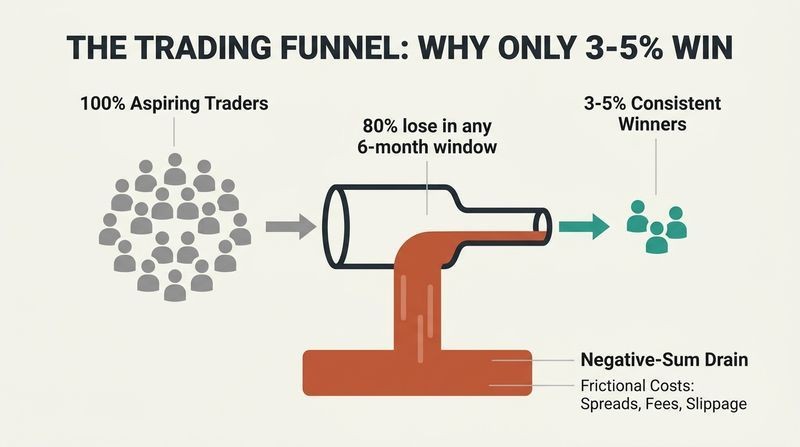
Trading is a negative sum game. Not zero sum. Transaction costs, spreads, and slippage bleed you dry, so you need genuine edge just to break even. Donnelly's research and experience converge on brutal numbers: independent day trader success sits around 3-5%. A Taiwan study found only about 1% of day traders generated persistent skill-based profit, while 8 of 10 lost money in any six-month window.
Even the pros mostly lose to the index. Just 28% of US large-cap fund managers beat the market in 2019, and only 11% over the prior decade. Markets are extremely (not perfectly) efficient. The reward is astronomical, which is exactly why the achievement is so rare. Go in clear-eyed about the odds.
What's striking is how closely trading's success rate mirrors other low-barrier, high-glamour fields: roughly 2-3% of published books sell over 5,000 copies, and about 2% of college athletes turn pro. This is the signature of what Nassim Taleb calls extremistan, domains where outcomes follow power laws rather than bell curves. The honest framing here is a public service. Most trading marketing sells the fantasy of easy money precisely because the reality is so unforgiving. The deeper point: barriers to entry and probability of success are often inversely related to perceived accessibility.
Rationality beats IQ; overconfidence is the trader's kryptonite
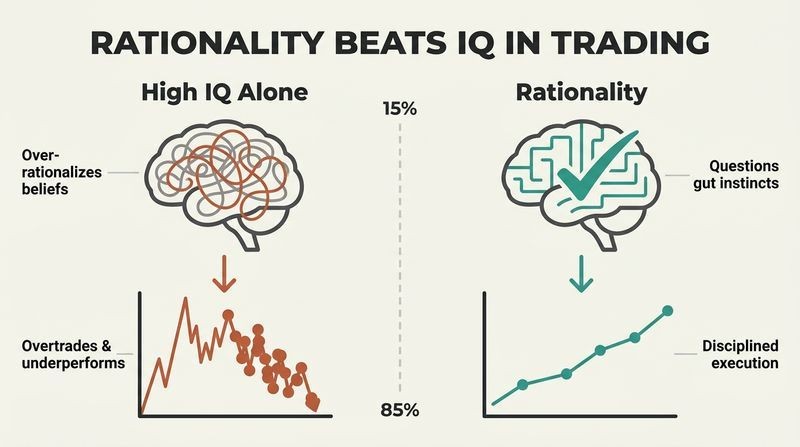
Smart is not the same as rational. Donnelly's synthesis of academic research yields two dominant findings: rationality best predicts trading success, and overconfidence best predicts failure. Rationality is measurable via the Cognitive Reflection Test, a three-question quiz that trips up people who trust their gut. (Classic example: a bat and ball cost $1.10, the bat costs $1 more than the ball, how much is the ball? The instinctive answer, 10 cents, is wrong. It's 5 cents.)
High IQ can even backfire. Intelligent people suffer more from confirmation bias because they are better at constructing arguments for what they already believe. Studies show men trade 45% more than women and underperform by roughly 1% because overconfidence drives overtrading. Buffett said it plainly: you don't need a 160 IQ, you need rationality.
Keith Stanovich, whose rationality research Donnelly draws on, coined the term dysrationalia, the failure to think rationally despite adequate intelligence. IQ and rationality correlate only moderately, sometimes near zero on specific tasks. This maps onto Kahneman's dual-process model: System 1 (fast, intuitive) versus System 2 (slow, deliberate). The trading twist is genuinely hard, though. Speed is sometimes edge, so traders can't always wait for System 2. Donnelly's clever workaround (act fast on the headline, then audit the decision with System 2 seconds later, and cut ruthlessly if it fails) is a practical reconciliation of the tension.
Your one job is to never blow up
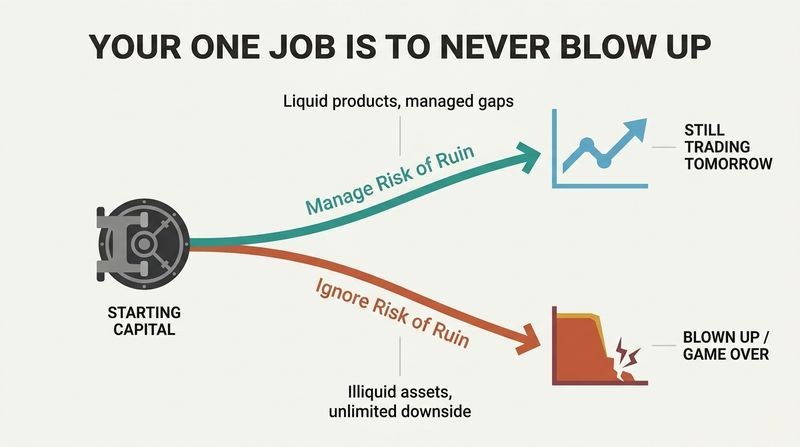
Survival trumps everything. Rule one is not to get rich, it's to still be trading tomorrow. Donnelly tells the story of Jerry, a 21-year-old with dazzling natural instincts who kept trading thinly-traded microcap stocks. Everyone warned him. He agreed, then did it again. He shorted a stock that ran from $2 to $8, turning a $50,000 account into negative $6,000 in minutes. He blew up twice with two different backers despite obvious talent.
Risk of ruin is the first risk to manage. Not risk of missing out, not risk of underperforming a benchmark. Trade liquid products, avoid pegged currencies and unlimited-downside positions, and manage overnight and weekend gaps. The 2021 GameStop short squeeze ruined funds that ignored this: cheap stocks offer limited profit but unlimited risk.
This echoes Warren Buffett's rules (never lose money) and Taleb's obsession with tail risk, but Donnelly grounds it in the mathematics of ruin. The insight that non-linear damage accelerates near zero is crucial: losing 50% requires a 100% gain to recover, losing 90% requires 1,000%. Behavioral economics adds a layer. The disposition effect and loss aversion mean traders instinctively do the opposite of survival, holding losers and cutting winners. Jerry's tragedy illustrates that talent without a survival framework is a liability, not an asset. Skill amplifies whatever system contains it, including a broken one.
Bet like a leopard: wait motionless, then pounce with force
Tight/aggressive is the winning style. Borrowed from poker, it means folding relentlessly until a genuinely juicy setup appears, then committing serious capital. Most traders fail at one half: either they're too impatient (spraying money on mediocre ideas) or too timid (nibbling even on once-a-year opportunities). Donnelly confesses his own kryptonite is overtrading, an itchy compulsion to press buttons.
Vary bet size dramatically by conviction. He uses three tiers:
1. Type I: routine high-conviction trades, risk 1-3% of free capital
2. Type II: major narrative shifts, risk 3-5% plus 10% of year-to-date profit
3. Type III: rare watershed events, risk the maximum you rationally can
Card counters win blackjack by betting big only when odds favor them. The default position, he insists, should be flat. When in doubt, do nothing.
The leopard metaphor captures something behavioral finance calls the activity bias, the human compulsion to act even when inaction is optimal. Studies of index funds versus active managers keep proving that doing less wins. Druckenmiller's famous line about being a pig (concentrating hard when conviction is highest) sits in tension with modern portfolio theory's diversification gospel, and Donnelly sides firmly with concentration for traders. One nuance worth adding: tight/aggressive demands accurate self-calibration of conviction, which overconfident humans routinely botch. The three-tier system is really a forcing function to prevent treating every trade as special, which is the overtrader's fatal error.
You control the process, never the short-term outcome
Judge decisions, not results. A good decision can produce a bad outcome, and a terrible decision can get bailed out by luck. Donnelly calls confusing the two resulting, borrowing from poker champion Annie Duke. His Flash Crash story is the perfect illustration: he executed a perfect three-day USDJPY short, banked $2.8 million, then impulsively flipped long for no reason and gave it all back, before recovering through disciplined re-entry.
Variance is not luck, and it evens out. Donnelly has tracked his trades since 2006 and wins on almost exactly 50% of days every year. His entire profit comes from the ratio of average winning day to average losing day. Losing streaks of 7-10 days are statistically inevitable even with a true 50% edge. Focus forward. Hindsight Harry, who dwells on missed trades, annoys everyone and improves nothing.
This is the poker-to-trading translation done well. Duke's Thinking in Bets and Michael Mauboussin's work on untangling skill from luck both argue that in high-variance domains, outcome-based feedback is actively misleading. There's a neat parallel to Billy Beane's Moneyball philosophy: process metrics predict future performance better than results. The psychological payoff is underrated. Traders who internalize variance suffer less, and suffering less preserves the cognitive bandwidth needed for good decisions. The challenge Donnelly honestly flags: distinguishing a genuine broken process from mere variance is extraordinarily hard in real time and often only clear with years of data.
Knowing a bias exists doesn't make you immune to it
Bias works like an optical illusion. You can be told exactly how your mind is malfunctioning and still fall for it. Donnelly catalogs the traders' greatest hits: confirmation bias (seeking evidence for what you already believe), anchoring (fixating on your entry price as if the market cares), the endowment effect (overvaluing positions you already own), extrapolation (assuming current trends continue forever), and apophenia (seeing patterns in randomness).
Anchoring runs deep. In experiments, people who drew high random numbers from a bag gave higher estimates to unrelated questions. In trading, you find it far easier to sell one cent above your entry (a win) than one cent below (a loss), even though the economics are identical. The fix isn't awareness alone. It's systems: pre-mortems, pros-and-cons sheets, actively arguing the opposite case, and automating stop losses so biased in-the-moment you can't intervene.
The claim that awareness is insufficient is well-supported. Research on debiasing consistently shows that education alone barely moves behavior, which is why Donnelly pivots to environmental design and automation, echoing the friction-based approach in behavioral economics (Thaler and Sunstein's nudge theory). The pattern-recognition point deserves emphasis: humans evolved to prefer false positives (mistaking wind for a predator costs energy) over false negatives (mistaking a predator for wind costs your life). That survival wiring becomes a liability in markets, where randomness generates convincing but meaningless patterns. Donnelly's skepticism toward technical analysis as forecasting flows directly from this evolutionary insight.
Charts can't forecast, but they optimize entries and exits
Technical analysis is a tactical tool, not a crystal ball. Donnelly is blunt: research shows chart patterns don't predict direction any better than random entries, and often with more volatility. He shares a personal embarrassment. He once got excited about a striking U-shaped pattern in currency highs and lows, only to learn it was a mathematical property of random walks (Arcsine Law), not a market signal.
So use charts for what they actually do well: managing risk and improving execution. His trade ideas always originate from narrative or microstructure, never from a chart. Technicals then help him pick a tight stop loss, find leverage, and signal when to abandon a bad idea. His favorite tools are simple: significant reference points like the NewsPivot (the last price before major news breaks), support and resistance, and reversal candles. The specific indicators barely matter. Keep it simple.
This is a refreshingly honest position in a field crowded with chartists selling forecasting systems. The Arcsine Law confession is a gem of intellectual humility, and it generalizes: much of what looks like signal in financial data is the statistical residue of random processes. Donnelly's reframe (technical analysis as a risk-management and execution discipline rather than a prediction engine) aligns with how many quant shops actually use price data. One extension: the NewsPivot concept is essentially a behavioral anchor made explicit. Markets treat the pre-news price as a psychological equilibrium, so a return through it signals the news was rejected.
Go deep on one market, not shallow across many
Narrow and deep beats wide and shallow. Donnelly argues expert-level knowledge of one product is a top source of edge. A StockTwits study found social-media sentiment predicted returns, but predictive power dropped as users followed more stocks. Attention and time are finite. Spreading them dilutes mastery. The pejorative macro tourist describes someone taking positions in a market they don't understand, chasing a popular narrative. Locals find the good meals; tourists overpay and leave disappointed.
Mastery has three layers:
1. Microstructure (who trades it, liquidity, bid-offer spreads, gap risk, volume by time of day)
2. Narrative (the evolving story driving price, and where it sits in its cycle)
3. Technicals, sentiment, and positioning
When new information hits, the expert reacts faster and smarter than everyone else, riding price to its new equilibrium and getting off as it overshoots.
This runs counter to the diversification instinct most investors absorb, but it's coherent for active traders seeking alpha rather than passive exposure. There's a deliberate-practice parallel here: Anders Ericsson's research on expertise emphasizes depth and focused repetition over breadth. Donnelly's microstructure obsession (knowing that S&P volume spikes at the open and close, or that Canadian bond futures surge at the 3pm Chicago close) is the trader's equivalent of a sommelier knowing terroir. The tension worth flagging: deep specialization creates fragility if that specific market's edge disappears, which is precisely why the book pairs this with a strong emphasis on adaptation.
Cut position size as volatility rises, or get chopped up
Bad traders always trade the same size. Good ones size dynamically. If the S&P moves 1% a day versus 3% a day, your stop loss and position must reflect that, or you'll get stopped out of good trades by ordinary noise. During the 2008 crisis, Donnelly slashed his usual USDMXN size from 20 million to 3 million and was still rattled by the P&L swings.
The formula flips inputs from how most people think. Start with dollars at risk (a percentage of capital), then use market volatility and technicals to set the stop, then back out the position size. Bad traders do it backwards, picking an arbitrary stop to fit a position they already chose. In crisis markets, forget overbought and oversold entirely. Oil fell from $65 to $50, seemed oversold, then went to minus $40. Nothing stays oversold in a panic.
Volatility-scaled position sizing is standard at systematic funds (risk parity, volatility targeting), but Donnelly makes it accessible to discretionary traders without the quant machinery. The deeper principle is that probability of hitting your stop is a direct function of volatility, so fixed sizing means your actual risk fluctuates wildly without your knowledge. The crisis-market caveat about overbought/oversold indicators failing is important and often ignored. Mean-reversion signals assume a stable regime, and regime change is exactly when they break, sometimes catastrophically. This is where many careers end: fading a crash that keeps crashing because the oscillator said oversold.
Behave like a call option: small losses, occasional huge wins
Structure your year for asymmetry. The ideal trading career looks like a call option: flat or small losses in bad years, medium-to-huge gains in good ones. The mechanism is simple but hard. Start each year slow, build a cushion, then take progressively more risk as profits accumulate, and pull back hard near zero.
Donnelly's Lehman story crystallizes this. In 2006 he hit his $6 million budget by March. His old bank would have told him to coast. His new boss instead said: set a stop at $3 million and try to turn $6 million into $10 million. That year he made $50 million. The lesson wasn't gamble your winnings, it was press hard when you have a capital cushion and opportunities are ripe. Simulations show risking a slice of year-to-date profit on high-conviction trades boosts upside dramatically without increasing downside.
This is a practical, toned-down application of the Kelly Criterion, which prescribes betting more as your edge and bankroll grow. Donnelly wisely warns it's distinct from the house money effect, the documented bias where gamblers treat winnings recklessly because they feel like free money. The distinction is subtle but vital: systematic risk-scaling is disciplined and opportunity-contingent, while house-money tilt is emotional and indiscriminate. The convexity framing (limited downside, unlimited upside) is the same shape Taleb champions in Antifragile. The path-dependence insight is underappreciated by non-traders: how you start the year mechanically constrains how much risk you can responsibly take later, so January mistakes echo for months.
Adapt constantly, because every edge decays toward zero
No strategy works forever. Markets are adaptive systems that arbitrage away known edges. Donnelly watched trend following's Sharpe ratios grind lower across the 1980s and 1990s as everyone piled in. His own bread-and-butter, correlation and cross-market trading, printed money from 2003 to 2013, then faded as live data feeds and cheap algorithms became universal. In 2006, few FX traders even watched gold and oil in real time. Now everyone does.
Kill your darlings. Borrowing Faulkner's advice to writers, he warns against loving a strategy that no longer works just because it made you money before. Major structural shifts (electronic broking in 1996, decimalization in 2001, algorithms in the mid-2000s, free retail trading in 2019) each rewired markets. When structure changes, stop and ask how it affects you, rather than complaining that the algos are stupid.
This is the trader's version of the Red Queen hypothesis from evolutionary biology, which Donnelly cites via Lewis Carroll: you must keep running just to stay in place. It reframes edge not as a possession but as a perishable good. The efficient-market implication is subtle. Markets aren't perfectly efficient, but they're relentlessly efficient-ing, constantly consuming inefficiencies. This creates a genuine strategic dilemma the book captures well: deep specialization (takeaway 8) builds edge, but specialization breeds the rigidity that adaptation punishes. The resolution is treating trading style as time-horizon and risk-approach, which persist, while specific strategies remain disposable tools swapped as regimes shift.
Love the game more than the money, and keep running
Passion beats greed as fuel. Trading is too grueling to endure for money alone. Donnelly grew up lower-middle-class, dreamed of wealth after reading Liar's Poker at 15, and money was his sole motivator early on. But once he crossed the threshold where more income stopped buying more happiness (the hedonic treadmill), he hit an existential wall. He rebuilt his motivation around enjoying the work itself.
Survival requires endurance and self-forgiveness. His darkest story: in December 2007, after a brutal year, a bad out-trade and a client trade pushed him into the red on the final day despite heroic effort. He emailed his wife that he couldn't do it anymore. He kept going. Twelve months later, he made over $50 million in 2008. Even Druckenmiller lost $3 billion in six weeks buying tech at the 2000 top. Forgive yourself, extract the lesson, and start fresh tomorrow.
The hedonic treadmill is robustly documented. Beyond roughly $75,000 to $125,000 in annual income, self-reported happiness barely rises with wealth, a finding Donnelly correctly cites. The deeper wisdom connects to intrinsic versus extrinsic motivation research (Deci and Ryan's self-determination theory): intrinsically motivated people persist longer and perform better in complex domains, precisely because the reward is the doing, not the payout. The 2007-to-2008 story is a testament to what Angela Duckworth calls grit, perseverance toward long-term goals through setbacks. The Chinese farmer parable that opens this section (maybe good, maybe bad, we never know how the story ends) is a quiet argument against overreacting to any single outcome.
Analysis
Alpha Trader belongs to a rare subgenre: trading books written by practitioners honest enough to admit how hard, and how psychological, the game actually is. Donnelly's structure (mindset, methodology, mathematics) is deliberate. He front-loads self-knowledge because he believes, correctly, that most traders fail not from lack of analytical skill but from irrationality and poor discipline. The book's intellectual backbone is the marriage of behavioral finance (Kahneman, Stanovich, Duke, Thaler) with the lived texture of a trading floor. That combination is what distinguishes it from both dry academic treatments and get-rich-quick pablum.
The central, somewhat contrarian thesis is that rationality, not intelligence, predicts success, and that overconfidence is the master flaw. This is well-supported but underappreciated because it's ego-deflating. Donnelly's willingness to catalog his own leaks (chronic overtrading, the Flash Crash flip, the 2007 near-quit) lends unusual credibility. He's not preaching from a pedestal; he's a recovering overtrader sharing his coping systems. The book's greatest strength is its integration. Position sizing, path dependence, variance, the call-option career shape, and dynamic risk allocation form a coherent survival mathematics rather than a grab-bag of tips. Its most valuable move is demoting technical analysis from prophecy to tactics, a stance that will irritate chartists but reflects the evidence.
Weaknesses worth flagging: the advice is calibrated to a professional discretionary macro trader with a bank seat, and some frameworks (Type II sizing, metagame politics) don't fully transfer to retail. The tension between deep specialization and constant adaptation is acknowledged but never fully resolved. And the honest 3-5% success rate raises an unanswered question: if edge is this rare and decaying, is the rational move for most readers simply to index? Donnelly would likely agree, which is itself a mark of the book's integrity.
Review Summary
Alpha Trader receives high praise from most readers, with an average rating of 4.58/5. Reviewers appreciate the book's insights on trading psychology, cognitive biases, and practical strategies. Many consider it a must-read for aspiring traders, highlighting its comprehensive coverage of mindset and methodology. Some readers found value in rereading the book, noting its applicability to various trading styles. A few critics mentioned its focus on short-term trading and advanced concepts, potentially limiting its relevance for some readers. Overall, the book is widely regarded as an excellent resource for traders at different experience levels.
People Also Read




Glossary
Alpha Trader
Rational, disciplined, adaptive elite traderDonnelly's archetype of the ideal trader: rational, intelligent, disciplined, patient, flexible, and courageously aggressive when opportunity strikes. Alpha refers to returns in excess of a benchmark. The Alpha Trader combines calibrated confidence (never overconfidence), a rigorous risk-management process, expert knowledge of one market, and the endurance to survive years of variance. An abstraction to aim toward, never fully attainable.
Tight/aggressive
Fold relentlessly, then bet bigA trading style borrowed from poker. Play as tight as possible by waiting patiently for high-quality, high-edge setups and rejecting mediocre ideas, then act with maximum committed force when a genuinely attractive opportunity appears. It resolves the paradox that trading demands both risk-loving aggression and iron discipline, two traits rarely found in the same person.
NewsPivot
Last price before major newsThe final price a security trades at immediately before market-moving news breaks. Because price reflects all known information, the NewsPivot marks the old equilibrium. If price later returns through it, the market has rejected the news as meaningless or larger players are using it as a liquidity event to trade the opposite way. Donnelly considers it the most powerful reference point in trading.
Type I, II, III trades
Three conviction and sizing tiersDonnelly's conviction-based position-sizing system. Type I are routine high-conviction trades (risk 1-3% of free capital). Type II involve a major narrative shift or dislocation (risk 3-5% plus roughly 10% of year-to-date profit). Type III are rare watershed events demanding the maximum bet you can rationally make. The scale is deliberately non-linear because Type III opportunities can define a career.
Free capital
Amount you can afford losingThe money a trader can afford to lose in a period. For retail traders, the portion of an account they could lose and still recover. For bank, real-money, and hedge fund traders, it equals the annual stop loss plus year-to-date profit. Position sizing percentages are calculated against free capital, so risk appetite expands as profits accumulate.
Resulting
Judging decisions by outcomesA term from poker champion Annie Duke, adopted by Donnelly. The error of evaluating a decision based solely on its outcome rather than the quality of the decision process. In high-variance domains, good decisions sometimes lose and bad decisions sometimes win, so outcome-based feedback misleads. Traders must focus on process, since they control inputs but not short-term results.
The Deviation
Price distance from moving averageDonnelly's overbought/oversold indicator: the gap between an asset's current price and its 100-hour moving average. By finding historical extremes of this gap, a trader can identify potential mean-reversion reversal points. It works in stable-volatility regimes but breaks down completely during crises, when assets can stay extremely stretched for extended periods.
Run-up trade
Positioning before a scheduled eventPredicting and profiting from what the crowd does in the days leading up to a major event, which is often easier than forecasting the event itself. Driven by three forces: traders reducing risk into volatile events, positioning for the obvious outcome, and speculators buying asymmetric lottery-ticket bets. Donnelly advises taking profit before the event rather than holding through it.
FAQ
What’s Alpha Trader about?
- Focus on Trading Success: Alpha Trader by Brent Donnelly explores the mindset, methodology, and mathematics necessary for successful trading. It emphasizes self-awareness and discipline as key factors for success.
- Market Dynamics and Psychology: The book provides insights into market dynamics and the psychological aspects of trading, helping readers understand their own behaviors and biases.
- Practical Guidance: It offers actionable advice and frameworks for traders at all levels, aiming to enhance their trading performance through practical strategies.
Why should I read Alpha Trader?
- Expert Insights: Brent Donnelly, with over 20 years of experience in the global foreign exchange market, shares valuable insights from his career.
- Comprehensive Approach: The book combines psychological, methodological, and mathematical perspectives, making it a well-rounded resource for serious traders.
- Real-Life Examples: Donnelly includes personal anecdotes and trading stories, illustrating key concepts and making the material relatable and engaging.
What are the key takeaways of Alpha Trader?
- Self-Awareness is Crucial: Understanding oneself is the first step to becoming a successful trader. The book emphasizes that the biggest enemy in trading is often the trader themselves.
- Mindset Matters: Developing a rational mindset with emotional control is essential for navigating trading complexities.
- Adaptability is Key: Traders must be flexible and willing to adapt their strategies as market conditions change.
What is the Alpha Trader mindset according to Brent Donnelly?
- Rational and Disciplined: The mindset involves being rational, disciplined, and self-aware, balancing confidence with humility.
- Continuous Improvement: It encourages a growth mindset, where traders are always looking to learn and improve their skills and strategies.
- Emotional Control: Managing emotions and maintaining focus during high-pressure situations is critical.
How does Alpha Trader define success in trading?
- Rational Decision-Making: Success is defined by the ability to make rational decisions based on a well-thought-out process rather than emotional reactions.
- Consistent Profitability: True success is about sustaining profitability over time, not just making money.
- Self-Management: Successful traders manage their behaviors and biases effectively, leading to better trading outcomes.
What role does risk management play in trading success according to Alpha Trader?
- Preventing Ruin: Effective risk management is essential to avoid catastrophic losses that can wipe out a trading account.
- Enhancing Longevity: Good risk management practices allow traders to survive in the market long enough to capitalize on their strategies.
- Balancing Risk and Reward: Finding the right balance between taking risks for potential rewards and protecting capital is crucial.
What is the concept of "NewsPivot" in Alpha Trader?
- Definition of NewsPivot: A NewsPivot is the last trade price before significant market-moving news is released, serving as a critical reference point.
- Market Reaction: The first price that trades after the news can indicate market perception. Returning to the NewsPivot suggests rejection of the news.
- Strategic Importance: Understanding NewsPivots helps traders make informed decisions about entering or exiting positions.
How does Brent Donnelly define "overconfidence" in Alpha Trader?
- Critical Bias: Overconfidence is described as a devastating bias, leading traders to take excessive risks and make poor probability assessments.
- Consequences: Overconfident traders tend to overtrade and ignore contradictory information, resulting in significant losses.
- Managing Overconfidence: Traders should remain humble and aware of their limitations, using strategies like pre-mortems to counteract overconfidence.
What is the "narrative cycle" discussed in Alpha Trader?
- Understanding the Cycle: The narrative cycle consists of stages that describe how market narratives evolve over time, influencing market behavior.
- Market Psychology: Each stage reflects the collective psychology of market participants, crucial for informed trading decisions.
- Identifying Turning Points: Recognizing the narrative cycle helps traders anticipate potential market turning points.
What are the Type I, II, and III trades mentioned in Alpha Trader?
- Classification of Trades: Trades are categorized into three types based on conviction levels: Type I (normal), Type II (high conviction), and Type III (outlier opportunities).
- Risk Management Implications: Each type has different risk management parameters, with Type III allowing larger positions due to high potential upside.
- Strategic Focus: Identifying trade types helps align strategies and execution methods, enhancing market condition adaptability.
How does Alpha Trader suggest handling emotions in trading?
- Self-Awareness is Key: Recognizing emotional states that impact decisions is crucial. Traders should observe emotions without letting them dictate actions.
- Time Delay Technique: Implementing a time delay before decisions helps avoid impulsive actions during strong emotions.
- Developing a Mantra: Personal mantras reinforce positive thinking and focus, reminding traders to stick to their plans.
What are the best quotes from Alpha Trader and what do they mean?
- "The only thing I am 100% sure of is that anyone who is 100% sure of anything is not worth listening to.": Emphasizes humility and skepticism, warning against certainty leading to overconfidence.
- "You cannot make your year in January, but you can lose it.": Highlights the dangers of excessive early-year risks, stressing a solid foundation before increasing exposure.
- "Flat is the most powerful position in trading.": Suggests neutrality provides clarity and flexibility, encouraging unbiased readiness for opportunities.
About the Author
Other books by Brent Donnelly
Download PDF
Download EPUB
.epub digital book format is ideal for reading ebooks on phones, tablets, and e-readers.








































