

Key Takeaways
Ordinary people beat CIA analysts at forecasting world events
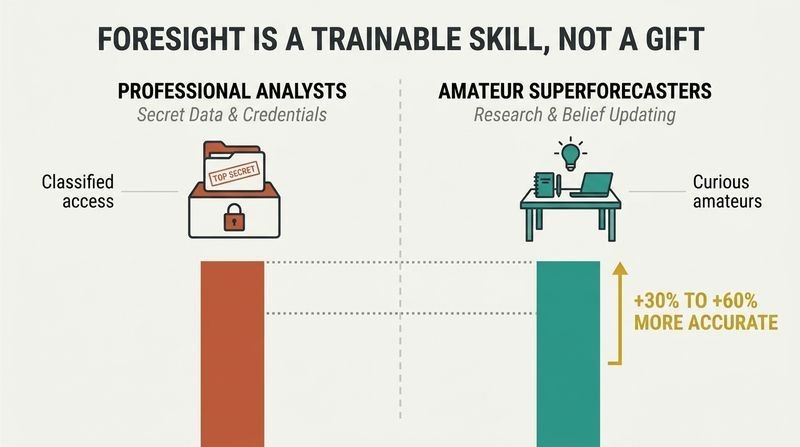
Foresight is a trainable skill, not a gift. In a tournament funded by IARPA (the intelligence community's research agency), Tetlock recruited thousands of volunteers to predict geopolitical events. A retired computer programmer named Doug Lorch and a former Agriculture Department worker named Bill Flack outforecast professional analysts who had access to classified intercepts, reportedly by about 30%. His team, the Good Judgment Project, beat the official control group by 60% in year one.
The top 2% of forecasters, whom Tetlock dubbed superforecasters, were not geniuses with secret data. They were curious amateurs forecasting global affairs at their kitchen tables for a $250 gift certificate. What made them exceptional was not who they were but what they did: relentless research, self-criticism, and belief updating.
What's striking is how this inverts the expert-worship baked into media and government. The finding echoes James Surowiecki's wisdom-of-crowds work and Paul Meehl's 1954 demonstration that simple algorithms beat clinical judgment. Yet Tetlock adds nuance: aggregation only works when judgments are genuinely independent and diverse. A skeptic might note selection bias, since these volunteers self-selected as unusually motivated news junkies. The deeper lesson connects to deliberate practice research from Anders Ericsson: elite performance in a well-defined domain with clear feedback is cultivated, not innate. The tragedy is that most forecasting domains never generate the feedback that would let anyone improve.
Most celebrity pundits forecast no better than a dart-throwing chimp
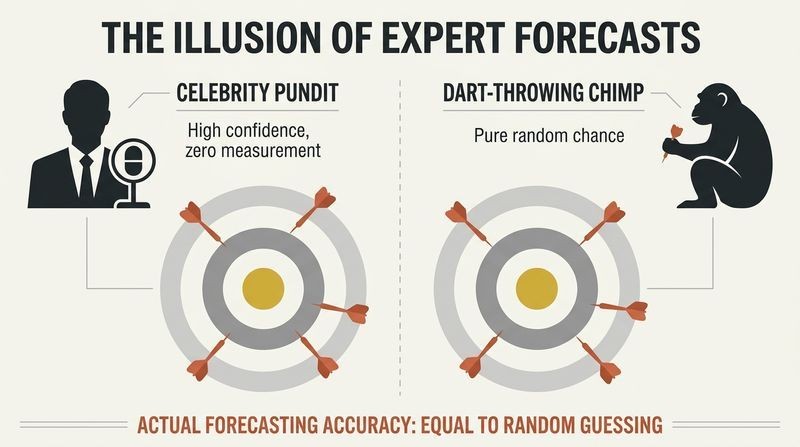
Confidence sells; accuracy is rarely measured. Tetlock's twenty-year study (1984 to 2004) collected roughly 28,000 predictions from 284 experts. The average expert did about as well as random guessing, and accuracy collapsed toward chance three to five years out. The famous punchline, that experts rival a dart-throwing chimpanzee, was widely misquoted to mean all expertise is useless. Tetlock rejects that nihilism.
The problem is a demand-side failure. Consumers of forecasts (governments, corporations, voters) never demand track records. Pundits like the fictionalized Tom Friedman are hired for compelling storytelling, not proven accuracy. Old forecasts vanish like yesterday's news, and no one reconciles what was said with what happened. Baseball managers consult batting averages, yet we bet lives and trillions of dollars on forecasters whose accuracy is entirely untested.
The chimp line became a backstop for know-nothing populism, which clearly irritates Tetlock. His real target is not expertise but unaccountability. This parallels the replication crisis in psychology and evidence-based medicine's slow triumph over authority. A useful extension: prediction markets and platforms like Metaculus now do systematically score forecasters, slowly building the accountability infrastructure Tetlock wants. One challenge worth raising is that pundits arguably serve functions beyond prediction, including agenda-setting and framing. Tetlock concedes this but insists that policy advocacy smuggles in implicit forecasts, which is fair. If you argue a policy will work, you have made a testable claim, whether you admit it or not.
Reality is part clock, part cloud, so calibrate your ambition
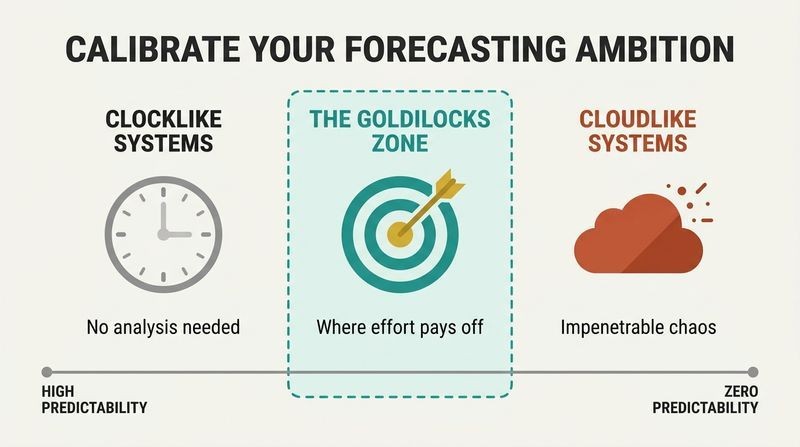
Predictability depends on what, how far, and under what conditions. Tetlock borrows two metaphors. The Laplacean clock represents perfect determinism, where knowing all present conditions lets you predict the future exactly. The Lorenzian cloud represents chaotic systems where tiny errors explode, like Edward Lorenz's butterfly whose wing-flap could alter a distant tornado. Weather is reliable two days out and useless beyond a week.
The world jumbles both. Tides, eclipses, and sunrises are clocklike and predictable for decades. The Arab Spring, sparked by one Tunisian fruit vendor's self-immolation in 2010, was cloudlike and unforeseeable. The skill lies in triage: identify which questions sit in the Goldilocks zone where effort actually pays off, and abandon the truly impenetrable ones rather than fooling yourself.
The clock-cloud distinction is a vivid teaching device, though the philosopher Karl Popper originated it. What's valuable is the practical implication: forecasting horizon matters enormously, and humility should scale with it. This connects to Nassim Taleb's fat-tailed distributions and to complexity science more broadly. A modern reader might add that machine learning has pushed some cloudlike frontiers slightly outward (weather models keep improving), yet the payoffs shrink toward zero as chaos reasserts itself. The genuinely actionable insight is triage: spending effort on twelve-year election predictions is wasted, while three-to-eighteen-month questions reward the diligent. Knowing the difference is itself a mark of good judgment.
Distrust the gut answer that feels obviously, effortlessly true
Your fast brain jumps to conclusions from thin evidence. Tetlock leans on Daniel Kahneman's two-system model. System 1 is automatic and instant; System 2 is slow and effortful. Ask most people whether a bat and ball costing $1.10 total, with the bat a dollar more than the ball, means the ball costs ten cents, and they blurt yes. It is wrong (the answer is five cents). System 1 delivered a confident, unchecked answer.
Tetlock calls the default the tip-of-your-nose perspective. It treats whatever is visible as the whole truth, a bias Kahneman labels WYSIATI (What You See Is All There Is). When Norway's 2011 Oslo bombing occurred, commentators instantly blamed Islamist terrorists; the perpetrator was a right-wing Norwegian. The plausible story felt true, so scrutiny stopped.
This is Kahneman and Tversky repackaged for forecasters, and Tetlock is transparent about the debt. The fresh contribution is showing that superforecasters do not possess superior intuition; they possess superior discipline in interrogating intuition. Note the tension with Gary Klein's research on expert intuition, where firefighters and nurses read valid cues fast. Kahneman and Klein reconciled this: intuition is trustworthy only in domains with stable regularities and quick feedback (chess, firefighting), not in politics or markets where cues are noisy. The Oslo example is a clean illustration of confirmation bias plus availability. The corrective is asking what would convince me I am wrong, a question scientists ask reflexively and pundits almost never do.
Foxes who know many things crush hedgehogs with one big idea
How you think beats what you know. Isaiah Berlin's parable divides thinkers into hedgehogs, who filter everything through one grand theory, and foxes, who gather scraps from many sources and stitch them together. Tetlock found foxes decisively outforecast hedgehogs on both calibration and boldness.
Hedgehogs wear green-tinted glasses. Like visitors forced to see the Emerald City as green, ideologues see confirmation everywhere. Larry Kudlow, wedded to supply-side economics, insisted through 2008 that a booming economy was roaring even as the Great Recession swallowed it. More information only inflated his confidence, not his accuracy. Perversely, hedgehogs make better television: their tight, certain stories grab audiences. Tetlock found an inverse correlation between fame and accuracy. The more famous the expert, the worse the forecasts.
The fox-hedgehog frame is Tetlock's signature contribution and it has aged well. The fame-accuracy inverse correlation deserves emphasis because it explains a structural pathology: media incentives select for exactly the traits that degrade prediction. This dovetails with Philip Converse's work on belief systems and with research on the overconfidence of specialists. A caveat Tetlock himself raises is that fox and hedgehog form a spectrum, not a binary, and people shift styles by context. Worth adding: hedgehog thinking sometimes generates the provocative questions foxes then answer well. Big-idea thinkers like Friedman can spotlight what matters even when their predictions flop. The ideal is symbiosis, not the extinction of one type.
Break impossible questions into answerable pieces, Fermi-style
Decompose to separate the knowable from the guessed. The physicist Enrico Fermi trained students to estimate seemingly unanswerable questions, like how many piano tuners work in Chicago, with no data. The trick is breaking the question into sub-questions: how many pianos exist, how often they are tuned, how long tuning takes, how many hours a tuner works. Crude guesses at each step combine into a shockingly accurate final estimate (around 63, close to reality).
Superforecasters Fermi-ize geopolitics. Facing whether polonium would be found in Yasser Arafat's exhumed body, Bill Flack did not start with Middle East politics. He asked what would have to be true: can polonium even be detected years later, and how many pathways could have contaminated the body? Decomposition dragged hidden assumptions into daylight.
Fermi estimation is standard in physics pedagogy and tech interviews, but applying it to political forecasting is Tetlock's clever transplant. The deeper cognitive value is that decomposition defeats attribute substitution, the mind's habit of swapping a hard question for an easy one. By forcing explicit sub-estimates, you expose where your uncertainty actually lives. This resonates with decision-analysis techniques like fault trees and with Douglas Hubbard's work on measuring the apparently immeasurable. A limitation: decomposition can propagate errors if sub-estimates are correlated or systematically biased, and false precision can masquerade as rigor. Still, the discipline of daring to be wrong on record beats the false comfort of a black-box hunch.
Anchor on the base rate before diving into juicy specifics
Start outside, then move inside. Kahneman distinguishes the outside view (how often things like this happen across a broad class) from the inside view (the vivid specifics of this case). Superforecasters consult the outside view first because of anchoring: whatever number we start with drags our final estimate toward it, and we underadjust. Starting with a meaningful base rate produces a meaningful anchor.
Example: does the Renzetti family own a pet? Amateurs spin stories from the family's Italian name and single child. Superforecasters first learn that about 62% of American households own pets, then adjust. When Bill Flack assessed China-Vietnam clash risk, he first estimated how frequently such clashes occur historically (say every five years, so 20% annually), then tuned for current conditions. The inside view refines; it should not lead.
This is one of the most portable tools in the book. The planning fallacy is the everyday cost of ignoring it: people estimate project timelines from the inside view and are chronically late. Larry Summers reportedly doubled employees' time estimates and bumped up the unit, a joke that is also sound base-rate correction. The outside view fights the seductive coherence of narrative. One nuance: base rates require choosing a reference class, and reference-class selection is itself a judgment call that can be gamed. Two forecasters can pick different classes and reach different anchors. The art lies in finding the class that genuinely resembles your case, then updating honestly.
Replace yes, no, and maybe with fine-grained probabilities
Most people own a three-setting mental dial. As Amos Tversky joked, humans default to gonna happen, not gonna happen, and maybe. This served Stone Age survival, where distinguishing a 60% from an 80% chance of a lurking lion added nothing. But it wrecks modern forecasting. Superforecasters think in granular percentages, sometimes debating whether a probability is 5% or 1%.
Granularity predicts accuracy. Barbara Mellers showed that forecasters who use single percentage points (say 21% versus 22%) beat those who round to fives, who beat those stuck on tens. When she artificially rounded superforecasters' estimates even slightly, their scores dropped, while regular forecasters lost little. Superforecasters also reject fate. On a nine-point scale measuring belief that events are meant to be, they scored lowest, and the more probabilistic the thinker, the more accurate.
The claim that meaningful precision below one percentage point matters strikes many as absurd, yet the tournament data support it. This connects to Sherman Kent's crusade to attach numbers to intelligence estimates, foiled when analysts realized vague words like serious possibility protected them from blame. The wrong-side-of-maybe fallacy (judging a 70% forecast wrong because the event didn't happen) is a genuine cultural obstacle, punishing honest probabilistic thinkers. Worth noting the tradeoff Tetlock flags elsewhere: granularity is only virtuous if the distinctions are real, not bafflegab dressed in decimals. The finding that rejecting fate correlates with accuracy is provocative and slightly uncomfortable, hinting that psychological comfort and forecasting skill may pull in opposite directions.
Update your beliefs often, but in small increments
Navigate between two rocks. Tetlock frames updating as sailing between Scylla (underreaction, clinging to beliefs) and Charybdis (overreaction, lurching at every headline). Underreaction is driven by belief perseverance and ego. The internment of 112,000 Japanese Americans in 1942 persisted because officials like Earl Warren had too much identity invested to admit the threat was imaginary; General DeWitt even claimed the absence of sabotage proved sabotage was coming.
Small updates capture value from both old and new information. Superforecaster Tim Minto won season three partly by changing a Syrian refugee forecast 34 times, each shift averaging just 3.5%. This is Bayesian updating in spirit: your new belief equals your prior belief weighted by the diagnostic value of fresh evidence. Superforecasters rarely compute Bayes's formula, but they live its logic, nudging from 60% to 64% rather than leaping.
The Scylla-Charybdis framing captures a real optimization problem also studied in signal processing and Kalman filtering, where you continuously blend prior estimates with noisy measurements. Belief perseverance links to Leon Festinger's cognitive dissonance and Dan Kahan's identity-protective cognition, where beliefs anchored near one's self-concept resist all evidence. Tetlock's Jenga metaphor (beliefs stacked so a foundational one topples everything) is a useful mental model. The counterintuitive gift is that superforecasters' amateur status is an advantage: with little ego staked on any forecast, they update freely. This suggests organizations might gain from separating the person who forecasts from the person whose reputation rides on being right.
Growth mindset and grit matter three times more than raw IQ
Perpetual beta is the strongest predictor of success. Borrowing the software term for software never released as final but endlessly improved, Tetlock found that commitment to self-improvement predicted becoming a superforecaster roughly three times more powerfully than intelligence. Superforecasting is about 75% perspiration, 25% inspiration.
Skill requires the try, fail, analyze, adjust cycle plus feedback. Keynes, a superb investor, was wiped out twice yet bounced back by ruthlessly scrutinizing his mistakes, embodying his reputed line about changing his mind when facts change (a quote Tetlock could not actually source). But experience alone teaches nothing without clear, timely feedback. Police officers grow more confident, not more accurate, at spotting lies because feedback is delayed and murky. Meteorologists and bridge players stay well-calibrated because outcomes arrive fast and unambiguous. Hindsight bias silently corrupts memory otherwise.
The primacy of grit over intelligence echoes Angela Duckworth (Tetlock's colleague) and Carol Dweck's mindset research, both cited here. The subtler and more original point is about feedback architecture: talent decays without a scoring system that turns the lights on. This is why forecasting stagnates in most institutions and why bridge and weather do not. Hindsight bias, documented by Baruch Fischhoff, is the quiet killer, retroactively editing memory so we believe we knew it all along and thus learn nothing. A practical takeaway: keeping a dated, explicit forecast journal is the single cheapest intervention available. The claim that mindset trumps IQ threefold should be read as domain-specific, above a threshold of basic numeracy and curiosity.
The best teams argue respectfully and share generously
Groups can be wise or mad. Kennedy's same advisers bungled the 1961 Bay of Pigs through groupthink (Irving Janis's term for cohesive groups suppressing dissent to preserve harmony), then averted nuclear war during the 1962 Cuban Missile Crisis after Kennedy institutionalized skepticism, devil's advocates, and even left the room so debate flowed freely.
Superteams outperformed everything. Putting superforecasters on teams made them about 50% more accurate. Teams of regular forecasters beat the wisdom of the crowd by 10%, and superteams beat prediction markets by 15 to 30%. The secret was a culture of precision questioning, constructive confrontation, and sharing. Adam Grant's research on givers (who contribute more than they take) applies: superforecasters like Doug Lorch and Tim Minto shared programming tools and analyses, and their teams won. A group's open-mindedness is an emergent property, not just the sum of members.
The counterintuitive result that amateur superteams beat liquid prediction markets challenges the strong efficient-market hypothesis, though Tetlock fairly concedes the markets tested lacked real money and depth. The finding that collective intelligence is emergent, not additive, aligns with Anita Woolley and Christopher Chabris's work showing a group's IQ depends more on communication patterns and social sensitivity than on members' individual IQs. Grant's giver research adds the moral-economy dimension: generosity is strategically rational in repeated interactions. The practical caution Tetlock raises is real: you cannot just anoint stars and marinate them in teams inside a real company without triggering resentment and disruption. Diversity of perspective, per Scott Page, may matter as much as raw ability.
Great leaders pair fierce resolve with intellectual humility
Command intent, not micromanagement. Tetlock resolves the apparent clash between doubt-driven forecasting and decisive leadership through the Prussian doctrine of Auftragstaktik (mission command), refined by Moltke and the Wehrmacht, later adopted by Eisenhower, Patteon, and modern corporations like Amazon and 3M. Leaders state the goal but leave the how to those on the ground, who improvise as reality shifts. No plan survives contact with the enemy.
Intellectual humility is not self-doubt. Poker champion Annie Duke distinguishes humility toward the game (which is fiendishly complex and never mastered) from confidence against opponents. Soros, Keynes, and Petraeus were all supremely self-assured yet recognized reality's staggering complexity and their own fallibility. Tetlock deliberately uses the Wehrmacht, an evil organization, to force the hardest perspective-taking: acknowledging competence in something we despise, lest we fatally underestimate opponents.
The synthesis is elegant: humility about the world plus confidence in one's ability to act. This maps onto the distinction between epistemic humility and paralysis. Auftragstaktik has become fashionable in agile management and Stanley McChrystal's Team of Teams, and the parallel to distributed decision-making in resilient systems is strong. Tetlock's choice of the Wehrmacht is provocative but pedagogically sharp: Fitzgerald's line about holding two opposed ideas at once captures the required cognitive move. The steelman is that moral revulsion should never distort factual assessment of capability, a discipline intelligence analysts sorely need. The risk, worth naming, is that admiring an evil institution's efficiency can slide into moral anesthesia if the reader forgets why it deserved destruction.
Analysis
Superforecasting is a science book disguised as a self-help manual, and its rigor is its distinguishing feature. Where most prediction advice offers aphorisms, Tetlock offers a tournament: hundreds of thousands of dated, scored, falsifiable forecasts adjudicated by IARPA. This methodological spine lets him make an empirical claim few pundits could survive, that forecasting skill is real, measurable, and teachable, and that a self-selected group of amateurs can outperform credentialed analysts with classified access. The book's intellectual lineage is clear: Kahneman and Tversky's heuristics, Meehl's actuarial superiority, Berlin's fox and hedgehog, Fischhoff's hindsight bias. Tetlock's originality lies less in inventing concepts than in operationalizing them into a portrait of a cognitive style, then proving that style wins.
The deepest tension in the book is between accuracy and meaning. Superforecasters reject fate, tolerate ambiguity, and treat beliefs as disposable hypotheses. Tetlock candidly notes that finding meaning correlates with wellbeing but negatively with foresight, raising an unresolved question: is probabilistic clarity psychologically costly? He sidesteps it, but it haunts the project. A related limitation, which Tetlock engages honestly through his sparring with Nassim Taleb, is that the tournament measured short-horizon questions (months, not decades) and cannot speak to the black swans that arguably shape history most. His rejoinder, that big events decompose into forecastable smaller ones, is clever but not fully satisfying.
What elevates the book is its refusal of false dichotomies: clock versus cloud, intuition versus analysis, human versus machine, leadership versus doubt. Repeatedly Tetlock insists the answer is a calibrated blend. This is intellectually honest but occasionally frustrating for readers wanting rules. His genuine contribution to public life is the call for an evidence-based forecasting revolution mirroring evidence-based medicine, keeping score, demanding track records, and depolarizing debates by forcing rivals to make precise, testable bets. If widely adopted, that norm would improve discourse more than any individual technique in the book.
Review Summary
Superforecasting receives high praise for its insightful analysis of prediction and forecasting. Readers appreciate Tetlock's rigorous research on "superforecasters" who consistently outperform experts. The book explores cognitive biases, decision-making processes, and the importance of open-mindedness in forecasting. Many find it thought-provoking and well-written, drawing comparisons to works by Kahneman and Taleb. While some criticize repetition or political focus, most consider it a valuable read for understanding prediction and critical thinking in an uncertain world.
People Also Read


FAQ
What's Superforecasting: The Art and Science of Prediction about?
- Focus on Prediction Skills: The book explores how certain individuals, termed "superforecasters," excel at making accurate predictions about future events.
- Research-Based Insights: It presents findings from the Good Judgment Project, highlighting the importance of rigorous analysis and continuous learning.
- Practical Applications: The skills of superforecasters can be cultivated and applied in various fields, including politics, business, and personal decision-making.
Why should I read Superforecasting: The Art and Science of Prediction?
- Improve Decision-Making: The book enhances your ability to make informed decisions by understanding effective forecasting principles.
- Learn from Experts: It offers insights from top forecasters, showcasing their techniques and thought processes.
- Engaging and Accessible: Philip E. Tetlock presents complex ideas in an engaging manner, making the content accessible to a wide audience.
What are the key takeaways of Superforecasting: The Art and Science of Prediction?
- Forecasting is a Skill: Forecasting is not just about luck; it is a skill that can be developed through practice and the right mindset.
- Importance of Updating: Superforecasters frequently update their predictions based on new information, significantly improving accuracy.
- Diverse Perspectives Matter: Considering multiple viewpoints and synthesizing them into a coherent forecast is crucial for effective forecasting.
What is a superforecaster according to Superforecasting?
- Definition of Superforecaster: A superforecaster is an individual who consistently makes accurate predictions about future events.
- Traits of Superforecasters: They are humble, reflective, and actively open-minded, viewing their beliefs as hypotheses to be tested.
- Commitment to Continuous Learning: They embrace a "growth mindset," believing that their abilities can be developed through effort and learning.
How do superforecasters differ from regular forecasters in Superforecasting?
- Cognitive Habits: Superforecasters employ distinct cognitive habits, such as open-mindedness and careful analysis.
- Use of Outside and Inside Views: They balance outside views (base rates) with inside views (specific details) when making forecasts.
- Frequent Updating: Superforecasters are diligent in updating their predictions based on new information, enhancing accuracy.
What is the Good Judgment Project mentioned in Superforecasting?
- Research Initiative: The Good Judgment Project was a large-scale research initiative to identify and improve forecasting skills.
- Tournament Structure: It operated as a forecasting tournament, where participants competed to make the most accurate predictions.
- Findings on Superforecasters: The project revealed that a small percentage of participants, dubbed "superforecasters," consistently outperformed others.
What is the significance of the term "dragonfly eye" in Superforecasting?
- Metaphor for Perspective: The term refers to the ability to see multiple perspectives simultaneously, akin to how a dragonfly’s eyes work.
- Enhanced Accuracy: This approach allows forecasters to better understand complex situations and make more informed predictions.
- Encourages Collaboration: It promotes collaboration among forecasters, encouraging them to share insights and challenge assumptions.
What is the "dilution effect" mentioned in Superforecasting?
- Understanding the Dilution Effect: It refers to the phenomenon where irrelevant information weakens the confidence of individuals in their judgments.
- Impact on Decision-Making: This effect can lead to overreaction or underreaction to important information.
- Relevance to Forecasting: Superforecasters strive to focus on pertinent information, filtering out noise to concentrate on relevant data.
How do superforecasters update their beliefs according to Superforecasting?
- Frequent and Incremental Updates: They regularly revisit their predictions and make small adjustments based on new evidence.
- Use of Bayesian Thinking: Superforecasters employ Bayesian methods to weigh prior knowledge against new information.
- Continuous Learning Process: They view belief updating as an ongoing process, learning from both successes and failures.
What is the significance of "perpetual beta" in Superforecasting?
- Concept of Perpetual Beta: It refers to the idea that superforecasters are always in a state of learning and improvement.
- Mindset of Adaptability: This mindset encourages them to remain flexible and open to change.
- Application in Various Fields: The principle can be applied beyond forecasting, emphasizing ongoing education and skill enhancement.
What are the "Ten Commandments for Aspiring Superforecasters" in Superforecasting?
- Guidelines for Improvement: They serve as practical advice for enhancing forecasting abilities.
- Focus on Key Principles: Key commandments include triaging questions and maintaining humility in the face of uncertainty.
- Encouragement of Practice: They stress the importance of practice and feedback in developing forecasting skills.
What are some common forecasting errors discussed in Superforecasting?
- Overconfidence and Underconfidence: Forecasters often fall into the traps of overconfidence or underconfidence in their predictions.
- Hindsight Bias: This occurs when individuals believe they could have predicted an event after it has happened.
- Failure to Update Beliefs: Many forecasters struggle to adjust their predictions in light of new information.
About the Author
Other books by Philip E. Tetlock
Download PDF
Download EPUB
.epub digital book format is ideal for reading ebooks on phones, tablets, and e-readers.








































