

Key Takeaways
A billion anonymous searches expose what surveys never could about desire
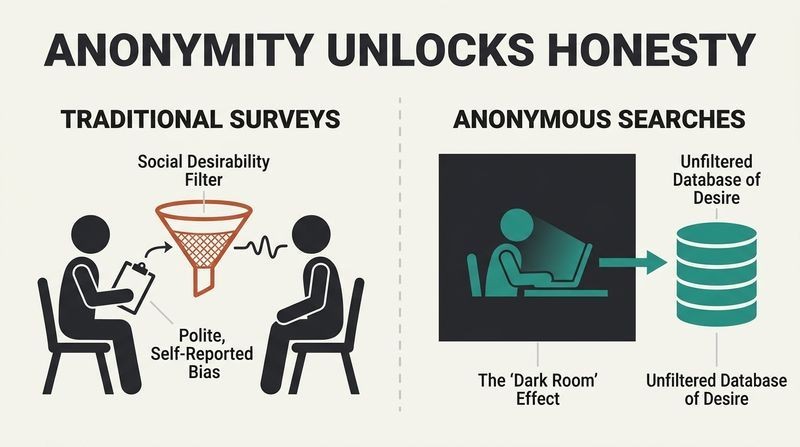
The internet is the largest sex experiment ever run. Two computational neuroscientists, Ogi Ogas and Sai Gaddam, analyzed roughly 400 million web searches, a half-million AOL search histories, 40,000 adult sites, millions of erotic stories, and reams of classifieds. Their premise: people lie to researchers but not to search engines. Traditional sexology relied on skittish undergraduates and self-reports, and only Alfred Kinsey ever surveyed sexual interests at scale, over half a century ago.
Anonymity unlocks honesty. They invoke a 1973 experiment where strangers placed in a pitch-dark room began touching, hugging, and kissing within minutes. The web is that dark room scaled to a billion people. About 13% of searches were erotic, revealing patterns invisible to any questionnaire.
The methodological leap here echoes the broader rise of "big data" behavioral science. What makes it compelling is the escape from the WEIRD sampling problem (Western, Educated, Industrialized, Rich, Democratic subjects who comprise 96% of psychology studies yet are global outliers). Yet search data carries its own biases: it captures wishes, not deeds, and skews toward interests hard to find on mainstream sites. It cannot distinguish curiosity from arousal, or a lonely teenager from a researcher. The authors are refreshingly candid about this. Still, triangulating searches against site traffic and subscriptions strengthens the case considerably beyond any single anecdote.
Male desire fires instantly at a single cue, like Elmer Fudd
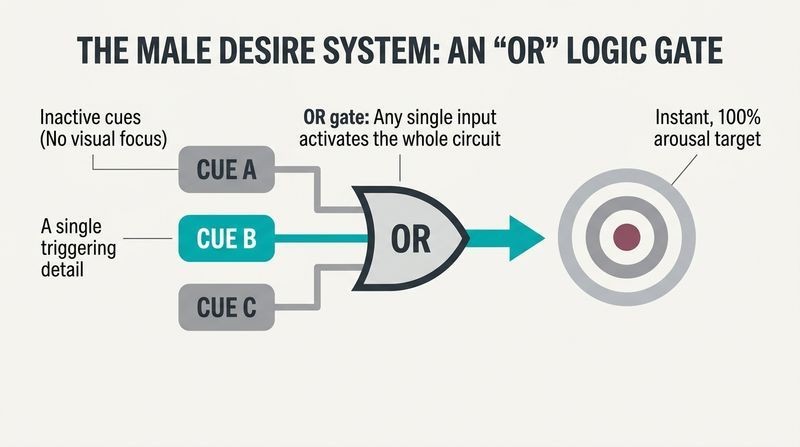
Men run an OR gate. Any one arousing cue (a curve, a body part, a MILF, a pair of heels) is enough to trigger male desire, which then aims straight at orgasm. The authors nickname this the Elmer Fudd system: solitary, trigger-happy, easily fooled, and endlessly persistent. Rhesus monkeys will trade fruit juice to view photos of female rumps. Men at the National Science Foundation risked their careers viewing porn on government computers.
Visuals dominate. Male arousal runs through the amygdala and hypothalamus, activated more strongly in men even when women report greater arousal. Roosters mount an artificial hen's comb; men objectify anatomy the same way, a tendency visible in 26,000-year-old faceless Venus figurines with exaggerated breasts and hips.
The OR gate framing is elegant and largely consistent with neuroimaging showing men's tighter coupling between visual stimulus and physiological response. But "objectification" as biological destiny risks overreach. Cross-cultural work (and the book's own admission about hunter-gatherer societies where breasts are not fetishized) suggests culture heavily shapes which cues fire. The Fudd metaphor is memorable but flattens variation: plenty of men require emotional context, and desire fluctuates with stress, age, and relationship. The evolutionary logic (cheap sperm, seize any opportunity) is a plausible ultimate cause, though such adaptationist storytelling is notoriously hard to falsify.
Female desire demands many cues at once, like a detective
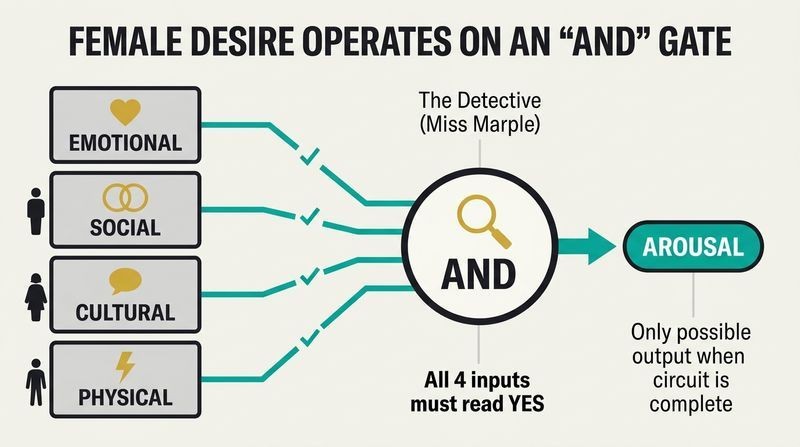
Women run an AND gate. No single cue suffices; a whole checklist must be satisfied simultaneously (status, kindness, confidence, safety, feeling desirable). The authors call this system the Miss Marple Detective Agency, after Agatha Christie's underestimated sleuth. Four sub-detectives gather clues: emotional, social, cultural, and physical. Only when enough evidence accumulates does Miss Marple green-light arousal.
Why so cautious? Sex historically committed women to pregnancy, nursing, and a decade of child-rearing, so the brain evolved to scrutinize a partner's long-term value. In the famous Clark and Hatfield study, roughly 75% of college men said yes to a stranger's offer of sex; zero women did. Women prefer stories over images because narratives carry the psychological data the detective craves.
The AND gate captures something real: the low correlation between women's genital and subjective arousal is one of sexology's most replicated findings (Chivers reviewed 132 studies). But the framing invites two challenges. First, the "caution" narrative can slide into just-so evolutionary determinism that underplays how patriarchal risk (reputation, violence, pregnancy without contraception) shapes behavior culturally, not just genetically. Second, Baumeister's own concept of female erotic plasticity, which the authors embrace, sits in tension with a hardwired detective. If female desire is the more culturally malleable of the two, then "Miss Marple" may be as much sociology as neurobiology.
Roughly two dozen interests satisfy nearly everyone's erotic searches
Desire is far less diverse than Rule 34 suggests. Rule 34, coined by a teenager traumatized by a Calvin and Hobbes parody, holds that if you can imagine it, porn of it exists. Technically true. Yet the data shows just 20 interests account for 80% of searches, and 35 interests cover 90%. Most people cluster around the same handful of tastes.
Taste works like flavor. The authors compare sexual cues to the five taste receptors (sweet, salty, sour, savory, bitter) that combine into infinite cuisines. A finite set of innate cues, mixed and matched, produces the apparent endless variety. The crucial twist: men and women are wired to detect different cues entirely, as if one tasted only salt and sour, the other only sweet and bitter.
This is the book's most reassuring finding and its strongest rebuttal to moral panic about internet depravity. The taste-cue analogy is genuinely useful and maps onto how neuroscience thinks about combinatorial coding (a limited receptor set yielding vast perceptual range, as with color vision's three cone types). The claim that squicky interests like transsexual porn outrank celebrities complicates simple cultural-conditioning stories. One caveat: "innate" is doing heavy lifting. The same clustering could reflect what the porn industry supplies and promotes, a supply-demand feedback loop, rather than pure biology. Markets shape appetites as much as appetites shape markets.
You cannot brainwash a boy's core attraction into existence
Two natural experiments prove it. David Reimer, whose penis was destroyed in a botched circumcision, was raised as a girl on the advice of sexologist John Money, who believed desire was purely social. Despite dresses, dolls, and hormones, Reimer rejected the identity, felt no attraction to boys, and reverted to living as male. Money nonetheless reported the case as a triumph for years.
Culture cannot flip the switch. Among the Sambia of Papua New Guinea, every boy performs fellatio on older males for years as a ritual, yet adult homosexuality runs around 5%, the same as the West. Fundamental orientation appears set by fetal biology, not upbringing. Attempts to reprogram gay men through conditioning and electroshock have uniformly failed.
The Reimer tragedy is one of the most consequential case studies in the history of sex research, and it rightly demolished the blank-slate extremism of mid-century sexology. Yet it is a single case, and single cases cut both ways. The Sambia example is more persuasive precisely because it is population-level. Modern consensus holds orientation is strongly influenced by prenatal hormonal environment, supported by fraternal birth-order effects and twin studies. The nuance the authors preserve is important: core orientation is rigid, but many other interests (the specific body types, kinks, and fetishes layered on top) remain shaped by experience during adolescence.
Male body-part obsessions get burned in during an adolescent critical period
Cued versus uncued interests. A cued interest develops when the brain's innate sensitivity guides it to imprint on a target: breasts, butts, feet, penises. These form during a critical period in adolescence and rarely change afterward. Male sheep raised by goats imprint permanently on goats; male zebra finches lock onto their mother's appearance for life during a brief window.
Uncued interests are accidents. Rarer and stranger, they form when an unexpected event (often involving touch, smell, or ejaculation) hijacks the imprinting process. One man developed formicophilia, arousal from crawling insects, after ants tickled him during his first masturbation. Another fetishized doctor's offices after an ultrasound. This explains why fetishes are overwhelmingly male, and why interests forged young feel inexplicable and permanent.
The imprinting model borrows heavily from ethology (Lorenz's goslings) and is one of the book's boldest extrapolations to humans, where controlled evidence is understandably scarce. It elegantly explains clinical observations: fetishes crystallize young, resist extinction (unlike Pavlovian conditioning, which fades), and cluster in males. The distinction between cued and uncued interests is a genuinely useful diagnostic frame. The weakness is that human critical-period sexual imprinting remains inferred rather than demonstrated, since no ethics board would run the experiment. The theory is plausible and generative, but readers should hold it as an informed hypothesis rather than settled fact.
Romance novels are the female equivalent of pornography, and outsell it
Romance decodes female desire. A $1.37 billion industry with over 74 million readers (90%+ women), romance reveals female cues the way porn reveals male ones. The hero is a psychological construct: an alpha (doctor, cowboy, prince, billionaire) who is dominant and competent with everyone, yet whose hidden tenderness only the heroine can unlock. The authors call this the coconut: hard shell, sweet center.
The heroine embodies irresistibility. Her defining trait, dubbed the Magic Hoo Hoo, is the power to make an experienced alpha lose control from desire. Women crave feeling desired, adored, and uniquely loved ("Twu Wuv"). Unlike porn's endless sequels, romance ends at one climax: the hero's confession of eternal, monogamous love, the Happily-Ever-After.
Framing romance as women's porn is provocative and productive, drawing on Salmon and Symons's Warrior Lovers. It reframes a denigrated genre as a rich behavioral dataset. The alpha-who-softens pattern maps onto mate-choice research valuing both dominance (good genes) and investment (good partner). Worth noting: the irresistibility cue and coercion fantasies raise thorny questions the authors handle carefully, distinguishing fantasy from desire ("arousal is not consent"). A critical lens might ask how much romance conventions are manufactured by a publishing industry optimizing for a captive market, versus reflecting deep psychology. Likely both, as with male porn tropes.
Gay men share straight men's brain software with two settings flipped
Same hardware, different target. Gay porn mirrors straight porn almost exactly: youth (twinks parallel teens), older "daddies" parallel MILFs, "bears" parallel Big Beautiful Women, plus the same obsession with body parts, large penises, and anonymous orgasm-focused sex. Gay men are Elmer Fudds too. What differs is a fundamental gender cue set to masculinity instead of femininity, which is why gay men are aroused by genuinely straight-acting men.
A second setting flips too. Most gay men prefer the submissive "bottom" role: analysis of 1.9 million Craigslist ads found 65% of casual-sex seekers wanted to be bottoms. Fetal hormones may explain both differences, plus a third: gay men average penises about half an inch longer than straight men.
The parallelism between gay and straight male porn is one of the book's most empirically grounded arguments, buttressed by brain-imaging showing gay and straight men respond more like each other than like women. The "masculinity cue" elegantly resolves the puzzle of why gay men often prefer straight-seeming partners. The fetal-hormone hypothesis linking penis length, masculinity preference, and bottom preference is the speculative frontier, intriguing but based on limited samples and anecdotal reports about penis size. It should be read as a testable conjecture. The larger point stands: sexual orientation reflects where innate cues point, not a wholesale rewiring of the erotic brain.
Men crave proof a woman is really enjoying it, not faking
Female pleasure is a top male cue. Across nearly all porn genres, the woman's visible ecstasy is the common thread. Fans obsess over whether stars like Sasha Grey have authentic orgasms, and "squirting" ranks high precisely because it reads as unfakable. This may work like a fidelity detector: an apathetic partner triggers suspicion (if I am not satisfying her, who is?), while genuine pleasure signals loyalty and mate value.
Authenticity beats perfection. Men prefer amateurs to professionals, fueling Joe Francis's Girls Gone Wild empire (over $100 million with no scripts or sets). Combined with the novelty cue (male arousal reignites for each new partner, the Coolidge effect seen in rats), this explains porn's endless churn of fresh, seemingly real faces.
The female-pleasure-as-fidelity-signal argument is clever and parallels the book's treatment of cuckoldry and sperm competition, though it leans on adaptationist reasoning that is hard to test directly. The amateur-authenticity paradox is genuinely insightful: objectively, a pixelated stranger is no more "real" or attainable than a star, yet the brain reads low production values as proof of genuineness. This connects to broader consumer psychology, where perceived authenticity drives value across domains from food to music. The novelty cue (Coolidge effect) is well-established in animal research and offers a sobering, non-moralizing explanation for why sexual satiation with a familiar partner is a design feature, not a personal failing.
Danger and taboo hijack the body's alarm system into arousal
Transgression is a byproduct, not a designed cue. The sympathetic nervous system that powers fight-or-flight also powers orgasm. When men on a terrifying suspension bridge met an attractive interviewer, they wrote more sexual stories and called her far more often than men on a safe bridge, misattributing fear-arousal as attraction. Forbidden or dangerous acts borrow this alarm circuitry to intensify desire in both sexes.
Women's response splits. After an anxiety-inducing film, women showed increased physical arousal but decreased psychological arousal, Miss Marple still vetoing what the body responded to. This quirk illuminates why some people are drawn to risky, taboo, or even frightening fantasies: it is wiring crossover, not a designed adaptation, which is why it operates across genders unlike most sexual cues.
The bridge study (Dutton and Aron, 1974) is a social-psychology classic, and using it to explain erotic transgression is a smart cross-domain application of misattribution-of-arousal theory. Framing transgression as an evolutionary byproduct rather than an adaptation is intellectually honest, avoiding the trap of finding adaptive purpose in everything. It resonates with excitation-transfer research showing arousal from one source spills into another. The gendered split in the anxiety-film study is a nice touch, reinforcing the book's central mind-body dissociation thesis. A limitation: byproduct claims are as speculative as adaptation claims, and disentangling learned taboo-thrill from innate wiring remains genuinely difficult.
Erotical illusions splice cues together like a Mona Lisa smile
Combining cues creates new cravings. Just as food engineers blend tastes into hyper-cravable dishes, and da Vinci exploited peripheral vision for the Mona Lisa's shifting smile, erotica splices cues into novel combinations. But male and female illusions have zero effect on the opposite sex.
Examples reveal the underlying cues. Transsexual ("T-girl") porn, popular mostly with straight men, fuses feminine cues (breasts, curves) with a penis, a supercharged jolt. Female paranormal romance turns vampires into ultra-alphas: immortal, rich, powerful, dangerous, yet tamed by one ordinary woman. Slash fiction (straight women writing gay male love stories like Kirk and Spock) doubles the alpha and the tenderness. Transformation fiction lets men imagine themselves as irresistibly desired women, blending submission with female-anatomy cues.
The "erotical illusion" concept is the book's most original synthesis, unifying seemingly bizarre niches under one principle: exaggerate and recombine innate cues, exactly how supernormal stimuli work in ethology (Tinbergen's birds preferring exaggerated fake eggs). The Mona Lisa and junk-food analogies make it vivid and testable. That male and female illusions leave the opposite sex cold is strong indirect evidence for the two-different-cue-sets thesis. The treatment of transformation fiction and autogynephilia wades into contested territory (the Bailey-Blanchard debates), which readers should know remains scientifically and politically disputed. As a framework for why fantasy media takes the shapes it does, though, it is genuinely illuminating.
Analysis
A Billion Wicked Thoughts is popular science built on an audacious methodological bet: that aggregated, anonymous internet behavior can reveal sexual truths that a century of surveys, hampered by shame and taboo, could not. Ogas and Gaddam, computational neuroscientists rather than sexologists, bring an outsider's data-mining lens to a field they argue has lagged embarrassingly behind physics since both were founded in 1886. Their central thesis is a strong claim of sexual dimorphism: male desire operates as an OR gate (any single cue triggers immediate, visually driven, orgasm-focused arousal, the "Elmer Fudd" system), while female desire operates as an AND gate (many psychological, contextual, and emotional cues must converge before arousal is licensed, the "Miss Marple" system). Nearly everything else follows from this architecture: why men pay for images and women pay for romance novels, why porn and romance are structural mirror images, why fetishes are overwhelmingly male, and why gay men behave more like straight men than like women.
The book's great strength is its willingness to be surprising and specific, backed by genuinely novel datasets. Its great vulnerability is the adaptationist framing inherited from Donald Symons: nearly every pattern gets an evolutionary just-so explanation that is plausible but rarely falsifiable. Search data reveals wishes, not deeds, and reflects industry supply as much as innate demand, a confound the authors underweight. The dimorphism thesis, while capturing robust findings like the mind-body arousal dissociation in women, risks hardening statistical averages into caricature and underplaying the erotic plasticity the authors themselves invoke.
Written in 2011, before the deep-learning data era, the book now reads as an ambitious early proof-of-concept for behavioral big data. Its enduring value is not the tidy Fudd-versus-Marple binary but its demolition of moral panic (most desire clusters tightly) and its reframing of stigmatized genres as legible windows into the mind. Read it as provocative hypothesis generation, not settled science.
Review Summary
A Billion Wicked Thoughts presents a data-driven analysis of human sexuality based on internet searches and online behavior. Readers found it fascinating, insightful, and well-written, praising its exploration of gender differences in sexual desires. However, some criticized its reliance on potentially unreliable data sources and oversimplified evolutionary explanations. The book's discussion of pornography preferences and romance novels was seen as both informative and controversial. While some readers appreciated its frank approach, others found it too generalized or lacking scientific rigor.
People Also Read







Glossary
Elmer Fudd (male desire software)
Instant single-cue male arousalThe authors' nickname for the male sexual brain: solitary, quick to arouse, visually driven, aimed at orgasm, easily fooled, and persistent. It functions like a computer OR gate, where any single sexual cue is enough to trigger arousal. Named for the cartoon hunter who fires at the slightest hint of a rabbit and never gets discouraged.
Miss Marple Detective Agency
Multi-cue female desire systemThe authors' name for the female sexual brain, after Agatha Christie's shrewd detective. It functions like an AND gate: many cues (emotional, social, cultural, physical) must be satisfied simultaneously before arousal is permitted. Four sub-detectives gather and weigh clues about a potential partner's long-term value before Miss Marple decides whether to allow desire.
Cued versus uncued interests
Innate versus accidental erotic targetsCued interests develop when the brain's innate sensitivity guides it to imprint on a natural target (breasts, butts, feet, penises) during an adolescent critical period. Uncued interests are rarer, idiosyncratic fetishes formed when an unexpected event, often involving touch, smell, or ejaculation, hijacks the imprinting process, like arousal to insects or doctor's offices.
Power of And / Power of Or
Female versus male arousal logicThe book's core framework for gender difference. The Power of Or describes male desire: any one cue suffices to trigger arousal. The Power of And describes female desire: no single cue is enough; a threshold of multiple simultaneous cues must be met, with the threshold varying by age, culture, health, and circumstance.
Magic Hoo Hoo
Heroine's irresistible sexual powerA term from romance-novel criticism for the heroine's power to make an experienced, jaded alpha hero lose control with desire and fall irreversibly in love. It embodies the female psychological cue of irresistibility, the deep wish to feel sexually and uniquely desired, which the authors identify as fundamental to female sexuality.
Coconut (romance hero)
Tough outside, tender insideThe ideal romance hero archetype: a dominant, competent alpha who is hard and aggressive with everyone else but hides a sweet, tender interior that only the heroine can crack open. Women want not simply a nice man but a powerful one who becomes tender specifically and exclusively for her.
Erotical illusion
Recombined cues creating new arousalThe authors' term for stimuli that splice multiple innate sexual cues into novel combinations, producing new cravings, analogous to how food engineers combine tastes or how the Mona Lisa exploits vision. Examples include transsexual porn, paranormal romance, and slash fiction. Crucially, male erotical illusions do not affect women and vice versa.
Rule 34
Porn exists of everythingAn internet maxim, traced to a 2003 comic by teenager Peter Morley-Souter, stating that if you can imagine something, pornography of it exists online. The authors note it is technically true but misleading: while niche porn exists for almost anything, the vast majority of people cluster around roughly two dozen common interests.
Gender cue
Innate attraction to masculinity/femininityA fundamental, relatively inflexible setting in the male brain that determines whether a person is attracted to masculinity or femininity, likely established by fetal hormones. In gay men this cue is set to masculinity while most other male desire software stays unchanged, explaining why gay porn parallels straight porn with the target simply switched to male bodies.
FAQ
What's A Billion Wicked Thoughts about?
- Exploration of Desire: The book delves into human sexual desires using internet data, offering insights into what men and women find appealing.
- Data-Driven Analysis: Authors Ogi Ogas and Sai Gaddam analyze vast amounts of online search data to understand sexual psychology, making it a unique study in sexology.
- Male vs. Female Desires: It highlights differences in male and female sexual desires, shaped by societal and biological factors.
Why should I read A Billion Wicked Thoughts?
- Unique Perspective: The book provides a fresh view on human sexuality using unfiltered internet data, challenging conventional wisdom.
- Surprising Insights: Readers will discover unexpected findings about sexual preferences and the psychological underpinnings of desire.
- Engaging Content: Complex ideas are presented in an engaging manner, accessible to both casual readers and those interested in psychology or sexuality.
What are the key takeaways of A Billion Wicked Thoughts?
- Diverse Interests: Human sexual interests are incredibly diverse, with many exploring unconventional desires.
- Internet's Role: The internet is a vast repository of human behavior, allowing unbiased analysis of sexual preferences.
- Gender Differences: Men and women experience and express sexual desire differently, influenced by visual and emotional cues, respectively.
What are the best quotes from A Billion Wicked Thoughts and what do they mean?
- “The Internet records the activities...”: Highlights the unprecedented access to behavioral data used to study human sexuality.
- “The sexual brain is guaranteed...”: Suggests that findings about sexual desire may challenge societal norms.
- “To encounter erotica designed...”: Reflects the exploration of fundamental differences in male and female sexual psychology.
How do Ogas and Gaddam use data in A Billion Wicked Thoughts?
- Data Mining: They employ data mining techniques to analyze search queries and online behavior, offering a quantitative approach to sexual desire.
- Comparative Analysis: Male and female desires are compared through examples, illustrating different arousal triggers.
- Interdisciplinary Approach: Insights from psychology, neuroscience, and evolutionary biology create a comprehensive view of human sexuality.
How do male and female desires differ according to A Billion Wicked Thoughts?
- Visual vs. Psychological Cues: Men are driven by visual stimuli, while women are influenced by emotional and psychological factors.
- Power of Or vs. And: Male desire operates on the "Power of Or," while female desire requires multiple cues, the "Power of And."
- Cultural Influences: Women’s desires are shaped by social and cultural contexts, making them more complex.
What role does the Internet play in understanding human sexuality in A Billion Wicked Thoughts?
- Vast Data Source: The internet provides extensive data on human behavior, allowing unbiased observation of sexual interests.
- Anonymity and Freedom: Online platforms enable anonymous exploration and expression of desires, leading to honest representation.
- Changing Dynamics: The internet has revolutionized engagement with sexuality, making it more accessible and diverse.
What surprising findings are revealed in A Billion Wicked Thoughts?
- Popularity of Kinks: Many kinks and unconventional desires are more common than previously thought, challenging societal norms.
- Desire for Older Partners: Many women express interest in older men, reflecting a preference for maturity and stability.
- Emotional Complexity: Women’s fantasies often involve emotional connections, highlighting the importance of context in female desire.
How does A Billion Wicked Thoughts address the concept of consent in sexual desire?
- Complexity of Consent: Women’s fantasies may include coercion elements, but this doesn't equate to real-life non-consensual desires.
- Fantasy vs. Reality: The book explores the distinction between fantasy and actual desire, emphasizing safe, fictional contexts.
- Cultural Reflections: These fantasies reflect deeper psychological needs and societal pressures, not an endorsement of coercive behavior.
What implications does A Billion Wicked Thoughts have for understanding modern relationships?
- Communication Gaps: Differences in expressing and experiencing desire can improve communication in relationships.
- Evolving Norms: Insights help individuals navigate evolving societal norms around sexuality.
- Empowerment through Knowledge: Understanding desire's psychological underpinnings can lead to healthier sexual dynamics.
How does A Billion Wicked Thoughts explain male sexual attraction?
- Visual Cues Dominance: Men are primarily driven by visual stimuli, rooted in evolutionary biology.
- Sperm Competition: Men seek multiple partners to ensure genetic legacy, driven by reproductive success.
- Cultural Influences: Societal standards of beauty influence male preferences alongside biological factors.
What role does culture play in shaping sexual preferences according to A Billion Wicked Thoughts?
- Cultural Norms and Standards: Cultural influences dictate attractiveness, varying across societies.
- Impact of Media: Media shapes public perceptions and individual desires, creating trends in desirability.
- Flexibility of Preferences: Cultural factors modify innate drives, leading to diverse sexual interests.
Download PDF
Download EPUB
.epub digital book format is ideal for reading ebooks on phones, tablets, and e-readers.








































