Points clés
1. La connaissance de soi, fondement de la compréhension et de la transformation
La connaissance de soi est le commencement de la sagesse, et donc le point de départ de toute transformation.
Se comprendre soi-même est la clé pour saisir la vie et opérer un changement véritable. Cela implique d’observer ses pensées, ses émotions et ses actions sans jugement ni condamnation. Il s’agit d’accepter la réalité de ce que nous sommes, plutôt que celle de ce que nous pensons devoir être.
La connaissance de soi ne consiste pas à :
- Accumuler des informations sur soi-même
- Analyser son passé
- Se conformer à un idéal ou à un modèle
Elle consiste plutôt à :
- Percevoir directement ses pensées et ses sentiments dans l’instant présent
- Prendre conscience de ses motivations et de ses réactions
- Reconnaître ses conditionnements et ses biais
En nous comprenant, nous saisissons notre relation au monde et aux autres. Cette compréhension est le socle d’une transformation authentique et d’une sagesse profonde.
2. La liberté vis-à-vis du connu ouvre la voie à la véritable intuition et à la créativité
Pour comprendre quoi que ce soit...
Résumé des avis
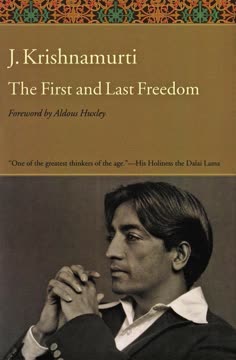
La Première et Dernière Liberté de J. Krishnamurti est unanimement saluée pour ses réflexions profondes sur la psychologie humaine et la conscience de soi. Les lecteurs apprécient l’approche rationnelle de Krishnamurti envers l’introspection ainsi que sa remise en question des idées reçues. Nombre d’entre eux témoignent d’une transformation radicale de leur regard sur le monde, soulignant le pouvoir de ce livre à métamorphoser la perception personnelle. Le style d’écriture, à la fois simple et profond, se caractérise par une syntaxe circulaire qui peut parfois dérouter. Certains reprochent toutefois une certaine répétitivité et des contradictions apparentes. Le message central de l’ouvrage invite à vivre pleinement l’instant présent, à observer ses pensées sans jugement, et à accéder à la liberté par la connaissance de soi.
Les lecteurs ont aussi lu

FAQ
What is "The First and Last Freedom" by J. Krishnamurti about?
- Exploration of Freedom: The book explores the nature of true freedom, not as political or social liberation, but as psychological and inner freedom from conditioning, authority, and self-imposed limitations.
- Self-Knowledge as Key: Krishnamurti emphasizes that understanding oneself—one’s thoughts, emotions, and conditioning—is essential for real freedom.
- Rejection of Authority: The book challenges the reliance on external authorities, traditions, and systems, urging readers to discover truth for themselves.
- Holistic Transformation: It presents the idea that personal transformation is the foundation for societal change, and that revolution must begin within the individual.
Why should I read "The First and Last Freedom" by J. Krishnamurti?
- Profound Self-Inquiry: The book offers a deep, practical approach to self-inquiry, helping readers question their beliefs, habits, and the roots of suffering.
- Universal Relevance: Its teachings are applicable to anyone seeking clarity, peace, and a more meaningful life, regardless of background or belief.
- Challenging Conventional Wisdom: Krishnamurti’s radical rejection of dogma, tradition, and authority encourages independent thinking and authentic living.
- Timeless Wisdom: The book’s insights into fear, desire, love, and the nature of the mind remain relevant for personal and collective transformation.
What are the key takeaways from "The First and Last Freedom" by J. Krishnamurti?
- Self-Knowledge is Essential: True freedom and transformation come from understanding oneself, not from following systems or authorities.
- Immediate Change is Possible: Real change happens in the present moment, not through gradual improvement or future promises.
- Freedom from Conditioning: Liberation requires awareness of and freedom from psychological conditioning, beliefs, and patterns.
- Love and Compassion: Genuine love arises only when the self is absent, and is not the result of effort, discipline, or desire.
What is Krishnamurti’s definition of “freedom” in "The First and Last Freedom"?
- Freedom from the Known: Freedom is not the ability to do what one wants, but the absence of psychological conditioning, beliefs, and past experiences that shape perception.
- Freedom from Authority: It means not relying on external or internal authorities—religious, political, or psychological—for guidance.
- Freedom from Fear and Desire: True freedom involves understanding and dissolving the roots of fear, desire, and conflict within oneself.
- Freedom as a Living State: It is a dynamic, ever-present state of mind, not a future goal or ideal.
How does Krishnamurti suggest we achieve self-knowledge in "The First and Last Freedom"?
- Observation Without Judgment: He advocates for observing one’s thoughts, emotions, and actions without condemnation, justification, or identification.
- Awareness in Relationship: Self-knowledge arises in the mirror of relationship—with people, things, and ideas—by seeing oneself as one is in daily life.
- No Methods or Systems: Krishnamurti warns against following any method, system, or authority, as these only reinforce conditioning.
- Moment-to-Moment Attention: He emphasizes the importance of moment-to-moment awareness, rather than accumulating knowledge or experience.
What is the role of authority, tradition, and systems in "The First and Last Freedom" by Krishnamurti?
- Authority as Obstacle: Krishnamurti sees all forms of authority—religious, psychological, or social—as barriers to direct perception and understanding.
- Tradition Conditions the Mind: Traditions and systems condition the mind, preventing fresh observation and genuine inquiry.
- No External Salvation: He asserts that no teacher, guru, or system can lead to truth; each person must discover it for themselves.
- Freedom from Authority: True learning and transformation require freedom from all forms of external and internal authority.
How does Krishnamurti address the problem of fear in "The First and Last Freedom"?
- Fear is Rooted in the Known: Fear arises from attachment to the known—memories, beliefs, and psychological security.
- Observation of Fear: He suggests observing fear without trying to escape, suppress, or analyze it, allowing its structure to reveal itself.
- No Escape or Suppression: Attempts to overcome fear through will, discipline, or belief only strengthen it.
- Understanding Ends Fear: When fear is fully understood in the present, without naming or resisting it, it dissolves naturally.
What does Krishnamurti mean by “self” and how does it relate to suffering in "The First and Last Freedom"?
- Self as Psychological Structure: The “self” is a bundle of memories, experiences, beliefs, and desires—a psychological construct.
- Source of Division and Suffering: The self creates division, isolation, and conflict, both internally and in society.
- Suffering is Self-Created: Suffering arises from the self’s attachments, fears, and desires for continuity and security.
- Ending the Self: Freedom and love emerge when the self is understood and its activity ceases, not through suppression but through awareness.
What is the relationship between thought, knowledge, and action in "The First and Last Freedom"?
- Thought is Conditioned: Thought is always the result of past experience and knowledge, and thus limited.
- Knowledge as Barrier: Accumulated knowledge and memory prevent direct perception and fresh action.
- Action Without Idea: Krishnamurti advocates for action that is not based on preconceived ideas or ideals, but arises spontaneously from awareness.
- Division Causes Conflict: When action is based on thought or ideals, it creates division and conflict between “what is” and “what should be.”
How does Krishnamurti define “love” in "The First and Last Freedom"?
- Love is Not Desire: Love is not attachment, desire, or pleasure, nor is it the result of discipline or will.
- Absence of Self: Love exists only when the self, with its demands, fears, and possessiveness, is absent.
- No Opposite or Conflict: Love has no opposite and is not born out of conflict, jealousy, or dependency.
- Love as Understanding: True love arises naturally when there is understanding, freedom, and the ending of psychological barriers.
What is Krishnamurti’s approach to meditation and awareness in "The First and Last Freedom"?
- Meditation as Awareness: Meditation is not concentration, repetition, or following a method, but choiceless awareness of the whole movement of life.
- No Goal or Achievement: True meditation has no goal, object, or end; it is a state of mind that is silent, open, and attentive.
- Awareness in Daily Life: Awareness is not separate from daily living; it is the observation of thoughts, feelings, and actions as they arise.
- Silence and Stillness: In this awareness, the mind becomes naturally quiet, and in that silence, insight and transformation occur.
What are the best quotes from "The First and Last Freedom" by J. Krishnamurti and what do they mean?
- “It is no measure of health to be well adjusted to a profoundly sick society.”
- This quote highlights the danger of conforming to a society that is itself in conflict and disorder, urging individuals to seek true understanding rather than mere adaptation.
- “Truth is a pathless land.”
- Krishnamurti’s famous statement means that truth cannot be approached through any path, system, or authority; it must be discovered individually and directly.
- “The ability to observe without evaluating is the highest form of intelligence.”
- This emphasizes the importance of observing oneself and the world without judgment, which allows for true understanding and intelligence to emerge.
- “Freedom from the known is the beginning of intelligence.”
- Letting go of past knowledge, beliefs, and conditioning is essential for real intelligence and creative living.
- “In the space which thought creates around itself, there is no love.”
- When the mind is occupied with its own thoughts and self-centered activity, love cannot exist; love arises only in the absence of the self.
These questions and answers cover the essential teachings, methods, and unique concepts of "The First and Last Freedom" by J. Krishnamurti, providing a comprehensive understanding for new and advanced readers alike.
À propos de l'auteur
Autres livres de J. Krishnamurti