

Key Takeaways
Stop fighting your anger: you are the anger, not its separate watcher
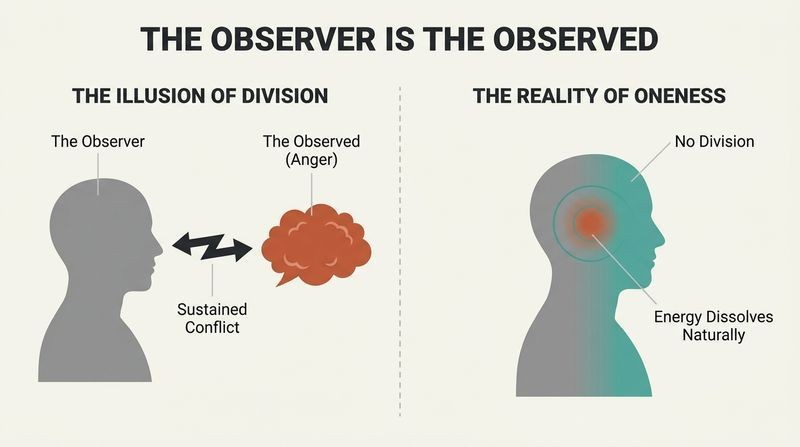
The observer is the observed. When you feel jealous or angry, you imagine a "you" standing apart, judging or suppressing the feeling. Krishnamurti insists this watcher is a fiction. It is assembled from past memory and conditioning, and it is not separate from the emotion it claims to control. That very split is what sustains conflict.
Watch how the division works. Gazing at distant hills with full attention, there is no "me" apart from the seeing. But turn inward wanting to fix what you find, and instantly a duality appears: the changer and the thing to be changed. When you actually perceive that the jealousy is you, not something you possess, the struggle stops. The emotion is no longer fed, and it dissolves without effort or suppression.
This anticipates decades of cognitive science. There is no homunculus, no little executive in the brain watching thoughts; the "self" is itself a construct of neural processing, echoing the Buddhist doctrine of anatta and modern predictive-processing models of mind. Acceptance and Commitment Therapy's "cognitive defusion" rests on the same insight: struggling against a feeling amplifies it. A fair challenge: some separation enables reflection and moral deliberation, and clinically, dissociation from acute distress can be protective. Krishnamurti's point is subtler though, that the habitual gap between watcher and watched, not momentary reflection, is the engine of chronic inner war.
You are the world: your private chaos is the planet's chaos
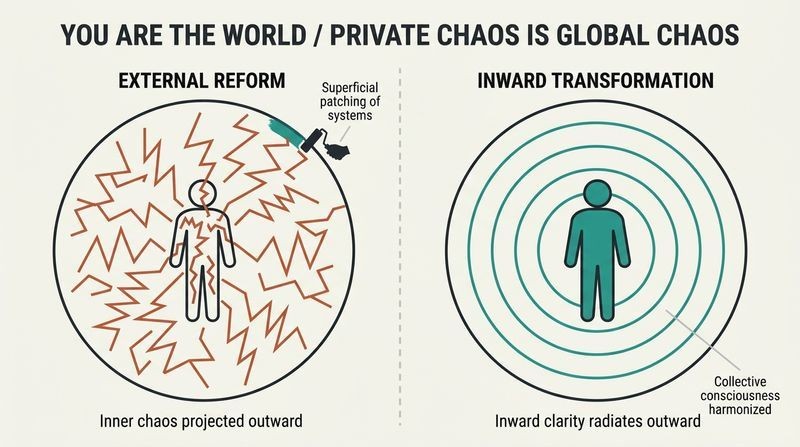
No line divides you from society. Krishnamurti collapses the comforting boundary between the individual and the world. The violence, greed, and division outside are not separate phenomena you observe from safety. They are expressions of your own consciousness, which is the collective human consciousness. The culture did not descend from heaven; humans built it out of ambition, fear, and comparison.
This makes reform inward first. Throwing bombs or swapping governments rearranges the furniture while the house stays corrupt. In a dialogue with Alain Naude, he argues that outer disorder, inner disorder, and the search for God are one unbroken movement, not three problems. If a genuine transformation occurs in even one mind, it affects the whole field of human consciousness, because that mind was never actually isolated from it.
The claim that changing yourself changes the world sounds like spiritual bypassing, a way to avoid structural politics. Krishnamurti anticipates this and does not oppose reform; he questions reform led by unchanged minds, which reliably reproduces the tyranny it overthrew. Systems theorists and social psychologists lend support: individuals internalize and re-enact cultural scripts, so consciousness and culture co-create each other. The weakness is empirical testability. Whether one transformed mind measurably shifts collective consciousness is unfalsifiable. Read as a moral stance rather than a mechanism, though, it dissolves the excuse that corruption is always someone else's fault.
Thought belongs to time and can never touch the genuinely new
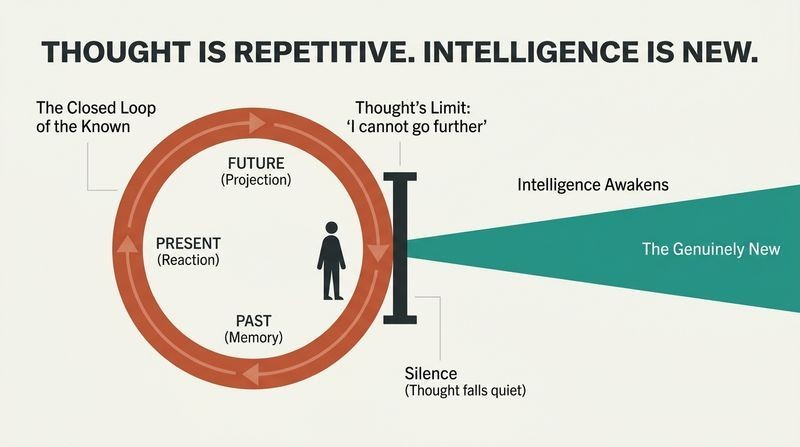
Thought is the response of memory. For Krishnamurti, thinking is always old. It is the echo of accumulated knowledge and experience, which is the past projecting itself as the future. It is mechanical, repetitive, and measurable, and therefore it can only move within the field of the known. It builds technology and language brilliantly, yet it cannot discover a genuinely new dimension because everything it produces is a modification of what was.
Intelligence is a different order. In the dialogue with physicist David Bohm, thought is described as a pointer, useful only when something reads its meaning. Intelligence does the reading. It awakens precisely when thought perceives its own limits and falls silent. The title of the book names this event: the awakening of intelligence is thought recognizing, "I cannot do this," and becoming quiet.
Distinguishing mechanical thought from a non-mechanical intelligence maps onto the divide between algorithmic computation and insight that thinkers from Bergson to Kahneman have probed. Kahneman's fast heuristic "System 1" and slow deliberate "System 2" are both, in Krishnamurti's terms, still thought, still bound by priors. What he points to resembles the "aha" of creative incubation, which research shows arrives when effortful analysis pauses, not while it strains. The bold move is denying that reasoning can ever reach the new. Skeptics note that scientific breakthroughs blend rigorous thought with insight, suggesting the two collaborate rather than being cleanly severed as he sometimes implies.
Anyone who says "I have realized truth" is selling you the dead past
Drop every authority, including his own. Krishnamurti relentlessly rejects gurus, saviors, systems, and holy books. The word guru means one who dispels darkness, yet most impose their burden rather than lift yours. His logic is simple: the moment someone claims to know, he refers to a past experience he recognized through old knowledge, so it is memory, not living truth.
Freedom sits at the beginning, not the end. He tells Swami Venkatesananda that a guru can at most point to the door, but you alone must walk through it. Practicing a method makes the mind mechanical, promising liberation later while enslaving you now. His famous formulation: the first step is the last step. Start as though you know absolutely nothing, refusing all secondhand certainty.
This is intellectually consistent to the point of self-subversion, since it undercuts Krishnamurti's own platform. He resolves the paradox by insisting listeners use him as a mirror, not a master. The stance resonates with the scientific ethos of not accepting claims on authority, and with Kant's call to think for oneself. Yet a genuine tension remains, explored in his exchange with Professor Needleman: beginners plausibly need scaffolding, and refusing all method can leave seekers stranded. Skill acquisition research shows structured practice matters. Krishnamurti's reply would be that psychological freedom is categorically unlike learning tennis, and no ladder reaches it.
Fear is manufactured by thought rehearsing yesterday and dreading tomorrow
Time is the raw material of fear. In the Saanen dialogues, listeners insist they fear the uncertain future. Krishnamurti traces the mechanism: thought remembers a past hurt or pleasure, then projects it forward, and the response to that projection is fear. Sitting in the tent, no one is actually afraid; the fear appears only when thought manufactures a tomorrow. Psychological time, unlike catching a train, is an invention.
End pain instantly, do not carry it. When physical pain comes, live with it completely and finish with it, rather than storing the memory that later breeds dread of its return. The same applies to psychological hurt. Fear and pleasure are two faces of one coin, both sustained by thought giving continuity to what is already over. Meet the present so wholly that time, and therefore fear, has no room.
This dovetails strikingly with modern affective science. Anxiety is fundamentally future-oriented rumination, and the amygdala responds to imagined threats as if real, exactly the mechanism Krishnamurti describes as thought breeding fear. Mindfulness-based interventions reduce anxiety precisely by anchoring attention in present sensation rather than narrative projection. His instruction to fully experience pain without registering it as memory prefigures exposure therapy and interoceptive acceptance. A caution: some anticipatory fear is adaptive planning, the reason humans store food and avoid cliffs. Krishnamurti grants this, distinguishing practical foresight from psychological dread. The confusion of the two, he argues, is where suffering multiplies.
The mental images you hold of people quietly murder your relationships
Relationship happens between two images, not two people. After years of marriage, Krishnamurti observes, you no longer meet your spouse; you meet the accumulated picture built from nagging, pleasure, insults, and habit. Both partners relate through their images of each other, so there is no actual contact, only two portraits facing off. This image is the past, and where there is image there is separation, and where there is separation there is conflict.
Stop the image-maker at the moment of action. Images form when you are inattentive during an encounter. If someone flatters or insults you and you are completely attentive in that instant, no residue is recorded, no image built. You cannot dismantle old images one by one, which is endless. But total attention in the living moment prevents new ones and dissolves the mechanism itself. What remains is direct relationship, which is love.
The idea that we love our representation of a partner rather than the changing person aligns with attachment research and Gestalt therapy's critique of "unfinished business" coloring present perception. Cognitive science confirms perception is heavily top-down: we largely see our predictions. Couples therapists observe that resentment calcifies into a fixed narrative that filters out disconfirming evidence, exactly Krishnamurti's "image." His remedy, moment-to-moment attention rather than retrospective analysis, is elegant but demanding. A reasonable pushback: some stable expectations build trust and safety, and total imagelessness might erase the continuity that intimacy relies on. He would counter that living contact renews trust fresh, without the dead weight of accumulated grievance.
Watch disorder honestly and order arises without a shred of discipline
Control is conflict, not order. Krishnamurti separates two things people conflate. Discipline in the usual sense means drilling, conforming, and suppressing, which creates a controller fighting the controlled, and that friction distorts the mind. Such enforced order is really disorder wearing a uniform. The permissive rebellion of the young and the rigid conformity of the old are both varieties of chaos.
Learning replaces control. The root of the word discipline means to learn. A mind constantly learning by observing its own confusion is already in order, without following any pattern. He compares true order to the harmony of mathematics or nature, something living rather than mechanical. When you see disorder as instantly and totally as you see the danger of a precipice, that very perception acts. You do not manufacture order; understanding disorder is order.
This challenges the self-help orthodoxy of habit stacking and willpower training. Behavioral science shows that ego-depletion and rebound effects plague suppression-based control, while curiosity-driven, insight-based change tends to stick, which supports his claim that friction is counterproductive. His model of order as an emergent property rather than an imposed structure echoes complexity theory, where coherent patterns self-organize without a central controller. The gap is practical: most people need transitional scaffolding, and "just see clearly and order follows" can feel like being told to relax under pressure. The seeing he describes is itself a rare and demanding attention, not a shortcut.
The "me" trying to improve itself is the very root of violence
Every movement of the self is violent. In a small group discussion at Brockwood, Krishnamurti drives to the source of violence beneath its branches of anger, ambition, and division. The root is the "me," the self-centered center that wants, resists, compares, and separates into you and me, us and them. Even the pursuit of peace by the "me" ("I must become non-violent") is another assertion of that center, and therefore violence.
Two ways of seeing. When the "me" observes its own violence, it grows afraid and resists, which perpetuates the cycle. But there is a seeing without the "me," without purpose or direction, that simply perceives the whole map of violence as you notice the color of a shirt. That purposeless seeing, uncontaminated by the self trying to fix things, is not itself violent. Ambition, will, and the drive to become all carry the seed.
Naming self-improvement itself as violence is a genuinely radical move that indicts the entire betterment industry. It parallels the Buddhist recognition that craving, including craving for enlightenment, prolongs suffering, and Alan Watts' "backwards law" that grasping for peace produces its opposite. Ecological and social framing supports him: the reified, competitive ego underlies zero-sum conflict from marriages to nations. The steelman is powerful. The difficulty is livability. A completely purposeless seeing seems to erase the motivation that fuels justice movements and personal growth. Krishnamurti's answer is that action from intelligence, not from the striving self, is more effective and free of the conflict that betterment breeds.
Say "I truly don't know" and watch the mind empty of borrowed answers
Not-knowing is the doorway to intelligence. Krishnamurti prizes a state most people never touch: honest not-knowing. Faced with a fundamental question, the mind usually rushes to memory, authority, or a book for an answer, which means it already thinks it knows. But when you genuinely say "I do not know," and are not secretly waiting to be told, the mind stops expecting, stops searching, and becomes completely alone and free of the past.
The impossible question empties consciousness. He asks people to hold a question that has no accessible answer, such as whether the entire hidden content of the mind can be seen at once. Confronted honestly, the mind cannot answer, cannot analyze layer by layer, cannot wait for a teacher. In that admission it sheds its accumulated content and becomes silent and alert, which is where real perception begins.
This inverts the intelligence we usually reward, the fast retrieval of stored answers. It resonates with Socratic docta ignorantia, the productive humility of knowing that one does not know, and with Zen's "beginner's mind" and the koan, a question engineered to exhaust discursive thinking. Neurologically, the disengagement of habitual answer-seeking may correspond to quieting the default mode network, associated in studies with insight and self-transcendent states. The subtle risk is performative not-knowing, a pose of openness that is really passivity or evasion. Krishnamurti guards against this by demanding it be uncontaminated by any expectation of an answer arriving, which is far harder than intellectual modesty.
Die psychologically each day to everything you have gathered and known
Freedom from the known requires daily ending. Krishnamurti reframes death as something to practice now, not fear later. To die psychologically is to end each day everything you have accumulated: your hurts, your ambitions, your comparisons, your images, your very continuity. When you meet tomorrow carrying none of it, the mind wakes fresh, young, and incapable of being hurt, which he calls innocence.
Meditation is emptying, not achieving. He strips meditation of its exotic machinery. Mantras, systems, breathing techniques, and controlled concentration only make the mind mechanical. Real meditation is total self-knowing in relationship, watching thought without directing it, until the brain becomes genuinely quiet. Only a silent mind, empty of the known, can meet the immeasurable. Since love is always new and never a product of memory, dying to the past is what makes love, and living, possible.
Treating death as a moment-to-moment psychological event rather than a biological endpoint parallels the Stoic memento mori and the mystical "die before you die." Neuroscience of expert meditators shows reduced default mode network activity and diminished self-referential narration, a physiological correlate of the "quiet brain" he describes, and this correlates with reported freedom from anxiety and enhanced present-moment vividness. His demolition of technique-based meditation is bracing in an era of commodified mindfulness apps. The honest tension is that most people cannot simply decide to empty the mind; techniques, however mechanical, are how many first glimpse stillness. Krishnamurti would say the glimpse bought by method is not the freedom he means.
Analysis
This is not a book so much as a transcript of a mind refusing to let its listeners rest. Assembled from talks, dialogues, and conversations across America, India, Europe, and England between 1968 and 1972, it circles a single seed relentlessly: intelligence awakens only when thought recognizes its own boundary and falls silent. Everything else, the observer and observed, fear, images, the "me," order, death, is a spoke radiating from that hub. What makes it hard to summarize is that Krishnamurti deliberately offers no system, so any tidy framework betrays him. His method is anti-method, the Socratic dismantling of every crutch the reader reaches for, including himself. The dialogues with physicist David Bohm and philosopher Jacob Needleman are the intellectual peaks, where his intuitions get pressure-tested against rigorous minds and hold up with surprising coherence, especially the argument that thought is mechanical, of time, and structurally incapable of the new. His originality is not in the individual claims, which overlap with Advaita, Zen, and phenomenology, but in his insistence on immediacy: not tomorrow, not gradually, not through a teacher, but now, through direct perception. The book's vulnerability is its unfalsifiability and its steep experiential demand. He asserts that seeing a truth instantly transforms behavior the way seeing a snake makes you jump, yet the audiences in these very transcripts repeatedly fail to make that leap, and Krishnamurti's mounting exasperation is almost comic. That gap between the elegance of the insight and the difficulty of living it is the honest heart of the book. Read as prescription, it frustrates. Read as a mirror held up to the machinery of one's own conditioned thinking, it does something few books attempt: it tries to end, rather than add to, the reader's accumulated knowledge. The awakening it points to cannot be given, only uncovered.
Review Summary
The Awakening of Intelligence is highly regarded for its profound insights into human consciousness and thought. Readers praise Krishnamurti's simple yet deep approach to understanding the mind, ego, and suffering. Many find the book transformative, offering a fresh perspective on life and spirituality. Some note its repetitive nature and challenging content, requiring focus and reflection. The book is seen as a valuable resource for self-examination and exploring questions of existence, though a few readers struggle with its complexity or perceive arrogance in Krishnamurti's responses.
People Also Read









Glossary
The observer is the observed
No separation between watcher, watchedKrishnamurti's core assertion that the entity observing an emotion or thought is not separate from it. The observer is built of past memory and conditioning, identical in nature to what it observes. As long as this division persists there is conflict; when it collapses, the thing observed transforms without effort, because there is no separate self to resist or manipulate it.
You are the world
Individual consciousness is collective consciousnessThe claim that there is no real boundary between the individual and society. Your consciousness, with its fear, greed, and division, is the content of humanity's consciousness, which humans collectively built. Therefore genuine change must begin inwardly, and a radical transformation in one mind affects the whole field of human consciousness, since that mind was never truly isolated.
Thought and intelligence
Mechanical memory versus timeless perceptionKrishnamurti's central distinction. Thought is the response of memory, always the past, mechanical, measurable, and bound to time; it can build technology but never discover the genuinely new. Intelligence is of a different order, not produced by thought, arising when thought perceives its own limitation and becomes silent. Thought is a pointer; intelligence reads its meaning.
Freedom from the known
Mind emptied of accumulated pastThe state in which the mind is no longer bound by knowledge, memory, tradition, and conditioning, all of which are "the known." Achieved not by acquiring something new but by ending, dying daily to what has been accumulated. Only a mind free of the known can meet the immeasurable, the field not contaminated by past experience.
The first step is the last step
Freedom is immediate, not gradualKrishnamurti's rejection of gradual progress toward liberation. There is no path, method, or ladder that reaches truth over time, because time and method are products of thought. Freedom exists at the very beginning of perception, not as a distant achievement. Seeing a truth clearly is itself the complete action, requiring no further steps.
Choiceless awareness
Watching without judgment or directionPure observation of what is, without choosing, condemning, justifying, or directing. Because choice arises from confusion and preference, and preference is the past intruding, choiceless awareness lets the mind see itself and the world directly. In this attention, the observer disappears, and perception becomes a living act rather than the repetition of old patterns.
The "me"
Self-centered root of conflictThe self, the center of wants, resistances, ambitions, and comparisons that divides existence into me and not-me. Krishnamurti identifies it as the root of violence and fragmentation. Crucially, any movement of the "me" to improve or transcend itself is still the "me" and therefore still violent. It dissolves only in seeing without the self, not in the self's effort to change.
FAQ
1. What is The Awakening of Intelligence by J. Krishnamurti about?
- Exploration of consciousness: The book is a comprehensive collection of talks and dialogues where Krishnamurti explores the nature of intelligence, consciousness, and the human mind.
- Radical psychological revolution: It calls for a fundamental change in how individuals and society approach thought, tradition, and self-awareness.
- Direct perception and self-inquiry: Krishnamurti emphasizes seeing reality without distortion, questioning authority, and understanding oneself deeply.
- Themes of love, fear, and freedom: The book addresses universal human concerns such as love, fear, death, and the possibility of true freedom.
2. Why should I read The Awakening of Intelligence by J. Krishnamurti?
- Profound psychological insight: The book offers deep understanding of the mind, thought, and the roots of human conflict and suffering.
- Practical guidance for freedom: Krishnamurti provides methods for self-observation and living without psychological conditioning or fear.
- Universal and timeless relevance: Its themes address fundamental issues that affect everyone, regardless of background or culture.
- Encourages independent thinking: Readers are empowered to question tradition, authority, and their own beliefs to discover truth directly.
3. What are the key takeaways from The Awakening of Intelligence by J. Krishnamurti?
- Intelligence beyond thought: True intelligence arises when the mind recognizes its limitations and functions harmoniously with the heart and body.
- Unity of observer and observed: Conflict ends when the division between observer and observed dissolves, allowing direct experience of reality.
- Freedom from conditioning: Awareness without resistance leads to liberation from psychological conditioning, fear, and the past.
- Meditation as choiceless awareness: Meditation is not a technique but a state of a quiet, unconditioned mind where intelligence can operate.
4. What is Krishnamurti’s definition of “intelligence” in The Awakening of Intelligence?
- Not personal or intellectual: Intelligence is not the result of reasoning, belief, or argument, but emerges when the brain sees its own limitations.
- Beyond time and thought: It is “immeasurable” and “not of time,” operating in a dimension beyond memory and conditioning.
- Harmony of mind, heart, and body: Intelligence arises when these aspects are in complete harmony, enabling a new quality of perception.
- Seeded by perception of limitation: Recognizing that thought cannot discover the new is the starting point for true intelligence.
5. How does The Awakening of Intelligence by J. Krishnamurti describe the relationship between the observer and the observed?
- Fundamental unity: The observer and the observed are not separate; realizing this unity dissolves inner conflict.
- Division breeds conflict: When the observer sees itself as separate, it creates resistance, fragmentation, and psychological struggle.
- True observation: Real perception happens when the mind looks without the past, images, or judgment, seeing “what is” directly.
- Cessation of conflict: When the observer is the observed, action becomes complete and effortless.
6. What is the role of meditation according to The Awakening of Intelligence by J. Krishnamurti?
- Not a technique or escape: Meditation is not about controlling thought or following systems, but about understanding and freeing the mind from the known.
- State of a quiet mind: True meditation is a state where the mind is completely quiet, allowing intelligence to function.
- Foundation in daily life: Meditation arises naturally from a life of order, virtue, and right relationship, not from discipline or suppression.
- Freedom from the known: It is the release from accumulated knowledge and conditioning, opening the mind to the immeasurable.
7. How does Krishnamurti in The Awakening of Intelligence address the concepts of fear and pleasure?
- Interlinked by thought: Fear and pleasure are sustained by thought, which projects memories of pain or pleasure into the future.
- Root of conflict: Fear arises from the desire for security and the machinery of thought, leading to resistance and division.
- Living in the present: Freedom from fear comes from living wholly in the present, without psychological time or division.
- Observation without resistance: Observing fear without resistance dissolves its psychological hold and ends conflict.
8. What does The Awakening of Intelligence by J. Krishnamurti say about the role of the guru and tradition?
- Guru as a pointer: A guru can only indicate the path; self-discovery and transformation must be done individually.
- Tradition as conditioning: Traditions often impose psychological conditioning and can imprison the mind.
- No dependence on authority: Truth must be found through personal inquiry and observation, not external authority.
- Maturity beyond roles: True maturity is the absence of self-centeredness and the ability to observe oneself without distortion.
9. How does Krishnamurti in The Awakening of Intelligence define “freedom” and its importance?
- Not mere reaction: Freedom is not just freedom from something, but total liberation from the mind’s habit-forming machinery.
- Requires energy and passion: True freedom demands passion and energy, which are often blocked by fear and dullness.
- Essential for clear seeing: Only a free mind can observe without distortion, leading to understanding and transformation.
- Cessation of the past: Freedom involves cutting off the past, including all conditioning and images that create the “me.”
10. What is Krishnamurti’s view on “attention” and its role in intelligence in The Awakening of Intelligence?
- Not will or desire: Attention is a state of listening or looking without interference, effort, or concentration.
- Leads to sensitivity: Total attention brings about sensitivity, which destroys mediocrity and allows for direct contact with reality.
- Key to order: Through attention, one can perceive disorder and naturally bring about order and virtue.
- A living quality: Attention is not mechanical but a vital, moving quality that brings clarity and understanding.
11. How does The Awakening of Intelligence by J. Krishnamurti explain the difference between thought and intelligence?
- Thought is mechanical and time-bound: Thought is repetitive, measurable, and based on memory and past experience.
- Intelligence is timeless and silent: Intelligence arises when the mind is quiet and sees the limitations of thought.
- Thought as a pointer: While thought can indicate the direction, only intelligence can perceive the whole and act without division.
- Intelligence bridges the measurable and immeasurable: It allows thought to function sanely without creating conflict or fragmentation.
12. What practical advice does The Awakening of Intelligence by J. Krishnamurti offer for living a life of intelligence and freedom?
- Observe without resistance: Watch thoughts, feelings, and conditioning without trying to change, suppress, or control them.
- Be aware of inattention: Recognize when the mind is inattentive and understand the causes of that inattention.
- Live without the “me”: By seeing the “me” as the root of conflict, one can live in harmony, love, and intelligence.
- End the building of images: Prevent the creation of images in relationships to avoid separation and isolation, living fully in the present.
About the Author
Other books by J. Krishnamurti






Download PDF
Download EPUB
.epub digital book format is ideal for reading ebooks on phones, tablets, and e-readers.








































