Points clés
1. L’Univers a Commencé par un Point Infiniment Petit et Dense
Au commencement, il y a près de quatorze milliards d’années, tout l’espace, toute la matière et toute l’énergie de l’univers connu tenaient dans un volume inférieur à un billionième de la taille du point qui termine cette phrase.
Genèse Cosmique. L’univers est né d’un point inimaginablement petit et incroyablement dense qui s’est rapidement étendu lors de ce que nous appelons le Big Bang. Ce moment primordial marque le début de l’espace, du temps et de toute matière connue, comprimés dans un état qui dépasse notre compréhension actuelle de la physique.
Caractéristiques clés de l’univers primordial :
- Température et densité extrêmes
- Forces fondamentales initialement unifiées
- Expansion rapide en une fraction de seconde
- Mécanique quantique et gravité intimement liées
Défis Théoriques. Les scientifiques peinent encore à comprendre les mécanismes précis de la naissance de l’univers, notamment durant l’ère de Planck — les premiers 10^-43 secondes après le commencement, où nos lois physiques actuelles s’effondrent.
2. La Matière et l’Énergie Ont Émergé du Big Bang
Ces transformations sont entièrement dictées par la célèbre équation d’Einstein : E = mc², une recette à double sens pour savoir combien vaut votre énergie en matière, et combien vaut votre matière en énergie.
Interactions Particulaires. Dans l’univers primitif, matière et énergie se transformaient sans cesse, avec des particules et antiparticules qui se créaient et s’annihilaient spontanément. Ce processus dynamique obéissait aux lois physiques fondamentales, en particulier à l’équation d’Einstein reliant masse et énergie.
Familles fondamentales de particules :
- Quarks
- Leptons
- Bosons
- Contreparties d’antimatière
Asymétrie Cosmique. Un moment crucial survint lorsque la matière dépassa légèrement l’antimatière, dans un rapport d’un milliard pour un, permettant à l’univers de conserver la matière au lieu de s’annihiler totalement.
3. Le Fond Diffus Cosmologique Révèle Nos Origines Cosmiques
Le fond diffus cosmologique révèle le portail par lequel nous sommes tous passés. C’est un point où une physique fascinante s’est produite, et où nous avons appris sur l’univers avant et après que sa lumière ait été libérée.
Lumière Primordiale. Le fond diffus cosmologique (CMB) représente la plus ancienne lumière ayant pu voyager librement dans l’univers, environ 380 000 ans après le Big Bang. Ce rayonnement offre un instantané de l’état primitif de l’univers et contient des informations cruciales sur sa structure et son évolution.
Importance du CMB :
- Preuve de la théorie du Big Bang
- Révèle les variations de température dans l’univers primitif
- Aide à comprendre la répartition de la matière
- Permet de reconstituer l’histoire cosmique
Découverte Scientifique. Le CMB fut découvert par hasard en 1964 par Arno Penzias et Robert Wilson, transformant la cosmologie d’une théorie spéculative en une science de précision.
4. La Matière Noire Maintient les Galaxies Ensemble
La matière noire est notre ennemie-amie. Nous n’avons aucune idée de ce qu’elle est. C’est un peu frustrant. Mais nous en avons désespérément besoin dans nos calculs pour obtenir une description précise de l’univers.
Mystère Gravitationnel. La matière noire est une substance invisible qui n’interagit pas avec la lumière mais exerce une influence gravitationnelle, fournissant la « colle » gravitationnelle nécessaire pour empêcher les galaxies de se disperser.
Caractéristiques de la matière noire :
- Constitue environ 85 % de la matière cosmique
- Détectée uniquement par ses effets gravitationnels
- N’est pas composée de matière atomique ordinaire
- Essentielle à la formation des galaxies et des amas
Recherche en Cours. Les scientifiques cherchent activement des preuves directes des particules de matière noire, utilisant des accélérateurs de particules avancés et des installations souterraines de détection.
5. L’Énergie Noire Accélère l’Expansion de l’Univers
L’énergie noire, propriété fondamentale du cosmos, finira par compromettre la capacité des générations futures à comprendre l’univers qui leur a été donné.
Accélération Cosmique. L’énergie noire est une force mystérieuse qui provoque l’accélération de l’expansion de l’univers, représentant environ 68 % de la masse-énergie totale de l’univers.
Implications majeures :
- Contredit les hypothèses antérieures sur l’expansion universelle
- Finira par rendre les galaxies lointaines invisibles
- Constitue un mystère fondamental de la cosmologie moderne
Défis Théoriques. Les scientifiques peinent encore à saisir la nature et l’origine de l’énergie noire, certaines théories suggérant qu’il s’agirait d’un effet quantique lié au vide spatial.
6. Les Éléments Sont Forgés au Cœur des Étoiles
Nous sommes de la poussière d’étoiles animée, puis habilitée par l’univers à se comprendre lui-même — et nous ne faisons que commencer.
Alchimie Stellaire. La plupart des éléments plus lourds que l’hydrogène et l’hélium sont créés par fusion nucléaire dans les cœurs stellaires et dispersés lors d’explosions de supernova, faisant des étoiles les principales usines d’éléments de l’univers.
Processus de formation des éléments :
- Hydrogène et hélium créés lors du Big Bang
- Éléments plus lourds formés dans les cœurs stellaires
- Éléments complexes produits lors des explosions stellaires
- Distribution dans les galaxies par vents stellaires et supernovas
Recyclage Cosmique. Chaque atome de notre corps a un jour fait partie d’une étoile, soulignant notre lien fondamental avec le cosmos.
7. Notre Planète Est Idéalement Placée pour la Vie
La Terre s’est formée dans une sorte de zone « juste ce qu’il faut » autour du Soleil, où les océans restent majoritairement à l’état liquide.
Conditions Planétaires. La distance précise de la Terre au Soleil, sa composition atmosphérique et ses caractéristiques chimiques créent un environnement idéal pour l’émergence et la pérennité de la vie.
Facteurs favorables à la vie :
- Eau liquide
- Températures modérées
- Atmosphère protectrice
- Chimie à base de carbone
- Interactions moléculaires complexes
Potentiel de Vie Extraterrestre. La découverte d’exoplanètes suggère que des conditions similaires pourraient exister ailleurs dans l’univers.
8. La Lumière Invisible Révèle des Phénomènes Cosmiques Cachés
Nous avons parcouru un long chemin depuis les expériences de Herschel avec des rayons « inaptes à la vision », nous permettant d’explorer l’univers tel qu’il est, plutôt que tel qu’il semble être.
Spectre Électromagnétique. Les télescopes détectant diverses longueurs d’onde — radio, infrarouge, ultraviolet, rayons X et gamma — ont considérablement élargi notre compréhension des phénomènes cosmiques.
Progrès observationnels :
- Détection d’événements cosmiques auparavant invisibles
- Compréhension de la formation et destruction stellaires
- Étude des processus cosmiques à haute énergie
Évolution Technologique. Les télescopes modernes et les systèmes de détection permettent aux scientifiques de « voir » au-delà de la lumière visible, révélant des interactions cosmiques complexes.
9. Nous Sommes Fondamentalement Reliés au Cosmos
Nous ne vivons pas simplement dans cet univers. L’univers vit en nous.
Interconnexion Cosmique. Les êtres humains sont composés d’éléments créés dans des processus stellaires, partageant un lien chimique fondamental avec l’univers tout entier.
Implications philosophiques :
- Liens génétiques entre espèces
- Composition atomique partagée
- Perspective cosmique transcendant l’expérience individuelle
Perspective Humble. Comprendre nos origines cosmiques offre une vision plus nuancée de la place de l’homme et de son interdépendance avec l’univers.
10. La Perspective Cosmique Transforme la Compréhension Humaine
La science ne consiste pas seulement à voir, mais à mesurer, de préférence avec quelque chose qui n’est pas vos propres yeux, intrinsèquement liés aux préjugés de votre cerveau.
Élargissement de la Conscience. La perspective cosmique remet en question les visions anthropocentriques, encourageant une compréhension plus large et inclusive de l’existence.
Révélations transformatrices :
- Remise en cause des biais culturels et personnels
- Reconnaissance des limites humaines
- Promotion d’une pensée globale et universelle
Humilité Intellectuelle. Adopter la perspective cosmique exige de reconnaître notre ignorance collective tout en célébrant la curiosité humaine et la découverte scientifique.
Résumé des avis
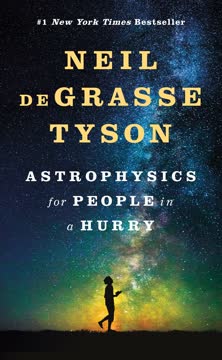
Astrophysique pour les pressés reçoit en grande majorité des critiques positives, saluant son approche accessible de sujets complexes. Les lecteurs apprécient l’humour de Tyson ainsi que sa capacité à simplifier des concepts ardus. Certains ont trouvé le livre exigeant ou parfois un peu écrasant, tandis que d’autres ont été profondément inspirés par cette perspective cosmique. L’ouvrage aborde divers thèmes de l’astrophysique, du Big Bang à la matière noire. Nombreux sont ceux qui le recommandent à tous ceux qui s’intéressent à l’espace et à la science, même si certains conseillent de le lire lentement afin d’en saisir pleinement la richesse. Dans l’ensemble, ce livre est loué pour sa faculté à éveiller la curiosité et l’émerveillement face à l’univers.
Les lecteurs ont aussi lu




 Immersif

FAQ
What's "Astrophysics for People in a Hurry" about?
- Purpose and Audience: The book is designed for those who are too busy to read lengthy scientific texts but still want to understand the cosmos. It provides a concise introduction to astrophysics.
- Content Overview: It covers major ideas and discoveries in modern astrophysics, including the big bang, dark matter, dark energy, and the cosmic microwave background.
- Author's Expertise: Neil deGrasse Tyson, a renowned astrophysicist, aims to make complex scientific concepts accessible and engaging for the general public.
- Cultural Relevance: The book also touches on the increasing public interest in science, as evidenced by popular media and scientific festivals.
Why should I read "Astrophysics for People in a Hurry"?
- Quick Learning: The book offers a fast yet comprehensive overview of astrophysics, perfect for those with limited time.
- Cultural Literacy: It helps readers become culturally conversant in astrophysics, enhancing their understanding of the universe and their place in it.
- Engaging Style: Tyson's engaging writing style makes complex topics understandable and enjoyable, even for those without a scientific background.
- Broader Perspective: It encourages readers to think about the universe in a broader context, fostering a cosmic perspective on life.
What are the key takeaways of "Astrophysics for People in a Hurry"?
- Universe's Origins: The book explains the big bang theory and the early universe's rapid expansion and cooling.
- Dark Matter and Energy: It discusses the mysterious dark matter and dark energy, which make up most of the universe's mass-energy content.
- Cosmic Perspective: Tyson emphasizes the importance of understanding our place in the universe and how it can influence our worldview.
- Scientific Inquiry: The book highlights the ongoing quest for knowledge and the importance of scientific exploration in understanding the cosmos.
What are the best quotes from "Astrophysics for People in a Hurry" and what do they mean?
- "The universe is under no obligation to make sense to you." This quote underscores the complexity of the universe and the humility required in scientific inquiry.
- "We are stardust brought to life, then empowered by the universe to figure itself out—and we have only just begun." It highlights the connection between humans and the cosmos, emphasizing our role in understanding the universe.
- "In the end, the universe is not required to be in perfect harmony with human ambition." This reflects the idea that the universe operates independently of human desires and expectations.
- "The cosmic perspective flows from fundamental knowledge." This quote suggests that a deeper understanding of the universe can lead to a more profound perspective on life.
How does Neil deGrasse Tyson explain the Big Bang in "Astrophysics for People in a Hurry"?
- Initial Conditions: Tyson describes the universe's beginning nearly 14 billion years ago, with all matter and energy contained in a tiny volume.
- Rapid Expansion: The big bang led to a rapid expansion, with the universe cooling and forming basic particles and forces.
- Planck Era: He explains the Planck era, a time when gravity and quantum mechanics were unified, though not yet fully understood.
- Formation of Elements: The book details how the first elements, like hydrogen and helium, formed as the universe expanded and cooled.
What is dark matter, according to "Astrophysics for People in a Hurry"?
- Mysterious Substance: Dark matter is a form of matter that does not emit, absorb, or reflect light, making it invisible and detectable only through its gravitational effects.
- Massive Influence: It accounts for about 85% of the universe's total gravitational force, influencing the motion of galaxies and galaxy clusters.
- Unsolved Mystery: Despite its significant role, the exact nature of dark matter remains unknown, with ongoing research attempting to identify it.
- Theoretical Implications: Tyson discusses how dark matter challenges our understanding of physics and the need for new theories to explain it.
How does "Astrophysics for People in a Hurry" describe dark energy?
- Opposing Gravity: Dark energy is described as a mysterious force that acts opposite to gravity, causing the universe's expansion to accelerate.
- Cosmological Constant: Tyson revisits Einstein's cosmological constant, which was initially introduced to allow for a static universe but later found to explain the accelerating expansion.
- Dominant Force: Dark energy constitutes about 68% of the universe's total mass-energy content, making it the most significant component.
- Ongoing Research: The book highlights the scientific efforts to understand dark energy and its implications for the universe's future.
What is the cosmic microwave background, as explained in "Astrophysics for People in a Hurry"?
- Afterglow of the Big Bang: The cosmic microwave background (CMB) is the remnant radiation from the early universe, providing a snapshot of the universe 380,000 years after the big bang.
- Discovery and Significance: Tyson discusses its accidental discovery by Penzias and Wilson and its role in confirming the big bang theory.
- Temperature Variations: The CMB's slight temperature variations offer insights into the early universe's structure and the formation of galaxies.
- Cosmological Tool: It serves as a crucial tool for cosmologists to study the universe's history and composition.
How does "Astrophysics for People in a Hurry" address the concept of the multiverse?
- Beyond Our Universe: Tyson introduces the idea of the multiverse, suggesting that our universe might be one of many, each with its own physical laws.
- Theoretical Basis: The concept arises from modern cosmological theories and the improbability of our universe being unique.
- Philosophical Implications: The multiverse challenges our understanding of existence and our place in the cosmos, prompting philosophical and scientific discussions.
- Open-Minded Exploration: Tyson encourages readers to remain open to new ideas and discoveries that could reshape our understanding of the universe.
What role do exoplanets play in "Astrophysics for People in a Hurry"?
- Search for Life: Exoplanets, or planets orbiting stars other than the Sun, are central to the search for extraterrestrial life.
- Detection Methods: Tyson explains various methods for detecting exoplanets, such as monitoring star brightness and observing gravitational effects.
- Earth-Like Planets: The discovery of Earth-like exoplanets raises the possibility of finding habitable worlds and understanding planetary formation.
- Expanding Catalog: The book highlights the growing catalog of exoplanets and the potential for future exploration and discovery.
How does "Astrophysics for People in a Hurry" explain the universality of physical laws?
- Consistent Laws: Tyson emphasizes that the laws of physics are consistent throughout the universe, governing everything from subatomic particles to galaxies.
- Scientific Discovery: This universality drives scientific discovery, allowing us to apply known laws to understand distant cosmic phenomena.
- Implications for Life: The consistent laws suggest that any intelligent life elsewhere in the universe would operate under the same physical principles.
- Cultural Impact: Understanding these universal laws can influence our worldview and foster a sense of connection with the cosmos.
What is the cosmic perspective, according to "Astrophysics for People in a Hurry"?
- Broader View: The cosmic perspective involves understanding our place in the universe and recognizing the vastness and complexity of the cosmos.
- Humility and Insight: It encourages humility, as it reveals the smallness of human concerns in the grand scheme of things, while also providing insight into our interconnectedness with the universe.
- Cultural and Spiritual Impact: Tyson suggests that adopting a cosmic perspective can lead to cultural and spiritual growth, promoting peace and understanding.
- Ongoing Exploration: The book advocates for continued exploration and discovery, as the cosmic perspective is ever-evolving with new scientific insights.