Points clés
1. Le temps et l’espace ne sont pas absolus
« Le temps était considéré comme une ligne de chemin de fer droite sur laquelle on ne pouvait aller que dans un sens ou dans l’autre. »
Perspective révolutionnaire. La théorie de la relativité d’Einstein a profondément transformé notre conception du temps et de l’espace, passant d’idées absolues et fixes à des dimensions relatives et dynamiques, vécues différemment selon les observateurs.
Conséquences essentielles :
- Le temps n’est pas universel, mais propre à chaque observateur
- Les observateurs en mouvement à des vitesses différentes mesurent le temps différemment
- La vitesse de la lumière reste constante pour tous les observateurs
Preuves expérimentales. Des expériences telles que celle de Michelson-Morley ont montré que la vitesse de la lumière est constante, indépendamment du mouvement de l’observateur, remettant en cause les notions classiques de temps et d’espace absolus.
2. L’univers a un commencement et une nature en expansion
« Si l’univers avait été créé sans le principe d’exclusion, les quarks ne formeraient pas des protons et des neutrons distincts et bien définis. »
Théorie du Big Bang. L’univers est né d’un état extrêmement dense et chaud il y a environ 13,8 milliards d’années, s’étendant rapidement et évoluant à travers des processus physiques complexes qui ont donné naissance aux galaxies, aux étoiles et aux structures élaborées.
Évolution cosmique :
- Un état initial très chaud et uniforme
- Un refroidissement progressif permettant la formation des atomes
- Une expansion qui se poursuit, potentiellement indéfiniment
- La formation des galaxies par attraction gravitationnelle
Confirmation par l’observation. La découverte par Edwin Hubble que les galaxies lointaines s’éloignent de nous a fourni une preuve empirique du modèle d’un univers en expansion.
3. La mécanique quantique introduit incertitude et probabilité
« La mécanique quantique ne prédit pas un résultat unique et certain pour une observation. Elle prédit plusieurs résultats possibles et indique la probabilité de chacun. »
Univers probabiliste. Contrairement à la physique classique, la mécanique quantique suggère que les particules fondamentales existent dans des états probabilistes, avec plusieurs issues possibles pour une même observation.
Principes quantiques clés :
- Les particules peuvent exister simultanément dans plusieurs états
- L’observation modifie l’état des particules
- Il est impossible de mesurer précisément position et vitesse en même temps
- Le hasard est inhérent à la nature
Implications révolutionnaires. Cette approche remet en cause la vision déterministe de l’univers, faisant de l’incertitude fondamentale une caractéristique essentielle de la réalité.
4. La gravité façonne la structure de l’univers
« La gravité est de loin la plus faible des quatre forces ; elle est si faible que nous ne la remarquerions pas sans deux propriétés particulières : elle agit à grande distance et elle est toujours attractive. »
Influence gravitationnelle. Bien que la plus faible des forces fondamentales, la gravité joue un rôle crucial dans la formation des structures cosmiques grâce à ses effets cumulatifs à longue portée.
Caractéristiques de la gravité :
- Elle agit universellement sur toute la matière
- Elle attire, elle ne repousse pas
- Elle détermine les structures cosmiques à grande échelle
- Elle est essentielle pour comprendre les trous noirs et l’évolution cosmique
Apport d’Einstein. La relativité générale a révélé que la gravité correspond à une courbure de l’espace-temps, transformant notre compréhension d’une force en une propriété géométrique de l’univers.
5. Les trous noirs ne sont pas vraiment noirs
« Les trous noirs font partie d’un nombre assez restreint de cas dans l’histoire des sciences où une théorie a été développée en détail comme modèle mathématique avant toute preuve observationnelle. »
Propriétés quantiques des trous noirs :
- Ils émettent un rayonnement (rayonnement de Hawking)
- Ils possèdent une température finie
- Ils peuvent s’évaporer progressivement
- Ils représentent des environnements gravitationnels extrêmes
Avancée théorique. Les travaux de Hawking ont montré que la mécanique quantique permet aux trous noirs d’émettre des particules, remettant en question la compréhension antérieure de ces phénomènes cosmiques.
Importance observationnelle. Les trous noirs offrent des laboratoires uniques pour tester les théories fondamentales sur la gravité, la mécanique quantique et l’espace-temps.
6. Les forces fondamentales peuvent être unifiées
« En fin de compte, on espère trouver une théorie complète, cohérente et unifiée qui engloberait toutes ces théories partielles comme des approximations. »
Quête d’unification. Les scientifiques cherchent une théorie globale intégrant la gravité, les forces électromagnétiques, fortes et faibles dans un cadre unique et cohérent.
Approches théoriques :
- La théorie des cordes
- Les modèles de gravité quantique
- Les théories de grande unification (GUT)
- L’exploration de dimensions supplémentaires
Difficultés. Les théories actuelles peinent à concilier complètement la mécanique quantique avec les effets gravitationnels à l’échelle microscopique.
7. La flèche du temps et l’entropie
« Le désordre augmente avec le temps parce que nous mesurons le temps dans la direction où le désordre croît. »
Direction thermodynamique du temps. L’univers tend vers un désordre croissant, créant une « flèche du temps » fondamentale qui distingue le passé du futur.
Principales flèches du temps :
- Flèche thermodynamique (augmentation de l’entropie)
- Flèche psychologique (progression de la mémoire)
- Flèche cosmologique (expansion de l’univers)
Implications philosophiques. Notre perception et notre expérience du temps sont intrinsèquement liées à la tendance de l’univers vers une complexité et un hasard croissants.
8. L’univers pourrait être autonome
« L’univers serait complètement autonome et non affecté par quoi que ce soit en dehors de lui-même. Il ne serait ni créé ni détruit. Il serait simplement. »
Hypothèse sans bord. L’univers pourrait exister sans cause extérieure, émergeant de fluctuations quantiques avec une cohérence mathématique intrinsèque.
Considérations théoriques :
- L’espace-temps pourrait être fini mais sans frontières
- Pas besoin d’un créateur extérieur
- Gouverné par des lois mathématiques intrinsèques
Perspective radicale. Cette idée remet en question les visions théologiques et philosophiques traditionnelles sur l’origine cosmique.
9. Les théories scientifiques sont des modèles mathématiques de l’observation
« Une théorie scientifique n’est qu’un modèle mathématique que nous construisons pour décrire nos observations : elle n’existe que dans notre esprit. »
Méthodologie scientifique. Les théories représentent des tentatives humaines pour décrire et prédire mathématiquement des phénomènes observables, en reconnaissant leur nature provisoire et évolutive.
Caractéristiques des théories :
- Capacité prédictive
- Testabilité empirique
- Susceptibles de révision
- Approximations de la réalité
Humilité épistémique. Elles reconnaissent la connaissance scientifique comme un processus continu de compréhension, non comme une vérité absolue.
10. L’existence humaine est un accident cosmique remarquable
« Le fait remarquable est que les valeurs de ces nombres semblent avoir été réglées avec une précision extrême pour permettre le développement de la vie. »
Principe anthropique. Notre existence dépend d’une configuration extraordinairement précise des constantes universelles et des lois physiques.
Improbabilité cosmique :
- De minuscules variations des constantes fondamentales empêcheraient la vie
- Des structures complexes émergent de conditions initiales simples
- La conscience humaine représente un résultat cosmique improbable
Réflexion philosophique. Ce constat souligne à la fois le hasard et la possible finalité du dessein de notre univers.
Résumé des avis
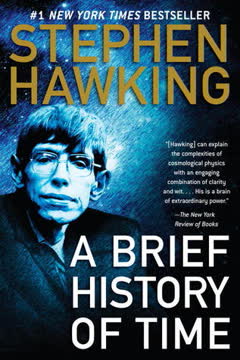
Une brève histoire du temps est un ouvrage de vulgarisation scientifique qui explique des concepts complexes de la physique, tels que la relativité, la mécanique quantique et la cosmologie, à un large public. Bien que salué pour sa clarté, certains lecteurs ont trouvé certaines parties difficiles à saisir pleinement. L’écriture limpide de Hawking et ses tentatives pour aborder des questions profondes sur l’univers ont été grandement appréciées. Le livre traite de sujets comme les trous noirs, le Big Bang et la quête d’une théorie unifiée de la physique. Si certaines spéculations philosophiques de Hawking ont été critiquées, l’ouvrage demeure une référence majeure dans la vulgarisation de la physique moderne.
Les lecteurs ont aussi lu

 Immersif
 Immersif

FAQ
What's "A Brief History of Time" about?
- Exploration of the Universe: "A Brief History of Time" by Stephen Hawking explores the nature of the universe, discussing its origins, structure, and eventual fate.
- Complex Concepts Simplified: The book aims to explain complex scientific concepts like black holes, the big bang, and quantum mechanics in a way that is accessible to non-scientists.
- Unified Theory: Hawking discusses the quest for a unified theory that combines general relativity and quantum mechanics to explain all physical aspects of the universe.
- Philosophical Implications: It also delves into the philosophical implications of scientific discoveries, questioning the role of God and the nature of time.
Why should I read "A Brief History of Time"?
- Understanding the Universe: It provides a comprehensive overview of the universe's workings, making it essential for anyone interested in cosmology and physics.
- Accessible Science: Hawking's ability to simplify complex ideas makes it a great read for those without a scientific background.
- Intellectual Curiosity: The book challenges readers to think about profound questions regarding existence, time, and the universe.
- Cultural Impact: As a bestseller, it has influenced both scientific and popular culture, making it a significant work in modern literature.
What are the key takeaways of "A Brief History of Time"?
- Nature of Time: Time is not absolute and is intertwined with space, forming a four-dimensional space-time continuum.
- Black Holes: Black holes are regions where gravity is so strong that nothing, not even light, can escape, and they can emit radiation.
- Big Bang Theory: The universe began with a big bang, a singularity where all known laws of physics break down.
- Unified Theory: The search for a unified theory that combines general relativity and quantum mechanics is ongoing and crucial for understanding the universe.
What are the best quotes from "A Brief History of Time" and what do they mean?
- "If time travel is possible, where are the tourists from the future?" This quote highlights the paradoxes and challenges associated with the concept of time travel.
- "The universe doesn't allow perfection." It suggests that imperfections and uncertainties are inherent in the universe, aligning with the principles of quantum mechanics.
- "The boundary condition of the universe is that it has no boundary." This reflects Hawking's no-boundary proposal, suggesting the universe is finite but without edges or singularities.
- "We are just an advanced breed of monkeys on a minor planet of a very average star." This quote emphasizes the insignificance of human existence in the vast universe.
How does Stephen Hawking explain black holes in "A Brief History of Time"?
- Definition and Nature: Black holes are regions in space where gravity is so strong that nothing can escape from them, not even light.
- Event Horizon: The boundary around a black hole is called the event horizon, beyond which nothing can return.
- Hawking Radiation: Hawking theorizes that black holes can emit radiation due to quantum effects near the event horizon, leading to their eventual evaporation.
- Singularity: At the center of a black hole lies a singularity, a point of infinite density where the laws of physics as we know them cease to function.
What is the significance of the big bang theory in "A Brief History of Time"?
- Origin of the Universe: The big bang theory posits that the universe began from an extremely hot and dense singularity and has been expanding ever since.
- Cosmic Microwave Background: The theory is supported by the discovery of cosmic microwave background radiation, the afterglow of the big bang.
- Time and Space: It suggests that time and space themselves began with the big bang, challenging the notion of a universe existing eternally.
- Scientific and Philosophical Impact: The big bang theory has profound implications for understanding the universe's origin and the nature of time.
How does "A Brief History of Time" address the concept of time?
- Relative Time: Time is not absolute but relative, varying for different observers depending on their velocity and gravitational field.
- Imaginary Time: Hawking introduces the concept of imaginary time, which is indistinguishable from directions in space and helps in understanding the universe's boundaries.
- Arrow of Time: The book discusses the thermodynamic, psychological, and cosmological arrows of time, explaining why time seems to move in one direction.
- Time's Beginning and End: It explores the idea that time began with the big bang and may end with the big crunch or in black holes.
What is the role of quantum mechanics in "A Brief History of Time"?
- Uncertainty Principle: Quantum mechanics introduces uncertainty, meaning we cannot predict exact outcomes, only probabilities.
- Wave-Particle Duality: Particles can exhibit properties of both waves and particles, challenging classical physics' distinct categories.
- Quantum Gravity: The book discusses the need to unify quantum mechanics with general relativity to form a complete theory of quantum gravity.
- Impact on Cosmology: Quantum mechanics plays a crucial role in understanding the early universe and phenomena like black hole radiation.
How does Stephen Hawking approach the search for a unified theory in "A Brief History of Time"?
- Grand Unified Theories (GUTs): Hawking discusses attempts to unify the electromagnetic, weak, and strong nuclear forces into a single framework.
- Challenges with Gravity: The main challenge is incorporating gravity, described by general relativity, with quantum mechanics.
- String Theory: The book explores string theory as a potential candidate for a unified theory, where particles are one-dimensional strings.
- Ultimate Goal: The search for a unified theory aims to provide a complete understanding of the universe's fundamental forces and particles.
What is the anthropic principle as discussed in "A Brief History of Time"?
- Weak Anthropic Principle: It suggests that the universe's laws appear fine-tuned for life because only in such a universe could observers like us exist.
- Strong Anthropic Principle: This version posits that the universe must have properties that allow life to develop at some stage in its history.
- Role in Cosmology: The anthropic principle is used to explain why the universe has the conditions necessary for life, despite the vast number of possible configurations.
- Philosophical Implications: It raises questions about the role of chance and necessity in the universe's design and our place within it.
How does "A Brief History of Time" address the concept of imaginary time?
- Mathematical Tool: Imaginary time is used as a mathematical tool to simplify calculations in quantum mechanics and cosmology.
- No Boundary Proposal: Hawking's no boundary proposal uses imaginary time to suggest that the universe is finite but without boundaries or singularities.
- Distinction from Real Time: In imaginary time, the distinction between past and future disappears, unlike in real time, where time has a clear direction.
- Implications for the Universe: Imaginary time allows for a universe that is self-contained and without a beginning or end, challenging traditional notions of creation.
What are the philosophical implications of "A Brief History of Time"?
- Role of God: The book questions the necessity of a creator if the universe can be explained by a self-contained set of laws.
- Nature of Reality: It challenges traditional views of reality, suggesting that time and space are not absolute and may have different properties than perceived.
- Human Significance: Hawking emphasizes the insignificance of human life in the vast universe, prompting reflection on our place and purpose.
- Quest for Knowledge: The pursuit of a unified theory represents humanity's ongoing quest to understand the universe and our existence within it.