


Key Takeaways
Every human being is worth sacrificing for, including you
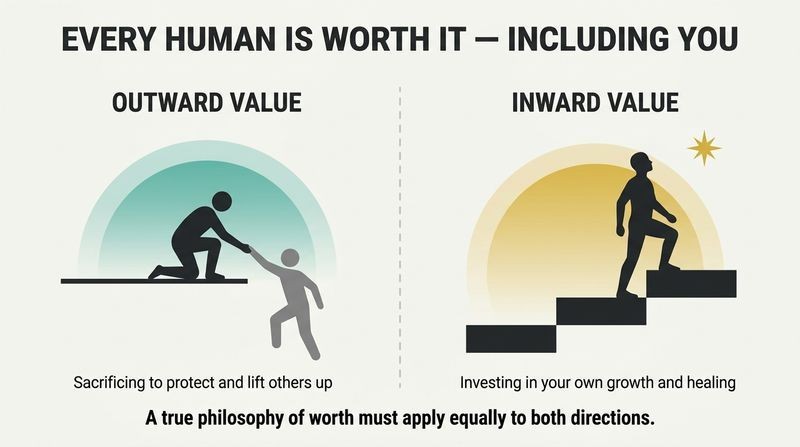
The title is the thesis. Kyle Carpenter, a Marine who covered a live grenade with his body in Marjah, Afghanistan on November 21, 2010, built his entire philosophy around a phrase he first blurted to an Uber driver named Bobby. When Bobby thanked him for his service, Carpenter replied, "You're worth it." He meant it literally: Bobby's family, freedom, and simple humanity made him worth deep scars and near death.
The idea cuts two ways. Others are worth protecting, and so are you. You are worth investing in, worth pushing past whatever blocks you, worth pursuing your own happiness. Carpenter refuses to split his life into "before" and "after" the blast, because that gives the enemy who threw the grenade too much power over his story.
What's striking is how Carpenter converts a battlefield instinct into a universal ethic. Philosophers call this inherent dignity, the Kantian notion that persons are ends in themselves, never merely means. Carpenter arrives at it not through theory but through blood. The move from "you are worth it" (others) to "I am worth it" (self) also anticipates self-compassion research by psychologist Kristin Neff, who finds people extend kindness to others far more readily than to themselves. Carpenter's insistence on refusing a before/after narrative echoes narrative therapy: we heal partly by choosing which story we tell about our wounds.
Refuse to let your worst moment become your whole identity
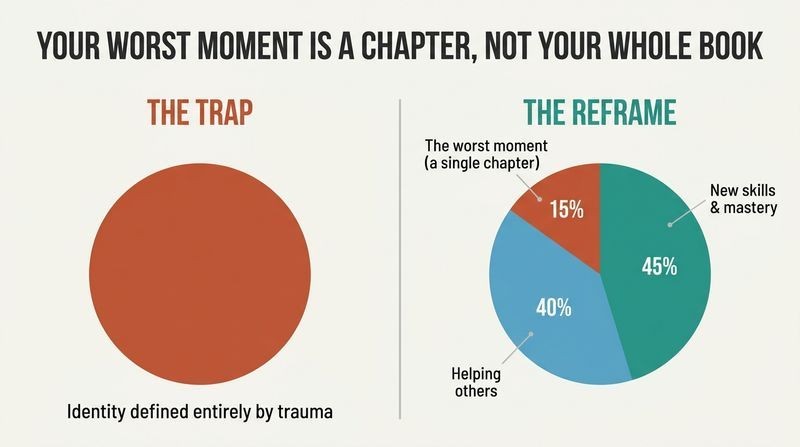
The kitchen counter turning point. Five months after the grenade, Carpenter tried to eat Wheaties, felt the small triumph of pouring his own bowl, then realized he couldn't chew. He broke down and asked his mother, "Who is ever going to love me again?" She held him and promised he would. In that moment he saw a choice: stay slumped at the counter forever, or get up and live. He chose to get up.
Fighting forward, not against the past. Carpenter reframed rehab entirely. Occupational therapy stopped being about recovering lost skills and became about discovering what he could still master. He developed a daily mantra: work hard, do the right thing, help people, and you cannot go wrong. Setbacks became part of the journey, not proof of failure.
Carpenter independently reinvents a core insight of acceptance and commitment therapy: suffering multiplies when we fight reality rather than build a life alongside it. His pivot from "recovering what I lost" to "discovering what I can do" mirrors the psychological concept of post-traumatic growth, where trauma survivors report new strength and purpose, not merely a return to baseline. One caution worth naming: Carpenter's own account shows the choice was not a single heroic act but a decision he recommitted to daily, and often through professional help. The clean "I chose to live" narrative risks underselling how repetitive and assisted real recovery is.
Lead by doing the worst job alongside your people
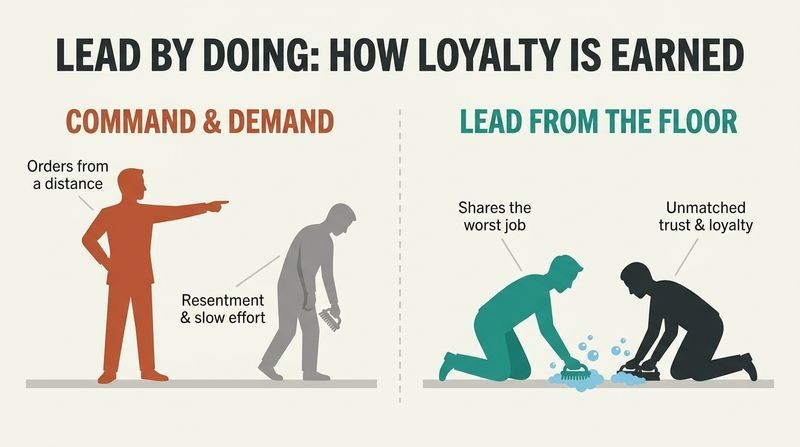
Scuzzing on his knees. As a boot camp squad leader, Carpenter learned that when he ordered his squad to clean the barracks, they moved immediately, because they knew he would drop to the floor and scrub with them. His drill instructor noted this follow-through as his defining leadership trait. A leader who shares the lows, not just the credit, earns loyalty rather than demanding it.
Two contrasting fire team leaders. His first was a disappointment: he yelled without purpose, was slowest in physical training, and cared only about his next cigarette. His replacement, Lance Corporal Taryn Heintz, embodied one rule, lead with action. Heintz ate last, worked holidays, took the worst posts, and had already done anything he asked of his men. Carpenter says he would have followed Heintz until his last breath.
This is servant leadership rendered in mud and sandbags. Robert Greenleaf coined that term in 1970, arguing the best leaders serve first and lead second. Carpenter adds a visceral test: would you scuzz the floor beside them? Modern management research supports him. Studies on "leader humility" show teams perform better and trust more when leaders admit limits and share menial work. The bad-leader contrast is instructive too. Carpenter's key lesson is that a poor leader above you does not excuse poor performance from you: the junior Marines trained themselves anyway. Ownership does not wait for permission from the top.
Keep promises to yourself, not just to other people
The delayed enlistment. Carpenter felt called to the Marines out of high school but agreed to try one semester of college first, out of respect for his heartbroken mother, who begged him to consider the Coast Guard or National Guard instead of active combat. He gave college a genuine shot, then enlisted anyway in January 2009. His father's verdict: "He's going to do this. Let's give him our blessing so we can support him."
Integrity runs inward. Carpenter argues we obsess over keeping our word to others while quietly betraying ourselves, shrinking to fit someone else's outdated vision of who we should be. In the Marines he learned brothers must trust your word absolutely. But self-respect, he says, means defending and following through on your own deepest convictions too.
Carpenter names a blind spot in conventional ethics: we treat promise-keeping as purely social, owed outward. Psychologists studying self-concordance find that goals chosen from authentic internal values, rather than to please others or avoid guilt, produce more sustained effort and wellbeing. His framing also reflects the delicate work of individuation, the developmental task of separating from parents without severing love. Notably, Carpenter did not rebel; he honored his parents by explaining, researching alternatives, and seeking blessing rather than sneaking off. That is the mature version of the insight: keeping faith with yourself need not mean trampling the people who love you.
Everyone carries invisible suffering you cannot see from outside
Watching planes from the dirt. On night watch in Helmand, Carpenter would stare up at passenger jets crossing the black sky, imagining warm, comfortable strangers thirty thousand feet up who had no idea an unshowered Marine was watching from the worst day of his life below. It crystallized a truth: someone, somewhere is always having their worst day, mostly unseen.
The corpsmen who treated the enemy. Navy medics patched up Afghan civilians and even wounded insurgents, seeing need rather than tribe or politics. Children arrived burned or cut, sometimes coerced by the Taliban. One boy was forced to throw a grenade into the Marines' compound or be killed. Carpenter began asking who he himself was dismissing based on circumstances he did not understand.
This is perspective-taking as a moral discipline, and it maps onto what psychologists call the fundamental attribution error: we explain others' behavior by their character while excusing our own by circumstance. Carpenter's combat vantage collapses that bias, since he watched "enemies" who were coerced fathers and terrified children. The image of anonymous planes overhead resembles what philosopher Thomas Nagel called the view from nowhere, the humbling recognition that your crisis is invisible in the wider frame. The practical takeaway is empathy as default: assume the stranger carries a weight you cannot see, and judge more slowly.
Shock your system by doing something your fear forbids
Jump out of the airplane. At Walter Reed, wounded warriors could join Jumping for a Purpose, a skydiving program founded by shot-in-the-face Navy SEAL Jay Redman, whose motto was that your only limits are self-imposed. Carpenter is terrified of heights. He jumped anyway from 13,000 feet, seated beside triple amputees who had already leapt. The free fall shattered his growing belief that his repaired body was made of glass.
Why extreme beats gentle. For young combat-wounded veterans facing forty more years in an altered body, depression is nearly universal. Carpenter argues that sometimes the fastest way to restart a stalled life is not to ease in but to do something reckless and epic that redraws the boundaries of what you believe is possible.
There is real behavioral science under the bravado. Exposure therapy treats fear by confronting it in escalating doses, and "behavioral activation" treats depression by scheduling meaningful action before motivation returns, not after. Carpenter's skydive is both at once. The presence of triple amputees leaping first also leverages social proof: seeing a peer with fewer limbs succeed dismantles the excuse. A fair caveat: extreme risk is not universally therapeutic, and clinicians would warn against reckless stunts as a coping default. Carpenter's own frame, that this jump-starts a stalled system rather than replaces sustained treatment, is the responsible reading.
Wear your scars openly; they are a universal language
Scars as credentials. Carpenter's gunpowder-tattooed face and skin-grafted arm cannot be hidden, so he stopped trying, even choosing the Twitter handle @chiksdigscars. He declined most scar-revision surgery, reasoning that erasing the marks would erase what he survived. Painful laser treatments left his face swollen like a beehive; he decided it was like buffing a dent out of a totaled car.
Bonds across worlds. In a Bethesda pub, gang members who were his friend Toranzo's childhood buddies embraced him as a brother because his scars proved he had been through hell. A homeless man named Kenny traded scar-stories with him. A high-ranking Marine confessed Carpenter's survival was the reason he had not killed himself. Visible wounds mark you as a survivor, and they give others hope theirs can heal too.
Carpenter turns stigma into connection, and the research backs the mechanism. Vulnerability researcher Brene Brown argues that revealed imperfection, not projected perfection, is what actually builds trust and intimacy. Carpenter's distinction between a wound (still fresh, needs covering, risks infection) and a scar (healed proof of survival) is clinically and emotionally precise: timing matters, and he explicitly refuses to pressure anyone to expose wounds prematurely. The gang-member scene is a small sociology lesson too. Shared suffering can bridge class and culture faster than shared background, because pain is a language nearly everyone already speaks fluently.
Motivation, not positivity, is what carries you hour to hour
"Stay motivated." The eye-rolling Marine cliche, tossed out when troops are cold, wet, and miserable, became Carpenter's engine. He distinguishes it sharply from positivity: positivity is feeling good about how the future will turn out, while motivation is the drive to make it turn out. Positivity alone cannot get you through a night breathing through a tracheostomy tube.
Decisions for Future You. Carpenter weaned himself off methadone (essentially pharmaceutical heroin) over a miserable week of tremors and sweats, and later threw away a nearly full bottle of Dilaudid the moment he noticed he enjoyed it, terrified of addiction. He endured three hours of failed blood draws before discharge by fixating on the goal: home. Sometimes you just lower your head and walk into the storm.
The positivity-versus-motivation split is sharper than most self-help allows. Psychologist Gabriele Oettingen's research on "positive fantasies" found that vividly imagining success can actually sap the energy to pursue it, because the brain half-experiences the reward already. Carpenter's instinct, that drive beats good feelings, aligns with her fix: mental contrasting, pairing the dream with the obstacle. His deliberate escape from opioids is quietly radical given the epidemic he watched Taliban poppy money feed. Choosing present pain to protect Future You is textbook delay of gratification, the trait Walter Mischel's marshmallow studies linked to long-term flourishing.
You will fail even when you do everything right
The third marathon. Carpenter ran his first Marine Corps Marathon in 2013 on four weeks of training, finishing in 4:27, three months out of the hospital. In 2014 he skydived onto the course, got blown off target into Arlington Cemetery, sprinted through headstones to the start, and still ran 5:12. Confident he was invincible, he trained religiously for 2017, aiming for under four hours.
Then the wall. Unusual heat triggered full-body cramps at mile eighteen. By mile twenty-two he was vomiting beside a medical tent, hauled in for bloodwork, arguing his way out against doctor's orders. He staggered across at just over six hours: angry, humbled, and grateful. The lesson: trying and failing is a disappointment, but never trying is the far greater one.
Carpenter reaches for Teddy Roosevelt's "man in the arena," and the fit is earned. The deeper value here is his correction of his own recovery mythology. The relentless-winner mindset that powered his rehab curdled into a belief in invincibility, and the marathon punctured it usefully. Sports psychologists note that athletes who attribute outcomes solely to effort and willpower are blindsided when uncontrollable variables (heat, genetics, luck) intervene. Maturity is learning to separate the quality of your striving from the outcome. That the same stubbornness which saved his life nearly caused heatstroke is a rare, honest admission that a strength overextended becomes a liability.
You are more than your resume, your ribbons, or your worst day
A medal in a GoPro case. In June 2014 President Obama placed the Medal of Honor around Carpenter's neck; he became the youngest living recipient and only the second living Marine honored since Vietnam. Yet he keeps the medal in a repurposed GoPro case in his closet and has worn it maybe a dozen times, refusing to let it become a prop for photos or fundraising.
The medal is not his. Carpenter insists there are no Medal of Honor "winners," only recipients, and that his story simply happened to be witnessed while countless equal acts of bravery went unseen or unsurvived. A grenade blast is an event, a speck of time. He refuses to be reduced to it, for good or ill, just as he refuses to let strangers freeze all veterans into heroes, demons, or saints.
Carpenter is fighting what sociologists call role engulfment, when a single identity swallows the whole person. His resistance is psychologically shrewd: research on "identity foreclosure" shows people who over-invest in one role (athlete, soldier, title) struggle profoundly when it ends or dominates. By treating the medal as a custodial trust for the fallen rather than a personal trophy, he sidesteps both survivor guilt and grandiosity. The point generalizes past the military. Anyone defined by a peak achievement, a diagnosis, a scandal, or a job title faces the same task: honoring the event without being imprisoned by it. You are the chooser, not the chosen moment.
Close the loop: gratitude completes healing that receiving alone cannot
The Gratitude Tours. Raised to write thank-you notes before the wrapping paper was cleared, Carpenter was haunted that he could never thank the strangers who saved him. So he went back. Operation Proper Exit let him return to Afghanistan and leave on his own two feet rather than a medevac, and see the ICU bed at Camp Bastion where he was first resuscitated. A trip to Landstuhl, Germany, reunited survivors with the medical staff who normally only see the bloodiest opening scene and never learn who lived.
Meeting the Pedro crew. In Nevada he finally met the Air Force medevac team who evacuated him in thirty-six minutes. He learned he had fought off their attempts to insert a breathing tube, flipping toward the door gunner. Moving from someone who only receives to someone who gives back, he says, is what let him finally breathe.
Gratitude here is not a mood but an action with a target, and the science is robust. Robert Emmons's studies link gratitude practice to measurable gains in wellbeing, sleep, and resilience. But Carpenter's version is sharper than journaling three blessings: it is reciprocity that restores agency. Trauma strips control and forces dependence; deliberately giving thanks back reverses the direction of the relationship and rebuilds selfhood. The Landstuhl detail adds a poignant layer often ignored, that caregivers suffer moral and emotional residue from seeing only carnage and never resolution. Letting rescuers meet the rescued heals the healers too. Gratitude, done in person, is mutual medicine.
Analysis
You Are Worth It is a memoir disguised as a leadership and resilience manual, structured as eighteen thematic chapters that each pull a life lesson from a scene in Kyle Carpenter's journey from small-town Mississippi and South Carolina to a rooftop in Marjah, through nearly forty surgeries, to the Medal of Honor and a college degree. The book's difficulty for a summarizer is that its power lives in accumulation and sensory detail (dust, blood, the sound of a reinflating lung) rather than in portable frameworks. Carpenter is not selling a system; he is testifying.
What elevates the book above genre is its refusal of the tidy hero arc. Carpenter, who genuinely cannot remember the grenade, keeps puncturing his own mythology: he admits the marathon nearly killed him through hubris, that his relentlessness curdled into a false sense of invincibility, and that his "choice to live" was actually a daily, assisted, backsliding process. This honesty is the book's intellectual spine. It resists the veteran-as-saint framing that Carpenter explicitly rejects.
The most transferable ideas are quietly countercultural. Motivation over positivity anticipates Oettingen's critique of positive fantasy. Keeping promises to yourself reframes integrity as inward-facing. Gratitude-as-action, culminating in his return trips, functions as reciprocity that restores the agency trauma steals. His treatment of scars as a connective language rather than shame prefigures vulnerability research.
The book's limits are worth flagging. It is theologically and culturally rooted in a specific American, Christian, military worldview, and its claims about willpower can underweight structural luck (Carpenter repeatedly calls his survival a cascade of miracles, then attributes recovery largely to grit). A reader should hold both: extraordinary personal drive and an extraordinary support system of surgeons, family, and strangers. The synthesis, that a life worth fighting for is built from small victories and mutual care, is more durable than any single act of valor.
Review Summary
You Are Worth It receives overwhelming praise for its inspiring, emotional, and well-written account of Kyle Carpenter's journey. Readers appreciate Carpenter's humility, gratitude, and positive outlook despite his traumatic experiences. The book is lauded for its raw honesty, life lessons, and ability to evoke a range of emotions. Many reviewers found it life-changing and recommend it to everyone. Carpenter's resilience, sacrifice, and perspective on life deeply resonate with readers, who describe the book as a testament to the human spirit and a source of motivation.
People Also Read




FAQ
What's You Are Worth It about?
- Personal Journey of Resilience: The book details Kyle Carpenter's transformation from a small-town boy to a Marine who survived a grenade explosion in Afghanistan, focusing on themes of sacrifice and courage.
- Military Experience and Recovery: Carpenter shares his combat experiences, the severe injuries he sustained, and the extensive recovery process, highlighting the support from family, friends, and medical staff.
- Inherent Human Worth: The central message is "You are worth it," emphasizing the value of every individual and the importance of mutual support and well-being.
Why should I read You Are Worth It?
- Inspiration and Motivation: Carpenter's story is a powerful reminder of human resilience and the ability to overcome adversity, offering motivation for those facing challenges.
- Insight into Military Life: The book provides a deeper understanding of military service's emotional and physical toll on service members and their families.
- Lessons on Leadership and Compassion: It offers valuable insights into leadership, empathy, and community support, showing how individuals can positively impact others' lives.
What are the key takeaways of You Are Worth It?
- Value of Human Life: Carpenter stresses that every person has inherent worth and deserves protection and care, driving his actions throughout the book.
- Importance of Connection: The narrative highlights the significance of relationships and support systems in overcoming challenges, with Carpenter's recovery aided by his loved ones.
- Resilience in Adversity: The book illustrates how resilience can be cultivated through determination and a positive mindset, showing that setbacks can lead to growth.
What are the best quotes from You Are Worth It and what do they mean?
- “You’re worth it.”: This phrase encapsulates the book's theme, reminding readers of their inherent value and the importance of mutual support.
- “If we don’t spend our time on this earth looking out for one another, what are we really doing with our lives?”: Emphasizes the importance of community and compassion, arguing that life's meaning comes from connections and support.
- “You are worth whatever you want to invest in yourself.”: Encourages readers to prioritize personal growth and well-being, linking self-worth to the effort invested in life.
How did Kyle Carpenter's family support him during his recovery?
- Constant Presence: Carpenter's family, especially his mother, provided unwavering emotional support and encouragement throughout his recovery.
- Advocacy for Care: His parents actively sought the best medical care, navigating the military health-care system to ensure he received necessary treatment.
- Community Support: The Carpenter family received significant support from their community, which played a crucial role in their journey.
How does You Are Worth It address the concept of survivor's guilt?
- Acknowledging Survivor's Guilt: Carpenter discusses the guilt of surviving traumatic events, reflecting on the emotional burden of being alive when others have died.
- Finding Purpose in Survival: He channels survivor's guilt into honoring those who didn't return, believing that living fully pays tribute to fallen comrades.
- Community Support: Emphasizes connecting with fellow veterans to share experiences and alleviate the weight of survivor's guilt.
What role does gratitude play in You Are Worth It?
- Foundation of Healing: Gratitude is vital in Carpenter's recovery, with appreciation for support aiding his emotional and mental healing.
- Gratitude Tours: Carpenter visits medical staff and fellow service members to thank them, transforming from a care recipient to someone who gives back.
- Cultivating a Grateful Mindset: Encourages readers to adopt gratitude, fostering resilience and positivity by recognizing others' support.
How does You Are Worth It explore the theme of identity?
- Struggle with Identity: Carpenter discusses redefining his identity post-injury, reflecting on how military experiences shaped him.
- Embracing Change: Emphasizes accepting change and finding new ways to define oneself, viewing scars and experiences as integral parts of identity.
- Finding Purpose: Carpenter discovers new passions and goals, encouraging readers to seek purpose and recognize identity as fluid and evolving.
What insights does You Are Worth It provide about the recovery process?
- Physical and Emotional Challenges: Carpenter shares the difficulties of recovery, emphasizing that setbacks are a natural part of the journey.
- Importance of Support Systems: Highlights the critical role of family, friends, and medical professionals in recovery, showing how support aids healing.
- Celebrating Small Victories: Encourages recognizing and celebrating small achievements, contributing to overall progress and motivation.
How does You Are Worth It address the concept of heroism?
- Redefining Heroism: Carpenter challenges traditional heroism, emphasizing selflessness and protecting others over seeking glory.
- Everyday Acts of Courage: Illustrates heroism in daily actions, highlighting the bravery of Marines and medical staff.
- Collective Heroism: Views the Medal of Honor as a tribute to collective efforts, believing heroism is shared among those who serve.
What does You Are Worth It teach about the importance of community?
- Supportive Networks: Carpenter underscores the significance of community support during struggles, sharing how it aided his recovery.
- Shared Experiences: Highlights the power of connecting with others who faced similar challenges, fostering understanding and empathy.
- Giving Back: Emphasizes giving back to the supportive community, with Carpenter's "Gratitude Tours" acknowledging their efforts.
What impact did Kyle Carpenter's story have on others?
- Inspiration for Veterans: Carpenter's journey inspires veterans facing similar challenges, with his resilience resonating with those who experienced trauma.
- Awareness of Military Issues: Raises awareness of service members' and families' struggles, encouraging understanding of military life complexities.
- Encouragement for Personal Growth: His message of self-worth and investing in oneself encourages readers to pursue growth and happiness, reminding them of their power to overcome adversity.
Download PDF
Download EPUB
.epub digital book format is ideal for reading ebooks on phones, tablets, and e-readers.








































