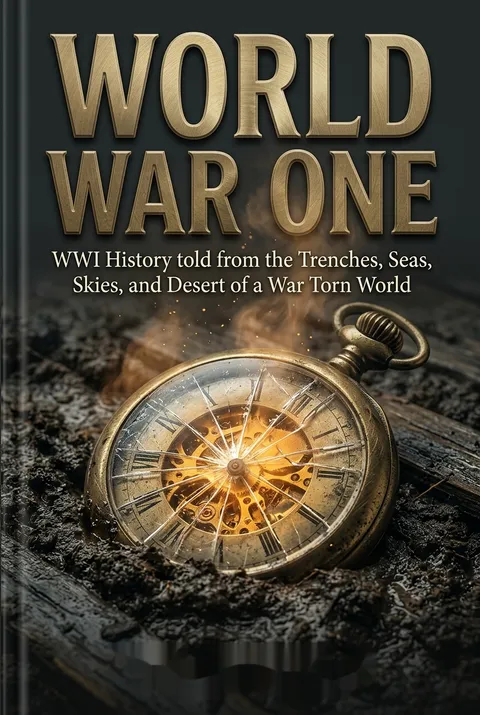

Key Takeaways
1. World War One: A Global Conflict of Unprecedented Brutality
After the final shell had been fired and the last gas canister unleashed, there was nothing to show for it except over 21 million dead.
A global catastrophe. World War One, initially anticipated as a swift, heroic conflict, quickly escalated into a global war involving countries from every continent. Leaders like the Kaiser optimistically predicted a quick victory, but only a few, like Sir Edward Grey, foresaw the grim, prolonged reality that would extinguish the "lamps... all over Europe." The sheer scale of the conflict, drawing in farm and factory workers, civil servants, and teachers, transformed everyday lives into a terrifying ordeal.
Technological slaughter. The war occurred at a critical juncture in military technology, where defensive weapons far outstripped offensive capabilities. Innovations like trench fortifications, barbed wire, machine guns, and rapid-fire rifles made defending positions straightforward, while attacking infantry, armed with rifles and bayonets, faced unprecedented slaughter. Artillery, reaching new levels of accuracy and rapid fire, caused over 70% of all casualties, turning battlefields into "ghastly butchery of vain and insane offenses."
Futility and immense loss. Battles like the Somme epitomized this futility, with 60,000 British casualties on the first morning alone, and over a million killed or wounded over five months for minimal territorial gain. The French army was decimated at Verdun, losing 350,000 men with nothing to show for it. This industrial-scale killing, driven by outdated tactics against modern weaponry, left behind a staggering 21 million dead, with little to justify the immense human cost.
2. The Human Spirit's Resilience Amidst the Horror
Christmas sometimes works a strange magic, even in conditions like those in December 1914.
A magical truce. Amidst the brutal fighting, the Christmas Truce of 1914 offered a poignant glimpse of shared humanity. On Christmas Eve, German guns fell silent, followed by British lines. Soldiers emerged from trenches, serenading each other with carols, exchanging cigarettes, chocolate, and even playing football in No Man's Land. This spontaneous goodwill, though quickly suppressed by high command, highlighted the common ground between ordinary soldiers.
Acts of unexpected kindness. Even in captivity or behind enemy lines, individual acts of compassion shone through. An American pilot, Lieutenant Ryan, shot down and captured, found an unexpected "German friend" in a hospital, a former San Franciscan who shared stories and even refused a coveted apple out of principle. Later, during his escape, desperate Belgian peasants, risking severe German reprisals, offered him food and shelter, demonstrating profound courage and empathy for a stranger.
Enduring the unimaginable. The psychological toll of the war was immense, with veterans tormented for years by what they had seen and done, suffering from what is now recognized as PTSD. Yet, stories of resilience, like the French soldiers marching to the front "bleating like sheep" in protest of futile offensives, or the unwavering loyalty of Captain Spindler's crew, underscore the human capacity to endure and find moments of defiance or connection even in the most dehumanizing circumstances.
3. Propaganda's Potent Influence on Public Perception
But from the bones of such stories, British propaganda built a picture of the German people as a nation of godless barbarians.
The myth of the Angels of Mons. In the early, desperate days of the war, with real news scarce, wild stories flourished. The "Angels of Mons," a fictional newspaper story about ghostly archers aiding British troops, was widely believed, fueled by public anxiety and a desire for divine reassurance. This urban legend, despite its author's confession of invention, became a powerful morale booster, illustrating the public's hunger for comforting narratives.
Demonizing the enemy. British propaganda deliberately fabricated grotesque images of Germans as "Huns," barbaric and godless. Stories circulated of German soldiers replacing church bells with hanging nuns or operating "corpse factories" to render bodies into industrial products. These narratives, though absurd, effectively stoked intense fear and hatred, convincing many to enlist and fight for "civilization against the barbaric foe."
A legacy of distrust. The widespread belief in these fabricated stories had profound consequences. It fueled a fervent anti-German sentiment, leading to attacks on German immigrants and their businesses. However, after the war, the public's realization that much of the news was outright lies led to a deep distrust of newspapers, an attitude that persisted into WWII, initially causing disbelief in reports of German death camps.
4. Naval Supremacy and its Decisive Strategic Impact
The German High Seas Fleet never put to sea again.
Jutland: The last great naval clash. The Battle of Jutland in May 1916 was the only full-scale confrontation between the British Grand Fleet and the German High Seas Fleet, marking the last great battleship engagement in history. Despite heavier British losses (14 ships and 6,000 men to Germany's 11 ships and 1,500 men), the Royal Navy maintained control of the seas. The German fleet, though proving its ships were better designed, never again challenged British naval dominance.
The critical British blockade. Britain's control of the sea was paramount, protecting its cargo ships and ensuring troop movements to the Western Front, while simultaneously blockading German waters. This blockade severely hampered Germany's war industries and caused widespread food shortages for its population. The failure of the High Seas Fleet to break this blockade was a strategic defeat for Germany.
U-boat warfare and US entry. Unable to challenge British surface power, Germany shifted to unrestricted U-boat warfare, sinking any ship, including neutral ones, bound for Britain. This desperate tactic, while effective in causing starvation fears in Britain, backfired spectacularly by provoking outrage in the United States. The sinking of American ships became a primary reason for the US entry into the war in April 1917, a move that ultimately sealed Germany's fate.
5. The Perilous Skies: Life and Death of WWI Airmen
The casualty rate in the RFC was atrocious.
High-stakes aerial combat. The early days of WWI aviation were marked by rickety biplanes and incredibly high casualty rates for pilots. Fighter aces like Lieutenant Ryan, an American serving in the British Royal Flying Corps, engaged in daily, deadly dogfights, where new maneuvers like the "spinning nosedive" were both dangerous stunts and vital escape tactics. Pilots faced not only enemy aircraft but also relentless anti-aircraft fire from the ground.
Zeppelin terror and its demise. German Zeppelins, massive hydrogen-filled airships, initially terrorized London with bombing raids, causing widespread panic and disruption. Despite their size, they were initially invulnerable to early fighter planes. However, advancements in aircraft design and the development of incendiary bullets, as demonstrated by Lieutenant William Robinson's downing of the SL-11, eventually made Zeppelins too vulnerable, leading to their replacement by faster, higher-flying bombers.
Psychological and physical toll. The constant threat of being shot down, catching fire, or crashing took an immense psychological toll on airmen. Ryan's vivid account of seeing a German pilot's "pure terror" before his plane disintegrated, and his own near-death experience, highlight the brutal reality. The high demand for new pilots meant a constant influx of eager but inexperienced young men into a deadly arena, where survival was often a matter of luck.
6. The Desperate Art of Escape and Evasion
The idea of remaining a prisoner of war was against the fabric of my soul.
Daring leaps for freedom. The personal narratives of captured officers reveal an extraordinary will to escape. Lieutenant Ryan, an American pilot, made a desperate leap from a moving German train, sustaining injuries but gaining his freedom. His subsequent journey through enemy territory, relying on wits, a stolen map, and the kindness of strangers, showcased immense courage and resourcefulness in the face of overwhelming odds.
Navigating hostile lands. Ryan's trek through Germany, Luxembourg, and Belgium involved constant concealment, foraging for food, and swimming across numerous rivers and canals. His encounters with German soldiers, where he feigned being deaf and mute, and his reliance on the "deaf and dumb Belgian peasant" disguise, highlight the ingenuity required to survive in enemy-occupied lands. The constant threat of recapture and execution fueled his determination.
The ultimate barrier. Both Ryan and Captain Spindler faced the formidable electrically charged barbed wire fence separating Belgium from neutral Holland. Ryan's harrowing passage, involving digging under the wire and risking electrocution, was a testament to his desperate resolve. Spindler's elaborate escape attempts from POW camps, including a planned aerial escape and a failed car getaway, underscore the relentless pursuit of freedom and the high stakes involved for captured officers.
7. WWI's Far-Reaching Theaters Beyond the Western Front
This book isn’t a history lesson of Allied actions in WWI Mesopotamia. This is the story of Frank Wooten.
Mesopotamia: The Garden of Eden at war. WWI extended far beyond the trenches of France, reaching distant lands like Mesopotamia (modern-day Iraq), a region strategically vital for its oil and trade routes. Frank Wooten, an American serving as a British officer in a motorized machine gun unit, provides a unique perspective on this often-overlooked front. His journey to Baghdad, navigating the Tigris and Euphrates rivers, revealed a land of ancient ruins, vibrant bazaars, and stark desert landscapes.
Desert warfare and cultural encounters. Wooten's experiences in Mesopotamia involved skirmishes on the Kurdish Front, advances up the Euphrates, and patrols in Babylon. His unit, equipped with Rolls Royce armored cars, adapted to the challenging terrain and extreme climate. Wooten's superior Arabic language skills allowed him unique access to local officials and tribesmen, offering insights into the complex cultural dynamics and the British efforts to develop the region.
Palestine and the global conflict. The war also raged in Palestine, where Wooten later traveled, encountering figures like Major A.B. Paterson and Colonel T.E. Lawrence. Lawrence's organization of Arab tribes to raid Turkish outposts and disrupt communication lines exemplified the diverse strategies employed across different theaters. These narratives underscore that WWI was a truly global conflict, fought in vastly different environments, with a multitude of cultures and peoples drawn into its vortex.
8. The Unforeseen Legacy: Seeds of Future Conflicts and Lasting Scars
The most terrible war in human history had a fitting conclusion. It bred another that would be even worse.
A fragile peace. The Versailles peace treaty of 1919, rather than ending all wars, was seen by many, including French commander Marshall Foch, as merely a "20-year cease-fire." The punitive reparations imposed on Germany, coupled with the shame of defeat and economic ruin, fueled deep resentment. This environment was fertile ground for figures like Adolf Hitler, whose Nazi Party capitalized on these grievances, setting the stage for World War II.
Widespread societal upheaval. The war brought about profound political and social changes across Europe. The Austro-Hungarian Empire disintegrated, Germany lost its monarchy, and the Russian monarchy was eradicated, leading to 70 years of brutal communist oppression under the Bolsheviks. The immense human cost, with half of all Frenchmen aged 20-35 killed or wounded, left deep demographic and psychological scars across nations.
Enduring trauma and consequences. Beyond the battlefield, a colossal influenza epidemic, exacerbated by the war's stress and deprivation, claimed over 10 million lives globally. Survivors, whether physically maimed or suffering from "shell shock" (now PTSD), carried the war's burden for life. The loss of millions of young men also meant hundreds of thousands of women were unable to marry, fundamentally altering societal structures and leaving a stark reminder of the horror of war for generations.
9. The Audacious Mission to Ireland: A Tale of Espionage and Sacrifice
An impossible mission suited for only the bravest and most fearless of men.
A daring German-Irish alliance. Sir Roger Casement, an Irish nationalist, orchestrated a plan with Germany to supply weapons to Irish rebels for an Easter Uprising against British rule. Captain Karl Spindler, a German sea captain, was tasked with this "impossible mission": smuggling 20,000 rifles, a million rounds of ammunition, and explosives to the Irish coast aboard the disguised steamer Libau, renamed Aud.
Evasion and deception. Spindler's journey was a masterclass in deception, transforming his ship and crew into a Norwegian tramp steamer. They meticulously forged documents, adopted Norwegian identities, and navigated treacherous waters, evading British patrols through cunning maneuvers and a "smokeless" engine trick. Despite defying British orders to follow a coastal route, they successfully slipped through multiple checkpoints, relying on luck and audacious bluffs.
Failure and scuttling. Upon reaching Tralee Bay, the rendezvous with the Irish rebels failed due to miscommunication and the capture of key Sinn Feiners. Spindler, realizing his mission was compromised and surrounded by British cruisers, made the ultimate sacrifice: he scuttled the Aud, blowing up his ship to prevent its capture and the exposure of its cargo. Though captured, his act of defiance and the subsequent trial of Sir Roger Casement, who was hanged for treason, became a significant, albeit tragic, chapter in WWI espionage and Irish history.
Review Summary
World War One receives a 3.91/5 rating with mixed feedback. Readers praise its social history approach and personal storytelling across four WWI narratives, including trench accounts, an American pilot's experience, a German-Irish smuggling plot, and the Motor Machine Gun Corps. Many appreciate the engaging, human perspective that avoids dry academic writing. However, some criticize grammatical errors, typos, and factual mistakes. Inconsistent storytelling quality across sections leaves certain portions lacking descriptive detail, though individual stories remain compelling for those interested in lesser-known WWI perspectives.
People Also Read

Download PDF
Download EPUB
.epub digital book format is ideal for reading ebooks on phones, tablets, and e-readers.








































