


Key Takeaways
Motivation is frosting; winners already kick their own ass
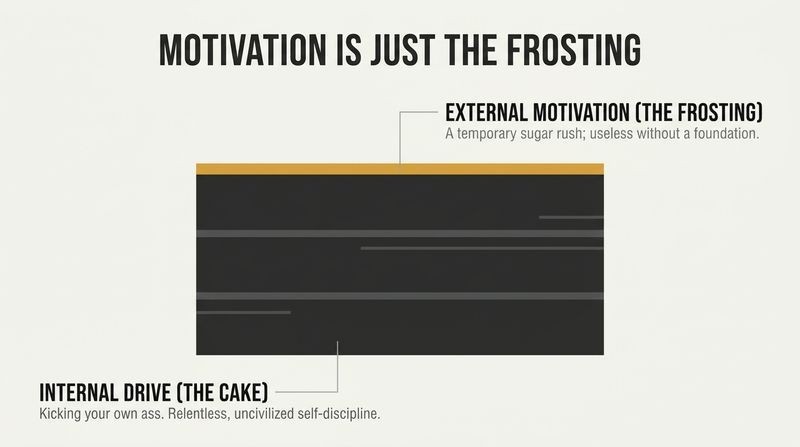
Winning has its own language, and it despises hype. Grover, who trained Michael Jordan for fifteen years and Kobe Bryant for years after, refuses to be a motivational speaker. Motivation, he argues, is entry-level: a sugar rush that leaves you face-planted on the floor when it wears off. He does not work with people who need a kick in the ass; he needs to know you are already delivering one to yourself so he can build on your best work.
When he asks elite achievers to describe Winning in one word, ordinary people say "glorious" or "euphoric." The greats say "uncivilized," "nasty," "unforgiving," "dirty." Kobe said "Everything." Winning is grit, not glamour. If your image matters more than your results, you picked the wrong pursuit.
What's striking is how sharply this cuts against the multibillion-dollar motivation industry of pump-up speeches and "You got this!" affirmations. Research on motivation broadly supports the distinction: intrinsic drive predicts long-term persistence far better than externally applied enthusiasm, which decays fast. Psychologist Angela Duckworth's work on grit echoes Grover's contempt for the temporary high. The limitation worth naming: not everyone starts as a self-starting elite. Grover explicitly selects for people already at the top, which means his advice may not transfer cleanly to someone still building the baseline discipline that motivation, however cheap, can help ignite.
Learn how to think, not what to think
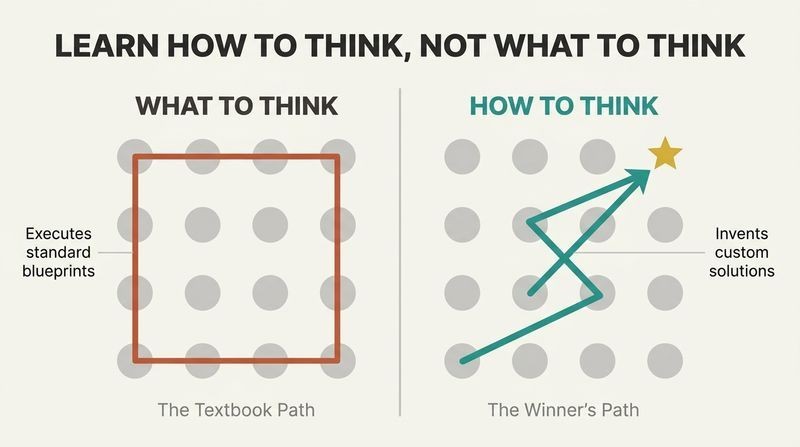
Education teaches what to think; life teaches how. Grover's central distinction between competing and winning: competitors execute what they are told, winners engage their own minds to invent new solutions. He had Jordan train on game days when the entire NBA said it would ruin his shot, fed him steak before games when everyone prescribed carbs, and told him to grab the bottom of his shorts (not his knees) to breathe deeper when fatigued.
None of it came from a textbook. Grover imagines a page of a thousand dots: most people connect them into a familiar picture, but winners chart their own course. He warns against self-help dependency: if you cannot decide anything without consulting mentors and podcasts, you are being told what to think. Question everything, including him.
This is intellectual autonomy dressed in sweat. It resonates with Kant's "dare to know" and with expertise research showing that masters possess flexible mental models rather than rigid procedures, letting them improvise when the script breaks. The steak-before-games detail is a nice illustration of n-of-1 experimentation: individualized data beats population averages at the elite margin. One caution: "think for yourself" can become an excuse to ignore hard-won consensus. Jordan still hired experts and absorbed fundamentals obsessively. The synthesis is not rejecting knowledge but earning the right to depart from it, which requires first mastering it.
Your real battlefield is the minefield inside your own skull
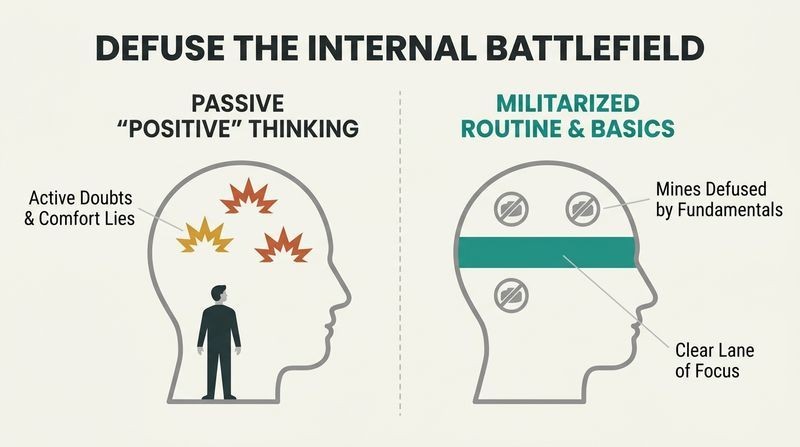
Winning is a war fought in your mind. Grover describes waking between 2 and 4 a.m. to a head full of detonating bombs: doubt, envy, anxiety, and dangerously kind lies like "take the day off, you've already won." Winners defuse these mines; losers brace for impact and clean up the mess.
His antidote is not positive thinking, which he dismisses as calling a disconnected number. It is routine and fundamentals. Jordan's game-day ritual was militarized down to lacing fresh shoes himself (he refused a pair Grover laced for him) and starting every warm-up with a basic chest pass. Routines remove battlefield decisions so the mind is free for the unpredictable. Grover deliberately threw imperfect passes in training so players learned to stay focused when reality did not cooperate.
The neuroscience aligns: routines offload decisions to the basal ganglia, conserving prefrontal resources for novel problems, which is precisely why elite performers ritualize the mundane. Grover's rejection of pure visualization is bolder and partly right. Visualization works best as process rehearsal (mentally practicing the mechanics), not outcome fantasy, which studies suggest can actually sap motivation. His "defuse the bomb" framing anticipates cognitive behavioral therapy's core move: interrogating automatic thoughts rather than obeying them. The blind spot is that some 3 a.m. dread signals genuine problems needing rest or help, not just weakness to override. Discernment, not blanket suppression, is the skill.
Bet on yourself before anyone else will believe in you
Confidence is built by being broken, not praised. Grover argues winners possess unshakable self-belief forged through humiliation, not confetti. His examples: Jordan cut from his high school team, Tom Brady drafted 199th, Kobe launching four airballs as a rookie in a playoff game, Scottie Pippen starting college as the team equipment manager. Grover himself stood alone in a college class for seven and a half weeks, unable to answer, until he taught himself the entire course.
He distinguishes the confident from the reckless: these are disciplined gambles on things you can control, not fantasies. Babies embody it, falling and rising without asking permission, until adults teach hesitation. To a room of CEOs he asked who had been called worthless, crazy, doomed to fail; everyone eventually stood. Crazy, he told them, is the compliment.
The counterintuitive claim (that confidence comes from surviving being broken rather than accumulating wins) finds support in post-traumatic growth research and in the concept of antifragility, where stressors strengthen rather than deplete. There is survivorship bias to flag: for every Brady who converts a late-round snub into fuel, countless equally slighted athletes simply washed out, and we never hear from them. Grover's selection of legends makes the pattern look inevitable when it was probabilistic. Still, the actionable core holds: agency and the willingness to act under uncertainty are trainable, and treating setbacks as data rather than verdicts is a documented marker of resilient high performers.
Let your mind outrank your feelings during competition
MIND greater than FEELINGS is Grover's formula. He argues champions put thought ahead of emotion, and their minds are stronger than their feelings. Kobe openly said he was not there to be a great teammate but to help you win championships; Jordan ridiculed teammates who would not meet his standard. Both were called assholes; between them they hold eleven rings.
Grover clarifies he is not anti-emotion, just anti-emotion-during-execution. He tells coaches to stop demanding "play with emotion" (which one) and demand energy, focus, and intensity instead. His control chain: control your thoughts, you control emotions; control emotions, you control actions; control actions, you control the outcome. Self-control means deciding which internal voice gets a vote today. Weakness and jealousy do not get one every day.
The "emotions make you weak" line understandably enraged readers, and modern affective science complicates it. Emotions are not noise to be deleted; they carry information and, when regulated rather than suppressed, fuel performance. Grover's own "controlled rage" and anger-as-fuel material actually concedes this. The more defensible reading is emotional regulation, not emotional absence, which aligns with research showing elite athletes do not feel less but recover faster and reappraise better. His anger scale (calm, annoyed, mad, pissed, angry, enraged) is a practical granularity tool; naming an emotion precisely is itself a regulation technique, a finding from affect-labeling neuroscience.
Chasing balance averages you out to zero
Winning wants all of you; there is no balance. Grover's most provocative claim: a perfectly balanced scale reads zero, so equal weight across everything yields zero happiness, zero results, zero achievement. Winning must dominate the scale. He tells the gutting story of his five-year-old daughter watching him pack and asking, "If I eat less, can you stay home more?" He kept packing. It took thirteen years before he could tell that story without crying.
His prescription is not adding more but deleting. Master the word "No," build a "NO List," and flex what he calls the IDGAF muscle: your internal capacity to stop caring what others think when making critical decisions about priorities. Stop spending time you do not have on people you do not like doing things you do not want to do.
This is the book's most contested and most honest chapter. The anti-balance stance runs against decades of burnout and well-being research linking sustainable performance to recovery and life integration. Yet Grover is describing a specific tier: those chasing singular greatness during finite competitive windows, where his athletes get an off-season most people never get. The daughter anecdote is unusually vulnerable and undercuts any triumphalism; he is not celebrating the cost, he is confessing it. The useful reframe for ordinary readers is not "neglect your family" but "stop diluting focus across obligations that do not matter," which subtraction-based prioritization research strongly endorses over endless addition.
Being called selfish is the tax on greatness
Winning requires selfishness, and Grover reframes it. He distinguishes selfish winners from selfish losers: losers take from everyone and no one benefits; winners give to themselves (confidence, time, focus) so they can ultimately give to others. He cites Buffett and the Gateses, whose decades of self-focused work funded historic philanthropy. Selfishness is really separation: moving away from others' expectations and from your own limiting beliefs.
Grover chose this himself, telling his Indian immigrant parents he would not attend the medical school he got into, choosing instead to train athletes. Central to selfishness is investing in yourself: education, skills, resources. He is blunt that people who skip college and preach you can too ignore all the failures who also skipped it. The one thing no one can repossess is what you have learned.
The redefinition of selfishness as enlightened self-investment echoes the oxygen-mask principle and Adam Grant's research showing that "otherish" givers (who protect their own interests while helping) outperform both pure takers and self-sacrificing givers who burn out. Grover's philanthropy examples are somewhat convenient (extreme wealth funds visible giving, obscuring less flattering cases), but the logic that you cannot pour from an empty vessel is sound. The separation concept connects to individuation in developmental psychology: becoming a distinct self requires tolerating others' disappointment. His insistence on education as unrepossessable capital is a quietly powerful hedge in an economy where every other asset can vanish overnight.
Winning is a round trip; expect to return to hell
Every win sends you back to the bottom. Grover insists Winning is not a one-way door but a cycle: start at the bottom, climb, win, then get escorted to the parking lot where the bus reads "Hell" again. Jordan spent seven seasons before his first title, then returned to hell after his father's murder and a baseball detour before winning three more. Kobe called Grover in 2007 with failing knees, five years removed from a title, and rebuilt his body through brutal work (deep-lunge shooting drills held five minutes per leg) to win in 2009 and 2010.
Resilience, Grover argues, is manufactured in hell, not comfort. Like scar tissue and rebuilt muscle, you heal back stronger and different. You do not pick up the broken pieces; the pieces pick you up and decide how you get reassembled.
The cyclical model corrects a common motivational distortion: the myth of arrival. It maps onto the hedonic treadmill, where achievement resets the baseline and yesterday's summit becomes today's starting line. Grover's scar-tissue metaphor is biologically apt (repaired tissue and muscle hypertrophy genuinely rebuild stronger) and philosophically kin to Nietzsche's "what does not kill me" and to kintsugi, the Japanese art of mending pottery with gold so the breakage becomes the beauty. The sobering nuance: repeated trauma does not always strengthen; chronic stress without adequate recovery produces breakdown, not growth. The variable Grover underweights is recovery capacity, which determines whether hell forges resilience or simply burns you out.
Fear sharpens you; doubt paralyzes you, and they differ
Fear and doubt are not the same. Grover separates them cleanly: fear is instinctive, heightens awareness, and is about the external threat; doubt is invited, slows you, and is about you. Fear says "I can do this"; doubt says "I'm finished." Even Kobe admitted nightly self-doubt and insecurity: you do not deny it, you embrace it without capitulating.
Grover names four concentric Rings of Winning. The outer ring is talent (everyone has some). Inside is intelligence (knowing how to develop the talent). Inside that is competitiveness (willingness to fight). The smallest center ring adds resilience: staying in the fight when fear says run, refusing to fall apart when everything goes wrong. You can win with three, but sustained greatness across career, health, and family demands all four, and very few possess them.
The fear-versus-doubt distinction is more than semantics; it tracks the psychological difference between arousal (physiological readiness, often performance-enhancing) and rumination (self-focused negative thought, reliably performance-degrading). Sports psychology's reappraisal research shows that relabeling pre-competition arousal as excitement rather than anxiety measurably improves outcomes, which is essentially Grover's "butterflies as allies." The Four Rings model is a clean expertise hierarchy, though it risks implying these traits are fixed endowments; competitiveness and resilience are substantially trainable, not just distributed. Kobe's candor about self-doubt is the chapter's gift: it demolishes the fantasy that elite performers feel no fear. They feel it and act anyway.
You can fake everyone but the scoreboard
Winning never lies; it is an absolute. There is a score, a number, a scale. Grover attacks the performance of success: the athlete posting 4 a.m. workouts for applause, the person in Gucci with twelve dollars until payday, the founder who claimed he had no dark side and was later ousted for letting it run his company down. He tells of a rookie labeled a bust whom he sent home to list what was real and what was fake; the honest inventory (distrust, hidden habits, fear) became the turning point.
His maxim: to have what you really want, you first must be who you really are. He mocks "showing up is half the battle" (it is none of it), "fake it till you make it," and options-hoarding. Winners run every plan as Plan A because Plan B is a permission slip to fail.
The scoreboard-as-truth-teller is bracing in an age of curated digital selves, where the gap between projected and actual competence has arguably never been wider. Grover intuits what social psychology calls impression management taken pathological: energy spent looking like a winner is energy stolen from becoming one. His "Plan A only" advice collides with decision science, which generally praises optionality and backup planning; research even shows merely making a Plan B can reduce Plan A effort. Yet for irreversible, all-in pursuits, his point holds. The nuance is domain-dependent: hedge in volatile, low-conviction bets; burn the boats only when commitment itself is the decisive variable.
Manage focus, not the clock, and treat every step as a sprint
A marathon is a sprint with no finish line. Grover detonates the cliche "it's a marathon, not a sprint," noting elite marathoners run sub-five-minute miles for 26.2 miles and never coast. The phrase, he argues, usually rationalizes procrastination. Kobe embodied the alternative: no hobbies, no golf, no parties, just relentless sprinting from season to season for twenty years, plus an Oscar and bestselling books after.
The secret was not time management but focus management. Grover says stop counting down to deadlines (which breeds panic and shortcuts) and count up, since the numbers are infinite and momentum never dies. Ask three questions of any goal: Do you want it? Can you do it? Is it worth your time? If any answer is no, move on. And the recurring warning: the biggest lie is believing you have plenty of time.
The count-up reframe is a clever hack against deadline-induced choking, which research attributes to attentional narrowing under time pressure. By shifting from scarcity (time running out) to accumulation (progress made), it reduces the threat appraisal that degrades performance. The flow-state parallel is explicit: Grover's "total focus mode" where hours vanish is textbook flow, and he correctly distinguishes it from the automaticity of the Zone. The three-question filter is a lightweight goal-audit that could prevent enormous wasted effort. The tragic undertone (Kobe's death making "you don't have time" literal) gives the chapter unusual gravity; urgency here is not hustle-culture cosplay but a confrontation with mortality.
Befriend your dark side, then build a quieter darker side
Your secrets and wounds are your fuel. Grover says winners wake at 3 a.m. to the ghosts, skeletons, and demons and shake their hands rather than hide them. The dark side is not evil; it is the raw, untamed drive to win, sourced from your deepest wounds. Kobe named his the Black Mamba, an assassin alter ego he could inhabit on the court and shed at home. Grover, once the fat, unathletic immigrant kid, found his own fuel there.
The evolution he adds in this book is the "darker side": the dark side wins battles and serves only you; the darker side wins the war, empowers others, and channels action over talk. The dark side tells you it is okay to have three drinks; the darker side stops at one, not from inability but because you do not need it.
This is Jungian shadow work in athletic vernacular: integrating the disowned parts of the psyche rather than repressing them, which Jung argued was essential to wholeness and power. The alter-ego device has empirical backing; the "Batman effect" studies show that adopting a persona improves persistence and self-distancing, and Kobe's Mamba is a vivid real-world case. Grover's exercise (hovering over each past humiliation to find the one that still burns) is a practical method for locating motivational fuel. The risk he flags himself: an uncontrolled dark side destroys careers, as with the ousted founder. The darker side, defined by restraint and generativity, is the mature synthesis: power that does not need to prove itself.
Analysis
Winning is best understood as the darker, more disillusioned sequel to Grover's Relentless, written in the shadow of Kobe Bryant's death, which frames the entire book with a mortal urgency that ordinary success literature lacks. It is a thesis-driven manifesto organized as "The Winning 13," a deliberately anti-listicle list (every item ranked number one) that rejects the step-by-step formula genre it inhabits. Grover's credibility is his moat: three decades inside the private worlds of Jordan, Kobe, and Wade give him anecdotes no researcher could access, and he wields them as evidence rather than decoration.
The book's intellectual signature is its contrarianism against the wellness-industrial complex. Where mainstream advice preaches balance, motivation, positive visualization, and self-compassion, Grover preaches imbalance, self-generated drive, brutal honesty, and controlled darkness. This is genuinely useful as a corrective, but it carries obvious survivorship bias: the sample is billionaires and Hall of Famers, and the failures who followed identical philosophies are invisible. His claims are descriptively accurate about the tiny elite and prescriptively hazardous if universalized.
What elevates the work above chest-thumping is its confessional undertow. The daughter's "if I eat less" question, his father's deathbed "you're stronger," and his on-camera tears in The Last Dance reveal a man cataloguing costs, not just spoils. The subtitle, "the unforgiving race," is the real thesis: Winning is personified throughout as a cruel, jealous, ungrateful lover who stiffs you with the check. This anthropomorphism is Grover's cleverest rhetorical move, converting abstract achievement into an adversary you can hate and pursue.
The practical toolkit is thinner than Relentless but sharp where it exists: the IDGAF muscle, the NO List, count-up focus, fear-versus-doubt, the Four Rings, and the dark-side fuel exercise. Read critically, Winning is less a blueprint than a psychological reality check for people already committed to greatness and unsettled by its loneliness.
Review Summary
Winning by Tim Grover receives mixed reviews, with an overall rating of 4.36/5. Many praise its raw, no-nonsense approach to achieving success, citing valuable insights from Grover's experience training elite athletes. Readers appreciate the book's emphasis on hard work, discipline, and unwavering commitment. However, some criticize its focus on winning at all costs, noting potential negative impacts on relationships and well-being. Critics also mention repetitiveness and a lack of practical advice. Despite polarizing opinions, many find the book motivating and thought-provoking.
People Also Read









FAQ
What's "Winning: The Unforgiving Race to Greatness" about?
- Author's Perspective: The book is written by Tim S. Grover, who shares insights from his experience training elite athletes like Michael Jordan and Kobe Bryant.
- Core Theme: It explores the relentless pursuit of success and the mental toughness required to achieve greatness.
- Winning's Nature: Grover describes winning as an unforgiving and demanding journey that requires total commitment and sacrifice.
- Personal Stories: The book includes personal anecdotes and lessons learned from working with top athletes and business leaders.
Why should I read "Winning: The Unforgiving Race to Greatness"?
- Unique Insights: Gain insights from someone who has worked closely with some of the greatest athletes in history.
- Mental Toughness: Learn about the mindset and mental strategies needed to achieve and sustain success.
- Real-Life Applications: The principles discussed can be applied to various fields, not just sports.
- Inspiration and Motivation: The book serves as a motivational guide for those striving to reach their highest potential.
What are the key takeaways of "Winning: The Unforgiving Race to Greatness"?
- Winning is Unforgiving: Success demands everything from you and offers no apologies.
- Mental Dominance: Achieving greatness requires mastering the battlefield in your mind.
- Relentless Pursuit: Winning is a continuous journey, not a one-time achievement.
- Self-Reflection: Understanding and embracing your dark side can fuel your drive to win.
How does Tim S. Grover define "Winning"?
- Winning is Everything: Grover emphasizes that winning is the ultimate goal and should be pursued relentlessly.
- No Finish Line: Winning is not a marathon but a series of sprints with no definitive end.
- Selfish and Unapologetic: Winning requires a level of selfishness and a focus on personal goals.
- Constant Challenge: It is a test with no correct answers, demanding constant adaptation and resilience.
What is the "Winning 13" in "Winning: The Unforgiving Race to Greatness"?
- Core Principles: The "Winning 13" are Grover's 13 principles that define the nature of winning.
- No Hierarchy: Each principle is ranked #1, emphasizing that all are equally important.
- Examples of Principles: They include "Winning makes you different," "Winning is selfish," and "Winning never lies."
- Guidance for Success: These principles serve as a guide for those seeking to achieve and maintain success.
What role does the "dark side" play in achieving success according to Tim S. Grover?
- Source of Power: The dark side is a source of energy and drive that fuels relentless pursuit.
- Embrace, Don't Fear: Grover advises embracing your dark side rather than fearing it.
- Personal and Unique: Each person's dark side is unique and deeply personal, shaped by their experiences.
- Controlled Use: It must be controlled and harnessed effectively to avoid self-destruction.
How does Tim S. Grover describe the relationship between winning and losing?
- Interdependent: Winning and losing are not enemies; they need each other to exist.
- Learning from Losses: Losing is part of the process and offers valuable lessons for future success.
- Resilience Required: The ability to bounce back from losses is crucial for sustained winning.
- Emotional Control: Winners manage their emotions and learn to accept losses as part of the journey.
What is the significance of "selfishness" in "Winning: The Unforgiving Race to Greatness"?
- Focus on Self: Winning requires prioritizing your own goals and needs above others.
- Not Negative: Grover redefines selfishness as a necessary trait for achieving success.
- Outcome-Oriented: Selfishness should lead to positive outcomes that benefit not just the individual but also those around them.
- Courage to Stand Alone: Being selfish means having the courage to make decisions that others may not understand or agree with.
How does Tim S. Grover suggest dealing with fear and doubt?
- Fear vs. Doubt: Fear is natural and can heighten awareness, while doubt is paralyzing and must be avoided.
- Trust Yourself: Confidence in your abilities is crucial to overcoming fear and doubt.
- Preparation is Key: Being well-prepared helps manage fear and prevents it from turning into doubt.
- Embrace Fear: Use fear as a motivator to push yourself beyond perceived limits.
What are some of the best quotes from "Winning: The Unforgiving Race to Greatness" and what do they mean?
- "Winning is everything." This emphasizes the ultimate importance of achieving success in any endeavor.
- "Winning never lies." It highlights the truth that results are the only measure of success, regardless of effort or intention.
- "Winning is a sprint with no finish line." This suggests that the pursuit of success is ongoing and requires continuous effort.
- "Winning is selfish." It underscores the need to prioritize personal goals and ambitions to achieve greatness.
How does Tim S. Grover's experience with athletes like Michael Jordan and Kobe Bryant inform his views on winning?
- First-Hand Insights: Grover's work with top athletes provides real-world examples of the principles he discusses.
- Unique Challenges: He shares the unique challenges and mental strategies these athletes used to achieve success.
- Relentless Work Ethic: Both Jordan and Bryant exemplified the relentless pursuit of excellence that Grover advocates.
- Personal Stories: The book includes anecdotes that illustrate how these athletes applied Grover's principles in their careers.
What practical advice does "Winning: The Unforgiving Race to Greatness" offer for achieving success?
- Embrace Challenges: View obstacles as opportunities to grow and improve.
- Focus on Results: Prioritize actions that lead to tangible outcomes rather than just effort.
- Develop Mental Toughness: Strengthen your mind to handle pressure and adversity.
- Continuous Improvement: Always seek ways to get better, even after achieving success.
About the Author


Download PDF
Download EPUB
.epub digital book format is ideal for reading ebooks on phones, tablets, and e-readers.








































