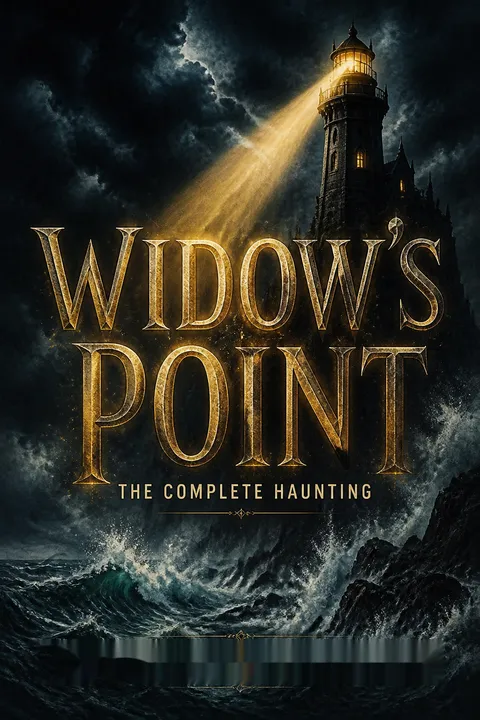

Plot Summary
Arrival at Widow's Point
In the shadow of Harper's Cove, a new generation arrives at Widow's Point, a lighthouse infamous for centuries of death and disappearances. Online influencers Trent, Steph, Jeff, and producer Phil seek to film an unrivaled paranormal event, joined by skeptic professor Durand and celebrity ghost hunter Rob. Ostensibly equipped with technology to capture every angle, they unlock the keep-away gates and enter the grounds, marveling at the lighthouse's brooding, oppressive presence. Despite warnings from the locals—especially the frail, embittered former owner Ronald Parker—the team feels a mixture of curiosity, excitement, and logic-based skepticism. That mixture will soon unravel, as the lighthouse's malevolent reputation is more than mere legend. The entrance closes behind them, and the air thickens with anticipation, as if the place itself is waiting.
Locked Inside History
Upon entering the lighthouse, the group is struck by oppressive air and layers of decay—rotted furniture, ancient refuse, and, most disturbingly, an excessive number of mannequin limbs. As they ascend to living quarters, history clings everywhere—stained floorboards, initials carved into beams, and relics from previous eras. As with the past, the present becomes quickly isolated: cell phone signals fail, the main door locks, and time seems unstable. Their "reality TV" bravado dissipates, replaced by the uneasy awareness that leaving might not be as simple as they thought. What began as performance or ritual for social media quickly shifts to a real, escalating crisis—facing both the physical dangers of the place and intangible disturbances that have tormented previous occupants.
Whispering Footsteps
The crew settles into the dusty living quarters and tries to document their first night. But the lighthouse does not sleep: unseen footsteps echo on the spiral stairs, the clank of unseen chains reverberates, and chilling drafts manifest in inexplicable cold spots. Steph, Rob, and Trent begin to experience auditory phenomena—whispered voices and children's singing—and objects move just out of sight. The diary of a long-dead girl is discovered, filled with frightened recountings of similar events nearly a century before. It becomes increasingly difficult to distinguish between the sounds of their own party, the rats that inhabit the place, and the phantom echoes of those who perished long ago. The tension heightens as they realize the haunting is interactive, not merely residual.
Legacy of Tragedy
Through audio footage, research, and found objects—the Delaney Collins diary, old news clippings, and the chilling confessions of survivors—the lighthouse's devastating legacy becomes vividly clear. Murder, suicide, disappearances, and occult rituals haunt its timeline: possessed keepers, an actress's public suicide, missing children, ritual sacrifices. The crew is forced to confront this tableau, internalizing the fates of doomed predecessors, most poignantly through Delaney's voice and the voice of Thomas Livingston, who also vanished in the lighthouse's grip. These stories are more than background; they are warnings, and each pattern—paranoia, obsession, violence—begins to echo through the group, as if destiny itself is being rewritten for new lives.
Haunted by the Past
It soon becomes clear that each member of the team is pulled by unseen strings tied to losses and regrets in their own pasts—Trent's guilt over his sister's death, Steph's constant vigilance over friends, Professor Durand's hidden trauma from childhood at Harper's Cove, Rob's obsessive quest for supernatural answers. The more they probe the lighthouse, the more their psychological wounds are mirrored and amplified by its spectral energy. During late-night vigils and fraught group conversations, their fears and secrets intermingle with ghost stories, and the walls between past and present, living and dead, seem to thin. For some, ghosts become directly personal: the spirits call them by secret childhood names or reflect their deepest failures.
The Living and Dead
As darkness deepens, the crew's investigations escalate: séances, Ouija board sessions, attempts to debunk or document phenomena. An old prop board produces terrifyingly accurate, deeply personal answers. The team interviews Ronald Parker, whose veiled remorse and cryptic warnings only add to their sense of ominous entrapment. Spirits respond to questioning, sometimes refusing to give names, sometimes giving chilling non-answers. The dead seem not just present, but manipulatively aware. Living and dead, perpetrator and victim, all seem to merge in the claustrophobic spaces of the lighthouse. It becomes plain that the goal is not just communication, but recruitment—or replacement.
Signals in the Night
Instruments designed to detect electromagnetic flux and digital anomalies begin recording the impossible: rhythmic signals that, when decoded by Durand, are revealed as Morse code—'HIGH TIDE'. Unexplained lights, sudden storms, and bizarrely timed electrical spikes demonstrate that some intelligence is actively manipulating their observations. Cold spots become arctic, and equipment malfunctions become meaningful rather than random. Video and audio constantly cut or alter content, almost as if the haunting itself exercises editorial control. Instead of simply witnessing haunting, the team is haunted in return—becoming both observers and objects in a greater pattern.
Diary of Delaney
The discovery of the diary of Delaney Collins unlocks a multi-layered narrative that overlaps with, and perhaps guides, the team's experiences. Delaney's descriptions—of a woman in white, suffocating fear, night wanderings, and seeing things only she could see—find eerie parallels with Steph's visions, the unexplained movement of objects, and the collapse of group trust. Delaney's innocence and descent into terror foreshadow what may await the team. Her voice is at once anchor and prophecy, making the ancient tragedies heartbreakingly real. In a place where the dead linger, a child's final days take on a prescient, guiding force for the living.
Rituals and Relics
Beyond mere haunting, the team finds evidence of ritual repetition: rooms filled with archaic tools, secret symbols in the cave, sacrificial implements, and the blasphemous crucifix of Livingston's account. The woods and caves yield carvings—faces and tentacles, eyes without number—suggesting something older than the lighthouse or town, something that devours. Mannequins move without explanation, forming ranks as if in worship or warning. The recurrence of teeth, blood, and sacrifice build toward the sense that the lighthouse is the site of an ongoing, cyclical ritual that consumes its investigative visitors, leaving only horror behind.
Contact from Beyond
As the boundaries fully dissolve, spirits reach into the minds and bodies of the living: Trent becomes the vessel for Thomas Livingston's voice and violence, his own trauma giving way to supernatural rage. Steph succumbs to lassitude and terror, and Professor Durand is directly addressed by the dead. Voices intrude on private thoughts, and phantoms enact the lighthouse's bloody history through the team, possessing them to reenact violence and despair. The interviews, diaries, and transcripts begin to blend into prophecy, and past tragedies replay with new actors—sometimes to the point of bodily takeover, madness, and self-destruction.
The Night Grows Endless
With every attempt at escape, the crew discovers that doors lead only to deeper labyrinths, stairs multiply beyond counting, and night falls in midafternoon. Darkness presses in as if the lighthouse is cut off from the world entirely. Town lights, ships, and even the coastline vanish into void. Disturbing, mythic entities—an immense, tentacled monster in the sea and a monstrous bird—appear as the beacon light unleashes visions of primordial terror. The repeated threat—that "no one ever leaves"—becomes a physical law. Even narrative structure breaks down, with video and audio capturing nothing or becoming blank where critical events unfold.
When Spirits Awaken
With most of the group dead, lost, or possessed, the final survivors, battered and traumatized, attempt to resist or bargain with the supernatural force. The hammer, the object of past murders, returns as the only weapon or tool left. Professor Durand, once the skeptic, must choose whether to use violence to break the cycle or be broken. Steph's attempt to escape leads only to doom, as even the lighthouse's land is not safe from its reach. The spirits, instead of seeking rest, enact their endless, malevolent rituals once again. The meaning of the haunting is made manifest: the lighthouse doesn't just collect deaths—it feeds on them.
Circle Without Exit
Even after climactic violence—having to kill a possessed Trent to save Steph—no true escape exists. Attempts to leave are thwarted by the lighthouse's will, whether by physical impossibility or through manipulation of reality itself. Any suggestion of freedom is an illusion; time, geography, and even narrative loop or spiral back. Steph's climactic escape in a truck ends in a plunge from the cliffs, with the lighthouse's spectral inhabitants watching and controlling her fate. Those who try to document, explain, or profit from Widow's Point become, in turn, its prisoners.
Madness in the Lighthouse
The survivors (and some dead) cycle between lucidity and delusion, their sense of self and world breaking down. Steph, Professor Durand, and Rob, each in their own way, become unreliable narrators—seeing, hearing, and enacting scenes from both past and present in a chimerical swirl. Obsessive repetition of childhood songs, phantom interviews, and the witnessing of impossible events (mannequins walking, cosmic monsters, temporal loops) suggest that the true haunting lies within as much as without. The lighthouse ingests visitors' narratives, blending their minds into its own fractured memory.
Sacrifices and Possession
At the bloody end, as Trent—completely possessed—tries to kill Steph, Professor Durand finally finds the strength to wield the hammer and shatter the cycle, at least momentarily. Yet that act does not free them, but merely opens the next loop. Outside, the town is invisible, the sun fails to rise, and spectral figures watch from the tower, waiting for new stories to begin. There is no closure, only repetition—no catharsis, only transformation of new victims into permanent residents of the haunting.
Escape Impossible
The final, ambiguous escape attempts—Steph and Durand seeking freedom—are met by physical impossibility and supernaturally-inflicted death. The lighthouse's domain reaches over land and sea, mind and memory, ensuring that what happens at Widow's Point never leaves. Meta-narratives—breakdowns of camera feeds, police transcripts, and after-the-fact digital epilogues—confirm that the cycle is unbroken, and the dead or lost are either erased from history or inscribed in its stones. Even after death, voices and footage leak onward, pulling in new seekers, explorers, and victims.
Ancient Hunger Returns
At the core, the lighthouse's curse is revealed as more than mere ghost story or personal tragedy. The cave paintings, recurring motifs (triangles, tentacles, endless circling), and the appearance of a cosmic, Cthulhu-like monstrosity in the sea, suggest an evil predating colonial history—inhuman, unconscious, devouring. Ritual sacrifice and repeated violence are not merely consequences but perhaps the source and aim of the haunting. The cause is not simply the accumulation of sin or memory, but a malignant, eternal hunger.
Death at Land's End
In the aftermath, official narratives fail to explain the deaths and disappearances at the lighthouse. Police and news reports offer only confusion and bland speculation—no bodies recovered, suspects vanished, and the property remains locked and guarded by a new set of warnings. Survivors, if any, are traumatized into silence or self-destruction. Digital fragments—live stream glitches, ghostly emails, and accounts from the dead—warn that the story will compel ever more victims. The Widow's Point Lighthouse stands, its light never quite extinguished, awaiting the next visitor or generation to be devoured.
Analysis
A devastating parable on trauma, cyclical evil, and humanity's contradictionsWidow's Point: The Complete Haunting is part classic ghost story, part meta-horror, and part meditation on collective memory. The lighthouse functions as both literal place and symbol: an edifice built for safety that becomes a beacon for violence, devouring its caretakers and explorers like a living tumor. The book explores the psychological and societal need to explain away atrocity—whether through blaming one corrupted individual, rationalizing with folklore, or desperately seeking answers through science or belief. Yet it suggests that evil is not so easily excised; places (and people) infected by tragedy become resonant sites where history repeats, and where the living become actors in pre-scripted tragedies. Through its recursive, multimedia structure, Widow's Point critiques the exploitative tendencies of true crime, ghost hunting, and even the horror genre itself, cautioning that attempts to uncover or mediate haunting—or to "turn it into content"—only feed both personal and collective doom. In the end, those who enter Widow's Point are both creators and victims of its darkness, drawn into a cycle as hungry and endless as the tides or spiral stairs at the story's heart.
People Also Read
Characters
Trent Bell
Trent, an influencer and content creator, is drawn to the lighthouse as much for redemption as for success. Witty, driven, and slightly egotistical, he masks deep wounds, above all guilt over his sister's childhood drowning. His showmanship gradually erodes under the stresses of the haunting, first leading investigations, then becoming a conduit for possession—first by the lingering presence of Thomas Livingston, then potentially by something deeper. His arc is a spiral from control to dissolution—he becomes seduced, then overpowered by the house's will, descending into violence against his own friends. In the end, his persona is shattered, both victim and antagonist, equally capable of empathy and monstrousness.
Steph DuPree
Steph, the group's trusted documentarian and "big sister," starts as a skeptical, funny, and deeply caring presence, intent on keeping her friends safe and the project honest. Her weaknesses are those of inherited trauma—ever-watchful, unable to fully trust that safety is possible. As the events progress, she is one of the first to sense the lighthouse's true threat; she is haunted by parallels to Delaney Collins and becomes increasingly alienated from reality. Her nightmares, visions, and brush with death at Trent's hands (and later, the fatal truck plunge) cement her not only as a victim, but also as a survivor who carries the curse forward into the world outside.
Professor Catherine Durand
A haunted-house historian from Harper's Cove, Durand represents skeptical inquiry and academic detachment, but is forced to confront repressed childhood terrors. Intellectual, resourceful, and caring despite a wary reserve, she is personally connected to the curse—through her father, family tragedies, and unwitting complicity in local cover-ups. She proves vital in deciphering messages, interpreting supernatural events, and recognizing patterns others miss. Ultimately, she faces impossible moral choices, forced to enact violence for survival. Her journey is one of reluctant belief—moving from denial to acceptance of the supernatural's presence and the need to directly confront it.
Rob Elliott
Ghost hunter Rob offers expertise as well as spiritual openness, longing for validation of the unseen. Honest, dogged, and increasingly vulnerable, he is excited by early phenomena but horrified by the malicious force beneath. He is the first to translate the Morse code signals and catalog the poltergeist phenomena. Possessed of deep empathy, his horror is not only for himself but for past victims. He is ultimately consumed by the haunting, his fate ambiguous and symbolic—the searcher destroyed or transformed by what he most sought to understand.
Jeff Koch
Jeff is practical, skeptical, and affectionate—a voice of reason and comic relief who tries to provide stability through technology and logistics. He engineers the monitoring systems, guards the "perimeter," and attempts to mediate among the others. His resistance to the uncanny ultimately fails, and his cruel, haunted death—lured and manipulated onto the catwalk, subsumed by the mannequins, and driven to suicide—symbolizes both the weakness of rational defenses and the allure of oblivion when reason fails.
Phil Park
Phil, the producer, is initially wary and sensitive to the danger, trying to leave early but mysteriously drawn back, ultimately becoming one of the first victims. His fate prefigures the spiral of the others—he is discovered dead in a tidal cave, his body decomposing faster than is natural. He embodies the promise and danger of ignoring premonitions and the inexorable force that calls the lost back to Widow's Point.
Delaney Collins
A twelve-year-old girl massacred with her family in 1933, Delaney's diary and voice act as the emotional keystone and narrative echo. Her innocence and terror shape and echo Steph's experiences, and her words prefigure and guide the suffering of every childlike visitor to Widow's Point. In the house's psychic ecosystem, she is both a lost soul and an inadvertent guide—a symbol of hope and vulnerability caught in an endless loop of trauma.
Ronald Parker
Old, embittered, and burdened by familial obligation, Parker is both skeptic and believer, simultaneously warning visitors and betraying them to the haunting with calculated complicity. Guilt and a sense of inevitability plague his actions, suggesting he sees no way out except the hope that new blood may finally exhaust the lighthouse's appetite. He is the voice of warning, reminiscent of horror's eternal archetype, "don't go in there," but powerless to stop the cycle.
Thomas Livingston
Livingston, a writer whose recordings form a core of the present-day narrative, went missing during a previous attempt to "debunk" the haunting by surviving a weekend in the lighthouse alone. His mental deterioration, possessions, and ultimate disappearance serve as both warning and contagion—his voice invades Trent, his failures are repeated by the living. Known for his biting wit and psychological insight, he is simultaneously the house's prisoner and one of its most powerful agents.
Joseph O'Leary
O'Leary is the spectral template for Widow's Point's violence. His rampage, as described in historical accounts and phantom reenactments, is depicted as both personal madness and external manipulation. He is invoked or appears whenever group trust or boundaries fail, acting as the voice of the lighthouse's homicidal will across generations. Ultimately, he serves as a reminder that the cycle of violence in haunted places is both collective and individual—a legacy that exceeds any one story or mind.
Plot Devices
Found Footage / Multi-Media Format
The book's narrative is constructed from emails, police transcripts, interviews, digital voice recordings, video logs, diaries, and live stream comments. This collage creates a sense of immediacy and verisimilitude, blurring the boundary between documentary and horror fiction, and accelerating the pace for readers with short attention spans. The multi-voice format enables the narrative to spiral (mirroring the lighthouse stairs), creating loops, interruptions, and overlaps that reinforce the sensation of being trapped or manipulated by forces outside the text.
Unreliable Narration & Possession
The characters' perceptions and accounts are constantly undermined by supernatural forces, exhaustion, and mental unraveling. The narrative shifts between mundane and uncanny without warning, and possessions by spirits lead to sudden, catastrophic violence. Possession is not only an event but a mode of storytelling: entire chapters or recordings are "hijacked" by other voices, rendering it impossible to distinguish between confession, warning, and manipulation.
Recurring Symbols and Motifs
The endless spiral staircase, nautical symbols (triangles, tentacles, the infinite), and collections of hair, teeth, and moldy mannequins ground the narrative in the cyclical, inescapable nature of the haunting. These objects and images become markers of progress—or futile repetition—as well as methods by which the haunting "marks" its victims (teeth, tattoos, carvings). Motifs of song, echo, and the phrase "We are here" or "We are still here" repeat with increasing urgency as madness closes in.
Temporal and Spatial Dislocation
The plot repeatedly demonstrates reality being warped: time flowing oddly, stairs multiplying, and distances looping back on themselves. Days blur into nights, characters dressed in past-century clothing, and the outside world grows unreachable or visually erased. This breakdown reflects the haunting's nature—a recursive, cancerous force feeding on souls rather than simply haunting rooms. Even the form of the novel mirrors these loops, with the ending leading back to the beginning in digital epilogue.
Metafiction and Self-Reference
Police/procedural epilogues speculate about the cause (madness, fraud, trauma) but cannot resolve anything, as digital "found" footage and ghostly emails suggest that the haunting is aware of its own story and readiness to attract new attention. Attempts to "explain" or "debunk" the haunting only serve to propagate it: the narrative itself is a contagion. This culminates in the novel's open ending, as potential new victims (or readers) are invited to participate.
Download PDF
Download EPUB
.epub digital book format is ideal for reading ebooks on phones, tablets, and e-readers.








































