

Key Takeaways
Nonviolent campaigns succeed twice as often as armed rebellion
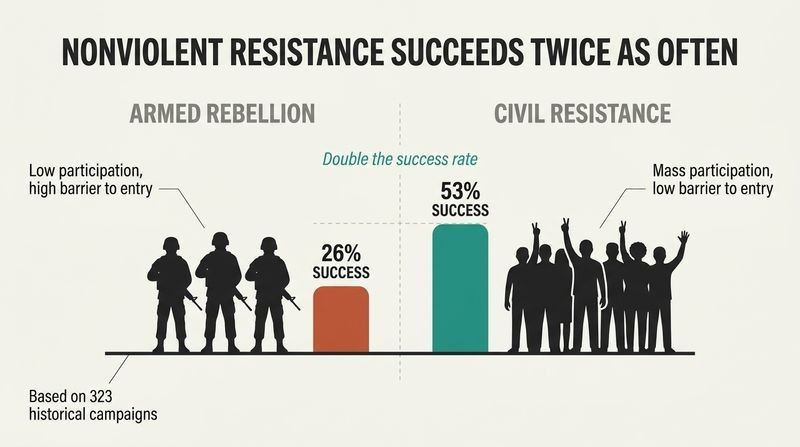
The central, counterintuitive finding. Chenoweth and Stephan built the NAVCO dataset of 323 major resistance campaigns from 1900 to 2006 seeking regime change, expulsion of occupiers, or secession. Nonviolent campaigns achieved full or partial success roughly 53% of the time versus about 26% for violent ones, nearly double. The gap held even after controlling for regime type, repression, and target power.
This defies conventional wisdom. Security scholars long assumed that against brutal regimes only guns work. Yet civil resistance toppled dictators in the Philippines and Iran where guerrillas had failed in the same countries. Violence is often treated as a necessary evil or last resort. The data says the opposite: unarmed struggle is the strategically superior instrument in most contexts, not merely the morally cleaner one.
What makes this claim powerful is that it reframes nonviolence from a pacifist's moral posture into a hardheaded strategic calculation. The authors deliberately study the hardest cases (regime change, occupation) usually associated with violence, not tidy civil rights campaigns. A fair challenge: the dataset excludes campaigns crushed in infancy, a selection concern the authors concede. Still, even recoding half of all violent campaigns as failed hidden nonviolent efforts leaves nonviolence competitive. The finding echoes Gene Sharp's consent theory of power: rulers depend on cooperation that can be withdrawn. The 3.5% participation rule the authors later popularized grew directly from this dataset.
Lower barriers to joining are nonviolence's decisive advantage
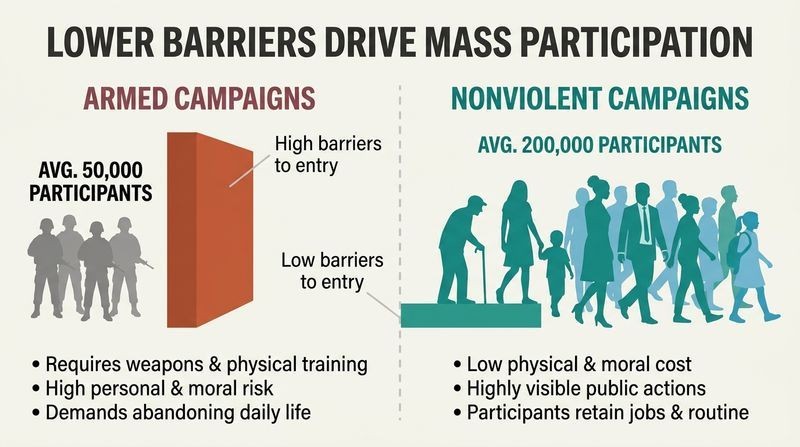
Participation is the master variable. The authors' core explanation is simple: unarmed movements recruit far more people because the costs of joining are lower. A guerrilla recruit needs physical fitness, weapons training, willingness to kill, and often must abandon home and family. A boycott or stay-away demands none of that. The average nonviolent campaign drew over 200,000 participants, roughly 150,000 more than the typical armed one.
Four barriers fall for civil resistance:
1. Physical: the elderly, women, and children can strike or boycott
2. Moral: refusing to cooperate requires less soul-searching than killing
3. Informational: public protests visibly signal strength, easing recruitment
4. Commitment: participants keep their jobs and anonymity, lowering risk
Each percentage-point rise in participation measurably raised the odds of victory.
This is the book's engine, and it connects neatly to collective-action theory. Mark Granovetter's threshold models and Timur Kuran's work on preference falsification both explain why visible early participation triggers cascades: people join once they believe others will too. Nonviolence solves the coordination problem that violence worsens. One nuance worth flagging: sheer numbers are necessary but not sufficient. East Germany's 1953 rising and China's Tiananmen both mobilized massively and failed. The quality, diversity, and strategic direction of participation matter as much as quantity, a caveat the authors are careful to preserve.
Diverse crowds make repression backfire instead of working
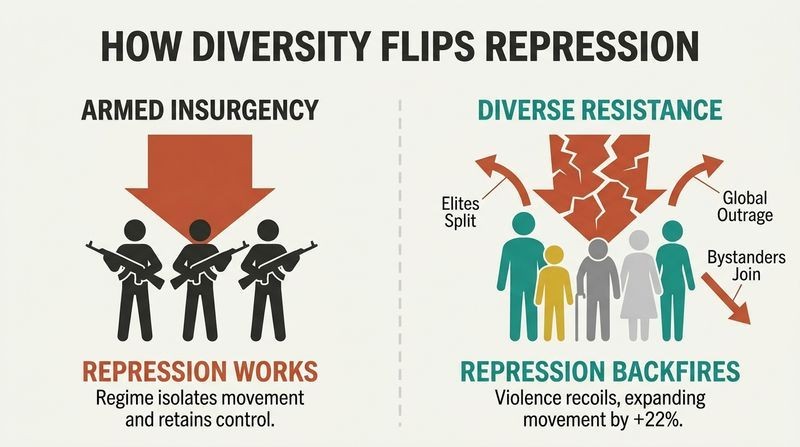
Backfiring is the mechanism that flips repression. When a regime shoots unarmed, sympathetic civilians, the violence often recoils against the perpetrator, converting bystanders into activists, splitting elites, and drawing international condemnation. The authors found reliance on nonviolence raised the probability of success by about 22% even when regimes cracked down violently.
Diversity is the multiplier. When participants span age, class, religion, gender, and profession, the regime cannot isolate and demonize them. Filming Indonesian troops killing over 200 unarmed East Timorese in Dili in 1991 triggered global outrage that armed Falintil attacks never generated. A broad movement also builds kinship ties into the security forces themselves. Repression against clearly armed insurgents, by contrast, looks legitimate and rallies the regime's supporters around the flag.
Brian Martin's concept of political jiu-jitsu underpins this, and it has a modern digital dimension: the 1991 Dili footage required a smuggled British cameraman, whereas today a smartphone broadcasts a massacre instantly. That should amplify backfire, yet authoritarians have adapted with internet shutdowns and disinformation, as Egypt attempted in 2011. The diversity insight also intersects with sociology of networks: heterogeneous movements have more bridges into the regime's base. The sharpest caveat is that backfire depends on an audience prepared to act. Where atrocities go unwitnessed, as in much of rural Burma, repression simply works.
Win by peeling security forces away from the dictator
Regimes rest on pillars, not on the ruler alone. Power depends on the cooperation of soldiers, police, bureaucrats, business elites, and state media. The single strongest predictor of nonviolent success in the data was security-force defection: the largest civil campaigns had roughly a 60% chance of triggering it, and such defections raised the odds of victory by nearly 60%.
Fraternize, do not fight. In Iran, protesters handed flowers to the Shah's soldiers and chanted that the army belonged to the people. Troops began taking leave, deserting, and finally declaring neutrality in February 1979. In the Philippines, nuns knelt before tanks and offered soldiers food until commanders refused to fire. Armed insurgents cannot produce this effect: soldiers facing gunfire close ranks and shoot back.
This is arguably the book's most actionable strategic lesson, and it inverts the military logic of destroying the enemy's forces. The goal is subversion, not attrition. It resonates with Machiavelli and later with theorists of coups: regimes fall from within. The authors note that mass movements create dense social ties linking ordinary protesters to individual soldiers who are, as one Serbian activist put it, someone's children. The limiting case is Burma, where Aung San Suu Kyi explicitly refused to divide the military out of loyalty to her father's legacy, and where troops stayed cohesive. Strategy, not just morality, decided the outcome.
Foreign backing helps guns but can poison civil resistance
External support is a double-edged sword. Roughly 35% of violent insurgencies received material aid from foreign states versus under 10% of nonviolent campaigns, and such sponsorship was the main predictor of armed success. But foreign patrons are fickle (Jordan expelled the PLO in 1970), attach strings, and let insurgents abuse the civilians they should be courting because resources come from elsewhere.
Local mobilization beats outside money. For nonviolent campaigns, foreign state support was not correlated with success at all. What helped was coordinated diplomatic pressure and solidarity that amplified local efforts, like the boycotts targeting apartheid South Africa or the U.S. abandonment of Marcos, never substitutes for homegrown participation. Outside cash can even delegitimize a movement, letting regimes brand activists as foreign puppets.
This finding is a useful corrective to the interventionist instinct that democracy can be exported or funded into existence. Jeremy Weinstein's research on rebel governance reinforces the point: insurgencies flush with natural-resource or foreign money predate on populations, while those dependent on local support treat civilians well. The policy implication is subtle. The authors endorse targeted diplomatic tools (visas for dissidents, sanctions on abusers, communications technology) but insist these work only at the behest of local actors. It complicates simple narratives that the CIA or foreign NGOs manufacture color revolutions; the causation runs mainly the other way.
Being unarmed guarantees nothing without smart, adaptive strategy
Nonviolence is not a magic charm. One in four nonviolent campaigns since 1900 failed completely. Movements lose when they cannot recruit broadly, maintain unity, or adapt tactically. The authors reject the idea that campaigns win simply by holding the moral high ground.
Tactical range and resilience matter. Skilled campaigns shift between methods of concentration (mass protests, sit-ins that gather people in one place) and methods of dispersion (boycotts, stay-aways, go-slows that spread risk and deny the regime a target). During Iran's revolution, leaders paused street protests after massacres and switched to crippling nationwide strikes, especially in oil. When Burma's movement was crushed, its only fallback was fleeing to join jungle insurgents, an admission it had run out of nonviolent moves. Diverse movements innovate more because innovation happens at a repertoire's margins.
This is the book's honest hedge against triumphalism, and it aligns it with strategic theory from Clausewitz to Schelling: outcomes hinge on interaction with an adapting adversary, not on the inherent virtue of one's weapons. The concentration/dispersion distinction, borrowed from Kurt Schock, is genuinely practical. Concentration builds visible momentum but exposes crowds to slaughter; dispersion protects participants but can feel invisible. The best campaigns pulse between them. A tension the authors leave partly open: strategic skill is hard to observe until after gains appear, which limits its predictive value even as it clearly drives results.
How you win shapes the peace: nonviolent wins breed democracy
The aftermath diverges sharply. Countries where nonviolent campaigns succeeded had roughly a 57% chance of being democratic five years later; for successful violent insurgencies the figure was under 6%. Strikingly, even failed nonviolent campaigns produced democracy more often (about 35%) than successful violent ones.
Method becomes political culture. Armed victors who seized power by force keep ruling by force, purging rivals and governing through secrecy and martial values, as in Cuba, China, and Taliban Afghanistan. Movements that won through mass participation and consent build habits of accountability and negotiation, and often co-opt rather than annihilate the old guard. Violent campaigns also raised the ten-year risk of renewed civil war to 42% versus 28% for nonviolent ones. Iran's theocratic turn is the notable exception, not the rule.
This may be the book's most consequential contribution, moving beyond whether a tactic works to what kind of society it produces. It dovetails with Terry Karl's modes-of-transition literature and with Robert Putnam's civic-capital thesis: the muscles a society exercises to overthrow a regime are the muscles it uses to govern. The causal story is plausible but faces endogeneity worries: perhaps societies already primed for democracy choose nonviolence. The authors wrestle with this using instrumental variables. Iran is the instructive anomaly, showing that a nonviolent revolution built around a single charismatic figure and an ambiguous ideology can still deliver tyranny.
Secession fails whether you use ballots or bullets
One clear exception to nonviolence's edge. Across the data, no nonviolent secession campaign fully succeeded, and only four of 41 violent ones did, under 10%. Breakaway movements face uniquely high stakes: governments will fight ferociously to avoid losing territory, and outcomes hinge on international politics beyond the movement's control.
The lesson is about goals, not just methods. Antiregime and antioccupation campaigns favored nonviolence heavily, and in antiapartheid-style struggles civil resistance held a near-monopoly on success. But the demand for separation triggers zero-sum resistance no tactic reliably overcomes. This nuance matters because it prevents overselling: the strategic superiority of civil resistance is real but bounded by what the campaign is asking for. Some objectives are simply near-impossible regardless of whether protesters carry banners or rifles.
This carve-out strengthens rather than weakens the book by showing the authors chasing accuracy over advocacy. It connects to Monica Toft's work on the indivisibility of territory: land claims are perceived as sacred and non-negotiable in ways that policy demands are not. The finding should temper enthusiasm among separatist movements from Catalonia to Kurdistan that civil resistance offers a reliable path. It also raises a research question the authors flag: what conditions ever crack the secession barrier? External recognition seems decisive, which loops back to their point that some outcomes depend on forces beyond any movement's strategic control.
Overreliance on one charismatic leader can sabotage a movement
Personalized movements carry hidden fragility. Comparing failures, the authors found that a single dominant personality often constrained a campaign at its critical moment. In Burma, Aung San Suu Kyi's identity as her father's daughter, the founder of the army, made her refuse to encourage military defections, blocking the one lever most associated with success. In the Palestinian case, overdependence on Yasser Arafat and the exiled PLO undermined the local United National Leadership and fractured the movement during the Oslo years.
Decentralized networks outperform. Iran's mosque-bazaar network and the Philippines' Catholic Church provided sturdy, distributed infrastructure that survived arrests: cut off one leader and another emerged. Diffuse authority made these movements resilient and harder to decapitate, while cults of personality created single points of failure.
This is a subtle organizational insight with wide application beyond politics, echoing findings on resilient systems in biology and business: redundancy and distributed nodes survive shocks that kill centralized hierarchies. It also complicates the popular image of movements as needing a Mandela or a Gandhi figurehead. The authors suggest charisma is a mixed asset, useful for mobilization but corrosive to institution-building and post-transition democracy, since politics becomes personalized rather than institutionalized. The counterpoint is that some movements may need a unifying symbol to coordinate at all. The likely synthesis: symbolic figureheads help, but operational authority should stay distributed.
Power flows from consent, so withdraw it en masse
The theory beneath everything. The book rests on a redefinition of power itself. A regime's apparent might, its army, treasury, and bureaucracy, ultimately depends on the ongoing obedience of ordinary people. When enough of them in key sectors stop cooperating, the machinery seizes regardless of how many weapons the ruler commands.
Iran illustrates the ceiling of coercion. By late 1978 the Shah's forces could not run the state they had seized: navy technicians could not operate striking oil pumps, soldiers dragged workers back only to see them walk out again, and jails filled beyond capacity with just 5,000 spare cells against plans to arrest 100,000. As the Shah admitted, you cannot make people on the next block behave. No regime can repress everyone at once when they simply stop obeying.
This is Gene Sharp's consent theory of power made empirical, and it inverts the Weberian and realist emphasis on the monopoly of force. The insight has deep roots, from Etienne de la Boetie's sixteenth-century essay on voluntary servitude to Hannah Arendt's argument that power and violence are opposites. The Iranian oil strike is the perfect illustration: technical, distributed noncooperation that no amount of firepower could break. The framework's limit is the totalitarian edge case, genocidal regimes where obedience is extracted at gunpoint from atomized victims. The authors concede civil resistance may not work once mass killing is fully underway, though they note violence fared no better against the Nazis.
Analysis
Why Civil Resistance Works is a landmark of quantitative political science that turned a moral intuition into a testable, and largely confirmed, empirical claim. Its intellectual audacity lies in treating nonviolent struggle as a species of warfare, subject to the same strategic scrutiny security scholars apply to insurgency and airpower. By assembling the NAVCO dataset of 323 campaigns and pairing it with four paired case studies (Iran, the Palestinian Territories, the Philippines, Burma), Chenoweth and Stephan achieve something rare: a big-N generalization anchored by process-tracing that shows the mechanisms actually operating.
The argument's spine is elegantly reductive. Everything flows from participation, and participation flows from low barriers to entry. From mass, diverse participation cascade the four mechanisms that decide contests: loyalty shifts, backfiring repression, tactical resilience, and international leverage. This is a genuine theoretical contribution, not merely a data exercise, because it explains why the correlation exists rather than just reporting it.
The book's methodological honesty is a strength. The authors confront endogeneity (do movements pick nonviolence only when victory is likely?) with instrumental variables, concede selection bias against crushed early campaigns, and carve out secession as an exception. They resist triumphalism: one in four nonviolent campaigns fails, and Iran shows nonviolent revolutions can birth tyranny.
What has aged is the data horizon (2006). The subsequent record, especially the Arab Spring's descent into war in Syria, Libya, and Yemen, and rising authoritarian countermeasures like internet shutdowns and mercenary repression, has prompted Chenoweth's own later work suggesting success rates have declined. This does not refute the book so much as bound it. The core insight endures: sustained, disciplined, broadly participatory noncooperation remains the most reliable, and least bloody, path to toppling entrenched power, and crucially, to what comes after.
Review Summary
Why Civil Resistance Works presents data showing nonviolent campaigns are more effective than violent ones for achieving political change. The book argues nonviolence attracts broader participation, increases chances of regime defections, and leads to more stable democratic outcomes. While some readers found it dry and overly academic, many praised its rigorous analysis and compelling case studies. Critics noted issues with definitions and data selection. Overall, most reviewers found the book's thesis convincing and its insights valuable, despite some methodological concerns.
People Also Read







Glossary
NAVCO dataset
Database of 323 resistance campaignsThe Nonviolent and Violent Campaigns and Outcomes dataset, compiled by the authors, catalogs 323 major resistance campaigns worldwide from 1900 to 2006 that sought regime change, expulsion of a foreign occupier, or secession. It records each campaign's primary method, participant numbers, and outcome, enabling the first large-scale statistical comparison of the effectiveness of armed versus unarmed struggle.
Participation advantage
Nonviolence recruits more, diverse peopleThe book's central explanatory concept: nonviolent campaigns attract far larger and more diverse memberships than armed ones because the physical, moral, informational, and commitment barriers to joining are much lower. This broad participation activates the mechanisms (loyalty shifts, backfiring, resilience, leverage) that drive campaign success.
Backfiring
Repression that recoils on regimeA process, drawn from Brian Martin's work, in which a regime's violent crackdown on unarmed, sympathetic protesters proves counterproductive. It converts passive supporters into active participants, splits the regime's own supporters, increases external support for the resistance, and erodes the regime's legitimacy at home and abroad.
Loyalty shifts
Regime backers defect to oppositionWhen members of a regime's pillars of support, especially security forces but also bureaucrats and business elites, withdraw cooperation and side with or refuse to suppress the resistance. Security-force defection was the single strongest predictor of nonviolent campaign success in the authors' data.
Pillars of support
Institutions sustaining a regime's powerA concept from Robert Helvey denoting the institutions and social sectors (military, police, civil servants, business elites, state media, religious bodies) that supply a regime with the resources and obedience it needs to rule. Resistance campaigns win by systematically pulling these pillars away from the ruler.
Methods of concentration vs. dispersion
Massing crowds versus spreading resistanceTwo tactical modes, from Kurt Schock. Concentration gathers large numbers in public spaces (protests, sit-ins, occupations), building visible momentum but exposing participants to repression. Dispersion spreads action across wide areas (boycotts, stay-aways, go-slows), protecting participants and forcing the regime to overextend. Skilled campaigns shift between them to maintain pressure and resilience.
Radical flank effect
How armed wings help or hurtA social-movement concept describing how the presence of a violent faction affects a nonviolent movement. A positive radical flank effect makes moderates look more acceptable to the regime; a negative (spoiler) effect causes the regime to lump violent and nonviolent challengers together, unify against them, and justify harsh repression.
FAQ
What's Why Civil Resistance Works about?
- Focus on Nonviolent Resistance: The book examines the effectiveness of nonviolent resistance compared to violent insurgency in achieving political change.
- Empirical Analysis: Authors Erica Chenoweth and Maria J. Stephan analyze 323 resistance campaigns from 1900 to 2006, showing nonviolent campaigns are nearly twice as likely to succeed.
- Mechanisms of Success: It identifies key factors like mass participation and loyalty shifts that contribute to the success of nonviolent movements.
Why should I read Why Civil Resistance Works?
- Understanding Conflict Dynamics: The book offers insights into the dynamics of civil resistance, challenging the conventional preference for violent methods.
- Practical Implications: It provides strategies for activists, policymakers, and scholars interested in conflict resolution and democratization.
- Case Studies: Detailed examples from Iran, the Philippines, and other regions illustrate the principles of successful nonviolent campaigns.
What are the key takeaways of Why Civil Resistance Works?
- Participation Advantage: Nonviolent campaigns attract broader participation, enhancing resilience and tactical innovation.
- Repression Backfires: Violent repression often increases support for nonviolent movements, unlike violent insurgencies.
- Durable Outcomes: Nonviolent campaigns are more likely to lead to stable democracies, while violent ones often result in authoritarian regimes.
How does Why Civil Resistance Works define civil resistance?
- Definition: Civil resistance is a nonviolent technique of socio-political action, including protests, strikes, and boycotts.
- Contrast with Violence: It is non-institutional and confrontational, differing from violent resistance, which involves armed struggle.
- Mechanisms of Action: It uses social, psychological, economic, and political methods to mobilize support and delegitimize adversaries.
How do nonviolent campaigns succeed according to Why Civil Resistance Works?
- Mass Participation: They attract a larger and more diverse group of participants, raising the costs for regimes to maintain control.
- Lower Barriers to Entry: Nonviolent resistance allows broader participation, including marginalized groups, due to lower physical and moral barriers.
- Tactical Innovation: High participation levels lead to greater tactical diversity and adaptability in response to repression.
What are the best quotes from Why Civil Resistance Works and what do they mean?
- “Nonviolence is fine as long as it works.”: This Malcolm X quote highlights the pragmatic approach to resistance, focusing on effectiveness.
- “The whole population fought for independence, even Indonesians, and this was decisive.”: Emphasizes the importance of mass participation in achieving political change.
- “The more diverse the participation in the resistance... the more difficult it is for the adversary to isolate the participants.”: Highlights the strategic advantage of broad-based support in nonviolent campaigns.
What are the main arguments presented in Why Civil Resistance Works?
- Effectiveness of Nonviolent Action: Nonviolent resistance is more effective than violent insurgency, supported by empirical data and case studies.
- Role of Participation: The level and diversity of participation are critical to the success of nonviolent campaigns.
- Repression Backfires: Repression against nonviolent movements often increases support for the resistance, unlike in violent campaigns.
What case studies are included in Why Civil Resistance Works?
- Iranian Revolution (1977-1979): Demonstrates how nonviolent campaigns can successfully oust regimes.
- First Palestinian Intifada (1987-1992): Highlights mass participation and nonviolent tactics against occupation.
- Philippine People Power Movement (1983-1986): Shows how a broad-based uprising led to significant political change.
How does Why Civil Resistance Works address the role of external support in resistance movements?
- Limited Impact: External support is beneficial but not essential; local mobilization is often more critical.
- Successful Examples: Some movements succeed without significant external backing, emphasizing domestic factors.
- Cautions Against Overreliance: Overreliance on external support can undermine local legitimacy and create dependency.
What are the challenges faced by nonviolent resistance campaigns according to Why Civil Resistance Works?
- Repression and Backlash: Nonviolent campaigns often face severe repression, which can undermine legitimacy.
- Internal Divisions: Lack of unity among opposition groups can weaken movements.
- Maintaining Nonviolent Discipline: Ensuring participants adhere to nonviolent principles is crucial, especially under provocation.
How does Why Civil Resistance Works compare nonviolent and violent campaigns?
- Success Rates: Nonviolent campaigns have higher success rates due to broader participation and loyalty shifts.
- Mechanisms of Change: Nonviolent campaigns generate international support and cause repression to backfire.
- Long-term Outcomes: Successful nonviolent campaigns are more likely to lead to democratic governance.
What lessons can activists learn from Why Civil Resistance Works?
- Emphasize Nonviolent Tactics: Prioritize nonviolent methods, as they are more effective in achieving political goals.
- Build Diverse Coalitions: Diverse participation enhances resilience and adaptability.
- Prepare for Repression: Develop strategies to maintain nonviolent discipline and ensure commitment to nonviolent principles.
Download PDF
Download EPUB
.epub digital book format is ideal for reading ebooks on phones, tablets, and e-readers.








































