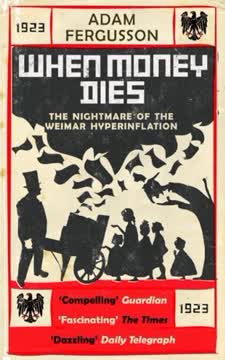
Key Takeaways
1. The Genesis of Collapse: War Finance and Early Depreciation
The mark was dead, one million-millionth of its former self. It had taken almost ten years to die.
Wartime financial recklessness. Germany's First World War financing, orchestrated by Karl Helfferich, State Secretary for Finance, deliberately avoided taxation in favor of borrowing and printing money. This policy, based on the expectation of a quick victory and war indemnities from the Entente, suspended gold redemption for Reichsbank notes and allowed unlimited rediscounting of Treasury bills, effectively turning the printing press into the primary source of war funds. By 1917, money in circulation was five times its 1913 level, while essential supplies grew scarcer.
A fiction of value. The "Mark gleich Mark" (mark equals mark) creed, promoted by the Reichsbank, falsely assured the public that paper marks held the same value as gold marks, even as their purchasing power plummeted. This deception, coupled with the closure of stock exchanges and censorship of foreign exchange rates, obscured the true extent of the mark's depreciation from the public. By the war's end in November 1918, the mark's foreign exchange value had halved twice, and its domestic purchasing power was a mere fraction of its pre-war strength.
Legacy of mismanagement. The new Weimar Republic inherited a devastating financial and fiscal legacy from the militarist establishment. The national debt soared, and the government found itself ill-equipped to manage the burgeoning inflation. This early financial mismanagement, driven by wartime expediency and a fundamental misunderstanding of monetary economics, set the stage for the catastrophic hyperinflation that would engulf Germany in the years to come, undermining public trust and economic stability from its very inception.
2. Versailles & Reparations: The Fatal Burden
The coals for this fire were the Versailles peace terms.
Crippling peace terms. The Treaty of Versailles, signed in June 1919, imposed devastating conditions on Germany, including the loss of 1/7th of its pre-war territory and 1/10th of its population, along with its colonies and significant industrial resources. Crucially, it assigned Germany sole responsibility for the war and demanded colossal reparations, initially set at 132 billion gold marks (£6.6 billion). This immense financial burden, coupled with the reduction of the German army, created an immediate and overwhelming challenge for the nascent Republic.
Economic strangulation. The reparations demands, particularly the annual payment of £100 million plus 26% of exports, were deemed impossible to meet without revolutionary levels of taxation or further currency depreciation. Lord D'Abernon, the British Ambassador, warned that such taxation would provoke a revolution. The ongoing Allied blockade further exacerbated Germany's economic woes, leading to a drastic fall in the standard of living. The mark, which stood at 20 to the pound in 1913, plummeted to 185 by December 1919, reflecting international distrust and Germany's national despair.
Political instability. The treaty's terms fueled universal condemnation within Germany, but instead of unity, it intensified political polarization. The Right, including the Army, used the treaty as a weapon against the government, cultivating the "Dolchstoss" (stab-in-the-back) myth. This constant political turmoil, exemplified by assassination attempts and the Kapp Putsch, diverted attention and resources from essential financial reforms, ensuring that the reparations question remained a destabilizing force that continuously undermined confidence in the mark and the government's ability to manage the economy.
3. The Human Toll: Social Disintegration & Moral Decay
The agony of inflation, however prolonged, is perhaps somewhat similar to acute pain — totally absorbing, demanding complete attention while it lasts; forgotten or ignorable when it has gone, whatever mental or physical scars it may leave behind.
Erosion of the middle class. Inflation systematically destroyed the savings and fixed incomes of the middle classes, including pensioners, civil servants, and professionals. Their pre-war wealth became worthless, forcing them into penury while manual workers, whose wages could be adjusted, fared relatively better. This created immense social resentment and a sense of betrayal, as those who had been the backbone of society found their security vanish.
Moral decay and corruption. The constant depreciation of money fostered a climate of greed, dishonesty, and opportunism. People resorted to:
- Hoarding goods (hamstering)
- Evading taxes
- Speculating in foreign currencies or shares
- Bribery and fraud
The traditional virtues of thrift and hard work lost their meaning when savings evaporated overnight and labor yielded less than speculation. This widespread moral degeneration permeated all levels of society, from ordinary citizens to high-ranking officials.
Social fragmentation. Inflation exacerbated existing social tensions and created new ones. Xenophobia flourished, with foreigners blamed for buying up cheap German assets. Class hatred intensified between the impoverished middle class, the relatively better-off organized labor, and the profiteering industrialists and farmers. The breakdown of trust and community spirit, as everyone became an "enemy" in the scramble for survival, left deep psychological scars that would persist long after the currency was stabilized.
4. The Reichsbank's Blind Folly: Havenstein's Delirium
Havenstein, the mad banker whose one object was to swamp the country with banknotes.
Denial of monetary principles. Dr. Rudolf Havenstein, President of the Reichsbank, epitomized the financial authorities' profound ignorance or willful denial of the link between money supply and inflation. He steadfastly believed that the mark's depreciation was caused by external factors like reparations and speculation, not by the relentless printing of banknotes. His mantra was to supply the "dearth of currency" by printing more, convinced that the existing circulation was "not excessively high" in real terms.
Unleashed printing presses. Despite mounting evidence and warnings from observers like Lord D'Abernon, Havenstein saw it as his duty to meet the ever-increasing demand for cash, which was itself a symptom of rising prices. He famously brought in strike-breakers to keep the presses running during a printers' strike, ensuring a continuous "blizzard of banknotes." His public pronouncements, such as boasting about the daily issuance of trillions of marks, only served to accelerate the mark's collapse by signaling the bank's reckless policy.
Autonomy as a curse. The Reichsbank's declaration of autonomy in May 1922, intended to insulate it from political pressure, ironically gave Havenstein unchecked power to pursue his disastrous policies. He discounted commercial bills as generously as Treasury bills, providing cheap credit that further fueled inflation and encouraged industrialists to convert paper marks into fixed assets. This institutionalized folly ensured that the Reichsbank, far from being a bulwark against inflation, became its primary engine, driving the German economy deeper into the abyss.
5. The Ruhrkampf: A Costly Act of Resistance
The Ruhr struggle was between French pressure and subversion on the one hand — it took many forms, economic, diplomatic, military, political — and the German printing press on the other.
French occupation and German defiance. On January 11, 1923, France and Belgium occupied the Ruhr industrial region, citing Germany's default on coal and timber deliveries. Germany responded with a policy of "passive resistance," urging workers to strike and refusing to cooperate with the occupiers. This act of national unity, while galvanizing the German spirit, came at an immense economic cost, as the industrial heartland ceased production and its 6 million inhabitants had to be supported by the rest of the country.
Economic paralysis. The Ruhrkampf severed Germany from 85% of its coal, 80% of its steel, and 70% of its goods traffic. The Exchequer lost all tax revenue from the region and the income from its railways. To fund passive resistance—paying striking workers and compensating businesses—the government resorted to unprecedented levels of money printing. This open-ended general strike, subsidized by the Reichsbank, transformed the inflation from severe to hyperinflation, as the mark's value plummeted from 35,000 to the pound at Christmas 1922 to 227,500 by the end of January 1923.
Escalating chaos. The occupation led to widespread arrests, expulsions, and even violence, further destabilizing the region. Sabotage of railways and infrastructure became common. The French, in turn, tried to undermine German authority by colluding with local Communists. The struggle became a "holy war" for both sides, with the German government's only weapon being the printing press. This period demonstrated that while national unity could be forged in adversity, it could not overcome the fundamental economic laws being violated, leading to an inevitable and catastrophic financial collapse.
6. The Flight from Money: Speculation and Real Assets
Anyone who was alive to the realities of inflation, he said, could safeguard himself against losses in paper currency by buying assets which would maintain their value: houses, real estate, manufactured goods, raw materials and so forth.
Desperate measures for survival. As the mark's value plummeted, individuals and businesses desperately sought ways to protect their wealth. Holding paper marks was financial suicide, leading to a frantic scramble to convert cash into anything tangible or stable. This included:
- Foreign currencies (dollars, Swiss francs, guilders)
- Real estate and land
- Industrial shares and machinery
- Antiques, jewelry, and luxury goods
This "flight from money" became a self-fulfilling prophecy, as the reduced demand for marks further accelerated their depreciation.
Profiteering and capital flight. Industrialists, like Hugo Stinnes, skillfully leveraged the inflationary environment to expand their empires, often borrowing cheap paper marks and repaying them with even cheaper ones. They also engaged in under-invoicing exports and over-invoicing imports to accumulate foreign currency abroad, effectively evading German taxation and insulating their profits from the mark's collapse. This practice, while rational for individual survival, drained Germany of vital foreign exchange and exacerbated the national crisis.
Distorted economic activity. The incentive to save vanished, replaced by a compulsion to spend immediately. This led to a "purchasing mania" where people bought goods, often unnecessary luxuries, simply to dispose of their rapidly depreciating money. This misdirected consumption fueled an artificial boom in certain industries, creating an illusion of prosperity even as the underlying economy disintegrated. The widespread speculation, often through "Winkelbankiers" (back-street operators), further destabilized the exchange rate and contributed to the general chaos.
7. Inflation's Political Harvest: The Rise of Extremism
Inflation is the ally of political extremism, the antithesis of order.
Fertile ground for radicals. The economic chaos and social misery wrought by hyperinflation created an environment ripe for political extremism. Both the far-Left (Communists) and the far-Right (National Socialists) exploited the widespread despair, anger, and disillusionment with the Weimar Republic. They offered simplistic explanations and scapegoats, blaming:
- The "Jew Government"
- The French and the Entente
- Capitalists or workers
- The "stab-in-the-back" politicians
This rhetoric resonated deeply with a populace desperate for answers and a return to order.
Hitler's ascent. Adolf Hitler and the Nazi Party skillfully capitalized on the "Ruhr patriotism" and the general anti-government sentiment. They organized rallies, paramilitary groups (SA), and openly attacked the Republic, promising a strong leader and national salvation. The economic distress, particularly the plight of the middle classes, made many receptive to Hitler's message, turning them from political apathy to fervent support for authoritarian solutions. The British Consul-General in Munich noted that "the middle class was going Nazi."
Weakening of democratic institutions. The constant political infighting, ministerial crises, and the government's inability to control the economic situation eroded public confidence in democratic processes. The perceived weakness of Berlin, contrasted with the decisive actions of regional strongmen like Gustav von Kahr in Bavaria, further undermined the Republic's authority. The widespread belief that "firmness" and a "strong hand" were needed paved the way for the eventual military dictatorship under General von Seeckt, demonstrating how economic collapse could fatally compromise democratic governance.
8. Austria's Warning: A Parallel Path to Ruin and Recovery
The plight of the Austrians, and more particularly of the Viennese, was indeed pathetic after the war.
Early and severe collapse. Austria, a rump state after the dismantling of the Habsburg Empire, experienced hyperinflation even earlier and more severely than Germany. Vienna, once an imperial capital, became a vast city without an adequate economic hinterland. The krone depreciated rapidly, far outpacing the mark initially, leading to acute food shortages, widespread hunger, and social unrest. The "Joyless Street" film vividly depicted the suffering, greed, and corruption that permeated Viennese society.
Psychological and administrative paralysis. Austrian society exhibited a profound distrust in its government and a childlike reliance on foreign aid. Political ineptitude, coupled with an overblown bureaucracy inherited from the monarchy, meant that essential reforms were delayed. The government's excessive expenditure on superfluous official salaries, automatically indexed to rising prices, could only be met by printing more money, creating a vicious cycle of inflation and despair.
League-backed stabilization. Desperate, Chancellor Ignaz Seipel appealed to the League of Nations, offering to trade part of Austria's independence for survival. The Geneva Protocols of September 1922 provided a blueprint for stabilization: an international loan, a new independent bank of issue, and strict financial supervision by a League-appointed Commissioner-General (Dr. Zimmermann). This external intervention, coupled with drastic cuts in public spending and a return to monetary discipline, miraculously stabilized the krone, demonstrating that confidence, even if externally imposed, could halt hyperinflation.
9. The Rentenmark Miracle: A Confidence Restored
The 'miracle of the Rentenmark' was that from November 20 onwards the price of the paper mark remained steady while the number in circulation did not stop growing.
Schacht's audacious reform. Appointed Commissioner for National Currency on November 13, 1923, Dr. Hjalmar Schacht faced an economy in utter chaos, with the government unable to pay its own officials. He spearheaded the Rentenmark Ordinance, creating a new currency backed not by gold (which was depleted) but by mortgages on agricultural land and industrial assets, totaling 3.2 billion gold marks. This "confidence trick" was designed to convince the public, especially farmers, that the new money had real value.
Halting the printing press. The most crucial step was the Reichsbank's immediate cessation of discounting Treasury bills on November 15, effectively cutting off the government's ability to finance its deficits by printing money. Although the paper mark continued to depreciate for five more days, reaching one-million-millionth of its pre-war value, this symbolic act, combined with the introduction of the Rentenmark at a fixed parity (one Rentenmark = one gold mark = one trillion paper marks), restored public faith.
Psychological triumph. The Rentenmark, though not legal tender and not convertible to gold, was accepted because it had a new name and was perceived as distinct from the old, worthless paper mark. The velocity of money circulation, which had been a frantic gallop, slowed to a walk as people began to hold onto the new, stable currency. This psychological shift, more than any intrinsic backing, was the "miracle" that brought hyperinflation to an abrupt halt, allowing food to flow back into cities and laying the groundwork for budgetary balance.
10. The Brutal Reckoning: Stabilization's Enduring Scars
The economic reckoning was still to come. Some would say that the political reckoning did not come until 1933, when economic recovery had to begin again.
The cost of stability. While the Rentenmark ended hyperinflation, it ushered in a period of severe economic contraction. The immediate consequences included:
- Mass unemployment: Over 1.5 million registered unemployed by Christmas 1923, with millions more on short-time or uncounted.
- Bankruptcies: A surge in business failures, particularly among firms that had over-expanded during the inflationary boom.
- Credit crunch: Drastic credit restrictions by the Reichsbank to maintain currency stability, leading to high interest rates and capital scarcity.
The "false prosperity" of inflation was liquidated, revealing an underlying structural weakness in the German economy.
Redistribution of wealth and enduring grievances. Stabilization cemented the expropriation of the middle classes, whose savings and fixed incomes had been wiped out. While some minimal restitution efforts were made, they were largely inadequate. The wealth had been brutally redistributed to a new plutocracy of industrialists and speculators. This created deep-seated resentment and a sense of injustice that persisted for years, contributing to the political instability of the Weimar Republic.
A fragile recovery. The Dawes Plan in 1924, with its foreign loans and the evacuation of the Ruhr, brought a temporary economic revival. However, this recovery was built on borrowed money and a return to pre-war industrial structures, not on a fundamental rebalancing of the economy. The experience of inflation left lasting scars: a public prone to extravagance and borrowing, a deep distrust in institutions, and a fertile ground for extremist ideologies. The "political reckoning" of these wounds, as the author suggests, would ultimately manifest in the rise of Nazism in 1933.
People Also Read

 Immersive