

Key Takeaways
Venting anger doesn't drain it; it rehearses you for more rage
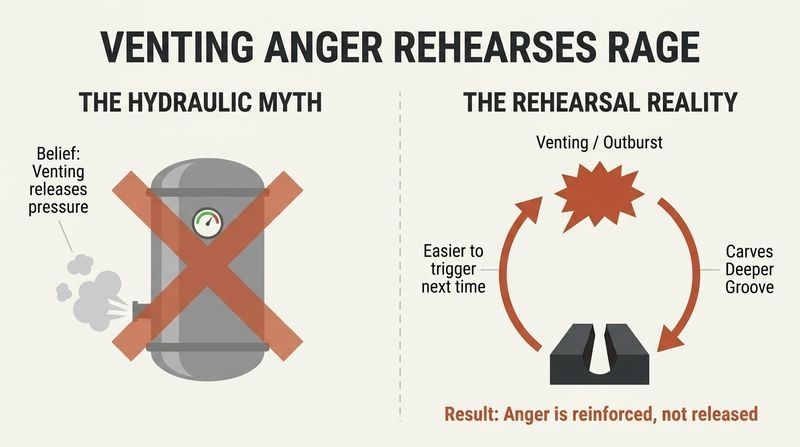
The catharsis myth is backwards. For decades, therapists told clients to "let it out," borrowing Freud's hydraulic image of anger as steam building in a boiler until it explodes. McKay dismantles this. Study after study shows that people who vent get angrier, not calmer, and their targets get angry too. Couples who yell feel worse afterward. Laid-off workers who ventilated in exit interviews grew more hostile toward the company. Children given violent toys to "discharge" aggression became more destructive.
Anger feeds on itself. Jack Hokanson's research revealed catharsis is a learned reaction, not a biological release. Ebbesen's aerospace study and Tavris's reviews confirm that expressing hostility freezes it in place. Each outburst carves a deeper groove, making the next one easier and more automatic.
This aligns with modern neuroscience of Hebbian learning: neurons that fire together wire together, so rehearsing rage strengthens the neural pathway rather than exhausting it. Brad Bushman's later experiments (hitting punching bags increases subsequent aggression) independently vindicate McKay. The hydraulic metaphor persists culturally because catharsis feels good momentarily, which is precisely the trap. One nuance worth flagging: the book allows genuine exceptions, such as an abuse survivor confronting a tormentor, where the relief comes from mastering a real injustice, not emptying a reservoir. The distinction between processing pain and performing anger is the load-bearing idea here.
Anger is a two-step choice: stress alone never makes you angry
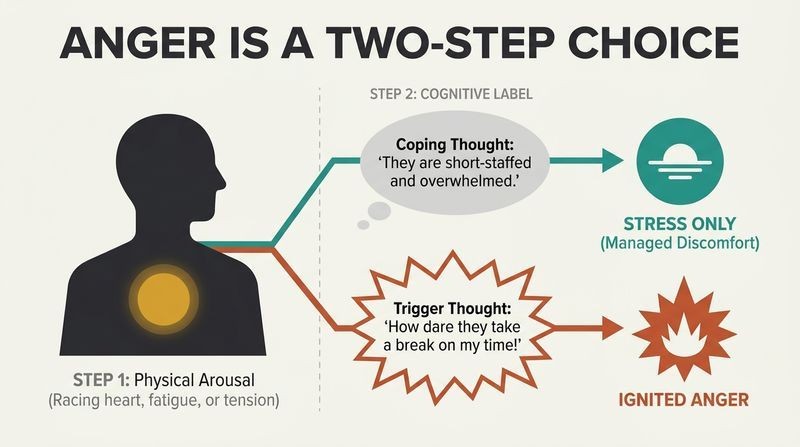
Stress plus trigger thoughts equals anger. McKay's core model separates physiological arousal (step one) from the thoughts that ignite it (step two). Pain, fatigue, frustration, or threat create arousal. But arousal by itself is just discomfort. Anger only ignites when you add "trigger thoughts," the interpretations that cast someone as deliberately harming you or breaking the rules.
The classic experiment proves it. Stanley Schachter injected subjects with adrenaline. Those who did not know why they felt aroused borrowed the emotion of a nearby actor, becoming euphoric or angry depending on his behavior. Same body chemistry, different label. Consider Stella fuming in a bank line: her pounding heart came not from the slow tellers but from her running monologue ("How dare they take a break?"). Change the thought, defuse the emotion.
This is cognitive appraisal theory applied with unusual practical force, echoing Lazarus and anticipating the reappraisal research of James Gross. The empowering implication is agency: if a thought is a choosable link, anger becomes editable rather than inevitable. Critics of pure appraisal models note that some threat responses (a fist swinging toward your face) trigger amygdala-driven reactions faster than conscious appraisal. McKay concedes this for genuine physical danger. But for the chronic, simmering anger that wrecks marriages and arteries, the two-step model holds: the interpretation, not the event, is doing the work, which is exactly why journaling trigger thoughts becomes the book's central intervention.
Chronic hostility corrodes your arteries as reliably as cholesterol
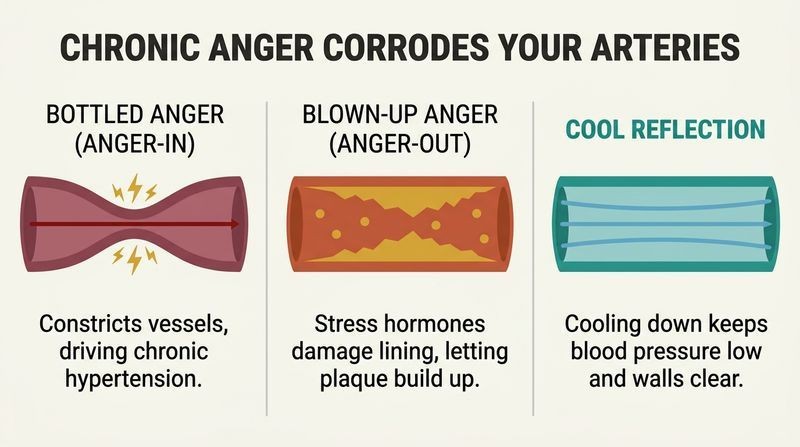
Anger is a cardiac risk factor. A 25-year study of law students found those scoring highest in hostility died at four times the rate of the least hostile. Friedman and Rosenman's Type A research eventually isolated hostility, not ambition or time-urgency, as the toxic ingredient predicting heart attacks. Barefoot's follow-up of physicians showed high-hostility doctors had six times the coronary disease.
Both bottling and blowing up hurt you. Suppressed anger (anger-in) chronically activates the sympathetic nervous system and drives hypertension. Expressed anger (anger-out) floods you with cortisol, adrenaline, and noradrenaline, constricting blood vessels and letting cholesterol accumulate. McKay's vivid image: it is like flooring the accelerator while slamming the brakes. Notably, the coping style called "reflection" (talking it over after cooling down) correlated with the lowest blood pressure.
The physiology has aged well. Redford Williams's Duke research and subsequent meta-analyses confirm hostility as an independent predictor of cardiac events, comparable to smoking. The mechanism (repeated cortisol and catecholamine surges damaging endothelial linings) is now textbook. What McKay captures elegantly is the double bind: neither repression nor expression is safe, which dissolves the false binary that dominated pop psychology. The escape hatch is the "reflection" style, essentially delayed, deliberate problem-solving. This foreshadows the entire skills program. A caveat: correlation studies cannot fully rule out that a third factor (say, low socioeconomic status) drives both hostility and heart disease, though the prospective designs make causation plausible.
Stop asking who caused your pain; ask what you can do about it
Personal responsibility rewires everything. McKay argues that blaming others for your pain hands them control of your life. You alone know your needs, others are entitled to prioritize their own, and needs inevitably conflict. When you accept full responsibility, helpless anger converts into options. Consider Irene, enraged that her chronically late, self-absorbed friend Nora monopolized every lunch. Reframing Nora as merely different (not wrong) freed Irene to bring a book, meet in groups, or interrupt to share her own stories.
Six responsible responses replace blame:
1. Reinforce others (reward the behavior you want)
2. Meet the need yourself
3. Find other sources of nourishment
4. Set limits (say no)
5. Negotiate assertively
6. Let go (accept it or leave)
Only children are true victims, because adults always have choices.
This is radical responsibility of the kind Stephen Covey and Viktor Frankl championed: the space between stimulus and response is where freedom lives. The framing is therapeutically shrewd because blame, while satisfying, is a dead end that produces only resentment and passivity. One tension deserves attention: the insistence that "you are never a victim" as an adult can feel harsh when applied to people trapped by poverty, coercion, or abuse, where real external constraints limit choice. McKay partly addresses this by including "let go" and by treating child abuse survivors separately. Read charitably, the claim is about reclaiming agency wherever it exists, not denying genuine oppression.
Hunt down your shoulds and blamers, the thoughts that manufacture rage
Two families of trigger thoughts. Shoulds impose your private rulebook on people who never agreed to it ("He should have called"). Blamers assign malicious intent ("She did that to hurt me"). Both cast you as an innocent victim of someone bad who deserves punishment. McKay catalogs the specific distortions: the entitlement fallacy (wanting something badly means you deserve it), the fallacy of fairness, the fallacy of change (enough pressure will remake people), assumed intent (mind-reading motives), magnifying ("always," "never," "terrible"), and global labeling ("he's a jerk").
The three-column technique dismantles them. Borrowing from Aaron Beck, you write the trigger thought, name its distortion, then rewrite it accurately. "That jerk's keeping me waiting" becomes "I don't like waiting." Expect three months of daily practice before the old thoughts lose their grip.
This is classic cognitive-behavioral therapy applied to anger specifically, and it holds up as one of the most evidence-based interventions in clinical psychology. The insight that people "do only what is reinforcing for them, not what they should" borrows from behaviorism (strength of need minus strength of inhibition) and is genuinely liberating: it replaces moral outrage with curiosity about motivation. The honesty about the timeline (three months of tedious journaling) is refreshing in a genre addicted to quick fixes. A limitation: purely cognitive restructuring can feel invalidating when anger points to a real injustice worth acting on. The best use pairs thought-correction with assertive problem-solving, which the book supplies.
Anger is a mask; find the fear, hurt, or guilt beneath it
Anger is often a defense. It empowers you, energizes action, blocks softer feelings, makes you self-centered, and convinces you that you are right. Those same properties make it a psychological shield against pain you would rather not feel. A father screams at his toddler for stepping off the curb, and the fury drowns out the fear of nearly losing her.
The blocked feeling festers unaddressed. When anger masks fear, you never correct the distorted danger or take real precautions. When it masks the inner critic, you never talk back to the self-attack. When it masks grief, you cannot let go. McKay's exercise: review your anger diary and, in red ink, name the underlying feeling beside each incident. Ask, "What would I feel if I didn't get angry here?"
This reframes anger as a secondary emotion, a view now central to Emotion-Focused Therapy (Leslie Greenberg) and widely taught in couples work. The evolutionary logic is sound: anger's mobilizing chemistry evolved to override inhibiting emotions during genuine threat, which is precisely why it so effectively smothers vulnerability. The addiction analogy is apt, because anger delivers immediate relief while compounding long-term damage, exactly the reinforcement schedule that traps gamblers and drinkers. The practical genius is the diagnostic question about what lies beneath. One caveat: not all anger is defensive. Sometimes anger is the primary, appropriate response to violation, and mislabeling it as a mask can itself become a form of self-silencing.
Commit to acting calm for 24 hours, no matter how justified you feel
Take it one situation at a time. Rather than vowing lifelong change, McKay borrows from addiction recovery: pledge to act calmly (not feel calm) for a single day. No raised voice, no tailgating, no threats, no verbal attacks. Tell people, recruit an ally with a nonverbal signal, preview your predictable trigger times and people, and make a coping plan.
When anger rises, do three things:
1. STOP. Observe the wave without acting; it crests and recedes.
2. Watch your self-talk. Swap "This isn't fair" for "I can do something different this time."
3. Act the opposite. Smile, unclench, lower and slow your voice, disengage, say something mildly empathetic even if you don't mean it.
Acting calm short-circuits the physical feedback loop that intensifies rage.
The 24-hour frame is behaviorally astute: distant goals feel abstract and defeat willpower, while a one-day commitment is concrete and winnable, echoing the "one day at a time" wisdom that makes AA durable. "Act the opposite" anticipates Marsha Linehan's opposite-action skill in Dialectical Behavior Therapy and rests on solid facial-feedback and embodied-cognition research: physical expression amplifies or dampens the emotion it signals. Softening your voice literally lowers the room's arousal. The instruction to fake empathy invites skepticism, and sincerity purists will balk, but the point is behavioral priming, not deception. Doing the calm thing often generates the calm feeling, reversing the usual assumption that feeling must precede action.
Kill escalation early: one "time-out" beats winning the argument
Aversive chains build predictably. Gerald Patterson's research shows conflicts escalate link by link between equals through rapid exchanges of punishing communications: a sigh, a criticism, a blame, a threat. Most chains die at the first link. Those lasting beyond thirty seconds risk yelling or violence. The final "trigger behavior" usually evokes abandonment or rejection.
Four tools break the chain:
1. Time-out (the referee's "T" sign, then physically separate for about an hour, and return)
2. Rechanneling (substitute a calming response at a weak link)
3. Inquiry (ask "What hurts?" since anger signals pain)
4. Calling process (comment on how you're both acting rather than the topic)
McKay also warns of mind-reading and "parataxic distortion," where an old parent or ex superimposes onto the present person, triggering a ten-foot response to a one-foot provocation.
Patterson's coercion theory, developed studying families, is one of the most replicated findings in behavioral science and underlies effective parent-training programs worldwide. The insight that escalation is a choreographed sequence, not a spontaneous explosion, makes it interruptible at identifiable junctures. The time-out has proven especially valuable in batterer intervention. Sullivan's "parataxic distortion" connects beautifully to modern attachment and transference research: we routinely react to templates from old relationships rather than the person in front of us. The antidote (checking it out with "I observe X, I imagine Y") is essentially a reality test. The discipline required to leave mid-fight, forgoing the last word, is the hard part.
Say "I think, I feel, I want" instead of blaming or seething
Assertiveness is the antidote to anger. McKay contrasts three styles: passive (say nothing, seethe, sabotage), aggressive (blame, punish, intimidate), and assertive (state needs directly without violating others). The passive-then-aggressive cycle is common: swallow needs until pressure spikes, then explode over something trivial.
The three-part assertive statement:
1. I think (the objective facts, no judgment, like a photograph)
2. I feel (your honest reaction, owning it with "I," not "you make me")
3. I want (one specific, behavioral request)
Requests must ask for behavior, not attitude. You cannot demand someone "be more loving," but you can ask them to do the dishes or accompany you to a party. When behavior shifts, feelings often follow, as with the baseball-obsessed husband who grew to love the Saturdays he initially resented spending with his kids.
This is textbook assertiveness training, refined since the 1970s work of Alberti and Emmons, and the "I-statement" is now a cliche precisely because it works. The behavioral-versus-attitudinal distinction is the sharpest practical point: vague requests ("be more supportive") set up guaranteed disappointment because they are unmeasurable and feel like character indictments. Specificity protects the relationship. The observation that behavior change often drags attitude change along it aligns with self-perception theory (Bem): we infer our feelings partly from our actions. One caution: assertiveness assumes a relatively safe partner who can hear a request without retaliating. In genuinely abusive dynamics, the book rightly treats direct assertion as risky and prioritizes safety first.
With kids, your interpretation of their behavior is the real trigger
Parenting is grueling, and anger is nearly universal. Two-thirds of normal parents report shouting at their kids about five times a week. But children pay steeply: parental anger distorts their self-image ("I must be bad"), makes them feel unsafe, and predicts worse academic, social, and emotional adjustment. Angry, punitive mothers raise more aggressive, less empathetic children. Frequent yelling correlates strongly with hitting, and corporal punishment breeds aggression, lying, and low self-esteem rather than conscience.
Trigger thoughts inflame parenting. The three worst themes: assumed intent ("He's defying me on purpose"), magnification ("I can't stand it"), and labeling ("She's selfish"). Replace them with coping thoughts: "It's just a stage," "He can't help it right now," "Just get through it." Ask what need the misbehavior expresses, then teach a better way to meet it.
The developmental stakes here are backed by attachment research and decades of work by Straus and others linking corporal punishment to worse outcomes. The reframe from "my child is bad" to "what need is this behavior serving" mirrors functional behavior analysis, the foundation of effective behavioral parenting programs like those descended from Patterson's Oregon work. What makes the parenting chapter powerful is recognizing that a small child, unlike an adult, cannot correct your mistaken mind-reading by explaining they were late due to traffic, so your distorted interpretation goes unchallenged and calcifies into a label the child may internalize and live up to. The self-fulfilling-prophecy risk raises the ethical stakes of casual name-calling.
On the road, surrender control: "I'll get there when I get there"
Road rage is a distinct, deadly arena. Angry drivers pilot thousands of pounds of metal while impulsive, and their fury inflicts millions of hours of terror on passengers plus documented cardiovascular harm (commuters have shorter lifespans partly from sustained frustration). McKay identifies the toxic attitudes: everyone should drive skillfully, no one should slow me down, bad drivers deserve punishment, and their driving is a personal disrespect.
Four reframes defuse it:
1. I'll get there when I get there (release control)
2. People are people (foolish, rushed, they are what they are)
3. People do what they want, not what they should
4. It's just a bad moment (thirty seconds, then over)
When another driver rages at you, follow the five don'ts: don't look, gesture, open the window, honk, or pull over.
Road rage is a natural experiment in McKay's whole thesis, because the provocations are anonymous, fleeting, and utterly beyond your control, stripping away any pretense that anger will fix the situation. The reframes are essentially applied Stoicism: Epictetus taught focusing only on what is within your power, and traffic is the purest modern laboratory for that discipline. The "who appointed me judge of Highway 5?" question punctures the self-appointed-vigilante mindset that fuels most road aggression. The five don'ts are sound de-escalation, since eye contact and gestures are the universal primate signals that invite confrontation. One addition worth noting: mental time-outs and distraction work because attention is a finite resource that anger and problem-solving compete for.
Abuse is always the abuser's choice, and it escalates if unchecked
No provocation justifies violence. McKay defines abuse broadly: any use of violence, threats, or intimidation to force someone to act against their will, including the occasional shove, the punched wall, or the ominously cleaned shotgun. One American family in two experiences some domestic violence yearly. Left unchecked, it escalates through predictable cycles of tension-building, explosion, and remorse (the "honeymoon" that reinforces staying).
Roots and remedies. Batterers typically carry low self-worth, traditional views, pathological jealousy, and childhood exposure to violence (such men batter at ten times the rate). Drugs or alcohol accompany over 80% of episodes. Responsibility for the violence rests solely with the abuser, never the victim. Change requires his genuine commitment and professional help. The victim's priorities are safety, restored self-esteem, and challenging the belief that she deserves the abuse.
This chapter reflects the feminist-informed batterer-intervention consensus of its era (the Duluth model looms behind it) and correctly refuses the "she provoked it" narrative that once dominated even clinical thinking. The cycle-of-violence framework from Lenore Walker remains influential, though contemporary researchers now recognize more heterogeneity among abusers than the single-cycle model implies. The most chilling concept is "instrumental aggression," calculated violence with no rage or remorse, which the book flags as largely untreatable and a signal to leave. That distinction between reactive and instrumental aggression has since become central to forensic psychology. The clear-eyed practical guidance (safety plan, packed bag, hotline numbers, arrest reduces recidivism) reflects the sober recognition that skills-building matters only after physical safety is secured.
Analysis
When Anger Hurts occupies a distinctive niche: it is a cognitive-behavioral self-help manual that stakes its authority on demolishing the reigning therapeutic orthodoxy of its time. Written by clinicians at San Francisco's Haight-Ashbury Psychological Services, the book's polemical spine is its assault on the catharsis myth, the Freudian-derived belief that anger is a fluid that must be discharged. McKay and colleagues marshal Tavris, Hokanson, and Feshbach to argue the opposite: expression rehearses and entrenches hostility. This was a genuinely contrarian stance in 1989 pop psychology, and subsequent research (Bushman's punching-bag studies foremost) has largely vindicated it.
The book's intellectual engine is Schachter's two-factor theory of emotion, repurposed into a practical two-step model: arousal is inert until trigger thoughts label it as anger. Everything downstream (the three-column technique, coping thoughts, anger inoculation, assertiveness training) flows from this appraisal logic. Methodologically the book is unabashedly Beckian and Ellisian, and it wears its cognitive-behavioral lineage proudly, even citing Meichenbaum's stress inoculation and Novaco's anger work directly.
What elevates the book above a generic CBT workbook is its physiological seriousness (the Type A and hostility-mortality literature grounds the stakes in cardiac disease) and its refusal of easy binaries: both suppression and expression damage you, so the exit is neither swallowing nor venting but responsibility, problem-solving, and assertion.
The book's vulnerabilities are twofold. First, its insistence on radical personal responsibility ("only children are victims") sits uneasily beside genuine structural constraint and can shade into victim-blaming, a tension the spouse-abuse chapter navigates carefully but the earlier chapters do not. Second, the near-total delegitimizing of anger ("rarely necessary") risks pathologizing an emotion that sometimes correctly signals injustice worth fighting. Anger has mobilized social movements, not just heart attacks. Still, for chronic, relationship-corroding, artery-hardening anger, the book's toolkit remains among the most rigorous and practical available, decades on.
Review Summary
When Anger Hurts receives mostly positive reviews, with readers praising its practical approach to anger management. Many find the book insightful, offering effective communication methods and tools for controlling temper. Readers appreciate the emphasis on personal responsibility and understanding underlying emotions. Some critique the book's stance on "shoulds" and societal protocols. Overall, reviewers recommend it for those dealing with anger issues or seeking to improve interpersonal skills. The book is seen as transformative when approached as a workbook and applied diligently.
People Also Read




FAQ
What's When Anger Hurts: Quieting the Storm Within about?
- Focus on Anger Management: The book provides practical techniques for managing anger and its effects on relationships and health, emphasizing that anger is often a choice.
- Cognitive Behavioral Approach: Authors Matthew McKay, Peter D. Rogers, and Judith McKay use cognitive behavioral therapy principles to help readers identify and change anger-triggering thoughts.
- Comprehensive Techniques: It includes strategies like anger inoculation, problem-solving, and effective communication to help individuals cope with anger healthily.
Why should I read When Anger Hurts: Quieting the Storm Within?
- Practical Tools: Offers actionable exercises and techniques that can be immediately applied to daily life, making it valuable for anyone struggling with anger.
- Improved Relationships: Learning to manage anger can enhance interpersonal relationships, reduce conflict, and foster healthier communication patterns.
- Health Benefits: Discusses the physiological costs of anger, linking chronic anger to health issues like hypertension, motivating readers to seek change for well-being.
What are the key takeaways of When Anger Hurts: Quieting the Storm Within?
- Anger is a Choice: Emphasizes that anger is not automatic but a choice influenced by thoughts and beliefs, empowering individuals to control their reactions.
- Coping Strategies: Provides a variety of coping strategies, including relaxation techniques, cognitive restructuring, and problem-solving methods.
- Responsibility for Emotions: Encourages taking personal responsibility for feelings and reactions, shifting focus from blaming others to understanding personal needs.
What are the best quotes from When Anger Hurts: Quieting the Storm Within and what do they mean?
- “Anger begets anger.”: Highlights the cyclical nature of anger, suggesting that expressing anger often leads to more anger in others.
- “You are responsible for the quality of your life.”: Emphasizes personal accountability, encouraging readers to recognize their power to change circumstances and emotional responses.
- “People do what is reinforcing for them to do.”: Underscores that behavior is often driven by personal needs and motivations, aiding in understanding others' actions.
How can I use the techniques in When Anger Hurts: Quieting the Storm Within?
- Practice Daily Exercises: Engage in exercises like keeping an anger journal to track triggers and responses, helping identify patterns and develop awareness.
- Implement the IDEAL Model: Use the IDEAL model (Identify, Develop, Explore, Action, Look) to systematically address problems that trigger anger.
- Incorporate Relaxation Techniques: Regularly practice methods like deep breathing and progressive muscle relaxation to manage stress levels and reduce anger responses.
What is the Two-Step Model of Anger in When Anger Hurts: Quieting the Storm Within?
- Understanding Anger Triggers: Posits that anger arises from stress and trigger thoughts, helping individuals understand the root causes of their anger.
- Choice in Response: Emphasizes that individuals can choose their response to anger by altering their thoughts, leading to healthier emotional regulation.
- Practical Application: By identifying specific trigger thoughts, readers can work on reframing these thoughts to prevent anger from escalating.
What is anger inoculation as described in When Anger Hurts: Quieting the Storm Within?
- Gradual Exposure: Involves gradually exposing oneself to anger-inducing scenarios while practicing coping strategies to build resilience.
- Worksheets for Practice: Provides worksheets to help create detailed anger scenes, identify trigger thoughts, and develop coping thoughts.
- Repetition for Mastery: Encourages repeated practice of scenarios to reinforce coping skills and reduce the likelihood of explosive anger.
How does When Anger Hurts: Quieting the Storm Within address anger in relationships?
- Interpersonal Costs: Discusses how anger can damage relationships, leading to isolation and decreased support from friends and family.
- Effective Communication: Emphasizes using effective communication strategies to express needs without resorting to anger.
- Coping with Conflict: Provides tools for managing conflicts constructively, encouraging focus on problem-solving rather than blame.
What is response choice rehearsal (RCR) in When Anger Hurts: Quieting the Storm Within?
- Structured Responses: Involves pre-learning specific responses to anger-provoking situations, allowing adaptive reactions.
- Active and Passive Responses: Outlines both active responses (like expressing needs) and passive responses (like seeking information).
- Practice Through Visualization: Encourages visualizing scenarios and practicing responses to reinforce skills needed to cope with anger.
How can I apply the techniques from When Anger Hurts: Quieting the Storm Within to my parenting?
- Recognizing Stressors: Emphasizes recognizing stressors like fatigue or feeling rushed and planning accordingly.
- Using Coping Thoughts: Encourages replacing trigger thoughts with coping thoughts that acknowledge a child’s developmental stage.
- Assertive Communication: Provides a framework for assertive communication, helping parents express feelings and expectations clearly.
What are some common trigger thoughts that lead to anger in parenting according to When Anger Hurts: Quieting the Storm Within?
- Assumed Intent: Thoughts like “You’re doing this to annoy me” can escalate anger by assuming negative intentions.
- Magnification: Statements such as “This behavior is intolerable” exaggerate situations, increasing frustration.
- Labeling: Using negative labels like “You’re so lazy” can damage self-esteem and provoke conflict.
How does When Anger Hurts: Quieting the Storm Within address the issue of spouse abuse?
- Cycle of Violence: Discusses the cycle of violence, including phases of tension building, explosion, and remorse.
- Understanding Responsibility: Emphasizes that while the abuser is responsible, both partners contribute to relationship dynamics.
- Support Resources: Provides information on seeking help, including counseling and support groups for victims and perpetrators.
About the Author
Other books by Matthew McKay

Download PDF
Download EPUB
.epub digital book format is ideal for reading ebooks on phones, tablets, and e-readers.








































