
Plot Summary
A Mountain Library in 2119
In the year 2119, Tom Metcalfe1 takes a ferry to the Bodleian Snowdonia Library, now perched a thousand feet above the sea in a Britain transformed by nuclear tsunamis, climate catastrophe, and the Inundation of 2042 into a chain of islands.
Average life expectancy has dropped to sixty-two. Tom1 is a humanities lecturer at the University of the South Downs, obsessed with the period 1990 to 2030 and one mystery above all: a long poem called A Corona for Vivien by the great poet Francis Blundy.3
Written on vellum as a birthday gift, read aloud once at a dinner in 2014, it was never published or seen again. An archivist named Donald Drummond14 shows Tom1 to his carrel and mentions a puzzling phone number found in Vivien Blundy's journal — a detail Tom1 dismisses.
Ten Guests, One Scroll
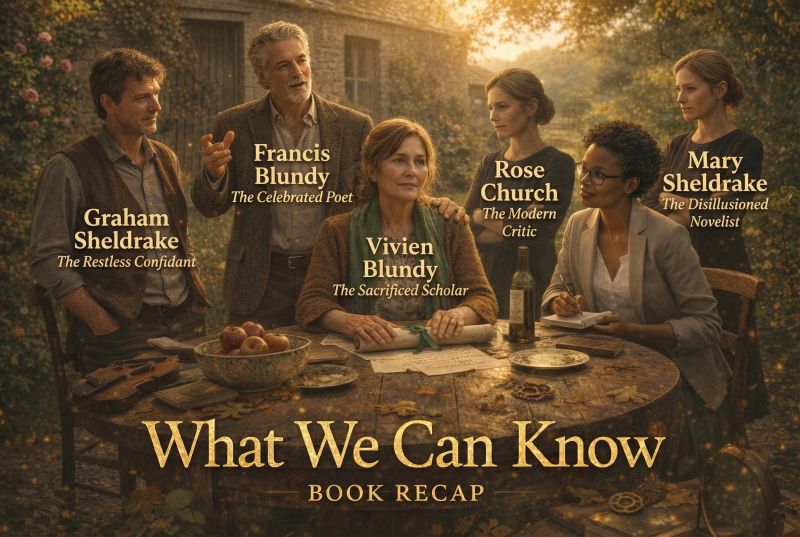
On an unseasonably warm October evening in 2014, Vivien Blundy2 prepares her fifty-fourth birthday dinner at the Barn, their converted farmhouse in rural Gloucestershire. Francis3 has spent five months composing a corona — fifteen interlocking Petrarchan sonnets — on a single sheet of vellum in minuscule handwriting.
He has destroyed all drafts, intending this to be the only copy, and hides the rolled scroll behind a mantel clock. Guests begin arriving: Graham13 and Mary Sheldrake,12 mid-marital crisis from confessions of mutual affairs; John Bale the vet and Tony Spufford the botanist; Harry Kitchener,6 Francis's3 editor and brother-in-law, with his wife Jane,7 Francis's3 sister.
The Gages10 — young parents Harriet10 and Chris11 — arrive last. Francis3 mixes fierce gin and tonics, then launches a climate-change rant that embarrasses the room.
Fifteen Sonnets, Ten Silences
Harry6 delivers an extravagant speech praising Francis3 as the greatest living English poet — praise so fulsome Vivien2 suspects satire. Francis3 leaps to his feet, cuts Harry6 off, retrieves the scroll, and fumbles with the ribbon.
For twenty minutes his baritone carries fifteen densely woven sonnets evoking nature's abundance, a river swim through a gorge, a rural church wedding, growing old with grace. Most guests are too drunk to follow. Chris11 ponders transporting scenery flats. Graham13 worries about his marriage. Tony, the botanist, recognizes that Francis3 — who once called a dandelion a buttercup — is faking botanical intimacy.
Mary Sheldrake12 is genuinely moved, resolving to abandon her arid prose style. When the final line fades, thirty seconds of charged silence follow before Harriet's10 sob breaks it and applause erupts. Francis3 presents the scroll to Vivien.2
Corona Outlives Civilisation
Harry6 wrote to the Times Literary Supplement calling the evening the Second Immortal Dinner and declaring the poem a masterpiece. Francis3 never published it. In 2017, as Francis3 lay dying of pancreatic cancer, journalist Harriet10 published an article portraying the Corona as an environmental call to arms and demanding to know why it remained hidden.
An anonymous blog claimed oil companies paid Blundy3 for silence. Vivien2 refused all comment. Over the following decades — through nuclear exchanges between India and Pakistan, the Inundation that drowned London and made Britain an archipelago, and the Third Sino-American War — the unread poem accumulated mythic power.
Activists wore Blundy T-shirts. Couples called themselves Blundy pairs. Poetry competitions tried to recreate it. The Corona became more beautiful for being unknown, a blank screen onto which each catastrophic age projected its hunger.
The Sandbar Declaration
Tom1 and his colleague Rose Church5 share a tangled history: fifteen months living together that went stale, then years as intimate friends who could not quite separate. On a hot June evening, they swim out from the campus beach across translucent water to a submerged sandbar.
Standing chest-deep, hands on each other's shoulders, they make love as gentle wavelets rock them. Rose5 speaks the three contractual words first. Tom,1 who has spent a lifetime avoiding them, follows. They move back in together and marry in a five-minute ceremony before the university mainframe.
Rose5 assembles a paper on realism's crisis during the Derangement; Tom1 drafts his reputation essay on the poem that exists only in people's minds. They argue constantly about whether the Corona still survives somewhere. She insists it is gone. He refuses to believe it.
The Students Walk Out
Rose5 proposes they teach a joint course on the history of artificial intelligence. Tom1 reluctantly agrees. On the first Thursday, fifty-eight students face them in a horseshoe arrangement. Rose5 begins a condensed history of computing. The silence feels wrong.
A graduate student named Kevin Howard15 stands — small, strangely beautiful, radiantly confident. He announces he speaks for the group. They are tired of being told what has been lost, tired of dead wars and extinct hedgehogs. They want to talk about their own future, not someone else's past.
As he speaks, students leave one by one in choreographed protest. When Howard15 finishes and hurries out, Tom1 and Rose5 sit facing empty chairs, unable to look at each other. The humiliation becomes campus legend. Their professional reputation suffers, and a coolness settles over their marriage.
Kevin Howard in Tom's Bed
Tom1 escapes to the Bodleian for more research, relieved to be away from Rose.5 He finds nothing new in the Blundy archives. Walking the cliffs, he contemplates whether their marriage can survive a failed course. He returns home at one in the morning.
A lamp burns by the sofa where an empty wine bottle and two glasses sit amid disarranged cushions. The bedroom door is closed. Rose5 emerges in her dressing gown, hair tousled, and says flatly that he is back early. Tom1 demands she remove her visitor.
When the bedroom door opens, out comes Kevin Howard15 — the student who humiliated them — unable to meet Tom's1 eyes. Rose5 positions herself between the two men as Howard15 hurries away. Tom1 sleeps on the sofa. Within days he moves into a monastic studio apartment, feeling nothing, which frightens him more than pain would.
A Fourteen-Year-Old's Eureka
Months pass. Tom1 teaches mechanically, avoids Rose,5 drifts through indifference. One November night at a dreary pub near campus, he opens a forgotten letter from Drummond,14 the Bodleian archivist. Drummond14 describes how his visiting niece Dolly, a fourteen-year-old math prodigy, became intrigued by the mysterious number in Vivien's journal.
When Dolly realized it could not be a phone number — no matching area code existed — she stripped the leading zero and recognized a geographic coordinate. Drummond14 entered it into an old map.
The location was the dairy at the Barn, Vivien's2 study. A cryptic journal entry — four metres out from the long south-east edge — confirmed a burial site. Tom1 leaps from his chair, sends it crashing backward. There is only one person he wants to tell, and her apartment lights are dark.
Fork and Spade in Forest
Tom1 shows Rose5 the letter at lunch. She is electrified — the sort of eccentric thing Vivien2 would do, she says. Their reconciliation proceeds cautiously through planning. Rose's5 inherited money funds the expedition. They hire Jo Mideksa,16 a compact, dark-haired captain with a shallow-draught fishing boat called Salty.
In March they sail from Port Marlborough through the Cotswold Islands. The site of the Barn is now a steep, tree-covered island. Tom1 and Rose5 scramble ashore, haul packs up a cliff, and hack through birch thickets and bramble using compass bearings and paced metres.
Their backs ache, Rose's5 heel blisters, an insect lodges in Tom's1 eye. They find the dairy's ruined stone walls and begin digging. The first hole hits impassable limestone. The second, guided by a coin toss, strikes something metallic at sixty-five centimetres.
A Violin, Not a Poem
They unearth a stainless-steel case, haul it through rain back to the boat, and cut it open with chisel, drill, and bolt-cutters. Inside a welded plastic inner container, embedded in moulded foam, lie two packages.
The larger one, tapered and light, contains Percy Greene's4 unfinished replica of a Vieuxtemps Guarneri violin — the instrument crafted by Vivien's2 first husband before Alzheimer's destroyed him. Tom1 recognizes it from Vivien's journals and his eyes fill. The smaller package is rectangular: not a poem on vellum but a prose manuscript on thick cotton paper.
Vivien's2 confession. Tom1 passes the folder to Rose,5 who reads, turns pages, and places her hand on his arm. Then she guides his hand to her belly, to a faint swell he had not noticed. She tells him it will be all right, and so will they.
Diana in the Cot
Vivien's2 confession opens with her childhood: a dismissive airline-pilot father who valued his son over his daughters, a compliant mother, sisters Rachel8 and herself liberated by neglect into good educations. After university, Vivien2 took an estate-agent job in London, fell into partying, and became pregnant by a man who walked away.
She named her daughter Diana. For six months she was happy, cared for by medical-student housemates. Then came the night of a large party. Vivien2 drank terribly. She forgot about Diana. She went to bed without checking on the baby.
In the morning she found her daughter face down in vomit. At the inquest, the coroner was gentle — which deepened the shame. Vivien's2 sister Rachel8 brought her home. Eventually Vivien2 crawled back to Oxford for a doctorate on the poet John Clare, certain she did not deserve another child.
The Banjoist's Slow Vanishing
At an east Oxford pub, Vivien2 watched a banjo player with a generous face and flickering forearm muscles. Percy Greene4 was a violin maker, a hiker who learned his birds from his mother and delighted in physical things. They married. He was kind, tender, competent — everything her father was not.
Then came the morning his memory swallowed several hours whole. Scans revealed compromised brain tissue: early-onset Alzheimer's at forty-three. The long plateau of decline followed. Percy's4 questions repeated endlessly. He followed Vivien2 through the house.
He forgot their love, forgot the Guarneri violin half-built in his shed. Vivien2 took unpaid leave from teaching to nurse him alone, escaping only when Rachel8 could visit. Meanwhile, she carried on a secret affair with Harry Kitchener,6 Francis Blundy's3 married editor — Tuesday evenings, ostensibly Italian classes.
Revenge at the Sheldonian
Harry6 ended things in seconds, leaning on his car door in the back lane with the casual smoothness of a man returning a library book. Vivien2 smiled through the humiliation, quoted Drayton, and went inside. The fury came later — weeks of rehearsing retorts she should have made.
When an invitation arrived for a Blundy3 reading at the Sheldonian Theatre, she saw her chance. She sat prominently in the fourth row and after the event approached Francis3 at the reception, making sure Harry6 watched them leave together.
At the Randolph Hotel, instead of sex, they talked until two in the morning — about families, faith, dementia, and Vivien's2 most guarded secrets. Francis3 listened like no one since Rachel.8 What began as a calculated humiliation of her ex-lover became something she had not foreseen: genuine, dangerous connection with a man whose mind seduced her.
Seduced by Conversation
Rachel8 arranged four days of respite. Francis3 drove Vivien2 to the Cotswolds to see his Barn under construction and the old dairy he intended as her study, complete with oak writing desk. He outlined their future together: herb pots by the kitchen door, poultry, fresh eggs, bookshelves being built in Witney.
They spent four days reading, talking, cooking, and making love in London. Then everything stalled. Percy4 refused care homes. Rachel8 had breast cancer. Francis3 took other lovers. The couple was reduced to twenty-minute meetings in his parked car in Vivien's2 back lane.
During one such meeting, Francis3 told her flatly they had to act. His meaning was unmistakable. She said no and fled to the house. But her desperate emails continued — describing Percy's4 incontinence, her sleeplessness, her hatred of what his disease had made him. Francis3 kept every message.
A Thump on the Tiles
One night, while Percy4 slept and Vivien2 sat in an exhausted daze at the kitchen table, tapping came at the French windows. Francis3 stood in a wide-brimmed hat and leather gloves, carrying a cloth shoulder bag. He asked where Percy4 was and told her to stay.
She was too slow to understand, too stupefied to move. She heard Francis's3 voice upstairs, then Percy's4 body hurtling headfirst down the steep stairs. He struck the tiled hallway. Francis3 knelt beside him, pulled a short-handled mallet from the bag, gripped Percy's4 hair, and brought the metal down against his forehead.
Vivien2 watched. She did not intervene. Francis3 gave instructions: delete emails, destroy letters, wait five minutes, call an ambulance. The coroner ruled death by misadventure — a common fate for Alzheimer's patients on steep stairs. No one investigated.
Vellum Into Flame
After seven months of silence, Francis3 summoned Vivien2 to a Greek island. On Amorgos he accused her of complicity — her desperate emails amounted to consent, he insisted, and he had kept copies. Trapped, Vivien2 proposed marriage. Years later, on the night of her fifty-fourth birthday, after guests departed and Francis3 retreated, she took the scroll to the dairy.
Reading the final sonnet, she recognized what Francis3 had done: stolen Percy's4 life — their walks, their river swims, their delight in naming wildflowers — and inserted himself. The poem's symbolic murder of a bearded nature figure was Percy,4 re-enacted in verse.
Vivien2 leaned toward the woodburning stove, stretched out her hand, and released the vellum. It caught, blazed, and was done — the only copy turned to ash. What she preserved instead was her own prose confession, buried with Percy's violin for the future to find.
Epilogue
A brief note at the novel's end reveals that The Confessions of Vivien Blundy2 was published in 2125 by the University of the South Downs Press, edited by Professor Thomas Metcalfe,1 with an introduction by Rose Church5 — now Gibbon Professor of History — and a preface by Donald Drummond14 of the Bodleian. The poem was never recovered; it existed only as ash.
But Vivien's prose confession survived, reaching the world more than a century after she wrote it. Tom's1 quest ended not with the masterpiece he sought but with a truth that mattered more. Rose's5 pregnancy, discovered alongside the confession aboard the boat, promised that their partnership — and the future itself — would continue.
Analysis
McEwan constructs a novel about the impossibility of knowing the past — and the moral weight of wanting to. Tom Metcalfe's1 obsessive research into Blundy's3 lost poem is presented as noble scholarship, but the novel quietly indicts the biographical impulse. Tom1 romanticizes Vivien2 to the point of imagining marriage to her; he prefers the archived dead to the living woman beside him. His nostalgia for a world that destroyed itself is self-harm dressed as intellectual passion. When the buried treasure turns out to be confession rather than poetry, McEwan delivers a structural rebuke: the truth is always prose, never verse.
The dual narration performs what it argues. Part One gives biography as reconstruction — educated guesses, archival fragments, the historian's careful scaffolding around absence. Part Two gives autobiography as confession — raw, specific, morally devastating. The gap between them is the gap between what we can know and what actually happened. Tom's1 hundred pages of inference cannot compete with Vivien's2 single paragraph describing a mallet striking Percy's4 forehead.
The Corona embodies a paradox McEwan has long explored: great art as an instrument of theft. Francis3 appropriates Percy's4 life — his love of nature, his river swims, his tenderness — and converts it into poetry addressed to the woman they both loved. The poem's destruction is not philistinism but justice: Vivien2 refuses to let Francis's3 art complete the erasure of the man she failed to protect. That she substitutes her own plain-prose account for his ornate verse is the novel's deepest argument about what writing owes to truth.
The futuristic frame — Britain as an archipelago, universities on mountaintops, students who reject history — is McEwan's quietest warning. The Derangement the dinner guests discussed has arrived. The past Tom1 aches for was the last moment anyone could have prevented it. His nostalgia, the novel suggests, is not personal weakness but civilizational diagnosis: we mythologize what we destroyed, then call the myth literature.
Review Summary
What We Can Know is a thought-provoking novel set in two time periods: 2119 and 2014. It explores themes of memory, climate change, and the limitations of historical knowledge. The story revolves around a lost poem and its impact on future generations. While some readers found the first half slow, many praised McEwan's prose and the novel's complex exploration of human relationships. The book's dystopian future setting and examination of past events garnered mixed reactions, with some readers deeply moved and others struggling to connect with the characters.
People Also Read
Characters
Tom Metcalfe
Future scholar hunting a poemTom is a humanities academic in the 22nd century, consumed by nostalgia for a world he never knew. His research into Francis Blundy's3 lost Corona poem is part scholarly quest, part psychological obsession—an attempt to inhabit a richer past that makes his diminished present feel intolerable. He romanticizes the Blundys' era to the point of imagining himself in love with Vivien2, a woman dead for eighty years. This fantasy both drives his research and strains his marriage to Rose5. Tom is intellectually rigorous but emotionally avoidant, preferring the company of archived voices to living relationships. His central contradiction is his willingness to cross oceans for a poem but not bridge the distance to his wife. Whether nostalgia is his strength or his affliction remains the question that defines him.
Vivien Blundy
The poet's wife, the keeperVivien is a former Oxford don who abandoned her career to become her poet-husband's secretary in rural Gloucestershire. Shaped by a dismissive airline-pilot father who valued only his son, she developed an attraction to emotionally unavailable men that she understands intellectually but cannot override. Her deepest wound—the death of her infant daughter Diana through her own drunken neglect—drives everything: her devotion to her first husband Percy4, her guilt-fueled caretaking, and her inability to break free of Francis's3 gravitational pull. She is rigorously honest in her journals yet adept at lying by omission. Her intelligence, learning, and capacity for love are repeatedly subordinated to the needs of the men around her. She is a woman whose fiercest act of autonomy has been deferred for decades, accumulating pressure like water behind a dam.
Francis Blundy
The celebrated, dangerous poetFrancis is a celebrated English poet whose public persona—the fierce intellect, the commanding presence, the social dominance—masks a profound selfishness. He is brilliant at appropriating others' experience for art: converting Vivien's2 intimacy into published love poems, wearing the gorgeous mask of botanical knowledge he does not possess. He controls through reasoned kindness—logical, caring, certain that what he wants is what everyone should want. His climate-change denial mirrors a broader refusal to acknowledge inconvenient truths about himself. In bed he reveals a surprising submissiveness that contradicts his public authority, suggesting a personality built around performance rather than authenticity. His need for the Corona to be his masterpiece reveals an artist who cannot separate creation from possession.
Percy Greene
Vivien's beloved first husbandPercy is a violin maker, banjo player, and the embodiment of uncomplicated goodness in a novel full of moral complexity. Big, bearded, cheerful, and emotionally generous, he represents everything Vivien's2 father was not: attentive, kind, delighted simply to exist. His craftsmanship—the patience of building instruments, the precision of tuning—extends to relationships. He treats his nephew Peter9 as an equal, learns birds from his mother, teaches Vivien2 wildflowers. His early-onset Alzheimer's diagnosis at forty-three makes his goodness all the more devastating: the slow erasure of a personality that defined warmth. Even in decline he retains enough tenderness to squeeze Vivien's2 hand. His catchphrase, borrowed from William Carlos Williams—no ideas but in things—captures his concrete, sensory engagement with the world.
Rose Church
Tom's wife and collaboratorTom's1 colleague, ex-lover, and eventual wife. Brilliant, practical, and emotionally direct where Tom1 is evasive. She studies the same period but without his crippling nostalgia. Her frustration with Tom's1 emotional absence drives her toward risky choices. She brings skepticism and funding to the expedition and represents the present tense Tom1 must learn to inhabit. Her pregnancy signals renewal.
Harry Kitchener
Francis's editor and rivalFrancis's3 editor, brother-in-law, and Vivien's2 long-term secret lover. Tall, stylish, ironically detached—a man who promotes Francis's3 work while envying his talent. His praise of the Corona in letters helped create its myth. He is serially unfaithful, emotionally stunted, and charming in the exact register that hooks Vivien2. His role as the poem's earliest champion and biographer-designate places him at the intersection of literary history and family secrets.
Jane Kitchener
Francis's sister, a potterFrancis's3 younger sister, a potter, and Harry's6 long-suffering wife. Shaped by the same strict Anglican upbringing as Francis3, she endured a childhood of subordination to her brother's needs. She took Harry6 back repeatedly for the children's sake. After both husbands die, she and Vivien2 share a Scottish cottage, bonded by grief, shared walks through the Rough Bounds, and the careful management of overlapping secrets.
Rachel
Vivien's devoted sisterVivien's2 younger sister and her lifeline during Percy's4 illness. Rachel married a man who resembles their dismissive father—same emotional range, same rectitude. She worked as an airline executive before devoting herself to motherhood. She battles breast cancer while serving as Vivien's2 emergency respite carer. Peter9 is her eldest child. Rachel represents unconditional family loyalty across decades of crisis.
Peter
Vivien's beloved physicist nephewVivien's2 adored nephew, Rachel's8 eldest son. As a child he formed a special bond with Percy4, working alongside him in the violin workshop, having long inconsequential conversations. He grows into a brilliant physicist studying loop quantum gravity. His scientific connections and practical determination make him instrumental to Vivien's2 plans for preservation. He bridges the Blundys' world and the future.
Harriet Gage
The journalist who lit the fuseA young journalist whose sympathetic profile of Francis3 opened her into the Blundy circle. After having three children, she wrote a Guardian article about the Corona dinner that ignited public frenzy and conspiracy theories. Her memory of the poem was filtered through environmental activism, transforming Francis's3 intimate gift into a climate manifesto. Her article inadvertently launched the poem's mythic afterlife.
Chris Gage
Capable handyman, Harriet's husbandHarriet's10 husband, a capable handyman without formal education. He challenged Francis's3 linguistic snobbery at dinner with a devastating grammar lesson on sentence adverbs, earning the poet's grudging respect and later becoming useful around the Barn.
Mary Sheldrake
Celebrated minimalist novelistA celebrated minimalist novelist, privately self-critical, who was genuinely moved by the Corona reading and resolved to transform her writing style. Her later interviews helped shape the poem's public narrative as an ecological masterpiece.
Graham Sheldrake
Mary's adulterous husbandMary's12 husband, a financial advisor who daydreamed through the Corona reading about his marital crisis. His mutual affair-confession with Mary12 during their drive to the dinner added comic tension to the evening.
Donald Drummond
Bodleian archivist with a puzzleSenior archivist at the Bodleian Snowdonia Library whose obsession with the mysterious number in Vivien's journal, and whose niece Dolly's mathematical insight, provide the crucial breakthrough that locates the buried confession.
Kevin Howard
Student rebel, Rose's loverA graduate student with an angelic face and fierce confidence who leads the student walkout against Tom1 and Rose's5 course. He briefly becomes Rose's5 lover, precipitating Tom's1 marital crisis and professional humiliation.
Jo Mideksa
Captain of the boat SaltyCaptain of the fishing boat Salty, of Ethiopian-British heritage. She navigates Tom1 and Rose5 through the Cotswold Islands to the site of the Barn, quoting Blundy's3 most famous poem en route and providing crucial local knowledge.
Plot Devices
A Corona for Vivien
The absent poem driving allA corona of fifteen Petrarchan sonnets written by Francis Blundy3 on vellum as Vivien's2 birthday gift—read aloud once, never published. Over a century of wars and catastrophes, it became a cultural myth: an environmental manifesto, a love poem, a spiritual talisman. Activists cited it, couples invoked it, poetry competitions tried to recreate it. Its absence gave it infinite meaning; any actual version would disappoint. Tom's1 quest to locate it drives Part One. Part Two reveals that the poem encoded a symbolic re-enactment of Percy's4 murder, that Francis3 stole Percy's4 love of nature to animate its lines, and that Vivien2 destroyed the only copy by feeding the vellum into her woodburning stove. The Corona illustrates how art detached from context becomes a mirror for collective anxiety.
The Vellum Scroll
Permanence undone by fireFrancis3 chose vellum—treated calfskin used for the Magna Carta—for permanence. He wrote the 2,500-word poem in minuscule handwriting, tied it with green silk ribbon, and hid it behind a mantel clock supported by two cherubs, one cracked into a toothless grimace. The scroll represents his conviction that his work deserved immortality and his belief that the gift would inevitably leak into publication. That Vivien2 fed this artifact into her dairy's woodburning stove inverts its intended meaning: material chosen for centuries of survival became the instrument of a single evening's destruction. The physical object bridges Francis's3 grandiosity and Vivien's2 quiet, devastating agency.
The Disguised Map Reference
The key to Vivien's secretIn her final journal, Vivien2 wrote what appeared to be a phone number: 05144 142418. Scholars and archivists puzzled over it for years because no matching area code existed. Archivist Drummond's14 niece Dolly, a fourteen-year-old math prodigy, recognized that if the leading zero were irrelevant, the remaining digits formed a standard geographic coordinate pointing to the dairy at the Barn site. Combined with a cryptic journal entry about four metres out from the long south-east edge, it pinpointed a burial location. The device reveals Vivien's2 dual intention: she wanted her confession found, but only by someone clever enough to earn the truth. It transforms a minor archival curiosity into the story's pivotal discovery.
The Buried Steel Container
Time capsule linking centuriesVivien2 arranged for Percy's4 ashes, his unfinished Guarneri replica violin, and her prose confession to be buried in an oxygen-free stainless-steel case near the dairy. The Bodleian's conservation department and nephew Peter's9 scientific connections ensured preservation underground for over a century. When Tom1 excavates it expecting a poem, he finds instead a violin and a confession—a substitution that reframes the entire narrative from literary mystery to moral reckoning. The container's professional engineering contrasts with its deeply personal contents, and the fact that Vivien2 chose to preserve Percy's4 craftsmanship alongside her own truth, rather than Francis's3 art, constitutes her final judgement on both marriages.
Vivien's Journals
Curated half-truths for scholarsTwelve volumes archived at the Bodleian, recording gardening notes, recipes, weather observations, and sporadic emotional confessions. They form the primary source for scholars like Tom1, offering apparent intimacy with a complex woman. But Vivien2 acknowledged teaching herself to lie by omission, aware that her journals were becoming the report of a better self rather than a truthful one. Her deepest secrets—Diana's death, the affair with Harry6, Francis's3 crime—were withheld for the separate buried document. The journals function as a narrative trap: they give researchers enough detail to feel they know Vivien2 while concealing the very information that would transform their understanding. They embody the novel's central question about what biography can ever truly know.








































