
Plot Summary
Prologue
In Puerto Barrios, Guatemala, the earth glows orange and the sky burns impossibly blue. An old shopkeeper sells the coldest Coca-Colas in the barrio. Kids climb palms for coconuts and chase lizards in hundred-degree heat. It is a place saturated with color — and with blood. Because here, bodies vanish from street corners and reappear months later in fragments.
You learn to count the dark stains on concrete, the places where neighbors were killed or taken. You catalog beauty and violence side by side, always planning your departure even as you search for reasons to stay. You plan because every bright thing here eventually goes dark. But you are never truly ready to go.
Born Into Barrios
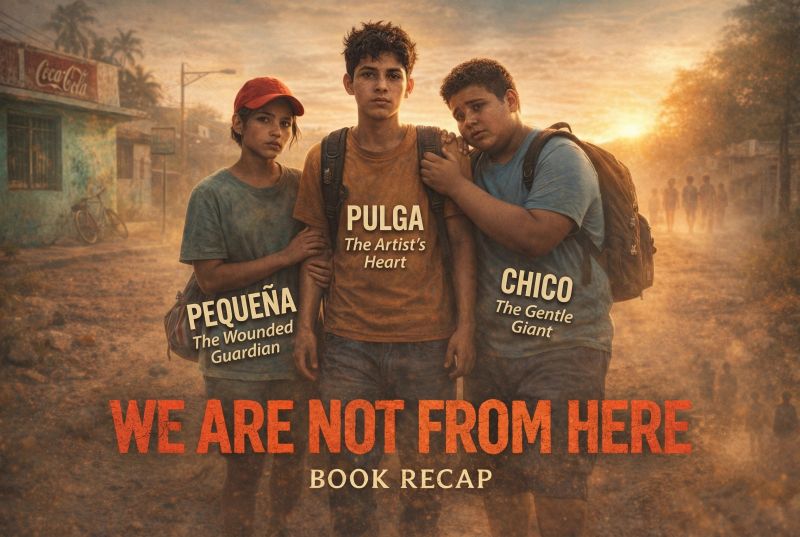
Pulga1 is fifteen, small and fast, raised in Puerto Barrios by his mother Consuelo5 after his Chicano musician father died in a California car crash before learning she was pregnant. His best friend Chico3 — big, gentle, orphaned after his mother was gunned down at the market — lives with them like a brother.
Upstairs at his aunt's house, Pulga's1 seventeen-year-old cousin Pequeña2 gives birth to a boy she refuses to hold, name, or look at. She dissociates into visions of water and a spectral figure she calls La Bruja — a witch-angel from a childhood near-drowning.
Her mother and Consuelo5 celebrate, but Pequeña2 lies silent, consumed by a secret she cannot speak. She once told Pulga1 they were small people meant for small lives. Now something smaller has arrived, and it terrifies her.
The Shopkeeper's Last Breath
Pulga1 and Chico3 walk to the neighborhood store owned by Don Felicio,7 a kind old man whose son Gallo12 left for the United States a decade ago and can never return. While they stock shelves in the back room for free sodas, they hear a commotion — a car, a shout cut short, then silence. Pulga1 finds Don Felicio7 on the floor, hands clasped around his slashed throat, blood pooling faster than life can hold.
He kneels in it, whispers lies about Gallo12 coming home soon, about his grandson. The old man's eyes fix on Pulga,1 then go vacant. They flee covered in blood, burn their clothes that night. When Consuelo5 comes home and tells them Don Felicio7 is dead, they pretend to know nothing. The killer's car belonged to Rey,4 the local gang boss.
Rey Owns All Three
At night, a hand reaches through Pequeña's2 window — Rey,4 the gang leader deported from a US prison, whose overlapping teeth and vacant eyes she knows too well. He calls the baby his son, forces kisses on her, announces they will be a family.
Pequeña2 knows his tenderness is a leash; she remembers the night he climbed through that window while her mother slept, pressed a gun against her, and raped her. Meanwhile, Rey's4 younger brother Nestor11 kidnaps Pulga1 and Chico3 at gunpoint, drives them to a warehouse.
Rey4 reveals he knows they were at Don Felicio's7 store. He orders Chico3 to beat Pulga1 as proof of loyalty. Pulga1 taunts Chico's3 deepest insecurities until fists fly. Rey,4 satisfied, recruits them as soldiers. Days later they're running drugs on motor scooters with guns in their waistbands.
The Dead Say Run
Don Felicio's7 widow, Doña Agostina8 — a former midwife with a reputation for prophetic visions — pulls Pulga1 aside at the funeral. She dreamed of Pequeña2 floating away on a bloody mattress, of Pulga1 and Chico3 running terrified. Her husband's ghost managed one word: run.
Separately, Pequeña2 slips into a vision where Don Felicio's7 spirit walks her through the barrio to his own coffin. His ghost begins choking on blood, pointing at Pulga1 and Chico3 — who mirror his wounds, blood gushing from their necks. One word escapes: corre.
Pequeña2 tells the boys they cannot stay. Pulga1 has been ready longer than he admits — maps under his mattress, routes printed from school computers, money stolen from his mother's hiding place, bus tickets bought on runs for Rey.4 He whispers to Chico3 in the dark: they have to go.
Three Shadows Before Dawn
That night, Pulga1 says goodnight to his mother5 — wanting to say everything, managing only buenas noches. He leaves a letter on the couch. He and Chico3 climb through the bedroom window with backpacks holding a photo of his parents, his dead father's cassette tape, a Walkman, stolen money, and bread.
At the station, Pequeña2 arrives unrecognizable: hair shorn under a cap, body padded with layers, walking like a stranger. She left the baby she could never hold with her mother,6 along with her earrings, her braid, and a goodbye note. They board the 3 AM bus to Guatemala City. As it pulls away, Pulga's1 heart cramps like a punched fist. He can outrun danger, it tells him. He cannot outrun this pain.
A Cemetery for a Bed
After six-hour buses through Guatemala City and Tecún Umán, they cross the Suchiate River on a wooden raft into Mexico. Night falls before they find transport. A farmer aims a shotgun at them but points toward a cemetery where migrants sleep.
Chico,3 terrified of the dead, clutches Pequeña2 behind a concrete tomb as insects feast on their skin. By morning they reach Tapachula's Belen shelter, where a priest welcomes them. A worker named Marlena interviews them — and when Pequeña2 admits she is fleeing the same man as the boys, the truth pierces Pulga1 like white lightning: Rey4 is the baby's father.
Pequeña2 won't meet his eyes. They eat warm food, shower for the first time, and prepare for the next leg — white minivans racing between military checkpoints through the Mexican night.
La Bestia Lets Them On
In Arriaga, they watch the freight train — La Bestia — hiss to life in the Ferromex yard. When it moves, hundreds sprint alongside. Pulga1 grabs a metal rung and climbs. Chico3 reaches, misses, reaches again. Pequeña2 falls back to run beside him rather than board alone.
His third lunge connects and he hauls himself up. Pequeña2 is last, the wheels gnawing at her ankles, until she seizes a bar and muscles herself to the rooftop. Atop scorching steel, gripping grates with aching fingers, they howl alongside everyone else — a hundred migrants raising arms against hot wind.
Pulga1 puts on his Walkman and plays his dead father's cassette for the first time on the journey — a mixtape laced with the voice of a man who promised love and a future that never arrived. The tape becomes fuel. The train roars north.
Gunfire Empties the Train
Cars race alongside the train at night, headlights slicing darkness. Armed men. The brakes scream. Pulga,1 Pequeña,2 and Chico3 jump from the roof into blackness, rolling through gravel into tall grass. Men with guns hunt the field, calling in singsong voices.
A family nearby — father, mother, a girl with red-ribboned braids — is found and dragged away. Pequeña,2 floating above herself in a vision, watches until something inexplicable drives the attackers off.
Hours later, a couple from the train10 — a protective man with a gun and his Salvadoran girlfriend — helps them reboard. But Chico3 hit his head badly in the jump and can barely walk. They hoist him onto a boxcar and deliver their verdict: the boy has a concussion. He cannot go on like this, or it will kill him.
Soledad Shaves Their Heads
The couple10 refuses to let them follow farther and directs them to a faded blue house near the Ixtepec tracks. Soledad,9 its sole keeper — a woman named for loneliness who has spent five years caring for the most desperate migrants — grabs Chico3 with surprising strength and carries him inside.
For seven days she nurses his concussion, cooks special meals, shaves their lice-ridden heads with electric shears, and sings softly while she works. She tells Pequeña2 her nickname will keep her small and asks her real one.
Flor, Pequeña2 answers, and Soledad's9 face lights up. Before they leave, Soledad9 cooks a feast from almost nothing — flautas, fideos, two salsas. When they part, she holds Pequeña's2 face like a mother would. They turn back toward the tracks. La Bestia waits, indifferent as always.
Chico Falls from the Train
Days blur across successive trains — tunnels, mountains, a storm that whips rain sideways. Pulga1 pushes relentlessly: one more train, one more leg. Chico's3 lips crack and bleed. His face turns leathery. At dawn, as La Bestia screeches and brakes, Chico's3 head bobs forward and his body follows.
Pulga1 reaches for his shirt and catches nothing. Chico3 disappears over the side. Pulga1 jumps off and runs back along the tracks until he finds him — leg mangled, flesh torn open, blood impossible in its volume. A priest and a woman arrive in a truck.
They try CPR, defibrillator paddles — once, twice, three times. Chico3 smiles at Pulga,1 whispers not to worry, says he sees something. Then his eyes fix on the sky and go still. Pulga's1 brother dies in his arms, wearing the blue American Eagle shirt he always called lucky.
A Coffin Far from Home
Men at the shelter build a coffin from scrap wood. Pulga1 sits beside Chico's3 wrapped body through candlelit hours, refusing to leave. He wants to carry Chico3 home to Barrios, bury him next to his mother. Pequeña2 grabs him by the shoulders: Chico3 would never want him to go back. They must continue for him. The priest leads a procession to a field of crosses — a cemetery for those who met their fate on this journey.
Pulga1 throws dirt into the grave, each shovelful a weight he will carry forever. Afterward he stops eating, stops speaking. He presses his fist against his own chest, trying to beat his heart into silence. He becomes what La Bestia makes of everyone — hollowed out, dust-coated, barely present. A mummy riding toward nothing.
Rey's Ring Buys the Desert
Weeks of trains leave Pulga1 ghostlike. In Altar, a border town with a holy name, a man's guard dog mauls Pulga's1 shoulder; a nun at a church stitches the wound with a fake gun nearby.
A priest drives them to a shelter run by a woman named Carlita,18 where they meet Alvaro,14 Nilsa,15 and their four-year-old son Nene16 — a Honduran family also beaten and robbed on their journey. Alvaro14 arranges a coyote for the desert crossing. The price: five thousand US dollars.
Pequeña2 pulls out the diamond ring Rey4 forced on her finger on a deserted beach, calling it her destiny. She places it in the coyote's palm. He studies the glint, pockets it, nods. The instrument of her captivity purchases their passage. Rey4 was right about one thing: this ring was always her future.
Abandoned Under Open Sky
Three nights of freezing desert walking, hiding in rock hollows by day. Pulga1 eats almost nothing, vomits what Pequeña2 forces into his mouth. On the third night, he shakes his head. No. He will not move. The coyote Gancho19 pronounces the verdict: the boy has given up, and carrying him will kill whoever tries. Pequeña2 begs the group.
One by one — Nilsa15 with Nene16 strapped to her back, Alvaro14 making the sign of the cross, the two brothers leaving their water — they apologize and disappear into darkness. Pequeña2 is alone with a boy who wants to die. She drags his dead weight across desert floor, stumbling, falling, screaming at him to walk. They collapse. She wakes at dawn in blazing sun, somehow near a highway she does not remember reaching.
The Border Splits Them
A white Border Patrol truck barrels toward them. An agent in green pats Pulga1 down, then Pequeña2 — and his hands stop on her chest. He squeezes, laughs, presses his weight against her while speaking English she cannot understand.
When Pulga1 collapses, the agent turns to pour water on him. Pequeña2 runs. She runs until her lungs burn, until the desert is featureless in every direction, until she crawls under a mesquite tree expecting to die. Night falls. She floats above her body, sees the spirits of women who perished in this desert walking an eternal loop.
La Bruja appears one final time, and the ghosts pour their strength into her. She wakes at dawn near a highway. She screams — a primal howl building since the day she was born. A car stops. Two women pull her inside.
Pulga's Heart Breaks Free
Pulga1 is thrown into a freezing concrete cell, wrapped in foil among silent boys. Days blur — frozen burritos, fluorescent light, no sense of time. He finds four-year-old Nene16 inside, separated from his parents after being tricked away with a promise of cookies.
Meanwhile, the women who saved Pequeña2 include Marta17 — who turns out to be Soledad's9 sister, an impossible grace woven across borders. Pequeña2 calls her mother6 for the first time since fleeing. The chain of tearful calls reaches Pulga's1 aunt in the United States, his father's sister, who arrives with a lawyer.
In the car driving away from the detention center, she holds the phone to his ear. Mamá's5 voice: she loves him, understands, is not angry. Everything suppressed erupts. Pulga1 screams — raw, shuddering, louder than La Bestia. His heart, the thing he beat against his own chest for weeks, shatters free of its armor. He is alive. He wants to live.
Analysis
The novel interrogates who deserves to dream. In Puerto Barrios, Pulga's mother5 says he has an artist's heart — a compliment that functions as a diagnosis, since sensitivity is a survival liability where he lives. The dual narration maps two responses to systemic violence: Pulga1 intellectualizes through notes, maps, and plans, while Pequeña2 dissociates through visions, La Bruja, and doorways into other realities. Neither strategy is sufficient alone. They survive only by combining Pulga's1 logistical grit with Pequeña's2 emotional endurance — and both fail when Chico,3 the emotional center, is lost. The novel organizes itself around the body's refusal to cooperate with despair. Pequeña's2 postpartum body bleeds through the journey, leaks milk, breaks teeth against rocks — yet carries her. Pulga1 beats his own chest trying to silence his heart, yet it keeps pumping. Chico's3 body, the largest and seemingly strongest, is the one that fails. This cruel irony destabilizes the myth that physical toughness determines survival; what ultimately delivers Pulga1 and Pequeña2 is psychological resilience and the accumulated mercy of strangers — shelter women, nuns with fake guns, sisters separated by borders.
The recurring motif of names maps how the world diminishes these children. Pulga1 means flea, Pequeña2 means small, Chico3 is a diminutive. Reclaiming identity — Pequeña2 becoming Flor, Pulga1 hearing his father's full name on the tape — becomes an act of resistance against systems designed to render them invisible. Even the shelters where they find help are named for loneliness and altars.
Most devastatingly, the novel insists that reaching the border is not salvation. Detention is not rescue. Pulga's1 primal scream in his aunt's car is not triumph — it is the sound of someone realizing they survived something that survival alone cannot heal. The book's deepest question is not whether they make it, but what remains of them if they do.
Review Summary
We Are Not From Here is a powerful, heart-wrenching novel about three Guatemalan teens fleeing violence and seeking safety in the United States. Readers praise the authentic, emotional portrayal of the characters' dangerous journey, which highlights the real-life struggles of immigrants. The book is lauded for its vivid writing, complex characters, and ability to humanize a timely issue. Many reviewers were deeply moved, describing it as eye-opening and impactful. While some found parts difficult to read due to the heavy content, most agree it's an important, unforgettable story that should be widely read.
People Also Read




Characters
Pulga
Dreamer who plans the escapeFifteen years old, small and fast, raised in Puerto Barrios by his mother Consuelo5 after his Chicano musician father died in a California car crash before knowing she was pregnant. His mother says he has an artist's heart—a sensitivity that makes him feel everything too deeply for a world that punishes softness. He dreams of becoming a musician like his father, carrying a cassette tape of the man's voice like a relic. Fiercely protective of Chico3 and Pequeña2, he projects toughness to compensate for his size, coaching Chico3 to curse harder and stand taller. His deepest conflict is between the dreamer who sees the world in color and the survivor who knows that seeing color here is a liability. He plans obsessively—maps, notes, routes—driven by a belief that intelligence can outrun fate.
Pequeña
Visionary survivor reclaiming herselfSeventeen, Pulga's1 cousin by love rather than blood, whose real name—Flor—lies buried under a nickname meaning little one. She carries a dissociative gift: the ability to slip into visionary states where a spectral figure called La Bruja guides her through imaginary doors into other realities. This capacity emerged in childhood when she nearly drowned and was saved by the apparition. Behind her stoicism lies a young woman whose body has been claimed against her will, whose motherhood was forced upon her, who reads danger the way animals sense earthquakes. She is pragmatic where Pulga1 is emotional, tough where Chico3 is tender. Her survival instinct runs deeper because she learned earlier that the world punishes girls who dare to look up—so she became someone who looks straight ahead.
Chico
Gentle giant with absolute trustAbout thirteen, big-bodied and soft-hearted, Chico broadcasts every vulnerability without meaning to—pulling at his too-small American Eagle shirt, flinching at sounds, crying openly when afraid. Orphaned after his mother was gunned down at the market, he moved in with Pulga's1 family and became a brother in every way that matters. He believes in reincarnation, hoping Pequeña's2 baby carries some piece of his mother back to him. His gentleness is both beautiful and dangerous: transparent fear makes him a target in a world that punishes weakness. Yet beneath the timidity lives surprising physical strength—he once dropped a bully with a single punch. He follows Pulga1 with absolute trust, a devotion that is simultaneously his anchor and his greatest vulnerability.
Rey
Gang predator who claims livesA gang leader deported from a US prison back to Guatemala, Rey operates with calculating patience rather than brute impulsiveness. His overlapping teeth, dead eyes, and sulfurous presence mark a predator who mistakes possession for love. He stalked and raped Pequeña2, fathered her child, and genuinely believes they share a romance. He recruits the boys as soldiers after discovering they witnessed Don Felicio's7 murder, seeing useful tools where others see children.
Consuelo
Pulga's fierce, loving motherPulga's1 mother, a waitress at a tourist resort who fell in love with a Chicano musician in California and returned pregnant after his death. She is fiercely loving but practical—dismissing visions as superstition, haggling for velvet couches, saving money for Pulga's1 future. Her deep fear of losing her son wars with her inability to see the danger tightening around him. To Pequeña2 she is Tía Consuelo, the woman who held everyone together with coffee and reassurance.
Tía Lucia
Pequeña's quietly resilient motherPequeña's2 mother, a hotel housekeeper and Consuelo's5 lifelong best friend. Abandoned by her husband, she raised Pequeña2 alone with stubborn dignity. She senses something terrible behind her daughter's pregnancy but cannot bring herself to ask the question that might unlock the truth—a protective silence that inadvertently leaves Pequeña2 isolated in her suffering.
Don Felicio
Kind shopkeeper who becomes catalystThe kindly neighborhood shopkeeper who sells the coldest Coca-Colas in Puerto Barrios and speaks constantly of his son Gallo12, who left for the United States a decade ago and cannot return. His store is a gathering place where men share migration stories and Pulga1 absorbs intelligence for his eventual escape. His murder is the event that forces everything into motion.
Doña Agostina
Midwife with prophetic visionsDon Felicio's7 wife, a former midwife with a reputation for seeing the future. She delivers Pequeña's2 baby and later shares a vision in which her husband's ghost commands the children to run. Her prophecies give supernatural urgency to the decision to flee, bridging the spiritual and practical imperatives for escape.
Soledad
Shelter-keeper named for lonelinessA Mexican woman who runs a tiny, nearly forgotten migrant shelter near the Ixtepec train tracks. Named for loneliness, she has spent five years caring for the most desperate travelers—those too broken to continue. She shaves lice-ridden heads, cooks feasts from scraps, and tells Pequeña2 to remember her real name. Her connection to a sister17 living across the border will unknowingly complete an extraordinary circle of grace.
The Couple from the Train
Reluctant guardian angelsAn unnamed man with a gun and his Salvadoran girlfriend, encountered atop La Bestia. He insists on protecting only himself and his girl; she insists on helping the three teenagers. After kidnappers attack the train, they carry the injured Chico3 back aboard. Later they refuse to let the trio follow them farther but direct them to Soledad's9 hidden shelter. Their push-pull between self-preservation and compassion mirrors the journey's central tension.
Nestor
Rey's eager younger enforcerRey's4 younger brother and a former schoolyard bully who grew into a gang enforcer. He kidnaps Pulga1 and Chico3 at gunpoint and trains them with weapons. His desperation to prove himself to Rey4 makes him unpredictably dangerous.
Gallo
The son who crossed and never returnedDon Felicio's7 son who left for the US a decade ago and can never come back. Pequeña's2 childhood crush who once gave her a ring pop and a promise. His successful crossing haunts his parents and proves to Pulga1 that the journey is survivable.
Leticia
Pharmacist who reads desperationA pharmacy worker in Puerto Barrios, once a dazzling beauty, now aged beyond her years after her boyfriend left for the States. She sells Pequeña2 birth control and a switchblade on credit, understanding the unspoken emergency without needing it named.
Alvaro
Faithful Honduran fatherA Honduran migrant traveling with his wife Nilsa15 and four-year-old son Nene16. Beaten and robbed on the journey, he remains sustained by relentless prayer. His generosity and connections at the final shelter offer unexpected hope to Pulga1 and Pequeña2.
Nilsa
Mother carrying her son forwardAlvaro's14 wife, who straps Nene16 to her back with a scarf and walks through the desert on bleeding feet. Her exhaustion and doubt are overridden by maternal determination.
Nene
Four-year-old asking innocent questionsAlvaro14 and Nilsa's15 small son, who asks his mother if they will die and whether his uncle in America will have candy. His innocent voice punctuates the journey's darkness with unbearable tenderness.
Marta
Soledad's sister across the borderAn American resident who finds Pequeña2 collapsed on a desert highway and takes her in. Her connection to Soledad9—revealed as her sister—is one of the novel's most astonishing coincidences, a thread of grace woven across the entire journey.
Carlita
Shelter-keeper with a feastA warm, faith-driven woman who runs a shelter near the border. She feeds the group a lavish final meal before their desert crossing, embodying the network of strangers whose quiet care sustains migrants between dangers.
Gancho
Desert coyote, all businessThe thin, missing-toothed coyote who guides the group through the Sonoran Desert. He warns plainly that those who cannot keep up will be left behind—and follows through without hesitation.
Plot Devices
La Bestia (The Death Train)
Central vehicle and crucibleThe freight train that carries migrants across Mexico, La Bestia is both salvation and executioner. Migrants ride atop boxcars for days, gripping metal grates against wind, sun, and rain, knowing that sleep or a moment's weakness means death under the wheels. The train turns people into mummies—dehydrated, dust-coated, soul-drained. It is where Pulga1 plays his father's tape, where they celebrate their most euphoric moment and suffer their worst loss. La Bestia functions as a crucible: whoever boards will be transformed, and many won't survive the transformation. It doesn't care about the dreams it carries. It simply moves, indifferent, consuming as many as it delivers.
Rey's Diamond Ring
Captivity converted to currencyRey4 forces this engagement ring onto Pequeña's2 finger on a deserted beach, declaring it her destiny—a diamond seal on his ownership of her body and future. Pequeña2 carries the ring hidden in her jacket through the entire journey: buses, rafts, trains, desert. In the novel's pivotal exchange, she places it in the coyote's19 palm to pay for the desert crossing to the US border. The ring's transformation from instrument of rape and possession into the literal price of freedom is the story's most concentrated irony. Rey4 was right that the ring was her destiny—just not in the way he imagined.
Pulga's Walkman and Cassette Tape
Dead father's voice as fuelPulga's1 mother gave him a Walkman and a cassette his father recorded years before dying—a mixtape for Consuelo5, laced with his voice promising love, a backyard wedding, a future. Pulga1 has memorized every word, every stumbled Spanish syllable from his father's Californian accent. He makes himself a rule: he will only listen once he reaches La Bestia. On the train, his father's voice fills his ears with a place he has never seen but feels in his blood. The tape fuels his dream of becoming a musician. Later, as grief dismantles him, those same words curdle into lies—promises from a man who never made it big, who died before fatherhood. The tape is simultaneously compass and wound.
La Bruja (The Witch-Angel)
Pequeña's dissociative guardianA spectral figure with silver hair and dazzling eyes who first appeared to Pequeña2 during a childhood near-drowning in Río Dulce. La Bruja shows Pequeña2 doors into other realities—visionary states that serve as psychological escape from unbearable trauma. Throughout the journey, these visions carry warnings and provide refuge: Don Felicio's7 ghost speaks through them, spiders drive off attackers in a moonlit field. The figure represents both Pequeña's2 dissociative response to violence and a supernatural lineage of feminine protection—the accumulated resilience of every woman who has survived before her, channeled through one shimmering apparition who appears when survival demands something beyond the physical.
Chico's Blue American Eagle Shirt
Irrational hope made wearableChico's3 favorite shirt—pale blue, too small for his round body, bearing an American Eagle logo he points to with defiant pride. He insists it brings good luck despite all evidence to the contrary, wearing it through the most dangerous moments of his life. The shirt becomes an emblem of Chico's3 refusal to stop believing even when the world offers no reason to. Its logo carries the destination's name on his chest—a country he yearns for printed directly over his heart. In a story where characters shed their identities layer by layer—cutting hair, changing names, leaving babies behind—Chico3 clings to this one piece of who he is.
FAQ
Synopsis & Basic Details
What is We Are Not From Here about?
- A perilous journey for survival: The novel follows three teenagers, Pulga, Chico, and Pequeña, who are forced to flee their home in Guatemala after witnessing a brutal murder by a local gang leader. Facing imminent danger, they embark on a treacherous journey north through Mexico towards the United United States border.
- Escape from violence and trauma: The story details their desperate flight aboard La Bestia, the infamous freight train, and their trek through the harsh desert, highlighting the constant threats of violence, exploitation, hunger, and the psychological toll of their experiences.
- The search for safety and a new future: More than just a physical journey, the narrative explores the emotional and psychological landscapes of the characters as they grapple with loss, fear, and the fragile hope of finding refuge and the chance to build a life free from the dangers they left behind.
Why should I read We Are Not From Here?
- Powerful and empathetic storytelling: The novel offers a deeply humanizing portrayal of the migrant experience, using dual perspectives to immerse readers in the emotional realities of young people fleeing unimaginable circumstances. It fosters empathy and understanding for those often reduced to statistics.
- Exploration of complex themes: It delves into profound themes such as the meaning of family (chosen vs. blood), the devastating impact of trauma, the resilience of the human spirit, and the harsh realities faced by those seeking asylum, prompting reflection on global issues.
- Literary depth and emotional impact: Jenny Torres Sanchez employs vivid imagery, subtle symbolism, and raw emotional honesty to create a narrative that is both gripping and heartbreaking. The story stays with you, challenging perspectives and highlighting the universal desire for safety and dignity.
What is the background of We Are Not From Here?
- Inspired by real-world migration crisis: The book is directly inspired by the surge of unaccompanied children and families fleeing violence in Central America and making the dangerous journey north, particularly aboard La Bestia. The author's note explicitly connects the fictional story to the real suffering of migrant children.
- Context of gang violence and lack of opportunity: The narrative is set against the backdrop of pervasive gang violence, corruption, and extreme poverty in the characters' home country, illustrating the dire conditions that make fleeing a matter of survival rather than choice.
- Focus on the journey through Mexico: The story highlights the specific dangers faced by migrants traveling through Mexico, including exploitation by cartels, corrupt officials, and the physical perils of riding the train and crossing the desert, drawing on extensive research into these routes.
What are the most memorable quotes in We Are Not From Here?
- "You plan your escape. But you're never really ready to go.": This quote from the Prologue encapsulates the constant state of fear and anticipation in Barrios, where escape is always a thought, yet the reality of leaving is terrifying and sudden, highlighting the complex relationship with a dangerous home.
- "We are small people... With small names, meant to live small lives... But sometimes even that, even that it won't give us. Instead the world wants to crush us.": Pequeña's words reveal the pervasive sense of powerlessness and predetermined fate felt by the characters, underscoring the systemic forces that seek to keep them marginalized and the inherent danger of simply existing in their world.
- "We are not from here.": This recurring phrase, the title of the book, embodies the characters' displacement and alienation, first in their own dangerous homeland, then as they travel through foreign lands, and finally even upon reaching the border, emphasizing their perpetual state of being outsiders.
What writing style, narrative choices, and literary techniques does Jenny Torres Sanchez use?
- Alternating First-Person Perspectives: The novel primarily uses the distinct voices of Pulga and Pequeña, offering intimate access to their thoughts, fears, and coping mechanisms, deepening reader empathy and highlighting their individual experiences of shared trauma.
- Sensory and Visceral Language: Sanchez employs vivid, often raw, descriptions of sights, sounds, smells, and physical sensations (hunger, cold, pain, fear), immersing the reader directly into the harsh realities and emotional intensity of the journey.
- Integration of Magical Realism and Symbolism: Elements of magical realism, particularly through Pequeña's visions and the symbolic weight of objects and places (La Bestia, the desert, the ring), blur the lines between reality and the characters' psychological states, reflecting the surreal nature of their trauma and resilience.
Hidden Details & Subtle Connections
What are some minor details that add significant meaning?
- The recurring image of blood: Beyond the initial murder, blood appears repeatedly – seeping into concrete, staining clothes, gushing from wounds, and even in Pequeña's visions. This motif underscores the pervasive violence they are fleeing and the physical and psychological marks it leaves, connecting individual traumas to the broader theme of a land saturated with death.
- The significance of names: The characters' nicknames – Pulga (Flea) and Pequeña (Small) – are explicitly linked by Pequeña to their perceived insignificance in the world ("small people... with small names"). Her later adoption of "Flor" (Flower) symbolizes her deliberate act of renaming and reclaiming her identity, contrasting the world's attempt to diminish them with her assertion of worth and potential for beauty despite hardship.
- The specific details of Don Felicio's death: Pulga's vivid, almost clinical, description of Don Felicio's gurgling, bulging eyes, and the way his blood pools "like water" is not just gruesome; it's a deeply traumatic sensory memory that haunts Pulga, manifesting in nightmares and contributing to his emotional numbness later, showing how specific violent images become internalized scars.
What are some subtle foreshadowing and callbacks?
- Pequeña's fall from the bus: Her "accidental" fall, which reveals her pregnancy, subtly foreshadows the later, fatal fall from the train. Both incidents involve a loss of control and a descent, linking her initial trauma and denial to the ultimate tragedy that befalls Chico, suggesting a pattern of vulnerability and the unpredictable dangers of transit.
- The whistling sound: The soft whistling heard outside Pulga's window the night after Don Felicio's murder, later revealed to be one of Rey's men (Toro), is a chilling callback. It signifies that Rey was watching them from the beginning, confirming their paranoia and highlighting the inescapable reach of the gang, even before they were directly confronted.
- Don Felicio's dream/vision: Doña Agostina recounts Don Felicio's dying vision of Pulga and Chico running and Pequeña riding away on a "bloody mattress." This prophetic vision, dismissed by Pulga, foreshadows their flight, Chico's death (linked to blood), and Pequeña's dissociation/escape through her mind ("riding away"), adding a layer of tragic inevitability to their fate.
What are some unexpected character connections?
- Soledad and Marta's sisterhood: The revelation that Soledad, the kind shelter worker in Ixtepec, and Marta, the woman who rescues Pequeña in the desert, are sisters is a powerful, subtle connection. It links two crucial moments of unexpected human kindness and aid on the journey, suggesting a network of compassion exists despite the surrounding brutality and reinforcing the theme of chosen family and solidarity among those affected by migration.
- Pulga's connection to Nene: Pulga's encounter with Nene in the detention center, a young boy separated from his family, is unexpected and deeply affecting. Nene's vulnerability and longing for his mother mirror the children's own earlier fears and losses, forcing Pulga, despite his emotional numbness, to confront the ongoing suffering and the innocence lost in the migration system.
- Pequeña's connection to the woman on the train: Pequeña feels a profound, almost spiritual, connection to the mother on the train whose family is later kidnapped. Their shared gaze and the mother's silent plea for help resonate deeply with Pequeña's own trauma and powerlessness, highlighting the shared vulnerability and unspoken bonds formed among migrants facing similar threats.
Who are the most significant supporting characters?
- Doña Agostina: More than just a midwife, she is a figure of traditional wisdom and unsettling foresight. Her visions, particularly the one about Pulga, Chico, and Pequeña running, serve as crucial foreshadowing and introduce the element of fate or unavoidable destiny that hangs over the protagonists.
- Soledad: The shelter worker provides a vital, albeit temporary, haven for the children. Her compassion, practical help (shaving heads, providing food/rest), and personal story of loss (her niece's death) embody the selfless aid found along the migrant trail and offer a stark contrast to the surrounding dangers.
- Alvaro and Nilsa: This family unit traveling with Pulga and Pequeña in the desert serves as both companions and tragic mirrors. Their struggles, Alvaro's death, and Nilsa's separation from Nene underscore the universal risks of the journey and highlight the devastating impact on families, reinforcing the high stakes for Pulga and Pequeña.
Psychological, Emotional, & Relational Analysis
What are some unspoken motivations of the characters?
- Pulga's need for control: Beneath his desire to protect Chico and Pequeña lies a deep-seated need for control in a chaotic world. His meticulous planning of the escape route, his insistence on following his notes, and his struggle to accept help or deviation reflect an attempt to impose order on unpredictable danger, stemming from his trauma and fear of powerlessness.
- Pequeña's desire for erasure: Pequeña's initial denial of her pregnancy and later dissociation are driven by a profound desire to erase the trauma inflicted by Rey and the child that embodies it. Her cutting of her hair and adopting the name Flor are physical manifestations of this psychological need to shed the past and become someone entirely new, free from violation.
- Chico's search for belonging and purpose: Orphaned and vulnerable, Chico's loyalty to Pulga and his eagerness to help (even timidly) stem from a deep need for belonging and validation. His belief in reincarnation and his attachment to Pequeña's baby reveal a longing to reconnect with lost family and find meaning in a world that has taken so much from him.
What psychological complexities do the characters exhibit?
- Dissociation and Magical Thinking: Pequeña frequently dissociates from traumatic reality, retreating into vivid internal worlds filled with water, spiders, and her "bruja" angel. This magical thinking is a complex coping mechanism, allowing her to survive unbearable experiences by mentally escaping, but also blurring her perception of reality and hindering her ability to process trauma directly.
- Emotional Numbness and Hypervigilance: Pulga oscillates between intense emotional sensitivity (his "artist's heart") and a forced numbness. The constant threat of danger leads to hypervigilance, making him constantly scan for threats, while the accumulation of trauma, particularly Chico's death, results in periods of profound emotional shutdown and a struggle to feel anything at all.
- Survivor's Guilt and Self-Blame: Both Pulga and Pequeña grapple with immense guilt, especially after Chico's death. Pulga blames himself for pushing Chico to continue and for not protecting him, while Pequeña feels guilt over her initial rejection of her baby and her inability to save others. This self-blame is a heavy psychological burden, complicating their ability to heal and move forward.
What are the major emotional turning points?
- Pequeña's forced breastfeeding: The moment Pequeña is compelled to breastfeed her baby is a significant emotional turning point. Despite her deep-seated aversion, the physical act triggers a complex mix of resentment and a nascent, unwanted connection, forcing her to confront the reality of the child's existence and her biological link to Rey, deepening her internal conflict.
- Pulga's fight with Chico in the warehouse: Pulga deliberately provokes Chico into fighting him to prove their usefulness to Rey. This act of calculated cruelty, born of desperation, is a major emotional turning point for Pulga, forcing him to betray Chico's trust and use his vulnerabilities, leaving him with profound guilt and a sense of having sacrificed a part of himself and their bond for survival.
- Pulga's scream in the detention center: After days of emotional numbness and dissociation in the cold detention center, Pulga's sudden, explosive scream is a cathartic emotional turning point. Triggered by hearing his mother's voice and the realization of all he has endured and lost, the scream signifies the shattering of his emotional defenses and the reawakening of his capacity to feel, marking the beginning of his potential for healing.
How do relationship dynamics evolve?
- Pulga and Chico's brotherhood under pressure: Their bond, forged in a schoolyard fight, deepens into a fierce, protective brotherhood. Pulga takes on a leadership role, while Chico relies on him. However, the extreme stress and Pulga's desperate actions (forcing the fight, pushing Chico to continue) strain their relationship, culminating tragically in Chico's death, which leaves Pulga consumed by guilt and grief.
- Pulga and Pequeña's evolving reliance: Initially, Pulga feels protective of Pequeña, especially after her trauma. As the journey progresses, their roles shift; Pequeña's resilience and determination become a source of strength for the faltering Pulga, particularly after Chico's death. Their shared trauma and mutual support forge a deeper, albeit somber, bond as they become each other's sole remaining anchor.
- The transient nature of connections with other migrants: The children form brief, intense connections with other migrants (the couple on the train, Soledad, Alvaro and Nilsa). These relationships offer temporary solidarity and aid, highlighting the shared struggle, but are ultimately fleeting due to the journey's dangers and separations, emphasizing the isolation and the necessity of relying primarily on their core group.
Interpretation & Debate
Which parts of the story remain ambiguous or open-ended?
- The nature of Pequeña's visions: It is left ambiguous whether Pequeña's visions (La Bruja, the water, the spiders, the ghosts in the desert) are literal magical realism, manifestations of trauma-induced dissociation, or a blend of both. This ambiguity allows for interpretation regarding the power of the mind to cope with horror and the potential for spiritual or psychological escape.
- The long-term fates of the characters: While the ending suggests Pulga and Pequeña (now Flor) have survived and are beginning processes of healing and seeking asylum, their ultimate futures in the United States remain uncertain. The legal battles, the lasting impact of their trauma, and the challenges of building new lives are left open-ended, reflecting the ongoing struggles faced by real migrants.
- The fate of Nene and other separated children: The story leaves the fate of Nene and the other children in detention uncertain. Their presence highlights a tragic reality of the migration system, but the narrative does not provide closure for their individual stories, emphasizing the countless unknown outcomes and the systemic nature of family separation.
What are some debatable, controversial scenes or moments in We Are Not From Here?
- Pequeña's inability to love her baby: Pequeña's profound rejection and inability to bond with her baby, a result of Rey's rape, can be a difficult or controversial aspect for some readers. Her internal struggle and moments of wishing the child away challenge traditional expectations of motherhood, forcing a confrontation with the brutal realities of trauma and its impact on emotional capacity.
- The decision to leave their mothers: The children's choice to leave their mothers without a direct, tearful goodbye (leaving only a letter) is a heartbreaking and potentially debatable decision. While presented as necessary for survival, it highlights the immense sacrifice and emotional cost of their journey, forcing readers to consider the impossible choices faced by families in crisis.
- The portrayal of the Border Patrol agent: The scene where the Border Patrol agent touches Pequeña inappropriately is brief but highly controversial and impactful. It depicts a moment of vulnerability and potential re-traumatization at the very point they hoped to find safety, sparking debate about the treatment of migrants, particularly women and girls, by authorities.
We Are Not From Here Ending Explained: How It Ends & What It Means
- Separation at the border: The journey culminates at the U.S. border where Pulga collapses and is apprehended by Border Patrol, while Pequeña, after a disturbing encounter with an agent, runs and is later rescued by a kind stranger, Marta. This separation underscores that reaching the border is not an end to hardship but often another phase of uncertainty and danger.
- Beginning of healing and reclaiming identity: Pequeña, now calling herself Flor, begins a process of physical and emotional recovery with Marta's help. She finally contacts her mother, initiating a painful but necessary step towards reconnecting with her past while asserting her new identity. Pulga is released from detention to his aunt, signifying a path towards legal process and potential safety, though deeply scarred by his experiences.
- Survival as a fragile, ongoing process: The ending emphasizes that survival is not a triumphant arrival but a complex, ongoing struggle marked by profound loss (Chico's death, separation from family/home) and lasting trauma. Pulga's final scream is a powerful symbol of his shattered heart but also a reawakening of feeling and a desperate assertion of being alive, suggesting that while broken, hope and the will to live persist, leaving their futures uncertain but open to the possibility of healing and finding a place where they are from.
Download PDF
Download EPUB
.epub digital book format is ideal for reading ebooks on phones, tablets, and e-readers.








































