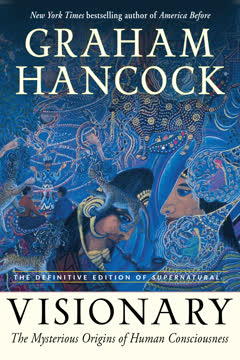
Key Takeaways
1. Psychedelics unlock ancient, universal patterns of consciousness.
Our normal waking consciousness, rational consciousness as we call it, is but one special type of consciousness, whilst all about it, parted from it by the filmiest of screens, there lie potential forms of consciousness very different.
Altered states reveal hidden realities. The author's personal journeys with ibogaine and ayahuasca demonstrated that psychoactive plants can reliably induce profound altered states of consciousness (ASCs), revealing vivid, often terrifying, hallucinations. These experiences felt convincingly real, suggesting a "secret doorway in our minds" to parallel realms. This aligns with the "reducing valve" theory, where the brain filters out most reality, and hallucinogens temporarily bypass this filter.
Universal visionary patterns. Regardless of cultural background, individuals in ASCs frequently report seeing specific abstract geometrical patterns, known as entoptic phenomena. These "form constants" are hard-wired into the human nervous system, suggesting a universal neurological capacity. The author's visions included intricate geometric tapestries, swirling colors, and ladder-like structures, mirroring patterns seen across diverse shamanic traditions and modern laboratory experiments.
Beyond mere illusion. The consistent and complex nature of these visions, often involving intelligent entities and detailed narratives, challenges the conventional scientific view that they are simply "brain fiction." The author posits that these experiences might be veridical glimpses into dimensions normally inaccessible, rather than mere subjective concoctions of a "drug-fried brain."
2. Prehistoric art reveals a shared, shamanic "otherworld."
The images are of hieratic profundity, full of religious force, and thus can clearly be classified as Sacred Art, the first in the history of humanity.
Art as a window to ancient minds. The magnificent cave art of Upper Paleolithic Europe (e.g., Pech Merle, Chauvet, Lascaux) and the rock art of Southern African San hunter-gatherers, dating back tens of thousands of years, share striking, inexplicable commonalities. These include:
- Depictions of therianthropes (half-human, half-animal beings).
- Chimeras (hybrid animals blending multiple species).
- Monsters (bizarre, distorted creatures).
- Geometric patterns intertwined with iconic figures.
- The rock face treated as a permeable membrane.
- Multiple superimpositions and floating figures.
Lewis-Williams' breakthrough. David Lewis-Williams' "neuropsychological theory" proposes that this art was inspired by visions experienced by shamans in ASCs. He argues that the geometric patterns are entoptic phenomena, and the iconic figures (animals, therianthropes) are full-blown hallucinations, often projected onto the cave walls. This model provides a coherent explanation for features that baffled previous generations of archaeologists.
Shamanic origins of art. The theory suggests that early humans, experiencing these powerful visions, sought to "fix" or memorialize them on enduring surfaces. The dynamic interaction with the rock face, where natural contours were incorporated into the art, further supports the idea that the visions seemed to emerge from "behind" the rock, perceived as a veil to the spirit world. This implies art's birth was deeply intertwined with spiritual exploration.
3. The "Wounded Man" archetype signifies a universal initiatory ordeal.
The “Wounded Men” may, I argue, represent a form of shamanistic suffering, “death” and initiation that was closely associated with somatic hallucinations.
A recurring, enigmatic figure. Across Upper Paleolithic European cave art and Southern African rock art, the "wounded man" appears as a non-naturalistic human or therianthropic figure pierced by multiple spears or arrows. This image, often floating and distorted, defies literal interpretation as a hunting scene or battle injury.
Somatic hallucinations as inspiration. Lewis-Williams links these depictions to "somatic hallucinations" experienced in deep trance states, where individuals feel painful pricking, stabbing, or dismemberment sensations. These are neurologically generated but culturally interpreted.
- Jivaro shamans perceive them as darts from spirits.
- Siberian shamans describe being cut, dismembered, and having bones torn out.
- Ju/'hoansi shamans speak of "arrows of sickness" or "arrows of potency."
Initiation, death, and rebirth. Beyond mere pain, the "wounded man" symbolizes a universal shamanic initiatory ordeal involving ritual suffering, symbolic death, and subsequent rebirth as an empowered healer. This process, documented across diverse cultures, equips the shaman with supernatural powers. The Lascaux bird-man, pierced and ithyphallic, is a prime example of this transformative suffering.
4. Spirits, fairies, and aliens are evolving manifestations of a single phenomenon.
The modern, global belief in flying saucers and their occupants is identical to the earlier belief in the fairy faith.
Cross-cultural consistency. A deep, structural matrix of similarities connects shamanic "spirits," European "fairies," and modern "aliens." Despite vastly different cultural contexts and historical periods, these entities share core characteristics:
- Shape-shifting abilities (animal, therianthropic, humanoid).
- Small stature, often with large heads and eyes.
- Ability to appear/disappear and pass through solid objects.
- Association with aerial vehicles or floating.
- Abduction of humans to other realms (sky, underground, underwater).
Historical continuity. Jacques Vallee's "Passport to Magonia" first highlighted the striking parallels between fairy lore and UFO phenomena, noting that "flying saucers" were seen long before the 20th century. The author extends this to shamanic traditions, arguing that the "Secret Commonwealth" of fairies, the spirit world of shamans, and the alien realms of abductees are all culturally-specific construals of the same underlying phenomenon.
Evolving manifestations. The phenomenon appears to adapt its presentation to the prevailing cultural mindset. Medieval "fairy coaches" become modern "UFOs," and "elf-shot" becomes "alien rays." This evolution suggests an independent, intelligent agency that interacts with humanity, rather than being a mere product of human imagination.
5. A core drive for supernatural encounters is reproductive hybridization.
What they want, more than anything else, is to mate with us and create hybrids.
Universal reproductive theme. A surprising and consistent theme across shamanic, fairy, and alien encounters is the imperative for sexual and reproductive contact with humans, leading to hybrid offspring. This is not a random detail but a central, recurring narrative.
- Siberian shamans marry "celestial wives" and father spirit children.
- Amazonian shamans have sex with "bee girls" or dolphin spirits, producing hybrid offspring.
- Fairies abduct humans for sex and require human wetnurses for their "fairy babes" (changelings).
- Aliens repeatedly impregnate human females, take sperm samples from males, and present hybrid babies for nurturing.
The mystery of changelings. Traditional descriptions of changelings—ugly, sickly, large-headed, old-looking infants—bear striking resemblance to modern abductees' descriptions of human-alien hybrids. This suggests changelings were not "pure-bred" fairies but failed hybrids, perhaps rejected by the supernatural entities.
"Strengthening the race." The consistent motivation attributed to these entities, whether spirits, fairies, or aliens, is to "strengthen their race" or "inject fresh blood and human vigor" into their dwindling stock. This implies a desire to acquire more physical permanence or power by mingling their non-physical essence with human materiality.
6. DNA as a cosmic serpent: a repository of ancient, alien intelligence.
DNA is a master of transformation, just like mythical serpents.
The "Cosmic Serpent" hypothesis. Jeremy Narby, inspired by ayahuasca visions, proposes that DNA is an "ancient, high biotechnology" developed elsewhere than on Earth, containing intelligent messages. This "source code" is accessible to human consciousness in altered states, manifesting as "plant teachers" or "clever entities."
DNA's mysterious language. Scientists have discovered that the vast majority (90-97%) of human DNA is "non-coding" or "junk DNA," whose function remains unknown. However, linguistic tests (like Zipf's Law) reveal that these non-coding regions exhibit the statistical properties of a structured language, unlike the coding regions. This suggests a hidden message within our genetic material.
Hallucinogens and genetic insight. The author's DMT visions, and those of Rick Strassman's volunteers, frequently included imagery of DNA, serpents coiled in double helices, and scrolling scripts. Francis Crick, co-discoverer of DNA's structure, reportedly used LSD (a tryptamine, like DMT) when he "perceived the double helix shape." This raises the possibility that hallucinogens can "retune" the brain to access information encoded within our own DNA.
7. The brain as a receiver, tuning into hidden dimensions of reality.
The brain, the seat of the receiver, becomes biochemically altered. The receiver is then tuned into another wavelength than that corresponding to normal, everyday reality.
Beyond reductionism. Prominent thinkers like William James, Aldous Huxley, and Albert Hoffman, along with Rick Strassman, challenge the materialist view of the brain as merely a generator of consciousness. They propose the "receiver model," where the brain acts as a filter or "reducing valve," normally tuned to a limited spectrum of reality.
DMT as a "channel changer." Strassman's research with DMT suggests it doesn't just alter perception but "switches our attention to a new channel altogether." This implies that "other planes of existence are always there... transmitting all the time," but our normal "hard-wiring" keeps us tuned to "Channel Normal."
Consistent, verifiable experiences. The remarkable consistency of experiences reported by DMT users, shamans, fairy abductees, and UFO abductees—despite diverse backgrounds—lends credence to the idea that they are perceiving something objectively real, rather than purely subjective fabrications. The brain, when retuned, accesses a shared, extra-human realm.
8. All major religions stem from shamanic, often hallucinogen-inspired, experiences.
All our knowledge of the supernatural derives de facto from the statements made by religious visionaries and ecstatics, i.e. prophets and shamans.
Shamanism as the root of faith. The author argues that all major religions, from ancient Egypt and Maya to Christianity, Judaism, and Hinduism, originated from the direct supernatural encounters and revelations of their founders—who were, in essence, shamans. These experiences, often induced by psychoactive plants, formed the bedrock of religious belief.
Hallucinogens in ancient cults. Evidence suggests hallucinogens played a vital role in ancient religious practices:
- Eleusinian Mysteries (Greece): Pilgrims drank a "kykeon" potion, likely containing ergot alkaloids (related to LSD), to induce visions of rebirth and overcome the fear of death.
- Soma (India): The Vedic deity Soma, a plant and a beverage, is strongly identified with the hallucinogenic fly agaric mushroom, known for its potent effects and unique property of remaining psychoactive in urine.
- Ancient Maya/Aztecs (Central America): Used water lilies, psilocybin mushrooms ("flesh of the gods"), and ololiuqui (Morning Glory seeds) to commune with deities and gain knowledge.
- Ancient Egypt: Blue water lilies, mandrake, and opium were used to induce shamanic trances, influencing their elaborate afterlife cosmology and therianthropic deities.
Bureaucratization and loss of direct experience. Modern religions, however, have largely abandoned or even outlawed these direct methods of spiritual exploration, replacing them with dogma and a priestly class who administer beliefs rather than experience them. This disconnect, the author suggests, leads to a spiritual void.
9. The "supernatural" is a real, extra-human realm, not mere delusion.
The bottom line would be that non-human, apparently non-physical intelligences, whose first interactions with us are documented in rock paintings of therianthropes dating back 35,000 years, and who inspired all the world's religious traditions, are still present amongst us today, following their own agenda according to their own timetable and purposes.
Beyond scientific dismissal. The consistent, complex, and evolving nature of "non-real" experiences across cultures and millennia—from ancient spirits to modern aliens—cannot be adequately explained by scientific materialism. Dismissing them as "mere hallucinations" fails to address why so many disparate individuals hallucinate the same specific things.
Evidence for an external reality. The author argues that the shared patterns, the sense of independent intelligence, and the physical traces (like scars or implants reported by abductees, or radar echoes of UFOs) suggest these phenomena are not solely internal. The evolution of the "hybrid program" and the changing "technology" of interdimensional travel (fairy dance to UFOs) further point to an external, adaptive intelligence.
A challenge to the paradigm. Accepting the possibility of an "extra-human realm" inhabited by non-physical intelligences challenges the fundamental tenets of Western science. These entities, perhaps existing in parallel dimensions, may be capable of observing and interacting with us, influencing human evolution and culture in profound ways.
10. Our evolutionary leap was catalyzed by exploring altered states of consciousness.
It may well have been shamanic explorations of hallucinatory realms during the Upper Paleolithic that played the catalytic role in extracting our ancestors from the five-million-year torpor of the hominid line, galvanized their intuition and creativity, helped them to build a stable and nurturing, non-violent society that lasted for 25,000 years—in itself a staggering accomplishment—and set them on a dramatically new course of evolution.
The "critical mass" of consciousness. The sudden emergence of complex symbolic behavior, art, and religion around 40,000 years ago, after millions of years of relative stasis, suggests a profound shift in human consciousness. This "behavioral revolution" may have been triggered by the widespread adoption of techniques to induce ASCs, democratizing access to visionary experiences previously limited to a few spontaneous trancers.
Adaptive advantage of the "unreal." While conventional evolution struggles to explain the adaptive benefit of hallucinating "non-real" things, the shamanic perspective offers a compelling alternative. If ASCs provide access to genuine knowledge, healing powers, and guidance from intelligent entities (whether spirits or DNA-encoded teachers), then this would confer immense survival advantages, fostering creativity, social cohesion, and innovation.
The ongoing quest. The author concludes that the "ancient teachers of mankind" may have been within us all along, accessible through altered states. Our future evolution may depend on our willingness to overcome scientific dogma and explore these profound, often unsettling, dimensions of consciousness, recognizing the potential reality of the "supernatural" and its enduring influence on the human story.
Review Summary
Visionary receives an overall rating of 4.3/5, with readers praising Hancock's ambitious connections between prehistoric consciousness, shamanism, UFO phenomena, and psychedelics. Many reviewers found the book fascinating and thought-provoking, highlighting its meticulous research and compelling narrative. Common criticisms include excessive length, repetition, and occasional logical leaps. Standout themes include the "stoned ape" theory, links between ancient cave art and trance states, and parallels between shamanic visions and modern paranormal encounters. Most readers recommend it despite its density and scope.








































