
Key Takeaways
1. Knowledge is Actively Constructed Through Adaptation
Knowledge, he concluded, is an evolving relationship between the child and his environment.
Dynamic interaction. Jean Piaget firmly rejected the idea that knowledge is either innate or passively received from the environment. Instead, he proposed an interactionist view where individuals actively construct their understanding of the world. This construction is a continuous process of adapting to new experiences, much like biological organisms adapt to their surroundings for survival.
Dual processes. This adaptation involves two fundamental, continuous processes: assimilation and accommodation. Assimilation is the process of incorporating new experiences, sensations, or ideas into existing mental frameworks (schemes). Conversely, accommodation is the adjustment of these existing schemes to fit new information or environmental demands. For instance, a baby first assimilates a rattle by trying to suck it, then accommodates by learning it's a suckable but not swallowable object, thus modifying their "objects-that-go-in-the-mouth" scheme.
Seeking equilibrium. The interplay between assimilation and accommodation drives a dynamic, self-regulating process called equilibration. This process constantly seeks a "steady state" of balance between what the child understands and what they experience. When new information creates a "cognitive conflict" or disequilibrium, the child is spurred to reorganize their thoughts, leading to higher, more complex levels of understanding and a new state of equilibrium. This continuous search for satisfying answers fuels intellectual growth.
2. Cognitive Development Progresses Through Four Universal Stages
Each stage arises out of the one preceding it by a reorganization of what has gone before, so that it is qualitatively different from the preceding stage.
Ordered progression. Piaget's most famous contribution is his theory of cognitive stages, which describes broad, characteristic structures of thought that appear reliably in a fixed sequence for all children. While the chronological ages may vary across individuals and cultures, the order of these stages remains constant. This progression is like a spiral, where each new level encompasses and reintegrates the achievements of earlier levels in a more complex form.
Four major periods:
- Sensory-Motor Period (Birth to 2 years): Infants understand the world through direct sensory experiences and motor actions.
- Preoperational Period (2 to 7 years): Children begin to use symbols (language, images) but their thinking is still egocentric and pre-logical.
- Concrete Operations Period (7 to 11/12 years): Children develop logical thought about concrete objects and events, mastering concepts like conservation.
- Formal Operations Period (11/12 years to Adulthood): Adolescents gain the ability to think abstractly, hypothetically, and deductively.
Qualitative shifts. Each stage represents a qualitative leap in intellectual functioning, not just an increase in knowledge. A child in the concrete operational stage doesn't just know more than a preoperational child; they think in a fundamentally different, more organized, and flexible way. This understanding helps us appreciate why children perceive and interpret information in ways that often seem strange to adults.
3. Infants Build "Practical Intelligence" by Acting on the World
The baby in his first two years effects "a miniature Copernican revolution."
Egocentric beginnings. At birth, an infant is "locked in egocentrism," unaware of anything beyond their immediate consciousness. Their initial intelligence is "practical intelligence," expressed through reflexes and basic sensory-motor actions. Through repeated interactions, they gradually differentiate themselves from the external world, moving from a self-centered universe to an awareness of external reality.
Six sensory-motor stages:
- Stage 1 (0-1 month): Reflexes (sucking, grasping) become more efficient.
- Stage 2 (1-4 months): Primary circular reactions; accidental discoveries repeated (e.g., fist to mouth).
- Stage 3 (4-8 months): Secondary circular reactions; actions to make "interesting spectacles last" (e.g., kicking a doll to make it move).
- Stage 4 (8-12 months): Intentional behavior; pushing obstacles, beginning of object permanence (searching for partly hidden objects).
- Stage 5 (12-18 months): Tertiary circular reactions; "directed groping," systematic experimentation (e.g., dropping bread from different positions).
- Stage 6 (18-24 months): Invention of new means through mental deduction; "interiorized" action, full object permanence, deferred imitation, symbolic representation (e.g., mimicking matchbox opening).
Object permanence. A major achievement of this period is the construction of object permanence – the realization that objects and people continue to exist even when out of sight. This crucial understanding reduces the infant's egocentrism and forms the foundation for later symbolic thought and memory, as they can now mentally represent absent objects.
4. Young Children's Thought is Egocentric and Perceptually Driven
In other words, in the preoperational period the child with his needs and purposes is still the "raison d'etre" of the universe.
Self-centered worldview. The preoperational child (ages 2-7) remains largely egocentric on a mental level, assuming everyone thinks and feels as they do. This leads to a belief in "magic omnipotence," where their actions or thoughts can control natural forces. They struggle to take another person's perspective, both physically (e.g., describing a view from a different angle) and intellectually (e.g., understanding a parent's headache).
Pre-logical characteristics:
- Animism: Belief that inanimate objects are alive, conscious, and have purpose (e.g., the sun follows them, clouds move to bring rain).
- Artificialism: Tendency to believe natural phenomena were created by humans or God (e.g., men made the sun).
- Realism: Confusion between subjective and objective reality; dreams, words, and feelings are seen as having external, objective existence.
- Syncretic Reasoning: Assuming a causal relationship between objects or events that simply occur together (e.g., the road makes the bicycle go).
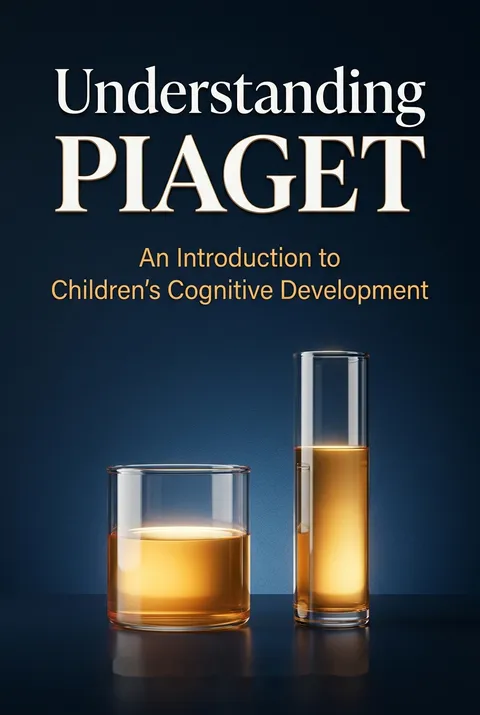
Perceptual dominance. Preoperational thought is "figurative," heavily influenced by immediate perceptual appearances rather than underlying logic. This is evident in conservation tasks, where children "center" on a single striking feature (e.g., the length of a clay sausage) and cannot mentally reverse transformations or consider multiple dimensions simultaneously. Their thinking is rigid, immobile, and lacks the stable, reversible character of true operational thought.
5. School-Aged Children Develop Logical, Concrete Operations
Such a child, says Piaget, has formed a total, coordinated, reversible structure of thought that is well organized and stably equilibrated.
Emergence of logic. Around age seven, children enter the period of concrete operations, marked by the ability to reason logically about concrete objects and events. They move beyond perceptual illusions and egocentric thinking, developing organized and reversible thought structures. This allows them to understand that certain attributes of an object remain constant despite changes in appearance, a concept known as conservation.
Key operational achievements:
- Conservation: Mastering the understanding that quantity, number, weight, and volume are conserved regardless of transformations in shape or arrangement. This is supported by arguments of:
- Reversibility: The ability to mentally reverse an action (e.g., rolling clay back into a ball).
- Compensation: Understanding that changes in one dimension are compensated by changes in another (e.g., a sausage is longer but thinner).
- Identity: Recognizing that the "stuff" remains the same.
- Classification: Organizing objects into hierarchical classes and subclasses (e.g., dogs and cats are animals).
- Seriation: Arranging objects in a logical series based on a property like size or weight (e.g., ordering sticks from shortest to longest).
"Movie film" thinking. Unlike the "slow projection of individual slides" in the preoperational period, concrete operational thought is faster, more flexible, and "runs like a movie film." Children can now coordinate multiple dimensions, remember past states, and anticipate future transformations, leading to a more stable and accurate understanding of their physical world.
6. Adolescents Master Abstract, Hypothetical-Deductive Thinking
By hypothetico-deductive thinking, Piaget means thinking based upon a hypothesis that leads to certain logical deductions.
Thinking about thinking. The period of formal operations, beginning around age eleven or twelve, marks the highest level of cognitive development. Adolescents gain the ability to "operate on operations," meaning they can think about abstract propositions, theories, and ideas, not just concrete objects. This allows for "second-order operations" – thinking about thoughts themselves.
Hallmarks of formal operations:
- Hypothetico-deductive reasoning: The ability to formulate hypotheses and systematically deduce logical consequences, even if those hypotheses are purely theoretical (e.g., "what would happen if no one ever died?").
- Combinatorial system: The capacity to consider all possible combinations of factors or relationships in a systematic way. This is crucial for designing multi-factor experiments and understanding complex systems (e.g., the liquid mixing experiment with four flasks).
- Propositional logic: Reasoning based on the form of an argument, independent of its content. This includes understanding logical structures like the INRC group (Identity, Negation, Reciprocal, Correlative transformations), which describes the flexibility of adolescent thought in problem-solving.
Beyond concrete reality. Formal operational thinkers are freed from the "bonds of physical reality" and can soar into the realm of hypothetical possibilities. They can analyze general laws, construct philosophical systems, and engage in "inferential thinking" to solve problems that have no direct physical exemplification. This advanced cognitive capacity is essential for scientific inquiry, complex problem-solving, and the development of abstract ideals.
7. Play and Imitation are Crucial for Symbolic Representation
Insofar as it goes beyond the necessity for adaptation, such play is seen to be "the function of assimilation."
Roots of symbolism. Mental images, symbolic play, and deferred imitation emerge around the middle of the second year, marking the transition from sensory-motor activity to symbolic representation. These functions are deeply intertwined, with imitation primarily serving to accommodate to reality (copying observed actions) and play primarily serving to assimilate reality to the child's own needs and desires (distorting reality for personal satisfaction).
Stages of imitation:
- Early imitation (0-8 months): Reflexive vocal contagion, then phonic and motor imitation of visible actions.
- Later imitation (8-24 months): Imitating familiar but invisible actions, experimenting with variations, and finally, deferred imitation (imitating an observed event hours or days later, indicating a mental image).
Symbolic play's role:
- Practice games: Repetition of sensory-motor activities for pleasure or skill development.
- Symbolic games ("make-believe"): Peak between ages 2-4. Children use objects to represent absent ones (e.g., a stick as a gun), allowing them to express feelings, work out forbidden wishes (compensatory play), and assimilate observed customs. Imaginary companions often appear.
- Games with rules: Emerge later, are social, and persist into adulthood.
From fantasy to reality. Symbolic play gradually becomes more orderly and realistic as the child accommodates more to the external world. By age 7-8, it declines in favor of socialized games and intellectual pursuits, eventually transforming into daydreams or creative activities. This process highlights how play, initially a distortion of reality for the ego's satisfaction, ultimately contributes to a more adapted and intelligent understanding of the world.
8. Language Reflects Thought, It Doesn't Create It
Language, he insists, does not constitute the source of logical thinking but is, on the contrary, structured by thought.
Thought precedes language. Contrary to many linguists, Piaget argued that language development is structured by and dependent upon cognitive development, rather than being its source. He cited studies showing that deaf children acquire logical operations only slightly later than hearing children, while blind children with normal language but limited sensory-motor experience show significant delays in logical development. This suggests that underlying cognitive structures are primary.
Language as a mirror:
- Early words are often onomatopoetic, reflecting sensory-motor experiences.
- Early grammar (e.g., "I goed home") shows children applying logical rules before mastering irregular forms.
- Children's use of comparative terms (e.g., "longer but thinner") in conservation tasks often follows their operational understanding, rather than preceding it.
Egocentric vs. socialized speech. Piaget's early work categorized children's speech:
- Egocentric speech: The child talks primarily to themselves, not expecting a response, often unaware if others are listening. This includes repetition, monologue, and collective monologue (children talking side-by-side without interacting). It serves to accompany and reinforce individual activity.
- Socialized speech: The child attempts true communication, taking the listener's perspective into account. This includes adapted information, criticism, commands, and questions.
"Why?" questions. The frequent "Why?" questions of preoperational children (ages 3-4) reveal their egocentric, animistic, and precausal thinking. They often seek anthropomorphic or purpose-driven explanations, reflecting their current cognitive stage. Piaget emphasized that answers should be framed in terms of what children are ready to assimilate, stimulating further thought rather than rote acceptance.
9. Perception is Subordinate to Intelligence and Develops Gradually
Perception is not, therefore, the source of knowledge, because knowledge derives from the operative schemes of action as a whole.
Figurative vs. operative. Piaget distinguished between perception (the immediate, often inaccurate, first glance at a stimulus) and perceptual activity (the active process of exploring and correcting initial impressions). While perception is largely "figurative" (focused on static appearances), intelligence is "operative" (focused on dynamic transformations and actions). Perception, though vital, is structurally and functionally subordinate to intelligence.
Errors and corrections:
- Centration: The eye tends to fixate on the most compelling features of a stimulus, leading to distorted initial perceptions (e.g., overestimating the length of a line seen directly in the center of vision).
- Decentration: Through repeated "encounters" and shifting focus, the eye gradually explores all elements of a stimulus, correcting initial errors and leading to more accurate perception. This process is crucial for overcoming perceptual illusions.
Perceptual constancy. During the preoperational years, children develop perceptual constancy, learning that objects retain their size, shape, and color despite changing viewing conditions (e.g., a distant person still being "tall"). This sets the stage for conservation, but conservation itself is a higher-order cognitive achievement based on thought, not just perception.
Educational implications. Understanding systematic distortions in children's perception (e.g., the "error of the standard" where a frequently viewed object is overestimated) is vital for educators. If a child struggles with tasks like copying letters or discriminating sounds, it may indicate incomplete sensory-motor development. "Prescriptive teaching" involves providing targeted perceptual activities to build these foundational processes, ensuring a child has the "right kind of experience at the right time" to support cognitive growth.
10. Memory is Actively Structured by Intelligence, Not a Passive Copy
In other words, if memory is an integral part of the structure of intelligence, and if that structure progresses over time, then memory must also change and reintegrate at more advanced levels as development proceeds.
Memory and intelligence. Piaget challenged the traditional view of memory as a passive storage of information. He argued that memory is actively structured by intelligence, meaning what a child remembers is influenced by their current cognitive schemes. This implies that memory is not a static record but can actually improve over time as intellectual structures develop.
Evidence for memory improvement:
- Graded sticks experiment: Children were shown a series of graded sticks and asked to draw them immediately, then again after 6-8 months. A significant percentage of children showed improvement in their drawings over time, reflecting a more advanced understanding of seriation.
- Conflict between schemes: Experiments designed to create conflict between different cognitive schemes (e.g., number vs. length in matchstick configurations) showed that memory reproductions were distorted by the child's dominant assimilatory schemes. As children progressed developmentally, their memory drawings reflected a more coordinated and accurate understanding of the conflicting elements.
Operative dominance. These findings suggest that memory images are dominated by operative schemes. If a child's cognitive schemes evolve and become more sophisticated between the initial perception and the later recall, their memory will reflect this more advanced level of understanding. This contradicts the idea that memory traces simply fade or remain static.
Types of memory: Piaget classified memory into:
- Recognition: Identifying familiar objects or persons (present even in infants).
- Reconstruction: Intentional reproduction of an action (like imitation).
- Evocation: Recalling past events (most influenced by operative schemes).
This dynamic view of memory highlights its interdependence with intellectual development, emphasizing that understanding shapes what and how we remember.
11. Moral Development Shifts from Constraint to Cooperation
The factor essential to moral development is mutual respect and cooperation—"cooperation between children to begin with, and then between child and adult as the child approaches adolescence, and comes, secretly at least, to consider himself as the adult's equal."
Rules and games. Piaget studied moral development by observing children's attitudes towards rules in games like marbles. He identified a progression from an early stage of motor manipulation with no consciousness of rules, to an egocentric stage where rules are individual and flexible ("we've both won!").
Two moral stages:
- Morality of Constraint (Heteronomous Morality): Characteristic of younger children (under 10). Rules are seen as sacred, unchangeable laws handed down by powerful adults or divine figures. Punishment is based on "moral realism," judging the severity of a deed by the objective amount of damage done, regardless of intention (e.g., breaking 15 cups accidentally is worse than 1 cup deliberately). Lying is wrong because it leads to punishment.
- Morality of Cooperation (Autonomous Morality): Emerges around age 10. Rules are understood as flexible agreements made by players, changeable through mutual consent. Moral judgments shift to considering subjective intentions and circumstances. Lying is wrong because it violates mutual trust and understanding.
Immanent justice. Younger children often believe in "immanent justice," where misdeeds automatically lead to punishment from the natural order of things (e.g., a knife cutting a child who was forbidden to use it). This belief gradually fades as children observe that "wickedness may go unpunished and virtue remain unrewarded."
Role of mutual respect. Piaget argued that true moral development, leading to a sense of justice and fairness, arises not from adult authority and unilateral respect, but from mutual respect and cooperation among peers. This social interaction helps children move beyond their egocentrism to understand different perspectives and construct their own moral standards.
12. Education Must Foster Active Discovery, Not Passive Rote Learning
The principal goal of education is to create men who are capable of doing new things, not simply of repeating what other generations have done—men who are creative, inventive, and discoverers.
Critique of traditional schooling. Piaget, though not a "pedagogue," was a sharp critic of traditional education, which he saw as promoting "cognitive passivity" and rote memorization of meaningless facts. He argued that such methods stifle intelligence and creativity, failing to prepare students for a rapidly changing world where critical thinking and innovation are paramount.
The "active school" approach:
- Knowledge from action: Children learn by actively manipulating objects, experimenting, and discovering relationships for themselves, rather than passively receiving information.
- Teacher's role: Not a lecturer, but an observer, questioner, and facilitator who "provokes" cognitive conflict to stimulate new solutions and structures of thought.
- Student autonomy: Children should be free to explore, question, and have a voice in their learning, fostering intrinsic motivation and self-discipline.
- Integrated learning: Connecting different subjects within meaningful projects (e.g., cooking involving reading, math, science, and writing).
Research over dogma. Piaget lamented the lack of scientific research in education, advocating for experimental studies to determine effective teaching methods. He believed that teachers should be active researchers, constantly trying out new ideas and observing children's learning processes, rather than merely transmitting "ready-made knowledge."
Beyond examinations. He strongly advocated for the abolition of traditional examinations, viewing them as harmful "mental artifacts" that prioritize ephemeral recall over genuine understanding and the development of intellectual explorers. True education, for Piaget, cultivates minds that can be critical, verify information, and invent new solutions, empowering individuals to "understand is to discover, or reconstruct by rediscovery."
Download PDF
Download EPUB
.epub digital book format is ideal for reading ebooks on phones, tablets, and e-readers.








































