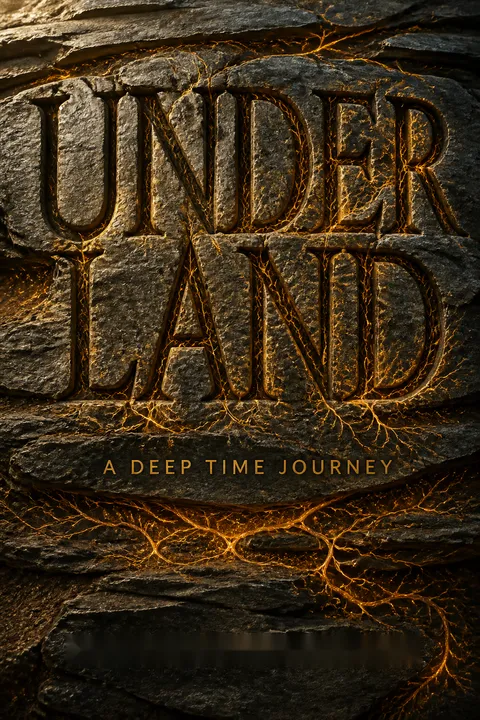

Key Takeaways
1. The Underland: A Hidden Realm of Profound Significance
Into the underland we have long placed that which we fear and wish to lose, and that which we love and wish to save.
Unseen worlds. The underland refers to the vast, mysterious spaces beneath the Earth's surface, a realm largely unknown and counter-intuitive to human perception. While we gaze at distant stars, our understanding of the ground beneath our feet often stops at the topsoil. This hidden world is a repository for secrets, from ancient fungal networks connecting forests to immense cave systems with their own weather.
Symbolic depths. Humans have consistently engaged with the underland for three fundamental purposes: to shelter what is precious, to yield what is valuable, and to dispose of what is harmful. This symbolic significance extends to our language, where "under" often connotes loss, grief, or the mind's obscured depths, and "understand" implies a descent to comprehend. Despite a cultural aversion to darkness and confinement, the underland is vital to our material existence, memories, myths, and metaphors.
A call to deeper seeing. The author argues that we must force ourselves to see more deeply, beyond our "flat perspectives," to understand the underland's pervasive influence. It is a terrain that daily shapes us, yet we are disinclined to acknowledge its presence or disturbing forms. The journey into the underland is often a quest for knowledge, revealing that darkness can be a medium of vision and descent a path to revelation.
2. Deep Time: A Radical Perspective for Understanding Our Present and Future
For to think in deep time can be a means not of escaping our troubled present, but rather of re-imagining it; countermanding its quick greeds and furies with older, slower stories of making and unmaking.
Vast chronologies. Deep time refers to the dizzying expanses of Earth's history, measured in epochs and aeons rather than human minutes and years. It is recorded in stone, ice, and tectonic shifts, extending billions of years into the past and future. This perspective can be dangerously comforting, leading to apathy about human actions, as our species' existence is but a blink in geological time.
Anthropocene surfacings. We are currently living in the Anthropocene, an epoch defined by human activity shaping the planet on a global scale. This era is marked by "surfacings" – things that should have stayed buried are rising up unbidden, revealing the long-term consequences of our actions. Examples include:
- Ancient methane leaks from melting permafrost.
- Anthrax spores released from reindeer corpses in thawing soil.
- Retreating glaciers revealing bodies and artifacts from decades past.
- Cold War military bases with toxic waste emerging from melting ice caps.
A call to action. Instead of fostering inertia, deep time should provoke radical action. It encourages us to see ourselves as part of a vast web of inheritance and legacy, spanning millions of years. This awareness compels us to consider what we are leaving behind for future epochs and beings, transforming inert matter into a vibrant, restless Earth with new responsibilities.
3. Burial: An Ancient Human Act of Memory, Preservation, and Disposal
To be human means above all to bury.
The burying species. Humans are fundamentally a burying species, a practice dating back at least 300,000 years, as evidenced by Homo naledi interring their dead underground. Burial is an act of returning the body to the earth, a means of safekeeping memory and matter, as time behaves differently in the underland, slowing or staying decay.
Limestone as cemetery. Limestone landscapes, formed from compressed marine organisms, are natural cemeteries. They offer numerous crypts for human remains and embody a cycle where mineral becomes animal becomes rock, nourishing future life. Ancient burial sites, like Aveline's Hole in the Mendips, reveal meticulous care in interring the dead with significant objects, demonstrating a desire for secure, returnable resting places.
Modern entombment. The story of Neil Moss, trapped and entombed in a cave shaft, illustrates a modern, tragic form of burial, where the fissure itself became his permanent grave to prevent further risk. This act, driven by a father's request, highlights the enduring human need to find a final resting place and the complex emotions surrounding the disposal of the dead.
4. Dark Matter: Seeking the Invisible in the Deepest Silence
To perceive matter that casts no shadow, you must search not for its presence but for its consequence.
The universe's hidden mass. Dark matter, a mysterious presence at the heart of the universe, constitutes about 27% of its mass but refuses to interact with light. Its existence is inferred from its gravitational effects on visible matter, such as the rotation speeds of galaxies and gravitational lensing. Proving its existence is a "grail-quest" of modern physics, promising a new understanding of light and darkness.
Underground observatories. To detect weakly interacting massive particles (WIMPs), the hypothesized constituents of dark matter, physicists must go deep underground. Subterranean laboratories, like Boulby Mine, shield experiments from "noise" – the constant barrage of everyday particles and cosmic rays. This allows them to listen for the faintest "breaths" or "scintillations" caused by a WIMP's rare collision with ordinary matter.
Ghost hunting. Experiments like DRIFT use sophisticated detectors, such as Time Projection Chambers, to track the scattering nuclei caused by WIMP collisions. This is akin to watching a billiards game where only the red balls are visible, inferring the path of the invisible white ball. The work is philosophical, requiring patience and faith, as scientists peer into the "absolute smallness of the universe" to give life meaning through exploration.
5. The Wood Wide Web: A Subterranean Network of Forest Intelligence
Instead of seeing trees as individual agents competing for resources, she proposed the forest as a 'co-operative system', in which trees 'talk' to one another, producing a collaborative intelligence she described as 'forest wisdom'.
Fungal connections. Ecologist Suzanne Simard's groundbreaking research revealed the "wood wide web," a vast subterranean network of mycorrhizal fungi connecting trees and plants. These fungi infiltrate root tips, creating an interface for molecular transmission. This network challenges the traditional view of forests as competitive environments, instead presenting them as cooperative systems.
Resource sharing and communication. Through this fungal network, trees can share vital resources like sugars, nitrogen, and phosphorus. A dying tree might divest its resources to benefit the community, or a struggling tree might receive support from its neighbors. The network also enables plants to send immune-signaling compounds, warning nearby plants of aphid attacks before they arrive.
Rethinking nature and self. This discovery prompts profound questions about species boundaries, whether a forest functions as a superorganism, and what "sharing" or "friendship" means in the more-than-human world. It suggests a "grammar of animacy," where nature is understood as an entangled, conversational assemblage, and humans are "holobionts" – collaborative compound organisms.
6. Invisible Cities: Layers of Human History and Concealment
Paris has another Paris under herself, which has its streets, its intersections, its squares, its dead ends, its arteries and its circulation.
Paris's hidden twin. Much of Paris was built from its own underland, with centuries of quarrying creating over 200 miles of subterranean galleries, rooms, and chambers. This "invisible city" was initially unregulated, leading to dangerous subsidence. Louis XVI established an inspection unit to map and manage these "quarry voids," creating a mirror-city beneath the surface.
Necropolis and refuge. In the late 18th century, these voids became the Catacombs, a vast ossuary for Paris's overflowing cemeteries, housing the remains of over 6 million people. Over time, the network served various purposes: mushroom farms, French Resistance hideouts, and Nazi bunkers. Today, it's explored by "cataphiles" – "lovers of the below" – who maintain an unofficial "university" dedicated to its preservation and mapping.
Vertical inequality. Cities are inherently vertical, extending upwards into skyscrapers and downwards into tunnels, basements, and infrastructure. This verticality often reflects social inequality, with wealth levitating and poverty sinking. The catacombs, for instance, were used to move political prisoners out of sight, becoming "dark sites" for extra-jurisdictional activities, highlighting the hidden histories of power and powerlessness.
7. Starless Rivers: Karst Landscapes and the Allure of Subterranean Water
The Timavo is a dream, a dream we are trying to bring into being metre by metre.
Water's hidden paths. Karst landscapes, formed by dissolving soluble rocks like limestone, are rich in underlands where water defies conventional flow. Rivers disappear into sinkholes, re-emerging elsewhere under new names, creating complex, often poorly understood hydrological systems. Classical myths of starless rivers like the Styx and Lethe reflect this geological reality, portraying the underworld as a watery domain.
The Timavo's mystery. The Reka-Timavo river in Italy/Slovenia plunges underground at Škocjan, flowing for 22 miles beneath the Carso plateau before resurfacing. Its exploration, spanning centuries, has been a dangerous, obsessive quest for "grottisti" (cavers). Early industrial attempts to map it for Trieste's water supply gave way to modern cave diving, pushing further into its "starless" depths, despite the risks of sudden floods and siphons.
Sacred and perilous depths. Karst landscapes are often "strong places," imbued with both sacred and violent histories. The Mithraeum, an underground Roman temple, exemplifies the devotional use of these spaces. Conversely, the "foibe" massacres during WWII saw sinkholes used for mass executions, intertwining geology with atrocity. The allure of these depths, whether for spiritual devotion or extreme exploration, reveals a profound human draw to the unknown.
8. Hollow Land: War, Memory, and the Contested Depths
History itself possesses its own burials and exhumations.
Mountains of war. The Julian Alps, a towering limestone range, became a "hollow mountain" during WWI, tunnelled out for shelter and combat. Soldiers burrowed into peaks, creating a war-machine of the landscape, where winter conditions often killed more men than bullets. This transformation of topography into a weaponized zone highlights how landscapes can be forcibly reorganized by conflict.
Foibe massacres. In WWII, the karst landscape of the Julian March was instrumentalized for mass murder. Sinkholes, or "foibe," became sites where victims were pushed alive or dead, predominantly by Communist partisans. These extrajudicial killings remain a deeply contested historical issue, with the landscape itself serving as a "memory-site" where past atrocities continue to wound the present, resisting closure.
Occluding landscapes. Landscapes like the Slovenian karst are "occulting," characterized by a complex interplay of light and dark, past pain and present beauty. While the natural beauty can be enchanting, it coexists with profound suffering, making it challenging to reconcile. This dissonance forces a re-evaluation of how we perceive and engage with places marked by violence, urging empathy and a recognition of the land's own enduring memory.
9. The Edge: Human Impact on the Ocean's Underland
To me the land does not stop when it dips into the ocean. It keeps on going and I know that land under the sea as well as I know this world above.
The undersea landscape. For coastal communities like those on Norway's Andøya island, the ocean's underland is as familiar and vital as the surface. Fishermen like Bjørnar Nicolaisen possess an intimate knowledge of the seabed's contours, which dictate rich fishing grounds. This deep connection highlights a worldview where land and sea are continuous, not separate.
Oil vs. cod. Norway's oil wealth, built over half a century, now faces dwindling reserves, leading to proposals for new drilling off the Lofoten and Vesterålen islands. This pits the nation's oil-lubricated economy against its ancient identity as a fishing nation and its self-perception as a green country. The debate is a battle for Norway's soul, with environmentalists and fishermen, like Bjørnar, fighting to protect fragile northern waters.
Seismic scars. Oil exploration involves seismic mapping, firing powerful sound pulses into the seabed to locate reserves. These blasts, though barely audible above water, send thunderclaps through the ocean, impacting marine life like fish and whales. Bjørnar's personal fight against seismic testing, despite its toll on his health, underscores the concept of "solastalgia" – the distress caused by environmental change in one's home landscape.
10. The Blue of Time: Ice as Memory, Vulnerability, and a Foreteller of Futures
Ice has a memory. It remembers in detail and it remembers for a million years or more.
The cryosphere's archive. Ice is a powerful recording medium, preserving atmospheric composition, temperature, and volcanic eruptions for millennia within trapped air bubbles. This "blue of time," glimpsed in crevasses and glacier faces, offers a legible archive of Earth's past climate. However, ice also suffers memory loss, as immense pressure distorts its layers and deep ice melts from geothermal heat.
Greenland's rapid melt. The Arctic cryosphere is melting at an unprecedented rate, with Greenland's ice cap losing mass at twice the rate of the previous century. This "unweather" has profound consequences:
- Sea ice thinning, making traditional hunting impossible for native Greenlanders.
- Mosquitoes and gnats arriving due to warming temperatures.
- Glaciers retreating and speeding up, contributing to sea-level rise.
- Cold War military bases and their toxic waste emerging from melting ice.
The moulin's draw. Moulins, vertical shafts bored into glaciers by meltwater, are increasingly common and act as portals to the ice's underland. They duct warm water to the glacier bed, accelerating its slide into the sea. The moulin's "blue blood-light" and its eerie song exert a powerful, almost hypnotic draw, embodying the sublime and terrifying beauty of ice in flux.
11. The Hiding Place: Our Deepest Grave and a Message to the Post-Human Future
Onkalo, which in Finnish means ‘cave’ or ‘hiding place’. What is to be hidden in Onkalo is high-level nuclear waste, perhaps the darkest matter we have ever made.
The ultimate tomb. Onkalo, a geological repository in Finland, is a tomb under construction, designed to secure high-level nuclear waste for 100,000 years – a timescale that dwarfs human history. This post-human architecture aims to prevent any future intrusion, relying on deep burial within 1.9-billion-year-old gneiss and granite, encased in layers of zirconium, iron, copper, and bentonite clay.
Nuclear semiotics. The challenge of communicating danger across such vast temporal chasms has led to the field of nuclear semiotics. Proposals for warning systems at sites like the Waste Isolation Pilot Plant (WIPP) include:
- "Hostile architecture" like "Landscape of Thorns" or "Forbidding Blocks."
- Transcendental signifiers like carved faces conveying horror or aeolian instruments playing sad tunes.
- An "atomic priesthood" to relay warnings through evolving myths and folklore.
These efforts highlight the difficulty of ensuring that future beings understand our warnings, as language itself has a "half-life."
A legacy of care. Despite the inherent dangers and the "thick speech" it induces, Onkalo represents a profound act of collective responsibility. It is a practical, if imperfect, attempt by a community to solve a vast problem, extending care far into a post-human future. The ancient Finnish epic, the Kalevala, with its warnings about buried power and the need for copper insulation, resonates uncannily with Onkalo's purpose, suggesting that some warnings from the underland have always been present, if unheeded.
Review Summary
Reviews of Underland are largely positive, averaging 4.22/5. Many readers praise Macfarlane's lyrical, poetic writing style and his ability to blend adventure, science, history, and nature writing into a compelling exploration of subterranean worlds. Frequent highlights include chapters on the Parisian catacombs, Greenland's glaciers, and the "wood wide web" of forest fungi. Critics, however, find the prose overly flowery and exhausting, the structure disjointed, and some chapters repetitive. The book's meditations on climate change, deep time, and humanity's legacy resonate strongly with most readers.
People Also Read
Download PDF
Download EPUB
.epub digital book format is ideal for reading ebooks on phones, tablets, and e-readers.








































