

Plot Summary
Prologue
Bella1 stands in a sun-filled room, staring into the dark eyes of a hunter7 who smiles at her with unhurried courtesy. She is about to die — she knows this with the certainty of stopped breath. But she's dying in place of someone she loves, and even now, terrified beyond any fear she's known, she cannot regret the chain of choices that led her here.
If she'd never gone to Forks, she'd be safe in Phoenix. But Forks gave her a dream beyond anything she'd imagined, and she refuses to grieve its end. The hunter7 saunters forward, pleasant and patient, to kill her.
Exile to the Rain
Seventeen-year-old Bella Swan1 boards a plane from Phoenix carrying a parka and a lie — that she wants to live with her father in Forks, Washington, the rainiest town in America. The truth: her mother Renée16 just married Phil, a minor-league baseball player who travels constantly, and Bella1 exiled herself so Renée16 could follow him without guilt.
In Forks, her father Charlie4 — the taciturn police chief — has already bought her a truck, a rusting red Chevy from Billy Black15 on the nearby Quileute reservation. Charlie4 can't cook. Bella1 can barely tolerate rain. She enrolls at a high school with 358 students where everyone already knows her name, and walks into her new life certain of exactly one thing: she will hate it here.
The Boy Who Recoils
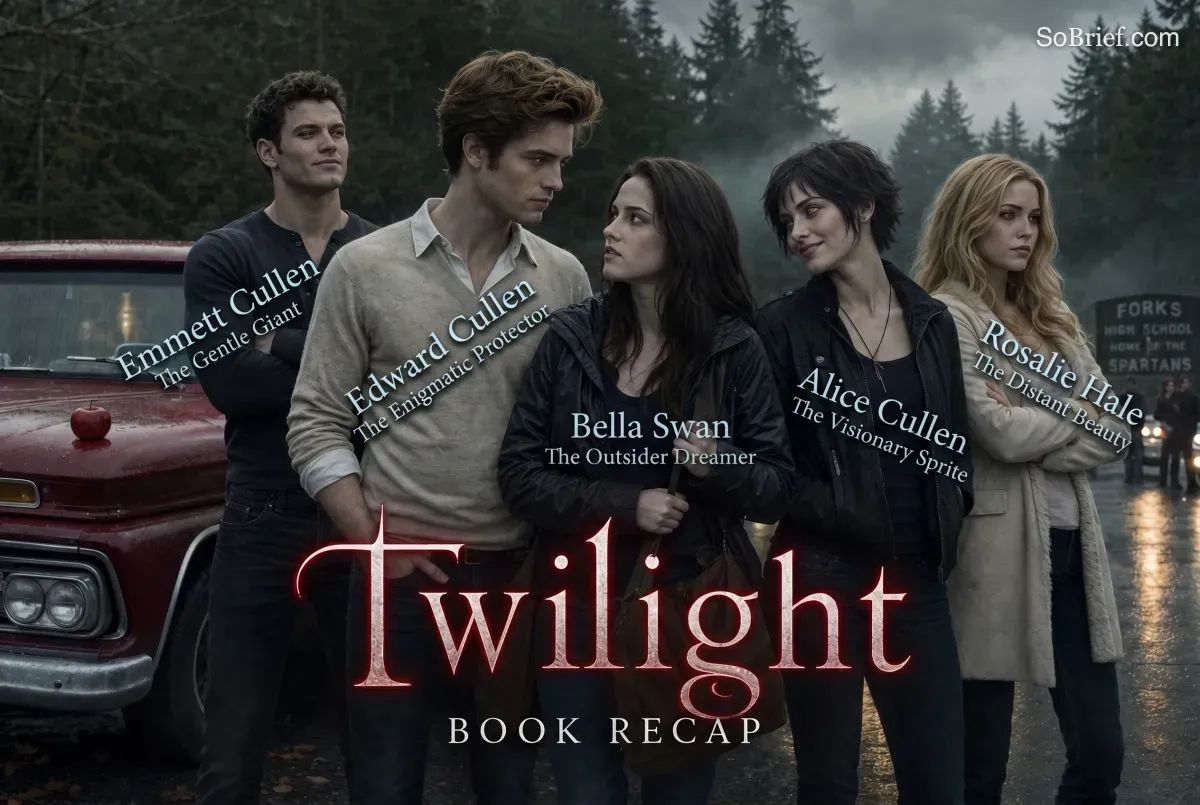
At lunch on her first day, Bella1 spots five students who move like they belong on a different plane of existence — chalky pale, bruise-shadowed under the eyes, inhumanly beautiful. Jessica Stanley12 identifies them: Edward2 and Emmett Cullen,11 Rosalie9 and Jasper Hale,8 and Alice Cullen,3 all adopted by the local doctor.5
In Biology, the only open seat places Bella1 beside Edward.2 The moment she sits, he goes rigid — leaning to the far edge of his chair, fist clenched white, coal-black eyes radiating revulsion.
He flees the instant class ends. Bella1 later overhears him in the office trying to transfer out of Biology. When the door opens and her scent reaches him again, he glares with undisguised hatred and leaves. He doesn't return to school for a week.
The Parking Lot Miracle
On an icy morning, Bella1 stands behind her truck when Tyler Crowley's van skids across the lot, tires locked and squealing. Edward2 was four cars away. Then he's beside her — his palm pressed flat against the spinning van, metal folding around his hand like foil. His other arm swings her legs clear a second before the van crunches into the spot where she stood.
At the hospital, Bella1 confronts him: she saw the dent his shoulders left in another car, saw his hands warp steel. Edward2 insists he was standing right next to her, deploying his golden eyes like a weapon of persuasion. She promises not to tell anyone. He refuses to explain. The mystery becomes a case she can't close, and his face begins visiting her dreams.
The Thaw and the Warning
After weeks of sitting one desk-width apart in rigid silence, Edward2 introduces himself as if they've never met. They ace a Biology lab together, finishing first, and he asks why she moved to Forks.
When Bella1 admits she exiled herself for her mother's16 happiness, he observes that she suffers more than she lets anyone see. She notices his eyes have shifted from coal-black to golden honey. Yet the connection stays unstable — he tells her it would be better if they weren't friends, then appears at her truck to tease her about a classmate's rejected prom invitation.
Three boys ask Bella1 to the spring dance; she turns each down. Edward2 offers to drive her to Seattle instead, warns her again to stay away from him, and admits he's tired of trying.
Scary Stories at La Push
On a group beach trip to the Quileute reservation, Bella1 sits on a driftwood log with Jacob Black6 — fifteen, tall, warm-smiled, and dangerously easy to talk to. She manufactures a clumsy flirtation to coax information from him, and it works.
Jacob6 drops his voice and tells her the old legends: the cold ones, pale-skinned blood drinkers who are the natural enemies of the wolf-spirit warriors in Quileute ancestry. His great-grandfather made a treaty with a specific clan of cold ones who claimed not to hunt humans — allowing them to live near Forks as long as they never set foot on Quileute land.
The extraordinary detail: the Cullens who attend Forks High School aren't merely similar to those treaty-era vampires. They are the same ones, unchanged across generations.
Already Too Deep
Bella1 spends a sleepless night, then a morning hunched over a dial-up connection, reading vampire myths from every continent. Almost nothing matches — except a single Italian legend about a vampire said to be on the side of goodness.
She walks into the forest behind Charlie's4 house and forces herself to confront two questions. First: could the Cullens be vampires? The speed, the strength, the color-shifting eyes, the cold skin, the never-eating — the answer has to be yes, or something equally impossible.
Second: what will she do about it? The choice arrives with startling ease. She's already too deeply pulled toward Edward2 to turn back. Even if the word vampire applies, she'd rather be near him than safe. The decision, once made, fills her with calm.
Headlights in the Dark
Bella1 gets lost in Port Angeles and four men herd her into a dead-end street. Edward's2 silver Volvo fishtails around the corner, passenger door flung open. He drives her away trembling with barely contained rage, confessing it took everything he had not to go back and kill those men.
Over dinner at an Italian restaurant, he reveals how he found her: he reads minds — everyone's except Bella's.1 He tracked her through Jessica's12 thoughts, then followed her scent. On the drive home, Bella1 says the word aloud: vampire.
Edward2 doesn't deny it. The myths are mostly wrong — he can't sleep at all, sunlight doesn't burn him, and his family survives on animal blood. But Bella's blood calls to him more powerfully than any human he's encountered in a century of existence.
The Meadow of Diamonds
Edward2 leads Bella1 through five miles of trackless forest to a hidden meadow drowning in wildflowers. He steps into direct sunlight, and his skin erupts in prismatic light — thousands of diamond-like facets embedded in marble. Sitting in the grass, he explains what she is to him: if most humans are stale beer to a recovering alcoholic, her blood is the rarest cognac.
He describes their first Biology class — how he imagined a hundred ways to lure her from the room, how he fled to Alaska for two days. They confess their love. He presses his cheek to her chest, listening to her heartbeat. She traces the contours of his impossible face. When their lips finally meet, her fierce response forces him to wrench away. His control holds. Barely.
The House in the Cedars
Edward2 was born in Chicago in 1901 and transformed by Carlisle5 during the 1918 influenza after his parents died. Carlisle5 himself was turned in 1640s London — then spent two centuries mastering his refusal to drink human blood before building a family who shared his philosophy.
At the Cullen home, a glass-walled mansion beneath ancient cedars, Bella1 meets them. Carlisle5 and Esme10 welcome her warmly. Alice3 — pixie-framed, exuberant, gifted with visions of possible futures — bounces forward to kiss Bella's1 cheek.
Jasper,8 the newest vegetarian in the family, keeps careful distance. Rosalie9 stays conspicuously cold. Edward2 plays piano for Bella,1 including a lullaby he composed for her. Quietly, he reveals that Alice3 has foreseen other vampires approaching the area — ones who don't share the Cullens' diet.
Thunder and the Tracker
The Cullens play baseball during a thunderstorm — they need the rolling boom to cover the crack of their superhuman swings. Bella1 watches as Emmett11 launches balls past the tree line and Edward2 sprints fast enough to catch them.
Then three figures emerge from the forest: Laurent,17 olive-skinned and diplomatic; Victoria,14 red-haired and feral; and James,7 nondescript and watchful, with burgundy eyes that mark a human-blood diet. When the wind shifts, James7 catches Bella's scent and drops into a predatory crouch.
Edward2 snarls, placing himself between them. Carlisle5 defuses the standoff, asserting Bella1 is with their family. But Edward2 has read James's mind: tracking is his consuming obsession, and protecting a single human has made this the most thrilling hunt of his existence.
The Cruelest Goodbye
The Cullens mobilize: Esme10 and Rosalie9 will drive Bella's1 truck as a decoy, Esme10 wearing Bella's1 clothes to draw the female tracker14 away from Charlie.4 Alice3 and Jasper8 will spirit Bella1 south in the Mercedes. Edward,2 Emmett,11 and Carlisle5 will pursue James.7
But first, Bella1 must stage a scene that keeps Charlie4 from calling the FBI. In his kitchen, she delivers the most devastating words she knows — echoing her mother's16 farewell years ago, telling him she hates Forks, can't stay another minute, refuses to end up trapped the way her mother16 did.
Charlie4 freezes in the doorway, shell-shocked. Bella1 runs to her truck sobbing, Edward2 hidden inside. She screams that she'll call tomorrow, but the tracker's shadow is already trailing them down the darkened highway.
Her Mother's Voice
In a Phoenix hotel, Alice3 sketches visions: a long room with mirrors and gold trim, James7 watching a VCR in darkness. Bella1 recognizes her childhood ballet studio near her mother's16 house. Edward2 calls from Vancouver — James7 eluded them and boarded a plane south.
Then Bella's1 phone rings. She hears her mother's16 panicked voice, then a man's calm tenor: James7 claims he has her mother.16 Come alone to the ballet studio, he instructs, or Renée16 dies.
Bella1 writes a farewell letter to Edward2 — she loves him, she's sorry, please don't follow — and seals it in an envelope on Alice's3 bag. At the Phoenix airport, waiting for Edward's2 incoming flight, she tells Jasper8 she needs the restroom, slips through a second exit, catches a shuttle, and disappears south in a cab.
Mirrors and Home Movies
Bella1 reaches the ballet studio and hears her mother's16 panicked voice calling her name. She sprints toward it — and finds a television playing a Thanksgiving home video from when she was twelve. Her mother16 was never captured; Renée16 is safe in Florida.
James7 found the recordings at her mother's16 house and weaponized them. He reveals one more thing: he once tracked a girl locked in an asylum who had visions, but another vampire turned her first, stealing his prey. That girl was Alice.3
James7 sets a video camera recording — a message for Edward2 — then attacks. He hurls Bella1 into the mirrored wall, snaps her leg, smashes her head against broken glass. Blood sheets across the wooden floor. He bites her hand, and venom begins burning through her veins like liquid fire.
Venom and the Choice
A snarl tears through the studio — deeper, wilder than anything Bella1 has ever heard. Edward2 rips James7 away from her. The sounds that follow — snapping, keening, abrupt silence — mean Emmett11 and Jasper8 have destroyed the tracker.
But the venom is still spreading through Bella's1 hand, and every second brings her closer to transformation. Carlisle5 presents Edward2 with an impossible choice: let the venom complete its work and Bella1 becomes a vampire, or try to suck it out — which means tasting the one blood in the world most likely to overwhelm his self-control.
Edward2 presses his lips to the wound. The fire in Bella's1 veins begins to recede, shrinking to a point, then vanishing. He drinks until her blood runs clean. And somehow — through love or will or both — he stops.
The Impasse at Twilight
Bella1 wakes in a Phoenix hospital with a broken leg, four cracked ribs, skull fractures, and a cover story about falling down hotel stairs. Renée16 arrives and invites Bella1 to Jacksonville — Phil got signed to a team in Florida. Bella1 refuses. She chooses Forks. When they're alone, Edward2 confesses he's considered disappearing from her life entirely, for her safety.
Bella1 panics and makes him swear to stay. Then she asks why he didn't let the venom finish — she could be like him now. He tells her he won't end her human life. She counters that she'll grow old and die regardless. He insists that's how things should be. They reach an impasse that neither can resolve: she wants eternity with him, and he won't grant it.
Epilogue
Edward2 takes Bella1 to prom in a blue silk dress and one stiletto — the other foot still encased in a walking cast. She's furious; she'd secretly hoped tonight meant transformation, not a high school dance. Jacob Black6 appears on the dance floor, sent by his father Billy15 with a warning: the Quileutes will be watching.
Outside, beneath moonlit trees, Bella1 admits what she really wanted — not prom but forever. Edward2 tells her he brought her so she wouldn't miss anything human. She replies that she's betting on Alice,3 whose visions have already shown her future as one of them. He presses his cold lips to her throat and murmurs that her love is enough. Enough for forever.
Analysis
Twilight operates as a sustained meditation on the erotics of restraint. Edward's2 century of self-denial isn't merely vampiric discipline — it's the architecture of a desire economy where withholding intensifies want. The novel's central innovation isn't the vampire-as-boyfriend premise but its inversion of predator-prey dynamics into a consent framework: Edward's2 constant choice not to consume Bella1 becomes the most potent expression of love the book can imagine. Control is the romance.
Bella's1 psychology rewards closer inspection than critics typically grant her. She arrives in Forks already performing a specific role — the parentified child who has managed her mother's16 finances, emotional life, and domestic stability since childhood. Her attraction to Edward2 isn't simply to his beauty; it's to someone she cannot manage, cannot protect, cannot sacrifice herself for in her usual ways. Edward2 disrupts her deepest coping mechanism. Her willingness to walk into the ballet studio isn't passivity — it's the logical extension of a selflessness so ingrained she doesn't recognize it as pathological.
The novel's treatment of immortality operates on multiple registers. For Edward,2 eternity is accumulated weight — guilt, frozen adolescence, decades of emotional isolation. For Bella,1 it represents escape from the ordinary decay she observes in Charlie's4 kitchen: yellowed curtains, unchanged cabinets, photographs marking time she can't stop. Their argument about transformation isn't really about death; it's about who defines the relationship's terms and whether love requires equality or tolerates permanent asymmetry.
Meyer's most underappreciated structural choice is the first-person narration that locks the reader's information to Bella's1 timeline. We discover Edward's2 nature on her schedule, feel her rationalizations as they form, and cannot step outside her certainty that love outweighs evidence of danger. The novel doesn't ask whether Bella1 is making a good decision. It makes you feel exactly why she can't make any other.
Review Summary
Twilight has polarized readers since its release. Many criticize its writing style, character development, and problematic themes, particularly regarding gender roles and relationships. Others praise its addictive storytelling and romantic elements. The vampire mythology and sparkly Edward Cullen have become cultural touchstones. While some view it as harmful for young readers, others defend it as harmless entertainment. The series' immense popularity and impact on YA literature are undeniable, despite its controversial reception.
People Also Read
Characters
Bella Swan
Self-exiled narratorSeventeen and self-exiled from Phoenix, Bella operates as the parentified child of a loving but erratic mother16, having spent years managing Renée's16 bills, meals, and emotional needs. This instinct — sacrificing comfort for someone else's happiness — defines her far more than the clumsiness she self-deprecates about. She's fiercely perceptive where Edward2 is concerned, cataloguing details others miss: eye-color shifts, impossible speed, cold skin. Her mind is the one place Edward cannot reach, which frustrates him and empowers her. She's drawn not simply to Edward's2 beauty but to his otherness — he's the first person she cannot manage, predict, or save through self-erasure. Her courage appears passive but runs startlingly deep; she makes irreversible choices with an unsettling calm that looks like recklessness from the outside.
Edward Cullen
The restrained predatorBorn in 1901, frozen at seventeen, Edward has spent over a century cultivating restraint — abstaining from human blood, reading minds he'd rather not hear, performing normalcy through endless high school enrollments. His telepathy isolates him: knowing everyone's thoughts makes genuine surprise, genuine connection, impossible. Bella1 disrupts this entirely. Her silent mind baffles him; her blood torments him with a specificity he's never encountered. He oscillates between protective devotion and self-loathing, convinced his existence endangers her. Beneath the controlled exterior lives a young man who never got to grow up, experiencing jealousy, desire, and vulnerability for the first time at an age when he's supposedly mastered everything. His love manifests primarily as restraint — each moment of closeness is a victory over his own nature.
Alice Cullen
Visionary sisterPixie-framed with close-cropped dark hair, Alice sees the future in shifting, subjective visions — possible outcomes that change when decisions change. She remembers nothing of her human life and embraces each new experience with infectious enthusiasm. Among the Cullens, she most openly welcomes Bella1, treating her as family before anyone else dares. Her optimism and warmth mask a mysterious and disturbing origin she herself doesn't fully understand.
Charlie Swan
The quiet fatherForks' police chief, a man of few words and deep feeling. Charlie never recovered from Renée16 leaving, still living in their original house, her yellow-painted cabinets preserved like relics. He expresses love through small acts — snow chains installed before dawn, a truck bought without being asked. He occupies the awkward space between protectiveness and emotional reticence, never quite sure how to parent a daughter he's rarely seen but loves without reservation.
Carlisle Cullen
The compassionate patriarchOver three centuries old yet impossibly youthful, Carlisle is the patriarch who chose compassion over predatory nature. The son of an intolerant Anglican pastor, he was turned against his will and spent two hundred years learning to resist human blood. He became a doctor to atone, finding peace in saving lives. His family represents his life's work: proof that vampires can choose their own morality and build something that resembles love.
Jacob Black
The unwitting informantFifteen, lanky, warm-smiled, and disarmingly easy to talk to, Jacob is Billy Black's15 youngest son from the Quileute reservation. He lives in the shadow of tribal legends he doesn't yet take seriously, treating the old stories about cold ones and werewolves as entertaining campfire material. His openness makes him both a natural friend to Bella1 and an inadvertent source of the most dangerous information she receives.
James
The obsessive trackerNondescript in appearance — average build, cropped light brown hair, forgettable features — James is the most dangerous kind of predator: the one who looks unremarkable. Tracking is not a skill for him but an identity, a consuming obsession that defines his existence. He hunts for the challenge rather than the kill, and the more difficult the prey is to reach, the more euphoric the pursuit. He is patient, methodical, and brilliantly resourceful.
Jasper Hale
The struggling empathTall, leonine, and perpetually measured, Jasper is the newest member of the Cullen family's vegetarian lifestyle and the one who struggles most with abstinence. His gift — manipulating the emotions of those around him — makes him invaluable in tense situations but cannot resolve his own internal battle. His careful distance from Bella1 reveals the constant effort his restraint requires.
Rosalie Hale
The resentful beautyBreathtakingly beautiful and openly hostile to Bella's1 presence, Rosalie resists the intrusion not from cruelty but from a specific grief: she wishes she were human. Among the Cullens, she struggles most with what they are, and Bella1 — fragile, mortal, carelessly risking what Rosalie would give anything to reclaim — represents an insult she cannot articulate without revealing her deepest wound.
Esme Cullen
The fierce motherCarlisle's5 wife, warm and fiercely maternal, Esme treats every Cullen as her own child. She welcomes Bella1 with immediate affection, grateful beyond measure that Edward2 has finally found someone who makes the loneliness leave his eyes.
Emmett Cullen
The jovial strongmanMassive, good-humored, and untroubled by Bella's1 humanity, Emmett finds genuine entertainment in her clumsiness and relishes any situation that promises a physical challenge.
Jessica Stanley
The gossipy social bridgeBella's1 first friend at Forks High, chatty and curious, Jessica functions as Bella's1 social translator and Edward's2 inadvertent informant — he reads her thoughts to monitor Bella1 secondhand.
Mike Newton
The persistent admirerFriendly and doggedly devoted, Mike appoints himself Bella's1 companion at school, interpreting her politeness as encouragement and Edward's2 presence as a temporary obstacle.
Victoria
The feral accompliceRed-haired and feline, Victoria moves with restless, predatory grace and functions as James's7 intelligence gatherer, scouting Bella's1 background while he orchestrates the hunt.
Billy Black
The worried elderJacob's6 wheelchair-bound father, a Quileute elder who recognizes what the Cullens are and fears for Bella1. His warnings go unheeded by nearly everyone around him.
Renée
The childlike motherBella's1 mother — youthful, erratic, and fundamentally dependent on her daughter's maturity. Her remarriage catalyzes Bella's1 move to Forks and the story's existence.
Laurent
The pragmatic nomadThe most diplomatic of the three nomad vampires, Laurent quickly recognizes the danger of opposing the Cullens and chooses self-preservation, departing for a vegetarian coven in Alaska.
Plot Devices
Edward's Mind-Reading and Bella's Immunity
Creates asymmetric intimacyEdward2 hears the thoughts of every person within miles — a constant hum he can focus to individual frequencies. This gift makes him an extraordinary protector and lie detector. Yet Bella's1 mind is completely silent to him, the single exception in over a century. This immunity draws him to her — she's the one person he must actually observe, ask, and guess about. The device drives their courtship: he cannot cheat his way to understanding her, which makes every conversation genuinely unpredictable. It also serves critical plot functions — he tracks Bella1 through Jessica's12 thoughts in Port Angeles, reads James's7 hunting intentions at the baseball game, and monitors threats throughout the story. Bella's1 silence remains unexplained, deepening the mystery of why she affects him so differently.
Alice's Subjective Visions
Flexible foreshadowing engineAlice3 sees possible futures that shift whenever someone changes a decision — snapshots of outcomes, not certainties. This flexibility creates suspense even when a seer is present: she can be wrong, her visions can arrive too late, and new decisions can alter what she's already seen. The device provides narrative tension across multiple scales — she foresees the thunderstorm for baseball, anticipates the nomad vampires' approach, and later sketches a mirrored room she can't locate until Bella1 recognizes it. The subjective quality also drives a recurring undercurrent: Alice3 appears to have seen something about Bella's1 future that she hasn't fully disclosed, a vision that haunts the margins of the story and becomes its parting wager.
Bella's Blood
Personalizes the central dangerEdward2 describes Bella's1 scent through an addiction metaphor: if ordinary humans are stale beer to a recovering alcoholic, her blood is the rarest cognac — a once-in-a-century specificity that makes proximity not merely emotionally charged but physically perilous. This device transforms vampire mythology from an abstract threat into moment-by-moment tension. Every touch, every breath near her throat, every car ride together filters through the knowledge that his self-control is the only barrier between intimacy and catastrophe. It personalizes the danger in a way no external villain could — the greatest threat to Bella's1 life sits beside her in Biology, holds her hand, and fights a war she cannot see with every inhalation.
The Quileute Treaty and Legends
Bridges myth to revelationThe treaty between the Quileutes and the Cullens — struck generations ago by Jacob's6 great-grandfather — establishes coexistence rules: the Cullens stay off tribal land, and the Quileutes don't expose them. Jacob6 relays these legends as campfire entertainment, not believing them, but Bella1 absorbs every syllable. The legends function as the narrative's decryption key, translating her scattered observations — speed, strength, cold skin, shifting eye color, refusal to eat — into a coherent explanation. They also introduce the staggering implication that the Cullens have existed unchanged for generations and that even their vegetarian diet doesn't eliminate danger. Billy Black's15 persistent distrust provides a counterweight to Bella's1 acceptance, reminding the reader that not everyone considers love a sufficient reason to ignore what the legends warn about.
Edward's Sparkling Skin
Reveals and redefines monstrosityWhen Edward2 steps into direct sunlight in the meadow, his skin doesn't burn as mythology claims — it erupts in prismatic light, as though thousands of tiny diamonds are embedded in marble. This reveal demolishes the traditional vampire framework Bella1 has researched and provides the practical reason the Cullens avoid sunny days: not harm, but exposure. The sparkling simultaneously cements their otherness and subverts expectations of what a monster looks like. It functions as a visual thesis for the novel's central tension — what seems monstrous is actually dazzling, but beauty doesn't eliminate danger. It merely makes danger harder to fear, which is precisely the problem Edward2 keeps trying to explain and Bella1 keeps choosing to ignore.
FAQ
Synopsis & Basic Details
What is Twilight about?
- Forbidden love blooms: A teenage girl, Bella Swan, moves to a new town and finds herself drawn to a mysterious and alluring classmate, Edward Cullen, who is secretly a vampire.
- Supernatural world revealed: As Bella and Edward's relationship deepens, she discovers the existence of vampires and other supernatural beings, entering a world of danger and intrigue.
- Internal and external conflicts: The story explores Bella's internal struggle with her feelings for Edward and the external threats posed by the vampire world, creating a complex and compelling narrative.
Why should I read Twilight?
- Captivating romance: The central love story between Bella and Edward is intense and passionate, drawing readers into their forbidden relationship.
- Supernatural intrigue: The introduction of vampires and other supernatural elements adds a layer of mystery and danger, keeping readers engaged and eager to uncover the secrets of this world.
- Emotional depth: The story explores themes of love, sacrifice, and identity, resonating with readers on a deeply emotional level.
What is the background of Twilight?
- Setting in the Pacific Northwest: The story is set in the small, perpetually overcast town of Forks, Washington, which creates a gloomy and atmospheric backdrop for the supernatural events.
- Cultural context of small-town life: The novel explores the dynamics of small-town communities, where everyone knows each other and newcomers are often viewed with suspicion.
- Supernatural lore and mythology: The story draws on vampire lore and mythology, creating a unique and compelling world with its own rules and traditions.
What are the most memorable quotes in Twilight?
- "And so the lion fell in love with the lamb...": This quote, spoken by Edward, encapsulates the forbidden and unlikely nature of their love, highlighting the inherent danger and vulnerability in their relationship.
- "About three things I was absolutely positive. First, Edward was a vampire. Second, there was a part of him—and I didn't know how potent that part might be—that thirsted for my blood. And third, I was unconditionally and irrevocably in love with him.": This quote reveals Bella's acceptance of Edward's true nature and her unwavering love for him, despite the risks.
- "It's not the supernatural that interests me, it's the human.": This quote, spoken by Edward, highlights his fascination with Bella's humanity and his internal struggle with his own vampire nature.
What writing style, narrative choices, and literary techniques does Stephenie Meyer use?
- First-person perspective: The story is told from Bella's point of view, allowing readers to experience her thoughts and emotions firsthand, creating a sense of intimacy and emotional depth.
- Descriptive language: Meyer uses vivid and descriptive language to create a strong sense of atmosphere, particularly in her portrayal of the gloomy setting of Forks and the ethereal beauty of the vampires.
- Foreshadowing and suspense: The narrative is filled with subtle hints and clues that foreshadow future events, creating a sense of suspense and keeping readers engaged.
Hidden Details & Subtle Connections
What are some minor details that add significant meaning?
- The old truck: Bella's beat-up truck, a gift from her father, symbolizes her connection to her past and her desire for independence, contrasting with the sleek, modern cars of the Cullens.
- The color of Edward's eyes: The changing color of Edward's eyes, from black to gold, reflects his emotional state and his struggle with his vampire nature, adding a layer of complexity to his character.
- The constant rain: The persistent rain in Forks mirrors Bella's internal gloom and her sense of isolation, creating a symbolic connection between the environment and her emotional state.
What are some subtle foreshadowing and callbacks?
- Edward's initial hostility: Edward's initial hostility towards Bella foreshadows the danger he represents and his internal struggle with his attraction to her.
- Jacob's stories: Jacob's stories about the "cold ones" foreshadow the true nature of the Cullens and the dangers that Bella will face.
- The mention of the Quileute treaty: The mention of the treaty between the Quileutes and the "cold ones" foreshadows the conflict that will arise when James arrives, highlighting the long-standing tensions between the two groups.
What are some unexpected character connections?
- Billy Black and Charlie Swan: The friendship between Billy and Charlie, despite their different backgrounds, highlights the interconnectedness of the small town and the shared history of the community.
- Alice Cullen and Bella Swan: The instant connection between Alice and Bella, despite their different natures, reveals Alice's ability to see beyond the surface and her genuine acceptance of Bella.
- Laurent's ambivalence: Laurent's ambivalence towards James and his eventual departure highlights the varying degrees of morality within the vampire world and the complexities of their alliances.
Who are the most significant supporting characters?
- Alice Cullen: Alice's ability to see the future makes her a crucial ally to Bella and Edward, providing them with warnings and guidance as they navigate the dangers of their relationship.
- Emmett Cullen: Emmett's strength and loyalty make him a steadfast protector of Bella, and his easygoing nature provides a counterpoint to the more serious members of the Cullen family.
- Jasper Hale: Jasper's ability to manipulate emotions makes him a valuable asset to the Cullens, and his internal struggle with his vampire nature adds a layer of complexity to his character.
Psychological, Emotional, & Relational Analysis
What are some unspoken motivations of the characters?
- Edward's self-loathing: Edward's self-loathing stems from his vampire nature and his fear of hurting Bella, driving him to push her away even as he is drawn to her.
- Rosalie's resentment: Rosalie's resentment towards Bella stems from her own desire to be human and her fear that Bella's presence will disrupt the Cullens' carefully constructed world.
- Jacob's longing: Jacob's longing for Bella is driven by his desire to protect her and his belief that he is a better match for her than Edward, creating a complex love triangle.
What psychological complexities do the characters exhibit?
- Bella's codependency: Bella's codependency on Edward stems from her deep-seated need for connection and her willingness to sacrifice her own well-being for his.
- Edward's internal conflict: Edward's internal conflict between his love for Bella and his fear of hurting her highlights the psychological toll of his vampire nature.
- James's obsession: James's obsession with the hunt and his desire to possess Bella reveal a deep-seated need for control and validation.
What are the major emotional turning points?
- Edward's rescue of Bella: Edward's rescue of Bella from the van accident is a major turning point, revealing his superhuman abilities and solidifying their connection.
- Bella's confrontation with Edward: Bella's confrontation with Edward about his true nature is a major emotional turning point, forcing him to reveal his secrets and acknowledge his feelings for her.
- The attack in the ballet studio: The attack in the ballet studio is a major emotional turning point, highlighting the danger that Bella faces and the lengths Edward will go to protect her.
How do relationship dynamics evolve?
- Bella and Edward's relationship: Bella and Edward's relationship evolves from initial curiosity and tension to a deep and passionate love, marked by both tenderness and danger.
- Bella and Jacob's relationship: Bella and Jacob's relationship evolves from friendship to a complex love triangle, highlighting the different paths that Bella could take.
- The Cullen family dynamics: The Cullen family dynamics evolve as they grapple with the threat posed by James and their growing acceptance of Bella, revealing the strength of their bond and their willingness to protect each other.
Interpretation & Debate
Which parts of the story remain ambiguous or open-ended?
- The nature of vampire transformation: The exact process of vampire transformation is left somewhat ambiguous, with different characters having different experiences and perspectives.
- The extent of Alice's visions: The extent of Alice's visions and their reliability is left open to interpretation, adding a layer of mystery to her character and her role in the story.
- The long-term consequences of Bella's choices: The long-term consequences of Bella's choices, particularly her desire to become a vampire, are left open-ended, leaving readers to speculate about her future.
What are some debatable, controversial scenes or moments in Twilight?
- Edward's controlling behavior: Edward's controlling behavior towards Bella, particularly his attempts to keep her away from danger, is a source of debate among readers, with some viewing it as protective and others as possessive.
- Bella's willingness to sacrifice herself: Bella's willingness to sacrifice herself for Edward is a controversial aspect of her character, with some viewing it as a sign of her deep love and others as a sign of her codependency.
- The portrayal of the Quileute tribe: The portrayal of the Quileute tribe and their legends has been a source of debate, with some criticizing it for perpetuating stereotypes and others viewing it as a respectful representation of their culture.
Twilight Ending Explained: How It Ends & What It Means
- Bella's transformation is not immediate: The ending of Twilight does not see Bella become a vampire, but rather sets the stage for her eventual transformation, leaving readers with a sense of anticipation and uncertainty.
- The promise of forever: The ending emphasizes the theme of eternal love, as Bella and Edward reaffirm their commitment to each other, despite the challenges they face.
- The beginning of a new chapter: The ending is not a resolution, but rather the beginning of a new chapter in Bella and Edward's story, with the promise of more danger, more love, and more supernatural intrigue to come.
The Twilight Saga Series
About the Author
Other books by Stephenie Meyer
Download PDF
Download EPUB
.epub digital book format is ideal for reading ebooks on phones, tablets, and e-readers.








































