

Key Takeaways
See Israel not as one nation but as feuding tribes
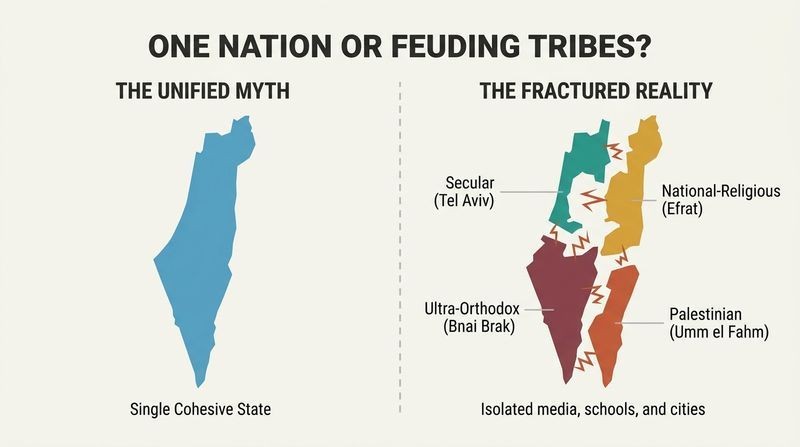
The book's organizing insight comes from a 2015 speech by Israeli President Reuven Rivlin, who warned that the country was splintering into separate tribes divided by faith, ethnicity, geography, and class. Rivlin identified four main camps: secular Jews, national-religious Jews, ultra-Orthodox Haredim, and Palestinian citizens of Israel.
Each tribe increasingly inhabits its own world. They read different newspapers, watch different channels, attend separate government-funded schools, and cluster in their own towns: Tel Aviv for secular Jews, Bnai Brak for Haredim, Umm el Fahm for Palestinians, Efrat for settlers. Michaeli borrows the biblical Twelve Tribes, who fought and betrayed one another after Joshua's conquest, as a template. His method is deliberately street-level: he interviews hundreds of ordinary people rather than politicians, using his Hebrew and American passport to cross internal borders others cannot.
The tribal frame is powerful precisely because it resists the binary (Israeli versus Palestinian) that dominates Western coverage. It echoes political scientist Arend Lijphart's work on consociational democracies like Lebanon and Belgium, where segmented communities coexist through elite power-sharing rather than integration. The risk of the metaphor is that it can flatten agency into essentialism, implying these divisions are permanent rather than politically constructed. Rivlin himself resisted that fatalism, arguing the mosaic could be an asset. What's striking is that a sitting president diagnosed his own society as failing to build shared identity, a candor rare among heads of state anywhere.
Israel's future belongs to the groups opting out of it
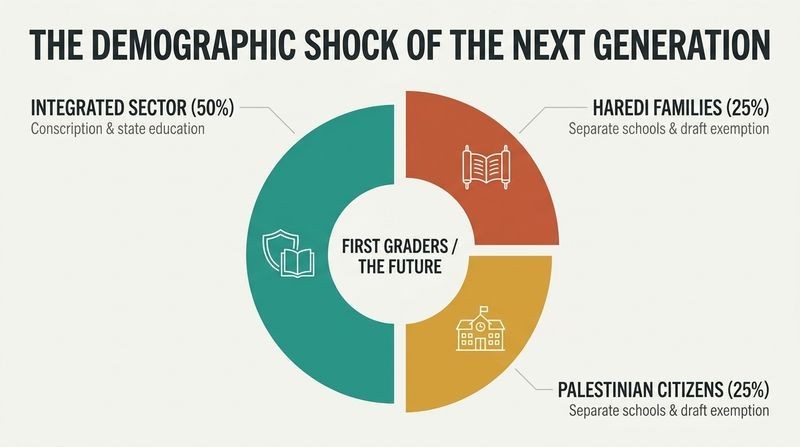
Rivlin's pie charts delivered a demographic shock: Haredim and Palestinian citizens each already supply roughly a quarter of Israel's first graders, meaning nearly half the next generation belongs to two communities that largely reject the Zionist state project. Haredi families average around 7.1 children per woman, and their population (over 1.1 million, about 12 percent of citizens) could double every sixteen years.
Here is the paradox: both groups are mostly exempt from military conscription, the institution that historically forged national solidarity and delivered education, housing, and job benefits. Both run separate school systems with their own curricula. A pilot in the preface frames the anxiety bluntly: as secular, liberal Israelis increasingly avoid military careers, will the soldiers of the future obey their commanders or their rabbis when ordered to evacuate a settlement?
Demography as destiny is seductive but deserves scrutiny. Fertility rates are not fixed; they respond to female education, workforce participation, and urbanization, all of which are slowly rising among Haredim. Israel's secular Jewish fertility (around three) is itself unusually high for a developed economy, complicating simple projections. Still, the structural point holds: a state whose unifying institutions rest on shrinking participation faces a legitimacy problem. Compare this to debates in Europe over integration and welfare-state solidarity. The deeper question the book raises is whether shared citizenship can survive when major communities are educated, from childhood, to see the state as illegitimate or merely instrumental.
American money is the invisible scaffolding holding Israel up
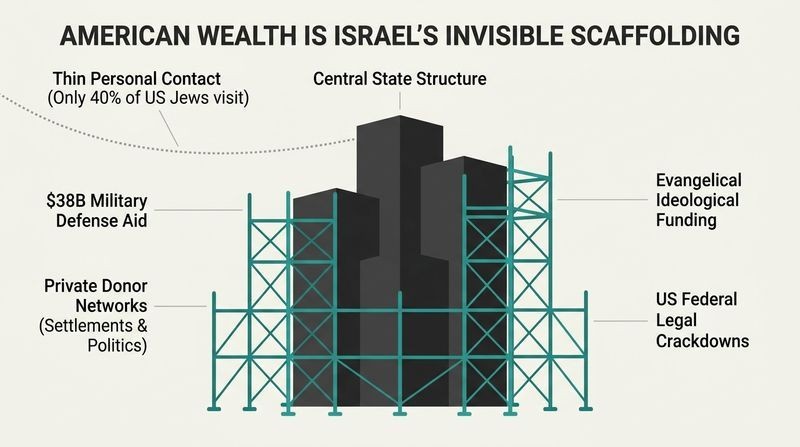
Michaeli argues that to understand Israel you must trace the American superstructure imposed on it. The 2016 defense agreement committed $38 billion over ten years, most of it spent buying weapons from American companies. American donors like the Falic family (owners of duty-free airport shops) funneled tens of millions to settlements and to Netanyahu's political accounts. American federal prosecutors, not Israeli ones, cracked down on Israel's binary options fraud.
The influence runs both ways and across tribes. Evangelical Christians fund settler wineries and cheer annexation as biblical prophecy. American Jews like Nate Shapiro shamed and maneuvered the Israeli government into rescuing Ethiopian Jews. Diaspora activists shape the occupation debate. Yet contact is thin: only about 40 percent of American Jews ever visit Israel, and more Israelis emigrate to America than the reverse.
This is one of the book's freshest contributions, reframing Israel less as a sovereign actor than as a node in an American political and economic network. It resonates with world-systems theory and with scholarship on how client-state relationships blur autonomy. The claim that pro-Israel lobbying matters less than oil and arms lobbies is contestable and pushes against Mearsheimer and Walt's thesis, but Michaeli's point is subtler: aid increasingly recycles into US corporate budgets. The uncomfortable implication for both American Jewish advocates and critics is that their leverage is real, which makes disengagement itself a political act with consequences on the ground.
Watch what Israelis eat to see who is winning the culture
Celebrity chef Gil Hovav, great-grandson of the reviver of modern Hebrew, offers the book's most delicious argument: Israeli cuisine is a live readout of demographic power. The European Ashkenazi kitchen of pickled fish and chopped liver, dominant at the founding, is being supplanted. More than 60 percent of Israeli Jews trace roots to North Africa, the Middle East, and Central Asia (Mizrahim and Sephardim), and their flavors are ascendant.
Hovav credits not Arab-Jewish fusion but Jews from across the diaspora improvising with local ingredients in home kitchens. A taxi driver named Ofer, son of a Polish father and Tunisian mother, learned to cook by watching his mother spice up her mother-in-law's gefilte fish. Even the salad is politicized: the right calls diced vegetables an Israeli salad, the left an Arab salad.
Food as a proxy for social power is well established in sociology, from Pierre Bourdieu's work on taste as class marker to studies of how immigrant cuisines gain prestige only after the immigrants do. Hovav's insistence that the transformation is intra-Jewish rather than Arab-Jewish is itself a political stance, one that quietly writes Palestinians out of a shared culinary story that scholars like Yael Raviv document as deeply entangled. The tension between Hovav and chef Yotam Ottolenghi over authorship of hummus and falafel is a small war standing in for the larger question of who gets credit for the land's culture.
The socialist kibbutz utopia quietly sold itself off
The kibbutz, once Israel's mythologized incubator of the self-reliant new Jew, has been largely privatized. Degania, founded in 1910 near the Sea of Galilee, was the first, born when workers revolted against a hired foreman and demanded communal self-rule. At its peak the movement captured the national imagination far beyond its numbers, producing a disproportionate share of elite officers and pilots.
The reckoning came after Likud's 1977 election victory. Criticized for excluding Mizrahim and for heavy government subsidies, kibbutzim lost volunteers and status. By 2017, three-quarters paid competitive wages rather than a common stipend. Amnon Ben Shoushan, a Moroccan-born survivor of the movement's founding generation at Kibbutz Ma'agan, now owns his cottage as private property he can bequeath, yet still praises the safety net that shames, in his view, America's abandonment of its poor.
The kibbutz arc is a compressed case study in why intentional communities rarely survive past their founding generation, a pattern documented from the Israeli kibbutzim to American utopian experiments like Oneida and the Shakers. Economists point to the free-rider problem and the difficulty of retaining talented members who could earn more outside. Yet Amnon's testimony complicates the standard declension narrative: the privatized kibbutz still delivers guaranteed minimum income, elder care, and medical pooling that most Israelis and nearly all Americans lack. The lesson is less that collectivism failed than that it survived by hybridizing, trading purity for durability.
The occupation is a profit machine, not merely a security policy
Palestinian American businessman Sam Bahour, who came to Ramallah full of optimism after the 1993 Oslo Accords, reframes the occupation in economic terms. He cites research estimating it costs the Palestinian economy around $16 billion annually. Israel controls imports (even water, even hotel beds are restricted as security issues), airwaves, and permits.
His vivid example: Palestinians were finally allowed a 3G cellular network just as the world moved to 5G, so Palestinian phone users must buy SIM cards tapping into settlement networks, and profits flow to Israeli firms while Palestinian developers are frozen out. Bahour describes a slow attrition designed to make people give up and leave. His counterstrategy is to court American corporate investors, because investors who discover the arbitrary rules become allies. Creating jobs, he insists, is nonviolent resistance.
Bahour shifts the debate from the moral and military registers where it usually stalls to political economy, echoing scholars like Sara Roy, who coined de-development to describe Gaza's engineered economic regression. The framing that some actors profit from a captive market is a serious charge and helps explain policy inertia: interests, not just ideology, entrench the status quo. The claim invites scrutiny (Israel also bears enormous fiscal and human costs), but the asymmetry of who controls the tools of development is hard to dispute. Bahour's investor-as-witness tactic is a shrewd application of contact theory to corporate stakeholders.
Fifty thousand praying peacefully gets no cameras; ten stone-throwers do
Issa Amro, a Hebron activist who studied Gandhi, Mandela, and King, embodies the dilemma of nonviolent Palestinian resistance. During the 2017 protests over new security devices at Al Aqsa, tens of thousands prayed without incident and eventually forced a reversal, yet the coverage went to a handful of teenagers throwing stones. His media logic is blunt: more recognition means more protection, so they film everything.
Michaeli witnesses the machinery up close when a soldier blocks their meeting by declaring a closed military zone that Amro insists is fabricated. Amro's group Youth Against Settlements occupies a building precisely to force a nonviolent confrontation, understanding that violence would justify military escalation, and that military control clears the way for settlers. His formula for how occupation advances: soldiers first, settlers second.
Amro's frustration exposes a structural bias in media economics that peace researchers have long noted: nonviolence is less photogenic and therefore less funded and less covered than spectacle, a perverse incentive Erica Chenoweth's data on civil resistance both confirms and complicates (nonviolent movements succeed more often, but slowly and unglamorously). His indictment cuts against both sides: Israeli authorities who criminalize his organizing, and a Palestinian Authority that also arrested him for a Facebook post. That he was prosecuted by both governments underscores his real threat, which is not weapons but legitimacy, the currency both establishments most fear losing.
Rescued minorities are rewriting themselves as heroes, not cargo
Two communities airlifted to Israel are reclaiming authorship of their own exodus. Ethiopian Jews are usually credited to the Israeli air force and Mossad, but physician Yoni Reuven insists no one lifted him, he raised himself. His father Mehari was imprisoned and tortured in Ethiopia for organizing emigration, part of decades of internal Ethiopian Jewish activism that preceded the famous 1991 Operation Solomon airlift of some 14,000 people in thirty-six hours.
Iraqi Jews, evacuated en masse in the early 1950s after the 1941 Farhud pogrom, arrived stripped of citizenship and possessions, their Arabic culture treated as a liability. Tsionit Kuperwasser, a former military officer, wrote a novel about Baghdad's Jews that became the first Hebrew book sold in Iraq, connecting her through social media to Iraqis hungry to recover their own lost pluralism.
This is a story about narrative sovereignty, the struggle of marginalized groups to be subjects rather than objects of their own history, familiar from postcolonial scholarship and from African American debates over who narrates emancipation. The Israeli founding ethos of erasing diaspora identities to forge a new Hebrew citizen, which Michaeli attributes partly to Ben-Gurion, produced exactly the resentment now surfacing. Kuperwasser's cross-border reception is especially poignant: Iraqis mourning their expelled Jews use her book to imagine a pre-sectarian past, a reminder that nostalgia can occasionally build bridges that politics cannot.
The war-zone reputation hides a strikingly low murder rate
Michaeli offers a corrective statistic that reframes Israel's image. In 2018, Israel recorded 103 homicides, a rate of 1.14 per 100,000 people in a non-war year. The United States that same year had 14,123 homicide victims, a rate of 5.35 per 100,000, nearly five times higher.
His home city of Chicago, with 3 million people, has suffered more than 500 homicides in a single year, down from over 900 in the 1990s. The point is not that Israel is peaceful (he witnesses rocket alerts, checkpoints, and street fights) but that the political violence saturating headlines coexists with unusually safe daily life. This makes it presumptuous, he argues, for Americans to prescribe solutions for a society statistically less violent than their own.
The juxtaposition is rhetorically effective and empirically sound, but it deserves a caveat the book only partly supplies: aggregate homicide rates fold together very different phenomena, and the lived insecurity of rocket barrages, checkpoints, and periodic war is not captured by annual murder counts. Criminologists distinguish interpersonal violence from political and structural violence for exactly this reason. Still, the comparison punctures a lazy Western assumption and models intellectual humility. It also quietly indicts the United States, turning the analytical lens back on the observer, a move that gives the whole travelogue its moral ballast.
Treat Israel as a microcosm of every nation's tribal stress test
Michaeli's closing thesis is that Israel is neither a cautionary tale nor a role model but a compressed laboratory for challenges every nation now faces: technology, mass migration, organized crime, religious extremism, and pandemic disease all straining the institutions of the state. Inside this tiny territory, individual identity has become a contest among tribal loyalty, respect for diversity, and national solidarity.
His prescription mirrors Rivlin's: survival depends on building a system that respects each tribe's integrity while ensuring all contribute to the collective. He stresses how porous the supposed borders actually are, revealed in the hybrid cuisine emerging from the country and in Haredi rabbis improvising guidance for modern life. Judaism endures, he concludes, because it adapts and defends its integrity under adverse and diverse conditions alike.
Reading a specific, fraught place as a bellwether for global modernity is an ambitious move with distinguished precedents, from Tocqueville reading America to Orwell reading imperial Burma. The danger is over-universalizing: Israel's particular history of Holocaust trauma, contested indigeneity, and ongoing military occupation is not neatly transferable to Sweden or Singapore. Yet the core insight (that the tension between tribal belonging and shared citizenship is the defining political problem of the twenty-first century) is echoed across the literature on polarization, from Robert Putnam's work on diversity and trust to Amy Chua's political tribes. Michaeli's contribution is to make the abstraction breathe through individual lives.
Analysis
Michaeli, a former Chicago journalist and author of a history of the Black newspaper The Defender, brings the sensibility of an American race-and-class reporter to Israel, and that transposition is the book's method and its innovation. Rather than argue a thesis, he assembles a mosaic: hundreds of street-level interviews gathered across four trips (2014, 2017, and 2018) framed by President Rivlin's tribal diagnosis. The genre is literary reportage in the tradition of Studs Terkel and Alexandra Fuller, prioritizing polyphony over verdict.
The book's intellectual spine is a double displacement of the standard Israel-Palestine narrative. First, Michaeli decenters the conflict itself, insisting the internal Jewish and civic tribalism (Haredi versus secular, Mizrahi versus Ashkenazi, settler versus Tel Aviv liberal) is equally consequential. Second, he decenters Israeli sovereignty, arguing that American money, law enforcement, universities, and evangelical politics form a superstructure that increasingly determines outcomes. This is his most original and debatable move. It risks understating Israeli agency and the region's own dynamics, yet it productively unsettles both AIPAC-style advocacy and its mirror-image critique.
Methodologically, his outsider-insider position (fluent Hebrew, American passport, Israeli-born brother) grants unusual access across checkpoints and communities, but it also shapes what he sees: he is drawn to entrepreneurs, activists, and cultural figures who speak in narratives of adaptation and hybridity. The book underrepresents Gaza and the truly dispossessed, a limitation he acknowledges implicitly when a planned Ramallah trip nearly falls through.
What endures is the argument that borders between tribes are more porous than the tribes themselves believe, evidenced in cuisine, commerce, and the surprising kindnesses between a Haredi cashier and a veiled Arab woman. Michaeli resists both despair and utopianism, landing on a pragmatic pluralism: a state that respects each tribe's integrity while compelling contribution to the whole. It is less a solution than a wager, and the book's honesty lies in leaving the outcome genuinely open.
Review Summary
Download PDF
Download EPUB
.epub digital book format is ideal for reading ebooks on phones, tablets, and e-readers.








































