

Key Takeaways
A newborn can sleep twelve straight hours by twelve weeks old
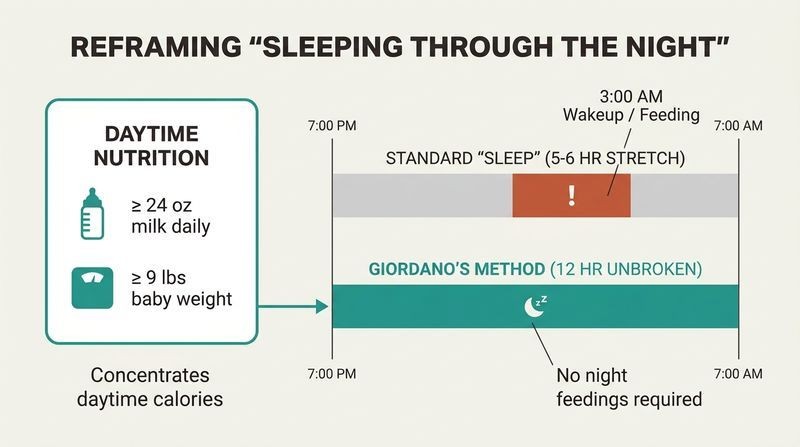
The core promise reframes what "sleeping through the night" means. Giordano, a Brazilian-born "Baby Coach" who raised five kids including twins, rejects the standard bar that many pediatric sources set: a stretch of five to six hours, with roughly half of babies still waking around 3:00 AM. In her definition, a twelve-week-old sleeps a genuine twelve hours (say 7:00 PM to 7:00 AM) with no feeding, no rocking, and no parent replacing a lost pacifier. If she wakes, she resettles herself.
The claim rests on nutrition math, not deprivation. A baby must weigh at least nine pounds and consume at least 24 ounces of milk per 24 hours before training begins, concentrating daytime calories so night feedings become biologically unnecessary. She reports over 100 families trained without a single failure.
The zero-failure claim invites healthy skepticism, since it reflects self-selected, often affluent, highly motivated families rather than a controlled trial. Still, the pediatric literature broadly supports that many healthy, adequately grown infants can consolidate night sleep by three to four months as circadian rhythms and stomach capacity mature. What's genuinely useful is the redefinition itself: parents chronically underslept often accept "waking twice" as success. Naming a concrete, ambitious target (twelve by twelve) changes behavior through expectation-setting, a well-documented effect in goal psychology. The nine-pound, 24-ounce gate is the ethical backbone here, ensuring the method never starves calories out of a baby to buy sleep.
Cap crying at five minutes, then step in to reassure
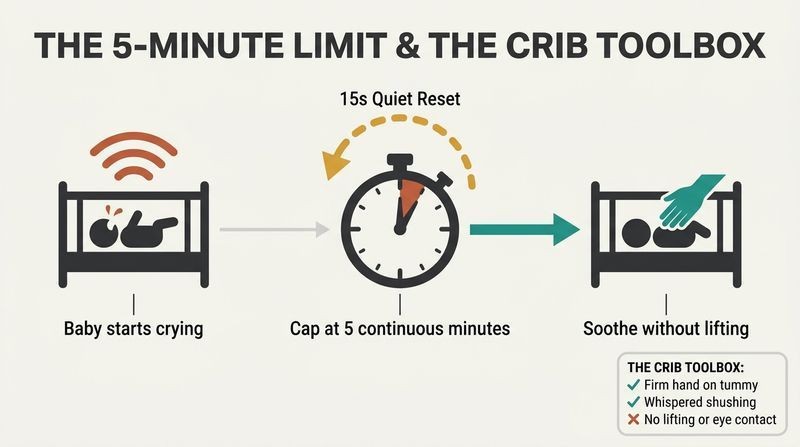
The Limited Crying Solution is the method's emotional middle path. Giordano rejects both extremes: full "cry it out" (which she finds emotionally damaging and hard for parents to sustain) and pure "no cry" (which she calls unrealistic for many babies). Her rule: let a baby fuss for three to five minutes, then enter to soothe without lifting the baby from the crib.
The mechanics matter. If the baby quiets even for fifteen seconds during the wait, restart the clock. When you go in, use the nighttime toolbox: shushing, a firm hand on the tummy, a scented blankie, whispered reassurance, but no eye contact and no conversational talking, which signals fun and keeps the baby awake. She argues little learning happens after five continuous minutes of hard crying, so slower, gentler steps beat marathon screaming, even if training takes longer.
This positions the book between Ferber's graduated extinction and Pantley's no-cry approach, and the five-minute ceiling is a shrewd behavioral compromise. There's tension worth naming: intermittent reinforcement (sometimes soothing, sometimes not) can, in operant conditioning, actually strengthen a behavior rather than extinguish it. Giordano sidesteps this by never rewarding the cry with removal from the crib, only presence. The "no eye contact" instruction aligns with research on arousal: social engagement cues activate alertness, exactly what you're trying to dampen. The honest tradeoff she names (gentler equals slower) is the kind of realism that builds parental trust and, crucially, adherence, which is what actually determines outcomes.
Concentrate feeds into four daytime meals, four hours apart
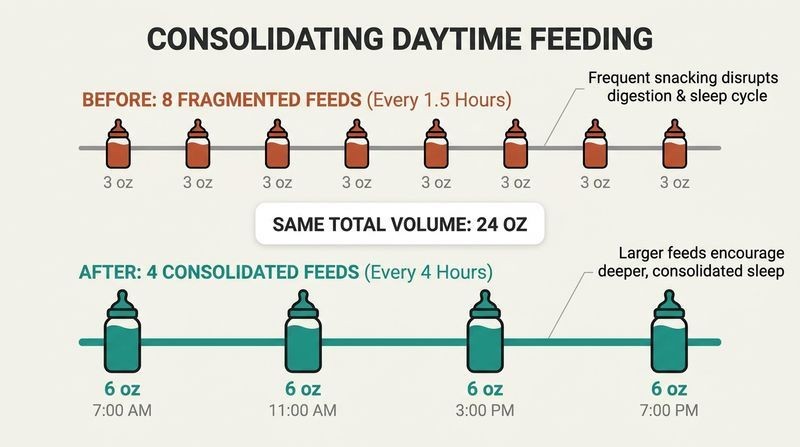
Feeding is the foundation everything else stands on. Before sleep can consolidate, daytime nutrition must consolidate first. The plan divides the day into a twelve-hour block anchored to family life (7 to 7, 8 to 8, even an 11-to-11 block for musician parents) and sets four feedings spaced four hours apart. Crucially, you time from the start of each feeding, not the finish.
The transition works through gradual stretching, not cutting. Using the daytime toolbox to distract (pacifier, bouncy seat, knee-bouncing, singing) you nudge a hungry baby fifteen to thirty minutes further each day. This creates a domino effect: longer gaps mean hungrier baby, means bigger meals, means longer digestion, means easier next stretch. The total intake stays constant. Eight small feeds of 3 ounces simply become four feeds of 6 ounces, the same 24 ounces, redistributed.
The insight that daytime structure precedes nighttime sleep is the book's most underappreciated contribution and echoes chronobiology: feeding is a powerful zeitgeber, or time-giver, that entrains circadian rhythms alongside light. By loading calories into daylight hours, the method leverages biology rather than fighting it. The "time from the start" rule quietly prevents feed-creep, where slow eaters ratchet the schedule tighter and tighter. One caution: rigid four-hour spacing can clash with responsive-feeding guidance and with breastfed babies, who digest faster and often need more frequent feeds. Giordano's own nine-pound, 24-ounce gate mitigates this, but parents of smaller or slower-gaining infants should hold the schedule loosely.
Put the baby down awake so she learns to self-soothe
The linchpin of the whole method is deceptively simple. Place the baby in the crib awake, not asleep. Giordano argues sleeping is a learned skill, as teachable as walking or talking, and a baby rocked to sleep every night never acquires it. All humans surface between sleep cycles; the trained baby simply resettles alone, while the untrained one cries for the conditions under which she fell asleep.
She wages war on "sleep crutches." Swings and the vibration mode on bouncy chairs "do all the work," so the baby never learns to calm herself. She compares this to endlessly carrying a toddler who can already walk. Permitted self-soothing aids include pacifiers (crib-only), thumb-sucking, and a scented blankie carrying the mother's smell, slept with for a few nights first so it comforts by proxy.
This is the empirically strongest pillar. The concept of "sleep-onset associations" is well established in pediatric sleep medicine: infants who fall asleep under conditions they cannot reproduce alone (rocking, feeding, motion) wake fully and signal for those conditions. Teaching independent sleep onset is the mechanism behind nearly every effective intervention. The framing of sleep as a developmental skill rather than a passive state is both accurate and empowering, shifting parents from "fixing" to "coaching." The scented-object trick is clever applied psychology, exploiting infant olfactory recognition of the caregiver. The one modern caveat: safe-sleep guidance discourages loose objects in cribs for young infants, so blankie use warrants age and safety judgment.
You are the parent; the baby adapts to your family
Parental empowerment is the philosophical engine. Giordano's first foundation flips the modern script: a new baby joins the existing family rather than reordering it around himself. Doorbells can ring, siblings can shout, and the washing machine can run during naps. Raise a baby in artificial silence, she warns, and you train him to sleep only in silence, a pattern guaranteed to fail the moment life gets loud.
Confidence is a practical tool, not arrogance. She urges parents to internalize "I am in charge" and to filter the deluge of conflicting advice from websites, talk shows, and relatives. Sleep deprivation erodes judgment and pushes exhausted parents toward the "quick fix": the swing, the hourly snack, whatever stops the crying now. Those emergency shortcuts calcify into daily habits that are painful to break.
The "baby adapts to the family" stance is culturally loaded and worth situating. It reflects a more authoritative, structure-first tradition (Giordano cites her Brazilian upbringing) and stands opposed to attachment-parenting philosophies that center infant cues. Neither is universally "correct"; the evidence suggests both secure attachment and healthy sleep are achievable across a wide range of parenting styles, provided the caregiver is responsive and consistent. The strongest kernel here is the noise point, which is genuinely practical and testable: habituating infants to ambient household sound builds robust sleepers. The empowerment framing also has a mental-health dividend, since parental confidence and reduced anxiety measurably improve infant regulation.
Wean night feeds by shrinking one feeding half an ounce at a time
Night weaning is surgical, not sudden. Once daytime feeding is locked in, you eliminate night feeds one at a time, tackling the smallest first (usually the middle-of-the-night feed). The method: check your log, then offer half an ounce less than last night, hold that amount for three nights, then drop another half ounce. Breastfeeding mothers substitute minutes for ounces, trimming three minutes every four days.
Two rules protect the baby and the progress. First, replace those lost night ounces during the day so total nutrition never drops. Second, let the baby "spring forward but not fall back": if he naturally sleeps past his usual feed time, that later time becomes the new normal, but never let a feed drift earlier. Keep night feeds boring, dark, and silent so the baby stays in a near-sleep state throughout.
The half-ounce taper is essentially a titration protocol borrowed, whether knowingly or not, from the logic of gradual dose reduction in medicine, minimizing withdrawal-style distress. It is gentler than abrupt night weaning and addresses the real physiological question: a baby genuinely hungry at 3:00 AM should not simply be left to cry, so you shrink the hunger first. The insistence on daytime calorie replacement is the ethical safeguard that separates this from crude sleep-training. The "spring forward, not back" ratchet is elegant behavioral design, capturing gains and preventing regression. The reliance on meticulous logging also quietly imports a data-driven, quantified approach that many exhausted parents skip to their detriment.
Good habits set in three days; bad ones take seven to break
Two timing rules calibrate parental patience. The Three-Day Rule holds that a positive new habit takes about three days to form: Day 1 is "Dark" (the hardest), Day 2 is "Gray" (usually calmer), and Day 3 is "White" (the baby has figured it out). Knowing Day 1 is the worst keeps parents from quitting at the moment of peak difficulty.
Breaking a bad habit costs more than making one. The Seven-Day Rule warns that a bad habit forms in three days but takes seven to undo. Rushing into the nursery at every morning peep is her example. She also names the "snowball effect": if you gradually tolerate longer crying before caving (two minutes, then five, then fifteen), you simply teach the baby to cry fifteen minutes to get picked up. The result never changes, only the volume.
The snowball effect is a crisp, accurate description of a variable-ratio reinforcement schedule, the same mechanism that makes slot machines addictive. By escalating the crying required before giving in, parents inadvertently train exactly the persistence they're trying to eliminate. This is genuinely important and often invisible to those living it. The three-versus-seven asymmetry is more heuristic than measured, but it captures a real behavioral truth: extinction of an established, intermittently reinforced behavior is slower and rockier than acquisition. The Dark-Gray-White labeling is smart risk communication, front-loading the expectation of a brutal first night so parents don't misread normal difficulty as failure and abandon ship prematurely.
Warn parents about the colicky "two-week storm" before it hits
Naming a crisis in advance defuses it. Around three to four weeks for singletons and six to eight weeks for twins, Giordano observed that nearly every baby, even "perfect angels," hits a rough patch of piercing cries, red faces, gas, cramps, and heavier spit-up. She calls it the Two-Week Storm and considers some form of colic near-universal: not whether, but when and how severe.
Preparation converts panic into competence. Because she warns families ahead of time, parents react with "this is the stage Suzy described" rather than "something is terribly wrong." A calmer parent means a calmer baby, since infant tension mirrors caregiver tension. She counsels riding it out with gas drops, gripe water, or gentle massage while resisting new crutches. Formal sleep training pauses during this window; you don't build habits on a foundation of pain.
This is applied expectation-management, and it echoes a robust finding from pain and childbirth research: forewarning reduces perceived severity and distress by removing the threat of the unknown. The storm metaphor gives parents a narrative frame that restores agency. Her claim that colic is essentially universal is stronger than the clinical consensus, which estimates colic (defined by the Wessel "rule of threes") at roughly 15-25% of infants, though milder fussiness peaks around six weeks in nearly all babies, so the observation isn't baseless. The genuinely valuable move is decoupling this developmental turbulence from training, preventing parents from misattributing normal maturational crying to a failing method.
Keep a written log; sleep deprivation erases your memory
Data beats a foggy brain. From the hospital onward, Giordano insists parents chart three things: when the baby ate, how much, and every diaper (wet or dirty), plus a notes column. In the sleep-deprived haze where days blur together, the log is memory insurance, a health early-warning system, and a communication tool between multiple caregivers.
The log powers every training decision. You cannot taper a night feed by half an ounce without knowing last night's exact amount. You cannot spot the baby's natural feeding pattern to "spring forward" without tracking wake times. She provides photocopiable 24-hour sheets and recommends switching to a day-anchored version once training begins. For older babies (nine to eighteen months), she pushes it further: log a full week, including room temperature, light, and noise, before changing anything.
The logging discipline quietly makes this a quantified, hypothesis-driven system rather than intuition, which is why it outperforms vague resolutions to "be more consistent." It mirrors the Quantified Self movement and clinical practice alike: you cannot manage what you don't measure. Behaviorally, tracking also creates the Hawthorne effect on the parent, since the act of recording sharpens attention and consistency. The environmental audit for older babies (light, temperature, noise, drafts) reflects sound sleep-hygiene principles now standard in adult insomnia treatment. The main cost is burden: an exhausted parent maintaining meticulous logs at 3:00 AM is a real ask, and adherence to the tracking may be the hidden bottleneck to the method's success.
It is never too late, even at nine months or five years
The method scales up in age with modifications. While designed for twelve-week-olds, the same four steps retrain babies from three to eighteen months, typically within one to two weeks. Older babies come with harder-set habits, so expect more crying (sometimes one to four hours the first nights), darken the room aggressively (garbage bags on windows if needed), use white noise, and keep language to blunt commands like "night-night." Starting on a Friday buys recovery time.
Extreme cases prove the range. Giordano recounts training twins with cleft palates, twins with severe reflux who slept propped in bouncy seats, quadruplets including two with Down syndrome, an eleven-month-old who used her mother as a "human pacifier," and Franklin, a five-year-old who had displaced his father from the marital bed for two years. One difficult night reset the boundaries.
The anti-fatalism message is psychologically valuable: parents of older "bad sleepers" often believe the window has closed, and that learned helplessness itself perpetuates the problem. The claim that special-needs infants (cleft palate, Down syndrome, reflux) can be trained is encouraging, though these cases demand pediatric oversight the anecdotes underplay. The Franklin story functions as a parable about boundaries more than sleep, and it exposes the method's underlying worldview: family structure as therapeutic. Honesty compels noting that older-child training entails substantially longer crying, which reopens the very ethical debate the five-minute rule was designed to sidestep. The Friday-night start is small but shrewd behavioral scaffolding for parental follow-through.
Analysis
This is a tightly focused, prescriptive parenting manual, closer to an instruction booklet than a theory book, deliberately readable in about two hours by an exhausted parent. Its structure is chronological (weeks 1 to 6, 6 to 8, 8 to 12, then older babies and edge cases) built around a four-step sequence: consolidate daytime feeds, wean night feeds, teach independent night sleep, then structure naps. The difficulty in summarizing it is that its value lives in granular mechanics (half-ounce tapers, fifteen-minute stretches, three-to-five-minute crying windows) rather than big ideas, so an adaptation must preserve enough procedural specificity to be actionable while distilling the philosophy that justifies it.
Giordano's real contribution is not the bold twelve-by-twelve promise but the underlying logic: sleep is a learnable skill, daytime nutrition is the lever that makes night sleep biologically possible, and gradualism (of both feeding and crying) is more sustainable than shock methods. The method sits deliberately between Ferber and no-cry camps, and its safeguards (the nine-pound and 24-ounce gates, daytime calorie replacement) are what keep it ethical rather than merely convenient.
The book's weaknesses are epistemic. "Never one failure in 100 families" is marketing, not evidence: no control group, heavy self-selection, survivorship bias, and a clientele wealthy enough to hire a live-in baby coach. The universality claims (all babies get colic, all special-needs infants can be trained) outrun the clinical literature. And the responsive-feeding and safe-sleep tensions (loose crib objects, rigid schedules for breastfed newborns) deserve more caution than the confident tone offers.
Yet as behavioral design, it is genuinely sophisticated: the snowball effect describes variable-ratio reinforcement, the log imposes data discipline, sleep-onset associations anchor the awake-in-crib rule, and expectation-management (the Two-Week Storm, the Dark-Gray-White nights) addresses the true failure point of all sleep training, which is parental abandonment mid-process. Used with pediatric oversight and situational flexibility, it is a coherent, humane system.
Review Summary
Twelve Hours' Sleep by Twelve Weeks Old receives mixed reviews. Many praise its concise, straightforward approach and report success in improving infant sleep. However, critics argue it's impractical for breastfeeding mothers, too strict, and lacks research backing. Some appreciate the clear schedule and instructions, while others find it unrealistic or potentially harmful. Positive reviewers cite improved sleep for both baby and parents, while negative reviewers express concerns about forced feeding schedules and ignoring babies' needs. Overall, opinions are divided on the book's effectiveness and appropriateness.
People Also Read






FAQ
1. What is "Twelve Hours' Sleep by Twelve Weeks Old" by Suzy Giordano about?
- Step-by-step sleep training: The book presents a practical, structured plan to help parents teach their babies to sleep twelve hours at night by the age of twelve weeks.
- Focus on empowerment: Suzy Giordano emphasizes empowering parents to take charge and set routines, rather than letting the baby dictate the household schedule.
- Adaptable for all families: The method is designed for singletons, twins, and even higher-order multiples, with adjustments for each situation.
- Balanced approach: The plan uses a "Limited Crying Solution," aiming for minimal crying and a middle ground between "cry it out" and "no cry" methods.
2. Why should I read "Twelve Hours' Sleep by Twelve Weeks Old" by Suzy Giordano?
- Regain sleep and sanity: The book promises to help parents and babies achieve restful nights, reducing parental exhaustion and stress.
- Clear, actionable guidance: It offers a concise, easy-to-follow manual that can be read in about two hours, perfect for busy or sleep-deprived parents.
- Proven track record: Giordano’s method has been used successfully with hundreds of families, including those with special circumstances or multiples.
- Long-term benefits: The approach not only improves sleep but also fosters happier, more cooperative children and a more harmonious family environment.
3. What are the key takeaways from "Twelve Hours' Sleep by Twelve Weeks Old" by Suzy Giordano?
- Four foundations of sleep success: Babies adapt to the family, parents must feel empowered, sleep is a learned skill, and sleep training requires commitment.
- Stepwise training process: The method involves gradually adjusting feeding and sleeping schedules, with a focus on daytime feeding first, then eliminating night feedings, and finally establishing solid sleep routines.
- Limited Crying Solution: The plan limits crying to 3-5 minutes at a time, with parental reassurance, to teach self-soothing without prolonged distress.
- Consistency and structure: Success depends on maintaining a predictable schedule and reinforcing good habits, with flexibility for exceptions like illness or travel.
4. How does the "Twelve Hours' Sleep by Twelve Weeks Old" method by Suzy Giordano work?
- Four-step chronological order: The method trains babies to eat every four hours during the day, gradually eliminates night feedings, establishes a twelve-hour nighttime sleep, and sets up consistent daytime naps.
- Three requirements for training: Babies must be at least nine pounds, consume at least 24 ounces of milk/formula in 24 hours, and be at least four weeks old (singletons), eight weeks (twins), or twelve weeks (triplets).
- Toolboxes for day and night: Parents use specific soothing and distraction techniques to help babies adjust to new routines and self-soothe.
- Three-day and seven-day rules: Good habits take three days to form, while breaking bad habits can take up to seven days, requiring patience and consistency.
5. What are the "Four Foundations of Baby Sleep Success" in Suzy Giordano's method?
- Baby adapts to family: The existing family structure should not revolve around the baby; instead, the baby learns to fit into the family’s routine.
- Parental empowerment: Parents must confidently set boundaries and make decisions, filtering outside advice to suit their family’s needs.
- Sleep is a learned skill: Just like walking or talking, babies need to be taught how to sleep and self-soothe.
- Commitment required: Parents must be consistent and dedicated, reinforcing sleep habits even after initial training, especially during disruptions.
6. What is the "Limited Crying Solution" in "Twelve Hours' Sleep by Twelve Weeks Old" by Suzy Giordano?
- Short, controlled crying: Babies are allowed to cry for only 3-5 minutes before parents intervene to reassure them without picking them up.
- Parental presence and soothing: Parents use calming techniques like shushing, patting, or offering a pacifier, but avoid stimulating the baby with conversation or eye contact.
- No prolonged distress: The method avoids long periods of crying, aiming to teach self-soothing in a gentle, emotionally supportive way.
- Gradual improvement: Over time, the frequency and intensity of crying decrease as babies learn to fall asleep independently.
7. How does Suzy Giordano's method in "Twelve Hours' Sleep by Twelve Weeks Old" structure feeding and sleep schedules?
- Daytime feedings: Babies are trained to eat every four hours, four times a day, during a consistent twelve-hour daytime block.
- Nighttime feedings: Night feedings are gradually reduced and eliminated, with the goal of twelve consecutive hours without feeding.
- Daytime naps: After nighttime sleep is established, babies take a one-hour morning nap and a two-hour afternoon nap, both in their cribs.
- Flexible but structured: While the schedule is predictable, it allows for minor adjustments to fit each family’s unique needs.
8. What are the main benefits of following the "Twelve Hours' Sleep by Twelve Weeks Old" method by Suzy Giordano?
- Minimal crying: The Limited Crying Solution ensures less distress for both babies and parents during training.
- Happier, more cooperative children: Well-rested babies are more content, alert, and able to play independently.
- Predictable routines: Parents gain free time during naps and after bedtime, making daily life more manageable.
- Works for multiples and special cases: The method is effective for twins, triplets, and babies with special needs or challenging circumstances.
9. How does "Twelve Hours' Sleep by Twelve Weeks Old" by Suzy Giordano address common challenges and exceptions (e.g., illness, travel, daycare)?
- Sickness: Adjust the schedule as needed during illness, but return to the routine and reinforce good habits once the baby recovers.
- Special events and travel: Minimize disruptions during the first six months; after routines are established, occasional exceptions are manageable with quick reinforcement.
- Daycare and working parents: Adapt the method to fit daycare schedules when necessary, but maintain consistent nighttime routines at home.
- Relapse management: If bad habits form, use the three-day and seven-day rules to reestablish good sleep patterns.
10. Can the "Twelve Hours' Sleep by Twelve Weeks Old" method by Suzy Giordano be used for older babies (3-18 months) or babies with special needs?
- Older babies: The same four-step method applies, but expect more resistance and possibly longer periods of crying, especially for babies over nine months.
- Special needs: The method has been successfully used with babies with colic, reflux, cleft palates, Down syndrome, and even older children with entrenched sleep issues.
- Individualized approach: Adjustments are made for each child’s age, developmental stage, and unique challenges, but the core principles remain the same.
- Parental consistency: Success depends on parents’ commitment to the process, regardless of the child’s age or circumstances.
11. What advice does Suzy Giordano give for breastfeeding mothers in "Twelve Hours' Sleep by Twelve Weeks Old"?
- Breastfeeding is compatible: The method works for breastfeeding mothers, who track feeding duration in minutes instead of ounces.
- Gradual reduction: Night feedings are reduced by shortening nursing sessions by three minutes every four days, or as the baby naturally nurses less.
- Maintaining milk supply: Increase nursing time during daytime feedings and consider pumping after feedings or before bed to maintain supply.
- Avoiding the "human pacifier": The plan discourages using the breast as a pacifier at night, recommending bottles or other soothing methods during sleep training.
12. What are the best quotes from "Twelve Hours' Sleep by Twelve Weeks Old" by Suzy Giordano and what do they mean?
- "Sleeping is a learned skill that you need to teach your baby." – Emphasizes that good sleep habits don’t just happen; parents play an active role in teaching self-soothing.
- "A baby must adapt to the existing family; the existing family does not adapt to a baby." – Encourages parents to maintain their household routines and empower themselves as leaders.
- "Good habits take three days to make and three days to break." – Reminds parents that consistency pays off quickly, but bad habits can also form rapidly if routines slip.
- "I cannot fix everything for you, but while you are learning to fix things for yourself, I will go through it with you by your side." – Captures the supportive, coaching philosophy at the heart of Giordano’s method, balancing guidance with fostering independence.
About the Author
Other books by Suzy Giordano
Download PDF
Download EPUB
.epub digital book format is ideal for reading ebooks on phones, tablets, and e-readers.








































