
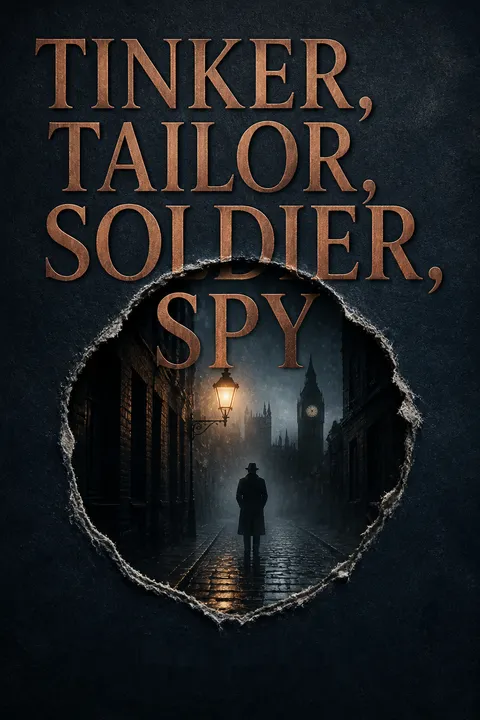


Plot Summary
The Exile in the Dip
Jim Prideaux3 arrives mid-term at Thursgood's preparatory school in Somerset, driving a battered red Alvis and towing a second-hand trailer straight into a sunken patch of wasteland the boys call the Dip. Only one person witnesses the arrival: Bill Roach,14 an unhappy, overweight child from a broken home who spends his rest periods staring through the dormitory window.
Jim3 is a ruin of a man — his right shoulder frozen high against his neck, his face lined and fierce — but to Roach14 he is magnificent. The two form an unspoken bond: Jim3 names Roach14 his best watcher, and Roach14 appoints himself Jim's3 guardian. Neither speaks of the past that put those bullets in Jim's3 back, or the world he fled to reach this quiet margin.
Smiley's Midnight Summons
George Smiley1 — small, bespectacled, and recently discarded by the Circus, Britain's secret intelligence service — has been rotting in genteel retirement, his wife Ann12 gone, his days wasted on scholarly distractions.
One rainy night he finds Peter Guillam,4 a marginalized Circus officer, waiting inside his Bywater Street house. Guillam4 drives him to the country estate of Oliver Lacon,11 the Cabinet Office's intelligence watchdog, where a third man waits: Ricki Tarr,9 an Australian scalp-hunter listed as a presumed defector.
Tarr9 has surfaced after seven months underground, carrying a story so explosive that Lacon11 has bypassed the entire Circus to hear it. Smiley1 settles into a chair before a miserable fire as Tarr9 begins to talk, and with each sentence the evening grows colder.
Irina's Gift and Vanishing
Six months earlier in Hong Kong, Tarr9 had stumbled into the hotel room of Irina,15 the common-law wife of a Soviet trade delegate — a Moscow Centre operative who was drunk, lonely, and desperate to confess.
Over furtive meetings, Irina15 told Tarr9 about a highly placed British mole codenamed Gerald, run by the legendary Soviet spymaster Karla5 and serviced through a colonel at the Soviet Embassy in London whose cover name was Polyakov.19 Tarr9 cabled London Station requesting emergency defector treatment. London stalled with follow-up questions.
Within twenty-four hours, Irina15 was carried unconscious onto an unscheduled Soviet plane. Behind the pew of a Baptist church, Tarr9 found her hidden diary — a frantic, love-soaked document naming the mole Gerald, describing his servicing, and begging Tarr9 to act.
Nightwork at the Islay
Smiley1 accepts Lacon's11 assignment to find the mole, operating from a shabby Paddington hotel under the alias Barraclough, with retired Inspector Mendel16 as his outside man. Each evening Lacon11 smuggles him classified files; each morning he reclaims them.
Through these records, Smiley1 traces the rise of Operation Witchcraft — a secret intelligence channel attributed to a Soviet source codenamed Merlin. Merlin's product won Whitehall's adoration and carried Percy Alleline6 to the Circus chieftainship, while Control,13 Smiley's1 old master, was discredited and died soon after.
Four men sit at the heart of Witchcraft: Alleline,6 Bill Haydon,2 Roy Bland,7 and Toby Esterhase.8 Smiley1 discovers that the Treasury funded a sixty-thousand-pound London safe house for the operation's most sensitive business, and that Merlin is described not as one source but several.
Guillam's High-Wire Theft
At Smiley's1 direction, Guillam4 penetrates the Circus archives to steal the operational file on Testify — the mission that got Jim3 shot and Control13 sacked.
Using a subminiature camera, a dummy file for the swap, and a canvas bag relayed through a borrowed stooge, he navigates librarians, janitors, and the oppressive proximity of London Station's personnel on the floor above. The theft succeeds, but minutes later Toby Esterhase8 materializes and escorts Guillam4 upstairs to Alleline's6 office.
Alleline6 interrogates him about Tarr,9 warns him that Tarr's9 daughter Danny is expected in London — intelligence from a source so secret Guillam4 must sign a Witchcraft secrecy form — and threatens consequences. Guillam4 lies with desperate composure and escapes with the file still in transit to Brixton.
Connie Remembers Polyakov
Smiley1 visits Connie Sachs10 in her cluttered Oxford rooms, where the former Circus researcher — arthritic, alcoholic, still brilliant — has been rotting since her dismissal. Connie10 tells him about Karla's5 private training school for elite agents, including three confirmed graduates, one being a colonel named Viktorov who vanished entirely.
She then recounts her obsession with Aleksey Polyakov,19 a Soviet cultural attaché in London whose Remembrance Day war medals exposed a military background he had hidden for seven years.
Connie10 demanded full surveillance; Alleline6 and Esterhase8 shut her down. She had also identified Polyakov's19 legman — a clerk called Lapin, the same figure described in Irina's diary. When Smiley1 leaves, Connie10 clings to him in the kitchen garden, begging him not to destroy the memories of her lovely boys.
Bill's Missing Hours
Sam Collins,17 the Circus duty officer on the night Jim3 was shot, has reinvented himself running a London gambling club. Over sandwiches in his basement office, Sam17 tells Smiley1 what happened: Control13 had secretly briefed him for weekend duty, then the Czech bulletins exploded with news of a shooting near Brno.
Sam17 phoned Bywater Street looking for Smiley1 and asked Ann12 where Bill Haydon2 was. Ann12 said she didn't know. Haydon2 arrived at the Circus at a quarter past one in the morning, claiming he had seen the news on his club's ticker-tape.
But his club would have been closed by then — and Haydon2 had been back in London for two days, not one. The implication settles over Smiley1 like weather: Bill2 was with Ann12 that night, and something flushed him from her bed.
The Russians Arrived First
Jerry Westerby,18 a shambolic journalist and occasional Circus asset, provides the missing piece from the field. In Prague, a young Czech soldier told him that Russian special forces had moved into the forest near Brno on Friday — a full day before Jim's3 Saturday rendezvous.
When Westerby18 reported this to Esterhase,8 Toby8 first praised him, then furiously reversed and ordered him silenced; a D-notice killed the story. Separately, Max — Jim's3 Czech driver on the Testify mission — tells Smiley1 how the operation unfolded on the ground: the black Fiat at the rendezvous, Jim's3 precaution of sending the driver ahead, the eruption of floodlights and gunfire.
Both Czech networks were subsequently rolled up and their agents killed. The evidence converges: the trap was laid before Jim3 ever crossed the border.
Jim Breaks His Silence
Smiley1 finds Jim3 at Thursgood's and drives him to a motel, then onto the dark hilltops of the Quantocks. Across hours of halting, painful talk, Jim3 tells everything.
Control13 had briefed him in a St. James's flat, using coloured charts and a nursery rhyme to codename five suspects: Tinker for Alleline,6 Tailor for Haydon,2 Soldier for Bland,7 Poorman for Esterhase,8 Beggarman for Smiley.1 A Czech general named Stevcek, Control13 believed, could identify which was Karla's5 mole.
Jim3 flew to Prague, detected heavy surveillance, shook it in Brno, and reached the forest rendezvous — where floodlights, troops, and cameras were already waiting. Shot twice in the back, he was interrogated by a cold, small man who knew every detail of Control's13 briefing. Jim3 identifies photos of his chief interrogator: Karla.5
Inside Karla's Architecture
Through nights of cross-referencing files, travel records, and lamplighter reports, Smiley1 identifies the design. Polyakov19 is not a recruited asset but Karla's5 officer, operating freely under diplomatic cover. The Merlin intelligence is controlled disinformation — genuine enough to buy Whitehall's trust, shaped to serve Moscow's interests.
The safe house in Camden Town is the operational heart: there the inner circle meets Polyakov19 under the fiction that they are running him as a double agent, feeding him harmless chicken-feed. In reality the flow runs the other way.
The mole hands over authentic British secrets through Polyakov19 to Moscow; the chicken-feed story provides perfect deniability. It is the most elegant deception Smiley1 has ever encountered — a closed loop in which the watchers cannot tell what they are watching.
Karla's Silence in Delhi
Driving through the night with Guillam,4 Smiley1 recounts his one encounter with Karla:5 a Delhi prison, mid-fifties. Karla5 — a small, wiry man with bright brown eyes — had been arrested servicing a Soviet network in California while Moscow had turned against him.
Smiley1 flew to India to offer him defection, safety, reunion with his wife. For hours he pleaded. Karla5 said nothing — not a word, not a syllable. He sat with calloused hands flat on the iron table, still as rock.
When they parted, Karla5 pocketed Ann's cigarette lighter from the table — engraved with her love — and walked back to his cell. A month later his accuser was shot, Karla5 was reinstated, and he began reactivating dormant agents. The lighter, Smiley1 now understood, was more than a trophy. It was a weapon.
Toby Gives Up the House
Smiley1 and Guillam4 corner Esterhase8 in a Lexham Gardens safe house, with the minder Fawn blocking the door. Under quiet, relentless questioning — backed by Lacon's11 authority and the threat of turning the matter over to the competition — Toby's8 studied neutrality crumbles.
He admits the inner circle has been meeting Polyakov19 at a house in Lock Gardens, Camden Town. The cover story: Polyakov19 is their recruited double agent, and they feed him chicken-feed to maintain his credibility with Moscow.
Toby8 provides the address, the caretaker's name, the signaling procedures for emergency meetings, and Polyakov's19 daily routine. He begs to sit out whatever follows. Smiley1 agrees, telephones the housekeeper to prepare the house, and begins setting his trap.
Gerald Has a Face
From Paris, Tarr9 sends a provocative telegram to Alleline6 claiming intelligence vital to the Circus's survival — the bait Smiley1 designed to flush the mole into an emergency meeting with Polyakov.19 Mendel16 watches from across Cambridge Circus as Alleline,6 Haydon,2 and Bland7 converge on the building.
At Lock Gardens, Smiley1 waits in the darkened scullery, gun in hand, listening through the wall. The first arrival unlocks the front door with his own key. Then a second taxi; Polyakov19 enters.
Through the wall Smiley1 hears a voice he has known for decades — Bill Haydon's2 — reading aloud the very telegram Smiley1 drafted. Guillam4 bursts through the door and seizes Haydon2 by the collar with a fury that collapses into something closer to grief. The tapes are recording. The mole Gerald is unmasked.
The Last Debrief
At Sarratt, the Circus interrogation centre, Haydon2 offers Smiley1 a rambling political confession — hatred of America, contempt for Britain's diminished role, an aesthetic preference for the Soviet system. He admits the Czech general Stevcek was a fiction; Operation Testify was a trap designed to destroy Control13 and the mole hunt.
He reveals that Karla5 ordered his affair with Ann12 specifically to cloud Smiley's1 judgment. Before his exchange to Moscow can be arranged, Haydon2 is found dead on a garden bench in the Sarratt grounds, his neck broken with professional precision.
No witness comes forward. Throughout the investigation, Smiley1 has noticed a shadow following him — a familiar, lopsided silhouette. The institution that sent Jim Prideaux3 into the trap has no answers for Haydon's2 death. Jim Prideaux3 does.
The Train to Immingham
Smiley1 boards a train heading east along the bleak Lincolnshire coast. He replays everything: Haydon's2 apologies, Karla's5 silence, the cost to Jim,3 to Irina,15 to the blown networks and their dead agents.
He tries to hate Haydon2 and finds he cannot quite manage it — only a complicated disgust, mixed with the recognition that they were all products of the same dying establishment. He wonders whether any love between human beings does not rest on some species of self-delusion.
At the station, Ann12 is waiting in her disreputable car, staring the wrong way — tall and puckish and essentially another man's woman. He remembers he forgot to bring her fur boots from the cupboard under the stairs. He remembers a copy of Grimmelshausen left uncollected at a club. He wishes he had brought the boots.
Epilogue
For the rest of that term, Jim Prideaux3 busied himself with small mercies — mending soccer nets, fixing the school play's lighting, taking enormous care over minor French corrections. His long solitary walks had ceased.
Bill Roach,14 appointed dimmer man on Jim's3 signal, watched the slow thawing of his hero's grief with a child's attentive hope. On the night of the performance, Jim3 was more lighthearted than Roach14 had ever seen him. Walking back through the rain, Jim3 introduced Roach14 to a visiting parent with something like tenderness, calling him by his real first name.
And the gun — the dark revolver Roach14 had once seen Jim3 cleaning by lamplight in the trailer, the bullets threaded into the chamber one by one — that, Roach14 had finally convinced himself, was after all only a dream.
Analysis
Tinker, Tailor, Soldier, Spy dismantles the spy thriller from within. Where conventional espionage fiction locates danger abroad, le Carré's threat is domestic, institutional, intimate — the traitor shares your office, your dinner table, your wife's bed. The novel's architecture mirrors its theme: just as the mole hides inside the Circus's own structure, the truth hides inside the narrative's layered retrospection, requiring the reader to perform the same patient reconstruction Smiley1 undertakes.
The nursery rhyme at the novel's center is devastatingly apt. Reducing a traitor's identification to a child's counting game exposes the arbitrariness of institutional trust — anyone might be the beggarman, the thief. Control's13 code transforms colleagues into suspects and friendship into evidence. The game's innocence mocks the gravity of what it describes.
Smiley's1 investigation is inseparable from his marital wounds. Every operational discovery doubles as personal revelation: the affair with Ann12 was not private weakness but professional warfare, orchestrated by Karla5 to compromise Smiley's1 judgment. The novel refuses to separate the personal from the political, insisting that betrayal operates identically at every scale — between nations, institutions, spouses, friends.
Le Carré's deepest provocation is the mirror between Smiley1 and Karla.5 Smiley's1 compassion is the vulnerability Karla5 exploits, yet his capacity for doubt is precisely what allows him to see the truth that more ideological colleagues cannot. The fanatic and the humanist need each other; each is defined by what the other lacks.
The institutional critique extends beyond espionage. The Circus is post-imperial Britain in miniature: trained to rule, incapable of admitting decline, purchasing American respect with borrowed intelligence. The mole succeeds not despite the institution's values but because of them — loyalty, discretion, and class solidarity become the very mechanisms of betrayal. The novel's lasting power lies in this recognition: that the structures we build for protection become, inevitably, the structures through which we are destroyed.
Review Summary
Tinker, Tailor, Soldier, Spy is widely praised as a masterful espionage novel. Readers appreciate Le Carré's intricate plotting, complex characters, and authentic portrayal of Cold War-era intelligence work. The slow-burning narrative and introspective tone are seen as strengths by many, though some find the pacing too slow. George Smiley is lauded as a compelling protagonist, and the book's exploration of loyalty, betrayal, and moral ambiguity resonates with readers. While some struggle with the jargon and complexity, most consider it a rewarding and intellectually stimulating read.
People Also Read


Characters
George Smiley
Retired spy hunting the moleSmall, podgy, bespectacled, and middle-aged, Smiley is the anti-spy: unremarkable in appearance but devastating in intellect. A former senior officer of the Circus, he was forced into retirement when his mentor Control13 fell from power. His wife Ann12, whom he loves helplessly, is serially unfaithful. Smiley's genius lies in patience—the slow assembly of fragments into patterns, the refusal to accept easy answers. Beneath his diffident exterior burns a moral seriousness his colleagues lack. His relationship with Ann12 is his great vulnerability, one that Karla5 identifies and exploits. Smiley embodies the paradox of the decent man operating in an indecent world, where loyalty itself becomes a weapon turned against the loyal.
Bill Haydon
The Circus's golden boyHandsome, brilliant, and aristocratic, Haydon is the golden boy of the Circus—artist, adventurer, wartime hero, and head of London Station. His exploits span continents: wartime operations in the Balkans, courier lines across southern Europe with Jim Prideaux3 as his partner. His Oxford friendship with Prideaux3 is legendary; his affair with Ann Smiley12 is common gossip. Haydon's charisma draws others into his orbit—Bland7, Esterhase8, Alleline6—each finding in him some quality they lack. He represents a vanishing breed: the pre-war English romantic whose grand visions of national purpose sit uneasily alongside a restless dissatisfaction with what England has actually become. His unfinished paintings and abandoned relationships suggest a man whose enormous appetites exceed any single canvas.
Jim Prideaux
Wounded exile at a boys' schoolA hulking, damaged man with a crooked back and fierce red face, Jim is a former Circus field officer who arrived broken at a boys' prep school after a catastrophic mission in Czechoslovakia. His body bears two bullets in the shoulder; his psyche bears wounds that go deeper. Before his injury, Jim was the consummate agent: brave, resourceful, unquestioning. His Oxford bond with Bill Haydon2 defined his professional life—they were field partners, intellectual complements, inseparable friends. Jim's tragedy is that his deepest virtues—loyalty, courage, discretion—made him the perfect instrument of his own undoing. At Thursgood's, he channels his damaged capacity for devotion into teaching and befriending young Bill Roach14, whose watchfulness mirrors Jim's own hypervigilant exile.
Peter Guillam
Smiley's field operativeLean, chivalrous, and aging into anxiety, Guillam is Smiley's1 operational right hand. A former field agent burned in North Africa, he now runs the diminished scalp-hunters from Brixton and harbors a growing fury at his marginalization. His conscious loyalties are determined by affection rather than ideology, which makes him Smiley's1 most reliable ally and his most emotionally volatile. His affair with Camilla, a mysterious young musician, becomes a mirror for his larger crisis of trust: as the investigation deepens, he begins suspecting everyone, including his lover. Guillam's journey is one of violent disillusionment—from institutional faith to the recognition that the man he most admired has corrupted everything he believed in.
Karla
Moscow's unseen spymasterMoscow Centre's most formidable intelligence officer, Karla is the unseen adversary around whom the entire plot turns. A small, wiry man with bright brown eyes, he appears directly only once—in Smiley's1 memory of a Delhi prison—where he sat in absolute silence, refused every offer of defection, and pocketed Smiley's cigarette lighter as a trophy. Karla is a fanatic, and therein lies both his strength and his potential weakness. He recruits with the patience of a chess grandmaster, placing agents decades before they are needed. He is Smiley's1 shadow self: where Smiley1 doubts, Karla believes; where Smiley1 is merciful, Karla is ruthless. His genius lies in identifying and exploiting human weakness with surgical patience.
Percy Alleline
Ambitious new Circus chiefA bullish Scottish careerist who ascends to Chief of the Circus on the strength of Source Merlin's intelligence product. Alleline craves respectability and the approval of Whitehall. He is ambitious but not brilliant—a front man whose hunger for status makes him the perfect instrument for whoever truly controls the Merlin operation. His bluster and banter mask a deep insecurity, and his relationship with the inner circle is one of willing dependency.
Roy Bland
Grounded satellite specialistA burly, red-haired former academic who spent a decade undercover in Eastern Europe. Bland's proletarian origins and left-wing credentials made him ideal for deep cover, but years of solitary deception left him cynical and mercenary. Now grounded at the Circus managing satellite networks, he drinks too much and leans heavily on Haydon's2 patronage, adopting Bill's2 mannerisms and even his political fashions. Smiley1 recruited him originally, a fact that complicates their later relationship.
Toby Esterhase
Head of Circus lamplightersA fastidious Hungarian émigré who runs the Circus lamplighters—its surveillance and support teams. Tiny, vain, and precisely dressed, Toby is a survivor who gravitates toward power. His loyalty is transactional: he serves whoever can advance his career. His elaborate social pretensions and linguistic facility mask a deep insecurity about his outsider status within the English establishment he serves. Under pressure, his carefully maintained neutrality proves fragile.
Ricki Tarr
Rogue scalp-hunter on the runA rough-edged Australian scalp-hunter—the Circus's strong-arm operative—whose Hong Kong encounter with a Russian woman15 triggers the entire investigation. Tarr is impulsive, sentimental, and distrusted by his superiors. His father was a preacher; Ricki is a fighter. His capacity for genuine attachment—to Irina15, to his daughter Danny—coexists with a talent for violence and a survival instinct that keeps him underground for seven months before he dares surface.
Connie Sachs
Fired Circus researcherA massive, arthritic, hard-drinking former Circus researcher who was pushed into retirement for pursuing the Polyakov19 connection too aggressively. Connie's extraordinary memory is a one-woman archive of Soviet intelligence. Her devotion to the Circus is quasi-romantic—she calls the agents her lovely boys. Fired for being right, she lives alone in Oxford with cats and a grey spaniel, nursing her grievances and her brilliance in equal measure.
Oliver Lacon
Cabinet Office adviserA tall, gangly Cabinet Office man who serves as Whitehall's watchdog over intelligence affairs. Lacon is awkward, boyish, and morally uncomfortable with the world he oversees. He values constitutional propriety above all, which makes him alternately an obstacle and a reluctant enabler. His initial refusal to hear Smiley's1 suspicions, then his grudging authorization, reflects the institutional cowardice that allowed the rot to spread.
Ann Smiley
Smiley's unfaithful wifeSmiley's1 beautiful, aristocratic, and persistently unfaithful wife. Ann is the absent center of his emotional life—a wound he cannot heal and cannot abandon. Her serial affairs represent everything Smiley1 cannot control: love, beauty, the irrational heart that his analytical mind can never master. She is perceptive enough to sense when something is deeply wrong, and courageous enough to urge Smiley1 back into action even when she cannot name what she senses.
Control
Former Circus chief, now deadThe former Chief of the Circus—gaunt, sardonic, and dying when the story begins. Control's paranoid last months were spent locked in his office, researching the mole he suspected within his own service. His decision to launch Operation Testify was a desperate gamble to identify the traitor before his enemies forced him out. His death leaves Smiley1 as the sole inheritor of his unfinished hunt, and his ghost hovers over every file Smiley1 reads and every witness he interviews.
Bill Roach
Schoolboy devoted to JimA lonely, overweight schoolboy at Thursgood's whose broken home makes him a natural watcher. He becomes Jim Prideaux's3 devoted guardian—a child-regent whose fierce vigilance mirrors the spy's own hyperalert exile. Roach is the novel's moral witness.
Irina
Tarr's doomed Russian contactA Moscow Centre operative and Boris's common-law wife who falls desperately in love with Tarr9 in Hong Kong. Her diary, hidden in a Baptist church, names the mole Gerald and sets the entire investigation in motion.
Inspector Mendel
Smiley's retired police allyA retired Special Branch officer who serves as Smiley's1 logistical support—driver, watchman, photographer, and relay point. Dry, steady, and fiercely loyal, he operates on the margins of the investigation with unflappable competence.
Sam Collins
Former Circus duty officerThe Circus duty officer on the night of Operation Testify, now managing a London gambling club. His account of that night—who arrived, when, and from where—provides Smiley1 with critical evidence about Haydon's2 movements.
Jerry Westerby
Journalist and Circus assetA large, shambolic journalist and occasional Circus agent whose suppressed Prague story proves the Russians were positioned in the forest before Jim3 ever arrived—evidence that the ambush was prearranged.
Polyakov
Soviet embassy liaison officerA Soviet cultural attaché at the London Embassy whose true role becomes the crux of Smiley's1 investigation. His seven-year tenure and hidden military background drew Connie Sachs's10 persistent—and officially silenced—attention.
Plot Devices
The Tinker Tailor Code
Names the five mole suspectsA children's fortune-telling rhyme—Tinker, Tailor, Soldier, Sailor, Rich Man, Poor Man, Beggarman, Thief—repurposed by Control13 as a classification system for the five officers he suspected of being Karla's5 mole. Each suspect received a codename: Alleline6 was Tinker, Haydon2 was Tailor, Bland7 was Soldier, Esterhase8 was Poorman, and Smiley1 himself was Beggarman. The code served a dual purpose: it compressed a devastating accusation into a mnemonic that could survive torture and border crossings, and it reduced the gravity of institutional treason to a game of chance—as though identifying a traitor among your closest colleagues were no more consequential than counting cherry stones. Jim Prideaux3 carried the code into Czechoslovakia, where under interrogation he surrendered it to Karla5 himself.
Operation Witchcraft / Source Merlin
Soviet deception channelThe crown jewel of the Circus under Alleline's6 leadership: an intelligence operation attributed to a Soviet source codenamed Merlin, allegedly leading a caucus of disaffected officials feeding high-grade secrets to the West. Merlin's product—naval assessments, Kremlin power analyses, nuclear strategy papers—was so impressive that Whitehall built a special Admiralty reading room to handle it. In reality, the Witchcraft operation is a Soviet deception channel designed by Karla5. The intelligence is carefully calibrated: genuine enough to earn trust, shaped to serve Moscow's strategic interests. Merlin's London representative, Polyakov19, meets the inner circle at a secret safe house where the ostensible exchange of chicken-feed actually flows in reverse—authentic British secrets delivered to Moscow under the guise of running a double agent.
The Lock Gardens Safe House
Trap location and deception hubA terraced house at 5 Lock Gardens, Camden Town, purchased by the Treasury for sixty thousand pounds at the Circus's request. Officially it serves as a secure venue for the Witchcraft operation's most sensitive meetings. Its housekeeper is Millie McCraig, a former Circus listener. The house contains built-in audio recording equipment concealed behind the wallpaper, controlled by switches disguised in the light panels. In the climactic operation, Smiley1 repurposes Lock Gardens as his trap: he reactivates the recording equipment, positions Guillam4 on the canal towpath, and waits in the darkened scullery while the mole arrives for his scheduled meeting with Polyakov19. The house functions as both the mechanism of the long-running deception and the instrument of its final exposure.
Irina's Diary
Inciting document of the huntA handwritten document in Russian, scrawled in urgent black ink across both sides of the paper and hidden by Irina15 in a dead letter-box behind the back pew of a Baptist church in Hong Kong. Written over four days as she sensed her arrest approaching, the diary is simultaneously a love letter to Tarr9 and a confession of Soviet intelligence secrets. It names the mole Gerald, describes his servicing by a legman called Lapin under Colonel Viktorov—workname Polyakov19—and traces the operational history of Karla's5 deep-penetration program targeting British intelligence. The diary is the inciting document of the entire investigation, the evidence that convinces Lacon11 and the Minister to authorize Smiley's1 secret hunt. Tarr9 copied it by hand and replaced the original in the church.
Ann's Cigarette Lighter
Symbol of exploited loveA gold cigarette lighter engraved with Ann Smiley's12 declaration of love to George1. During Smiley's1 failed attempt to recruit Karla5 in a Delhi prison, Karla5 silently pocketed the lighter—the only item he took from their encounter. The lighter became both trophy and operational instrument: years later, during Jim Prideaux's3 interrogation, Karla's5 chief inquisitor displayed it as psychological warfare, demonstrating intimate knowledge of Smiley's1 vulnerability. The mole later confirms that Karla5 identified Ann12 as Smiley's1 one exploitable weakness and orchestrated a specific affair to compromise his judgment. The lighter thus traces the full arc of Karla's5 strategy—from a Delhi cell to a London bedroom—proving that love itself can be weaponized in the intelligence war.
George Smiley Series
About the Author
Other books by John le Carré
Download PDF
Download EPUB
.epub digital book format is ideal for reading ebooks on phones, tablets, and e-readers.








































