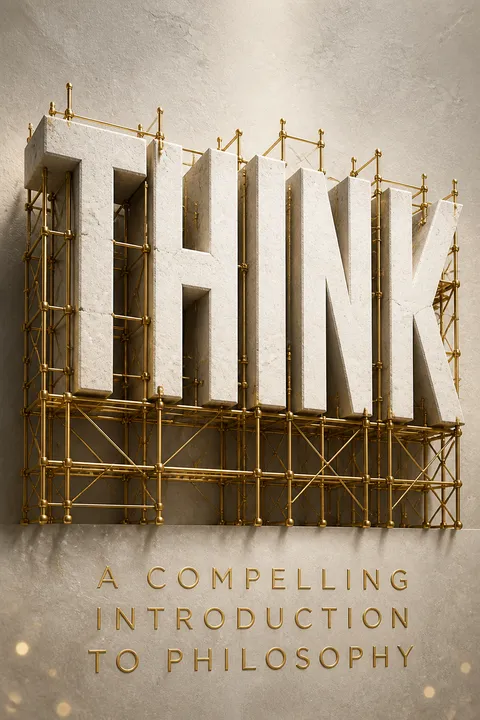


Key Takeaways
Philosophy is conceptual engineering: study the scaffolding of your own thought
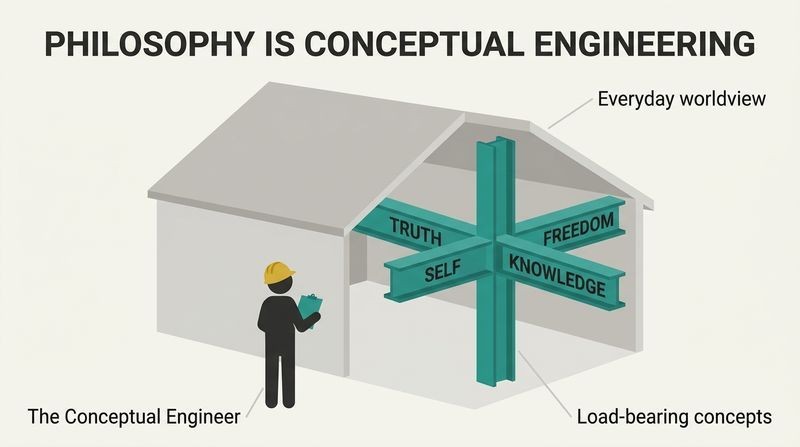
Reframing an intimidating word. Blackburn rebrands philosophy as "conceptual engineering." Just as a structural engineer studies how girders and joints bear load, the philosopher examines how ideas like knowledge, truth, freedom, and self hold our worldview together. Our concepts are the mental housing we live in. Sometimes we admire the structure; sometimes it needs demolishing and rebuilding.
Reflection is unavoidable and practical. The big questions (Am I free? Can I know anything? Does God exist?) are not specialist trivia but things ordinary people wonder about. Skill here is a "knowing how" like piano playing, not a stockpile of facts. Socrates prized knowing how little he knew. Success means staying clear-headed when arguments get stormy, detecting ambiguity, and taking ideas seriously enough to follow where they lead.
The engineering metaphor is a shrewd rhetorical move against the stereotype that philosophy is impractical navel-gazing. It echoes Wittgenstein's later view that philosophical confusion is a kind of mental cramp to be dissolved rather than a body of doctrine to memorize. What's striking is how Blackburn positions reflection as continuous with action: bad metaphysics about human selfishness can make societies less trusting and raise real economic transaction costs. The claim that thinking well is a skill, not knowledge, aligns with modern cognitive science on expertise and tacit knowledge. A skeptic might ask whether engineering, with its clear success criteria, is too flattering an analogy for a discipline that rarely settles anything.
Descartes proved only that thinking guarantees a thinker, nothing more
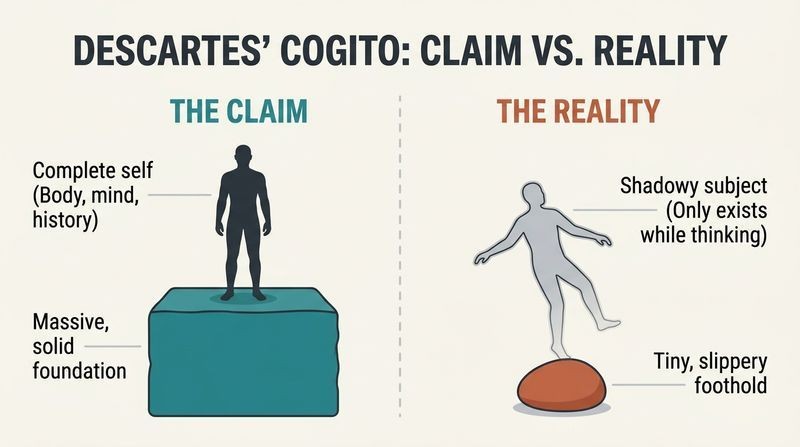
The method of doubt. Descartes tried to rebuild knowledge from bedrock by doubting everything doubtable. The senses deceive, dreams feel real, and a hypothetical all-powerful Evil Demon could feed him a totally false reality (the modern update is a brain in a vat). One thing survives: even a deceived mind must exist to be deceived. "I am thinking, therefore I am."
But the rock is tiny and slippery. The Cogito proves existence only while thinking, and only of a shadowy subject stripped of body, history, and personality. Blackburn shows the underlying argument is weaker than advertised: the senses "sometimes" deceiving does not license "always" (compare: banknotes are sometimes forged, so all are forged, which is impossible since forgery presupposes genuine notes). Lichtenberg's jab lands hard: we should say "it thinks" like "it thunders," claiming no owner-self at all.
Blackburn's handling of the Cogito models good philosophical hygiene: separate what an argument actually earns from what its author hoped it would. The forgery example is a crisp demonstration that some skeptical arguments are self-undermining, since doubt itself depends on a background of reliable belief. The brain-in-a-vat reformulation connects to Hilary Putnam and to films like The Matrix, showing the puzzle is culturally alive. The deepest cut is Lichtenberg's, anticipating Hume and Buddhist no-self doctrines: the grammatical subject "I" may be a linguistic illusion, not a discovered entity. This foreshadows a recurring Blackburn move, diagnosing metaphysical extravagance as bad grammar mistaken for deep insight.
You cannot reason your way out of doubt using reason itself
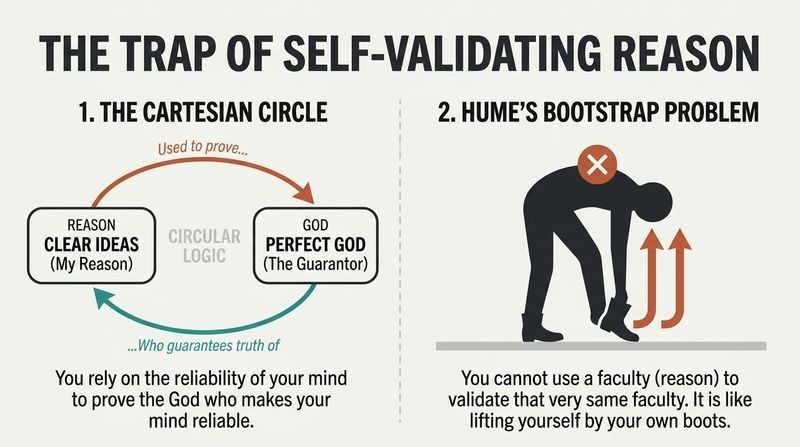
The Cartesian circle. To escape the Evil Demon, Descartes argued God exists and, being perfect, would not deceive us, so our clear ideas are trustworthy. But he trusted his clear ideas to prove God in the first place. Hume nailed the fatal flaw: if you doubt your own faculties, you cannot validate them by using those very faculties. Any foundation-hunt collapses.
Four options in the theory of knowledge. Blackburn lays out the menu:
1. Rational foundationalism (Descartes): certainty built on self-evident bedrock.
2. Natural foundationalism (Hume): we simply, naturally trust experience and correct errors as we go.
3. Coherentism: beliefs support each other like a web or Neurath's ship rebuilt plank by plank at sea, needing no ultimate base.
4. Scepticism: there is no knowledge.
Each has distinguished defenders. The honest challenge is defending whichever you pick.
Neurath's boat is one of philosophy's most durable images, and Blackburn deploys it to defang the demand for absolute foundations. The point generalizes beyond epistemology: legal systems, scientific paradigms, and even software all function without a self-justifying ground floor. Contemporary reliabilism and Bayesian epistemology largely vindicate Hume's naturalism, treating knowledge as well-calibrated tracking rather than demon-proof certainty. Blackburn adds an evolutionary sweetener: creatures whose senses systematically misrepresented predators and food would not survive, so mind-world harmony is not a lucky accident but a design consequence. The honest caveat, which he grants, is that this reply borrows from the very world-knowledge the skeptic queries, so it persuades rather than refutes.
If mind and body were truly separate, zombies could be everywhere
Cartesian dualism breeds monsters. If the mind is a separate ghost-substance loosely tied to the body, two nightmares open up. A Zombie behaves exactly like you, brain and all, but has no inner experience. A Mutant is conscious but wired backwards, feeling middle C on a clarinet where you feel pain, seeing your blue as their yellow. On dualism, you could never tell who is which, even about your past self.
The lesson is to reject the picture. Blackburn treats these possibilities not as spooky truths but as a reductio: if your theory of mind makes them wide open, the theory is broken. Wittgenstein dismantled the "argument from analogy" (I know minds from my own case, so I generalize) as hopeless, like inferring everyone's box contains a beetle from your one beetle. Better options: logical behaviourism, functionalism, or a psycho-physical identity theory that closes the gap.
The zombie thought experiment Blackburn sketches became the centerpiece of David Chalmers's "hard problem of consciousness," published the same decade. Where Chalmers treats conceivable zombies as evidence that consciousness is metaphysically extra, Blackburn treats their conceivability as a symptom that the dualist framing is confused. This is a genuine live fault line, not a settled matter. His colour-science section is the strongest constructive move: facts like why nothing can look reddish-green (the opponent-process channels are mathematical opposites) suggest qualia are rationally tied to physical function, not floating add-ons. That reframes an inverted spectrum from obviously possible to increasingly incoherent, which is exactly how good conceptual engineering should feel.
Feeling free proves nothing, because we never sense our own causes
Schopenhauer's water. Imagine water musing that it could rage into waves or plunge as a waterfall, yet chooses to sit calm in the pond. It mistakes ignorance of its causes for freedom from them. Blackburn's fig-tree version makes the same point: not sensing the machinery does not mean the machinery is absent. Being unaware of X is not awareness of X's absence.
The dilemma of determinism. Either every event is caused (so your choices trace back to before your birth) or some events are random quantum fits and starts. Neither delivers responsibility: you cannot control electron jumps any more than childhood conditioning. Blackburn rejects the dualist escape hatch (a "Real Me" intervening from outside nature), since an inner ghost faces the identical dilemma and secretly just borrows the human freedom it was meant to explain.
Blackburn's diagnosis anticipates decades of neuroscience debate, from Libet's readiness-potential experiments to Sapolsky's hard determinism. His sharpest contribution is procedural: the dualist "solution" to free will is a category of error he flags repeatedly, throwing a new entity into the arena without asking whether it escapes the original problem. The parasite that steers an ant up a grass blade to be eaten, while the ant presumably feels free, is a vivid reminder that the felt sense of agency is cheap and unreliable. The quantum-randomness rescue is correctly dismissed: indeterminism buys unpredictability, not authorship. Chance, as he puts it, is as relentless as necessity.
Blame the person you are now, not the causes that shaped you
Compatibilism as brain modules. Blackburn pictures decision-making as software: a scanner takes in the situation, a tree-producer generates options, an evaluator ranks them, a producer acts. When your action flows through these flexible modules, you chose it, unlike a drowning swimmer whose fate bypasses deliberation entirely. This is "inside control," like a thermostat that genuinely regulates temperature by being part of the causal chain.
Why blame still bites. If you throw my dog out the window, I will not be soothed by hearing your upbringing set you that way. What matters is that this is your setting, and my anger might reset your evaluator for next time, or deter other dog-chuckers. Freedom means being responsive to reasons, not being uncaused. Kant scorned this as "the freedom of a clockwork," a "wretched subterfuge," and the mini-Martian objection (invaders locking your modules) still presses the point.
Blackburn's modular sketch prefigures the mechanistic accounts in cognitive science and echoes Frankfurt and Dennett's compatibilism, especially Dennett's "elbow room." The genuinely useful practical upshot is that blame and praise are forward-looking tools that recalibrate flexible agents, which is why we distinguish laziness (responsive to incentives) from stupidity (not). This reframes punishment as engineering rather than cosmic desert. The honest weakness, which he concedes through Kant and the mini-Martians, is that compatibilist "could have done otherwise" may not satisfy the retributive intuitions built into our moral emotions. If those intuitions secretly require libertarian freedom, and libertarian freedom is incoherent, our whole blame culture may rest on a comforting fiction.
The soul you imagine surviving death is a trick of perspective
No self to be found. Hume looked inward for the "I" and only ever stumbled on particular perceptions: warmth, colour, love, pain, never the owner of them. The self is a bundle of experiences with no container. Reid banged the table insisting the soul is simple and indivisible, but Locke showed that even swapping soul-substances nightly (like changing a computer's disk while keeping the files) would leave personhood intact, so soul-stuff explains nothing.
Imagining is not transporting. When you picture watching your own funeral or being Genghis Khan, you feel a soul-you has migrated into the scene. Blackburn, following Kant, argues nothing migrates. "I can imagine seeing X" and "I can imagine myself seeing X" are the same purely formal move, with no substantive soul in either. The "I" is just the required point of view for organizing experience, like a robot solving for its own position, not an object floating inside you.
This is Blackburn at his most liberating and most unsettling. The Kantian point, that self-consciousness is a structural precondition for organizing experience rather than an item within it, is subtle and easy to miss, and his robot-with-a-camera illustration makes it unusually concrete. It converges with Buddhist anatta and with Thomas Metzinger's neuroscience of the self as a model the brain builds. The scrambling thought experiment exposes a real asymmetry in how we think about past versus future personal identity: we tolerate vagueness looking back but crave three crisp options looking forward. Blackburn suggests that craving is illusion, though he honestly admits the illusion is nearly impossible to shake, which is itself a fascinating datum about human psychology.
You cannot define something into existence, not even God
Sense versus reference. You can write the perfect dating advert for your dream partner, but the world, not your description, decides if anyone matches. Adding "and who exists" to the spec changes nothing. Existence is not a further quality you can bolt on, like liking Guinness. This dooms Anselm's ontological argument, which tries to prove God (a being than which none greater can be conceived) must exist because existing is greater than not existing.
Every proof has a matching flaw. A five-hundred-pound imagined turkey shows the confusion: real turkeys are heavier than imagined ones, yet you can imagine a turkey heavier than any real one. Comparing "God in reality" with "God in the understanding" for greatness is that same slippery comparison. The cosmological (first cause) argument fares no better, since if God needs no cause, the universe might not either. And the design argument, Hume showed, argues from a mixed, spotty world to at best a mixed, spotty creator.
Blackburn compresses three centuries of philosophy of religion with Hume's Dialogues as his scalpel. Kant is the unnamed hero here: "existence is not a predicate" is his line, later formalized in quantification theory, which treats existence as a matter of whether a concept is instantiated, not a property objects carry. The design argument section is especially timely given fine-tuning arguments in cosmology, where the odds of life-permitting constants are staggeringly small. Blackburn's Humean reply is that we have zero comparative experience of universe-making causes, so the inference is reckless. His dormitory analogy for the problem of evil (inferring a benevolent, all-powerful management from a leaky, rat-infested building) is a devastatingly ordinary reframe of theodicy's core difficulty.
Reject any miracle unless the lie would be more miraculous
Weighing two improbabilities. Hume's test for testimony: when someone reports a miracle, compare two scenarios. Either the wildly improbable event happened, or the reporter lied, misremembered, was deceived, or exaggerated. Since human error and wishful storytelling are extremely common, and genuine miracles are by definition about as improbable as anything can be, the balance almost always favours disbelief.
The base rate rules. Blackburn recasts this with Bayes's theorem. The prior probability of a miracle is near zero, while the prior probability of false testimony is high, because there are countless natural ways false reports arise: inflamed passions, the pleasure of wonder, the profit of prophethood, and rival religions each claiming incompatible miracles that cancel out. He connects it to the medical-test trap: a disease afflicting 1 in 1,000, with a 99% reliable test, still leaves a positive result only about a 1 in 11 chance of real illness. Ignoring the base rate is a dangerous, ubiquitous error.
Pairing Hume's essay on miracles with Bayes's theorem is inspired, because Hume was essentially doing Bayesian reasoning a century before it was formalized for this use. The base-rate medical example is one of the most practically valuable ideas in the entire book, with direct relevance to cancer screening, airport security, forensic DNA matches, and pandemic testing, where doctors and juries routinely commit the fallacy. Kahneman and Tversky built a career documenting exactly this base-rate neglect. The framework also disciplines conspiracy thinking and viral misinformation. One nuance worth flagging: extraordinary but genuine discoveries (meteorites, germ theory) were once dismissed as impossible, so the rule counsels provisional skepticism until phenomena become repeatable, not permanent closure.
The warm, colourful world you experience may reside only in your mind
Primary versus secondary qualities. Galileo and Locke split reality in two. Primary qualities (size, shape, motion, number, solidity) belong to objects themselves. Secondary qualities (colour, taste, smell, sound, warmth) are just powers to produce sensations in us, holding their residence in the perceiving mind. The argument from perceptual relativity drives this: a dog, a colour-blind creature, or a differently wired observer could live equally well while sensing the world completely differently, so no single distribution of colours or smells is the correct one.
But the split may not hold. Berkeley and Hume pressed harder: strip away colour, smell, and feel from a tomato and you get an invisible, intangible non-tomato. Even solidity is known only through the sensation of resistance, so why is it more "real" than colour? Faraday dissolved particles themselves into forces, leaving the physical world as a shimmer of powers with no solid "thing" underneath. Kant's response was to treat space, time, and causation as the mind's organizing framework, not inferred objects.
This chapter tracks how the scientific revolution accidentally hollowed out the everyday world, splitting the "manifest image" from the "scientific image," a distinction Wilfrid Sellars later named. Blackburn's clever twist is showing the secondary-quality argument needs a hidden premise (that differently-wired observers are equally well-adapted per sensory dimension) or it collapses, since a dog's nose might be the authority on smells the way our eyes are the authority on colour. The Faraday point remains startlingly modern: contemporary physics really does describe matter as fields and probability amplitudes with no billiard-ball stuff at the bottom, vindicating the worry that our craving for something solid to "fill" space is a psychological demand physics need not satisfy.
Values are concerns we demand of each other, not truths we glimpse
Concerns, not cravings. Blackburn grounds ethics in "concerns," features of a situation that weigh with us and move us. Cutting the grass need not put a gleam in your eye; you can act from a concern without desiring the act. He demolishes psychological egoism (the claim we only ever want our own good feeling) with the Mafia example: a boss who wants Luigi dead is not satisfied by a convincing delusion that Luigi is dead. We want the world a certain way, not just pleasant inner states.
Read the equation right to left. Does "good" name a truth we perceive that then moves us (cognitivism), or do our concerns come first and generate our talk of good and reasons (non-cognitivism)? Blackburn backs the latter: there is no mysterious normative order plugged into our motivation. We invent normative claims to clarify and improve which concerns to demand. Superior values are not truer; they produce lives that are loyal, fair, and sympathetic rather than treacherous and cruel.
Blackburn is the leading exponent of quasi-realism, and this chapter is his ethics in miniature. The non-cognitivist move dodges Moore's "open question" (any natural fact leaves it open whether it is good) and the queerness of Platonic moral facts, while still letting us rank value systems by the lives they yield. His refutation of psychological egoism via the punch-in-the-stomach and fake-assassination cases is philosophically clean and should be standard undergraduate equipment. The critique of the "therapy" industry, that dissolving justified guilt with a pill alienates you from your own moral awareness rather than repairing the wrong, is a genuinely original ethical observation connecting to debates about authenticity, moral emotions, and psychiatric medicalization of ordinary conscience.
Different customs can be equally valid without every practice being tolerable
Coordination versus cruelty. Britain drives left, America drives right, and both solve the traffic problem equally well, so moralizing over the difference is silly. Many customs, rituals, grammars, and social forms are like this: alternative good answers to shared problems of coordination and expression. When in Rome, drive as the Romans drive.
But relativism has limits. Denying women education (Blackburn cites the Taliban), caste systems that ration health and food by birth, or outright slavery are also "solutions" to how to live, but they trespass against boundaries of concern and respect we rightly refuse to tolerate. Here the language of rights signals that violation warrants resentment and correction. We voice these judgments as our own sympathies, without a certificate from God or Plato's Forms, and that is fine. Like Neurath's sailors rebuilding their ship at sea, we inspect our ethics plank by plank, and a coherent, imaginative result can still be seaworthy.
Blackburn threads the needle between smug universalism and spineless relativism, a balance much of the humanities lost to what he bluntly calls postmodern nominalism, the doctrine that there is nothing but texts. His driving-side analogy elegantly isolates the cases where tolerance is appropriate (arbitrary coordination) from those where it is not (violations of basic concern). The move parallels debates in liberal political theory between Rawlsian universal principles and communitarian context, and anticipates later work on moral progress by thinkers like Kwame Anthony Appiah. The honest tension he leaves open: if judgments express our concerns rather than track mind-independent truths, critics ask what authority grounds condemning another culture. Blackburn's answer, that the other side lacks a certificate too, is bracing but will not satisfy everyone.
Analysis
Think is a rare specimen: a genuine introduction to philosophy that neither dumbs down nor drones through the canon chronologically. Blackburn's structural choice is thematic (knowledge, mind, free will, self, God, reasoning, world, ethics), and his through-line is methodological rather than doctrinal. Philosophy is conceptual engineering, the inspection of the load-bearing beams of thought. This lets him treat dead philosophers as live interlocutors and recurring problems as recurring engineering faults.
Two intellectual heroes anchor the book: Hume and Kant. Hume supplies the demolition work, exposing the Cartesian circle, the poverty of the design argument, the problem of induction, and the fragility of testimony. Kant supplies reconstruction, reframing self, space, time, and causation as the mind's organizing apparatus rather than inferred objects. Blackburn's own quasi-realist non-cognitivism surfaces most openly in the ethics chapter, where he grounds value in concerns we demand of one another rather than in a normative order we perceive.
What makes the book unusually valuable is its diagnostic style. Blackburn repeatedly identifies the same error across domains: solving a problem by positing a new entity (a soul, a ghost, a deity, a normative fact) without asking whether the new entity escapes the original difficulty. This is his signature move against substance dualism, libertarian free will, and moral Platonism alike, and it gives the book a coherence most surveys lack.
The honest limitation is that Blackburn is a committed partisan wearing the guise of a neutral guide. His Humean naturalism and non-cognitivism are defensible but contested, and readers meeting these debates for the first time may not realize how much live opposition exists, from Chalmers on consciousness to moral realists on ethics. Still, the transparency of his allegiances is itself instructive. The lasting gift is practical: a toolkit of distinctions (valid versus sound, sense versus reference, base rates, coherence versus foundations) that sharpens thinking far beyond the seminar room, plus a bracing final counsel of mitigated scepticism, the intellectual modesty that becomes anyone who has actually wrestled with these problems.
Review Summary
Think receives mixed reviews as an introduction to philosophy. Some praise its engaging approach to big questions, while others find it too dense and challenging for beginners. The book covers major philosophical themes like knowledge, free will, and God, using examples from renowned thinkers. Critics note inconsistent chapter quality and confusing explanations. However, many appreciate Blackburn's thematic organization and ability to inspire deeper thinking. The God chapter stands out as particularly well-executed. Overall, it's recommended for those seriously interested in philosophy rather than casual readers.
People Also Read




Glossary
Conceptual engineering
Studying the structure of thoughtBlackburn's rebranding of philosophy. Just as an engineer studies how physical structures bear load and interconnect, the philosopher examines how our concepts (knowledge, truth, freedom, self) are built, how they function, and whether they need repair or replacement. The lens itself, rather than what we see through it, becomes the object of study.
Evil Demon
Descartes's total-deception thought experimentDescartes's hypothesis of a supremely powerful, cunning being devoting all its energy to deceiving him about everything (sky, earth, colours, his own body). It sets all of experience against a possible false reality, sharpening the challenge of skepticism. The modern version is the brain kept alive in a vat and fed simulated sensory inputs.
Cogito, ergo sum
Thinking guarantees the thinker existsDescartes's one certainty surviving radical doubt, better translated "I am thinking, therefore I am." Even a totally deceived mind must exist to be deceived. Blackburn stresses it proves only a shadowy thinking subject during the act of thought, not a body, a personality, or an enduring soul.
Zombie and Mutant possibilities
Hidden gaps in dualist mindsTwo thought experiments testing Cartesian dualism. A Zombie is physically and behaviourally identical to you but has no inner experience. A Mutant is conscious but wired so its experiences differ radically from yours (feeling clarinet notes where you feel pain). If dualism leaves these wide open and undetectable, Blackburn argues, dualism is broken.
Compatibilism (inside control)
Freedom as reason-responsive causationThe view that free will and determinism are consistent. Blackburn models it as decision-making flowing through flexible brain modules (scanner, tree-producer, evaluator, producer). You act freely and responsibly when your choices flow from your own reason-responsive processes, contrasted with rigid "interventionist" freedom that requires an uncaused soul stepping outside nature.
Neurath's boat
Rebuilding beliefs without firm foundationsOtto Neurath's image, used by Blackburn for coherentism. We are like sailors who must rebuild their ship plank by plank while afloat, never able to start from dry dock. Any belief can be replaced if enough of the rest supports the repair, but the whole structure cannot be challenged at once from outside.
Ontological argument
Proving God from His definitionAnselm's a priori argument that God, defined as a being than which nothing greater can be conceived, must exist, since existing is greater than existing only in the understanding. Blackburn rejects it because existence is not a predicate or quality you can add to a definition to guarantee something answers to it.
Primary and secondary qualities
Objective traits versus mind-dependent sensationsGalileo and Locke's distinction. Primary qualities (size, shape, motion, solidity, number) belong to objects themselves. Secondary qualities (colour, taste, smell, sound, warmth) are merely powers in objects to produce sensations in perceivers, residing in the mind. Berkeley and Hume challenged whether the two can really be pulled apart.
Bayes's theorem
Updating probability with evidenceA formula for the probability of a hypothesis given evidence, depending on three factors: the hypothesis's prior probability, how well the evidence fits the hypothesis, and the prior probability of the evidence itself. Blackburn uses it to explain miracles, the base-rate fallacy, and why improbable results alone do not prove a cause.
Non-cognitivism (in ethics)
Values express concerns, not truthsBlackburn's preferred reading of moral language. Calling something good or a reason for action expresses a motivational concern (something weighing with us) rather than reporting a fact about a normative order. We invent normative claims to clarify and improve which concerns we demand of ourselves and each other. Better values yield better lives, not truer beliefs.
The lazy sophism
Fatalist excuse for inactionThe fatalist argument that since the future is already fixed, action is pointless ("if a bullet has my number, precautions are futile"). Blackburn refutes it: outcomes generally depend on our choices, so the reasoning equally supports "get cracking" as "do nothing," and there is no rational ground for preferring passivity.
FAQ
What is [Think: A Compelling Introduction to Philosophy] by Simon Blackburn about?
- Broad introduction to philosophy: The book offers a comprehensive overview of major philosophical themes, including knowledge, mind, free will, self, God, reasoning, the world, and ethics.
- Accessible conceptual engineering: Blackburn presents philosophy as "conceptual engineering," helping readers understand how our ideas shape our understanding of reality.
- Engagement with fundamental questions: The book explores profound questions such as "What am I?", "Does God exist?", and "How can we know anything for sure?" through both historical and contemporary perspectives.
- Philosophy’s practical value: Blackburn argues that philosophy is essential for critical thinking, self-understanding, and challenging complacency in everyday life.
Why should I read [Think: A Compelling Introduction to Philosophy] by Simon Blackburn?
- Accessible yet rigorous: The book is written for readers without prior philosophical training, making complex ideas understandable and engaging without oversimplifying.
- Comprehensive coverage: It addresses foundational philosophical problems, providing a solid base for further study or personal reflection.
- Critical thinking emphasis: Blackburn encourages readers to question assumptions, analyze arguments, and develop intellectual humility and curiosity.
- Preparation for classic texts: The book equips readers to engage with classic philosophical works and debates.
What are the key takeaways from [Think: A Compelling Introduction to Philosophy] by Simon Blackburn?
- Philosophy as a practical tool: Philosophy is not just abstract theorizing but a way to clarify thinking and improve reasoning in all areas of life.
- Critical examination of arguments: The book models how to analyze and critique both historical and contemporary philosophical arguments.
- Intellectual modesty and reflection: Blackburn stresses the importance of intellectual humility, recognizing the limits of certainty and the value of ongoing inquiry.
- Engagement with perennial questions: Readers gain tools to think deeply about existence, knowledge, morality, and the nature of reality.
What are the main philosophical problems discussed in [Think: A Compelling Introduction to Philosophy] by Simon Blackburn?
- Knowledge and skepticism: The book explores how we can know anything for certain, addressing Descartes’s method of doubt and the challenge of skepticism.
- Mind-body problem and consciousness: Blackburn examines the relationship between mind and body, including dualism, behaviorism, and the nature of subjective experience.
- Free will and determinism: The dilemma of whether our actions are determined or free is analyzed, along with compatibilist responses.
- Personal identity and the self: The book investigates what constitutes the self and how personal identity persists over time.
How does [Think: A Compelling Introduction to Philosophy] by Simon Blackburn explain Descartes’s "Cogito, ergo sum" and its significance?
- Foundation of certainty: Descartes’s "I think, therefore I am" is presented as the one indubitable truth that survives radical doubt.
- Nature of the self: Blackburn explains that Descartes identifies the self with the mind, not the body, leading to the concept of an immaterial soul.
- Critiques and limitations: The book discusses philosophical challenges to Descartes’s argument, such as the "masked man fallacy" and the reliance on "clear and distinct ideas."
- Role in epistemology: The Cogito serves as the starting point for Descartes’s search for certain knowledge.
What is the "Evil Demon" hypothesis in [Think: A Compelling Introduction to Philosophy] by Simon Blackburn, and why is it important?
- Radical skepticism: The Evil Demon thought experiment imagines a powerful being deceiving us about everything, highlighting the possibility that all our experiences could be illusions.
- Challenge to knowledge: This scenario forces us to question the certainty of our beliefs and the reliability of empirical evidence.
- Philosophical method: Descartes uses the Evil Demon to justify his method of doubt, seeking indubitable foundations for knowledge.
- Value for reflection: Blackburn notes that while psychologically unsustainable, the hypothesis is valuable for philosophical inquiry into the nature of certainty.
How does [Think: A Compelling Introduction to Philosophy] by Simon Blackburn address the mind-body problem and the concept of consciousness?
- Cartesian dualism: The book presents Descartes’s view of mind and body as distinct substances, raising questions about their interaction.
- Alternative theories: Blackburn explores behaviorism, functionalism, and identity theory as attempts to explain mental states in physical or functional terms.
- Subjective experience: The nature of consciousness and qualia (subjective experiences) is discussed as a central challenge for physicalist theories.
- Intentionality and thought: The book examines how thoughts represent or "point to" things beyond themselves, complicating the mind-body relationship.
What is the dilemma of free will in [Think: A Compelling Introduction to Philosophy] by Simon Blackburn?
- Determinism vs. randomness: Blackburn explains that if determinism is true, our actions are caused and not free; if indeterminism is true, actions are random and also not free.
- Compatibilism: The book presents compatibilism, which redefines freedom as acting according to one’s internal decision-making processes, even if those are determined.
- Moral responsibility: Blackburn discusses the implications for blame, responsibility, and social practices if free will is reinterpreted or denied.
- Critiques of compatibilism: The book addresses objections, such as scenarios where internal processes are manipulated or controlled.
How does [Think: A Compelling Introduction to Philosophy] by Simon Blackburn explore the concept of the self and personal identity?
- Bundle theory vs. substance: Blackburn contrasts Hume’s view of the self as a bundle of perceptions with Reid’s idea of a simple, indivisible self.
- Memory and continuity: The book examines Locke’s theory that personal identity is based on continuity of consciousness and memory, including challenges like the "brave officer" objection.
- Structural views: Drawing on Kant and Wittgenstein, Blackburn suggests the self may be an organizing principle rather than a substance.
- Puzzles of identity: Issues like amnesia and multiple personalities are discussed to highlight the complexity of personal identity.
What are the main arguments about the existence of God discussed in [Think: A Compelling Introduction to Philosophy] by Simon Blackburn?
- Ontological argument critique: Blackburn explains and critiques Anselm’s ontological argument, highlighting problems with defining God into existence.
- Cosmological and design arguments: The book presents the cosmological argument (first cause) and the design argument, including Hume’s critiques of both.
- Problem of evil: The existence of evil is discussed as a major challenge to the idea of an all-powerful, all-good God.
- Faith and reason: Blackburn distinguishes between religious belief as truth-claims and as emotional or practical engagement, emphasizing the need for critical reflection.
How does [Think: A Compelling Introduction to Philosophy] by Simon Blackburn explain the problem of induction and its significance?
- Hume’s insight: The book presents Hume’s argument that inductive reasoning—inferring future events from past experience—lacks rational justification.
- Lottery analogy: Blackburn uses a thought experiment involving spirits and sky colors to illustrate the difficulty of justifying inductive inferences.
- Implications for science: The problem of induction challenges the certainty of scientific laws and predictions, fostering a "mitigated scepticism."
- Natural habit, not necessity: Our belief in the uniformity of nature is a psychological habit, not a logically necessary conclusion.
What is Kant’s "transcendental idealism" as explained in [Think: A Compelling Introduction to Philosophy] by Simon Blackburn?
- Copernican revolution: Kant proposes that objects must conform to our faculties of intuition and understanding, reversing the traditional view.
- Organizing principles: Space, time, and causation are seen as necessary conditions for experience, structuring how we perceive the world.
- Distinction from subjective idealism: Kant maintains that while we only know phenomena (appearances), these are not mere illusions but are structured by universal cognitive conditions.
- Limits of knowledge: The "noumenal" world (things-in-themselves) remains unknowable, setting boundaries for human understanding.
Download PDF
Download EPUB
.epub digital book format is ideal for reading ebooks on phones, tablets, and e-readers.








































