
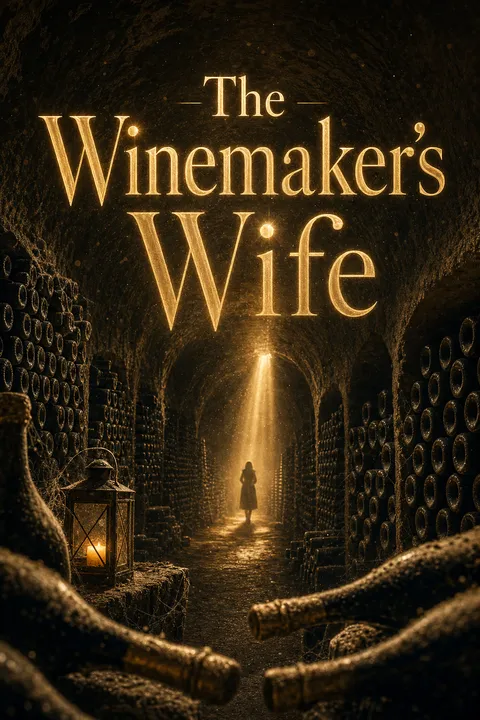


Plot Summary
A Marriage Among the Vines
Inès Chauveau1 tears along the Champagne roads in May 1940 to tell her cautious older husband, Michel,3 that the Germans have crossed into France. In the chalk cellars beneath their château, Michel3 and his winemaker, Theo,6 begin walling away their finest vintages behind a concealed door guarded by a movable Madonna statue.
Married barely a year, Inès1 already feels like a decoration: clumsy at bottling, ignored at dinner, overshadowed by Theo's6 capable, half-Jewish wife, Céline.2
Michel,3 who once promised she would never lift a finger, now grows impatient with her failures and colder by the season. War hardens what was already brittle. Inès1 wanted, for once, to be the one delivering news that mattered, but even her warning lands as proof of her smallness.
Harmel opens on a marriage curdling from fairy tale into confinement, using the occupation as accelerant rather than cause. Inès's speeding car and her petty craving to matter establish the novel's central psychology: validation-hunger in a woman denied any meaningful role. The cellars, cool and labyrinthine, are introduced as both sanctuary and moral maze. The contrast between Inès's flightiness and Céline's competence is deliberately weaponized, priming a rivalry that will metastasize. Beneath the domestic friction runs a larger question the book keeps asking: when history bears down, does character reveal itself or deform under pressure? The answer, for everyone here, will be devastatingly both.
The Grandmother's Sudden Summons
Seventy-nine years later, Liv Kent4 signs her divorce papers in New York. Her husband, Eric,14 abandoned her after failed fertility treatments, taking up with a younger colleague and leaving her jobless, childless, and unmoored.
Into this wreckage sweeps her imperious, martini-loving grandmother, the Chanel-clad Grandma Edith,5 who announces they are flying to Paris that very afternoon. In Paris, then in Reims, the old woman behaves strangely: slipping out alone, meeting a handsome lawyer named Julien Cohn11 whose firm has served her family for seventy years, refusing to explain why any of it exists.
Liv,4 worried and bewildered, senses her grandmother5 is chasing ghosts. Edith5 insists that the past shows you things whether you want it to or not, but she will divulge them only in her own time.
The modern strand opens on erasure: Liv has been slowly deleted from her own life by a self-serving husband, mirroring how war will erase others in the historical thread. Grandma Edith functions as both engine and enigma, her brittle wit a lacquer over something unspeakable. Harmel plants deliberate mysteries (why Reims, why a seventy-year legal relationship, why the secrecy) that convert reader curiosity into narrative propulsion. The pairing of a grieving young woman with a haunted ancient one suggests the book's thesis: identity is inherited and reclaimed. Edith's aphorism about the past reframes the entire dual timeline as a delayed, reluctant confession.
The Boots Overhead
In June 1940, German soldiers roll into Ville-Dommange and strip the Chauveau estate bare, hauling off furniture, food, and crates of champagne while Michel3 counsels total submission.
The officer in charge, the mustached Hauptmann Richter,10 lingers over Céline,2 who secretly understands his German muttering but plays deaf, and departs with a threat that they will meet again. Céline,2 whose father and grandparents remain trapped in Burgundy, dreads what occupation means for Jews, though Inès1 breezily insists France will keep them safe.
Thrown together sliding wine crates through the tunnels, the two women remain wary strangers rather than allies. Michel's3 philosophy of quiet endurance keeps them alive for now, but the invasion seeds humiliation, dread, and a personal menace that will circle relentlessly back to Céline.2
Occupation arrives not as abstraction but as inventory theft and a leering officer, rendering tyranny intimate and bodily. Richter's fixation on Céline transforms geopolitics into predation, foreshadowing how vulnerability will be exploited privately. Céline's concealed German is a small, potent act of resistance-as-observation that anticipates the brasserie's espionage. Inès's cheerful denial that Jews are in danger is the book's portrait of comfortable obliviousness, the willful blindness Harmel repeatedly indicts. Michel's submission strategy exposes the excruciating calculus of survival under occupation: dignity traded for time. The scene establishes stakes that are simultaneously civilizational and horribly specific, ensuring later violence feels inevitable rather than gratuitous.
The Barrels Full of Rifles
As quotas from the German wine overseer13 squeeze the region, Michel3 briefly lands in prison for shipping the Nazis dirty, mislabeled bottles, returning defiant and quoting de Gaulle. His resentment sharpens into action.
One frozen February night in 1942, Inès1 follows a wash of lamplight into the caves and finds Michel3 with a scarred stranger, wine barrels pried open to reveal dozens of rifles. He has been running arms for the Resistance and never trusted her with the secret.
Their argument strips the marriage bare: he shields Céline2 because she is endangered, while dismissing Inès1 as safe, shallow, and self-absorbed. Watching him, Inès1 wonders whether he loves her at all, and later glimpses, through a kitchen window, a warmth between her husband3 and Céline2 she cannot unsee.
Michel's radicalization reframes heroism as a jealous exclusion: his courage becomes another way of leaving Inès outside the door. Harmel complicates the noble résistant by showing how principled men can wield righteousness as intimacy withheld. The rifles literalize danger while the withheld trust wounds more deeply than any weapon. Inès's dawning suspicion of Michel and Céline introduces the affair as dramatic irony long before its confirmation, letting dread accumulate. The section interrogates the relationship between political and marital fidelity, suggesting both men in the house betray their wives through neglect while congratulating themselves on higher purposes. Inès's isolation is now weaponized loneliness, primed to seek relief anywhere.
Loose Lips and a Lover
Fleeing her cold house, Inès1 drives to Reims to see Edith,7 her childhood friend from Lille, who runs the Brasserie Moulin with her husband Edouard.8 Inès1 is horrified to find it packed with carousing Germans, until Edith7 confides the truth: they serve the enemy to harvest drunken secrets for the Resistance. Yet Edith7 refuses to let Inès1 join, judging her too great a risk.
Rejected on every side and starving to be seen, Inès1 lets a silver-haired, elegantly ruthless man named Antoine Picard9 buy her champagne and praise her mind. He listens where Michel3 dismisses. Their affair begins, and only later does Inès1 grasp that Antoine9 dines with the Nazi high command, a collaborator whose flattering attention she mistook for genuine worth.
This is the pivot where Inès's need for recognition becomes morally catastrophic. Harmel stages a cruel symmetry: Edith resists by charming Germans for information, while Inès succumbs to a German-aligned charmer for validation. Same tools, opposite souls. Antoine is the perfect predator for her wound, offering the attentive listening her husband denies. The brasserie becomes the novel's theater of masks, where everyone performs allegiance they do not hold. Inès's inability to distinguish being desired from being valued dramatizes how emotional deprivation corrodes judgment. Crucially, her betrayal here is not ideological but psychological, which makes it both more forgivable and more dangerous.
The Winemaker and the Wife
Terrorized by Richter,10 who corners her alone in the cellars and paws at her, Céline2 turns toward Michel,3 who offers tenderness, a contact to trace her arrested family, and a cause worth dying for. Their bond deepens into an affair and shared underground work, hauling weapons dropped at a bend in the road with the ox-like courier Madame Gaudin.15
When Céline2 realizes she is pregnant, she confesses the child is Michel's,3 not Theo's,6 then hastily sleeps with her husband6 to disguise the timeline. Michel,3 overjoyed, dreams of a future none of them can safely have. Céline,2 half-Jewish and adulterous, carries both a miracle and a lit fuse, loving a man who was never hers to claim and betraying, however quietly, a woman who will one day save her.1
Céline's arc reframes adultery as a search for moral partnership rather than mere passion; she loves Michel because he takes the war, and her humanity, seriously. Harmel refuses easy condemnation, situating the affair inside terror, loneliness, and shared conviction. The pregnancy converts private transgression into an unconcealable future, tightening the narrative noose. Richter's assault and Michel's tenderness are deliberately juxtaposed, contrasting predation with chosen intimacy. Céline's frantic effort to deceive Theo underscores how survival demands layered lies. The section explores how people under existential threat cling to love as proof of a livable future, even when that love plants the seeds of their undoing.
A Name Carved in the Wall
In modern Reims, Liv4 pieces together fragments while Edith5 stonewalls. At the Brasserie Moulin she discovers the printed history of former owners Edouard8 and Edith Thierry,7 celebrated Resistance figures, and a 1939 photograph of a young Edith7 that unmistakably matches her grandmother.5
A restaurant manager tells her that Edith's7 dearest friend, a woman named Inès Chauveau1 of a famed champagne house, was shot as a résistante, though Inès1 had also kept a collaborator lover.9 Meanwhile Liv4 falls into easy intimacy with the lawyer Julien,11 a devoted single father, only to recoil when he kisses her, convinced his wife Delphine still lives. Every clue she gathers deepens rather than solves the puzzle of who her grandmother5 truly was.
The modern thread becomes detective work, with the brasserie's menu and photographs functioning as breadcrumbs seeded for later payoff. Harmel exploits the reader's superior knowledge: names like Inès and Chauveau ring with dread that Liv cannot yet hear. The manager's garbled account (heroine, collaborator, victim) captures how history flattens contradictory people into legends. Liv's misreading of Julien's marital status mirrors her larger pattern of assuming the worst about men and herself, a scar left by Eric. Her guilt over the kiss reveals a woman still policing her own worthiness. The chapter argues that inherited stories arrive fragmented, demanding the living reassemble their own origins.
The Cohns in the Cellar
Shaken by watching German trucks haul screaming Jewish children away in Reims, Inès1 begins doubting Antoine's9 tidy justifications. When siblings Samuel12 and Rachel Cohn flee to Edith7 with nowhere left to turn, Inès1 insists they be smuggled into the Chauveau caves, using the secret room only Michel3 and Céline2 knew existed.
Michel,3 astonished by his wife's1 initiative, and Céline2 both help conceal the pair from the unsuspecting Theo.6 After days of dread, the Cohns are moved along an escape line to Switzerland. For Inès,1 sheltering them feels like the first genuinely honest act of her life, a taste of the redemption she craves. Samuel,12 a law student, vows to repay her someday, planting a seed that will quietly flower generations later.
Inès's turn toward real courage is triggered not by ideology but by the unbearable image of stolen children, the moment obliviousness becomes impossible. Harmel tracks moral awakening as a slow accretion rather than a lightning strike. The secret room, once a lovers' hideout and arms cache, now shelters human lives, layering its symbolism into a chamber of every kind of concealment. Samuel's vow is a structural promise, a debt the narrative files away for the modern timeline's payoff. The section insists that redemption is possible yet incremental, and that a single decent act cannot yet outweigh the compromises Inès has already made.
The Champagne Bottle
Emboldened by his power, Richter10 returns and drags the pregnant Céline2 into the cellars, slashing her cheek with a knife and preparing to rape her. Inès,1 spotting them from a window, races down and smashes a champagne bottle over his skull. The two women stand guard over his slumped body until Michel3 and Theo6 return; the men finish what Inès1 began and dispose of the officer, burning bloodied clothes and scrubbing the chalk walls clean.
Theo,6 dragged into complicity against his will, demands they never speak of it again. For a few taut days it seems they might escape any consequence. Inès1 has now saved Céline's2 life and unborn child, an act of ferocious bravery that briefly, achingly, makes her feel worthy of respect.
Violence erupts from the accumulated menace, and Harmel lets a marginalized woman become the instrument of deliverance, momentarily inverting Inès's powerlessness. The bottle, emblem of celebration, becomes a weapon, condensing the book's central irony that beauty and brutality share the same cellar. Céline's scar will permanently inscribe the trauma. Theo's forced complicity draws the last uninvolved character into the web of deadly secrets, making collective doom feel structurally sealed. The scene grants Inès a genuine heroism that the tragedy will soon overshadow, deepening the pathos: she is capable of profound good, which makes her coming failure a matter of circumstance and character, not simple weakness.
Caught, and the Cost
Days later, Inès1 stumbles upon Michel3 and Céline2 making love in the caves and understands at last that the baby is his. Devastated, she flees to Reims, is brushed off by a preoccupied Edith,7 and drinks herself senseless in Antoine's9 apartment, where she pours out the story of Richter's10 killing. Antoine,9 ever the opportunist, hands the confession to the Germans, then forces himself on her the next morning.
She races home too late: soldiers are arresting Michel3 and Céline.2 Amid the chaos, the premature baby, David,16 has just been born. Inès1 screams a false confession trying to shield them, but Antoine9 has already vouched for her whereabouts. The Germans release her, and she flees into the dawn with David16 clutched against her chest.
Here the two great betrayals collide: Michel and Céline's affair, and Inès's grief-loosened tongue. Harmel constructs tragedy from psychology rather than villainy; Inès does not intend to destroy them, which makes the outcome unbearable. Antoine's cold exploitation, culminating in rape, exposes collaboration's true face beneath the charm. The simultaneity of birth and arrest fuses creation and annihilation into a single dawn. The infant David becomes the fragile thread of continuity salvaged from catastrophe. This is the novel's point of no return: a single alcohol-fueled confession converts a wounded woman into the unwitting agent of her loved ones' deaths, seeding a lifetime of guilt.
Executed at Dawn
Michel3 is shot by a German firing squad in Reims the same day he is arrested, convicted of Richter's10 murder. Céline2 is shipped east to Auschwitz, begging Inès1 with her final words to keep David16 safe. Theo,6 enraged by the affair and the betrayal it exposed, packs his belongings and vanishes south to Burgundy, refusing to denounce anyone yet wanting nothing more of any of them.
Inès,1 now the guilt-crushed guardian of another woman's child, secures scarce baby formula by blackmailing Antoine9 and spreads the lie that the infant died, hoping to erase David16 from German records. She brings the baby to Edith,7 then disappears to join armed resistance fighters, determined to earn a redemption she believes she can never truly deserve.
The catastrophe fully lands: a family annihilated by intertwined loyalties and one careless confession. Harmel refuses melodrama, letting Michel's execution and Céline's deportation register as historical routine, which is precisely their horror. Céline's dying plea transfers moral responsibility to Inès, converting the baby into both burden and penance. Inès's blackmail of Antoine and her protective lie show her ingenuity finally harnessed to good ends, too late for those she loved. Her flight to the Maquis reframes resistance as self-punishment, a search for absolution through danger. The section crystallizes the book's meditation on guilt: some debts can be labored at forever without ever being repaid.
The Tour That Broke Her
In 2019, Edith5 insists on touring the Maison Chauveau, now a flourishing house run by a trust. As the guide recounts Michel Chauveau's3 Resistance work and death, the old woman corrects him with details no tourist could know, revealing that Michel3 was executed on the rue Jeanne d'Arc, betrayed by someone he once loved. She drifts through the tunnels as if haunted by them.
Liv,4 meanwhile, learns from Edith5 that Julien's11 wife died in childbirth six years earlier; stricken with relief and shame, she calls to apologize, and the two reconcile, kissing among the vines. Edith,5 watching her granddaughter4 open to love, grows calmer and stranger at once, hinting she brought Liv4 here to confess a truth buried for a lifetime.
The tour collapses the timelines into a single space, letting the historical dead speak through the living. Edith's impossible knowledge is the moment the modern reader's suspicion hardens toward revelation. Harmel stages memory as physical haunting: the caves hold what she cannot say aloud. Liv's romantic reconciliation runs in counterpoint, suggesting the past's tragedies exist to enable the present's second chances. Edith's calm is ominous, the peace of someone approaching a decision. The section dramatizes the paradox of confession: the closer Edith comes to the site of her guilt, the more she can gesture at truth while still being unable to name her own part in it.
Two Widows, One Stolen Name
In 1945 Céline2 walks out of Auschwitz alive and returns to Ville-Dommange, only to be told Michel3 is dead, Inès1 is dead, and her baby16 did not survive. Hollowed out, she disappears into Paris, later marrying and moving to Israel, mourning a son she believes lost.16 Inès,1 meanwhile, fought with the Maquis as a fearless munitions expert.
Returning to Reims, she learns the real Edith7 was shot by Germans, and that Edouard,8 thinking Inès1 already dead, had identified the body under Inès's1 name. Grief-worn, he hands Inès1 his wife's papers7 and the child,16 then vanishes. Inès1 becomes Edith Thierry, carries David16 to America, raises him as her own, and is falsely told that Céline2 perished of tuberculosis in the camp.
Harmel delivers the twin engine of the novel's tragedy: both women survive believing the other, and the child, are gone. The identity swap resolves the modern mystery while deepening its melancholy, transforming Inès's penance into a literal erasure of self. Taking Edith's name is the ultimate act of atonement and self-punishment, living as her better, braver friend. The cascade of misinformation, each lie told for protection, ensures decades of unnecessary separation, indicting how war corrupts even mercy into loss. The section reframes survival itself as a burden rather than a victory, and sets the mechanism by which Grandma Edith's secret has festered across seventy years.
The Truth on a Bench
Having led Liv4 to the very threshold of the truth, Edith5 cannot force herself to speak it. She leaves two letters, slips out at dawn, and takes pills on a bench overlooking the vineyards, dying in the arms of the aged Samuel Cohn,12 the fugitive she once saved. Julien11 reveals the full history to Liv:4 her Grandma Edith5 was really Inès Chauveau,1 who accidentally betrayed Michel3 and Céline2 and then spent her life atoning under a dead friend's name.
Michel3 was Liv's4 true grandfather; Céline,2 his half-Jewish lover, her true grandmother. Liv4 inherits the Maison Chauveau and a fortune, and chooses to remain in Champagne, apprenticing in the family trade and building a life with Julien11 and his young daughter.
Edith's suicide is framed as a final reckoning, echoing the wartime policeman who chose death over complicity, an act she reads as belated justice against herself. Harmel makes her death an inheritance: she cannot confess, so she engineers the confession posthumously through letters and Julien. The revelation redraws Liv's entire identity, transforming a rootless divorcée into the heir of heroes and tragedy. Samuel's presence at the end closes the debt seeded decades earlier. The section argues that redemption may require both relentless labor and, finally, surrender. Liv's decision to stay converts inherited guilt into inherited belonging, honoring the dead by choosing to live fully where they could not.
The Grandmother Who Lived
A feature in Le Monde about the American heiress4 reviving her family's Resistance legacy reaches a very old woman2 living outside Tel Aviv. Recognizing Liv's4 eyes as those of her lost firstborn son,16 she travels to France with her second son, Joël.
She introduces herself as Céline Laurent,2 Liv's4 true grandmother, alive after all, the tuberculosis report merely wartime confusion. Walking the vineyards where she once loved Michel,3 Céline2 tells Liv4 she long ago forgave Inès,1 understanding the betrayal was careless rather than cruel, and that her own great sin was loving another woman's husband.3
She asks only for the chance to know her granddaughter4 now. The buried dead finally have their reckoning, and the living, at last, choose to begin again.
The reunion is the book's grace note, the one loss war does not get to keep. Céline's survival vindicates the hope that sustained her in Auschwitz and rewards the reader's grief with restoration rather than mere catharsis. Her forgiveness of Inès reframes the entire tragedy: judgment gives way to compassion, and the two rival women are reconciled across death and time through the granddaughter they share. Harmel resists sentimentality by acknowledging the irretrievable years and the son neither woman could save. The chapter insists that families are assembled from blood, choice, and endurance alike, and that acknowledging the past is the precondition for any honest future.
Epilogue
By September, as the harvest begins, Liv4 has settled into the caretaker's cottage once occupied by Céline2 and taken up the champagne trade in earnest, learning soil and blending from the veteran chef de cave, who likens her to the widow Clicquot who rebuilt an empire from grief.
She has fallen in love with Julien11 and with his young daughter, Mathilde, discovering that family is forged as much by choice as by blood. Newspaper stories and curious visitors flood the reborn house. Liv4 honors Michel,3 Céline,2 and Inès1 by finally telling the estate's true history, and she resolves, as her grandmother5 urged too late in her own life, to live with her whole heart in the present.
The closing turns inheritance into vocation: Liv does not merely own the house, she learns to make its wine, embodying continuity through labor. The Clicquot comparison links her to a lineage of women who transformed loss into legacy, universalizing the family's private resilience into Champagne's larger mythology of survival. Mathilde's presence completes Liv's arc from infertility and erasure toward a chosen family, quietly answering the wound that opened the modern timeline. Harmel frames storytelling itself as reparation: publicizing the true history restores dignity to the dead. The epilogue distills the novel's ethic, that honoring the past frees rather than imprisons, and that magic, like champagne, is made from perseverance against long odds.
Analysis
The Winemaker's Wife braids romance, wartime tragedy, and family mystery into a meditation on complicity, atonement, and the porous border between the resistant and the accommodating. Harmel's most incisive move is refusing to sort her characters into heroes and villains: Michel's3 courage is inseparable from his marital cruelty, Céline's2 admirable moral clarity coexists with adultery, and Inès,1 the book's most maligned figure, is neither collaborator nor saboteur but a lonely woman whose starvation for recognition curdles into ruin. Guilt, not villainy, powers the plot. The catastrophe hinges on a single drunken confession, an act of grief rather than malice, which lets the novel probe how ordinary emotional wounds can, under the pressure of history, produce irreversible harm. Willful blindness recurs as a moral category: Theo6 hides in his craft, Inès1 in Antoine's9 flattery, and Liv's ex-husband14 in his own comfort, and the book quietly indicts the ease of looking away. Against this, resistance appears in small, unglamorous forms, dirty bottles shipped to Berlin, secrets gleaned from drunken officers, a bottle swung in a cellar. The champagne itself operates as extended metaphor: something exquisite pressed from war-scarred, chalk-poor land, magic wrung from perseverance. The dual timeline argues that the past is not dead but inherited, that identity descends through both blood and chosen love, and that acknowledging history is the precondition for a livable future. Grandma Edith's5 decades under a dead friend's name embody atonement as self-erasure, a penance so total it consumes the self, while Liv's4 arc offers the redemptive counterweight, a woman erased by others learning to reclaim herself. The novel's final grace, a survivor's forgiveness across seventy years, insists that compassion can outlast judgment, and that the living honor the dead best by choosing, at last, to live wholly in the present.
Review Summary
The Winemaker's Wife receives mixed reviews, with many praising its historical detail and engaging storyline set in WWII France's Champagne region. Readers appreciate the dual timeline, complex characters, and insights into winemaking. Some criticize underdeveloped characters and romance elements. The book explores themes of resistance, betrayal, and redemption. While some find it compelling and emotional, others feel it lacks depth or trivializes the war. Overall, it's recommended for historical fiction fans interested in WWII and wine.
People Also Read










Characters
Inès Chauveau
Lonely young winemaker's wifeThe orphaned bride from Lille who anchors the wartime story. Raised alongside her devoted friend Edith7, she marries the older, prosperous Michel3 expecting a fairy tale and instead finds isolation, clumsy at cellar work and shut out of her husband's confidence. Her arc is driven by a corrosive need to be seen, which makes her both sympathetic and dangerous, since she mistakes attention for worth. Vain and naive at first, she proves capable of startling courage under pressure. Harmel uses Inès as a study in how loneliness and wounded pride can steer ordinary people toward catastrophic choices, and in how guilt, once acquired, can reshape and consume an entire life.
Céline Laurent
Half-Jewish winemaker's wifeTheo's6 elegant, capable wife and the daughter of a Burgundy winemaker, Céline is half-Jewish and grows increasingly terrified as the occupation tightens around her family. Serious, competent, and quietly proud, she finds no companionship in her work-obsessed husband6 and gravitates toward Michel3, who shares her moral urgency. She is defined by a fierce ethical and maternal drive, caring more about human lives than about the wine that consumes the men around her. Her love is genuine and doomed, and she bears the weight of betraying a friend1. Psychologically she embodies survival through stubborn hope, clinging to belief in a future even as nearly everything is stripped away from her.
Michel Chauveau
Principled champagne house ownerThe cautious, older heir of the Maison Chauveau who transforms from a lecturing pragmatist into a committed résistant, smuggling arms and sheltering fugitives beneath his estate. Idealistic and morally serious, he quotes de Gaulle and prizes France's honor over profit. Yet his coldness toward his wife1 and his passion for Céline2 reveal a private selfishness beneath the public bravery. He drives much of the wartime action, a man whose genuine nobility and personal betrayals are inseparable, illustrating how heroism and human failing can share the same heart.
Liv Kent
Adrift divorced granddaughterA forty-one-year-old New Yorker reeling from divorce, infertility, and the loss of career and self. Sensitive, self-doubting, and unmoored, she has spent years being slowly erased by a controlling husband14. Her journey to Champagne becomes a reclamation of identity and worth. Warm, observant, and quick to blame herself, she is drawn to the lawyer Julien11 and gradually rediscovers her capacity for hope. Liv embodies the novel's argument that understanding the past can revive a stalled present, and that belonging is something a person can still choose.
Grandma Edith
Secretive elderly matriarchLiv's4 imperious, gin-loving, impeccably dressed grandmother, ninety-nine and living in Paris, who orchestrates the mysterious trip to Champagne. Sharp-tongued, evasive, and quietly haunted, she hides profound grief and guilt beneath brittle elegance. She loves Liv4 fiercely yet holds everyone at arm's length, unable to embrace or confide. She carries a secret about the family's wartime past that she has spent decades unable to speak, and her whole late life reads as an act of restless, unfinished atonement.
Theo Laurent
Craft-obsessed head winemakerThe Maison Chauveau's gifted, Burgundy-trained chef de cave and Céline's2 husband. Consumed by his craft and blind to the war's moral stakes, he prefers to keep his head down and trust that survival lies in doing nothing. His passivity and emotional distance drive his wife2 away. Loyal to Michel3 yet fundamentally cautious, he becomes reluctantly entangled in dangerous events he never wanted and cannot forgive.
Edith Thierry
Brave brasserie-owning best friendInès's1 beloved childhood friend from Lille, who runs the Brasserie Moulin in Reims with her husband Edouard8. Warm, shrewd, and courageous, she works secretly for the Resistance, using her German-filled restaurant to gather intelligence from drunken officers. She loves Inès1 like a sister but refuses to endanger her network, forcing painful boundaries between friendship and duty.
Edouard Thierry
Weary resistance restaurateurEdith's7 husband and the brasserie's proprietor, a generous host turned careful Resistance operative. Serious and protective of his cell, he initially distrusts Inès1 and resents the risks she brings. The war grinds him down into a diminished, grief-worn keeper of dangerous secrets.
Antoine Picard
Charming Nazi collaboratorA silver-haired, worldly former government official turned collaborator who seduces Inès1 at the brasserie. Charming, manipulative, and coldly self-interested, he flatters her intelligence to possess her, dining comfortably with the Nazi high command. Beneath his refinement lies cruelty and opportunism; he treats survival as a matter of backing the winning side and people as instruments to be used and discarded.
Hauptmann Richter
Predatory German officerThe mustached officer who leads the first looting of the estate and fixates on Céline2. Educated, sadistic, and menacing, he weaponizes her Jewish identity for intimidation and sexual coercion, embodying the occupation's casual, personal brutality and the constant threat hovering over the household.
Julien Cohn
Warm lawyer and single fatherA charming, salt-and-pepper-haired lawyer in Reims whose family firm has served Liv's grandmother5 for seventy years. A devoted widowed father to young Mathilde, thoughtful and kind, he becomes Liv's4 guide through the family history and her love interest. He carries his own grief and slowly learns to move toward the future rather than remain anchored in loss.
Samuel Cohn
Sheltered fugitive turned lawyerA young Jewish law student who, with his sister Rachel, is hidden in the Chauveau cellars. Grateful and principled, he vows to repay the kindness. Decades later he becomes the trusted lawyer and lifelong friend who guards the family's secrets and its inheritance.
Otto Klaebisch
German wine overseerThe weinführer of Champagne, born to a brandy-merchant family, who enforces crushing champagne quotas for the Reich while affecting a connoisseur's civility toward the winemakers he squeezes.
Eric
Liv's self-absorbed ex-husbandAn executive who abandoned Liv4 after failed fertility treatments for a younger colleague, leaving her jobless and doubting herself, the catalyst for her arrival in France.
Madame Gaudin
Deceptively ordinary Resistance courierA stout vigneron's wife who smuggles rifles beneath her skirts and shuttles weapons through the Chauveau caves, her homely disguise the perfect cover for fearless underground work.
David
The baby who survivesThe premature infant born at the Maison Chauveau, child of Michel3 and Céline2, whose survival and protection become the fragile hinge on which the family's entire future turns.
Plot Devices
The Hidden Cave Behind the Madonna
Chamber of every concealmentDeep in the labyrinthine chalk cellars, Michel's3 family built a secret room sealed behind a false brick wall and disguised by a movable Virgin Mary statue. It first hides prized champagne from looting Germans, then becomes a cache for smuggled rifles, a refuge for the fleeing Cohn siblings12, and the private meeting place for Michel3 and Céline's2 affair. The same darkness that shelters heroism also conceals betrayal, so the room accrues layered meaning across the story. Its twisting, easily-lost passages mirror the characters' moral disorientation, and it becomes the physical stage for the novel's gravest acts of courage, love, and violence.
Dual Timeline Structure
Mystery scaffolding across erasThe novel braids 1940 to 1945 Champagne with 2019, alternating between the wartime chapters of Inès1 and Céline2 and Liv's4 present-day quest. The modern strand poses questions (who Grandma Edith5 really is, why she chose Reims, what secret she guards) that the historical strand gradually answers. Harmel withholds and releases information across the gap so that a revelation in one era recontextualizes the other, converting historical detail into present-day suspense. The braid also creates thematic rhymes between generations of women facing loss, forcing the reader to hold two ostensibly separate stories in mind until they fuse into a single inheritance.
Brasserie Moulin Breadcrumbs
Buried-past clue trailThe restaurant, its printed history, a plaque, and a 1939 photograph serve as the evidence trail Liv4 follows into her family's wartime story. Names like Thierry, Chauveau, and Inès1 surface here as tantalizing fragments long before their significance is clear, and a longtime manager supplies a garbled legend that both illuminates and misleads. The device lets Harmel dramatize how ordinary places quietly preserve extraordinary histories, and how descendants must reassemble their origins from scattered public traces rather than direct testimony, since the one person who knows5 refuses to speak.
The Drunken Confession
Accidental tragic catalystAfter discovering the affair, a grief-stricken and intoxicated Inès1 pours out the story of Richter's10 killing to the collaborator Antoine9. This unintended confession is the pivot on which the entire catastrophe turns, converting a wounded woman into the unwitting instrument of her loved ones' arrest and destruction, and seeding the lifelong guilt that defines her subsequent existence. Harmel uses it to argue that tragedy often springs from psychology and circumstance rather than villainy, making the outcome both more forgivable and more devastating.
The Stolen Identity
The uniting central twistAfter the war, believing herself already declared dead, Inès Chauveau1 assumes the name and papers of her killed friend Edith Thierry7, becoming the Grandma Edith5 of the modern timeline and raising the orphaned baby David16 as her own in America. This swap is the hinge that binds the two eras and explains the decades of secrecy, the trust that preserves the estate, and Liv's4 true parentage. Living under a dead heroine's name functions simultaneously as protection, penance, and self-erasure, dramatizing atonement taken to the point of surrendering one's very self.
About the Author
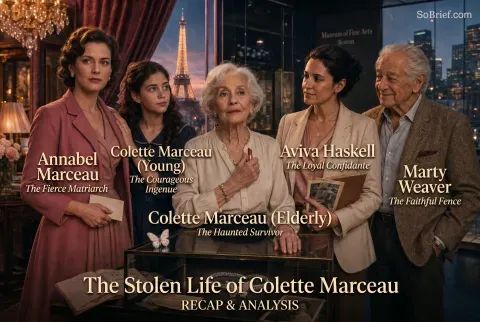



Download PDF
Download EPUB
.epub digital book format is ideal for reading ebooks on phones, tablets, and e-readers.








































