

Key Takeaways
Your urge to rescue is really an attempt to heal your own childhood wounds
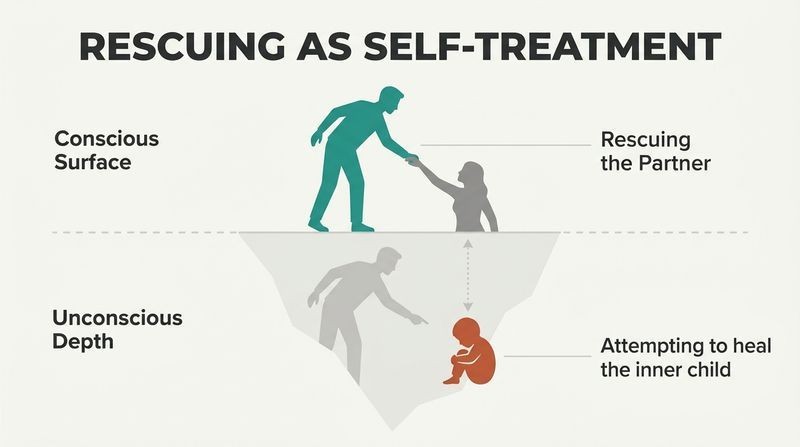
Rescuing is self-treatment in disguise. The white knight is a person who compulsively seeks out needy, wounded, or vulnerable partners and rides to their rescue, over and over. Lamia and Krieger, two clinical psychologists, argue this pattern is not generosity but an unconscious strategy: by slaying a partner's metaphorical dragons, the white knight is really trying to slay the dragons from their own past.
The wound sets the trap. White knights typically carry a history of loss, abandonment, trauma, or a caregiver whose suffering they absorbed. They hope a grateful, adoring partner will finally repair their damaged sense of self. Instead, their choice of partner and how they treat that partner tends to replay the exact childhood distress they fled, leaving them defeated rather than healed.
What's striking is how this reframes codependency as a repetition compulsion, Freud's idea that we unconsciously recreate unresolved conflicts hoping for a better ending. Modern attachment research echoes this: our earliest bonds become templates we project onto adult partners. The insight resists the flattering self-image of the selfless helper. It asks an uncomfortable question: whose need is actually being served? One caution: not all helping is pathological, and the book knows it. The diagnostic line is compulsion and repetition, not kindness itself. Readers prone to guilt should avoid pathologizing ordinary care as a hidden character flaw.
Healthy helpers care freely; white knights need to be needed
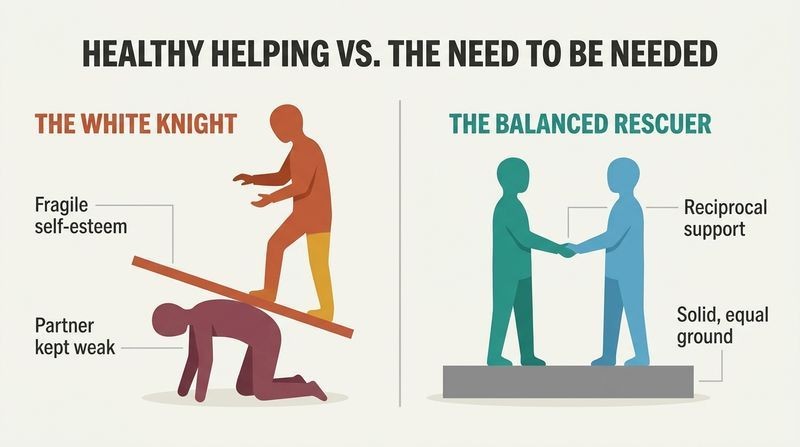
Self-esteem borrowed from another's weakness is always fragile. The book's central distinction is between the white knight, whose worth depends on a partner's helplessness, and the balanced rescuer, who helps out of genuine love and expects reciprocity. The white knight can only feel good when anticipating relief he can provide someone weaker. Tie your self-esteem to another's deficiency and it stays perpetually in jeopardy.
The balanced rescuer looks different in five ways. Consider Greg, who reshaped his work around his wife's cancer treatment but ensured she got credit for her own strengths:
1. Helps when asked and offers freely, without control
2. Delights in a partner's success rather than feeling threatened
3. Chooses a stable partner, not a project
4. Tolerates being the short-term cause of a partner's pain
5. Seeks appreciation that is actually attainable
This maps neatly onto self-determination theory, which distinguishes autonomous motivation (helping because it aligns with your values) from controlled motivation (helping to regulate your own anxiety or shame). The balanced rescuer helps from abundance; the white knight helps from deficit. A useful test the book implies: notice how you feel when your partner thrives without you. Genuine love feels expansive; the knight feels obsolete. The framing is generous rather than shaming, positioning balance as a learnable destination. What it underplays is culture: some societies valorize self-sacrifice so heavily that the line between virtue and compulsion blurs, complicating any clean diagnosis.
Kids who absorb a parent's pain become adults who cannot stop absorbing
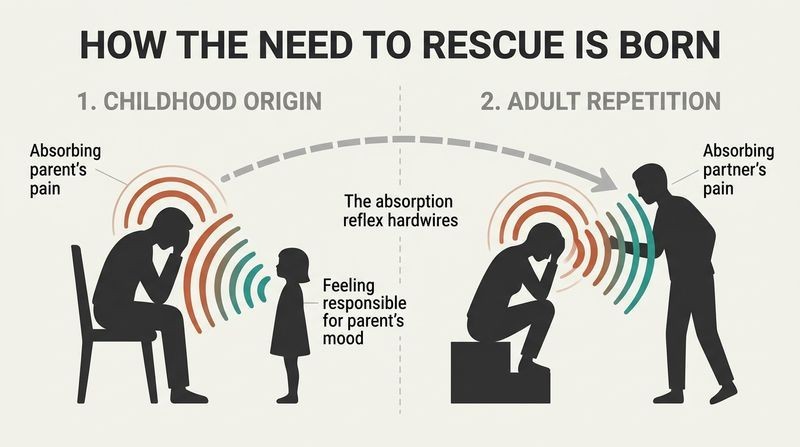
Empathy develops early, and sometimes too well. The authors trace white knighthood to childhood, where a sensitive child reads a caregiver's distress before having the maturity to interpret it. Such children conclude they are responsible for a parent's moods: if I am good, mother is happy; if father is sad, it is my fault. This heightened, premature empathy becomes a lifelong reflex.
Parenting style shapes the outcome. Drawing on Martin Hoffman's research, the book contrasts two disciplinary approaches. Power-assertive and love-withdrawal discipline (punishing, withholding affection) makes a child focus on what they will lose. Empathy-focused discipline, where a parent explains how a child's behavior affected a sibling, builds an internal, other-directed conscience. Little Andrew, who played Superman in therapy and later rescued suicidal classmates, learned he was responsible for his emotionally unstable mother's wellbeing.
This connects to research on parentification, where children take on caregiving roles beyond their developmental stage, a pattern linked to later anxiety, over-functioning, and difficulty receiving care. The book's nuance is valuable: empathy is not the villain. The problem is empathy fused with an inflated sense of causal responsibility. Cognitive science calls this an egocentric bias in attribution, common in young children who cannot yet separate correlation from cause. The practical implication is subtle. You cannot un-learn sensitivity, but you can update the false childhood belief that other people's feelings are your fault. That belief, not the empathy, is the target.
There are three broken knights: the overly empathic, the tarnished, and the terrifying
One compulsion, three flavors of pain. The authors sort unhealthy rescuers by their dominant fear:
1. The overly empathic white knight fears emotional distance. Driven by guilt and worry, she over-helps to stay close. Betsy funded her boyfriend's stalled career and could not leave despite her misery.
2. The tarnished white knight fears his own inadequacy being exposed. He idealizes and eroticizes partners to glorify himself, then devalues them. Brad praised other women's bodies while his wife battled bulimia.
3. The terrorizing/terrified white knight, shaped by the most severe abuse, controls through fear, jealousy, and sometimes violence. Brenda hurled her boyfriend's device from a moving car.
Subtypes are clusters, not cages. People overlap and can shift between them as they gain insight, which matters for the hope of change.
The typology's strength is clinical texture, but a smart reader should treat it as a heuristic rather than a taxonomy. The three types correspond loosely to recognized personality organizations: dependent, narcissistic, and borderline. That mapping gives the framework empirical grounding but also its main risk, which is armchair diagnosis of oneself or a partner. The book's escalating severity, from guilt-driven over-helping to physical abuse, usefully clarifies that these are points on a spectrum of the same underlying dynamic: self-esteem propped up by a weaker partner. The terrorizing type stretches the sympathetic frame, since here rescuing shades into abuse that no explanation should excuse.
You are unconsciously drawn to partners who resemble the parent who hurt you
Chemistry is often trauma recognition. The book argues attraction has a neurobiological basis, with early caregiver relationships stored as implicit memories in the limbic system. These buried templates make certain people feel magnetic. Betsy chose Phil, who was gentle and dream-filled like her father, and later revealed himself entitled and blaming like her mother.
The familiar feels like home, even when home was harmful. Ron, a psychologist, repeatedly chose depressed, vulnerable women, unconsciously reenacting his role as listener to his traumatized mother. When his wife recovered and no longer needed rescuing, he felt useless and drifted toward a new woman in crisis. The pattern reveals the trap: the knight seeks a partner similar enough to the wounding caregiver to promise healing, yet that similarity guarantees the old wound reopens.
This is the Imago theory of Harville Hendrix rendered in psychoanalytic terms: we seek partners who match a composite image of our caregivers in hopes of rewriting the ending. Neuroscience lends partial support through implicit memory and emotional priming, though the specific limbic imprinting story is more metaphor than settled mechanism. The deeper wisdom is behavioral: what feels like destiny is often recognition of the familiar. This suggests a countermeasure. When a new person feels instantly, overwhelmingly right, treat that intensity as data to examine, not a green light. Calm and stable can feel boring precisely because it is unfamiliar, and that discomfort is worth tolerating.
Every rescuer secretly picks the rescued: neediness is the qualification, not a coincidence
The partners fall into two camps. The book classifies the rescued as either the helpless rescued (passive, needy, weak) or the rapacious rescued (covertly predatory beneath a seductive surface). The helpless include the depressed, the dependent, the self-defeating, and the anxious worrier. The rapacious include the depleting needy, the exotically unstable, the self-centered, and the rigid perfectionist.
The rescued do the choosing too. A dependent partner's clinginess flatters the knight's judgment. A self-defeating partner like Phil helps you constantly while sabotaging himself, making you feel indispensable, then defeated. Crucially, roles blur: the apparent rescuer may actually be the one being rescued. What defines white knighthood is not who looks weaker but the compulsion to seek out neediness again and again.
The catalog of rescued types reads like a field guide to the personality-disorder spectrum, and its practical value is pattern recognition across relationships. The most useful move here is the reversal: asking whether the seemingly strong partner is quietly propping up a fragile self behind the caregiving. This resonates with systems thinking in family therapy, where two people unconsciously collude to keep an equilibrium, each needing the other's role to sustain their own. A limitation worth flagging is the labeling risk. Sorting a real, complex partner into a subtype can harden contempt rather than compassion. The book's own reminder that no one is a pure type is the safeguard.
Idealizing, devaluing, and controlling are armor, not love
Anxiety, guilt, and shame trigger the defenses. When the knight's fragile self feels threatened, automatic self-protections kick in, all involving some distortion of reality:
1. Idealizing: inflating a partner (or yourself) far beyond reality
2. Devaluing: shrinking a partner to escape your own envy or inadequacy
3. Controlling: managing a partner's feelings to feel secure
4. Anger: masking fear, guilt, or helplessness
5. Withholding empathy: understanding a partner's pain yet refusing to respond
The last point overturns a myth. The book insists that people who seem to lack empathy usually have it and are simply unwilling to show it, because feeling it would expose their own weakness. Tom could weep at a news story about a missing child yet stay coldly critical of his own wife.
The distinction between inability and unwillingness to empathize is the chapter's sharpest contribution, and it aligns with contemporary affective neuroscience that separates cognitive empathy (understanding another's state) from empathic concern (caring enough to act). Many people the world calls callous are flooded, not empty. Feeling the other's pain threatens a shaky self, so they defensively shut the valve. This has real therapeutic implications: the fix is not teaching empathy but reducing the shame that makes empathy feel dangerous. The framework also usefully names controlling behavior as anxiety management rather than malice, though victims of that control rightly care more about impact than intent.
Shame makes you attack; guilt makes you apologize too much
Two different inner critics drive two different knights. The book draws a precise line. Guilt concerns behavior that violated your moral code and pushes you to confess and make amends. Shame concerns a defective quality of the self and makes you want to hide or disappear. The overly empathic knight is guilt-driven, over-apologizing and accepting blame that is not hers. The tarnished and terrorizing knights are shame-driven, and shame is far more dangerous.
Shame turns outward as rage. Because admitting fault feels like exposing a fundamental inadequacy, shame-prone people rarely apologize sincerely. Instead they externalize: they get angry, blame the victim, or offer pseudo-apologies like sorry you feel that way. The book notes that abusers often carry childhood histories of having been shamed and humiliated, converting unbearable shame into aggression against others.
This tracks decades of research by June Tangney and others showing guilt is generally adaptive while shame predicts aggression, defensiveness, and poorer relationships. Guilt says I did a bad thing; shame says I am a bad thing, and the second is intolerable, so it gets ejected onto others. The pseudo-apology taxonomy is quietly practical, giving readers language to detect insincerity in themselves and partners. The actionable frontier the book gestures toward: building enough self-worth that a mistake feels survivable rather than annihilating. When failure is not identity-threatening, genuine accountability becomes possible. The overly empathic reader faces the opposite task, learning that being the short-term cause of pain is sometimes necessary.
Trapped in the armor is a frightened child who wanted rescuing himself
The hero and the helpless child are the same person. One patient dreamed of a fallen knight in armor; peering through the helmet's eye slits he found a tender, frightened little boy who could not get out. The image captures the book's emotional core. The knight shows the world a courageous rescuer while hiding a needy, vulnerable self underneath. The whole performance exists to keep that inner child concealed.
Rescuing others is the closest the knight gets to being rescued. Because the knight cannot ask for care directly, he gives to a partner the exact validation, empathy, and protection he secretly craves, hoping it will boomerang back. It rarely does. The dreamer had a depressed, volatile mother whose golden boy he became, learning to hide his own longing to be nurtured.
The armored-child image is the book's most resonant metaphor and connects to Winnicott's idea of the false self, a protective persona built to please a caregiver while the true self hides for safety. The knight's tragedy is structural: the armor that protects also imprisons, blocking the very intimacy that could heal. This explains why relentless givers often feel chronically unseen. They broadcast strength so convincingly that no one thinks to care for them, confirming the original wound. The therapeutic path implied is learning to voice need directly, an act that feels dangerous precisely because childhood taught that needs go unmet or invite punishment.
Stop rescuing others by mercilessly reclaiming what you projected onto them
Self-perspective is the exit. The final prescription is to observe yourself honestly and ask whose needs your rescuing actually serves. Because you treat a partner as an extension of yourself, you project your own disowned qualities onto them: your fear of inadequacy, your longing for validation, your shame. Reclaiming those projections means recognizing your partner as a genuinely separate person.
Three concrete moves. The authors offer starting points:
1. Relinquish misguided hope: accept that what you see in a partner now is what you will get, and that you cannot change them
2. Examine pathogenic beliefs: the childhood convictions (I am undeserving, vulnerability is unsafe) that you keep testing partners to confirm
3. Build agency and optimal self-esteem: influence your own life, pursue intrinsic goals, and apologize with real behavioral change rather than words
The closing framework is essentially cognitive-behavioral in spirit, targeting the pathogenic beliefs (a term from Joseph Weiss and control-mastery theory) that scripts keep reenacting. The concept of self-verification is worth dwelling on: research by William Swann shows people with negative self-views unconsciously seek partners who confirm those views, prizing consistency over happiness. That is why a knight can consciously want love yet keep choosing people who diminish them. Breaking the cycle requires the counterintuitive discipline of tolerating a partner who treats you well, which can initially feel wrong. The emphasis on intrinsic over extrinsic goals also echoes robust well-being research: connection and growth outperform wealth and image.
Analysis
The White Knight Syndrome (2009) is a psychodynamic self-help book by clinical psychologists Mary Lamia and Marilyn Krieger, built on composite case studies from decades of practice. Its structure is diagnostic: define the pattern, trace it to childhood, dissect its emotional machinery (altruism, empathy, shame, self-protection), illustrate it through three subtypes, then offer a path out via the balanced rescuer and self-reflection. The book's strength is its refusal of flattery. It treats compulsive helping not as virtue but as a symptom, an unconscious bid to repair a wounded self through a proxy.
Intellectually, the work sits at the intersection of attachment theory, self psychology (Kohut), and shame research (Morrison, Wurmser, Tangney). Its most durable contributions are the guilt/shame distinction, the claim that apparent lack of empathy is usually unwillingness born of vulnerability, and the armored-child metaphor. These reframe familiar codependency territory in fresh, clinically grounded terms. The subtype taxonomy adds texture but carries the genre's characteristic risk of encouraging amateur diagnosis, of self and partners alike.
The book's dating shows in its neuroscience. Mirror-neuron enthusiasm and limbic-imprinting claims were cutting-edge in 2009 but have since been tempered by replication debates. These flourishes are decorative rather than load-bearing; the psychodynamic core stands without them. A more serious tension is the sympathetic frame stretched over the terrorizing/terrified subtype, where explanation can edge toward exculpation of abuse. The authors partly guard against this by insisting abuse never be tolerated.
For the contemporary reader, the enduring value is a single uncomfortable question the book keeps posing: when you help, whose wound are you actually treating? That inquiry, paired with the self-verification insight that we choose partners who confirm our worst beliefs about ourselves, gives the book practical teeth beyond its clinical vocabulary. It is less about becoming a better helper than about becoming a person who no longer needs to help to feel real.
Review Summary
The White Knight Syndrome receives mixed reviews, with an average rating of 3.89 out of 5. Some readers find it insightful, helping them understand relationship dynamics and self-reflect. The book categorizes different types of "white knights" and explores how childhood experiences influence adult relationships. Critics feel the categories are oversimplified or unhelpful. Many appreciate the case studies and questionnaires provided. Some readers find it eye-opening, while others feel it lacks depth or practical advice for managing rescuing behavior.
People Also Read





Glossary
White Knight Syndrome
Compulsive need to rescue partnersA chronic, often unconscious pattern in which someone repeatedly seeks out needy, wounded, or vulnerable romantic partners and compulsively rescues them. The rescuing is driven by early-life experiences that left the person feeling damaged, shamed, or afraid, and it aims to repair the rescuer's own self-esteem rather than genuinely serve the partner.
Overly Empathic White Knight
Guilt-driven rescuer fearing distanceThe most common subtype, dominated by heightened empathy, excessive guilt, and an intense fear of emotional distance. This rescuer over-helps and worries excessively to stay needed and close, absorbs blame that is not theirs, and often feels too guilty to leave an unhappy relationship.
Tarnished White Knight
Shame-driven rescuer craving adorationA subtype who rescues partners to disguise deep feelings of shame and inadequacy formed in childhood. He idealizes and eroticizes partners to glorify himself, needs constant admiration, cannot admit mistakes, and eventually devalues or betrays partners when his fragile self-image feels threatened.
Terrorizing/Terrified White Knight
Fear-driven controlling, sometimes abusive rescuerThe most severely wounded subtype, typically shaped by childhood abuse or chaos. This rescuer controls partners through intimidation, jealousy, humiliation, and sometimes physical violence, transferring their own emptiness, shame, and fear of abandonment onto the partner while feeling powerful only when in complete control.
Balanced Rescuer
Healthy helper expecting reciprocityThe healthy counterpart to the white knight. Having a secure sense of self, this person helps altruistically and freely, chooses a capable equal partner, expects mutual give-and-take, delights in a partner's success, can tolerate causing short-term pain for long-term good, and never resorts to control or abuse.
Pathogenic Beliefs
Harmful childhood self-convictionsA term from Joseph Weiss describing unhealthy beliefs children develop about themselves and caregivers (for example, I am responsible for a parent's happiness, or vulnerability is unsafe) that harm self-esteem and social functioning. These beliefs persist into adulthood partly out of loyalty to early relationships and get repeatedly tested in adult partnerships.
Self-Verification
Seeking partners confirming self-viewA social-psychology finding (William Swann) that people seek partners who confirm their existing self-view, even a negative one, because consistency feels more stable than positive feedback. This explains why someone can consciously want love yet unconsciously choose partners who diminish them, reinforcing childhood beliefs about being unworthy.
Withholding Empathy
Understanding pain but refusing responseA self-protective maneuver in which a person genuinely understands another's feelings but deliberately does not respond with compassion. The book stresses this is unwillingness rather than inability: feeling the other's pain would expose the rescuer's own vulnerability, so they shut it off, which is different from truly lacking empathy.
Download PDF
Download EPUB
.epub digital book format is ideal for reading ebooks on phones, tablets, and e-readers.








































