

Key Takeaways
Our crises are not separate problems but one crisis of perception
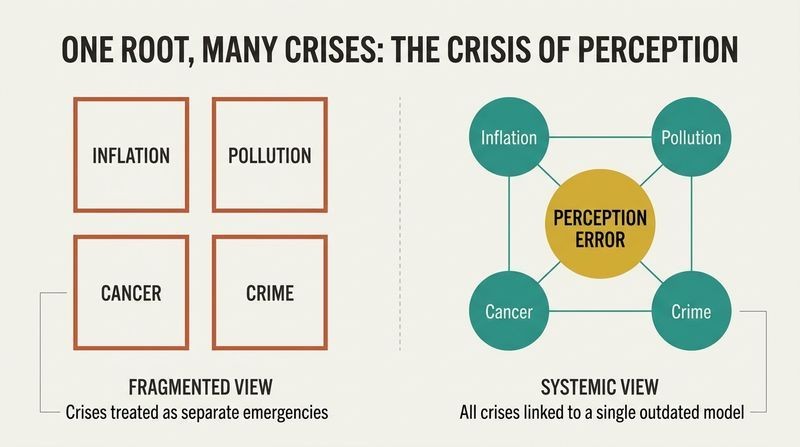
One root, many symptoms. Capra argues that inflation, energy shortages, pollution, rising crime, cancer, and psychiatric breakdown are not distinct emergencies to be solved one at a time. They are facets of a single crisis: we keep applying an outdated worldview, the mechanistic framework of Descartes and Newton, to a reality that has become globally interconnected and ecological.
A crisis of concepts. Just as physicists in the 1920s discovered their classical concepts could not describe atoms, our economists cannot explain inflation, oncologists cannot pin down cancer, and psychiatrists remain baffled by schizophrenia. The experts fail because their fragmented methods cannot grasp systemic, interdependent problems. Shifting these problems around the web (from air to water, from one nation to another) never resolves them.
Capra's diagnosis anticipates modern systems science and complexity theory, later developed at institutions like the Santa Fe Institute. What's striking is how well the framing has aged: climate change, pandemics, and financial contagion are now routinely described as coupled, nonlinear problems resisting single-cause solutions. A fair challenge is that labeling everything one crisis risks explaining nothing, since a theory that fits all facts is hard to falsify. Yet the practical payoff holds: interventions that ignore feedback between systems (subsidizing fuel while fighting pollution) reliably backfire, a pattern documented across policy failures for decades.
Physics abandoned the world-as-machine; every other science should follow
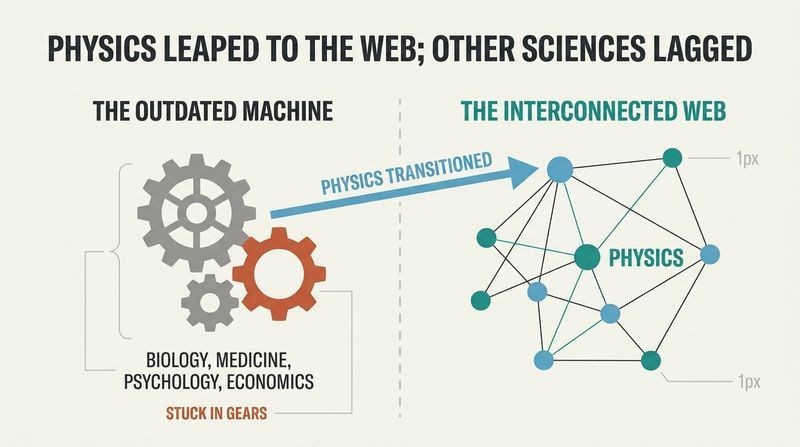
The machine metaphor was built, then broken. Between 1500 and 1700, Copernicus, Galileo, Descartes, and Newton replaced the organic medieval cosmos with a clockwork universe of separate parts governed by exact mathematical laws. This paradigm made engineering triumphs possible, from steam engines to moon landings.
Twentieth-century physics dissolved it. Quantum theory revealed that subatomic particles are not solid building blocks but probability patterns, interconnections in a web that includes the observing mind. Relativity fused space and time and showed mass is a form of energy. The universe now appears as one indivisible, dynamic whole. Capra's point: biology, medicine, psychology, and economics still cling to the mechanistic model that physics itself has outgrown.
The historical claim is sound and elegantly told, but the leap from physics to social science deserves scrutiny. Quantum nonlocality operates at subatomic scales and does not straightforwardly license holistic economics; critics like physicist Victor Stenger argued Capra overextends the analogy. Still, the deeper methodological lesson survives: reductionism is a tool, not a metaphysics. Systems biology, network neuroscience, and ecological economics have since vindicated Capra's call to study relationships and organizing principles rather than isolated parts, even without invoking quantum mechanics as justification. The mistake is treating physics as proof rather than as inspiration.
Our culture overfeeds yang and starves yin, causing cultural imbalance
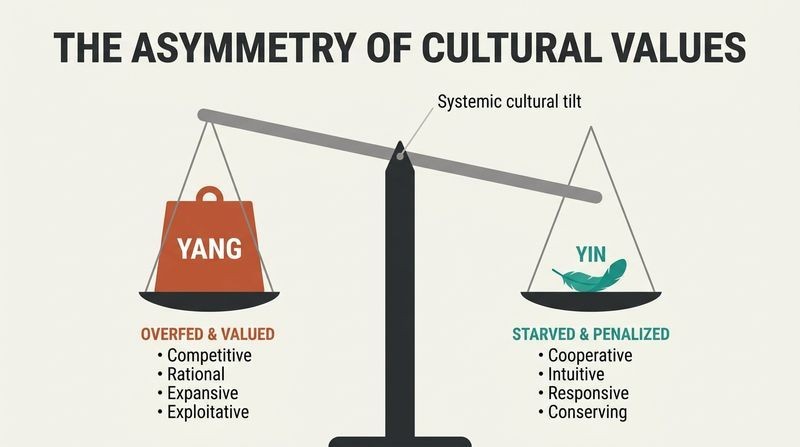
Two complementary poles, not moral opposites. Borrowing from Chinese thought, Capra uses yin and yang to map cultural values. Yang is expansive, competitive, self-assertive, rational, and analytic. Yin is responsive, cooperative, intuitive, and synthesizing. In Chinese philosophy, health is the dynamic balance between them, and sickness is imbalance, not one pole itself.
The West chose one side and called it virtue. Reinforced by patriarchy and three centuries of what sociologist Pitirim Sorokin called sensate culture (matter as the only reality), our society consistently rewards yang: science over intuition, exploitation over conservation, competition over cooperation. Capra links this even to how work is paid, with nurturing, integrative labor (nursing, homemaking) ranked lowest.
The yin-yang lens is evocative but carries real risk of essentialism, mapping intuition and cooperation onto the feminine and analysis onto the masculine, which can reinforce the very stereotypes Capra elsewhere criticizes. He hedges by noting both qualities exist in everyone, echoing Jung's anima and animus. The stronger, defensible core is his claim about balance: research on organizational resilience and ecological stability consistently shows that pure optimization of a single variable (efficiency, growth, control) reduces adaptability. Diversity and redundancy, the yin virtues, are now recognized as prerequisites for robust systems, from portfolios to rainforests.
Living things are self-organizing systems, not machines to be repaired
The core distinction. A clock is assembled from fixed parts and its structure determines its activity; when it breaks, one cause is found. An organism grows, continually renews its own components, and its processes determine its structure. Capra calls this self-organization, with two engines: self-renewal (recycling components while keeping overall integrity) and self-transcendence (reaching creatively beyond itself in learning and evolution).
Wholes within wholes. Every living system is a holon (Arthur Koestler's term), simultaneously a self-assertive whole and an integrative part of a larger whole. Cells form tissues, tissues form organs, organisms form ecosystems. Health at one level produces balance at the level above. The pancreas replaces most of its cells daily; you replace nearly all your cells within years, yet remain recognizably yourself.
This is the book's intellectual spine and it has aged remarkably well. Ilya Prigogine won the 1977 Nobel for dissipative structures, systems that maintain order by exchanging energy far from equilibrium, exactly the framework Capra popularizes. The living-systems view now underpins autopoiesis theory (Maturana and Varela), network biology, and even organizational design. One nuance worth adding: self-organization does not mean systems lack constraints or that any intervention is holistic. Genes, though embedded in context, do impose powerful boundary conditions, a point Capra sometimes underplays in his enthusiasm to dethrone genetic determinism.
Health is dynamic balance and flexibility, not the mere absence of disease
Redefining health. Because a living system stays alive through constant fluctuation, health is not a static state of perfection but an ongoing, flexible balance across physical, psychological, and social dimensions. Flexibility means having many options for interacting with the environment. Lose flexibility, lose health.
Three interdependent levels. Capra insists individual, social, and ecological health rise and fall together. What sickens the ecosystem sickens the society and the person. He draws on Hippocrates, who saw health as equilibrium among environment, lifestyle, and human nature, and classical Chinese medicine, where illness is disharmony and the physician's job is to nudge the body back toward its own balance using the gentlest possible therapy.
Capra's stress-centered, flexibility-based model prefigures decades of research. Heart rate variability, literally the flexibility of cardiac rhythm, is now an established marker of health, with lower variability predicting mortality, exactly as his framework predicts. Allostatic load theory (Bruce McEwen) formalized his intuition that chronic stress accumulates biological cost. Where caution is warranted: defining health as balance can shade into vagueness that resists measurement, and traditional systems he admires sometimes lacked the diagnostic precision biomedicine provides. The mature position, which Capra ultimately endorses, is integration rather than replacement of the biomedical model.
Illness carries a message; suppressing symptoms can just reroute the sickness
Symptoms versus origins. Biomedicine confuses disease processes (the mechanism) with disease origins (why it occurred). It asks how a disease operates so it can interfere, rather than why it happened so it can be removed. Prolonged stress, Capra argues, is channeled through an individual's particular personality to produce a specific disorder.
Blocking one exit opens another. If illness is one of several unhealthy ways of coping with an unlivable situation, then curing the physical disease while the stressful situation persists may simply shift the response into mental illness, addiction, or violence. As a doctor friend tells Capra, reducing physical illness while increasing crime or madness is no victory. True therapy uses illness as an opportunity for introspection and change.
The claim that personality funnels stress into specific diseases was the boldest and most contested part of this view. The Type A hypothesis for heart disease had genuine support, but the cancer-prone personality that Capra cites (via Lawrence LeShan) has largely failed replication, and psychologist James Coyne has shown emotional state has little effect on cancer survival. This is where the book most risks blaming patients for their illness, a danger Capra acknowledges but does not fully neutralize. The durable insight is subtler and well-supported: symptom suppression without addressing upstream social and psychological causes produces symptom substitution and recurrence.
The mind can heal the body, proven by the 35% placebo response
Psychosomatic runs both ways. If mental states help cause illness, they can help cure it. Capra points to the placebo effect: roughly 35% of patients get satisfactory relief from a dummy pill across a wide range of conditions, driven purely by positive expectation and trust in the therapist. He notes medical history is arguably the history of the placebo effect.
Expectation as medicine. The inverse also holds: a doctor who tells a patient they have six months to live can make that prophecy come true, a near-magic spell on the mind-body system. Capra folds together three terms medicine used dismissively, placebo effect, psychosomatic, and spontaneous remission, arguing they all name one real phenomenon: the healing power of mental attitude.
Placebo research has exploded since Capra wrote, and it vindicates his core claim while complicating it. Ted Kaptchuk's Harvard work shows placebos work even when patients know they are placebos, and neuroimaging reveals real endorphin and dopamine release. The effect is genuine but domain-specific: it reliably modifies pain, nausea, and subjective symptoms, far less so tumors or infections. Capra slightly overstates by implying broad curative power. The actionable core is solid and underused in practice: the therapeutic relationship, framing, and expectation are active ingredients, not window dressing, which is why communication training now matters in clinical outcomes.
Economists mistake money for reality and growth for health
A discipline frozen and blind. Capra charges that economists treat the economy as isolated from its ecological and social fabric, use money as the only variable, and worship undifferentiated growth. They freeze the economy in its current structure instead of seeing it evolve. Ten dollars of coal equals ten dollars of bread, with no distinction between renewable and nonrenewable, useful and wasteful.
Hidden costs, false accounting. Social and environmental costs get labeled externalities and ignored, while cleanup, litigation, and disease treatment are added to GNP as if they were gains. Capra draws on Hazel Henderson's entropy state (bureaucratic maintenance costs eventually exceeding productive capacity) and Schumacher's small is beautiful to argue for scale, decentralization, and thermodynamic rather than monetary efficiency.
This chapter reads as a founding document of ecological economics, later formalized by Herman Daly (steady-state economics) and Kate Raworth (doughnut economics). Capra's attack on GNP anticipated the Genuine Progress Indicator and today's Beyond GDP movement at the OECD and UN. His critique of externalities is now mainstream, embedded in carbon pricing debates. Where he overreaches: dismissing mathematical modeling wholesale throws out genuinely useful tools, and his prediction that fossil fuels would force imminent transition underestimated both new reserves and market adaptability. The framework is prophetic; the timeline was optimistic, a recurring feature of paradigm-shift literature.
Nuclear power fuses energy and domination into one existential threat
Two meanings of power, inseparably linked. Every reactor produces 400 to 500 pounds of plutonium a year, enough for 20 to 50 bombs, so reactor technology and weapons technology cannot be divorced. Plutonium stays toxic for at least 500,000 years, more than a hundred times longer than recorded history, and one pound evenly distributed could induce lung cancer in everyone on earth.
Power that centralizes power. Capra argues nuclear energy is favored not because it is safe, clean, or cheap (it is none) but because it concentrates political and economic control in a small elite through complex, secretive, capital-intensive technology. The deepest driver is an obsession with control, the yang tendency pushed to a pathological extreme, making nuclear the ultimate expression of the mechanistic mindset.
Written near Three Mile Island, this reflects the antinuclear conviction of its moment, and history has partly complicated it. The proliferation link is real (civilian programs seeded several weapons states), but the safety record of nuclear power, measured in deaths per unit of energy, is actually among the lowest of any source, better than coal by orders of magnitude. In an era of climate urgency, many former critics now see fission as a necessary low-carbon bridge. Capra's structural insight endures regardless: energy technologies embed political forms. Centralized systems concentrate power; distributed ones (his beloved solar) diffuse it. That link between infrastructure and governance is his lasting contribution.
Map the psyche as a spectrum, not a single battleground
No one theory owns the mind. Capra applies a bootstrap approach: rather than one master theory, use a network of models, each valid for a band of consciousness. Ken Wilber's spectrum runs from ego to biosocial to existential to transpersonal levels, each with its own therapy. Stanislav Grof's cartography maps psychodynamic (biographical), perinatal (birth-and-death), and transpersonal domains.
Jung over Freud. Capra credits Freud with discovering the unconscious but faults his Newtonian mechanics of clashing instinctual forces. Jung's self-organizing psyche, collective unconscious, and acausal synchronicity align better with modern physics. Mental illness, in this view, is often a failure to integrate unusual experiences, and the mystic and the schizophrenic swim the same ocean, but one swims while the other drowns.
The spectrum framing productively dissolves the tribal warfare between therapeutic schools, and integrative, pluralistic psychotherapy is now the empirical mainstream, since no single modality dominates outcomes (the so-called Dodo bird verdict). Capra's embrace of transpersonal psychology and psychedelic therapy looked fringe in 1982 and looks prescient now, with Johns Hopkins and Imperial College running rigorous psychedelic trials for depression and end-of-life anxiety. The weak spot is epistemological: treating mystical experience as valid knowledge about reality, rather than valid experience, blurs a line careful researchers keep sharp. Grof's perinatal matrices in particular remain scientifically unsupported despite their clinical suggestiveness.
Think globally, act locally: scale problems to human dimensions
Two complementary rules for managing systems. First, there is an optimal size for every structure; maximizing any single variable (GNP, efficiency, a city's size) destroys the larger system. Second, the more an economy recycles its resources, the more it harmonizes with its environment. Because problems are globally interconnected yet solutions must fit human scale, Capra endorses the slogan that reconciles the two.
Soft technologies embody this. Solar collectors, wind generators, organic farming, and local food production are small-scale, decentralized, labor-intensive, and renewable. Capra cites the finding that during the 1970s most new European energy came not from any power source but from conservation, from millions of individual efficiency measures adding up to twenty times the output of the nuclear program.
The conservation-as-energy-source insight, drawn from Amory Lovins, has been overwhelmingly validated: efficiency (the negawatt) remains the cheapest and largest energy resource decades on, central to every serious decarbonization plan. The scale principle resonates with Elinor Ostrom's Nobel-winning work showing that local, polycentric governance manages common resources better than either pure markets or central states. The tension Capra underweights is that some challenges (pandemics, atmospheric carbon, semiconductor supply chains) genuinely require large-scale coordination, and romanticizing smallness can hamstring them. The sophisticated reading is balance: match the scale of the solution to the scale of the problem, not a blanket preference for small.
Cultures decline when they grow too rigid to adapt
The rhythm of civilizations. Drawing on Toynbee, Sorokin, and the I Ching, Capra sees cultures move through genesis, growth, breakdown, and disintegration. Breakdown comes from loss of flexibility: when institutions become too rigid to meet new challenges, harmony collapses into discord. Crucially, during decline two dramas play out at once. The dominant minority rigidly rehearses its own defeat while creative minorities generate fresh responses.
We are at the turning point. Three transitions coincide: the slow decline of patriarchy, the end of the fossil-fuel age, and the paradigm shift from mechanistic to ecological thinking. The declining culture (established parties, obsolete corporations, hospital-based medicine) clings harder as it disintegrates, while the rising culture of social movements prepares to assume leadership. Transformation, Capra insists, cannot be prevented, only made more or less painful.
The rise-and-fall schema is seductive but methodologically shaky; Toynbee's cyclical history has been heavily criticized for cherry-picking and unfalsifiability, and predicting an imminent turning point is a perennial move that rarely dates well. Four decades on, the mechanistic institutions Capra pronounced dying (large corporations, centralized medicine, GDP-driven politics) remain dominant, suggesting paradigms are stickier than the model allows. Yet the core mechanism, that rigidity kills adaptive systems, is robust across biology, organizational studies (Clayton Christensen's disruption), and ecology. The honest reading treats this less as prophecy and more as a warning: institutions that cannot bend to new conditions eventually break.
Analysis
The Turning Point is a work of intellectual synthesis rather than original research, and its ambition is its defining feature. Capra, a physicist trained in the quantum revolution, attempts to export the conceptual shift he witnessed in his own field to biology, medicine, psychology, economics, and politics. The unifying claim is that a single obsolete paradigm, the Cartesian-Newtonian machine, underlies failures across all these domains, and that a systems or ecological worldview is emerging to replace it.
The book's greatest strength is timing and pattern recognition. Writing in 1982, Capra assembled ideas that were then marginal (ecological economics, systems biology, integrative medicine, transpersonal psychology, renewable energy, feminist critique) and showed their kinship years before they became institutionalized. Much has been vindicated: Prigogine's dissipative structures, the negawatt revolution in energy efficiency, Beyond-GDP economics, placebo neuroscience, and the psychedelic therapy renaissance all track his intuitions. His concept of health as flexibility anticipates heart rate variability and allostatic load research.
The book's central weakness is the load-bearing analogy itself. Capra repeatedly uses quantum nonlocality and observer effects to justify holism in social and biological sciences, but this is inspiration masquerading as proof. Subatomic interconnection does not logically license ecological economics or psychosomatic medicine; those fields stand or fall on their own evidence. Critics such as physicist Victor Stenger rightly flagged this quantum mysticism. Capra also occasionally romanticizes premodern and Eastern systems while underselling biomedicine's genuine triumphs, and his cancer-personality claims have not survived replication.
Read correctly, the book is not a scientific treatise but a philosophical manifesto and a remarkably durable map of a civilizational transition still underway. Its enduring value is methodological humility toward reductionism and moral seriousness about interconnection. The specifics sometimes fail; the reframe, that relationships and context deserve the analytic priority we once gave to isolated parts, has become common sense.
Review Summary
The Turning Point receives mostly positive reviews for its holistic approach to science, society, and culture. Readers appreciate Capra's critique of Cartesian-Newtonian paradigms and his advocacy for systems thinking. Many find the book's ideas still relevant decades after publication, praising its interdisciplinary perspective on complex global issues. Some criticize it as dated or oversimplified, but most view it as thought-provoking and potentially transformative. Reviewers often mention the book's exploration of quantum physics, ecology, and Eastern philosophy in relation to societal challenges.
People Also Read





FAQ
What is [The Turning Point: Science, Society, and the Rising Culture] by Fritjof Capra about?
- Crisis and transformation: The book examines the multidimensional crisis facing humanity, linking nuclear threat, environmental degradation, and social disintegration as symptoms of a deeper global crisis.
- Paradigm shift: Capra argues that these crises stem from an outdated mechanistic worldview and calls for a fundamental shift to a holistic, systems-based perspective.
- Interdisciplinary synthesis: The book integrates insights from physics, biology, psychology, economics, and spirituality to propose a new ecological and feminist worldview for cultural transformation.
Why should I read [The Turning Point] by Fritjof Capra?
- Comprehensive framework: The book provides a coherent conceptual framework that links diverse social movements and scientific developments, helping readers understand the interconnectedness of global challenges.
- Philosophical depth: Capra bridges modern physics with ancient wisdom, showing how new scientific paradigms resonate with mystical traditions and offer a new vision of reality.
- Urgent call to action: The author emphasizes the necessity of embracing a new worldview to prevent ecological and social collapse, making it essential reading for those concerned about the future.
What are the key takeaways from [The Turning Point] by Fritjof Capra?
- Crisis as opportunity: The current global crisis is a turning point that can lead to cultural transformation if society adopts a holistic, ecological worldview.
- Limits of reductionism: The mechanistic, Cartesian-Newtonian paradigm is inadequate for understanding complex biological, psychological, and social phenomena.
- Systems approach: Modern science, especially physics, reveals a dynamic, interconnected universe, inspiring a systems view of life, health, and society.
- Integration of knowledge: The new paradigm blends Western science with Eastern philosophies, emphasizing balance, cooperation, and ecological awareness.
How does Fritjof Capra define the crisis in science and society in [The Turning Point]?
- Outdated worldview: The crisis arises from applying a mechanistic, reductionist worldview to a complex, interconnected reality that it can no longer explain.
- Fragmentation: This paradigm causes fragmentation in academic disciplines, government agencies, and social institutions, hindering holistic solutions.
- Need for new paradigm: Capra calls for a shift to a holistic, ecological perspective that recognizes interdependence and systemic relationships across all domains.
What is the significance of the yin and yang concept in [The Turning Point] by Fritjof Capra?
- Dynamic balance: Yin and yang represent complementary polarities—feminine/masculine, receptive/active, intuitive/rational—that together create dynamic balance in nature and human behavior.
- Cultural imbalance: Western culture has overemphasized yang qualities (rationality, competition, domination), leading to ecological and social crises.
- Restoring balance: Capra advocates valuing yin qualities (intuition, cooperation, ecological awareness), aligning with the emerging systems view of life and consciousness.
How does [The Turning Point] by Fritjof Capra critique the biomedical model in medicine?
- Mechanistic view: Medicine treats the body as a machine and disease as malfunctioning parts, neglecting psychological, social, and ecological dimensions of health.
- Reductionism limits: Focusing on cellular and molecular mechanisms ignores the integrative functions of living organisms and the healing process.
- Health crisis: Despite technological advances, health care costs soar and chronic diseases rise, revealing the biomedical model’s inadequacy for holistic health.
What are the limitations of reductionism in biology and psychology according to [The Turning Point]?
- Complex systems: Living organisms are dynamic systems whose properties cannot be fully explained by analyzing parts in isolation.
- Mind-body split: Psychology inherited Descartes’ division between mind and body, complicating the understanding of consciousness and behavior.
- Emerging holistic views: Capra highlights alternative approaches like gestalt psychology and systems biology that emphasize integration and dynamic processes.
How does [The Turning Point] by Fritjof Capra relate modern physics to the new worldview?
- Quantum mechanics: Reveals matter as interconnected probability waves, challenging classical notions of reality and causality.
- Relativity theory: Shows space and time as relative and unified, emphasizing the dynamic nature of matter-energy.
- Holistic universe: These theories support a vision of the universe as an indivisible, dynamic whole that includes consciousness.
What is the systems view of life and health in [The Turning Point] by Fritjof Capra?
- Living systems as wholes: Organisms and ecosystems are integrated, self-organizing wholes whose properties cannot be reduced to parts.
- Dynamic balance: Health is seen as a state of balance within the organism and between organism and environment.
- Multileveled organization: Life exists in stratified systems, from cells to the biosphere, each level being both a whole and a part of a larger whole.
How does [The Turning Point] by Fritjof Capra integrate Eastern and Western medical philosophies?
- Subjective knowledge valued: Eastern medicine values subjective experience and qualitative assessments, reflecting the living system's continuous flux.
- Holistic diagnosis: Traditions like Chinese and Hippocratic medicine emphasize balance and harmony within the individual and environment.
- Complementary integration: Capra suggests combining Eastern holistic concepts with Western psychological and social therapies for comprehensive health care.
What is the role of stress and the mind-body connection in health according to [The Turning Point] by Fritjof Capra?
- Stress as imbalance: Stress is an imbalance in response to environmental challenges, essential in moderation but harmful when chronic.
- Mind-body unity: Mind and body are inseparable in health and illness; psychological states can influence physical healing.
- Holistic therapy: Effective health care integrates physical, psychological, and social measures, recognizing the organism's innate self-healing capacity.
How does [The Turning Point] by Fritjof Capra envision the cultural transformation needed for the future?
- Declining and rising cultures: Society is transitioning from a rigid, mechanistic culture to an ecological, holistic one, with social movements leading the change.
- Role of social movements: Feminism, environmentalism, human potential, and ethnic liberation movements are catalysts for new values emphasizing cooperation, sustainability, and spirituality.
- New social institutions: The transformation involves restructuring education, media, health care, and political systems to support ecological awareness and holistic well-being.
About the Author
Other books by Fritjof Capra


Download PDF
Download EPUB
.epub digital book format is ideal for reading ebooks on phones, tablets, and e-readers.








































