

Key Takeaways
Technical brilliance gets you hired; trust gets you everything else
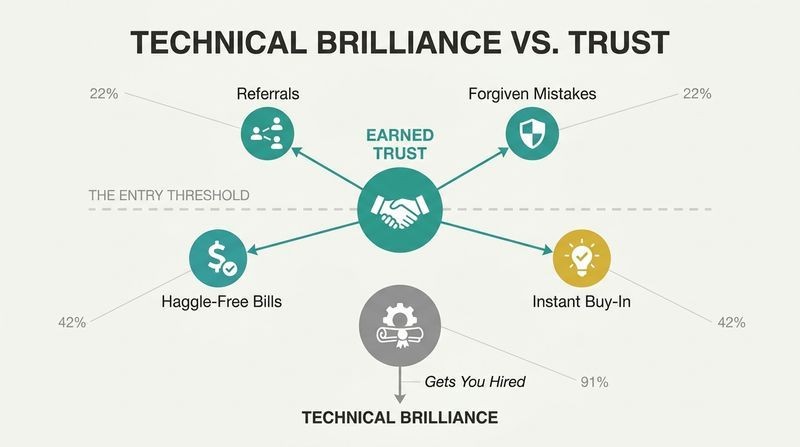
The core thesis reframes professional success. Mastering your discipline (law, accounting, consulting, medicine) is the price of entry, not the prize. What separates a merely competent expert from a trusted advisor is the ability to earn a client's confidence so completely that they bring you their problems first, before those problems even fully form.
The authors, with roughly fifty years of combined consulting experience, argue that trust unlocks concrete rewards: clients accept your recommendations, pay bills without haggling, forgive mistakes, refer friends, and protect you inside their own organizations. Yet trust is scarce. The handshake era, when reputation alone earned business, is gone. Clients now audit bills line by line and force long-term suppliers into competitive "beauty contests." Trust must now be actively earned and re-earned throughout a career.
What's compelling here is the inversion of professional-school priorities. Universities drill content mastery and treat relationship skills as fuzzy soft stuff. This mirrors research in emotional intelligence (Daniel Goleman) showing that beyond a threshold of technical competence, interpersonal skill predicts career success far better than raw IQ. One caveat worth noting: in truly high-stakes, one-shot transactions (a single complex surgery, a bet-the-company lawsuit), sheer expertise can still trump warmth, as the book's own famous surgeon anecdote shows. But for repeat, relationship-based work, the authors' claim is robust and increasingly validated by client-retention economics across professional service industries.
Trustworthiness equals credibility, reliability, and intimacy divided by self-orientation
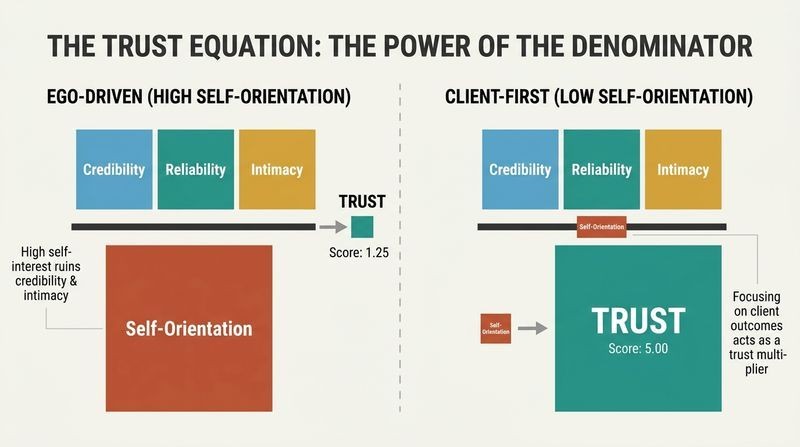
The book's signature framework is the Trust Equation: trust rises with credibility (do I believe what you say), reliability (can I depend on you to act), and intimacy (can I safely share difficult things), and falls as self-orientation (do you care more about yourself than me) rises.
Because self-orientation sits in the denominator, it is the most powerful lever. A brilliant, dependable advisor who seems chiefly interested in their own fee, ego, or being right destroys trust fast. The authors illustrate with numbers: a new client relationship might score (5+3+2)/8 = 1.25, while a seasoned one scores (7+8+5)/4 = 5, a fourfold difference that mirrors the real finding that winning new business costs four to seven times more than expanding existing relationships. Most professionals over-invest in credibility and neglect intimacy and self-orientation.
The equation's elegance is also its risk: it looks scientific but is admittedly a heuristic, not measured data. Its real value is diagnostic. When a relationship stalls despite obvious competence, the equation forces you to ask which specific variable is failing rather than vaguely trying harder. The placement of self-orientation as a divisor echoes Adam Grant's research in Give and Take, where genuinely other-focused "givers" ultimately outperform self-interested "takers." It also connects to therapeutic literature: Carl Rogers found client outcomes hinged on the counselor's empathy and unconditional regard, essentially low self-orientation plus high intimacy, more than on technique.
Give value away before you are hired, not after
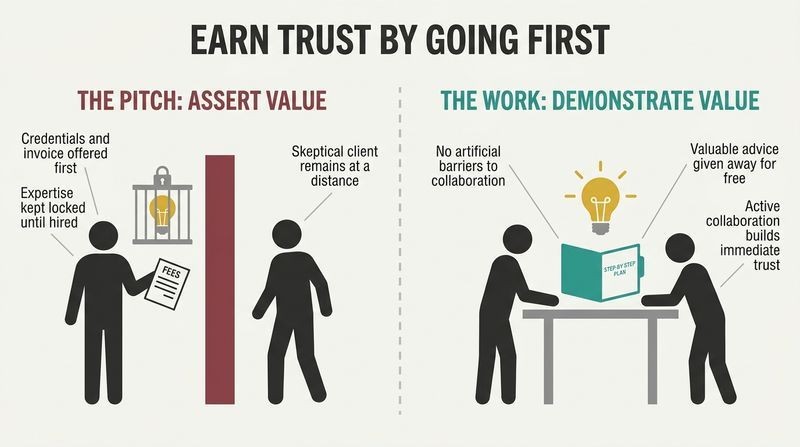
Trust is earned by going first: making a visible investment before any guarantee of return. The authors tell of hiring a lawyer to probate a will. Several candidates recited their firm's history and fees. One instead asked how much the client knew, then faxed a free step-by-step outline including phone numbers for government offices unrelated to his own legal fees. He won the business by being generous with knowledge.
The deeper principle: demonstrate, do not assert. A dentist who phoned every patient the evening after a procedure to check on their pain converted skeptics into believers not through claims but through accumulated small gestures. In sales, the best technique is to stop selling and start serving. Use a proposal meeting as the first working session so the client feels what collaboration will actually be like.
This reframes selling as generosity, which sidesteps the discomfort many experts feel about self-promotion. It aligns with Robert Cialdini's principle of reciprocity: unsolicited favors create genuine obligation. But there is a real tension the book underplays. Giving away expertise assumes abundance, that knowledge is not depleted by sharing. For pure information products this can be exploited by clients who take the free outline and walk. The safeguard is that trust-based buyers rarely behave that way, and the free sample signals confidence that competitors reciting credentials cannot match. Modern content marketing and freemium business models rest on exactly this logic.
Being right is worthless unless you are also helpful
Early in his career, David Maister was fired from a client for delivering a blunt, accurate diagnosis: here is what you are doing wrong. He was correct, and everyone knew it, yet he was dismissed as disruptive. The lesson: an advisor's job is not to win the argument but to be useful.
Advice giving is an emotional duet, not a logical solo. The authors suggest treating clients the way you would coax a beloved parent, softening implied criticism, offering reasoning rather than conclusions, and turning assertions into questions. Instead of "you must do X," walk through options together so that if the client resists, the conversation stays alive. The Socratic method matters: help clients reach the answer themselves so they own it. Maister learned this teaching statistics, when "did everyone understand?" produced silence and failure, while "have I made myself clear?" invited honesty.
The pedagogical parallel is sharp and underappreciated. Cognitive science confirms that self-generated conclusions stick far better than delivered ones, the "generation effect." The reframe from "did you understand" to "was I clear" is a masterstroke of taking responsibility, shifting the ego risk from client to advisor. One limitation: Socratic patience can frustrate action-oriented clients who explicitly want a direct answer. The authors acknowledge this, and the mature move is diagnostic flexibility, reading whether a given person wants exploration or a verdict. Being helpful sometimes means being blunt, but only after earning the right.
Master the five stages: engage, listen, frame, envision, commit
Trust builds through a repeatable sequence, each stage earning the right to the next:
1. Engage: the client concludes there is an issue worth discussing and you are worth discussing it with.
2. Listen: the client feels genuinely understood, not just heard.
3. Frame: you crystallize the messy problem into a clear, blame-free statement, often the moment value becomes visible.
4. Envision: you jointly picture the desired end state before rushing to solutions.
5. Commit: you ensure the client truly grasps and accepts what achieving the vision will require.
The near-universal failure is skipping straight to action and solutions. Framing is usually hardest and most rewarding because it blends the rational and emotional in real time. Envisioning is most often neglected, yet skipping it leaves solutions untethered from what the client actually wants.
The sequence resembles clinical practice: no competent doctor prescribes before history-taking and diagnosis. Its power is in naming the temptation everyone succumbs to, jumping to the fix, and explaining why. Experts are trained and rewarded for answers, so ambiguity feels intolerable and they fill silence with hypotheses. This connects to design thinking, which similarly insists on defining the problem before ideating solutions, and to the medical adage that a good problem statement is half the cure. The framework's weakness is rigidity risk: real conversations loop and backtrack. The authors wisely note that when commitment stalls, you back up a stage, usually to envisioning.
Name the elephant in the room, cushioned by responsibility-taking caveats
The hardest, highest-payoff skill is emotional framing: speaking the uncomfortable truth everyone senses but no one says. The authors call the technique naming and claiming, which has three parts: acknowledge how hard the issue is to raise, accept responsibility for raising it, then state it plainly.
An accountant named Ellen, delivering bad news, watched her client's face redden and knuckles whiten. Instead of fleeing, she paused and said, "You look a little angry." The client erupted, then clarified he was furious at his own staff, not her. The observation dissolved her imagined fears and deepened the bond. To lower the risk, string together caveats borrowed from TV detective Lieutenant Columbo: "It's probably just me, but..." or "I may have this wrong, but..." Add as many as the moment's tension requires, then say the unsayable.
This is the book's most psychologically sophisticated move. The counterintuitive insight is that admitting uncertainty and difficulty reduces rather than increases risk, because it signals humility and gives the other person a face-saving exit. It parallels the "pratfall effect" in social psychology, where showing vulnerability increases likability among competent people. The Columbo device is genuinely clever: feigned or genuine tentativeness disarms defensiveness. A modern connection is Kim Scott's Radical Candor, which similarly argues that caring personally earns the right to challenge directly. The caution: caveats overused become mush. The skill is calibration, just enough cushioning to overcome the fear, not so much you bury the message.
You cannot trust an institution, only a person
The authors flatly reject the phrase "institutional trust" as an oxymoron. Organizations cannot understand you; only their people can. Brand reputation may earn a firm a spot on the shortlist, but only a human being keeps it there. The old Texaco jingle even admitted this, urging drivers to trust the man wearing the star, not the star itself.
This has hard implications. Trust is personal, largely non-transferable, and two-way: unlike love or respect, which one person can feel unilaterally, trust requires the client to participate and reciprocate. You cannot force it, and you must sometimes choose carefully whom to build it with. It also means firms cannot advertise their way to trust. It lives entirely in the interactions between individual advisors and individual clients, which is precisely why cross-selling a colleague into a relationship is so hard.
This claim carries real weight in an age of corporate brand-building and "trusted brand" marketing. Behavioral evidence supports it: the New York Times survey the authors cite found sixty percent of Americans distrust most people, but only twenty percent distrust people they actually know. Familiarity breeds trust. Yet the claim can be pushed too far. Institutions do build systemic trust through reliable processes, think of how consistently FedEx delivers, or the confidence a strong audit-firm brand confers. The nuance: institutions create predictability, which is trust's cousin, but genuine trust still crystallizes person to person. Reputation opens the door; a human relationship furnishes the room.
Listening earns the right to speak, and it is active, not passive
Jack Welch praised his lawyer Steven Volk as a great advisor chiefly because he listened better than anyone. Deloitte's Jim Copeland opened a tense nine-hour meeting with a hostile client not by defending his firm but by repeating "tell me more about that problem." That listening seeded a long, lucrative relationship.
The authors warn against two failures. First, listening only for rational content while ignoring emotion: a client who says "we do 300,000 transactions a day" has a feeling about that number (pride, boredom, embarrassment), and a flat "mm-hmm" signals you missed it. Second, listening passively. Good listening demands active acknowledgment, probing for the story, letting people finish, and reflecting back until they say "yes, exactly." Do not impose your own structure by asking "what are your top three issues," which prescribes the answer and buries what matters.
The distinction between hearing content and hearing emotion maps onto affective versus cognitive empathy in neuroscience, two separable capacities. The best advisors deploy both. The warning against premature structuring is subtle and important: leading questions contaminate the data you need. This echoes qualitative research methodology, where open-ended interviewing preserves the respondent's frame. It also connects to the therapeutic technique of reflective listening pioneered by Carl Rogers. One practical extension the book hints at: reflecting back accurately is itself a form of proof, demonstrating you understood rather than merely claiming you did. In a distracted, notification-saturated era, undivided attention has become a genuinely scarce and therefore powerful gift.
What feels like business risk is usually just personal fear
When professionals resist trust-building moves as "too risky," the authors argue they nearly always overstate the danger. Dig in and the feared business risk turns out to be personal discomfort: fear of looking ignorant, being wrong, or being rejected. A consultant named Rebecca never called a past client because contacting her seemed presumptuous. A year later the client said, with hurt in her voice, "How come you never called? I could have used your help."
There are two kinds of risk: doing the wrong thing and failing to do the right thing. Most people are paralyzed by the first while unknowingly committing the second, which is more insidious. Creating trust inherently requires risk, because trust without the possibility of betrayal is meaningless. As the Sicilian proverb goes, if you play alone you never lose, but you never win either.
This is a bracing reframe grounded in loss aversion, the well-documented tendency to weigh potential losses roughly twice as heavily as equivalent gains. The authors extend it: the invisible loss of inaction escapes our mental accounting entirely because nothing bad visibly happens. Regret research by Thomas Gilovich confirms that over a lifetime people regret inactions, the calls not made, far more than actions taken. The Rebecca story is a perfect illustration of anticipated-rejection paralysis. One honest limit: not all perceived risk is illusory. Clumsy, mistimed intimacy attempts genuinely backfire. The skill is distinguishing genuine relational risk from mere ego protection, and the authors bet that most of it is the latter.
Techniques without genuine caring get exposed as manipulation
The authors confront the sincerity question head-on: can you use trust-building tactics if you do not truly care? Their answer is nuanced. A businessman named Jim photographs and memorizes forty-five students' names before the second class, dazzling them. Is that calculated? Absolutely. Is it manipulative? No, because he genuinely cares, evidenced by his willingness to spend hours on it.
Occasional tactics that clash with how you normally behave get spotted as phony fast. But sustained caring behavior becomes indistinguishable from, and effectively is, the real thing. You can sometimes act your way into right thinking, since clients only perceive sincerity through external behaviors anyway. If, despite honest effort, you simply cannot care for a client, the options are grim, and the authors advise passing them to a colleague or resigning: reputation before revenue. Faking it forever is no life.
This wrestles honestly with a genuine ethical gray zone. The philosophical move, that sustained behavior and genuine feeling converge, echoes Aristotle's virtue ethics: we become just by doing just acts, character forms through practice. It also parallels cognitive-behavioral therapy, where changing behavior reliably shifts internal states. The claim that clients infer sincerity only from behavior is empirically sound but slightly unsettling, since it implies a sufficiently disciplined performer is indistinguishable from a sincere person. The authors' safeguard is duration: nobody sustains genuine caring behavior toward someone they despise. Their surprising data point, that professionals genuinely like clients only 20 to 30 percent of the time, makes the fit question refreshingly candid rather than naively idealistic.
Assume you are less trusted than you think you are
A study of graduate students and their faculty advisors asked each side how trustworthy they were, how trustworthy the other was, and how trustworthy they thought the other perceived them to be. Both groups rated themselves as more trustworthy than the other, and both wrongly assumed the other shared their flattering self-assessment.
The authors found the same pattern in their own workshops: asked whether they or their colleagues were more trustworthy, some 800 participants overwhelmingly answered "me." They rated 15 percent of colleagues at the lowest trust level, yet only one of 800 placed themselves there. The practical upshot is humbling: your starting position with any client is a trust deficit relative to your self-image. You must continuously work to prove worthiness, because people trust what they know, and they do not yet know you.
This taps a robust finding in social psychology: the better-than-average effect, where most people rate themselves above the median on desirable traits, a statistical impossibility. Combined with the transparency illusion (we overestimate how visible our good intentions are to others), it explains why so many capable professionals feel unfairly distrusted. The remedy is not indignation but evidence. The insight connects to Chris Argyris's work on the gap between espoused values and actual behavior. One useful extension: because trust asymmetry is mutual, both parties feel underappreciated simultaneously, which quietly corrodes relationships neither side is consciously neglecting. Naming this asymmetry is itself a corrective, replacing resentment with the recognition that trust always requires demonstrable, repeated proof.
Neutralize your status symbols the way Lieutenant Columbo does
The rumpled TV detective Columbo, in his cheap cigar and old car, appears bumbling and underqualified, forever apologizing and asking to use the restroom. It is all studied. By puncturing the intimidating expert-versus-dummy dynamic, he sets suspects at ease until they let their guard down and reveal the truth.
The lesson for advisors is not to fake incompetence but to consciously dismantle the barriers that put clients on the defensive: the diplomas on the wall, the jargon, the air of infallibility. Clients arrive already anxious, feeling dependent on a practitioner of an impenetrable art. The biggest obstacle to Columbo-style humility is the advisor's own love of the status trappings they worked so hard to earn, plus the belief that success is purely about displaying technical mastery. Subordinate your ego to the client's problem, and, like Columbo, you win.
This is a memorable capstone because it operationalizes low self-orientation into observable behavior. The psychology is sound: perceived similarity and reduced status distance increase disclosure, a finding replicated across interrogation, sales, and therapy research. Columbo's tentativeness also exploits what negotiators call the power of appearing to have less power, which lowers the other party's defenses. There is a fine line, though. Deliberately downplaying competence can shade into deception, and clients who later feel manipulated may resent it. The ethical version, which the authors intend, is genuine humility rather than theatrical self-deprecation: strip away intimidating symbols so the client can speak honestly, not to trick them, but to serve them.
Analysis
The Trusted Advisor occupies an unusual niche: a business book about the emotional substructure of professional work, written by three consultants who deal in the supposedly rational trades of law, accounting, and strategy. Its enduring influence, over two decades on, stems from a single reframe that lands hard against professional-school conditioning: expertise is necessary but never sufficient. The scarce, decisive resource is trust, and trust is emotional before it is rational.
The book's intellectual architecture is its strength. The Trust Equation (credibility plus reliability plus intimacy, all divided by self-orientation) and the five-stage process (engage, listen, frame, envision, commit) give texture and diagnostic power to what could have been platitudes. The authors are candid that these are heuristics, not measured science, which is both honest and a limitation. The equation cannot be validated empirically, yet it functions well as a checklist for locating exactly where a stalled relationship is failing.
What dates the book is minor: FedEx zip-strips, Michael Jordan's endorsements, references to fax machines. What ages well is the psychology, which anticipates later popular work on emotional intelligence, vulnerability (Brene Brown), radical candor, and giver-versus-taker dynamics. The book's boldest and most defensible claim is that self-orientation is the master variable, the denominator that can sink an otherwise stellar numerator.
The main critique is scope. The authors focus deliberately on dyadic, individual trust and repeat relationships, explicitly bracketing institutional and team trust, which matters enormously in modern platform and networked economies. Their insistence that institutional trust is an oxymoron is rhetorically punchy but overstated; systems and reputations do generate reliable expectations. Still, for the individual professional wondering why technical excellence is not translating into influence, the book remains close to definitive. It teaches that the deepest form of professionalism is not distinguishing yourself from clients but aligning with them, and it makes that unfashionable humility feel like the smartest career strategy available.
Review Summary
The Trusted Advisor is highly regarded as a valuable resource for professionals in consulting and client-facing roles. Readers appreciate its practical advice on building trust, effective communication, and developing strong client relationships. Many find the book's emphasis on emotional intelligence and interpersonal skills particularly insightful. While some reviewers note that the content can be repetitive and dated, most consider it essential reading for those in professional services. The book's use of real-life examples and actionable tips is frequently praised, though some criticize its focus on a narrow demographic.
People Also Read





Glossary
Trust Equation
Formula for measuring trustworthinessA heuristic stating that trustworthiness equals credibility plus reliability plus intimacy, all divided by self-orientation. Credibility concerns words, reliability concerns actions, intimacy concerns emotional safety, and self-orientation concerns focus on oneself versus the client. Because self-orientation is the denominator, reducing self-focus is the single most powerful way to increase trust.
Self-orientation
Focus on oneself not clientThe denominator in the Trust Equation and the greatest destroyer of trust. It covers not only greed but any preoccupation with one's own agenda: needing to appear smart, to be right, to win, to fill silences, or fear of looking ignorant. High self-orientation signals the advisor cares more about themselves than the client.
Naming and claiming
Voicing the uncomfortable unspoken issueA technique for emotional framing that surfaces a difficult, previously unsayable issue. It has three parts: acknowledging how hard the issue is to raise, accepting responsibility for raising it, and then stating the issue directly. Responsibility-taking caveats ("it's probably just me, but...") cushion the risk of speaking the truth.
Five-stage trust process
Sequence for building trustThe book's structural framework: Engage (client sees an issue worth discussing and you as worth discussing it with), Listen (client feels understood), Frame (crystallize the problem clearly), Envision (jointly picture the desired outcome), and Commit (ensure the client accepts what the solution requires). Each stage earns the right to proceed to the next.
Emotional framing
Surfacing the hidden emotional issueThe act of identifying and articulating the emotional or political core of a client's situation rather than just the rational one, breaking logjams that logic cannot solve. Contrasted with rational framing (distilling complexity into a clear problem statement), it is the hardest and often highest-payoff advisory skill.
Lieutenant Columbo approach
Disarming through studied humilityNamed for the rumpled TV detective, this is the deliberate neutralizing of intimidating status symbols and expertise displays to put clients at ease so they speak openly. Not faking incompetence, but subordinating ego and stripping away barriers (jargon, credentials, air of infallibility) that trigger client defensiveness.
Go first
Invest before expecting returnA relationship-building principle: to earn a relationship you must make the first visible investment, giving value or taking a risk before any guarantee of reciprocation. Demonstrates willingness to deserve the relationship and triggers reciprocity, as illustrated by advisors who provide free, genuinely helpful work before being hired.
Inclusive professionalism
Aligning with clients not separatingA mindset defining professionalism as aligning with clients to improve their situation jointly, rather than the exclusive version that sets the expert apart from the client. It rejects the belief that the advisor must control interactions or solve problems alone, favoring joint responsibility and shared ownership of the work.
FAQ
What's The Trusted Advisor about?
- Focus on Trust: The Trusted Advisor by David H. Maister emphasizes the critical role of trust in professional relationships, especially between advisors and clients.
- Building Relationships: It provides a roadmap for developing strong, trust-based relationships, highlighting that technical expertise alone is insufficient.
- Framework for Trust: The book introduces a structured approach to building trust, including the Trust Equation and five stages of trust development.
Why should I read The Trusted Advisor?
- Enhance Professional Effectiveness: The book offers insights to improve your ability to connect with clients and build lasting relationships.
- Practical Techniques: It provides actionable advice and techniques that can be immediately applied to enhance trust and communication.
- Real-World Examples: Filled with anecdotes and case studies, the book illustrates principles in a relatable and understandable manner.
What are the key takeaways of The Trusted Advisor?
- Trust is Earned: Trust must be actively earned through consistent actions and behaviors, not assumed based on credentials.
- Trust Equation: Introduces the Trust Equation, consisting of credibility, reliability, intimacy, and self-orientation.
- Stages of Trust Development: Outlines five stages: Engage, Listen, Frame, Envision, and Commit, each requiring specific skills.
What is the Trust Equation in The Trusted Advisor?
- Four Components: Defined as (Credibility + Reliability + Intimacy) / Self-Orientation, each component affects perceived trustworthiness.
- Credibility: Relates to the advisor's expertise and knowledge, essential for establishing initial trust.
- Reliability and Intimacy: Reliability involves dependability, while intimacy refers to emotional closeness and understanding.
How do I earn trust according to The Trusted Advisor?
- Genuine Interest: Show care for the client's needs through active listening and insightful questions.
- Consistency and Reliability: Deliver on promises consistently to build confidence and reinforce trustworthiness.
- Emotional Engagement: Establish emotional connections by being open and approachable, sharing relevant experiences.
What are the five stages of trust development in The Trusted Advisor?
- Engage: Capture the client's attention and demonstrate worthiness to discuss their issues.
- Listen: Actively listen to fully understand the client's concerns, earning the right to provide insights.
- Frame: Clarify and articulate the client's issues, providing new perspectives for better understanding.
What is the importance of listening in The Trusted Advisor?
- Active Engagement: Listening engages clients and makes them feel valued, essential for building trust.
- Earning the Right: Demonstrates understanding and empathy, making clients more likely to accept advice.
- Clarifying Issues: Helps identify underlying issues, leading to more effective problem-solving.
How can I improve my listening skills as suggested in The Trusted Advisor?
- Reflective Listening: Summarize what the client has said to confirm understanding and show engagement.
- Open-Ended Questions: Encourage deeper conversations by asking questions that require more than yes or no answers.
- Be Present: Eliminate distractions to focus fully on the client, demonstrating respect and commitment.
What is the role of intimacy in building trust according to The Trusted Advisor?
- Emotional Closeness: Intimacy involves creating emotional closeness, allowing open discussions about sensitive issues.
- Mutual Risk-Taking: Requires sharing personal insights and vulnerabilities, deepening the relationship.
- Difficult Conversations: Enables addressing challenging topics more effectively, fostering honest discussions.
How does The Trusted Advisor define emotional framing?
- Naming and Claiming: Techniques to address difficult emotions and situations openly, facilitating honest conversations.
- Acknowledgment of Feelings: Emphasizes recognizing clients' emotional states for better understanding and resolution.
- Risk-Taking: Involves addressing uncomfortable topics, leading to stronger relationships.
What are some common client types discussed in The Trusted Advisor?
- “Just the Facts, Ma’am”: Prefers straightforward, factual communication; advisors should focus on clarity.
- “I’ll Get Back to You”: Cautious clients who take time to decide; provide information and support without pressure.
- “You Don’t Understand”: Feels misunderstood; advisors should seek to understand their unique context and show empathy.
How does The Trusted Advisor suggest managing client expectations?
- Clear Communication: Articulate roles and responsibilities clearly to prevent misunderstandings and build trust.
- Set Realistic Goals: Ensure clients have realistic expectations about outcomes, discussing potential challenges upfront.
- Regular Check-Ins: Maintain open communication to manage expectations and address concerns as they arise.
About the Author
Other books by David H. Maister

Download PDF
Download EPUB
.epub digital book format is ideal for reading ebooks on phones, tablets, and e-readers.








































