

Plot Summary
The Fort Nobody Leaves
One September morning, newly commissioned Lieutenant Giovanni Drogo1 leaves his mother's house for his first posting at Fort Bastiani — a remote mountain garrison he can barely locate on a map. After two days climbing ever-steeper valleys, he reaches a small, silent fortress straddling a narrow pass above a vast northern desert.
Captain Ortiz,2 who has served there eighteen years, tells him the frontier is dead and the land beyond — called the Tartar steppe — is empty. Drogo1 reports to the adjutant, Major Matti,4 and asks to transfer immediately.
Matti,4 with practiced smoothness, persuades him to wait four months for a routine medical inspection, when a doctor's certificate will make departure easier and protect his record. The four months, Matti4 assures him, will pass quickly.
What Lies North
That same evening, Lieutenant Morel10 — a warm, friendly officer — breaks regulations to lead Drogo1 through dim corridors and up narrow stairs to the ramparts of the third redoubt. There, for the first time, Drogo1 looks north. The valley falls away in moonlight.
Beyond the rocks lies the steppe — a pale, stone-covered expanse stretching to distant mists where soldiers claim to have glimpsed white towers, forests, even a smoking volcano. None of it has ever been confirmed.
Drogo1 stands rigid, face drained, as if recognizing a landscape from a forgotten dream. The view awakens something he cannot name: not hope exactly, not dread, but a pull so deep it bypasses reason entirely. When Morel10 says they should go, Drogo1 barely hears. Something has taken root.
The Silver Trumpets Win
Four months pass under snow. Drogo1 sits in Doctor Rovina's7 office while Rovina7 fills out a medical certificate declaring him unfit for altitude — the agreed fiction to let him leave. Through the window, the changing of the guard begins below.
Silver trumpets sound the famous calls of Fort Bastiani, pure notes that shake the motionless hedge of bayonets like a struck bell. Drogo1 looks up and sees the Fort's walls rising impossibly high toward the crystal sky — towers, battlements, airy fortifications he has never noticed.
Something seizes him. He tells Rovina7 he wants to stay. The doctor, incredulous, asks if he is serious. Drogo1 insists: throw away the form. His voice trembles. The state of exaltation shifts into a strange pain near happiness. He cannot explain it, even to himself.
The One Who Won't Go
A farewell dinner for Count Lagorio,11 who is leaving after two years. Eight bottles crowd the tablecloth. Lagorio11 tries to persuade Lieutenant Angustina3 — an aristocratic, pale young officer who has also completed his tour — to come with him.
He describes the city's pleasures: music, beautiful women, Angustina's3 old flame Claudina. Angustina3 sits with detached boredom, smoothing his moustache, declining everything. He coughs with elegant restraint, as if even illness must conform to his style.
When Lagorio11 departs the next morning, Angustina3 strokes his friend's horse and asks him to tell his mother he is well. As Lagorio11 rides off, Angustina3 raises his hand slightly — as if to call him back, to say one last thing — then lowers it and says nothing.
The Horse from Nowhere
On a night watch at the New Redoubt — the isolated outpost commanding the steppe — Drogo1 and Sergeant-Major Tronk6 spot a dark shape moving on the plain below. Dawn reveals it: a beautiful black horse, saddled, standing at the base of the rocks.
No living thing has appeared from the steppe in living memory. Private Lazzari,14 a young soldier, claims the horse is his and sneaks away to catch it. He succeeds — but when he returns leading the animal toward the Fort, he does not know the password.
The sentry, his own friend called Moretto among the troops, challenges him three times by regulation. Tronk6 watches in silence, face inscrutable. Moretto fires. Lazzari14 crumples forward, calling out that Moretto has killed him. His body is carried back by lantern light on a stretcher.
The Enemy That Wasn't
At dawn, a thin black line appears on the northern plain — troops advancing from the steppe for the first time in living memory. The Fort erupts with anticipation. Gunners clean their cannons. Officers demand the general alarm.
But Colonel Filimore8 sits paralyzed in his office, unable to believe his fortune has finally arrived. He has waited too long; hope has become exhausting. He polishes his spectacles, turns the pages of routine reports, cannot move.
Before he can address his assembled officers — their faces feverish, their eyes demanding he confirm the enemy — a dusty dragoon arrives with a sealed message from the Chief of Staff. The foreign troops are surveyors marking the frontier. Not enemies. Filimore's8 voice goes hollow. The officers' gleaming eyes dim back to the dull gaze of garrison men.
Angustina's Last Cards
Captain Monti12 leads Angustina3 and forty soldiers up into the crags to mark the disputed frontier before the Northerners claim it. Monti12 deliberately forces a punishing pace, hoping Angustina's3 elegant jackboots will break him.
They do — leather bites through skin — but Angustina3 never falters. They reach a ledge just below the summit. Too late: the Northerners already stand on the crest. As thick snow begins to fall, the foreigners offer ropes down to them. Monti12 refuses.
Angustina,3 soaked with frozen sweat, pulls out a deck of cards and deals — so the Northerners watching above will think them unconcerned. His hands stiffen. His voice fades to a whisper. He manages three final words — tomorrow we should — before his head drops forward and his life ends in the snow.
The City That Moved On
Drogo1 leaves the Fort for the city. His mother has not changed, but the house feels evacuated — his brothers scattered, rooms empty, familiar smells tinged with staleness. He wanders the streets seeking old friends who have become lawyers, politicians, industrialists.
They greet him hastily. At a grand ball, the host traps him in a library discussing military strategy while the night races past; when he escapes, the girl he was speaking to has gone home. He visits Maria Vescovi,13 his friend's sister, a woman who might have been his wife.
They sit in a shadowed drawing room while piano chords drift from upstairs. The old warmth between them has calcified into courtesy. She is leaving for Holland in three days. He says nothing that matters. They part with exaggerated cordiality.
The Transfer That Never Was
Drogo1 seeks a personal audience with the divisional general to request a city posting. The general reveals the problem: the garrison is being halved, and about twenty officers from the Fort have already filed transfer requests — without telling Drogo.1
His comrades kept the news secret to eliminate a rival. The general notes a reprimand on Drogo's1 record, dismisses Angustina's3 death as a diplomatic embarrassment, and explains that four years count for nothing against formal precedence. Drogo1 leaves empty-handed. He considers resigning his commission.
Instead, with a faint-hearted relief at avoiding upheaval, he rides back up the valley to the Fort, swallowing the injustice, deluding himself that a wonderful revenge awaits at some remote date. Meanwhile, his former companions disappear into the distance.
The Telescope and the Road
Lieutenant Simeoni5 — a methodical, physically robust officer — approaches Drogo1 with a secret. Using his personal telescope, he has watched tiny black specks moving along a line at the very edge of the plain for five days. He believes the Northerners are building a military road toward the Fort.
He kept quiet until the departing officers left, not wanting rivals to benefit from his discovery. Drogo1 and Simeoni5 begin watching together nightly, tracking the specks' glacial progress. At night, a faint light glimmers on the far horizon.
Simeoni5 calculates six months to bring the road within gunshot. Then an official order bans non-regulation telescopes and alarmist rumours. Simeoni5 surrenders his telescope immediately. When Drogo1 confronts him, Simeoni5 denies everything — it was only a joke, he says, a way to pass time.
Fifteen Years Like Water
Riding back to the Fort one September, Drogo1 hears a young lieutenant calling across the valley — an exact mirror of his own arrival decades ago, when he had been the one shouting at Ortiz.2 The roles have reversed. A generation has been consumed.
The Northerners' road inches forward year after year; Simeoni's5 six-month estimate proves absurd — the construction takes fifteen years. When it is finally complete, marked by a stake on the escarpment half a mile from the Fort, the garrison has been stripped to a skeleton.
Ortiz,2 now lieutenant-colonel and commandant, retires on pension; Drogo1 accompanies him to the plateau's edge for a goodbye neither can properly speak. Drogo1 is past fifty. His liver is failing. One evening he took the stairs slowly, and without knowing it, that was the evening his youth ended.
War Comes, Drogo Goes
Prosdocimo,9 the ancient regimental tailor who has waited as long as anyone, bursts into Drogo's1 sickroom: battalions are advancing down the finished road, artillery visible on the ridge. Drogo1 hauls himself to the ramparts.
Through a telescope he sees the black mass of the advancing army — the event he has spent his entire life anticipating. Then the image spins and darkens; he faints against the parapet. Colonel Simeoni5 — now commandant — visits him in bed with forced cheer: a carriage has been sent.
Two regiments of reinforcements are arriving and Simeoni5 needs Drogo's1 room for three officers' beds. Drogo1 pleads to stay — thirty years of waiting, surely he has earned the right. Simeoni5 pulls rank. The carriage rocks down the valley while young soldiers march upward past him toward the battle he will never see.
Smiling in the Dark
The carriage stops at a small inn in the valley. Drogo1 watches a child sleeping on the doorstep and remembers that he too once slept with such innocence. That evening he sits alone in his room as the sky deepens through violet to black. Stars appear.
From below rises a folksong about love. Then, from somewhere deep within him, the thought of death surfaces — clear and terrible. But instead of panic, Drogo1 discovers something unexpected: calm. This is his real battle, harder than any he imagined on the ramparts.
No trumpets, no comrades, no enemy with a face — only an omnipotent darkness closing in on an anonymous room. He straightens his uniform collar, takes one last look at the stars through the window, and smiles, although there is no one to see him.
Analysis
The Tartar Steppe anatomizes a condition modern psychology has only recently named: the sunk-cost trap elevated to existential principle. Drogo1 does not stay at the Fort because he is forced to; he stays because each year of waiting increases his psychological investment, making departure feel like an admission that everything before was wasted. Buzzati understood, decades before behavioral economics, that hope can function as a prison — that the capacity to imagine a better future can prevent us from acting in the present.
But the novel is subtler than cautionary allegory. The Fort's enchantment is genuine. The silver trumpets are beautiful. The steppe does stir something primal. Drogo's1 error is not that he responds to beauty but that he mistakes aesthetic experience for destiny. The book's cruelest insight is that meaning-making — the very faculty that distinguishes human consciousness — is precisely what traps us. We cannot help constructing narratives of significance from the raw material of routine, and these narratives become the bars of our cage.
Angustina's3 death offers an apparent counterpoint: the possibility of transforming even pointless suffering into grace. But Buzzati complicates this by having Angustina3 play cards for an audience that has already departed. Style without witness is indistinguishable from delusion — or perhaps it is not, and that ambiguity is the book's deepest provocation.
The final scene executes a breathtaking reversal. Stripped of the Fort, the steppe, the trumpets, and every stage-prop of his illusions, Drogo1 discovers that courage was available all along — not for a battle against the Tartars but for the universal one that comes to everyone. His smile in the dark proposes that dignity needs no audience, no rampart, no enemy worth the name. It redeems nothing — his life remains objectively wasted — yet it transforms the novel from tragedy into something more unsettling: a story in which waste and redemption coexist in the same breath, the same darkened room, the same final smile.
Review Summary
Readers praise The Tartar Steppe as a masterful exploration of time, waiting, and wasted potential. The story follows Giovanni Drogo, a young officer assigned to a remote fortress, where he spends decades anticipating an enemy invasion that never comes. Many find the novel's themes of unfulfilled dreams and the passage of time deeply affecting and relatable. The writing style is described as simple yet powerful, creating a melancholic atmosphere. While some find the pacing slow, most consider it integral to conveying the story's message about life's fleeting nature and the danger of living in perpetual anticipation.
People Also Read
Characters
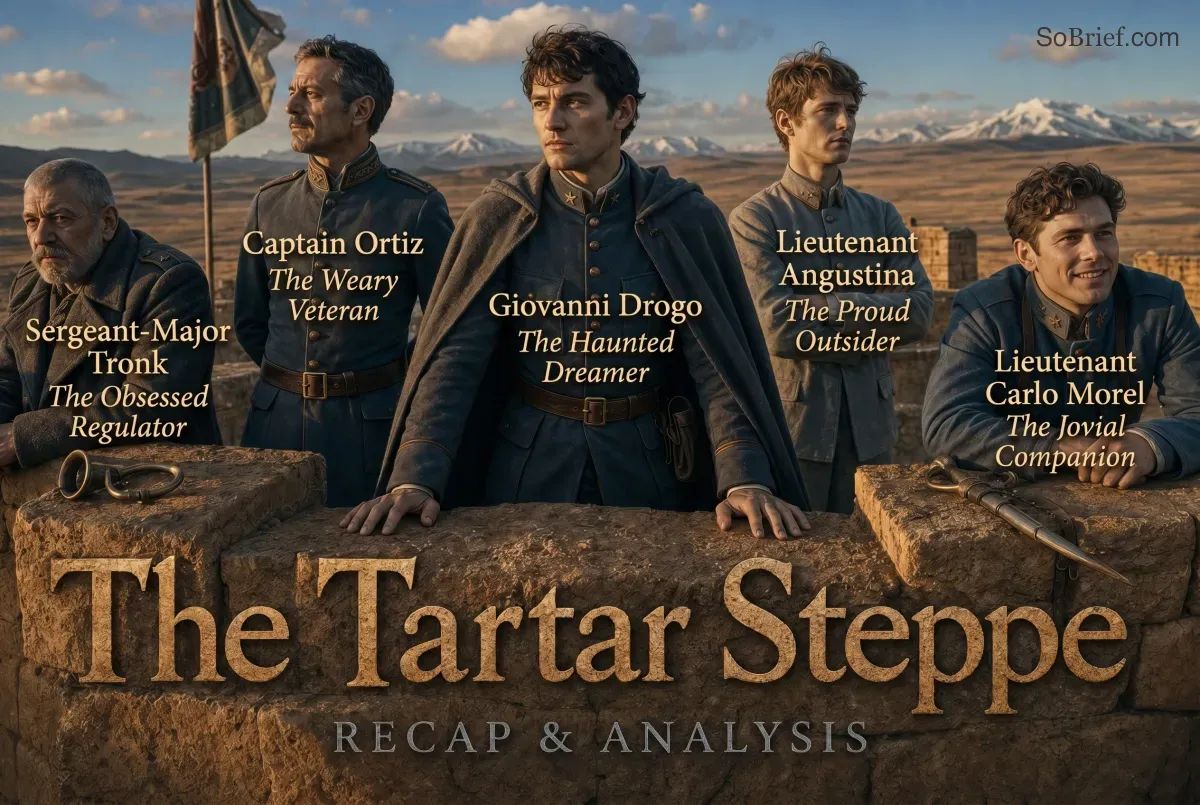
Giovanni Drogo
The officer who waitedA newly commissioned lieutenant posted by accident to a remote mountain fort, Drogo embodies the paradox of knowing exactly what one should do yet being powerless to do it. His psychology is defined by a fatal pull between two forces: the reasonable desire for ordinary happiness and an irrational enchantment with the possibility of something extraordinary. He is not weak so much as seduced—by ritual, landscape, and the persistent whisper that destiny lies just beyond the horizon. His relationships are marked by passive attachment: he loves his mother without expressing it, desires Maria13 without pursuing her, respects Ortiz2 without heeding his warnings. Drogo's core wound is temporal—he treats time as infinite until it is nearly gone, always believing the important things still lie ahead.
Ortiz
Drogo's lifelong companionThe first officer Drogo1 encounters on the road to the Fort, Ortiz becomes his closest and most enduring friend across three decades of shared exile. When they meet, Ortiz has served eighteen years and exhibits the double consciousness of a man who simultaneously disparages and worships his prison. He tells Drogo1 the Fort is insignificant, then gazes at its walls as if witnessing a miracle. His psychology reveals the self-deception of the long-committed: he advises Drogo1 to leave while knowing he himself never will. Ortiz represents the fate Drogo1 is headed toward—someone who has made peace with diminishment. Their friendship is built less on conversation than on shared vigil, two men staring at the same empty horizon, promoted through the ranks together while life empties out around them.
Angustina
The aristocrat who staysAn aristocratic, physically frail officer of extreme elegance and pride who refuses to leave the Fort despite completing his tour of duty. His detachment borders on contempt for ordinary pleasures—he dismisses the city, women, amusements with a bored flick of the hand. Angustina represents a rarefied ideal: someone who transforms futility into style, whose composure in the face of hardship makes everyone around him feel crude by comparison. His relationship with Drogo1 is one of distant admiration; Drogo1 envies him without understanding him.
Major Matti
The adjutant's velvet trapThe Fort's adjutant, a plump, excessively cordial man whose smooth diplomacy masks a bureaucratic ruthlessness. He manipulates new officers into staying through a choreography of false choices—medical certificates, four-month delays, implied career consequences. Matti embodies institutional inertia wearing a human smile. He is incapable of direct rebuke, preferring the more terrible weapon of written inquiries and phlegmatic interrogations that magnify the slightest shortcomings into punishable offenses.
Simeoni
The pragmatist who inheritsA methodical, physically robust officer who discovers evidence of a road being built from the north—then denies his own discovery when authority frowns upon it. Simeoni's psychology is defined by opportunistic pragmatism: capable of genuine insight but equally willing to betray it for personal safety. He guards his discoveries jealously, not from scientific passion but from competitive instinct. His rise to commandant of the Fort traces an arc of increasingly comfortable conformity that culminates in cold administrative efficiency.
Tronk
The regulation incarnateA small, thin sergeant-major who has served at the Fort for twenty-two years without taking leave. Tronk lives entirely within regulations, enforcing password protocols with inhuman precision. He studies music in solitude and owns an accordion he rarely plays. Beneath his rigidity lies the same unacknowledged hope that grips every man at the Fort—he too scans the northern steppe, though he would never admit why.
Doctor Rovina
The Fort's weary philosopherThe Fort's medical officer, serving for over twenty-five years. Rovina has a flabby, intelligent face and an air of tired resignation. He prepares Drogo's1 exit certificate early in the story but later becomes his ally, helping him stay on when illness threatens forced departure. His wry sadness and quiet empathy make him the garrison's resident philosopher of wasted potential—a man who sees through every illusion yet lacks the energy to act on his own clarity.
Colonel Filimore
The commandant who frozeThe Fort's commandant during its most dramatic episode, an aging officer who has spent his career believing the frontier matters. His psychology is defined by a paralysis born of excessive hoping: the more he desires something, the less capable he becomes of seizing it when it seems to arrive. He embodies the corrosive long-term effects of sustained anticipation—hope stretched so thin it becomes indistinguishable from fear.
Prosdocimo
The tailor on temporary basisThe regimental tailor, working in the Fort's cellar for decades while insisting he is there on a merely temporary basis and expects to leave any day. His delusion mirrors the officers' own, rendered absurd by its transparency.
Morel
The warm-hearted friendA friendly, enthusiastic lieutenant who smuggles Drogo1 onto the ramparts for his first view of the steppe. One of the few officers who shows genuine emotion when finally departing the Fort.
Lagorio
The one who escapesA cheerful count who completes his two-year tour and leaves happily, contrasting sharply with Angustina's3 refusal. He represents the path of sensible departure that Drogo1 fails to take.
Captain Monti
The brute on the mountainA huge, physically powerful captain who leads the frontier expedition. He deliberately torments Angustina3 with a forced march, driven by class resentment, but finds himself awed by his subordinate's composure.
Maria Vescovi
The love Drogo lostDrogo's1 friend's sister, a woman who might have become his wife. When he visits after years at the Fort, the old intimacy between them has calcified into polite distance.
Lazzari
The soldier killed by rulesA young private who catches a mysterious horse from the steppe and returns to the Fort without knowing the password. His death by his own comrade's rifle illustrates the Fort's lethal rigidity.
Plot Devices
The Tartar Steppe
Embodies hope and emptinessThe vast desert stretching north beyond the Fort, allegedly once crossed by Tartars in ancient times. It is simultaneously nothing—a lifeless expanse of stones and mist—and everything, the screen onto which every officer projects fantasies of purpose and glory. No enemy has come from it in living memory; rumored towers and forests on its horizon dissolve on closer inspection. Yet men spend their lives gazing at it, unable to look away. The steppe functions as the physical manifestation of the gap between aspiration and reality—an infinite canvas for hope that may or may not ever be filled. Its emptiness is both torment and seduction, offering just enough mystery to sustain decades of watching.
The Changing of the Guard
Ritual enchantment mechanismThe elaborate daily ceremony—silver trumpets with red-and-gold silk cords, bayonets gleaming, soldiers motionless as statues—that transforms monotonous garrison life into something resembling destiny. It is this ceremony, witnessed through a window during the medical inspection, that seduces Drogo1 into staying at the Fort. The ritual's beauty is entirely disproportionate to its purpose of guarding an empty frontier, and that disproportion is precisely the source of its power. The ceremony gives Drogo1 the illusion that sacrifice has meaning, that the Fort exists for something noble rather than bureaucratic inertia. It is the aesthetic trap at the heart of the novel: beauty mistaken for significance.
Simeoni's Telescope
Instrument of forbidden hopeThe personal telescope that allows Simeoni5 and Drogo1 to observe tiny specks of movement and a faint light on the extreme edge of the steppe. It becomes their private channel to hope—evidence that something is being built, that the long-awaited event may actually materialize. When an official order bans non-regulation optical instruments, the telescope is confiscated, and with it the capacity to observe what might be approaching. The ban represents authority's power to suppress even the perception of inconvenient truth, and Simeoni's5 immediate compliance reveals how easily conviction collapses under institutional pressure. The telescope dramatizes the difference between seeing and being permitted to see.
The Road from the North
Time made visible as constructionOver many years, the Northerners construct a road across the steppe toward the Fort—first detected as specks through Simeoni's telescope, eventually visible to the naked eye as a dark line across the desert. Simeoni5 predicts the work will take six months. Its actual completion takes fifteen years. The road's glacial progress serves as a clock measuring the garrison's collective life, an external marker of time that makes visible what the characters cannot otherwise perceive: the accumulation of wasted years. The road embodies the novel's central tension—whether the thing waited for will arrive before those who wait are spent.
The Dripping Cistern
Time made audibleBehind the wall of Drogo's1 room, a cistern drips with an irregular hollow sound that disturbs his first night at the Fort and torments his early sleep. Over decades, the drip becomes so familiar that it disappears into the background of consciousness—a sonic companion he no longer registers. The cistern traces Drogo's1 transformation from resistant newcomer to absorbed inhabitant: what once represented everything intolerable about the Fort becomes inseparable from his sense of home. Each drip marks a moment falling into nothing, time made audible in the hollow between wall and wainscot, persistent and indifferent as the years themselves.
FAQ
Synopsis & Basic Details
What is The Tartar Steppe about?
- Awaiting a Fateful Encounter: The novel follows Giovanni Drogo, a newly commissioned officer, as he is assigned to Fort Bastiani, a remote mountain outpost overlooking a vast, desolate northern steppe. He initially intends to stay only a few months, but the fort's mysterious allure and the persistent, yet unfulfilled, hope of an enemy attack from the north gradually consume his entire life.
- Life Consumed by Waiting: Drogo and his fellow soldiers dedicate their lives to a vigilant watch for the legendary Tartars, an enemy that never materializes for decades. The story becomes a poignant exploration of human existence defined by anticipation, routine, and the slow, unnoticed passage of time, as Drogo's youth and opportunities slip away.
- Allegory of Unlived Life: Beyond a military narrative, The Tartar Steppe functions as a powerful allegory for the human condition, illustrating the universal experience of waiting for a significant event—be it glory, love, or purpose—that often arrives too late, or in an unexpected, unheroic form.
Why should I read The Tartar Steppe?
- Profound Existential Reflection: Readers seeking a deep meditation on the passage of time, the nature of hope, and the search for meaning will find Buzzati's work profoundly resonant. It challenges the reader to consider how much of life is spent waiting for a future that may never arrive as imagined.
- Masterful Atmosphere and Symbolism: Buzzati crafts an incredibly evocative and melancholic atmosphere, where the desolate landscape and the fort itself become powerful symbols of isolation, futility, and the human psyche. The subtle, dreamlike quality of the prose draws you into Drogo's internal world.
- Timeless Human Experience: Despite its specific military setting, the novel's core themes—the trap of routine, the allure of illusion, the quiet desperation of unfulfilled ambition, and the inevitability of aging and death—are universal, offering a timeless commentary on the human tendency to defer true living.
What is the background of The Tartar Steppe?
- Author's Personal Inspiration: Dino Buzzati conceived the novel from his own monotonous night-shift work at the Corriere della Sera newspaper, feeling his life "would never end and so would eat up my whole life quite pointlessly." He transposed this feeling into a "fantastical military world," making the fort a metaphor for routine existence.
- Pre-War European Context: Written in 1938 and published in 1940, the novel subtly reflects the anxieties and deferred conflicts of pre-World War II Europe. The publisher's insistence on changing the title from "The Fort" to "The Tartar Steppe" aimed to avoid direct military allusions, yet the underlying tension of an unseen, approaching threat resonates with the era.
- Italian Mountain Culture Influence: Buzzati's lifelong passion for climbing in the Dolomites, a region with a history of "glorious" military campaigns (WWI), deeply influenced the setting. The mountains are not just a backdrop but a "limit-experience," lending a "borrowed sublimity" to the fort's rigid routine and the soldiers' wasted lives, connecting human futility with nature's vast emptiness.
What are the most memorable quotes in The Tartar Steppe?
- "At a certain point they shut a gate behind us, they lock it with lightning speed and it is too late to turn back." (Chapter 6): This powerful metaphor, appearing as Drogo sleeps, encapsulates the novel's central theme of time's irreversible passage and the sudden realization that life's opportunities have been irrevocably lost, highlighting the trap of waiting.
- "We think there are beings like ourselves around us and instead there is nothing but ice and stones speaking a strange language; we are on the point of greeting a friend but our arm falls inert, the smile dies away because we see that we are completely alone." (Chapter 10): This quote, prompted by Drogo's misinterpretation of a waterfall's sound, profoundly expresses the novel's pervasive theme of existential loneliness and the illusion of connection, even amidst comrades.
- "Be brave, Drogo, this is the last card – go on to death like a soldier and let your bungled life at least have a good end." (Chapter 30): In his final moments, this internal monologue reveals Drogo's ultimate, solitary act of heroism—facing death with dignity, transforming a life of unfulfilled waiting into a meaningful, if private, "battle," offering a poignant commentary on the nature of true valor.
What writing style, narrative choices, and literary techniques does Dino Buzzati use?
- Allegorical and Existential Prose: Buzzati employs a detached, precise, and often melancholic prose style that elevates the specific military narrative into a universal allegory for human existence. The narrative consistently uses the fort and the steppe as symbolic landscapes, reflecting internal states and the futility of deferred dreams, as noted by Tim Parks in the introduction.
- Repetitive and Cyclical Structure: The novel's structure mirrors its themes of monotony and the passage of time, with recurring routines, similar dialogues, and cyclical events (like Drogo's return to the fort mirroring his first arrival). This narrative choice emphasizes the inescapable nature of the characters' predicament and the slow erosion of their lives.
- Subtle Foreshadowing and Ironic Detachment: Buzzati masterfully uses subtle hints and ironic observations to foreshadow future disappointments and the characters' self-deception. The narrator often provides insights that the characters themselves are oblivious to, creating a sense of tragic inevitability and highlighting the gap between their hopes and reality.
Hidden Details & Subtle Connections
What are some minor details that add significant meaning?
- The Cistern's Persistent Drip: In Chapter 4, the "soft drip of water" from the cistern in Drogo's room, initially a nuisance, becomes a constant, inescapable background noise. This seemingly minor detail symbolizes the relentless, unnoticed passage of time and the slow, insidious erosion of life, a constant reminder of the fort's unchanging, draining reality.
- The "Humanissimi Viri" Print: The old print in Drogo's room (Chapter 4) with the partially visible text "Humanissimi Viri Francesci Angloisi virtutibus" (Of the virtues of the most humane man, Francesco Angloisi) subtly contrasts the ideal of human virtue and achievement with the barren, unheroic reality of Drogo's life, hinting at the lost potential and the ironic distance from a life of "virtues."
- The Fort's Gradual Decay: While the fort's age is mentioned, Chapter 21 notes "a piece of parapet had fallen here and there, and a platform had broken away, yet no one had it mended." This physical decay, ignored by the inhabitants, subtly reflects the internal decay of hope and purpose within the garrison, and the High Command's increasing indifference to its strategic importance.
What are some subtle foreshadowing and callbacks?
- Drogo's "Journey of No Return" Foreboding: In Chapter 1, as Drogo leaves home, he feels "a vague foreboding as if he were about to set out on a journey of no return." This early, almost throwaway line subtly foreshadows his lifelong entrapment at Fort Bastiani, setting a melancholic tone for his entire trajectory and hinting at the irreversible nature of his decision to stay.
- The Tailor's Brother's Warning: In Chapter 7, Prosdocimo's old, limping brother warns Drogo to "See that you leave as soon as possible, that you don't catch their madness." This direct, yet unheeded, advice from a minor character who has witnessed years of the fort's psychological toll serves as a clear, albeit ignored, premonition of Drogo's eventual fate.
- Moro's Arrival Mirroring Drogo's: In Chapter 25, Lieutenant Moro's arrival and his initial, awkward interaction with Drogo ("Nothing, I wanted to say 'Good day' to you") is an almost exact callback to Drogo's own first encounter with Captain Ortiz. This structural repetition powerfully underscores the cyclical nature of life at the fort and Drogo's transition from the hopeful young officer to the jaded veteran, highlighting the relentless march of generations.
What are some unexpected character connections?
- Prosdocimo and His Brother's Shared Delusion: The regimental tailor, Prosdocimo, and his older brother (Chapter 7) represent a subtle connection to the fort's pervasive delusion. While Prosdocimo outwardly claims to be temporary, his brother reveals he's been there fifteen years, still repeating the same lie. This shows how the "illness" of waiting infects even the most mundane roles, creating a shared, unspoken fantasy that binds them.
- The Sentry Moretto's Tragic Duty: The sentry, Giovanni Martelli (nicknamed Moretto), who kills Private Lazzari (Chapter 12), is not a villain but a soldier forced by rigid regulations and Tronk's silent command to perform a tragic duty. This connection highlights the dehumanizing effect of the fort's rules, where personal relationships are overridden by an absurd, unyielding military code, leading to an "unfortunate incident" that serves as a false alarm for war.
- The Collective Unspoken Hope: Beyond individual characters, there's an unexpected, almost telepathic connection among the officers regarding their shared hope for the Tartars. In Chapter 13, "no one has the courage to speak about it, that would perhaps mean bad luck, above all it would look like confessing one's dearest thoughts and of that soldiers are ashamed." This collective, unspoken yearning creates a powerful, binding psychological force, making their shared delusion a form of camaraderie.
Psychological, Emotional, & Relational Analysis
What are some unspoken motivations of the characters?
- Fear of the Outside World: Beyond the explicit hope for glory, many characters, including Drogo, are subtly motivated by a growing fear of the outside world. The city, once a symbol of freedom and opportunity, becomes "completely foreign" (Chapter 25) after years at the fort, making the familiar monotony of Bastiani a comforting, albeit stifling, refuge from the unknown challenges of civilian life.
- Comfort in Routine and Status: The rigid military routine, initially a burden, transforms into a source of comfort and identity. Drogo finds "a special pleasure from his mastery of the routine and savoured the growing respect of soldiers and N.C.O.'s" (Chapter 10). This unspoken motivation—the security and minor prestige derived from their established roles—binds them to the fort, making departure a terrifying leap into insignificance.
- Self-Deception as a Coping Mechanism: The characters, particularly Drogo, engage in profound self-deception, constantly postponing action and clinging to the "consoling thought that there was always time still to leave" (Chapter 10). This psychological mechanism allows them to endure the futility of their wait, transforming their inaction into a noble sacrifice for a future glory that remains perpetually out of reach.
What psychological complexities do the characters exhibit?
- The Paradox of Hope and Disappointment: Drogo embodies the complex psychological paradox of hope: it sustains him, yet it is also the very force that traps him in a cycle of disappointment. His "presentiment – or was it only a hope? – of great and noble events" (Chapter 10) keeps him at the fort, but each unfulfilled expectation deepens his internal weariness, leading to a profound sense of "loneliness of life" (Chapter 24).
- Collective Delusion and Individual Isolation: The fort fosters a collective delusion about the Tartars, where shared fantasy provides a sense of purpose. However, this collective belief paradoxically intensifies individual isolation, as characters like Simeoni (Chapter 23) are mocked or silenced when their observations deviate from the accepted narrative, revealing the fragility of their shared reality.
- The Erosion of Will and Desire: Over decades, the characters exhibit a subtle but profound erosion of their will and desires. Drogo notices he no longer runs up stairs or rides for pleasure, not due to physical decline, but a loss of "desire to do so" (Chapter 25). This psychological apathy, a consequence of prolonged waiting, highlights the insidious way the fort drains their vitality and ambition.
What are the major emotional turning points?
- Drogo's Decision to Stay (Chapter 9): The medical examination, intended to facilitate Drogo's departure, becomes a pivotal emotional turning point. Overwhelmed by a sudden, almost mystical vision of the fort's "solitary towers, crooked battlements crowned with snow" and the "pure sound of brass and human voice" of the trumpet, Drogo declares, "I'm all right and want to stay." This moment marks his emotional surrender to the fort's enchantment and the beginning of his long wait.
- Angustina's Heroic Death (Chapter 15): Lieutenant Angustina's death during a seemingly mundane frontier marking expedition, though not in battle, is a profound emotional turning point for Drogo and Ortiz. It forces them to confront the possibility of a "true soldier's death" (Chapter 17) outside the anticipated glory, making them question the nature of heroism and the value of their prolonged wait for a grand, external conflict.
- The General's Dismissal of Drogo (Chapter 20): Drogo's interview with the General, where his four years of service are dismissed as "nothing at all" and his past "reprimand" is highlighted, is a crushing emotional blow. This moment shatters his illusions of career progression and recognition, revealing the indifference of the outside world and the futility of his sacrifice, leaving him with a "burning sensation in his breast."
How do relationship dynamics evolve?
- Drogo and Ortiz: From Mentor to Mirror: Initially, Captain Ortiz acts as a cynical mentor to Drogo, warning him about the fort's trap and urging him to leave (Chapter 2, 16). Over time, their relationship evolves into a shared, melancholic understanding, with Ortiz eventually becoming a mirror of Drogo's own future—an old man resigned to his fate, still clinging to a faint, almost contradictory hope for war.
- Drogo and Simeoni: Shifting Beliefs and Isolation: Drogo's relationship with Simeoni initially forms around their shared, almost exclusive, belief in the approaching enemy and the road construction (Chapter 22). However, Simeoni's later denial of his observations due to fear of reprimand (Chapter 23) isolates Drogo, highlighting the fragility of shared hope and the individual's ultimate loneliness in their convictions.
- Drogo and His City Connections: Growing Alienation: Drogo's relationships with his family and friends in the city (Maria, Vescovi) gradually wither, marked by awkwardness and a sense of mutual incomprehension (Chapter 18, 19). His attempts to reconnect reveal how deeply the fort has alienated him from "normal" life, symbolizing the irreversible cost of his chosen path and the fading relevance of his past.
Interpretation & Debate
Which parts of the story remain ambiguous or open-ended?
- The True Nature of the "Enemy": The novel deliberately leaves the identity and intentions of the "Northern Kingdom" and the Tartars ambiguous. Are they a real military threat, a nomadic people, or merely a projection of the fort's collective desire for purpose? This ambiguity fuels the central debate about whether the characters are waiting for a genuine external event or an internal, self-created illusion.
- The Fort's Strategic Importance: The actual strategic value of Fort Bastiani is consistently questioned and undermined throughout the narrative. It's described as "completely out of date" (Chapter 2), a "dead stretch of frontier" (Chapter 2), and later "merely a road block" (Chapter 21). This ambiguity raises questions about the inherent meaning of their duty and whether their sacrifice serves any real-world purpose.
- The Meaning of Drogo's Final Smile: In his dying moments, Drogo smiles, a gesture open to multiple interpretations. Is it a smile of acceptance, of triumph over fear, of a final, private heroism, or perhaps a tragic, ironic smile at the futility of his life's wait? This ambiguity leaves the reader to ponder the ultimate meaning of his existence and the nature of a "good end" to a "bungled life."
What are some debatable, controversial scenes or moments in The Tartar Steppe?
- Lazzari's Execution by Moretto: The shooting of Private Lazzari (Chapter 12) by his comrade Moretto for failing to give the password, under Tronk's silent watch and Matti's later approval, is a highly debatable moment. It highlights the brutal, dehumanizing rigidity of military regulations and the chilling indifference of authority, raising questions about the value of human life versus abstract rules and the nature of "duty."
- Colonel Filimore's Inaction and Self-Deception: Colonel Filimore's prolonged hesitation and refusal to acknowledge the approaching "enemy" (Chapter 14) is a controversial portrayal of leadership. His internal struggle, driven by a fear of false hope and a desire for "Fortune" to "touch him on the hand
Synopsis & Basic Details
What is The Tartar Steppe about?
- Awaiting a Fateful Encounter: The novel follows Giovanni Drogo, a newly commissioned officer, as he is assigned to Fort Bastiani, a remote mountain outpost overlooking a vast, desolate northern steppe. He initially intends to stay only a few months, but the fort's mysterious allure and the persistent, yet unfulfilled, hope of an enemy attack from the north gradually consume his entire life.
- Life Consumed by Waiting: Drogo and his fellow soldiers dedicate their lives to a vigilant watch for the legendary Tartars, an enemy that never materializes for decades. The story becomes a poignant exploration of human existence defined by anticipation, routine, and the slow, unnoticed passage of time, as Drogo's youth and opportunities slip away.
- Allegory of Unlived Life: Beyond a military narrative, The Tartar Steppe functions as a powerful allegory for the human condition, illustrating the universal experience of waiting for a significant event—be it glory, love, or purpose—that often arrives too late, or in an unexpected, unheroic form.
Why should I read The Tartar Steppe?
- Profound Existential Reflection: Readers seeking a deep meditation on the passage of time, the nature of hope, and the search for meaning will find Buzzati's work profoundly resonant. It challenges the reader to consider how much of life is spent waiting for a future that may never arrive as imagined.
- Masterful Atmosphere and Symbolism: Buzzati crafts an incredibly evocative and melancholic atmosphere, where the desolate landscape and the fort itself become powerful symbols of isolation, futility, and the human psyche. The subtle, dreamlike quality of the prose draws you into Drogo's internal world.
- Timeless Human Experience: Despite its specific military setting, the novel's core themes—the trap of routine, the allure of illusion, the quiet desperation of unfulfilled ambition, and the inevitability of aging and death—are universal, offering a timeless commentary on the human tendency to defer true living.
What is the background of The Tartar Steppe?
- Author's Personal Inspiration: Dino Buzzati conceived the novel from his own monotonous night-shift work at the Corriere della Sera newspaper, feeling his life "would never end and so would eat up my whole life quite pointlessly." He transposed this feeling into a "fantastical military world," making the fort a metaphor for routine existence.
- Pre-War European Context: Written in 1938 and published in 1940, the novel subtly reflects the anxieties and deferred conflicts of pre-World War II Europe. The publisher's insistence on changing the title from "The Fort" to "The Tartar Steppe" aimed to avoid direct military allusions, yet the underlying tension of an unseen, approaching threat resonates with the era.
- Italian Mountain Culture Influence: Buzzati's lifelong passion for climbing in the Dolomites, a region with a history of "glorious" military campaigns (WWI), deeply influenced the setting. The mountains are not just a backdrop but a "limit-experience," lending a "borrowed sublimity" to the fort's rigid routine and the soldiers' wasted lives, connecting human futility with nature's vast emptiness.
What are the most memorable quotes in The Tartar Steppe?
- "At a certain point they shut a gate behind us, they lock it with lightning speed and it is too late to turn back." (Chapter 6): This powerful metaphor, appearing as Drogo sleeps, encapsulates the novel's central theme of time's irreversible passage and the sudden realization that life's opportunities have been irrevocably lost, highlighting the trap of waiting.
- "We think there are beings like ourselves around us and instead there is nothing but ice and stones speaking a strange language; we are on the point of greeting a friend but our arm falls inert, the smile dies away because we see that we are completely alone." (Chapter 10): This quote, prompted by Drogo's misinterpretation of a waterfall's sound, profoundly expresses the novel's pervasive theme of existential loneliness and the illusion of connection, even amidst comrades.
- "Be brave, Drogo, this is the last card – go on to death like a soldier and let your bungled life at least have a good end." (Chapter 30): In his final moments, this internal monologue reveals Drogo's ultimate, solitary act of heroism—facing death with dignity, transforming a life of unfulfilled waiting into a meaningful, if private, "battle," offering a poignant commentary on the nature of true valor.
What writing style, narrative choices, and literary techniques does Dino Buzzati use?
- Allegorical and Existential Prose: Buzzati employs a detached, precise, and often melancholic prose style that elevates the specific military narrative into a universal allegory for human existence. The narrative consistently uses the fort and the steppe as symbolic landscapes, reflecting internal states and the futility of deferred dreams, as noted by Tim Parks in the introduction.
- Repetitive and Cyclical Structure: The novel's structure mirrors its themes of monotony and the passage of time, with recurring routines, similar dialogues, and cyclical events (like Drogo's return to the fort mirroring his first arrival). This narrative choice emphasizes the inescapable nature of the characters' predicament and the slow erosion of their lives.
- Subtle Foreshadowing and Ironic Detachment: Buzzati masterfully uses subtle hints and ironic observations to f
Download PDF
Download EPUB
.epub digital book format is ideal for reading ebooks on phones, tablets, and e-readers.








































