

Key Takeaways
You are spirit, soul, and body, not merely soul and body
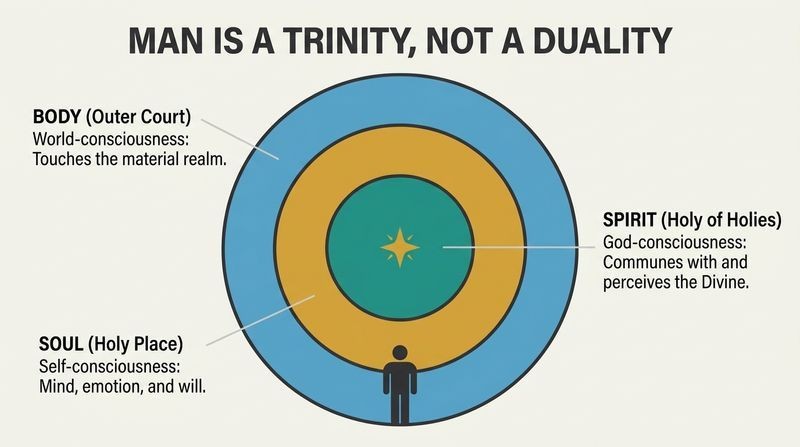
Man is a trinity, not a duality. The popular view splits a person into a physical body and an invisible soul. Watchman Nee argues from 1 Thessalonians 5:23 that God divides us into three parts. The spirit is our God-consciousness, the organ that communes with and perceives God directly. The soul is our self-consciousness, the seat of personality, housing mind, emotion, and will. The body is our world-consciousness, touching the material realm.
Nee pictures man as the ancient temple: the body is the outer court open to all, the soul is the Holy Place of thought and feeling, and the spirit is the Holy of Holies where God dwells. Confusing spirit with soul, he warns, traps believers into mistaking soulish excitement for genuine spiritual life.
This tripartite anthropology, drawn from Paul and shared by figures like Andrew Murray and Jessie Penn-Lewis, cuts against both dualist and monist views in theology. Many biblical scholars argue that Scripture uses spirit and soul interchangeably, making Nee's sharp division contestable. Yet the psychological instinct is sound: distinguishing a deep, intuitive knowing from surface emotion and reasoning loosely anticipates modern dual-process models of cognition. Whether or not the metaphysics holds, the practical payoff is discernment. Not every warm feeling or clever thought is contact with the transcendent, and mistaking one for the other keeps a person spiritually stuck.
God's salvation targets three enemies: sin, self, and Satan
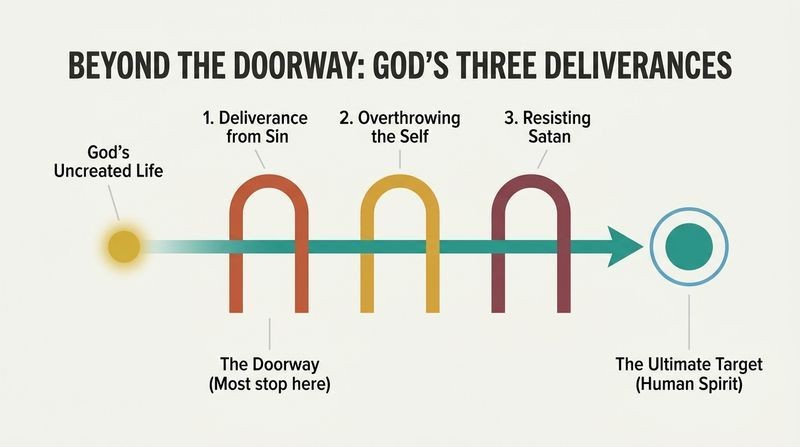
Forgiveness is only the doorway. Nee charges that most Christians settle for a half-salvation, content merely to have sins forgiven and to stop sinning. But God's design has three deliverances: from sin, from the natural self, and from the supernatural satanic powers. To stop at sin, he says, falls far short of God's purpose.
The petty self, the natural life inherited from Adam, must also be overthrown, and the unseen enemy resisted. Nee is blunt: tears, penitence, reform, zeal, and labor are not the hallmarks of a Christian. The one essential mark is receiving God's own uncreated life into the dead human spirit. Everything else is preparation or consequence, not the substance itself.
Nee's escalation from sin-management to self-death to spiritual warfare reframes faith as a lifelong campaign rather than a single conversion event. What's striking is his refusal to treat good behavior as the finish line. The idea resonates across contemplative traditions: the Sufi war against the nafs, Buddhist non-self, all insisting that the well-mannered ego is itself the final obstacle. The scope limitation worth naming is spiritual perfectionism, a believer forever hunting deeper corruption within. Nee flags this danger elsewhere, but the tension between relentless self-suspicion and restful assurance runs through the whole book.
Self-righteousness is as offensive to God as open sin
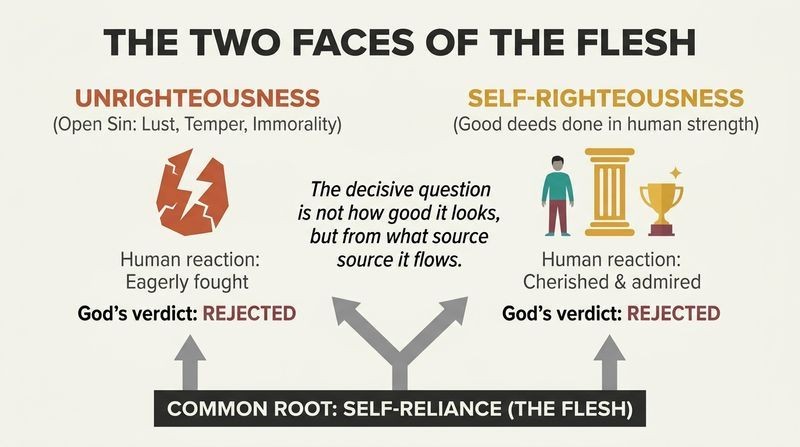
The flesh has two faces. Nee splits the flesh into the unrighteous (lust, temper, immorality) and the self-righteous (good deeds done in one's own strength). Christians eagerly fight the first while cherishing the second. God rejects both, because both center on self and bypass dependence on Him.
The mark of fleshly good works is independence: acting without waiting on God or relying on the Spirit. Nee points to the Galatians, who began in the Spirit but tried to be perfected by the flesh. A sermon prepared with more hours spent outlining than praying may be admired by people yet counted dead by God. The decisive question is never what was done or how good it looked, but who did it and from what source it flowed.
This is Nee's most countercultural claim. In a results-obsessed religious culture that measures worth by output, he insists the source matters more than the fruit. It echoes the parable of the Pharisee and tax collector and Kierkegaard's suspicion of works performed for display. The genuine difficulty: Spirit-empowered action and natural effort can look identical from the outside, so Nee's test, dependence and waiting, can shade into passivity or excuse inaction. Still, the diagnostic question, who is doing the doing, is a bracing corrective to burnout-driven achievement dressed up as devotion.
Reckon your old self already crucified, then let the cross work daily
Two applications of one cross. Nee separates deliverance from sin's power, which is a finished fact, from denial of self, which is a daily practice. Our old man was crucified with Christ (Romans 6:6), so we do not crucify ourselves; we reckon it true and believe. This can be entered in a moment.
Denial of the self life, however, is a lifelong bearing of the cross. Nee warns against two errors: knowing the doctrine of co-crucifixion but never applying it, and straining to put self to death without standing on the accomplished fact. The pattern is knowing your death with Christ, then by the Holy Spirit putting to death the deeds of the body moment by moment. The Spirit alone translates the fact into lived experience.
Nee's insistence that we cannot crucify ourselves, only reckon what Christ did, is a precise move against self-flagellating asceticism. It mirrors a therapeutic finding: white-knuckle willpower against a compulsion often strengthens it, while a new identity plus acceptance loosens its grip. His position-versus-experience framing anticipates how identity-based change (I am someone who has died to this) outperforms mere behavior-fighting. The weakness critics note is that reckoning can degrade into a mental formula detached from real change, a risk Nee himself names by insisting the Spirit, not the recitation, does the actual work.
Your natural talent and energy accomplish nothing in God's work
Soul power cannot beget spirit life. Nee draws a hard line between soul power, the natural talent, eloquence, and zeal received at birth, and spirit power, received from the Holy Spirit at regeneration. A believer becomes spiritual only by drawing on the latter and refusing the former.
Using Jesus's image of the grain of wheat that must fall and die to bear fruit, Nee argues that the soul life, however brilliant, cannot quicken a dead human spirit in another person. The old creation cannot produce the new. Emotional persuasion, tears, and psychological technique may move an audience and yield apparent success, yet they leave the hearer's spirit as dead as before. What looks like a harvest can be rootless blades that wither under the sun.
This lands hard in an era of charismatic influence and data-driven persuasion. Nee effectively critiques the use of marketing psychology in religion: manipulation can produce decisions without transformation, and revival movements built on emotional stimulation often show high fall-away rates, echoing his rootless-blades warning. The steelman is strong. The nuance he underplays is that gifts and personality are themselves God-given, as he elsewhere concedes when he says talents must die and be resurrected. So the target is not talent but its independent, self-glorifying deployment, a distinction that is experiential and rarely obvious from the outside.
Follow the quiet intuition of your spirit, not feelings or logic
Guidance is known, then understood. For Nee, God's direction reaches us through the spirit's intuition, a direct inner knowing that arrives without reasoning or emotional trigger. He distinguishes it from the mind, which reasons, and emotion, which reacts to outside stimuli. The spirit knows; the mind then understands and puts into words what the spirit received.
The danger is mistaking a sudden flashing thought, a warm feeling, or clever reasoning for God's leading. True guidance is gentle, deep, and often contrary to human logic. Nee counsels keeping the emotions quiet so the small voice can be heard, then engaging the mind to test whether the sense is genuinely from the spirit and consistent with Scripture. Intuition initiates; the mind verifies.
Nee's intuition-first, mind-as-verifier model is psychologically shrewd. It resembles dual-process cognition, where fast intuitive judgments precede slower analytical checking, and it guards against both cold rationalism and runaway emotionalism. His demand that intuition be tested against Scripture blocks pure subjectivism. The obvious hazard, which Nee treats at length, is that intuition can be indistinguishable from wishful thinking or suggestion. His safeguard, a functioning mind that examines rather than a blank one that passively receives, is the crucial and frequently ignored corrective in circles that prize spontaneity over discernment.
Live by faith, not feelings; God withdraws joy to train your will
The up-and-down life is soulish. Nee describes a familiar cycle: a new believer feels God intensely, loses the feeling, panics, assumes he has sinned, regains it, then loses it again. He argues this rollercoaster is itself soulish, because a life ruled by feeling, whether ecstatic or dry, is still ruled by feeling.
God deliberately grants and withdraws pleasant sensations, chiefly to train the will to obey without emotional support. Real progress is measured not by how one feels but by whether the will stays united to God's will in darkness. To love God only when you feel His love, Nee warns, may be loving the feeling rather than God. Faith fixes on the unchanging One believed, not on the believer's shifting inner weather.
This is spiritual direction that doubles as cognitive behavioral therapy. Nee's diagnosis that consolation-seeking masquerades as devotion parallels Ignatius of Loyola's discernment of consolation and desolation, where the mature soul refuses to judge its state or make decisions by fluctuating affect. Behavioral science agrees that commitment anchored in values outlasts commitment anchored in mood. His reframe, that dry obedience is worth more than felt obedience, inverts the experience-chasing of much modern spirituality. The risk of producing joyless stoics is one Nee guards against by distinguishing shallow emotional joy from a deeper joy rooted in faith.
A passive mind hands ground to demonic invasion
Surrender is active, not vacant. Nee's most distinctive teaching is that passivity, ceasing to actively use the will and mind, gives ground to evil spirits. Consecrated believers fall here most easily, wrongly assuming that yielding to God means becoming a will-less puppet waiting to be moved.
He contrasts two operating laws. The Holy Spirit requires active cooperation and never bypasses your personality; evil spirits demand a blank, inert mind so they can act in your place. Symptoms of an invaded, passive mind include intrusive flashing thoughts, forgetfulness, broken concentration, insomnia, and stubborn irrationality. The path out is to reactivate the will, refuse the ground once conceded, and resist point by point until the mind is restored to its normal, self-controlled state.
Written before modern psychiatry, Nee's symptom list (intrusive thoughts, memory lapses, compulsive rumination) overlaps strikingly with what we now understand neurologically. A contemporary reader should hold the demonological framing loosely, since much of what he attributes to evil spirits maps onto anxiety, OCD, and trauma. Yet the core insight is durable and echoed in agency-based therapy: reclaiming active choice and refusing to run on autopilot is genuinely restorative. His larger correction, that authentic surrender to God is cooperation rather than self-erasure, punctures any spirituality that romanticizes passivity and emptiness as holiness.
Neither God nor Satan can act in you without your consent
One law governs both. Nee argues that a single principle binds divine and demonic work alike: neither can operate in a person without that person's consent, given knowingly or unknowingly. God created humans with a sovereign, free will and refuses to violate it, persuading and commanding but never coercing, exactly as He did with Adam in the garden.
Satan too must obtain permission, which is why he works through deception to extract it. This is why Nee treats the union of the believer's will with God's as the summit of spiritual life, deeper than any union of feeling or thought. Salvation itself, he says, is God bringing the rebellious human will back into willing, active agreement with His own, not overriding it.
Nee's symmetry, that God and Satan alike are bound by human consent, elevates the will to cosmic significance and grounds a robust free-will theology. It stands opposed to strong Calvinist determinism, and critics would fault it for constraining divine sovereignty too tightly. But it yields a potent practical ethic: you are never merely a victim of forces, and every deception requires your assent to take root. This dovetails with existentialist emphasis on radical responsibility and with research linking a sense of personal agency to mental resilience. The theology is debatable; the empowerment it confers is real.
Stop dissecting yourself; look off to Christ instead
Introspection breeds stagnation. Despite writing a manual of minute inner analysis, Nee repeatedly warns that habitual self-examination is spiritually harmful. Probing your thoughts and feelings from dawn to dusk, he says, destroys peace, because you inevitably keep discovering the gap between what you expect to be and what you actually are.
Self-consciousness feeds the very self life that needs to die. The believer's rest lies in looking off to the finished work of Christ, not in monitoring shifting personal experience. Nee's discipline is not perpetual surveillance but targeted honesty: when God's light exposes something, deal with it, then turn your gaze outward again. The degree to which you look to Him is the degree to which you are freed from self.
This is the paradox at the book's core: a near-clinical anatomy of the inner life that nonetheless forbids morbid self-scrutiny. The tension is instructive rather than fatal. Modern psychology confirms Nee's warning: rumination, repetitive self-focused analysis of distress, is a well-documented driver of depression, while self-distancing and outward focus improve wellbeing. His look-off-to-Christ counsel functions like a decentering practice, shifting attention from the anxious self to a stable external object. The prescription is not endless monitoring but honest response to conviction followed by deliberate release, a rhythm easier to state than to sustain.
The Holy Spirit gives life to your mortal body, not just your soul
The body is for the Lord. Nee refuses to spiritualize the body away. Citing Romans 8:11, he argues the same Spirit who raised Jesus quickens our present mortal frame, meaning real strength and healing now, not only future resurrection. The body is for the Lord and the Lord is for the body.
Sickness, he claims, is often God's chastisement flagging some unjudged sin or self-will, so healing follows self-judgment and surrender rather than frantic pursuit of a cure. He is wary of leaning on medicine over God, and even speaks of resisting premature death until one's appointed work is done. Crucially, health is never for self-indulgence; a strong body is strength consecrated wholly to God's purposes.
This places Nee in the divine-healing stream of Keswick and early Pentecostal thought, and it is his most contested material. The claim that sickness typically signals personal sin risks the cruelty of Job's friends, blaming sufferers for their suffering, though Nee partly hedges by noting that the holiest are often the most chastened. His suspicion of medicine will trouble many readers. Yet his refusal to treat the body as spiritually irrelevant is a healthy corrective to gnostic tendencies, and his reframing of health as consecrated stewardship rather than personal entitlement quietly challenges a wellness culture built on self-optimization.
Analysis
The Spiritual Man is arguably the most systematic work of Chinese Protestant mysticism, and its reach into global evangelical, Keswick, and charismatic spirituality is enormous. Written in the 1920s by a man in his twenties who claimed to have forged its truths through suffering and warfare, it fuses Pauline exegesis with the higher-life teaching of Murray, Meyer, Guyon, and especially Jessie Penn-Lewis, whose War on the Saints Nee cites directly on passivity and demonic ground. The book's architecture is its argument: spirit, soul, and body, examined organ by organ, all bent toward one thesis, that the redeemed spirit must regain rule over the whole person through the Holy Spirit's power. What makes it hard to summarize is its sheer scale and repetition; Nee deliberately circles back, precept upon precept, so that themes recur across ten parts rather than building linearly. The genius and the liability are the same: a relentless dividing of inner faculties finer than most readers can verify experientially. Modern scholarship questions whether spirit and soul are truly separable in Scripture, and Nee's demonology and healing theology sit uneasily with contemporary psychiatry and medicine. A reader should distinguish his durable psychological insights (the futility of willpower against self, the corrosiveness of rumination, the danger of mood-driven faith, the necessity of active agency) from his more speculative metaphysics. His deepest contribution is the reframing of surrender: not self-erasure into passivity, which he sees as an open door to bondage, but the active, conscious cooperation of a free will united to God's. This anti-passivity thesis, counterintuitive within quietist mysticism, is his most original and most needed word. Read critically, the book offers a rigorous phenomenology of the inner life and a bracing warning against every counterfeit of spirituality, whether emotional, intellectual, or moralistic, that leaves the self quietly enthroned.
Review Summary
The Spiritual Man is regarded as a profound and life-changing book on Christian spirituality. Readers praise its depth, biblical foundation, and comprehensive exploration of the human spirit, soul, and body. Many found it challenging but rewarding, requiring spiritual maturity and commitment to fully grasp. The book is highly recommended for serious Christians seeking to deepen their faith and understanding of spiritual life. Some readers noted its difficulty and occasional extremes but overall considered it an essential read for spiritual growth and discipleship.
People Also Read



Glossary
Spirit, soul, and body
The threefold nature of manNee's foundational model, drawn from 1 Thessalonians 5:23, dividing a person into three parts: the spirit, which communes with God (God-consciousness); the soul, the seat of personality containing mind, emotion, and will (self-consciousness); and the body, which contacts the material world (world-consciousness). Spiritual maturity means the spirit ruling the soul and body under the Holy Spirit.
Soul life
The natural self-energy of manThe natural life inherited at birth, the animating power of the self, expressed through mind, emotion, and will. Nee argues it is not necessarily sinful but is natural and self-centered, and must be denied and delivered to death (like the grain of wheat) so the believer lives by the spirit's power rather than by native talent, feeling, or reasoning.
Soulish (soulical)
Governed by the soulNee's term for a Christian who is genuinely regenerated but still ruled by the soul rather than the spirit. Soulish believers rely on emotion, intellect, or willpower, chase pleasant feelings, and produce natural rather than spiritual results. The word describes a person dominated by soul faculties, as distinct from carnal (body-driven) or spiritual (spirit-governed).
The flesh
Fallen human nature, two-sidedThe composite of the fallen soul and body, comprising everything an unregenerated person is. Nee stresses it has two expressions: unrighteous sins (lust, temper) and self-righteous good works done in one's own strength. Both must go to the cross, because even the flesh's virtue is independent of God and therefore rejected by Him.
Intuition, communion, conscience
The three functions of the spiritNee's analysis of the human spirit's three faculties. Intuition is direct inner knowing of God's mind without reasoning. Communion is the capacity to worship and fellowship with God. Conscience is the spirit's organ that discerns right from wrong and reproves sin. Walking after the spirit means following these rather than the soul's mind, emotion, and will.
Dividing of spirit and soul
Separating spiritual from natural lifeBased on Hebrews 4:12, the experiential work by which God's Word, wielded by Christ as High Priest, separates the believer's spirit from the soul so that natural thought, emotion, and will no longer contaminate spiritual life. Nee treats this not as mere doctrine but as a necessary lived experience for entering true spirituality.
Passivity
Ceasing to use the willNee's key coined danger: the cessation of active self-control, where a believer stops exercising will and mind, wrongly believing that surrender means becoming a will-less instrument. Passivity gives ground to evil spirits, who require an inert, blank mind to operate, whereas the Holy Spirit requires active cooperation. It is the primary cause of deception in consecrated believers.
Ground (giving ground)
A foothold ceded to evil spiritsThe place or opportunity a believer surrenders to evil spirits, allowing them to work. Ground is given through positive sin, through passivity, or through believing satanic lies. Deliverance requires recognizing, refusing, and reclaiming each foothold point by point, standing on Christ's finished work at the cross.
FAQ
What is "The Spiritual Man" by Watchman Nee about?
- Tripartite nature of man: The book explores the biblical teaching that man is composed of spirit, soul, and body, and how understanding this is foundational for spiritual growth.
- Spiritual life and warfare: It serves as a manual for living a victorious Christian life, focusing on walking by the spirit, overcoming the flesh, and engaging in spiritual warfare.
- Practical Christian living: Watchman Nee provides detailed guidance on how believers can cooperate with the Holy Spirit, maintain a controlled mind and will, and apply spiritual laws for daily victory.
Why should I read "The Spiritual Man" by Watchman Nee?
- Comprehensive spiritual guidance: The book offers deep insights into the inner workings of the spirit, soul, and body, making it invaluable for those seeking spiritual maturity.
- Practical methods for victory: It teaches practical steps for overcoming sin, deception, and spiritual passivity, equipping readers for effective spiritual warfare.
- Balanced Christian living: Watchman Nee emphasizes the harmony between spirit, soul, and body, helping believers avoid extremes and live a balanced, fruitful Christian life.
What are the key takeaways from "The Spiritual Man" by Watchman Nee?
- Spirit must govern life: True spiritual life flows from the spirit, which should rule over the soul and body, not the other way around.
- Necessity of the cross: The cross is essential for dealing with the self-life, natural affections, and soulish tendencies, enabling the Holy Spirit to operate freely.
- Active cooperation with God: Spiritual growth requires the believer’s active will, discernment, and daily yielding to the Holy Spirit, rather than passivity or self-effort.
How does Watchman Nee define the tripartite nature of man in "The Spiritual Man"?
- Spirit, soul, and body: Man consists of three distinct parts—spirit (God-consciousness), soul (self-consciousness: mind, will, emotion), and body (world-consciousness).
- Distinct functions: The spirit is the organ for communion with God, the soul mediates between spirit and body, and the body expresses the inner life outwardly.
- Biblical foundation: Nee grounds this teaching in passages like 1 Thessalonians 5:23 and Hebrews 4:12, emphasizing its importance for understanding spiritual life.
What is the difference between the spirit and the soul according to "The Spiritual Man"?
- Different natures and roles: The spirit is the innermost part, capable of knowing and communing with God, while the soul is the seat of intellect, emotion, and will.
- Potential for confusion: Many believers mistake soulish experiences (emotions, thoughts) for spiritual ones, which hinders true spiritual maturity.
- Dividing by the Word: The Word of God and the cross are necessary to divide soul from spirit, allowing the spirit to govern the whole person.
What does Watchman Nee teach about the role of the Holy Spirit in the believer’s spirit?
- Indwelling presence: At regeneration, the Holy Spirit comes to dwell in the believer’s spirit, making it the center of God’s operation in man.
- Guidance and revelation: The Holy Spirit communicates God’s will through the spirit’s intuition, leading and teaching the believer in all truth.
- Empowerment for victory: The Spirit strengthens the inner man, enabling believers to overcome the flesh, resist the enemy, and bear spiritual fruit.
How does "The Spiritual Man" explain the process and importance of the dividing of soul and spirit?
- Spiritual necessity: Dividing soul and spirit is essential for walking by the spirit and not being controlled by soulish emotions or thoughts.
- Means of division: This is accomplished through the believer’s submission to the cross and the piercing work of God’s Word.
- Resulting freedom: Once divided, the spirit is liberated to commune with God, while the soul becomes a servant rather than a master.
What practical advice does Watchman Nee give for walking after the spirit in "The Spiritual Man"?
- Discern spiritual senses: Believers must learn to recognize the movements of their spirit—intuition, conscience, and communion—and distinguish them from soulish or bodily influences.
- Obey intuition and conscience: Prompt obedience to the spirit’s intuition and conscience is crucial for maintaining fellowship and spiritual sensitivity.
- Daily reliance on the Spirit: Walking by the spirit involves daily yielding to the Holy Spirit, resisting the enemy, and reckoning oneself dead to sin.
What are the dangers of soulish living and passivity according to "The Spiritual Man"?
- Suppression of the spirit: Living by the soul (mind, emotions, will) suppresses the spirit, leading to spiritual dullness and defeat.
- Openness to deception: Passivity and soulishness open the door for satanic deception, confusion, and counterfeit spiritual experiences.
- Loss of spiritual power: Without active cooperation of the will and discernment, believers become vulnerable to spiritual bondage and ineffectiveness.
How does Watchman Nee describe the role of the mind and will in spiritual life in "The Spiritual Man"?
- Mind as spirit’s outlet: The mind expresses the spirit and must be renewed and controlled to avoid confusion and deception.
- Will as the real self: The will is the organ of decision and must remain active, choosing to obey God and resist the enemy.
- Danger of passivity: Passivity of mind or will allows evil spirits to operate; believers must maintain self-control and active cooperation with the Holy Spirit.
What does "The Spiritual Man" teach about the believer’s body and its role in spiritual life?
- Body as temple: The body is a temple of the Holy Spirit and should be presented as a living sacrifice, sanctified for God’s use.
- Union with Christ: The believer’s body is united with Christ, making it a channel for His life and power.
- Care and discipline: Physical health and discipline are important for spiritual service, and the body must not be neglected or indulged.
How does Watchman Nee address sickness, healing, and overcoming death in "The Spiritual Man"?
- Sickness and sin: Sickness is often linked to sin or disobedience and may be used by God for chastening and sanctification.
- Healing in salvation: Christ’s atonement includes healing, and believers are encouraged to seek healing through faith, confession, and prayer.
- Victory over death: Through Christ’s resurrection, believers can overcome the power of death, live in resurrection life, and look forward to the hope of rapture.
Download PDF
Download EPUB
.epub digital book format is ideal for reading ebooks on phones, tablets, and e-readers.








































