
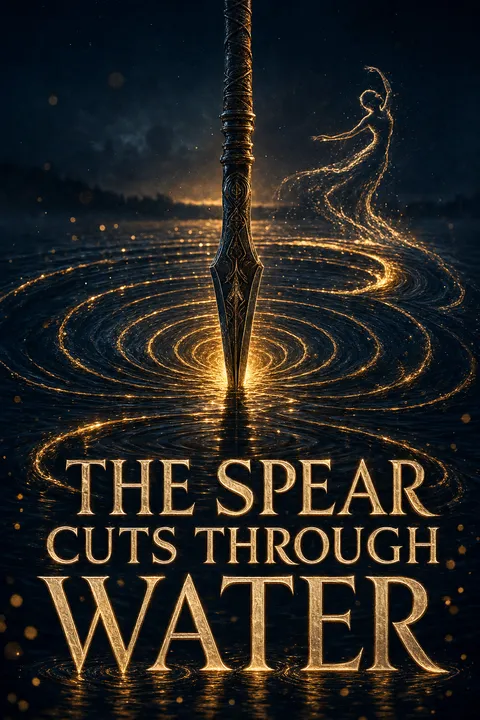


Plot Summary
Prologue
The narrator remembers their lola5 smoking in the kitchen, spinning tales of the Old Country between burning cigarettes: of ruined kingdoms, of the Moon and Water who once loved each other, and of the Inverted Theater, a pagoda built between worlds and reachable only through deep dreaming, where a visitor is told the right tale at the right time and then forgets it upon waking.
Years later, a merchant's child1 from a dockside town shadowed by war, radios, and warships is dream-tripped into that very theater, clutching the ancient red spear that has hung on the family mantel for generations. Seated in the eighth row, they watch a beautiful moonlit performer15 conjure from fire the tale of a faraway land and the spear that cut through it.
The frame establishes the book's central preoccupation: how diaspora inherits a homeland it never touched, transmitted as smoke, story, and heirloom. By seating the reader inside a dreaming spectator addressed as 'you,' Jimenez makes inheritance participatory rather than passive. The lola's cigarettes fuse memory to sensory decay, foreshadowing that all tales here are ephemeral, meant to be felt and lost. The spear on the mantel, at once revered and ignored, mirrors the descendant's ambivalent relationship to ancestry. Crucially, the grandmother frames the coming violence as a love story, planting the interpretive key that the novel's carnage must ultimately be read through tenderness, not glory.
The Emperor Craves Immortality
The First Terror,7 crown prince and Scourge of the Valley, leads his Red Peacock brigade across the country, forcing villages to prepare for the Emperor's Holy Pilgrimage. At the palace, the aged Eighth Emperor Magaam8 sulks: his pet bird has vanished and, in a paranoid fit, he has stranded his own moving bridges.
To soothe his rage, the court frames and beheads an innocent servant of thirty-three years. The emperor8 then confides his true purpose to his son:7 recurring dreams of a tiger and a cherry bough promise eternal life across the sea. His pilgrimage is no spiritual gesture but a hunt for godhood, funded by harvest and craft wrung from a starving, drought-cracked land withering under his Endless Summer.
The opening establishes the Throne as a machine of casual atrocity, where a bureaucratic dice-roll decides who dies to protect a god-king's pride. Jimenez frames tyranny as fundamentally selfish: the pilgrimage sold as devotion is actually the emperor's terror of death dressed as piety. The Endless Summer literalizes how a ruler's private appetites become an entire ecology of suffering. The innocent servant's execution, narrated partly in his own voice, introduces the choral technique of the anonymous dead, insisting that history's victims speak. Immortality, the book's engine, is revealed as the ultimate refusal to accept the natural cycle, a refusal that will demand catastrophic correction.
The Wolf Door Opens
Deep beneath the palace, behind a door guarded by one hundred golden wolves, the emperor8 keeps his own mother imprisoned: the Moon herself,4 reduced to a withered old woman. Emboldened by his dreams, he intends to drag her across the sea and devour her power. He orders the young peacock-masked guard3 on duty killed, then unlocks the door only to find her restraints cut and her cell empty.
She detonates him into a mist of blood against the cavern walls, while the doomed guard vanishes into a shallow pool before the assassins can strike. A soul-freezing shiver runs the length of the country. That night the escaped empress,4 carried in a wagon by a masked driver,3 flees east toward an unlikely refuge: Tiger Gate Checkpoint.
The reversal is exquisite: the devourer becomes the devoured, and the prisoner authors her own liberation by feeding her captor false dreams. The Wolf Door, ornate and monstrous, embodies how empires ornament their cruelties. That the emperor plans matricide-as-cannibalism to gain power renders the Throne's parasitism literal, a motif the sons will repeat. The nationwide shiver marks the metaphysical rupture: with the Moon loose, the old order's currents reverse. Jimenez withholds the masked guard's identity, planting a mystery whose eventual payoff recontextualizes the entire chase. The scene converts a god from static icon into desperate, dying agent, giving the epic its beating, mortal heart.
Araya's Poisoned Tea
At Tiger Gate, Commander Uhi Araya,6 mocked as Araya the Drunk, grinds a paralytic poison meant for the First Terror,7 part of a years-long conspiracy to devour the royal family. Among her sentries is Keema of the Daware Tribe,2 a one-armed former mercenary despised by his peers, exiled to the latrine trench and refused even a friendly duel.
Araya6 summons him to a private tea and asks a strange favor: carry a treasured family spear east to the Divine City and deliver it to a soldier named Shan,12 for fifty copans, and never return west. Keema,2 who came to this fortress because a water reader foretold he would find his purpose here, hesitates, unsettled and drawn by the mystery of her request.
Here the epic narrows to human scale, introducing its wounded protagonist. Keema's fabricated tribal identity, revealed later, is prefigured in the pride with which he wields his name against constant humiliation. Araya embodies the novel's doubled selves: the jovial drunk masking a revolutionary, performance as survival in an authoritarian state. Their tea scene is an oasis of dignity, the rare moment someone treats Keema as fully human, which is precisely why he will risk everything for her. The poison-brewing and the delivery request braid personal kindness with political conspiracy, showing how revolutions run on small trusts extended between the overlooked.
The Gate Cannot Hold
A palace wagon arrives at night, its masked driver3 bearing a corpse-old woman.4 Keema,2 sent to inspect it, faints at her overwhelming presence. Then the Brigade of the Red Peacock thunders up the cliff road: the First Terror7 demands the gate open, revealing the driver3 stole his mother4 and killed one of his sons. Araya6 refuses, and the prince7 punches the timber apart with fists of wind.
As the fortress burns and her sentries fall, Araya6 presses her spear into Keema's2 hand, renews his oath to reach the soldier Shan,12 and shoves him toward the fleeing wagon. He leaps aboard; Araya6 is trampled dead. On the road ahead the old woman4 raises her hand and shatters a bridge, dropping the pursuing Peacocks into the chasm. She is the empress.4
The siege converts abstract dread into visceral loss, and Araya's death consecrates the spear as sacred obligation rather than mere errand. Jimenez stages the First Terror's power as effortless and total, establishing the seemingly unbeatable antagonist whose pursuit will structure the journey. Keema's oath, though built on an invented code, becomes genuinely binding, showing how self-authored meaning can harden into real ethics. The empress's casual demolition of the bridge announces her scale while the wagon's flight begins the road-story proper. Fire, blood, and a burning gate render the cost of defiance in a land where refusing a prince is itself unthinkable heresy.
The Tortoise and the Bird
By dawn the exhausted horses collapse and die, and the empress4 destroys the wrecked wagon. Keema2 and the masked driver,3 after a bitter brawl, settle into an uneasy truce. They beg the ape castes for aid; the apes refuse but point them to an abandoned wagon guarded by drunken royal soldiers.
A quick-thinking farmer girl helps Keema2 steal supplies while the driver3 spares and recruits a broken, foul-smelling tortoise called the Defect,11 who can read the tortoise messaging network. Hidden beneath a floorboard Keema2 discovers a bound purple bird10 and, on instinct, frees it, unknowingly loosing a creature that will shadow their path. With new beasts of burden secured, the odd party rolls onward toward the Thousand Rivers, still hunted.
The chapter widens the fellowship and seeds two crucial payoffs: the Defect, whose network-reading enables later survival, and the freed bird, whose identity is the novel's most patient long fuse. The apes deliver the book's political thesis, that killing one bad man changes nothing when the dance itself remains, tempering the reader's hope for easy triumph. Keema's reflexive mercy toward a caged creature characterizes him as instinctively liberatory, the opposite of his masters. The truce with the driver, born of pointless violence, begins a relationship the book insists is forged in the only language these damaged young men initially share: combat.
The Empress Names Her Plan
The party learns the First Terror7 has sent a rider ahead to seal Rabbit Gate against them. When the purple bird10 knocks the messenger from his horse, Keema2 chases him down and spears him through the heart, recovering the order to close the gate.
The empress4 then pulls Keema2 into a waking vision, showing her fall from the heavens, her long imprisonment, and her design: she is dying and means to reach the eastern coast where a rebellion gathers, offering her flesh so the people can inherit enough god-power to shatter the Moon Throne. Her three surviving sons, the Terrors, each hold only a fraction of her gifts and crave to devour her. Bound now to her cause, Keema2 commits.
The messenger's murder, narrated from his hopeful, dying perspective, refuses to let a necessary killing feel clean, deepening Keema's moral weight. The empress's mind-vision functions as expository myth and seduction at once, binding Keema through awe the way she once bound Jun. Her plan inverts the emperor's cannibal-immortality: where he ate to hoard power, she offers herself to distribute it, sacrifice against accumulation. The revelation that the Terrors are diminished, power-starved children clarifies both their menace and their pathos. Jimenez frames the coming revolution as literal communion, the god's body shared among the people, a radical theology of decentralized power.
The Masked Driver Unmasked
At Rabbit Gate, Keema2 bluffs that the Defect11 has died, letting them slip through to steal a boat as the brigade arrives. The First Terror7 overtakes them, striding across the water, and boards the vessel. In the brawl his blade knocks the driver's mask3 away, exposing the tattooed face of Jun Ossa,3 the prince's7 own favorite son and the very guard who fled the Wolf Door.
The stunned father7 falters at the sight, and Keema2 seizes the moment to swing an ax, taking his head. Jun3 lifts the severed head high so the watching brigade sees their patriarch fallen,7 then seals it in a rice jar. The boat vanishes into the labyrinth of the Thousand Rivers, the empress4 weeping in grief and joy.
The mask's fall detonates the novel's central relationship: the masked driver is the First Terror's beloved son, and the empress's chosen instrument of patricide. Jun's willingness to let Keema strike, and the father's fatal hesitation born of love, dramatize how tenderness becomes the tyrant's single vulnerability. Keema's ax-blow makes him kin to Jun in guilt, binding them further. That the head survives, still talking, keeps the father grotesquely present, a psychological haunting made literal. The empress's mingled grief and joy captures the book's refusal of clean catharsis: liberation is also matricide's mirror, a mother watching her children destroy one another.
The Gathering Worships Her
Fishermen ambush the boat and haul the party before their leader, Kaara,14 secretly an ancient river spirit who once knew the Moon.4 Recognizing the empress4 and learning Keema2 slew the First Terror,7 they bring everyone to the Gathering, a floating town of lashed-together boats where the river clans prepare to storm the Bowl of Heaven.
Speaking through Jun's body,3 the empress4 performs her divinity and wins the rebels' fervent devotion. When the Defect11 suddenly shrieks that the Second Terror, Luubu,9 has been assassinated and the Bowl thrown into chaos, the empress4 seizes the opening, agreeing to join the assault, hungry both to be worshipped again and to free the imprisoned tortoise god who once broke her fall from the sky.
The Gathering embodies grassroots resistance, a mobile, improvisational commons opposed to the Throne's fixed checkpoints. Kaara's revelation that even the empress's 'gifts' seeded centuries of oppression complicates the god's heroism, insisting no benefactor is innocent. Most tellingly, the empress admits to herself that she craves worship, exposing divinity's narcissistic hunger, the same appetite that drives her sons. Her decision to divert toward the Bowl, chosen partly from vanity, becomes the story's hinge into catastrophe. Jimenez shows liberation movements riding on charismatic myth while quietly warning that gods, like emperors, are dangerous vessels for a people's hope.
Luubu's Terrible Feast
The rebels strike the Bowl of Heaven under night's cover, and the empress4 tears open a prison barge to free the tortoise god. But Luubu9 is not dead: he faked his assassination and has spent months devouring the tortoise god, absorbing its network and its powers. Moonrock traps snap down, silencing the empress.4 Ballista bolts kill the loyal Defect,11 pinning it to the boat.
Keema2 is knocked into the water and captured by slavers. Trapped and weakening, the empress4 splits her spirit into the purple bird,10 then possesses a caged performing bear to rampage through a pleasure barge and drag the unconscious Keema2 to safety, all while, aboard his ship, Luubu9 bites off her fingers one by one.
The reversal punishes the empress's vanity: her craving for worship led the rebels into slaughter. Luubu's cannibalism of the tortoise god completes the family pattern, eating divinity to hoard connection and sight, a chilling metaphor for surveillance capitalism made flesh. The Defect's death lands hard precisely because Keema alone treated it as a person. Moonrock's power-nullifying scream introduces the one force that levels gods, essential to the finale. The empress's desperate body-hopping into bird and bear renders godhood improvised and vulnerable. Jimenez stages the massacre through the drowned, dying voices of nameless rebels, refusing spectacle without grief.
A Family Crushed to Coin
Luubu9 drags the empress4 aboard his ship, gloating that he will devour her whole. Meanwhile the First Terror's7 surviving sons steal in and sew their father's severed head back onto his body, reviving him. But Luubu,9 strengthened by the eaten fingers, seizes control and forces the First Terror7 to behead every one of his beloved sons, then commands Jun3 to kill his own father.
At the last instant the empress4 breaks the moonrock's hold, frees the First Terror7 from Luubu's9 word, and folds both brothers together, compressing them into a single small coin of flesh that she swallows. The Bowl heaves and cracks; the Moon Throne's bloodline is nearly spent, with only the youngest Terror10 left alive.
The forced fratricide is the novel's most harrowing image of tyranny turned inward: love weaponized, a father made to slaughter the children he adored. Luubu's cruelty, rooted in a lifetime of being the overlooked middle child, reveals how neglect metastasizes into monstrousness. The empress's act of crushing her sons into a coin she consumes is both mercy and horror, reclaiming the power they stole and the lives she gave. Jimenez refuses to let her be a clean savior; she is a grieving mother annihilating her own progeny. The Bowl's collapse marks the old order's penultimate death, leaving one wounded thread dangling.
Eat Me, Kill My Last Son
Fleeing the collapsing Bowl by boat, the empress4 admits she cannot survive to reach the coast. By a small campfire she makes her last request of Keema2 and Jun:3 consume her body, take whatever power remains, use it to destroy the Third and final Terror10 who rules the eastern shore, then return her bones to the sea so a new Moon may be born.
Both swear the oath. Unable to sing her a lullaby, the two warriors lull her to sleep with the only songs they know, hoarse war chants of battles won and dead men mourned, and she slips away content, marveling that after a lifetime of fear she is finally unafraid. Afterward they wash her fragile bones clean in the river.
The communion the empress once described now becomes intimate and grotesque: her guardians must literally eat a god. Her serene death reverses the emperor's terror of mortality, arguing that acceptance, not conquest, is the answer to death. The detail that only war songs remain to these young men, no lullabies, distills their brutalized upbringing into a single ache, yet even those songs become tender. Jimenez turns cannibalism into sacrament, transmission of power and memory across bodies. The scene quietly seals Keema and Jun as inheritors, their shared oath and shared meal binding them at the cellular level for the transformation to come.
Two Minds, One Rhythm
Waking the next morning, Keema2 and Jun3 find themselves transformed: senses painfully heightened, wounds that heal, thoughts that bleed into one another, and objects that move at their will. Their newly shared minds embarrass and expose them, forcing an intimacy neither has known.
A river-bathing becomes hesitant mutual desire, though Jun's3 haunted guilt keeps interrupting the tenderness. At Swan Gate, sealed because its tortoise refuses to serve, the two silently pull the towering jaxite gate open with their power, inspiring the sentries to defy their commander and freeing the trapped pilgrims.
Riding on with the trinket seller16 through a canyon, they shelter from a dust storm and spar until sparring softens into something like a dance, and the wall between them thins.
Telepathy literalizes the terror and gift of true intimacy: to be fully known is unbearable and irresistible. Jimenez routes the queer romance through this device so that desire, guilt, and healing all become audible to the other, making privacy impossible and vulnerability total. Jun's recoil dramatizes trauma's conviction that one does not deserve gentleness. The gate they open together, freeing common people, ties their bond to collective liberation: love and revolution move in the same rhythm. The recurring transformation of combat into dance foreshadows the finale's central image, that violence, reoriented, can become communion and even salvation.
The Theater's Cruel Price
Three spirit animals lead Keema2 and Jun3 through the underworld into the Inverted Theater, where the moonlit performer15 delivers a warning: the Water, grieving its lost Moon,4 is gathering into a colossal wave to reclaim her bones from their very bodies. To stop it, both men must give themselves to the Water and drown.
Here the dreaming audience member, revealed as a distant descendant of Araya,1 is called onstage to return the family spear, long ago lost, into Keema's2 hands. Jun3 accepts death at once, believing himself beyond redemption. Keema,2 having only just tasted a reason to live, refuses, rages, then relents. They are sent onward to the Fifth Day to keep their oath, warned that once the sun is swallowed, it will be too late.
The frame collapses into the tale, as the descendant's spear crosses centuries to arm the hero, dramatizing how the living sustain the dead and the dead shape the living. The moonlit body's ultimatum reframes the wave not as villainy but as grief, nature demanding its beloved back. Jun's eager assent versus Keema's furious refusal crystallizes their arcs: one convinced he is worthless, the other finally daring to want. The theater's insistence that they will be forgotten strips heroism of glory, insisting sacrifice matters even unwitnessed. Jimenez binds cosmic myth to personal choice, asking what a life is worth precisely when no one will remember it was given.
The Demon of Joyrock
The Fifth Day dawns on war: the Five Families' armies besiege the Divine City while the sea drains away and a wall of water swells on the horizon. Shan Araya,12 Uhi's daughter6 and Djove Induun's granddaughter,13 charges to free the father she believes still languishes in the pit of Joyrock. Keema2 and Jun3 arrive, warn Lord Induun13 to sound the retreat, and give Shan12 the spear, its tip blessed with moondust.
Then the purple bird10 reveals its true form: the Third Terror, a wolf-headed shapeshifter raised as Joyrock's torturer, who escaped, was recaptured, and has adored Keema2 ever since Keema first freed him from the wagon. Rejected and wounded by Shan's12 moondust spear, the anguished creature10 descends into fury.
The revelation retroactively rewrites the bird's every rescue as courtship, transforming a plot helper into the story's most tragic figure. The Third Terror is the ultimate abused child, shaped into a monster by a father's disgust, capable only of a love that curdles when unreturned. His hunger for inclusion echoes Keema's own lifelong exclusion, making Keema's revulsion a bitter mirror. Shan's parallel quest, a daughter descending into hell for an unknown father, doubles the book's obsession with parental longing. Joyrock, a prison that is also a lonely child's kingdom, embodies how systems make torturers of the tortured, victim and villain fused in one wounded body.
The Duel on the Seabed
The wounded Terror10 swells into a colossus, crushing the Summer Home and rolling through the Divine City as Keema,2 Jun,3 and Shan12 lure him toward the cliff's edge. They sever the rock beneath him and plunge to the exposed ocean floor among the emperor's8 grounded ships, the impossible wave towering behind them. To halt his rampage, Keema2 challenges the demon10 to a proper duel.
Injured and weak, Keema2 is beaten in moments, but the wolf-child,10 who wanted nothing his whole life but to be included in a game, honors the rules, bows to his opponent, and lies down beside his mother's bones,4 finally satisfied. Jun,3 nearly strangled to death, revives. The last of the Moon Throne is spent, yet the wave still comes.
The duel resolves the Third Terror not through conquest but recognition: Keema grants him the single dignity he was always denied, to be treated as a worthy participant rather than a beast. That a losing fight ends the god shows the novel's ethic, that acknowledgment can pacify where violence cannot. His contented death beside his mother's bones completes the family's tragic arc of children starved for maternal love. Jimenez pointedly stages the climax among the wrecked immortality-fleet, the emperor's godhood ambitions rotting on the seabed. The bloodline is ended, but the environmental reckoning remains, insisting that toppling tyrants does not by itself heal a wounded world.
The Spear Cuts the Water
With the wave poised to swallow the entire land, Keema2 asks Jun3 to dance with him. Barefoot on the seabed, feeling the Rhythm in their soles, they perform the ancient steps etched into the spear's shaft. The water freezes, then splits like two unfolding wings, sparing the country and returning the empress4 to her grieving Water.
Rain falls across the land for the first time in years, ending the Endless Summer, and a new Moon is stitched into the black sky. The two warriors, expelling the empress4 from their bodies, are pulled under by the parting flood and drown together, believing this the end, grateful to have been, at last and however briefly, truly held.
The resolution fulfills the book's thesis that the dance, not the blade, must change: salvation arrives through art, cooperation, and grief rather than slaughter. The spear, weapon turned instrument of choreography, literalizes the transformation of violence into communion. Returning the Moon to the Water reconciles the sundered lovers of the opening myth, restoring cosmic balance and, with the rain, ending the ecological curse of tyranny. That Keema and Jun drown while feeling held reframes death as intimacy rather than defeat, honoring the lola's claim that this is a love story to the bone. The new Moon promises renewal born of acceptance, not conquest.
Epilogue
The Water, at the moonlit performer's15 plea, secretly returns Keema2 and Jun3 to life in a rain-soaked glade, where Shan Araya12 finds them. Now heir to the Induun family,13 she frees Jun3 with a new mask rather than execute the last Peacock. Jun,3 hoping to spare Keema2 a hunted life, tries to slip away alone; Keema2 chases him down and chooses him, and beneath the new Moon they become lovers and wandering companions.
Across centuries the spear passes through conquest, occupation, and exile until it reaches the dockside descendant. Having heard the whole tale, the merchant's child1 is asked whether they would want to keep living their strange, lonely life, even unchanged. They offer the spear and answer yes, and the descendants of Araya bow.
The coda restores the frame and answers its deepest question: is an ordinary, lonely, disappointing life worth choosing? The descendant's yes, offered while surrendering the ancestral spear, becomes an act of self-acceptance that mirrors the empress's fearless death. Jimenez threads the weapon through generations of empire and diaspora, showing how objects carry severed histories to people who barely remember them. Keema and Jun's survival, unwitnessed and unrecorded by history, insists that love persists in the margins of grand narratives. The reunion privileges the small and the intimate over the epic, arguing that the truest inheritance is not glory or grievance but the choice to keep living, and loving, anyway.
Analysis
The Spear Cuts Through Water is an epic fantasy built as a nested performance: a lonely, war-era grandchild of immigrants1 is dream-summoned to a theater between worlds to watch their own ancestral myth staged by the collective voices of the dead. Jimenez uses this frame to interrogate how a diaspora inherits its homeland, as story, as heirloom, as half-remembered smoke, and how a descendant1 can both treasure and mock a heritage they cannot fully claim. The recurring second person implicates the reader as heir and witness. Against the grandfather's cult of glory and destiny, the novel sides with the lola's5 insistence that this is a love story to its blade-dented bone. The romance between Keema2 and Jun,3 two young men shaped by rejection and violence, becomes the counterargument to empire: intimacy as the one thing worth saving when everything else is architecture of cruelty. Their telepathic bond, granted by eaten god-flesh, literalizes the terror and gift of being wholly known. The book is equally a meditation on cyclical power. The empress's4 confession, that she birthed the Throne to cheat her own death, frames tyranny as a self-feeding spiral, the dance itself that must change rather than merely the dancer. The Terrors are monsters and abused children at once, and the tortoise network, the checkpoints, and Joyrock render surveillance and bureaucratic sadism with chilling specificity. Formally, the italic murmurs of anonymous farmers, messengers, and orphans insist history is choral, not heroic. That the final threat, a grieving wave, is answered with a dance rather than a weapon proposes reconciliation over conquest as the only true resolution. The frame's closing question, whether the descendant1 would live their small, lonely life again, ties cosmic myth to ordinary endurance: to choose one's flawed existence, and to love within it, becomes the book's quiet, defiant act of grace.
People Also Read


Characters
The Merchant's Child
Dreaming audience heirThe 'you' of the narrative, an adolescent from a dockside town in an era of trains, radios, and endless war, dream-summoned to the Inverted Theater holding the family's ancient spear. Youngest sibling among nine brothers, raised by a stern textile-merchant father and a chain-smoking, story-hoarding lola5, they are lonely, self-conscious, and quietly aching to be seen. Their bond to the Old Country is ambivalent, half-treasured and half-mocked, complicated by mixed blood that lets them hide their heritage. Now the sole keeper of a decaying family house and an undying great-grandfather, they live automatically, too frightened to want a different life. Watching the tale forces them to reckon with inheritance, guilt, and the buried question of whether they would choose their own small existence again.
Keema
One-armed oath-keeperKeema of the Daware Tribe is a one-armed young mercenary whose proud tribal name may be entirely his own invention, a fiction he clutches for dignity in a world that calls him a man of poor fortune. Scorned, assigned the filthiest work, refused even a duel, he armors his deep loneliness with rigid discipline and self-authored oaths that give his driftwood life a spine. He came to Tiger Gate chasing a water reader's prophecy that he would find his purpose there. Beneath the calcified hurt of endless rejection runs a starved yearning to be respected and touched. Over the journey his loyalty to a dead commander swells into something vast: a willingness to shoulder a dying god4, a doomed companion3, and an entire country's fate.
Jun
Masked, haunted driverA young man who drives the empress's4 wagon behind a carved demon mask, hiding a face and a history he can no longer bear. Once a feared and accomplished killer in the Throne's service, he was broken and remade during six months guarding a certain sealed door, and now the voices of everyone he slaughtered crowd his skull. Guilt is his climate; he believes himself beyond redemption and follows the empress4 hoping to earn a sliver of atonement, having sworn never to kill again. Imperious and cold one moment, weeping the next, he is a conscience awakening too late. His deepening bond with Keema2 terrifies him precisely because it offers the tenderness he is certain he has forfeited forever.
The Empress
The dying MoonThe empress is the Moon made mortal flesh, now a withered, ancient woman who once ruled the night sky and loved the Water across the barrier of worlds. To cheat her own death she had herself unstitched from the heavens, then bore a warrior-king the sons who founded the Moon Throne, a bargain that curdled into centuries of imprisonment behind the Wolf Door. Imperious, manipulative, and running out of life, she spends her fading god-power like a miser counting coins and craves worship even as she disdains those who give it. Her love for her monstrous children is bottomless and knotted with hatred, for they were shaped by the cruel world she helped birth. She dreams, at the end, of undoing what she began.
The lola
Storytelling grandmotherThe narrator's grandmother, a chain-smoking keeper of the Old Country's tales whose stories, told over burning cigarettes, wed myth to the smell of tobacco and death. Sharp-tongued, mercurial, and wounded by her own aging, she both cherishes and torments the child1 on whom she pours her entire inheritance of legend. Against the men of the family, she alone insists that this bloody history is, at its blade-dented core, a love story.
Uhi Araya
Tiger Gate commanderCommander of Tiger Gate, known across the ranks as Araya the Drunk, a jovial, flask-carrying woman who takes bribes and shelters lost orphans with equal ease. Her burping, cockeyed performance masks a patient conspirator laboring for years toward an all but impossible goal, and a private grief she guards behind her practiced smile. She respects Keema2 when no one else will, and entrusts him with a family spear and a secret that outlives her.
The First Terror
Relentless crown princeThe Eighth Emperor's8 eldest son, crown prince and Scourge of the Valley, a charming, soft-spoken man whose easy smile hides unmatched command over wind and water. He is a doting, sentimental father to his warrior sons, weeping and laughing with them, and a tireless hunter once he is wronged. His singular weakness is love, for his children and for the mother he was forbidden to know4, a devotion that makes him at once the tale's most terrifying pursuer and its most human antagonist.
Emperor Magaam
Death-fearing god-kingThe Eighth Emperor of the Moon Throne, the Smiling Sun, an aged and paranoid god-king consumed by dreams of eternal life. Cruel on a whim, he shifts his palace bridges in terror of assassination and executes innocents to soothe his moods. His planned pilgrimage across the sea is a desperate flight from death itself, the engine that sets the whole tale in motion.
Luubu
Second Terror, showmanThe middle triplet and ruler of the Bowl of Heaven, a refined painter and theatrical host who bends others to his will with his Word. Overlooked his entire life between a favored eldest7 and a hidden youngest10, he nurses bottomless resentment and a cruelty dressed as courtesy, forcing dancers to collapse and lords to grovel. He hungers above all for the power and attention denied the forgotten middle child.
The Third Terror
Hidden monstrous princeThe youngest and most concealed of the triplets, born monstrous and shunned by his disgusted father, granted the gift of transformation. Raised in cruelty and confinement, he became both torturer and prisoner of a legendary labyrinth, feral, guileless, and starved for the two things always withheld from him: a mother's love and the simple joy of being included. His desperate longing renders him as pitiable as he is dangerous, a child in a demon's body.
The Defect
Broken freedom-dreaming tortoiseA malformed, foul-smelling tortoise born wrong, its link to the mind-web of its kind frayed so that it misses many messages. Bitter, giggling, and quietly hopeful, it wants nothing more than to escape its watchtower fate and feel cool eastern waters on its useless legs. In Keema2 it finds, for the first time, a companion who treats it with genuine kindness rather than disgust.
Shan Araya
Towering young warriorA towering fifteen-year-old warrior, granddaughter of the textile lord Induun13 and daughter of the commander Araya6, mocked as the Child Giant and doubted despite her formidable skill. Raised apart from her mother among the powerful, she is sustained by secret letters and a single fierce purpose: to descend into a legendary pit and free the father she has never met. Blunt, resolute, and old beyond her years, she despises argument and keeps her promises at any cost.
Djove Induun
Deaf textile lordThe nearly deaf lord of the textile fleets and the most powerful of the Five Families, a man of studied false modesty and cold, patient ambition. A childhood near-drowning left him immune to certain manipulations. Behind the calculating patriarch orchestrating a coup lies a capacity for love, for a lost daughter6 and a stubborn granddaughter12, that he can scarcely admit even to himself.
Kaara
Ancient river-spirit rebelAn age-old river spirit wearing the guise of a weathered fisherwoman, now leader of the river clans' rebellion against the Bowl of Heaven. Mercurial and older than memory, she once knew the Moon4 intimately and carries centuries of grievance against the divine gifts that, in her view, corrupted and enslaved her land. Pragmatic and hard, she nonetheless recognizes courage when she sees it.
The Moonlit Body
Eternal theater performerThe eternal performer of the Inverted Theater, the beautiful, one-armed child of the Moon4 and the Water, who conjures the entire tale from fire, shadow, and the whispering voices of the dead. Neither wholly god nor mortal, it hosts the dreaming shades and speaks the story into being for the single audience member1 summoned across time to witness it.
The Trinket Seller
Opportunistic roadside peddlerA plush, fast-talking peddler of dubious wonders and pornographic tablets, forever slipping out of danger, whose garish wagon keeps crossing the travelers' path with mischief, complication, and, when the world ends, an unexpected act of help.
Plot Devices
The Red Spear
Heirloom that binds timeAn ancient korga-wood spear with a blood-red tassel and mysterious grooves, dismissed as useless decor on the narrator's family mantel. Within the tale it is Araya's6 treasured possession, forged by a lost love and later blessed at its tip with moondust that can wound gods. It is the object Keema2 swears to deliver, the connective tissue between the dreaming descendant1 and the ancient story, and, in its carved grooves, a lost dance notation. The device physically threads centuries together: given across time from descendant1 to hero2, it arms the climax and reveals that the summary's frame and its myth are one continuous inheritance. Weapon, relic, and choreography, it embodies how the past keeps cutting into the present.
The Inverted Theater
Nested dream-frame narrationA pagoda suspended between worlds, reachable only through deep dreaming, where mortals are told a single tale then forget it upon waking. It frames the entire novel: the merchant's child1 watches the moonlit performer15 stage the five-day story, addressed throughout in second person. Interwoven are the lola's5 kitchen tales and the family's later history, so the reader oscillates between ancient myth and modern war. The device lets Jimenez layer time, implicate the audience as heir and witness, and voice the anonymous dead as a chorus. It also generates the book's deepest question, whether a witnessed life, soon forgotten, still matters, by making remembrance itself the theater's fragile, sacred function.
The Tortoise Network
Living surveillance webGiant tortoises bred by the Throne serve as a living communication network, perched in every checkpoint watchtower, sniffing moods and motives and relaying messages instantly across vast distances, all bound together through a single tortoise god. They are the emperor's8 eyes, enabling the paranoid machinery of checkpoints, taxes, and denunciations that strangles the land. The device drives the plot's logistics: it lets the First Terror7 track the fugitives and dispatch orders ahead, forcing bluffs and detours. Its collapse, once the binding god dies, cripples the old order and frees the creatures, dramatizing how surveillance states depend on a central captive intelligence and unravel when that dependency is severed.
Moonrock and the Shriek
Divine power nullifierMoonrock, scattered across the land by the Moon's ancient fall4, makes water shriek when suspended just above it, an effect that knots the world's Rhythm and stuns fish, spirits, and gods alike. Fishermen use netted moonrock traps to catch their haul, incidentally scrambling the empress's4 senses whenever the boat passes through them. The same principle becomes a weapon: moonrock pentagrams once imprisoned the empress4 behind the Wolf Door, and moonrock sacks are the trap that silences her during the Bowl assault. As the single reliable leveler of god-power, it establishes the rules that make both her captivity and the climactic confrontations possible.
Consuming a God
Power transferred by fleshIn the Old Country, the dead flesh of a god can be eaten to inherit its memories and power, an old rite of succession between deities. The emperor's8 whole pilgrimage is a plan to devour his mother4 for immortality, and the Terrors each crave to eat her for the same reason. The device pays off catastrophically when one son9 secretly eats the tortoise god to seize its network, and redemptively when Keema2 and Jun3 consume the empress4 at her own request, gaining shared minds, telekinesis, and healing. It literalizes the book's argument that power is either hoarded through cannibalism or shared through sacrifice, the difference between tyranny and communion.
Download PDF
Download EPUB
.epub digital book format is ideal for reading ebooks on phones, tablets, and e-readers.








































