

Plot Summary
Prologue
Five years before the story opens, Prince Silas2 races to the Outer Ring of Otacia after reports of arson. Inside a smoke-blackened cottage, he finds a charred body — what remains of Lena Daelyra,1 the copper-haired girl he loved in secret, trained in combat, and dreamed of marrying. He weeps over her burned face, kissing her forehead, promising to find her in the afterlife.
Back at the castle, King Ulric12 discovers his son sobbing and calls him pathetic. Silas2 punches his father. Ulric12 draws a dagger and slashes his son's cheek, leaving a scar meant to remind him what a disappointment he is. What Silas2 doesn't know: Lena1 is a Mage who faked her death with her mother to escape Otacia's kill order. She is alive — and carrying his child.
Kayin's Voice Returns
Weeks after the Otacian army destroyed her Mage village and Silas2 recognized the lover he'd mourned for five years, Lena1 — now Supreme of Ames — receives a telepathic message from Kayin,11 a mysterious seer she hasn't heard from in half a decade. Kayin11 tells her to reach Nereida, a mythical Mage island beyond the southern coast, and insists the sapphire necklace Lena1 wears will provide answers.
Their group of nine — Mages, Otacian soldiers who defected with Silas,2 and his wife Erabella4 — prepares to leave Mount Rozavar's safety. Lena1 says goodbye to her mother, who begs to join, while Silas2 quietly promises Minerva he will protect her daughter. The journey south begins with alliances to forge and an entire continent turning hostile.
Blood in Half-Life Pass
The group treks through a narrow mountain corridor rumored to house Vampires. Decomposing bodies hung with dried flowers confirm the rumors. On the second night, a Vampire rips into Roland's6 throat while he and Lena1 are about to kiss. Lena1 wraps herself in flame and fights back; Silas2 impales another with his sword.
A starving male Vampire named Daris bites Lena's1 wrist, and she feels both his bloodlust and his terror through the euphoric pull of her blood. Instead of killing him, she lets him drink until satiated, then releases him. Daris promises the Vampires of the pass will remember her kindness. Elowen7 heals Roland6 through the night. The flowers, Lena1 realizes, were mourning wreaths — not threats.
The Warlock King's Test
In Forsmont, King Leroy13 greets the group with a dangerous test: kill one of the Mages to earn alliance. Silas2 refuses. Leroy13 drops his glamour, revealing pointed ears and pupilless eyes — he is a Warlock, one of over two hundred hiding in plain sight.
His sibling Dani,8 a shapeshifter who alternates between male and female forms, introduces the group to a staggering secret: Mages can wield Warlock incantation magic from an ancient grimoire called Potestas Verae Maleficis, making them far more powerful than either group alone.
Dani8 begins teaching Lena1 spells — soundproofing, healing circles, teleportation. Meanwhile, Roland6 and Lena's1 flirting graduates from banter to a night at a Forsmont inn that leaves them tangled in sheets and agreeing to keep things casual.
Puppets at the Circus
At The Freak Show — an underground circus of concealed Warlock performers — Lena1 and Silas2 dance together in the adult tent, their bodies pressed close before they wrench apart. The reprieve shatters when four cloaked figures attack: Undead unlike any seen before, intelligent and speaking with a voice that blends their own with someone else's. One puppet is Elowen's7 mother Heildee.
Another wears a porcelain mask that Lena1 shatters only to discover the corpse beneath is Igon,15 the Supreme who named her his successor. Through Heildee's distorted mouth, the necromancer calls himself the Lord of the Shadows and promises to eradicate them all. Three puppets escape; one does not. Silas2 carries Lena's1 shattered, overheated body to a healer's bed.
Otacia Storms the Gates
Thousands of Otacian soldiers flood through Forsmont's broken walls. Silas2 fights his former comrades while Warlocks shift into mountain lions, tearing through enemy ranks. But Lena's1 fire usage triggers Silas's2 panic — the scent of burning flesh throws him back to finding her supposed corpse. She senses his breakdown, ceases all flame, and switches to electricity and ice.
Emma, Leroy's13 wife, is beheaded by a soldier wielding a magic-nullifying powder called siaxcide. Leroy,13 in lion form, executes every soldier responsible. The attack is repelled, but Forsmont is scarred. Dani,8 devastated by Emma's death, volunteers to join the journey south — bringing the grimoire and a shapeshifter's versatility that will prove essential.
The Baby She Lost
Around a campfire, Erabella4 innocently asks about past loves. Lena1 tells the group she fell in love at sixteen with a boy in Otacia named Quill and describes discovering her pregnancy after fleeing, then losing the baby — a boy — months later.
Silas2 sits motionless as his own history is narrated by the woman he doesn't know remembers him. Elowen7 later confirmed the gender; Merrick3 and Torrin5 helped bury the child. Later, by a river, Merrick3 — the Empath whose gift lets him feel others' emotions — confronts Lena:1 he has pieced together that Silas2 is Quill, sensing the Prince's overwhelming love.
Lena1 confirms it and begs secrecy. From this moment, Merrick3 carries the burden of knowing both leaders of their alliance are former lovers still consumed by each other.
The Lord of Shadows Speaks
The necromancer strikes through Merrick's3 father Vicsin, now a puppet Undead. He inflicts psychic torture on Elowen7 and Silas2 — hallucinations that leave them screaming and bleeding from the nose. Lena1 confronts the entity and claims she alone knows the location of the Weapon, a mysterious power said to stop all magic. She offers to deliver it if he spares her friends.
The bluff works: the Lord of the Shadows releases his grip but warns the hallucinations will linger. Lena1 tends to Silas2 through hours of breakdown in a soundproofed tent, guiding him back to reality by describing memories of swimming together, of their first kiss. He drifts to sleep in her arms, whispering her name. He will not remember this tenderness come morning.
Torrin in Chains
Faltrun's King Dimitri has secretly allied with Otacia and enslaved hundreds of Mages rather than turn them over. When the group is captured and shoved into filthy cells wearing magic-erasing cuffs, Lena1 hears a voice she thought she'd lost — Torrin Brighthell,5 her telepathic Mage protector, imprisoned here for a year.
His parents, Tobias and Josie, missing for fifteen years, sit beside him. Torrin5 reveals that Dimitri sexually abuses the enslaved women, rotating through them and keeping their hair unshaved as markers.
Josie is among the victims. When Dimitri leers at Lena1 with clear intent, Silas2 makes a quiet, lethal vow. Meanwhile, Dani8 and Viola10 — hidden in shifting forms since the capture — begin planning a prison break from the shadows.
Her Father's Green Eyes
Waylon Daelyra16 — the man Lena's1 mother Minerva abandoned twenty-three years ago to protect her Mage identity — stands on the other side of the iron bars, tears streaming down his face. He tells Lena1 she looks exactly like her mother. He never remarried, never stopped loving Minerva. When Lena1 tells him her mother is alive, his composure shatters.
He agrees to help free every prisoner, volunteering to unlock cuffs before dawn during his next shift. Silas2 advises him to act alone to avoid betrayal. As Waylon16 departs, Lena1 stands before the father who shares her green eyes, feeling the warmth of a bond that existed her whole life without her knowing. She decides: when this is over, she will reunite her parents.
Saoirse's Last Healing
The Mages revolt at dawn. Torrin5 leads freed prisoners into battle while Lena1 hunts for Silas,2 taken upstairs for torture. She finds him stabbed multiple times but alive — Viola,10 shapeshifted as a guard, intervened just in time.
During the ground battle, four-year-old Saoirse17 — who befriended Silas2 in the cell, calling him her new daddy and clutching a kitten doll named Boots — runs into combat with a tiny dagger. An arrow pierces her chest. Silas2 cradles her dying body, screaming for healers who cannot come.
With her final breath, Saoirse17 places her small palm over the fresh slash on his cheek and heals it with magic she didn't know she possessed. Silas2 weeps openly for the first time in years. Elowen7 ends the child's pain with her enchanted dagger.
Consumed and Discarded
After learning Lena1 was intimate with both Roland6 and Torrin,5 Silas2 storms into her room, fury and desire indistinguishable. They fight — she screams that she hates him; he confesses he's still in love with her. Five years of denial ignites into desperate, electric sex. Afterward, shame replaces ecstasy.
Silas2 tells Lena1 she has destroyed him, that he loathes her for consuming him. She sobs as he walks out. When he returns to apologize an hour later, she is gone — fled to the only solution she could imagine. What he said was a lie born of self-hatred; he wanted to push her away to punish them both. Instead, he demolished the only person who ever saw past his armor.
Oblivisci
At one in the morning, Lena1 arrives at Merrick's3 door clutching the Warlock grimoire, pointing to its final page: Oblivisci, a spell to erase specific memories. She wants every romantic interaction with Silas2 erased — their first kiss at Amethyst Pond, the lovemaking, even the nickname Flower. Merrick3 resists, but feeling the full weight of her anguish through his empathic gift, he yields.
Dani8 assists, warning the spell requires monthly renewal. When morning comes, Lena1 does not remember why Silas2 matters. She stares blankly when he whispers her old name. She cannot recall the festival, the pond, or the night she surrendered her body to his. The Prince stands before his soulmate, and she sees only a stranger she barely knows.
The Valley's Cabin
Crossing to Nereida on Dani's8 sea dragon form, the group is attacked by Undead and plunged into freezing water. Lena1 and Silas2 wash ashore on a snow-covered island, stumbling into a cabin that will later vanish without trace.
Their soaked bodies press together for warmth, and the Valley of Awakening's magic strips the memory spell. Lena1 whispers his old alias — Quill — and everything floods back. When she finally sees his bare back, she finds no tattoos: only a ruined topography of whip scars, burns, and flayed skin.
Silas2 tells her everything. His father's12 beatings for showing compassion. The weekly rapes ordered as punishment for a stolen kiss with Roland.6 How repeating her words — you will not break — was the thread that kept him alive.
Kayin Was Ryia
In Nereida's underwater Chamber of Time, Igon's compass and Ryia's necklace activate decades of hidden memories. The group watches, stunned: Queen Ryia La'Rune was born Kayin Natarion — Igon's15 daughter, a Mage seer from Ames who married Ulric12 to fulfill a vision meant to save Magekind. Her true love was a human named Quill Callon, the very name Silas2 once borrowed.
Silas's2 sister Aria, believed murdered, was fathered by Quill and smuggled to safety. Most devastating: Ulric12 discovered Ryia's11 secrets, stabbed her, then revealed his own pointed ears and solid black eyes. He is the God of Deceit — the necromancer plaguing the continent. Ryia11 survives as his Undead prisoner, five years chained to his will.
Erabella's Reckoning
The Chamber shows everything — not just ancient revelations but Silas2 and Lena's1 romance across multiple timelines: their kisses, their confessions, their bodies entwined. Erabella4 watches her husband love another woman through century-spanning visions. When the light fades, she slaps Lena1 across the face and tells them both to rot.
Merrick3 follows her to a temple balcony, confessing he fell in love with her during the forty-three days they spent together in the Valley of Awakening. She shoves him away — furious that he knew about the affair and chose Lena's1 secret over her dignity. Silas2 finds her later and admits everything, including his rape. She asks for time. The compassion behind her eyes is gone, replaced by something colder.
The Betrayal at Ravaiana
At Temple Ravaiana, Edmund9 watches Halstedian soldiers — from one of Otacia's allied territories — kill Hendry14 with an arrow through the chest and slit Merrick's3 throat. Both die before help arrives. Edmund9 fights off the attackers alone but cannot save either friend. Inside, the remaining group is ambushed with siaxcide powder that neutralizes their magic.
Erabella4 stands uncuffed — she contacted the soldiers, trading their location for freedom. Guards drag Silas2 to the altar and impale him with a sword cursed by Undead magic, a wound no healer can mend. Lena1 screams, begging to take his place. Silas2 touches her face one final time, tells her he loves her, asks her not to give up. His eyes close. The soldiers club Lena1 unconscious.
The Weapon Is Her
In Halsted's dungeons, Lena1 endures a month of interrogation — fingernails ripped out with bamboo shards, flesh branded, bones crushed in iron boots. She repeats Silas's2 mantra: I will not break.
On her thirtieth night, strapped to a rack under open sky, she counts the stars as her mother once taught her and accepts this is the end. Then Azrae19 appears — the God of Vengeance, wearing her father Waylon's16 face. He is not Waylon;16 Waylon's16 appearance was altered to resemble him. Azrae19 is her true father.
Lena1 is not merely a powerful Mage. She is the Goddess of Purification — the being whose white flame can restore balance to a fracturing world. She is the Weapon that both the necromancer and the prophecy have sought. The magic to stop all magic was inside her body all along.
Epilogue
In the temple where his blood pools beneath the altar, Silas's2 vision blurs as the cursed sword drains the last of his life. He has accepted death — accepted that he failed Lena,1 his mother, his kingdom. Then footsteps approach. A young woman with jet-black hair and golden eyes identical to his own kneels beside him, swearing as she examines the wound.
Behind her stands a man with grey eyes whom Silas2 recognizes instantly — Quill Callon,11 the man who raised him in spirit, whose name he once borrowed to court a girl in the Outer Ring. And the girl is Aria,11 his sister, alive after all these years. Silas2 whispers their names before his eyes flutter shut, leaving the question of his survival suspended in the dark.
Analysis
The Sins of Silas interrogates a question rarely posed this starkly in fantasy romance: what happens when the person you love was systematically rebuilt to destroy everything you are? Lena1 and Silas2 are not merely star-crossed — they are products of opposing systems, and their love exists as rebellion against institutional hatred that is, by the novel's end, revealed to be orchestrated by a literal deity masquerading as a mortal king.
The novel's treatment of sexual violence is remarkably deliberate for the genre. Both protagonists survive rape, and neither recovery is presented as linear or resolved. Silas's2 abuse is the precise mechanism by which his father converted a compassionate prince into a weapon — sexual violence deployed specifically to erase empathy. That Silas2 later recognizes the same hollow-eyed dissociation in Lena1 after her own assault creates understanding between them that transcends romance. The text refuses to treat trauma as backstory decoration; it shapes every interaction, every flinch at unexpected touch, every moment of misplaced cruelty toward the people they love most. The memory erasure subplot poses the novel's most provocative philosophical question: is forgetting a form of healing or self-mutilation? Lena's1 choice to erase her romantic memories is presented sympathetically — the pain genuinely exceeded her capacity — yet the narrative frames it as severing load-bearing walls of identity. When the Valley of Awakening forcibly restores what she surrendered, the implication is unmistakable: painful truths cannot be surgically removed without collapsing the structure built around them.
The revelation that King Ulric12 is the God of Deceit recontextualizes Magekind's persecution as not merely political but cosmic — bigotry engineered by a deity weaponizing humanity's prejudice as camouflage. And Lena's1 discovery that she herself is the Weapon transforms the quest from external treasure hunt to internal reckoning. The greatest power against tyranny was never hidden in a temple. It was a woman — battered, tortured, stripped of everything — who still refused to break.
Review Summary
The Sins of Silas has received overwhelmingly positive reviews, with many readers giving it 5 stars. Praised for its complex characters, intricate world-building, and emotional depth, the book is described as a dark romantasy with intense plot twists. Readers appreciate the found family dynamic, the balance of romance and action, and the author's storytelling skills. Some criticize the messy relationships and multiple love interests. Overall, fans are eagerly anticipating the next installment in the series, comparing it favorably to other popular fantasy works.
Characters
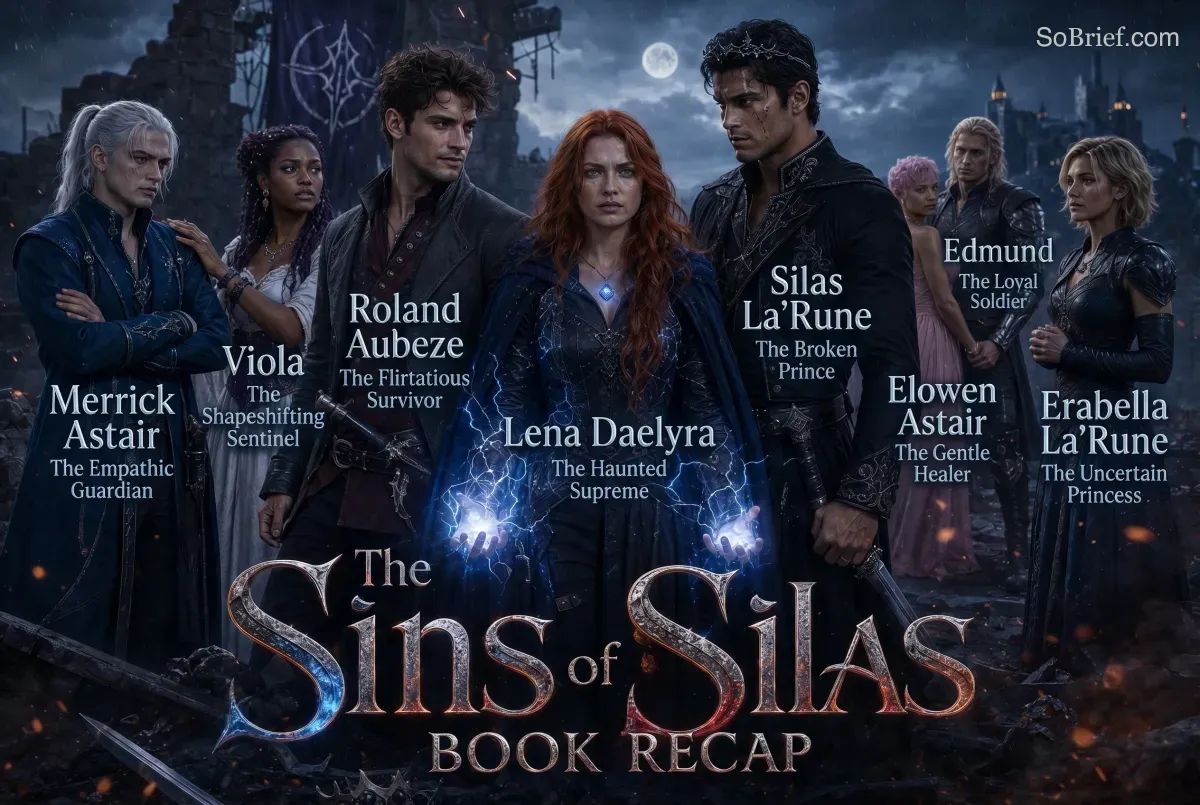
Lena Daelyra
Supreme of Ames, fire MageLena carries the weight of an entire people on shoulders still bruised from personal devastation. Orphaned of her father's16 presence, survivor of miscarriage and sexual assault, she masks fractures with fierce determination and acerbic wit. Her fire magic emerged from grief—literally igniting the night she lost her unborn child—and serves as both weapon and metaphor for the rage she struggles to contain. She loves with reckless totality, willing to die for those she protects while privately believing she is too damaged to deserve happiness. Her journey from concealing her Mage identity to embracing leadership reflects her central tension: the war between self-preservation and the compulsion to save everyone, even at the cost of herself.
Silas La'Rune
Prince of Otacia, Witch SlayerBeneath tattoos, scars, and five years of calculated cruelty lies a man whose humanity was systematically dismantled by his own father12. Silas's cold exterior is a survival mechanism forged through unimaginable abuse—the shell of a person who learned that showing emotion invited punishment. He oscillates between genuine tenderness and deliberate cruelty, pushing away those who get close because closeness once cost him everything. His love for Lena1 is the one flame his father's conditioning could never fully extinguish, and it becomes the crack through which his buried self struggles to re-emerge. His relationship with violence is deeply ambivalent: killing brings no pleasure anymore, yet it remains the one skill where his father's training excels.
Merrick Astair
Empath Mage, ice wielderMerrick's empathic gift is both superpower and curse—he absorbs every emotion in proximity, including grief, desire, and terror, yet struggles to process his own feelings. Raised by a mother who killed herself after his father's betrayal, he carries the unconscious belief that love is inherently destructive. His hostility toward humans masks vulnerability; forming genuine bonds with Otacians terrifies him because it contradicts his worldview. He uses sarcasm, smoking, and emotional walls as defense mechanisms, yet is unfailingly loyal to those he loves. His lip ring and silver hair mark him visually, but his real distinguishing feature is the dark swirl of his eyes when reading someone—an invasion of privacy he cannot always control.
Erabella
Princess of Otacia, Silas's wifeErabella entered her marriage as an escape from a family that despised her, not as a love match. She is perceptive, witty, and surprisingly adaptable—learning archery, fighting alongside Mages, and earning the respect of people who should be her enemies. Beneath her composed exterior lies a woman starving for genuine connection, someone who has never been anyone's first choice. Her growing closeness with Merrick3 represents the first time she feels truly seen. Erabella's psychology is defined by a quiet hunger for validation she refuses to articulate—channeling hurt into stubborn resilience and sharp deflection rather than admitting how deeply she can be wounded. Her capacity for both kindness and cold resolve makes her the story's most unpredictable presence.
Torrin Brighthell
Telepathic Mage, Lena's protectorTorrin is a selfless guardian whose telepathy allows him to understand everyone except himself. He sacrificed his freedom following a seer's orders, endured a year of enslavement, and still prioritizes others over his own needs. His love for Lena1 is genuine and deep, yet he recognizes it will never be returned in equal measure. His burned left hand—scarred while calming Lena's1 first fire—is the physical manifestation of his devotion: permanent damage accepted without hesitation for the person he loves most.
Roland Aubeze
Otacian soldier, charming rogueRoland weaponizes humor to survive pain he refuses to discuss. Bisexual, unabashedly flirtatious, and fiercely loyal, he uses sexual confidence as both armor and genuine expression. Beneath the bravado lies a man who joined a treasonous cause without hesitation because he believed in Silas's2 potential. His piano-playing talent hints at the sensitivity he hides behind crude jokes and reckless grins. His history with Silas2 runs deeper than either publicly admits.
Elowen
Healer Mage, Merrick's sisterA tiny powerhouse of compassion, Elowen is the group's indispensable healer. Despite relentless cheerfulness, she carries guilt over her existence—born of her father's affair, she blames herself for her stepmother's suicide. Her Soul-Tie bond with Edmund9 represents her first experience of unconditional acceptance. Sweet-natured but increasingly hardened by the violence surrounding her, she acquires fire magic through emotional trauma, signaling a shift from pure healer to someone forced to reconcile destruction with her gentle nature.
Dani
Warlock shapeshifter, Leroy's siblingDani fluidly shifts between male and female forms, reflecting a comfort with identity that contrasts with most characters' internal conflicts. Cobalt-haired and quick-witted, Dani bridges the ancient animosity between Warlocks and Mages through pragmatism: teaching Lena1 incantation magic from a forbidden grimoire. Grief over their sister-in-law Emma's death drives them to join the quest. Dani reads people with startling accuracy, often noticing romantic tensions before the involved parties acknowledge them.
Edmund
Otacian soldier, enchanted limbsEdmund lost an arm and leg to an Undead attack, then received enchanted carbonado replacements crafted by Mage technology—making him a living argument against anti-Mage prejudice. An old-fashioned romantic whose first kiss was with Elowen7, he is fiercely devoted to her and surprisingly capable of standing up to Merrick3. His emotional openness contrasts sharply with the other soldiers' guarded personas.
Viola
Shapeshifter Mage, natural leaderViola is the group's most versatile tactical asset, capable of becoming any creature or person. She is pragmatic, physically striking, and emotionally cautious—her relationships tend toward the physical rather than the vulnerable. She organizes liberated Mages with natural authority, revealing leadership instincts that complement Lena's1 more emotional approach. Her silver hair rings, gifted by an unlikely friend, symbolize an alliance she never thought possible.
Kayin
Mysterious imprisoned seerA telepathic voice that has guided Lena1 and Torrin5 for years, Kayin is a seer whose identity and location remain among the story's most closely guarded secrets. She communicates in cryptic fragments, clearly constrained by forces she cannot explain. Her messages carry urgency and sorrow, suggesting she is both powerful and imprisoned. Her relationship to Igon Natarion15 and the broader prophecy forms a thread connecting the story's deepest mysteries.
King Ulric
Tyrant King of OtaciaOtacia's ruler is a man of terrifying control who believes emotion is weakness and obedience is love. He orchestrated a continental kill order against Mages, brutalized his own son2 into compliance, and rules through fear so absolute that no soldier dared defect even when Silas2 turned against him. His motivations extend far beyond mere xenophobia—something darker and more ancient drives his relentless pursuit of power and his obsession with a weapon that could end all magic.
Leroy
Warlock King of ForsmontForsmont's young Warlock king rules democratically, with checks on his power. He and his wife Emma built a community where Warlocks and humans thrive together. His devastating personal loss transforms him from an optimistic leader into someone who finally understands Silas's2 grief.
Hendry
Quiet, deadly Otacian soldierThe tallest and quietest of Silas's2 men, Hendry hides significant personal darkness behind a composed exterior. His mismatched eyes and preference for older women make him distinctive. He is capable of extreme, precise violence when the situation demands it.
Igon Natarion
Former Supreme of Ames, seerAmes's visionary leader named Lena1 his successor before his death. His cryptic riddle about a phoenix reborn from ashes and his bronze compass drive much of the quest. He saw the future in fragments and manipulated events over decades, even at devastating cost to those he loved.
Waylon
Lena's human fatherA Faltrunian guard who never stopped loving Lena's1 Mage mother Minerva, Waylon has spent decades grieving a relationship he didn't understand losing. His discovery of his daughter's existence catalyzes a prison break that frees hundreds.
Saoirse
Orphaned four-year-old MageAn orphaned child in Faltrun's slave cells who latches onto Silas2, asking him to be her new father. She clutches a kitten doll named Boots and embodies the innocence that war consumes without hesitation or mercy.
Valter
Prince of Nereida, scholarLucretia's son and a scholar of Mage history, Valter18 is warm, knowledgeable, and clearly intrigued by Lena1. He provides crucial historical context about the Gods and volunteers to help warn the mainland kingdoms.
Azrae
God of Vengeance and BalanceThe only deity still permitted to walk the mortal realm, Azrae communicates through cryptic questions and refuses to intervene directly, insisting that those he guides must arrive at truth themselves. His white flame is the only power capable of restoring cosmic balance.
Plot Devices
Magic-Erasing Cuffs
Suppress all Mage abilitiesMetal bands with glowing red gems that nullify magical abilities on contact. They represent Otacia's technological edge over Magekind and appear as instruments of control throughout—binding prisoners, enslaving Mages in occupied kingdoms, and rendering the most powerful beings helpless. They require a specific thumbprint to unlock, making escape dependent on either the right person or creative workarounds like Viola's10 shapeshifting into the keyholder. The cuffs' mysterious origin becomes a recurring question, as their technology seems to exceed normal human capability, and their existence predates the timeline Silas2 was given.
Ryia's Necklace
Memento unlocking hidden truthA silver and sapphire necklace that belonged to Queen Ryia La'Rune11, given to Lena1 before the Queen's supposed death. Kayin11 tells Lena1 it will provide answers, though how jewelry could do so remains unclear for most of the story. Its true function is revealed when used as a memento in Nereida's Chamber of Time: it unlocks Ryia's11 memories, exposing that Ryia11 was actually Kayin11—a Mage seer who married Ulric12 to save her people. The necklace also reveals that Ulric12 is the God of Deceit and that Ryia11 survives as his Undead prisoner. A piece of sentimental jewelry becomes the key that cracks the entire conspiracy open.
Potestas Verae Maleficis
Ancient grimoire of true magicA Warlock grimoire whose title translates to 'The Power of a True Witch,' containing incantation spells that Mages can perform with even greater potency than Warlocks themselves. Dani8 provides it to Lena1, who uses it to learn soundproofing, advanced healing circles, teleportation, and the memory-erasing spell Oblivisci. The book serves as both practical toolkit and thematic symbol: the centuries-old division between Mages and Warlocks was artificial, and their combined magic represents the unity needed to face a common enemy. Its self-preserving enchantment ensures it cannot be destroyed, though it can still be lost.
Igon's Compass
Seer's memento and riddle-keeperA bronze compass with a pelican engraved on its back, given to Lena1 by Igon15 before his death along with the riddle: only through fire can the phoenix be reborn from the ashes. The pelican symbolizes sacrifice in the ancient animal mythology shared by the Warlocks. In the Chamber of Time, the compass serves as the memento that unlocks Igon's15 hidden memories, revealing him to be Kayin's11 father and exposing decades of manipulation designed to position Lena1 at the center of a cosmic prophecy. The compass transforms from a cryptic keepsake into proof that Igon15 orchestrated events across generations.
The Undead Curse
Necromantic weapon and armyDark magic wielded by the necromancer that reanimates the dead in two forms: feral Undead that attack in mindless swarms, and intelligent 'puppets' who retain their original appearance and serve as speaking vessels for the Lord of the Shadows. The puppets can teleport, think strategically, and wield the memories of their hosts. The curse can also be applied to weapons, creating blades whose wounds resist all known healing magic. Only the original souls trapped within the puppets show signs of resistance—brief flashes of sapphire eyes behind the solid black, moments of lucidity that suggest the person inside is not entirely gone.
FAQ
Synopsis & Basic Details
What is The Sins of Silas about?
- A continent fractured by prejudice: The story follows Prince Silas of Otacia and Lena, a Mage in hiding, whose lives are irrevocably linked by a forbidden past and a continent on the brink of war, fueled by King Ulric's persecution of magic-kind.
- A quest for survival and truth: After a devastating attack on Lena's village and the revelation of Silas's betrayal of his kingdom, they embark on a perilous journey with a small group of Mages and defecting Otacian soldiers, seeking allies and answers about a rising necromancer and a mysterious Weapon.
- Unearthing hidden histories and destinies: The narrative delves into ancient prophecies, the true nature of magic, the complex pasts of its characters, and the possibility that their personal traumas and relationships are tied to the fate of the entire world.
Why should I read The Sins of Silas?
- Deeply emotional character arcs: The novel offers an intense exploration of trauma, love, and resilience through the eyes of characters like Silas and Lena, whose personal pain and growth are central to the plot.
- Intricate world-building and magic system: Beyond the political conflict, the story reveals layers of hidden magical societies, ancient prophecies, and unique abilities like empathy, shapeshifting, and elemental control, enriched by the discovery of Warlock incantations.
- Compelling mysteries and twists: Readers are drawn into uncovering secrets about the past, the identity of the true villain, and the nature of the Weapon, with revelations that constantly challenge expectations and deepen the stakes.
What is the background of The Sins of Silas?
- A history of human-Mage conflict: The continent of Tovagoth is defined by centuries of animosity and violence between humans and those with magic, exacerbated by King Ulric La'Rune's brutal kill order against Mages.
- Hidden magical societies: Unknown to most on the mainland, powerful magical communities like the Warlocks of Forsmont and the Mages of Nereida have survived by concealing their existence or isolating themselves.
- Ancient prophecies and divine interference: The world is shaped by the actions of Gods and Goddesses, whose past sins and ongoing influence are tied to a prophecy foretelling the rise of new deities and a looming conflict that threatens all realms.
What are the most memorable quotes in The Sins of Silas?
- "You will not give up. You will not break.": This mantra, first spoken by Lena to Silas in their youth and later echoing through his darkest moments, encapsulates their shared resilience and refusal to succumb to despair despite immense suffering (Chapter 63).
- "Only through fire can the phoenix be reborn from the ashes.": Igon's cryptic message to Lena before his death serves as a central riddle, hinting at themes of destruction, rebirth, and Lena's own fiery power and destiny (Chapter 2).
- "I am the God of Deceit.": King Ulric's chilling declaration reveals his true nature as the necromancer and a divine entity, fundamentally shifting the understanding of the conflict from a political struggle to a cosmic battle against evil (Chapter 72).
What writing style, narrative choices, and literary techniques does Kylie Snow use?
- Alternating first-person perspectives: The story primarily shifts between Silas and Lena's viewpoints, offering intimate access to their thoughts, emotions, and experiences, highlighting their individual traumas and their intertwined destinies.
- Emphasis on emotional intensity: Snow employs vivid descriptions of physical pain, psychological torment, and overwhelming emotions like grief, rage, love, and desire, often using internal monologue and sensory details to immerse the reader in the characters' subjective experiences.
- Integration of magical realism and fantasy elements: The narrative blends realistic depictions of trauma and relationships with high fantasy elements like magic systems, mythical creatures (Sea Nymphs, Dragons), divine beings, and ancient prophecies, grounding the fantastical in relatable human emotion.
Hidden Details & Subtle Connections
What are some minor details that add significant meaning?
- Silas's scar as a mark of trauma: The scar above Silas's lip, initially presented as a consequence of his father's anger, is later revealed to be the first physical mark of Ulric's systematic abuse, symbolizing the beginning of Silas's descent into coldness (Chapter 61).
- Roland's piano playing reveals hidden depth: Roland's unexpected talent for playing melancholic piano pieces at Hidden Rhythm shows a sensitive, artistic side beneath his charming, vulgar exterior, hinting at the emotional complexity he hides (Chapter 62).
- Viola's hair rings symbolize acceptance: The silver hair rings Silas gifts Viola, which she proudly incorporates into her new hairstyle in Nereida, represent her acceptance of herself and her Mage identity, contrasting with the forced conformity of the mainland (Chapter 70).
- The Freak Show as a symbol of hope: The underground circus in Forsmont, where Warlocks and those with 'oddities' find community and acceptance, serves as a powerful microcosm of the diverse and tolerant society the protagonists are fighting to create (Chapter 8).
What are some subtle foreshadowing and callbacks?
- Lena's fire mirroring Amatta's death: Lena's acquisition of fire magic after her miscarriage, described with intense heat and burning skin, subtly foreshadows her later use of fire against the Undead and echoes the method of Amatta's death, hinting at a deeper connection between them (Chapter 11).
- The spider symbol's recurring appearance: The spider symbol etched onto the Undead's foreheads, first seen on Heildee, is later revealed to be the symbol for Deceit in the Titharan language, foreshadowing Ulric's identity as the God of Deceit (Chapter 58).
- The Valley of Awakening's time distortion: The discrepancy between the perceived duration of the trials in the Valley (weeks) and the actual time passed (hours) subtly hints at the magical nature of the location and foreshadows the later revelation of Tithara's power over time (Chapter 65).
- Ryia's necklace as a key to the past: Queen Ryia's necklace, given to Lena, is initially presented as a sentimental gift but is later revealed by Kayin to hold the "answers you need," foreshadowing its use as a memento in the Chamber of Time to unlock hidden memories (Chapter 2, Chapter 65).
What are some unexpected character connections?
- Ryia La'Rune is Kayin Natarion: The shocking revelation that Silas's murdered mother is the seer Kayin, daughter of Igon, fundamentally alters the understanding of the prophecy and the motivations behind key events (Chapter 71).
- Lena Daelyra is Azrae's daughter: Lena discovers she is not Waylon's biological child but the daughter of Azrae, the God of Vengeance/Purification, revealing her true identity as the Goddess of Purification and the prophesied Weapon (Chapter 81).
- Quill Callon is Ryia's lover and Aria's father: The man whose name Silas adopted is revealed to be Ryia's secret human lover and the father of her Mage daughter, Aria, adding layers to Silas's identity and Ryia's sacrifices (Chapter 72).
- Torrin Brighthell's telepathic link to Ryia: Torrin's blood oath with Ryia, performed using Igon's siphoning spell, created a telepathic connection, explaining how Kayin could communicate with him and Lena across distances (Chapter 72).
Who are the most significant supporting characters?
- Torrin Brighthell: As Lena's confidante, protector, and telepathic link to Kayin, Torrin's loyalty and self-sacrifice are crucial, providing emotional support and vital information, despite his own pain and unrequited love.
- Merrick Astair: The empath's ability to read emotions provides critical insights into characters' true intentions and hidden feelings, while his personal struggles with trauma and forbidden desire add significant emotional depth to the narrative before his tragic death.
- Roland Aubeze: Initially presented as a charming flirt, Roland's unwavering loyalty, surprising hidden talents (piano, torture skills), and complex past with Silas reveal a character of unexpected depth and importance to the group's survival and emotional well-being.
- Dani: As a Warlock shapeshifter and teacher, Dani bridges the gap between Mages and Warlocks, providing essential magical knowledge (incantations, teleportation) and strategic support, while also offering moments of levity and forming meaningful connections like the one with Viola.
Psychological, Emotional, & Relational Analysis
What are some unspoken motivations of the characters?
- Silas's coldness masks profound trauma: Silas's seemingly unfeeling demeanor and ruthless efficiency as the "Witch Slayer" are not inherent traits but a psychological defense mechanism developed after months of systematic torture and rape by his father, designed to suppress all emotion (Chapter 63).
- Lena's drive fueled by unresolved grief: Lena's relentless pursuit of answers and her determination to save her people are deeply motivated by the unresolved trauma of her miscarriage, the loss of her home, and the belief that her past pain was somehow her fault, pushing her to seek control and purpose (Chapter 11).
- Erabella's betrayal stems from hurt and confusion: Erabella's decision to betray the group is driven by the profound hurt and confusion caused by Silas's emotional distance, his clear feelings for Lena, and her own burgeoning, forbidden feelings for Merrick, leading her to lash out in pain rather than malice (Chapter 74).
- Torrin's self-sacrificing love for Lena: Torrin's decision to leave Ames and later his refusal to pursue a romantic relationship with Lena are motivated by his deep, selfless love for her and his belief that she is destined for Silas, choosing her happiness over his own despite his pain (Chapter 69).
What psychological complexities do the characters exhibit?
- Silas's PTSD and emotional suppression: Silas displays clear symptoms of PTSD, including emotional numbing, difficulty with intimacy (especially regarding his back), and panic responses triggered by fire or helplessness, stemming from his father's abuse and the trauma of believing Lena died (Chapter 63).
- Lena's trauma response and memory spell: Lena's tendency to dissociate under extreme stress ("I am safe" mantra) and her decision to use a memory spell highlight the psychological burden of her traumas (miscarriage, rape, loss), showing her struggle to cope with overwhelming pain (Chapter 6, Chapter 53).
- Merrick's empathic burden and coping mechanisms: Merrick's constant exposure to others' emotions, amplified by trauma, leads him to develop coping strategies like building mental walls and using substances (dagga) to numb the overwhelming feelings, illustrating the psychological toll of his gift (Chapter 57).
- Erabella's internal conflict and identity struggle: Erabella grapples with her identity as a princess versus her desire for authenticity, her loyalty to Silas versus her feelings for Merrick, and the shame of her betrayal, revealing the psychological complexity of navigating conflicting desires and societal expectations (Chapter 74).
What are the major emotional turning points?
- Lena's acquisition of fire magic: Triggered by the devastating loss of her child and home, this moment marks Lena's transformation from a fearful Mage hiding her power to a force of nature fueled by grief and resilience (Chapter 11).
- Silas's breakdown over Saoirse: Witnessing the death of the innocent Mage child, Saoirse, shatters Silas's emotional suppression, allowing him to cry for the first time in years and reconnecting him with his buried empathy and grief (Chapter 42).
- Erabella's confrontation with Merrick and the truth: Erabella's emotional breakdown after learning about Silas and Lena's history and Merrick's knowledge forces her to confront her own feelings and the reality of her relationships, leading to her desperate act of betrayal (Chapter 74).
- Lena's memory spell and its aftermath: Lena's decision to erase painful memories, while intended to help her lead, creates emotional distance and confusion, highlighting the cost of suppressing trauma and leading to a pivotal confrontation with Silas (Chapter 53, Chapter 56).
How do relationship dynamics evolve?
- Silas and Lena's Soul-Tie bond endures trauma: Their relationship transforms from a secret youthful romance, shattered by perceived death and betrayal, to a complex bond tested by trauma, infidelity, and memory loss, ultimately reaffirming their deep, fated connection despite everything (Chapter 64).
- Silas and Erabella's arranged marriage dissolves: Their relationship, initially a pragmatic alliance that developed into genuine affection, is irrevocably broken by Silas's inability to fully love her due to his past and his eventual infidelity with Lena, culminating in Erabella's painful betrayal (Chapter 68).
- Merrick and Erabella's forbidden connection deepens: Their dynamic evolves from initial antagonism to a complex emotional bond forged in shared trauma (Valley of Awakening, battle), exploring themes of forbidden desire, loyalty, and the pain of unrequited or complicated love before Erabella's betrayal severs their connection (Chapter 41, Chapter 74).
- Roland and Lena's relationship shifts: Their dynamic moves from playful flirting and casual sex to a deeper friendship built on mutual respect and understanding, particularly after Lena confides in Roland about her past and trauma (Chapter 67).
- Silas and Roland's friendship is tested and healed: Their relationship, strained by Silas's past resentment and later by Roland's intimacy with Lena, is ultimately repaired through honest confession and forgiveness, revealing the depth of their loyalty despite past hurts (Chapter 75).
Interpretation & Debate
Which parts of the story remain ambiguous or open-ended?
- The full extent of the rift and other dimensions: While the necromancer mentions a rift bringing objects and ideas from other dimensions (like the phone), the nature, origin, and implications of these other worlds remain largely unexplored by the end of the book (Chapter 58).
- The specific powers and identities of all new Gods: The prophecy names four new Gods (Rebirth, Purification, Sacrifice, Deceit) and hints at their relationships (Azrae as Purification's father), but the identities and powers of Rebirth and Sacrifice are not definitively revealed by the end.
- The future of the Undead and Kayin: It's unclear if the Undead puppets can be fully restored or if their souls are permanently trapped, leaving the fate of characters like Igon and Kayin (Ryia) ambiguous despite the revelation that Kayin is still partially conscious (Chapter 73).
What are some debatable, controversial scenes or moments in The Sins of Silas?
- Lena's decision to erase her memories: While presented as a necessary act for her leadership and healing, the ethics of using magic to erase painful memories, particularly those involving Silas, are debatable, raising questions about authenticity and the right to forget (Chapter 53).
- Erabella's betrayal of the group: Erabella's choice to lead the Halstedian soldiers to the temple, resulting in Silas's execution, is highly controversial; readers may debate whether her actions were justified by her pain and betrayal or if they were unforgivable (Chapter 78).
- Silas's torture of Dimitri: Silas's brutal torture of Dimitri, including mutilation and humiliation, is a morally ambiguous act, prompting debate about whether his vengeance was justified given Dimitri's atrocities or if it revealed a disturbing capacity for cruelty (Chapter 44).
The Sins of Silas Ending Explained: How It Ends & What It Means
- Silas's Execution and Lena's Revelation: Silas is executed by a Halstedian soldier using a cursed, Undead sword, fulfilling a prophecy of death. In her moment of despair and torture, Lena is visited by Azrae, who reveals himself as her father and her true identity as the Goddess of Purification and the prophesied Weapon (Chapter 81).
- The Meaning of the Ending: Silas's death, while tragic, is hinted in the acknowledgements to be a form of "rebirth," aligning with the prophecy of the God of Rebirth and suggesting his story is not over. Lena's awakening as a Goddess signifies her acceptance of her immense power and destiny, positioning her as the only one capable of stopping Ulric, the God of Deceit.
- Setting up the Next Conflict: The ending leaves the protagonists scattered, traumatized, and facing the seemingly insurmountable task of defeating a God (Ulric) and potentially finding a way to resurrect or heal those touched by the Undead curse (including Kayin/Ryia and potentially Silas), setting a high-stakes stage for the next book.
Download PDF
Download EPUB
.epub digital book format is ideal for reading ebooks on phones, tablets, and e-readers.








































