

Key Takeaways
All seers are prophets, but not all prophets are seers
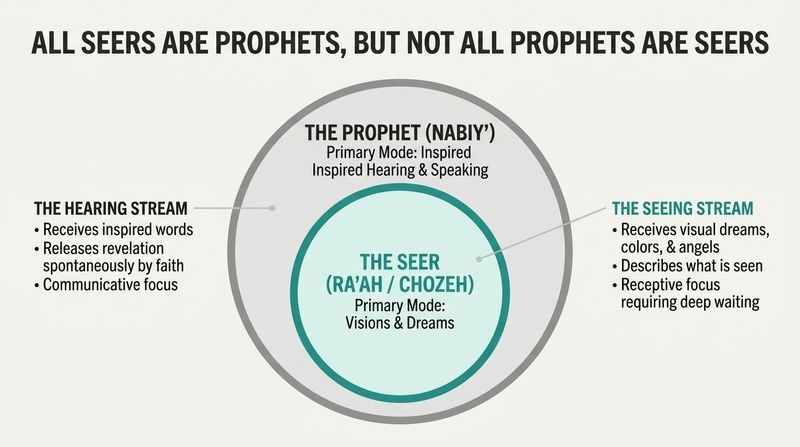
Two prophetic streams feed one river. Goll uses the Nile, formed where the White and Blue Nile merge, to picture how the prophetic flows from heaven in two distinct currents. The nabiy' prophet is primarily an inspired hearer who then speaks, the communicative dimension. The seer (Hebrew ra'ah or chozeh, meaning "one who gazes or beholds visions") is primarily visual, the receptive dimension. A nabiy' hears a word and releases it spontaneously by faith. A seer sees pictures, angels, colors, and dreams, then describes them, often depending on the manifested presence of God and lengthy waiting.
Both are equal, neither superior. Scripture lists Samuel, Gad, and Asaph as seers and Nathan as a prophet, all serving King David. Goll notes that historically the two roles were named interchangeably, and both exist to edify, exhort, and comfort.
What's striking is how Goll frames a distinction that could feel like spiritual hierarchy as complementary specialization instead. The parallel to cognitive science is hard to miss: humans do split into verbal and visual-spatial processors, and modern neuroscience distinguishes auditory from visual working memory. Goll intuits something psychologists formalize, that revelation, however one theologically frames it, is filtered through different perceptual channels. A fair critique is that the nabiy'/ra'ah word study leans heavily on lexical etymology, which can overstate how cleanly ancient Hebrew authors separated the terms. Still, the humility of the framework, insisting neither gift outranks the other, guards against the ego traps that plague charismatic movements.
Whatever you fix before your eyes is what you become
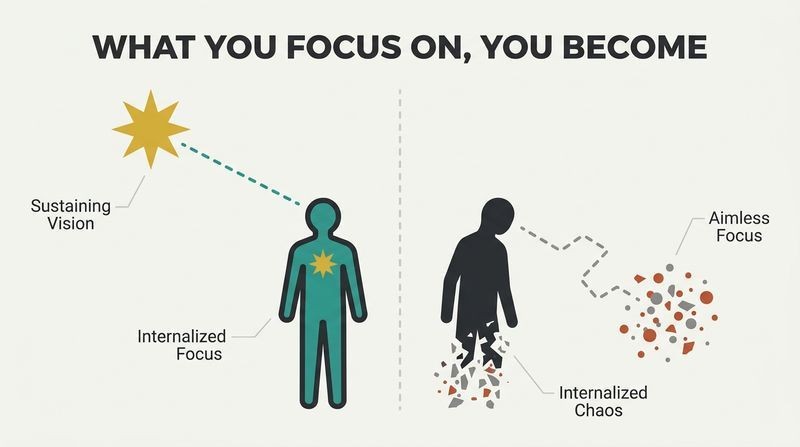
Vision sustains, its absence destroys. Goll builds on Proverbs 29:18, that without vision people cast off restraint, using Israel's golden calf collapse when Moses vanished up the mountain. His central mechanism is that what we gaze upon shapes our outcome. His favorite illustration is Jacob, who set peeled striped rods before mating flocks so they bore striped, speckled offspring, growing wealthy while his cheating father-in-law's herds weakened.
Great figures were carried by a single sustaining sight. Elisha received a double portion because he saw Elijah taken up in the chariot of fire. Daniel repeatedly "kept looking" until, past the vision of rising beasts and evil, he glimpsed the Ancient of Days on the throne. The lesson: set a target on the Lord and refuse to look away, because aiming at nothing guarantees hitting nothing.
The underlying claim, that sustained attention reshapes identity, has robust secular support. Visualization is standard in elite sports psychology, and the reticular activating system genuinely filters perception toward whatever we prime it to notice. Viktor Frankl's logotherapy made nearly the same argument from a concentration camp: those with a vision of future meaning survived. Goll's Jacob example is theologically colorful but biologically dubious as literal genetics, and readers should take it as parable rather than animal husbandry. The stronger point stands on its own: chronic aimlessness is corrosive, and disciplined focus on a compelling image of the good functions as psychological ballast.
Don't get mesmerized by the vision; interrogate it for meaning
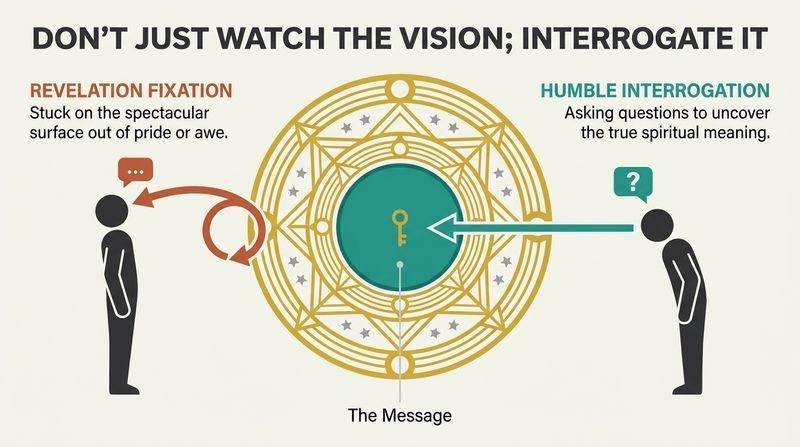
Beware revelation fixation. Goll coins this phrase for a specific trap: becoming so impressed by a supernatural image that you stop pressing toward its interpretation, treating the vision as an end rather than an instrument. Daniel avoided it by repeatedly saying "I kept looking," refusing to freeze on the fearsome beasts until he saw the throne and understood.
Humility is the key that unlocks understanding. Zechariah, shown a golden lampstand and two olive trees, immediately asked the interpreting angel, "What are these, my lord?" and admitted "No, my lord" when tested. That posture released the famous meaning: "Not by might nor by power, but by My Spirit." Goll contrasts this with his younger self nodding along to the seer Bob Jones's visions while privately baffled, too proud to ask. His rule now: no matter how familiar an image, always ask, "What is this, Lord?"
This is quietly one of the book's most transferable insights, and it maps onto epistemology far beyond religion. Confusing a vivid signal for a validated conclusion is exactly the error behind conspiracy thinking, pattern-seeing in noise, and premature diagnosis in medicine. The remedy Goll prescribes, sustained inquiry plus intellectual humility, mirrors what philosophers of science call the difference between observation and interpretation. Daniel Kahneman would recognize "revelation fixation" as a cousin of the availability heuristic, where the emotionally salient crowds out the analytically true. The practice of interrogating rather than worshipping one's own impressions is good discipline for anyone, mystic or skeptic.
Run every spiritual experience through nine scriptural tests before trusting it
Revelation flows from three possible sources. Goll insists supernatural input can come from the Holy Spirit, the human soul (our own unsanctified emotions), or evil spirits masquerading as light, so discernment is non-negotiable. Even genuine prophecy arrives through flawed people, producing what he wryly calls "hamburger helper," where sincere folks pad God's nugget with their own opinions.
Test relentlessly against these standards. Among his nine tests: Does it edify, exhort, or console? Does it agree with Scripture? Does it exalt Jesus? Does it bear good fruit? If predictive, does it come to pass? Does it produce liberty or bondage, life or death? Before any of this, Goll requires the ABCs of safety: regular Bible study, a prayer life, pursuit of purity, membership in a local church, and peer relationships that can speak into your life. Scripture, the logos, always outranks the personal rhema word.
Goll's framework is essentially a fraud-detection protocol, and its logic echoes far outside charismatic circles. Scientists demand replication and falsifiability precisely because vivid personal conviction is unreliable evidence. The insistence that revelation be subordinate to a fixed external standard (Scripture) parallels how legal systems subordinate eyewitness testimony to corroboration, given how confidently people misremember. The honest admission that God's genuine people routinely contaminate the message with ego is refreshingly self-critical for the genre. One tension worth naming: the ninth test, whether the Spirit inwardly confirms truth, is admittedly subjective, and layering a subjective check atop objective ones risks circularity, which Goll himself flags by ranking it last.
The Bible names at least eight distinct kinds of visionary states
Different Greek words, different experiences. Goll argues nearly half of Scripture is visionary or ecstatic, and the New Testament uses precise vocabulary that English flattens into "vision" or "dream." His survey includes:
1. Onar: the ordinary sleeping dream (Joseph told to flee to Egypt)
2. Enupnion: a dream with a startling surprise quality that lingers
3. Horama: a waking vision or spectacle (Peter's sheet, Paul's Macedonian man)
4. Optasia: a self-disclosing apparition where one sees a divine being and sometimes oneself within it
5. Ekstasis: a trance, the root of "ecstasy"
Seeing has two sets of eyes. Horasis covers both physical and inner sight, tied to Paul's prayer that "the eyes of your heart may be enlightened." Apokalupsis, the most frequent word, means unveiling of something hidden, the root of "apocalypse." None of these states is higher than another; the Spirit distributes them as He wills.
The taxonomy is genuinely useful because naming distinctions sharpens perception, a principle linguists call the Whorfian effect. Where a layperson has one bucket labeled "weird spiritual experience," Goll offers eight, which lets practitioners categorize rather than fear. Comparative religion scholars would note that trance, waking vision, and ecstatic states appear across nearly every tradition, from shamanic cultures to Sufi mysticism, raising the question of whether these are universal features of human neurology (the temporal lobe's role in mystical experience is well documented) or genuinely distinct spiritual channels. Goll would answer that the counterfeit exists precisely because an authentic original does, an argument that is coherent even if unfalsifiable.
Spiritual discernment trains your five senses like muscles
Two related but different capacities. Goll separates general discernment, earned through study, maturity, and life experience, from the discerning of spirits, a supernatural gift imparted by the Spirit that no learning can manufacture. Both grow through the same soil: meditating on Scripture and time in God's presence. Hebrews 5:14 anchors it: the mature have "senses trained to discern good and evil."
Perception arrives through all five senses. Goll reports discerning addictions by literally smelling a particular smoke, sensing evil as an unexplained foul odor or a room turning ice-cold, receiving physical pains that reveal another person's wounds, and hearing supernatural wind. The gift serves six purposes, including delivering people from demons, exposing error, and recognizing how the Spirit is moving so one cooperates rather than works against Him. His warning: this is not "the gift of suspicion," never a license for gossip or spiritual surveillance of others.
The framing of discernment as trainable sensory acuity is more defensible than it first sounds. Expertise research shows that seasoned professionals, from radiologists to chicken sexers to firefighters, develop rapid intuitive pattern recognition that feels like a sixth sense but is actually compressed experience, what Gary Klein calls recognition-primed decision making. Goll's insistence that discernment strengthens through practice fits this literature precisely. The caution against weaponizing the gift as suspicion is ethically important and often ignored in high-control religious groups, where claims of discernment become tools of manipulation. His self-imposed guardrail, that the gift exists for edification not exposure of others, is a meaningful check.
Pray for opened eyes; the seer capacity isn't a closed elite
Vision can be imparted, not just inherited. Goll rejects the idea that seeing is reserved for a chosen few. He has prayed two scriptures daily for over twenty years: Paul's prayer in Ephesians 1 that the eyes of the heart be enlightened, and Elisha's prayer in 2 Kings 6. When the Syrian army surrounded the city and Elisha's servant panicked, Elisha prayed, "O Lord, open his eyes that he may see," and the terrified servant suddenly saw the hills full of horses and chariots of fire.
One seer's prayer opened another's eyes. That story is Goll's proof text that spiritual sight transfers from person to person through intercession. He teaches that any believer who prays over the eyes of their heart will receive a spirit of wisdom and revelation. It is a sovereign gift, he says, but not an exclusive one, which is why he prays it over his family and countless others.
Democratizing a gift usually reserved for spiritual celebrities is one of the book's more generous moves, and it lowers the barrier that keeps ordinary believers passive spectators. Psychologically, the claim that expectancy shapes perception is well grounded: priming and attentional set demonstrably change what people notice in ambient noise. There is a shadow side worth naming. If everyone can and should "see," the pressure to manufacture experiences rises, and suggestible people may confabulate to meet the group's expectation. Goll's earlier insistence on rigorous testing is the necessary counterweight, and the two teachings should be held together, not separately.
Never manufacture a trance; genuine ecstasy is God-initiated only
The line between the holy and the occult. Goll admits he long feared trances and out-of-body experiences because the New Age movement had colonized them. His resolution: these phenomena originated with God and were merely counterfeited by the enemy. A trance (ekstasis) is a state where normal consciousness is suspended so the Spirit can impart revelation. Peter fell into one on a Joppa rooftop and saw the sheet of unclean animals, which broke his prejudice and opened the gospel to Gentiles.
The non-negotiable safeguard. Every such experience must be God-induced, never self-willed. Goll flatly labels self-projection and astral projection as witchcraft. His explanation for why occult practitioners seem to prosper in these realms unharmed: they pose no threat to darkness because they are already deceived and in league with it. The believer's posture is to seek God, not experiences, and let genuine encounters come.
The distinction Goll draws, receptivity versus self-generation, is theologically sharp and practically wise, whatever one's metaphysics. It functions as a safeguard against the ego's hunger to command the transcendent, a temptation as old as Simon Magus offering to buy the Spirit. Neurologically, trance states are real and inducible through breathwork, rhythm, and sensory deprivation, which complicates Goll's clean line, since the same brain mechanisms fire whether the trigger is meditation or the Spirit. His deeper point survives that complication: the orientation of the heart, seeking the Giver rather than the experience, is what he treats as decisive, and that is a claim about motive more than mechanism.
God shares His secrets only with those who become His friends
Standing in the council of the Lord. Goll's Hebrew key is cowd, meaning an intimate session of persons in close, secret deliberation. Jeremiah says the mark of a true prophet is that he has stood in this council and heard God's word. Amos 3:7 clinches it: God does nothing without revealing His secret counsel to His servants the prophets, not because He needs them, but because at creation He delegated stewardship of earth to humanity and honors that chain of command.
Intimacy, not technique, grants access. Abraham heard God's plan for Sodom in advance and interceded, rescuing Lot's family. Goll stresses two entry conditions from Zechariah 3: walk in God's ways and perform His service. He also warns of what blocks it, listing Jeremiah's catalog of prophetic sins: manipulation, mixed sources, immorality, speaking from imagination, and stealing others' words rather than admitting "I don't have a word today."
The relational model of revelation, that access flows from friendship rather than mastery, distinguishes this from magic, where technique compels results regardless of the practitioner's character. That is a meaningful theological boundary. The delegation argument, that God consults humans because He deputized them at creation, is an elegant reading of divine sovereignty coexisting with human agency, and it resonates with covenant theology broadly. The honesty about prophetic corruption is the section's ethical spine. In an industry where reputation depends on always having a word, Goll's permission to say "I don't know" is countercultural integrity, the same virtue that separates trustworthy experts from charlatans in any field.
An open heaven forms over a person before it forms over a city
Intimacy is the master key. The book's climax argues that the seer's entire purpose is intimacy with God that reveals Jesus. Jacob, a fugitive sleeping on a stone, dreamed of a ladder to heaven and awoke declaring the barren place was the gate of heaven. Nothing had changed but Jacob. An "open heaven" is a state where God's manifest presence becomes tangibly accessible, and Goll's core claim is that it always begins with one surrendered individual.
History turns on wasted lovers of God. Charles Finney carried such an anointing that workers wept under conviction before he spoke a word, what Goll calls presence evangelism. Welsh revivalist Evan Roberts, only 26, ignited a nation after being pierced by the prayer "Lord, bend the Church." Goll accesses this through contemplative prayer in three phases (recollection, the prayer of quiet, spiritual ecstasy) and the discipline of listen, watch, and wait.
Ending a book on prophetic pyrotechnics with a plea for quiet contemplative prayer is a deliberate and mature inversion, redirecting readers from spectacle back to relationship. The historical claim about revival origins is partly verifiable: the 1904 Welsh revival and Finney's Second Great Awakening ministry genuinely began with individuals of intense private devotion, though sociologists would add that economic stress, social networks, and cultural readiness also shaped their spread. Goll's "open heaven over a person first" mirrors a broader leadership truth, that movements crystallize around transformed individuals rather than programs. The retrieval of desert fathers and figures like Madame Guyon and Bernard of Clairvaux also quietly reconnects Pentecostal spirituality with ancient contemplative Christianity, bridging traditions often held apart.
Analysis
The Seer occupies an unusual niche: a systematic manual for a subjective phenomenon. Goll, a self-identified veteran of the Kansas City Prophets movement, attempts what most charismatic writers avoid, namely bringing lexical rigor, historical documentation, and testable criteria to territory usually left to anecdote. The book's structure moves deliberately from taxonomy (prophet versus seer, twelve anointing variations, eight Greek visionary words, twelve levels of vision) to safeguards (nine scriptural tests, discernment of spirits) to its true destination, intimacy with God. That trajectory is the book's quiet argument: the spectacular exists to serve the relational.
The intellectual honesty is stronger than the genre norm. Goll repeatedly concedes that prophecy flows through flawed vessels, that sincere people contaminate genuine revelation with their own psyche, and that the enemy counterfeits the authentic. His insistence that Scripture always outranks personal revelation functions as an epistemological anchor, preventing the untethered subjectivism that has wrecked prophetic movements. The recurring theme that character gates access to revelation, standing in the council requires friendship not technique, distinguishes his framework from magic.
The limitations are equally clear. The word studies sometimes carry more interpretive weight than etymology can bear, and the historical anecdotes (Constantine's vision, Blake, revival accounts) are cited uncritically as evidence. For skeptical readers, the entire edifice rests on unfalsifiable premises. Yet even a secular reader finds transferable insight: the danger of "revelation fixation," the training of perceptual acuity through practice, the corrosive effect of aimlessness, and the discipline of interrogating one's own impressions rather than worshipping them.
Ultimately the book is best read as spiritual formation literature wearing the clothes of a technical manual. Its lasting contribution is not the catalog of visionary states but the pastoral redirection: seek the Giver, not the gifts, and let the seeing serve love.
Review Summary
The Seer receives overwhelmingly positive reviews, with readers praising its depth, insights, and biblical foundation. Many found it enlightening about prophetic gifts, visions, and dreams. Readers appreciate Goll's explanations of different types of seers and prophetic experiences. Some noted the book's density, requiring multiple readings to fully absorb. The included 40-day devotional was well-received. A few readers mentioned minor issues with formatting or writing style, but overall, the book is highly recommended for those interested in prophetic ministry and spiritual growth.
Glossary
Seer (ra'ah / chozeh)
Prophet who receives visuallyA particular type of prophet whose revelation is primarily visual rather than verbal. From two Hebrew words meaning to gaze, behold, or perceive visions. Seers see pictures, angels, dreams, and colors, then describe them, and typically depend on the manifested presence of God, often receiving information ahead of time rather than spontaneously.
Nabiy'
Prophet who hears and speaksThe most common Hebrew word for prophet, emphasizing the active work of hearing God's word and speaking it forth. Meaning to flow or bubble forth like a fountain. The nabiy' is the communicative, audible, verbal dimension of prophecy, tending to be spontaneous and activated by faith, in contrast to the more receptive, visual seer.
Revelation fixation
Getting stuck on the imageGoll's coined term for the trap of becoming so impressed with a vision or supernatural image that one stops pressing toward its interpretation. The person treats the vision as an end in itself rather than an instrument God intends to teach something, and never presses on to understand its meaning.
Ekstasis
Spirit-induced trance stateThe Greek word for trance, the root of the English ecstasy. A state in which ordinary consciousness and natural perception are suspended so the person becomes susceptible only to the vision God imparts. Goll insists it must always be God-initiated, never self-induced, since self-projection belongs to the occult.
Standing in the council of the Lord (cowd)
Intimate access to God's secretsFrom the Hebrew cowd, meaning a session or company of persons in close, secret deliberation. Goll's picture of the prophet gaining access to God's confidential counsel as a trusted friend, based on Jeremiah 23 and Amos 3:7. Access is granted through intimacy and obedience, not technique.
Open heaven
Tangible access to God's presenceA state or event in which the celestial realm is disclosed and God's manifest presence becomes tangibly accessible, marked by conviction of sin, conversions, and healings. Goll teaches that an open heaven forms over a surrendered individual first, then can extend over homes, congregations, cities, and regions.
Contemplative prayer
Quiet fellowship for intimacyAn ancient Christian practice of quieting the soul to commune with God who dwells within the believer, distinct from intercession which appeals to God on His throne. Goll follows Richard Foster's three phases: recollection (releasing distractions), the prayer of quiet (stillness and beholding), and spiritual ecstasy (being caught up in God's presence).
Manifest presence vs omni-presence
God everywhere versus specially presentA distinction Goll draws from Wade Taylor. Omni-presence is God's unconditional abiding presence that fills heaven and earth, tied to salvation. Manifest presence is His conditional, personal coming to fellowship with believers who love and obey Him, when He tangibly shares Himself and reveals His purposes.
FAQ
1. What is "The Seer: The Prophetic Power of Visions, Dreams, and Open Heavens" by James W. Goll about?
- Explores the prophetic realm: The book delves into the biblical and practical aspects of the prophetic, focusing on the unique role of the "seer"—those who receive revelation primarily through visions and dreams.
- Distinguishes seers from prophets: Goll explains the difference between the "seer" and the "prophet" streams, showing how both are vital but distinct expressions of prophetic ministry.
- Offers practical guidance: The book provides tools for discerning, interpreting, and stewarding supernatural experiences, including dreams, visions, trances, and open heavens.
- Emphasizes intimacy with God: At its core, the book teaches that all prophetic experiences should lead to deeper intimacy with God and a greater manifestation of His purposes on earth.
2. Why should I read "The Seer" by James W. Goll?
- Foundational for prophetic understanding: The book is a comprehensive resource for anyone interested in the prophetic, especially those who experience or desire to understand visions and dreams.
- Balances experience and Scripture: Goll grounds supernatural experiences in biblical truth, offering a safe and scriptural approach to the prophetic.
- Practical application: Readers receive step-by-step advice on discerning, interpreting, and applying revelatory encounters in their lives and ministries.
- Encourages spiritual growth: The book is designed to help believers grow in spiritual discernment, intimacy with God, and effectiveness in their calling.
3. What are the key takeaways from "The Seer" by James W. Goll?
- Two prophetic streams: There are two main prophetic streams—nabiy’ (prophet, primarily auditory) and ra’ah/chozeh (seer, primarily visual)—both are valid and needed in the Church.
- Diversity of visionary experiences: The Holy Spirit communicates through a variety of visionary states, including dreams, visions, trances, and open heavens.
- Importance of discernment: Not all supernatural experiences are from God; the book provides biblical tests and wisdom for discerning the source and meaning of revelations.
- Intimacy is the goal: All prophetic activity should lead to greater intimacy with God, not just the pursuit of supernatural experiences.
4. How does James W. Goll define and distinguish between a "seer" and a "prophet" in "The Seer"?
- Seer is primarily visual: Seers (ra’ah/chozeh) receive revelation through visions, dreams, and visual impressions, often requiring interpretation and contemplation.
- Prophet is primarily auditory: Prophets (nabiy’) receive and deliver God’s word through inspired speech, often spontaneously and verbally.
- All seers are prophets: While all true seers operate in the prophetic, not all prophets function as seers; the seer realm is a subset within the broader prophetic ministry.
- Complementary roles: Both seers and prophets are essential for the full expression of God’s voice to His people, each bringing unique strengths and perspectives.
5. What are the main types of prophetic and visionary experiences described in "The Seer"?
- Dreams (onar, enupnion): Nighttime visions that can be symbolic or literal, used by God to communicate with both believers and non-believers.
- Visions (horama, horasis, optasia): Waking visual experiences, ranging from mental images to open, external visions, sometimes involving angelic or divine appearances.
- Trances (ekstasis): States of being overwhelmed by the Spirit, where normal consciousness is suspended and deep revelation is received.
- Open heavens: Experiences where the spiritual realm becomes visible, allowing direct encounters with God, angels, or heavenly realities.
- Out-of-body and translation experiences: Rare occurrences where a person’s spirit is taken to another place or realm for divine purposes.
6. How does "The Seer" by James W. Goll advise readers to discern and judge revelatory encounters?
- Scriptural foundation: All revelations must be tested against the written Word of God for consistency and truth.
- Nine scriptural tests: Goll provides nine biblical criteria, including whether the revelation edifies, aligns with Scripture, exalts Jesus, produces good fruit, and comes to pass if predictive.
- Source identification: Revelations can originate from the Holy Spirit, the human soul, or demonic spirits; discernment is needed to identify the source.
- Community and accountability: Submitting revelations to trusted spiritual leaders and peers provides safety and helps prevent deception or error.
7. What practical steps does James W. Goll recommend for developing the seer anointing in "The Seer"?
- Pray for revelation: Regularly pray Paul’s prayer in Ephesians 1:17-21 for a spirit of wisdom and revelation and for the eyes of your heart to be enlightened.
- Cultivate intimacy: Spend time in worship, prayer, and contemplative practices to deepen your relationship with God, which is the foundation for all revelation.
- Practice discernment: Learn to test and interpret dreams and visions using biblical principles and seek counsel from mature believers.
- Steward experiences: Record, reflect on, and act upon revelations as the Holy Spirit leads, always seeking to glorify Jesus and serve others.
8. What are the "dimensions of the prophetic anointing" outlined in "The Seer"?
- Twelve prophetic expressions: Goll describes twelve variations, including dreamers/visionaries, corporate prophets, prophets of holiness, social justice prophets, administrative prophets, prophetic worship leaders, intercessors, spirit-bearers, counselors, equippers, writers, and evangelists.
- Unique callings: Each dimension represents a unique way the prophetic anointing can manifest, tailored to the individual’s gifts and calling.
- Avoid comparison: The book warns against coveting others’ anointings and encourages faithfulness to one’s own calling.
- Accountability and balance: Emphasizes the need for integrity, accountability, and balance in expressing prophetic gifts.
9. How does "The Seer" by James W. Goll explain the role of dreams, visions, and symbolic language in prophetic ministry?
- Dreams and visions as communication: God uses dreams and visions as legitimate, biblical means to speak to His people, often employing symbolic language.
- Consistency of symbols: Biblical symbols (colors, numbers, objects, actions) are generally consistent throughout Scripture and can aid in interpretation.
- Interpretation principles: Goll provides guidelines for interpreting dreams, including seeking scriptural parallels, understanding personal symbolism, and relying on the Holy Spirit.
- Cautions and wisdom: Not all dreams are from God; discernment and wisdom are necessary to distinguish between divine, soulish, and demonic sources.
10. What is the significance of "open heavens" and "standing in the council of God" in "The Seer"?
- Open heavens defined: An open heaven is when the spiritual realm becomes accessible, allowing for direct encounters with God, angels, and heavenly realities.
- Council of God: Standing in God’s council refers to being invited into intimate deliberation with God, receiving His secrets and counsel for His people.
- Purpose of encounters: Such experiences are meant to produce fruit—holiness, repentance, and alignment with God’s purposes—not just personal excitement.
- Intimacy and humility: Access to open heavens and God’s council is granted to those who walk in humility, purity, and deep intimacy with the Lord.
11. How does "The Seer" by James W. Goll address the importance of intimacy and contemplative prayer in prophetic life?
- Contemplative prayer explained: Goll highlights the ancient Christian practice of contemplative prayer as a means to deepen intimacy with God and receive revelation.
- Three stages: The process includes recollection (letting go of distractions), the prayer of quiet (resting in God’s presence), and spiritual ecstasy (being caught up in the Spirit).
- Inner life fuels outer ministry: Maintaining a vibrant inner life with God is essential for effective prophetic ministry and for carrying God’s presence into the world.
- Love and humility: The ultimate goal is union with Christ, marked by love, humility, and a transformed life.
12. What are the best quotes from "The Seer" by James W. Goll and what do they mean?
- “All true seers are prophets, but not all prophets are seers.” — Highlights the unique visual dimension of the seer within the broader prophetic ministry.
- “The purpose of both the prophet and the seer is to reveal the glorious wonders of Jesus Christ, God’s purpose in each generation, and bring an awareness of eternity, Heaven and hell, and the Father’s great presence among His people.” — Emphasizes that all prophetic activity should point to Jesus and God’s purposes.
- “In all our ‘seeing,’ let’s see Jesus!” — Reminds readers that the ultimate goal of all revelation is a deeper relationship with Christ, not just supernatural experiences.
- “The antidote to this poison [of covetousness] is to learn to walk in accountability with others, cultivating faithfulness while giving ourselves to the unique expression of grace that God has imparted to each of us.” — Stresses the importance of humility, accountability, and embracing one’s unique calling.
- “Intimacy is the key that unlocks open heavens over entire cities.” — Suggests that personal and corporate intimacy with God is foundational for greater spiritual breakthrough and revival.
Download PDF
Download EPUB
.epub digital book format is ideal for reading ebooks on phones, tablets, and e-readers.








































