

Key Takeaways
America was designed by a secret brotherhood to fulfill an ancient plan
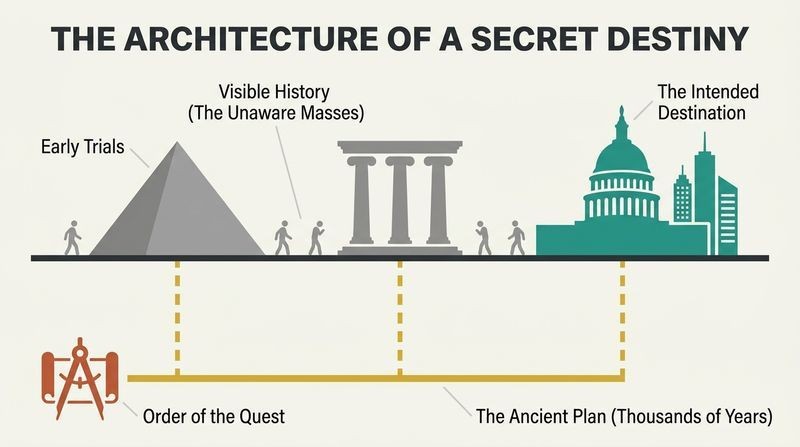
The book's central claim is audacious. Hall argues that a hidden fellowship of enlightened seekers, which he calls the Order of the Quest, has worked for thousands of years toward one goal: a global democracy of self-governing, wise individuals. Egypt, Greece, and Rome were early attempts. America is the intended culmination, a continent supposedly set apart by ancient philosophers long before Columbus.
Most people, Hall says, live unaware of this. The masses drift along with no idea they are part of a "Universal Motion in time and space." The founders, many of them Masons steeped in esoteric philosophy, were the plan's latest agents. America's true assignment, written in 1944 amid world war, is not just to win but to lead humanity toward a spiritual commonwealth of nations bound by brotherhood rather than power politics.
What's striking is how neatly Hall's thesis fits the tradition of American civil religion, from John Winthrop's "city upon a hill" to manifest destiny. He supplies an occult backstory for the exceptionalism many Americans already feel. The idea echoes Madame Blavatsky's Theosophy, which framed America as a vessel for free individual searching. The danger, as historians note, is that providential nationalism can sanctify conquest as easily as liberty. Hall's grand arc conveniently skips slavery and Indian displacement. Still, as a myth of purpose, the claim has undeniable motive force: it asks a nation to measure itself against an ideal rather than mere prosperity.
Read this as inspiring myth, not documented history
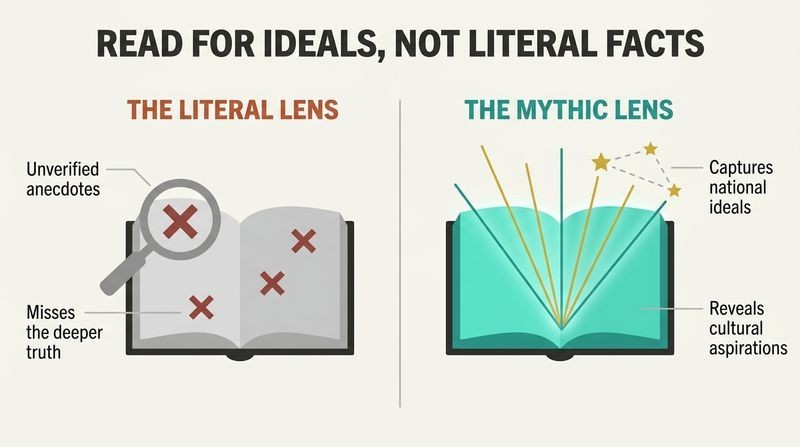
The framing matters enormously. In his introduction, historian Mitch Horowitz argues that myth often captures the ideals and failures of a people more honestly than a ledger of events. Hall is not a "literal historian." He treats human events as a transcendent arc of ideas, and his tellings are frequently parabolic, revealing what a culture aspires to be rather than what verifiably happened.
Hall repeatedly overreaches. He turns Columbus into a Greek prince, dates secret societies to fanciful antiquity, and leans on single folkloric sources. Horowitz flags these as under-sourced drama. Yet Hall also grasped genuinely unseen currents, like Freemasonry's real role in the founding: nine of fifty-six Declaration signers and thirteen of thirty-nine Constitution signers were Masons. The value lies in decoding America's self-conception, not in fact-checking each anecdote.
This is the interpretive key that rescues the whole enterprise. Reading Hall as literal history invites eye-rolls; reading him as national mythology unlocks insight. The move parallels how scholars treat Plutarch or Genesis, mining psychological and moral truth from unreliable narrative. Horowitz's editorial honesty, correcting Hall even while championing him, models good faith engagement with fringe material. There is a useful epistemic lesson here: myths function as compressed value statements, and a society reveals its character by which stories it repeats. The caution is that readers untrained in this distinction can mistake evocative parable for evidence, which is precisely how conspiracy thinking metastasizes.
A visionary leader can be born thousands of years too soon
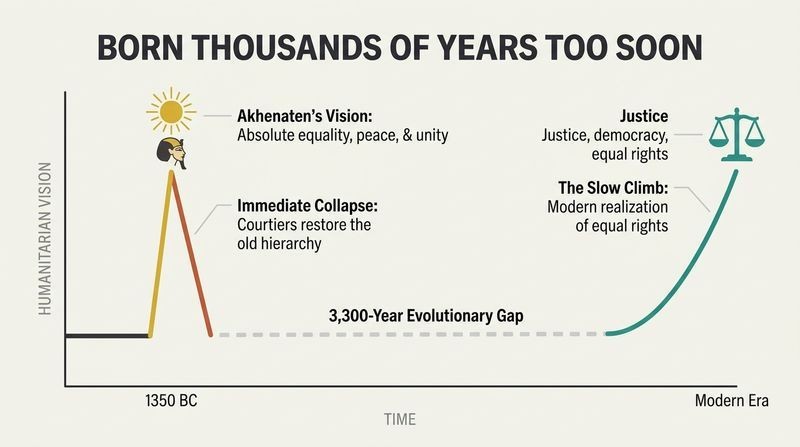
Hall crowns Akhenaten "the world's first democrat." The Egyptian pharaoh (reigning around 1353 BC) rejected the powerful priesthood of Amon-Ra, proclaimed a single loving god, Aten, and built a new capital to escape his enemies. He saw every living creature, peasant and slave alike, as possessing a divine right to live, dream, and aspire. He refused to send armies even as invaders pillaged his lands, because enemies too were children of Aten.
His reforms collapsed almost immediately. After his death around age thirty-six, courtiers abandoned his city and restored the old polytheism under Tutankhamen. Hall reads this as tragedy: the humanitarian internationalist arrived before humanity could hold his vision. Horowitz notes historians are divided, some seeing Atenism as the dawn of monotheism, others as a forced state religion swiftly discarded.
The Akhenaten portrait shows Hall at his most romantic and least reliable. He drew on Charles Potter's 1930 account and early twentieth-century idealization of a ruler whom modern Egyptologists find far more ambiguous, even authoritarian. Sigmund Freud, intriguingly, argued in his final book that Moses himself was a priest of Akhenaten's cult, making Atenism the hidden root of Jewish monotheism. The deeper, transferable idea survives the shaky scholarship: reformers whose ethics outrun their era often fail politically yet plant seeds that germinate centuries later. History is littered with such premature prophets, from Hypatia to abolitionists jailed as radicals before their cause became consensus.
Atlantis fell because power bred the hunger to dominate others
Hall reads Plato's Atlantis as political allegory. Ten benevolent philosopher-kings once ruled a league of nations bound by oath never to make war on one another, sworn upon a column inscribed with the laws of enduring empire. This was the archetype of right government, a cooperative commonwealth where the only aristocracy was wisdom earned through self-discipline.
Then the divine faded and the mortal took over. As spiritual perception dimmed, material ambition surged. The kings coveted what others had, dissolved their league, and resolved to enslave all the earth. For this hubris, Zeus destroyed Atlantis by earthquake and fire. Hall's moral: "Competition is natural to the ignorant; and cooperation is natural to the wise." The fall of the ideal state is a permanent warning that selfishness corrodes any union of nations.
Whether or not Atlantis existed (Horowitz devotes pages to the disputed Sphinx water-erosion thesis dating civilization to 10,000 BC), the parable works as political philosophy. Hall essentially retells the tragedy of the commons and the security dilemma: cooperation is unstable because any member gains by defecting. His diagnosis anticipates the collapse logic Jared Diamond later applied to real societies, where success breeds overreach. The framing also indicts empire from within, suggesting dominance itself is the disease. One caveat: attributing collapse to a moral failure (lost "spiritual perception") romanticizes decline and understates the mundane drivers, drought, disease, and resource depletion, that actually topple civilizations.
Fix the human being, and material problems dissolve
This is Hall's most practical argument. Writing as World War II raged, he warned that postwar planners were treating symptoms. Wars, depressions, crime, and dictators are not the disease; they are indicators of a deeper ailment. Rebuilding economies and redrawing borders, he insisted, solves nothing lasting if you ignore that man is not merely physical but mental, emotional, and spiritual.
Experts fail because they think in silos. The economist sees economics, the general sees discipline, the industrialist sees production. None addresses "the human problem" whole. Hall's remedy is idealism made practical: convince people that selfishness sabotages their own happiness, that self-seeking has "gone out of fashion." A durable peace requires a shared world dream big enough to bind selfish people to something larger than themselves.
Hall anticipates a critique that systems thinkers and psychologists have since formalized: treating symptoms while ignoring root causes produces "policy resistance," where fixes generate new failures. His insistence that reconstruction address the inner life resonates with Viktor Frankl's argument, forged in the same war, that humans need meaning above material security. It also prefigures modern debates about why GDP growth fails to deliver wellbeing. The weakness is prescriptive vagueness. Hall diagnoses brilliantly but offers little machinery beyond "education" and moral awakening. Convincing selfish people to abandon self-interest is the oldest unsolved problem in ethics, and exhortation alone has never scaled.
Persecuted thinkers hid their ideals inside symbols and secret rites
Secrecy was survival, not villainy. Hall and Horowitz agree that most members of esoteric orders were not hooded conspirators but self-preserving intellectuals. In eras when heresy meant death, secret societies let members practice forbidden beliefs privately and pass knowledge across generations. The Dionysian Artificers, ancient guild builders, encoded philosophy in architecture, treating the uncultured person as a rough uncut stone to be perfected into one fit for the temple of human society.
The lineage runs underground through history. As Christianity persecuted pagan thought, these guilds went deeper into secrecy, reclothing old ideas in Christian phrasing. Alchemists, Cabalists, Knights of the Grail, Rosicrucians, and eventually Freemasons all belonged, in Hall's telling, to one Order of the Quest, searching under different symbols for the same prize: a perfected social order.
The historical core here is sound and often underappreciated. Freemasonry's radical innovation, as Horowitz stresses, was recognizing the validity of all faiths and refusing to elevate Christianity as the sole path to salvation, a genuinely subversive stance in the colonial world. That religious neutrality helped seed the church-state separation later codified constitutionally. Hall's overreach is the totalizing move: stitching every mystical current across three millennia into a single continuous brotherhood. Real esoteric history is messier, full of rivalry, forgery, and reinvention. Notably, Hall missed Prince Hall Masonry, the Black Masonic order whose founder signed some of America's earliest anti-slavery petitions in 1777 and 1778.
Bacon's fictional utopia became the blueprint for colonizing America
A novel supposedly launched a nation. In Francis Bacon's unfinished 1627 fable New Atlantis, shipwrecked sailors reach Bensalem, an ideal society governed by Solomon's House, a research college dedicated to "the knowledge of causes, and secret motions of things." Bacon explicitly identifies Atlantis with America. Hall argues Bacon led a secret society of Europe's finest minds who deliberately steered English colonization to plant the philosophic empire in the New World.
Agents allegedly seeded the colonies. Benjamin Franklin, in Hall's account, was the appointed spokesman of these unknown philosophers: "he did not make laws, but his words became law." Horowitz adds sober grounding, noting the Somers Islands hog coinage bearing Bacon's family crest and Bacon's documented membership in the Virginia Company, whose charters helped germinate American constitutionalism.
Bacon as intellectual godfather of America is less far-fetched than it sounds. His empirical method genuinely shaped the scientific institutions the colonists prized, and Solomon's House is a recognizable ancestor of the Royal Society and modern research universities. Where Hall strains credibility is agency and intention, portraying centuries of migration as a coordinated script rather than the chaotic push of persecution, profit, and desperation. The truth is subtler and more interesting: ideas travel along trade routes and through books without needing a central committee. Bacon's utopian imagination did influence America, but as cultural software, not as a covert operation run by hidden handlers.
The dollar's pyramid and eye are deliberate occult signatures
Look at the back of a one-dollar bill. The reverse of the Great Seal shows an unfinished thirteen-tiered pyramid capped by a radiant all-seeing eye, ringed by Latin words meaning roughly "Providence smiles on our new order of the ages." Hall reads this as pure esoteric philosophy: the incomplete pyramid is human society, imperfect and unfinished, and the eye of providence signals that material achievement is worthless without higher wisdom.
Even the eagle may be a phoenix. Hall argues the bird on the seal's front was originally the phoenix, the ancient symbol of rebirth and immortality, the one "twice-born" through wisdom. Horowitz notes the reverse only reached the dollar in 1935, placed there by two Masons, Henry Wallace and Franklin Roosevelt. The symbols, Hall insists, are no accident of farmers and shopkeepers.
The symbols are real; the interpretation is contested. Mainstream heraldry scholars attribute the pyramid and eye to conventional Enlightenment iconography rather than a Masonic master plan, and note the all-seeing eye was common Christian imagery too. Yet Hall's core reading, that the founders encoded aspiration into national iconography, holds regardless of secret societies. Nations always mythologize themselves through design, from Rome's fasces to revolutionary France's Marianne. What makes the American case distinctive is the explicit incompleteness: a pyramid missing its capstone is a rare admission that the national project remains unfinished, a permanent invitation to strive rather than a boast of arrival.
A patriotic legend that never happened still shaped presidents
Hall's most famous story is fiction. He recounts that as the Declaration's signers wavered, fearing the gallows, a mysterious stranger rose in the locked Philadelphia statehouse and thundered "God has given America to be free!" Emboldened, the delegates rushed to sign, then turned to thank him and found he had vanished from the guarded room.
Horowitz traces the truth. The tale originated as invented "gothic" fiction in George Lippard's 1847 book of Revolutionary legends; Lippard openly admitted composing the eloquence himself. Hall received it without sourcing and treated it as history. Remarkably, Ronald Reagan adopted Hall's version, retelling it in speeches from 1957 through his presidency, sometimes in language nearly identical to Hall's. Evidence suggests Reagan and Hall met at Hall's Los Angeles research society while Reagan was governor.
This is the book's most instructive episode about how myth actually operates. A deliberately fabricated story migrated through a Theosophical journal into Hall's work, then into the rhetoric of the most consequential American politician of the late twentieth century, reaching television audiences of millions during the Statue of Liberty centenary. It demonstrates the real mechanism of civil religion: emotional resonance, not verification, determines which stories endure. The parable sits comfortably beside Washington's cherry tree, equally false and equally load-bearing. For the critically minded, it is a caution; for the student of persuasion, it is a case study in how invented origins become sincerely believed national scripture.
The Americas ran on democracy long before Europeans arrived
Hall insists 1776 was not the first American democracy. He celebrates the Maya, whose classical civilization he calls the most advanced on earth in the centuries after Christ, with a hundred cities linked by paved highways, elected rather than hereditary rulers, and an accurate calendar. Most striking, he claims the Maya held "the world record" for five hundred years of continued peace, which he attributes partly to their having no money or currency.
Religious tolerance was native, he argues. Across Indigenous American cultures, Hall says, religious intolerance was "utterly beyond their comprehension"; each person's belief was respected as their own. North American tribes cared for their aged and orphaned, and the Iroquois League united nations to settle disputes by arbitration. The democratic archetype, in his view, was already woven into the continent.
Hall's celebration is a corrective to Eurocentric history, and the Iroquois Confederacy's genuine influence on federal ideas is now widely acknowledged. But the portrait is idealized to the point of distortion. Archaeology shows Maya civilization endured cycles of intense warfare, and the "five hundred years of peace" claim does not survive modern scholarship; Aztec culture practiced large-scale human sacrifice. Horowitz offers a subtler theory from Ptolemy Tompkins: later Mesoamerican societies may have turned to ritual violence as spiritual vitality faded, chasing a "false feeling of life" through bloodshed, a pattern he provocatively compares to modern culture's appetite for violent entertainment and online cruelty.
Reunite science, religion, and philosophy into one education
Hall's endgame is educational, not political. The democratic commonwealth, he argues, cannot be legislated or treatied into existence; the failed League of Nations proved that. It must grow from within individuals through education aimed at right motivation and consequences, not mere job training. He revives the Roman dream of Platonopolis, a philosophers' city where the world's finest minds work protected from war, their discoveries becoming common property of all humanity.
The three must reunite. Religion (the spiritual), philosophy (the mental), and science (the physical) are for Hall three parts of one truth. A government built on only one or two "must ultimately degenerate into a tyranny." A half-truth is the most dangerous lie because it can be defended in part. The perfection of society, he concludes, must be accomplished first in the perfection of the individual.
Hall's plea against fragmented knowledge lands harder in an age of hyperspecialization than it did in 1944. His call to fuse science with ethics and meaning echoes C.P. Snow's later lament about the "two cultures" and today's debates over teaching wisdom alongside technical skill. The Platonopolis vision resembles CERN, the Institute for Advanced Study, or open-science movements, sanctuaries for knowledge above nationalism. The tension he glosses over is real: history's attempts to let philosopher-kings rule (Plato's own Syracuse experiment failed) rarely end well, and "rule by the wise" has justified plenty of elitism. Yet his insistence that character must precede institutions remains a bracing challenge to purely structural reformers.
Analysis
Manly P. Hall's twin volumes are best understood not as history but as scripture for American civil religion, an esoteric origin myth that supplies metaphysical purpose to a young nation. Written across the trauma of World War II and its aftermath (1944 and 1951), they answer a real hunger: what is America for? Hall's answer, that a millennia-old fellowship of sages engineered the United States as the seedbed of a global philosophic democracy, is empirically indefensible and imaginatively potent in equal measure. The 2024 edition's genius is Mitch Horowitz's introduction, which performs a delicate rescue operation, separating Hall's genuine insights (Freemasonry's underrated role in the founding, the radicalism of Masonic religious neutrality, the function of secret societies as havens for persecuted intellect) from his fabrications (a Greek Columbus, a pharaonic democracy, an invented statehouse orator). This layered structure, credulous mystic corrected by skeptical historian, is what makes the book intellectually respectable rather than merely occult curiosity. The most consequential revelation is genealogical: a fictional speech invented by George Lippard in 1847 passed through Theosophical channels into Hall's work and then into Ronald Reagan's presidential rhetoric, demonstrating how myths become load-bearing regardless of truth. Hall belongs to the lineage of Blavatsky's Theosophy and prefigures later providential nationalism; his continuities with manifest destiny are uncomfortable, and his near-silence on slavery and Indigenous dispossession is a serious moral blind spot that Horowitz honestly flags. Yet the enduring provocation survives the bad scholarship. Hall argues that nations, like individuals, are shaped by the stories they tell about their purpose, that material reconstruction without spiritual vision produces recurring catastrophe, and that fragmented knowledge breeds tyranny. Read as myth, which is the only honest way to read it, the book illuminates the American self-image more than any archive could. It is a study in how a people dreams itself into being.
Review Summary
The Secret Destiny of America by Manly P. Hall receives mixed reviews averaging 4.12/5 stars. Readers appreciate the alternative historical perspective connecting Freemasonry, secret societies, and America's founding, though many criticize the lack of citations and sources. Some view it as fascinating conspiracy theory exploring how America was envisioned as the "New Atlantis," while skeptics see it as speculative propaganda promoting New World Order ideology. Critics note dated, problematic content including racist claims about civilizations. Supporters praise Hall's esoteric insights and inspirational vision of democracy's mystical origins.
People Also Read

Glossary
Order of the Quest
Hall's hidden fellowship of sagesHall's name for a supposed body of enlightened individuals united across thousands of years to advance civilization toward a global philosophic democracy. He claims it encompassed ancient mystery schools, alchemists, Rosicrucians, and Freemasons, all searching under different symbols for the same goal: a perfected, self-governing social order. Most of humanity, he says, lives unaware of belonging to this larger design.
Universal Plan / Great Plan
Ancient blueprint for world democracyHall's concept that history follows an inevitable arc, secretly guided, moving humanity from tyranny toward freedom and eventually a democratic commonwealth of all nations. America is its intended fulfillment, a continent allegedly reserved by ancient philosophers before Columbus. Those who resist the plan destroy themselves; those who cooperate survive and advance it.
New Atlantis / Solomon's House
Bacon's utopian research collegeFrancis Bacon's unfinished 1627 fable describing Bensalem, an ideal society whose central institution, Solomon's House, is a college devoted to discovering the causes and hidden workings of nature for humanity's benefit. Bacon equates Atlantis with America. Hall treats it as the deliberate charter for colonizing the New World as a philosophic empire, and as an ancestor of modern research universities.
Atenism
Akhenaten's monotheistic sun religionThe nationwide worship of a single god, Aten, instituted by the Egyptian pharaoh Akhenaten around the 14th century BC, replacing traditional polytheism. Hall celebrates it as the first humanitarian, internationalist faith. Historians dispute this: some see the dawn of monotheism, others a coercive state religion that collapsed and was reversed shortly after Akhenaten's death.
Platonopolis
Proposed city ruled by wisdomA philosophers' city the Neo-Platonist Plotinus sought to found in Roman Italy, governed by Plato's laws, but blocked by a fearful Senate. Hall revives it as a proposal for a protected international sanctuary where the world's finest minds could work above war and nationalism, their discoveries becoming the common property of all mankind.
The Unknown Speaker
Legendary orator at Declaration signingA mysterious stranger who, in Hall's telling, rose in the locked Philadelphia statehouse in 1776 to deliver a rousing speech ("God has given America to be free!") that emboldened wavering delegates to sign the Declaration, then vanished. The story was actually invented fiction by George Lippard in 1847; Ronald Reagan later repeated Hall's version throughout his political career.
Dionysian Artificers
Ancient secret guild of buildersAn order of skilled craftsmen and architects originating among the Greeks and Syrians before 1500 BC, which Hall presents as an early link in the chain of secret societies. They encoded philosophy in sacred architecture and treated the untutored person as a rough, uncut stone to be perfected through discipline into a fit building block for the temple of human society. Hall traces Freemasonry's descent from them.
Download PDF
Download EPUB
.epub digital book format is ideal for reading ebooks on phones, tablets, and e-readers.








































