

Key Takeaways
Computers are now doing for brainpower what steam did for muscle
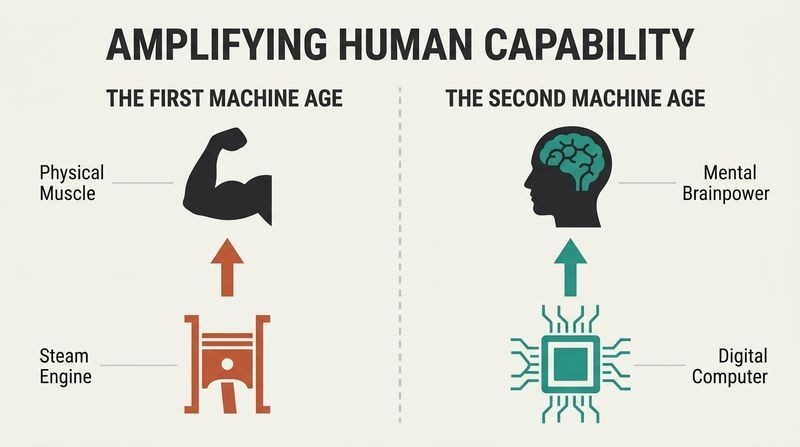
The second machine age is here. Just over two centuries ago, James Watt's improved steam engine bent the curve of human history almost ninety degrees, freeing us from the limits of muscle and launching the Industrial Revolution. Brynjolfsson and McAfee argue we now stand at an equally profound inflection point. Digital computers, software, and networks are amplifying mental power, our ability to understand and shape our environment, the way engines once amplified physical power.
Mental power matters at least as much as physical power for mastering our world and getting things done. So a vast, unprecedented boost to it should be an enormous boon for humanity. The authors reached this after being repeatedly surprised: machines suddenly started diagnosing diseases, driving cars, and writing prose after decades of being laughably bad at all of it.
The muscle-versus-mind framing is elegant, but worth pressing. Steam replaced muscle while leaving cognition entirely to humans, which created new jobs. If machines now encroach on cognition itself, the historical reassurance that displaced workers always find better work grows shakier. Economist Robert Gordon counters that steam, electricity, and plumbing were more transformative than anything digital, since they altered basic physical existence. The authors themselves concede the transition's outcome is genuinely uncertain. What makes the analogy powerful is not prophecy but perspective: it forces readers to think in centuries, not quarters, and to treat computing as a general-purpose force rather than a gadget.
Exponential doubling drops you into the chessboard's terrifying second half
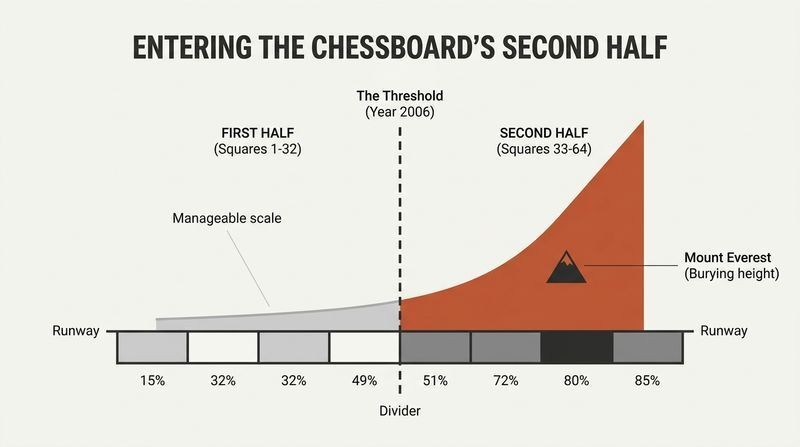
Small, steady doublings become staggering. An ancient legend has a chess inventor ask a king for one grain of rice on the first square, two on the second, doubling each square. The first half of the board yields a manageable pile, about four billion grains. The second half yields more rice than has ever existed, enough to bury Mount Everest. Ray Kurzweil used this to show that constant doubling eventually produces numbers that shatter our intuition.
We have entered computing's second half. Moore's Law, the observation that computing power per dollar roughly doubles every 18 to 24 months, has held for over four decades. Counting business computing from 1958, the authors calculate we crossed into the second half of the chessboard around 2006, precisely when driverless cars, Watson, and cheap robots suddenly appeared.
The chessboard metaphor captures why smart forecasters keep getting blindsided: human brains extrapolate linearly while technology compounds geometrically. There is a subtlety the authors handle well. Moore's Law is not physics but sociology, a self-reinforcing prophecy sustained by what they call brilliant tinkering, engineers routing around each physical wall. That distinction matters because it means the trend could genuinely stall, unlike a law of nature. Physicists have predicted its death for years and been wrong, yet transistor miniaturization does face atomic limits. The deeper point survives regardless: even if chip density plateaus, storage, sensors, bandwidth, and algorithmic efficiency continue their own exponential climbs.
Innovation isn't fruit you pick, it's Lego bricks you recombine
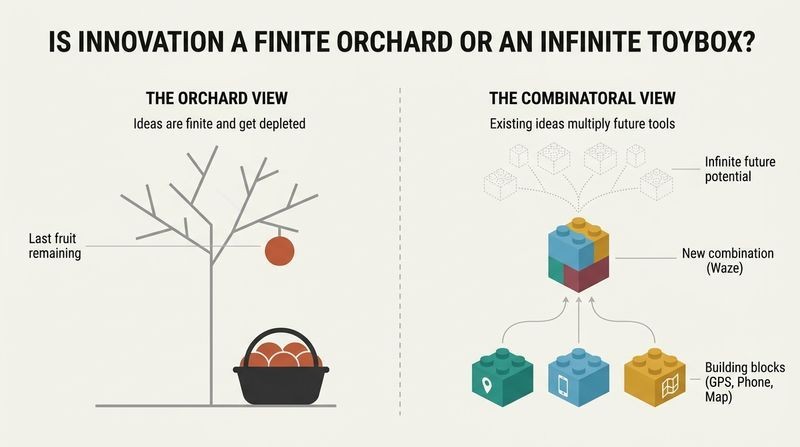
Two rival views of innovation. Pessimists like Tyler Cowen and Robert Gordon see innovation as low-hanging fruit: a finite orchard of big ideas (steam, electricity, plumbing) that gets picked clean, leaving stagnation. The authors champion the opposite, recombinant view: innovation is rearranging existing building blocks into new combinations, and each new block multiplies future possibilities rather than depleting them.
Digital tools supercharge recombination. Waze combined a GPS chip, a phone, a social network, and map data, inventing none of them. The Nobel-winning polymerase chain reaction merged well-known biochemistry steps. Economist Martin Weitzman modeled this mathematically: combinatorial possibilities explode so fast that the real constraint becomes our capacity to process and test them, not a shortage of raw ideas. Growth, in this view, is limited only by imagination and processing power.
The recombination thesis aligns with how evolutionary biology and complexity science understand novelty: new forms arise from reshuffling existing components, not from spontaneous creation. It offers genuine optimism grounded in combinatorics rather than wishful thinking. The tension with Gordon is not fully resolvable by argument alone, and the authors know it hinges on data. One caveat: recombination generates a torrent of possibilities but says nothing about their average value. Many combinations are worthless, and the filtering problem, deciding which recombinations matter, may itself become the bottleneck. This is precisely why crowdsourcing platforms that harness many minds to test ideas grow so important.
Machines conquer rules and math but stumble on toddler skills
Moravec's paradox flips our intuition. We assume high-level reasoning is hard and basic perception is easy. Computers reveal the reverse: they crush chess, arithmetic, and logic, yet struggle to walk upstairs, fold a towel, or grab a jar that isn't perfectly positioned. A Berkeley robot took over 24 minutes to fold a single towel. Evolution spent millions of years perfecting our sensorimotor skills, giving us billions of specialized neurons, while abstract reasoning is an evolutionary newcomer requiring less computation to mimic.
This reshapes who competes with machines. As Steven Pinker put it, stock analysts and engineers are more replaceable than gardeners and cooks. Rethink Robotics' Baxter, a $20,000 robot trainable by grabbing its wrist, chips away at the paradox, but for now, jobs blending physical dexterity with judgment remain stubbornly human.
Moravec's paradox is one of the most useful mental models for anyone planning a career or a business. It predicts, counterintuitively, that white-collar cognitive work faces earlier automation than many manual trades. The past decade has largely borne this out: language models now draft legal memos while plumbing and elder care remain untouched. The paradox also explains why offshoring and automation hit the same routine, well-structured tasks, since anything you can precisely specify to a distant worker you can eventually specify to a machine. The limit is worth watching, though; advances in machine learning and robotics steadily erode the paradox, so today's safe harbor is not permanent.
Digital goods break economics: free, perfect, and instant copies
Bits obey strange economics. Digital information is non-rival (your listening to a song doesn't stop mine) and has near-zero marginal cost of reproduction (copying a file is essentially free, perfect, and instantaneous). As economists Shapiro and Varian put it, information is costly to produce but cheap to reproduce. This is why Google Translate works by statistically matching huge pre-translated document sets, and why Wikipedia holds over fifty times the content of Encyclopaedia Britannica at no cost.
Free is great for well-being, terrible for GDP. When people swap paid newspapers for free blogs or CDs for streaming, billions of dollars vanish from official statistics even as people consume more and better. The authors call this analog dollars becoming digital pennies. GDP, designed for an economy of physical things, increasingly fails to measure real value.
This exposes a measurement crisis hiding in plain sight. If our primary economic gauge systematically undercounts the fastest-growing part of the economy, policymakers are flying with a broken altimeter. The authors' estimate that the free internet generates roughly $2,600 of value per user annually, invisible to GDP, suggests productivity statistics may understate true progress. Yet there is a darker reading they honor too: the same zero-marginal-cost dynamic that showers consumers with free abundance also hollows out the revenue that once funded middle-class jobs at firms like Kodak. Abundance and precarity spring from the identical economic property, which is the book's central and unsettling paradox.
Technology delivers bounty and spread, and the spread is widening
Two consequences, one engine. Digital progress produces bounty (more volume, variety, quality, and lower prices, the best economic news around) and spread (ever-larger gaps in income, wealth, and opportunity). Kodak once employed 145,000 people; Instagram had 15 employees when Facebook bought it for a billion dollars, having created several billionaires while displacing photo-chemical workers.
The median is falling behind. US median household income peaked in 1999 and then declined even as GDP hit records. Productivity and employment, which tracked together for decades, decoupled in the late 1990s. The top 1 percent captured roughly two-thirds of income growth between 2002 and 2007. This is not mainly about Wall Street or bad policy; the authors argue the primary driver is exponential, digital, combinatorial technology itself.
The bounty-and-spread duality is the book's moral core, and it resists easy ideological capture. The right emphasizes the bounty (everyone has a smartphone rivaling a 1990s supercomputer); the left emphasizes the spread (stagnant median wages). The authors insist both are true simultaneously and causally linked. What strengthens their case is the international pattern: inequality rose across countries with wildly different tax and labor institutions, pointing to a common technological cause rather than local politics. A fair challenge, though: economists like Thomas Piketty attribute much inequality to capital dynamics and policy choices, and the relative weight of technology versus institutions remains genuinely contested among serious researchers.
Three groups win big: skilled workers, capital owners, and superstars
Technology favors specific winners over everyone else. The authors identify three widening gaps:
1. Skill-biased technical change: digital tools complement educated, abstract-reasoning workers while automating routine clerical and factory tasks, hollowing out the middle.
2. Capital versus labor: as machines substitute for people (Foxconn buying hundreds of thousands of robots), labor's share of GDP fell from a stable 64 percent to under 58 percent, while corporate profits hit records.
3. Superstars versus everyone: digitization lets the single best provider serve the entire globe at near-zero cost.
Winner-take-all markets reshape rewards. When a mapping app slightly beats its rivals, there's little demand for the tenth-best. J.K. Rowling reaches billions where Shakespeare reached thousands. Incomes shift from a bell curve, where most cluster near average, to a power law, where a tiny few capture almost everything.
The power-law insight has a mind-bending statistical consequence the authors highlight: under such distributions, most people fall below the average, so goodbye, Lake Wobegon. This breaks the mental models politicians and marketers rely on when they invoke the typical voter or average consumer. The three-gap framework is analytically clean and largely holds up, though the categories overlap: a superstar CEO is simultaneously a skilled worker, a capital owner, and a superstar. The capital-versus-labor point deserves a caveat the authors raise themselves: capital can be replicated cheaply too, so capitalists face the same margin-eroding competition, meaning the ultimate scarce resource may be neither labor nor capital but genius and timing.
Race with machines, don't race against them
Partnership beats pure competition. After Deep Blue beat Kasparov in 1997, chess seemed a lost human cause. But in freestyle tournaments, where any mix of humans and computers can compete, the 2005 winner was neither a grandmaster nor a supercomputer. It was two amateur Americans skillfully coaching three ordinary PCs. Their formula: weak human plus machine plus better process beat both the strongest computer alone and the strongest grandmaster with a machine.
Cultivate what machines still can't do. The durable human advantages are ideation (generating genuinely new ideas, hypotheses, dishes, business plans), large-frame pattern recognition (using our broad sensory frame), and complex communication. Zara relies on human store managers, not algorithms, to sense what trendy shoppers want. As Kevin Kelly quipped, future pay depends on how well you work with robots.
The freestyle chess result is the book's most practically hopeful finding, and it generalizes. The lesson is not that humans are obsolete but that the winning unit is a well-designed human-machine team with a strong process. This anticipates today's debates about AI copilots: the highest performers are neither those who refuse the tools nor those who blindly trust them, but those who orchestrate them. The framing echoes economist David Autor's work on complementarity, tasks where human judgment and machine capability multiply rather than substitute. The open question the authors cannot answer is durability: each supposedly safe human skill (creativity, pattern recognition) has partially fallen since, so the advice requires continuous adaptation.
Learn like a Montessori kid, not a Victorian clerk
Schools were built for a vanished economy. Education researcher Sugata Mitra argues our rote-learning model was engineered by the British Empire to mass-produce identical, interchangeable clerks: good handwriting, reading, and mental arithmetic. But those clerks are now literally computers. The three Rs are exactly the routine skills machines have mastered.
Cultivate self-directed, creative learning. The founders of Google, Amazon, and Wikipedia all attended Montessori schools that emphasized curiosity, self-pacing, and questioning rules. Yet the study Academically Adrift found 45 percent of US college students showed no significant gains in critical thinking after two years, largely because they study just 9 percent of their time. The winners are highly motivated self-starters who exploit free tools like Khan Academy and MOOCs, one of which drew 160,000 students, whose top 410 online performers beat the best on-campus Stanford student.
The critique of rote schooling is compelling but risks overcorrection. Ideation and critical thinking are hard to build on an empty foundation; creativity in a domain typically requires deep factual mastery of that domain first, as expertise research on chess masters and musicians shows. Montessori alumni make a charming anecdote, though selection bias looms large, since these founders also had wealth, connections, and extraordinary talent. The more robust signal is the college data: if higher education is failing to develop the very skills that command a premium in an automated economy, the widening wage gap between motivated self-learners and passive credential-seekers is a warning worth heeding.
Reward work with a negative income tax, not just a handout
Money alone doesn't solve joblessness. A basic income (giving everyone unconditional cash) addresses need but ignores what Voltaire called work's other benefits: it saves us from boredom and vice. Research shows long-term unemployment devastates well-being about as much as a spouse's death, mostly from lost self-worth, not lost income. Charles Murray's study of the fictional Fishtown found that as work vanished, marriage, community, and social health collapsed.
Subsidize employment instead. The authors favor Milton Friedman's negative income tax: below a threshold, government pays you a fraction of the gap, so every dollar earned still increases total income. It guarantees a floor while preserving the incentive to work. The existing Earned Income Tax Credit is a small version; states with more generous EITCs show greater intergenerational mobility. Tax work less; tax pollution and economic rents more.
This is where the book stakes an unfashionable moral claim: work has intrinsic dignity beyond its paycheck, so policy should preserve employment even when machines could do the job cheaper. The evidence from Murray and Wilson on the social decay of workless communities is genuinely sobering and crosses ideological lines. Skeptics of the work ethic argue this romanticizes often-degrading jobs and that a post-scarcity society should decouple identity from labor. The authors' pragmatic middle path, subsidizing rather than replacing work, sidesteps that debate while the peer economy (Airbnb, TaskRabbit) shows technology can create new work, not just destroy it. Whether such platforms scale enough to matter remains unproven.
GDP was a great 20th-century invention that now misleads us
What gets measured gets done. GDP, pioneered by Simon Kuznets in the 1930s, was one of the great inventions of the twentieth century, letting governments finally see the economy. But it counts transactions and physical output, missing the free, digital, intangible value that increasingly defines modern life. Wikipedia, Skype calls home, and a million free apps add real welfare while adding nothing (or even subtracting) from GDP.
We need new instruments. The gap between what we measure and what we value grows every time a good becomes free or digital. The authors point to promising alternatives: consumer surplus estimates, time-use studies, well-being indices, and real-time data from online prices and searches. Choosing better metrics matters because bad gauges produce bad decisions: measure only tangibles and you starve the intangibles that make us better off.
This is a quietly radical argument with major implications. If official statistics undercount digital abundance, then pessimistic narratives about stagnation may be partly a measurement artifact, while simultaneously the spread they do capture is real. Both distortions can coexist. The push for new metrics connects to broader movements: Bhutan's Gross National Happiness, the Stiglitz-Sen-Fitoussi commission, and the social progress index. A constructive caution: metrics shape incentives powerfully, so poorly designed well-being indices could be gamed or politicized just as GDP has been. The deeper wisdom is Robert Kennedy's, that GDP measures everything except what makes life worthwhile, and the authors turn that lament into a research agenda.
Technology is not destiny; our choices shape the outcome
Enormous power demands enormous responsibility. The same digital forces creating unprecedented bounty also multiply risks: tightly coupled systems prone to cascading failures (the 2003 blackout hit 45 million people), cheap tools of destruction like the Stuxnet worm or weaponized genomes, and threats to privacy and freedom. The far-future possibility of conscious machines or a singularity remains genuinely unknowable; as the authors note, airplanes don't flap their wings, so today's AI only resembles human thought superficially.
The future is a choice, not a forecast. Like Scrooge asking whether the ghost showed what must be or what might be, humanity faces a fork. Technology creates possibilities; our institutions, policies, and values determine whether we reap shared prosperity or deepening division. The authors reject technological determinism: we can have bounty and broadly shared gains, but only through deliberate collective action.
Ending on human agency rather than prophecy is the book's ethical signature, and it distinguishes serious futurism from breathless techno-utopianism. The refusal to predict the singularity is intellectually honest; the authors resist the Kurzweilian temptation to name a date. What is most durable here is the emphasis that values become more decisive as constraints fall away, since when we can do almost anything, what we choose to do reveals who we are. A friendly extension: this echoes Amartya Sen's capability approach, which judges progress by the real freedoms people have to live lives they value, not merely by output. The choices are political, and politics, unlike Moore's Law, does not automatically improve.
Analysis
This is a thesis-driven work of economics and technology forecasting, structured in three movements: describing the second machine age's foundations (exponential, digital, combinatorial progress), analyzing its twin economic consequences (bounty and spread), and prescribing policy and personal responses. Written for a general educated audience, its difficulty for a summarizer lies in its breadth: it fuses economic history, labor economics, computer science anecdotes, and policy debate into one arc.
The book's enduring contribution is conceptual clarity. Brynjolfsson and McAfee gave the culture durable vocabulary, bounty versus spread, racing with rather than against machines, the second half of the chessboard, that continues to frame debates about AI and work. Their central intellectual move is to hold two truths simultaneously: technology is the best economic news in history and a powerful engine of inequality. This refusal to collapse into either techno-optimism or doom is the book's greatest strength and the reason it aged better than most 2014 technology books.
Seen from the present, some claims look prescient and others premature. The authors underestimated how fast machine learning would erode their supposedly durable human moats of ideation and complex communication; large language models now write prose and code, activities the book confidently placed on the human side. Yet their core macroeconomic diagnosis, decoupling of productivity from median wages, the rise of superstar firms, winner-take-all dynamics, has been amply confirmed by subsequent research from Autor, Piketty, and others.
The book's weakness is a certain policy optimism. Its Econ 101 playbook (education, infrastructure, immigration, entrepreneurship) is sensible but assumes functional politics, precisely the variable it cannot control. The deepest tension it surfaces but cannot resolve is whether an economy premised on paid human labor can survive machines that do most cognitive work. The authors bet on complementarity and human agency. That bet remains open, which is exactly why the book still matters.
Review Summary
Readers found this book to be an engaging and thought-provoking exploration of how AI and automation are reshaping the economy. Many appreciated the balanced perspective on both the benefits and challenges of technological progress. Some felt the policy recommendations were a bit vague, but overall praised the book's insights into the future of work and society in the age of intelligent machines. The accessible writing style made complex economic concepts understandable to a general audience.
People Also Read



FAQ
What's The Second Machine Age about?
- Focus on Technology's Impact: The book explores how digital technologies, especially AI and computers, are reshaping economies and societies. It marks the transition from the first machine age, driven by physical power, to the second, characterized by mental power and digital innovation.
- Bounty and Spread: Introduces "bounty," the abundance from technological advancements, and "spread," the growing inequality in wealth and income distribution due to these changes.
- Future Implications: Discusses the effects on individuals, businesses, and policymakers, emphasizing the need for new strategies to handle rapid technological progress.
Why should I read The Second Machine Age?
- Understanding Modern Changes: Offers insights into how technology is transforming work, productivity, and economic structures, affecting everyday life and future job markets.
- Informed Decision-Making: Provides recommendations for adapting to the evolving landscape of work and technology, empowering informed career or business decisions.
- Engaging Examples: Uses engaging examples and anecdotes to make complex ideas accessible and relatable.
What are the key takeaways of The Second Machine Age?
- Exponential Growth of Technology: Highlights that technological progress is exponential, leading to rapid societal changes, exemplified by Moore's Law.
- Digital Goods and Non-Rivalry: Explains that digital goods are non-rival with near-zero marginal costs, challenging traditional economic models.
- Inequality and Job Displacement: Discusses how technological advancements can increase inequality, concentrating benefits among a few and challenging workers in routine jobs.
What are the best quotes from The Second Machine Age and what do they mean?
- “Technology is a gift of God.”: Highlights technology's transformative power in shaping civilizations and improving life, underscoring its potential to drive progress.
- “Any sufficiently advanced technology is indistinguishable from magic.”: Reflects the awe new technologies inspire, suggesting advanced tech may seem miraculous to those unfamiliar with it.
- “The greatest shortcoming of the human race is our inability to understand the exponential function.”: Emphasizes the struggle to grasp exponential growth, crucial for understanding rapid technological changes.
How does The Second Machine Age define "bounty" and "spread"?
- Bounty Explained: Refers to the abundance of goods, services, and opportunities from technological advancements, signifying positive economic effects like increased productivity.
- Spread Defined: Highlights growing inequality in wealth and income distribution accompanying technological progress, pointing to disparities in who benefits from innovations.
- Interconnected Concepts: Argues that while bounty can lead to economic growth, it can also exacerbate social inequalities, necessitating policy interventions for equitable distribution.
What is Moore's Law as discussed in The Second Machine Age?
- Definition of Moore's Law: Observes that the number of transistors on a microchip doubles approximately every two years, leading to exponential computing power growth.
- Implications for Technology: Drives economic growth and productivity by enabling increasingly powerful and efficient technologies, a key driver of the second machine age.
- Historical Context: Has held true for over four decades, influencing various sectors and industries, central to the computer age.
How does The Second Machine Age address the challenges of inequality?
- Recognition of Inequality: Acknowledges that technological advancements can lead to increased inequality, concentrating benefits among a small group.
- Policy Interventions: Discusses the need for interventions like improved access to education and training for vulnerable workers to ensure broader benefits from technological progress.
- Long-Term Solutions: Advocates for solutions promoting inclusive growth, essential for sustaining economic progress and social stability amid rapid technological change.
What role does artificial intelligence play in The Second Machine Age?
- AI as a Transformative Force: Key driver of the second machine age, enabling machines to perform cognitive tasks once thought exclusively human.
- Applications of AI: Examples like IBM's Watson in healthcare and OrCam for the visually impaired show AI enhancing human capabilities and quality of life.
- Future Prospects: As AI advances, it will increasingly shape the economy and society, raising ethical concerns and potential job displacement issues.
How does The Second Machine Age suggest we measure economic progress?
- Limitations of GDP: Argues traditional measures like GDP fail to capture the full value of digital goods and services, leading to misleading economic well-being conclusions.
- Consumer Surplus as a Metric: Proposes using consumer surplus to measure economic progress, reflecting the value individuals derive from goods and services relative to cost.
- Need for New Metrics: Calls for developing metrics accounting for intangible assets and digital technologies' impact on well-being for a clearer economic progress picture.
What is the "strong bounty" argument presented in The Second Machine Age?
- Focus on Overall Improvement: Suggests rising inequality may be less concerning if overall economic conditions improve for everyone, even if benefits are unevenly distributed.
- Counterpoint to Inequality Concerns: Argues that if lower-income groups see quality of life improvements, focusing on income disparity may be misplaced.
- Critique of the Argument: Challenges this view with data showing many losing ground in absolute terms, indicating inequitable technology benefits.
How does globalization relate to the themes in The Second Machine Age?
- Globalization's Impact on Jobs: Discusses how globalization, alongside technology, contributes to job displacement and wage stagnation, especially in manufacturing.
- Competition from Abroad: Explains that global hiring pressures local labor markets, leading to wage declines in certain job categories.
- Interplay with Technology: Argues that while globalization is significant, rapid technological innovation is a more critical economic change driver.
How do the authors suggest we prepare for the future of work in The Second Machine Age?
- Emphasize Education and Skills: Advocates for education fostering creativity, critical thinking, and adaptability to thrive in a technology-driven economy.
- Encourage Entrepreneurship: Highlights supporting startups and innovation to create new job opportunities and drive economic growth.
- Policy Recommendations: Proposes measures like a negative income tax and improved education access to mitigate technological change effects on the workforce.
Download PDF
Download EPUB
.epub digital book format is ideal for reading ebooks on phones, tablets, and e-readers.








































