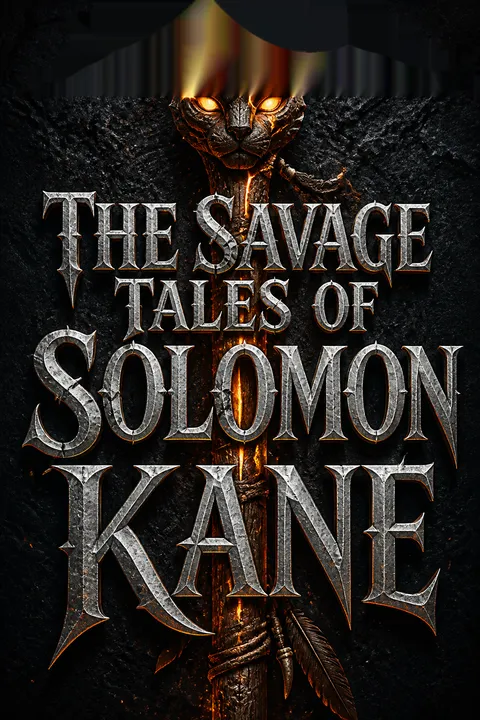
Key Takeaways
1. Solomon Kane is a somber, fanatical puritan driven by a divine urge to right wrongs.
A true fanatic, his promptings were reasons enough for his actions.
A divine calling. Solomon Kane is a tall, gaunt Englishman clad in somber black garments, whose life is governed by a relentless, fanatical urge to protect the weak and avenge the helpless. He does not seek personal glory or wealth, but views himself as a literal vessel of God's wrath, destined to empty his fury upon the unrighteous across the globe.
Unwavering moral compass. Kane's driving force is an absolute, uncompromising sense of justice that compels him to act on impulse whenever he encounters cruelty. He roams the earth without a fixed destination, trusting entirely in a higher power to guide his steps to where he is needed most. His character is defined by:
- A dark, brooding countenance and cold, deep eyes
- An ascetic lifestyle free of worldly vanity
- An absolute refusal to tolerate oppression or tyranny
An atavistic knight. Though he considers himself a strict Puritan, Kane behaves more like an ancient knight-errant born out of his proper time. He carries his life in his hands, ready to face any earthly or supernatural foe to fulfill what he believes is his divine destiny.
2. True courage is a concrete weapon capable of overcoming supernatural horrors.
For man's only weapon is courage that flinches not from the gates of Hell itself, and against such not even the legions of Hell can stand.
Conquering the supernatural. In his battle against the ghostly spirit of the maniac Gideon on the moor, Kane discovers that physical weapons are useless against incorporeal demons. His rapier passes harmlessly through the misty fiend, yet his unyielding courage allows him to grapple with and eventually overcome the monster.
Mind over terror. Kane's victories demonstrate that spiritual fortitude and an unflinching will are the only true defenses against the dark forces of the universe. When confronted with mind-shattering horrors, his cold, analytical mind refuses to succumb to panic. This psychological resilience manifests in several ways:
- Standing his ground when physical weapons fail
- Refusing to flee from foes that would drive ordinary men mad
- Using his iron will to dominate and weaken supernatural entities
The power of abstract hate. Just as abstract hatred can give material form to a ghostly apparition, Kane's abstract courage acts as a concrete shield. By refusing to flinch, he forces the legions of hell to yield to his righteous fury.
3. Vengeance is a consuming fire that can only be quenched by blood.
...but forbye the fires of Hell there is no hotter fire than the blue flame of vengeance which burneth a man's heart night and day without rest until he quench it in blood.
The relentless pursuit. When Kane discovers the dying, violated girl in the valley, he embarks on a multi-year, globe-spanning quest to hunt down her tormentor, the bandit leader Le Loup. This blood-feud takes him across oceans and deep into the African jungle, demonstrating that his vengeance is an unquenchable fire.
A deadly resolution. Kane's vengeance is never a matter of quick, hot-headed anger, but a cold, calculated, and patient resolve. He pursues his targets relentlessly, refusing to rest until justice has been meted out to the uttermost. Key aspects of his vengeful crusades include:
- Tracking the pirate Jonas Hardraker across the seas to avenge a ruined maid
- Refusing bribes, wealth, or empires in exchange for abandoning his feuds
- Executing cold, deliberate justice on those who prey on the helpless
The burden of the slayer. Despite the righteousness of his cause, Kane often feels a strange sense of futility and melancholy after his enemies are slain. He realizes that while blood may quench the immediate fire of vengeance, it cannot fully erase the tragedies that sparked the feud.
4. Ancient, forgotten civilizations leave behind dark, lingering evils.
A mystery that was old when Egypt was young! And nameless evil more ancient than dark Babylon – that spawned in terrible black cities when the world was young and strange.
The legacy of Atlantis. In the hidden city of Negari, Kane confronts the lingering remnants of the ancient empire of Atlantis. This city, built on a colossal scale with pre-human architecture, has become a breeding ground for blood-lust, madness, and horrific religious rites.
Decadence and decay. The ruins of these ancient civilizations harbor evils that have survived the sinking of continents and the passage of eons. The current inhabitants, though degenerate, still practice the cruel, blood-drenched rituals of their ancient masters. These ancient evils are characterized by:
- Massive stone temples dedicated to dark, blood-thirsty deities
- The worship of death and the preservation of fleshless, speaking skulls
- A latent, hereditary insanity that drives entire populations to slaughter
The shadow of antiquity. Kane's encounters with these ancient ruins reveal a world far older and more terrifying than European history records. He is forced to battle horrors that were spawned when the earth was young, realizing that some evils never truly die.
5. Magic and sorcery are real, primal forces that require ancient tools to combat.
This voodoo staff... Where your guns and long knife fail, this save you.
The power of the fetish. Kane's alliance with the West Coast voodoo priest N'Longa introduces him to the reality of primal African magic. N'Longa gifts Kane a carved, cat-headed wooden stave of immense antiquity, which proves to be a potent weapon against supernatural entities.
Combating the unnatural. While Kane's puritanical conscience initially recoils at the use of what he considers diabolical witchcraft, he is forced to rely on these ancient tools to survive. The stave possesses unique properties that physical weapons lack:
- It crumbles walking dead men and vampires to dust upon contact
- It acts as a protective barrier that supernatural monsters cannot cross
- It serves as a spiritual anchor, allowing N'Longa to communicate with Kane in his dreams
A necessary alliance. Kane's experiences demonstrate that to defeat the dark, pre-human forces of the world, one must sometimes fight magic with magic. He accepts the stave as a tool of providence, using it to carve a path of light through the darkest corners of the earth.
6. Human cruelty and tyranny are the ultimate evils Kane is destined to destroy.
...but you must die that others may live – and God knoweth you deserve death.
The scourge of tyrants. Whether dealing with the miser Ezra, who murdered his insane cousin, or the cruel Baron Von Staler, who hangs children from his gibbets, Kane is the sworn enemy of tyrants. He views the oppression of the weak as an insult to God that must be answered with swift, decisive steel.
Defending the helpless. Kane's sword is ever drawn in the defense of those who cannot defend themselves. He is entirely indifferent to the rank, wealth, or power of the oppressors he faces. His crusades against human cruelty include:
- Slaying the bandit Le Loup to avenge an unknown peasant girl
- Rescuing the English heiress Marylin Taferal from her years of captivity
- Confronting the slave-raider Hassim ben Said to free his captive train
The executioner of justice. Kane does not hesitate to act as judge, jury, and executioner when dealing with unrepentant evil. He believes that some men are so thoroughly corrupted that their deaths are required so that the innocent may live in peace.
7. The boundary between life and death is thin, porous, and easily manipulated by dark forces.
For the dead die not – and Songa the king stood frozen, arms outstretched as if to fend off the terror.
The walking dead. Throughout his travels, Kane repeatedly encounters instances where the dead refuse to rest. In the Black Forest, he witnesses a murdered sorcerer's skeleton rise to strangle his killer, while in Africa, he battles a literal nation of vampires who sustain their dead flesh by drinking the life-force of the living.
The manipulation of life-force. Dark sorcery allows powerful magicians to bridge the gap between the physical and spiritual worlds. N'Longa demonstrates the ability to send his own soul across vast distances to animate dead corpses or temporarily inhabit the bodies of others. This porous boundary manifests in:
- Skeletons clashing and rattling in secret rooms to fulfill death-vows
- Vampires lurking in dark caverns, fearing only fire and the sun
- The projection of astral spirits to guide and protect allies
A horrific reality. These encounters force Kane to confront the terrifying truth that death is not always the end of existence. He must constantly guard against foes who are already dead, relying on his faith and ancient relics to lay their spirits to rest.
8. Nature and time eventually reclaim the proudest empires of men.
The green sea roared through the fanes and the castles, and the sea-weed encrusted the golden spires and the topaz towers.
The fall of Negari. The catastrophic destruction of the ancient city of Negari by a sudden, violent earthquake serves as a stark reminder of the transience of human power. The massive stone walls and towering pyramids, which had stood invincible for thousands of years, are reduced to smoking ruins in a single night.
The cycle of civilization. Kane's journeys reveal that all empires, no matter how mighty or technologically advanced, are subject to the inevitable laws of decay and collapse. The proud cities of Atlantis and Mu were swallowed by the ocean, leaving only degenerate remnants to fade in the jungle. This cycle is marked by:
- The physical crumbling of massive stone structures and paved roads
- The degeneration of ruling classes into savage, blood-thirsty tyrants
- The ultimate reclamation of human works by the encroaching wilderness
A lesson in humility. The ruins of Ninn and Negari teach Kane the futility of earthly ambition. He rejects the offers of pagan queens and kings to rule over these dying empires, choosing instead the humble path of a wanderer.
9. Solomon Kane is a homeless wanderer destined to roam the earth forever.
I come out of the sunset and into the sunrise I go, wherever the Lord doth guide my feet.
The eternal road. Even when Kane returns to his beloved Devon, he finds that he cannot remain there. The quiet life of an English country gentleman is closed to him; the restless, wayward hunger in his soul drives him back to the wild, unknown corners of the earth.
The call of the wild. Kane is cursed and blessed with an incurable wanderlust that prevents him from ever finding a permanent home. The howling of the ocean winds and the mysterious whisper of the jungle are calls he cannot resist. His destiny is characterized by:
- An endless journey through dark and naked lands
- A life spent in the saddle, on the decks of ships, or on foot in the jungle
- The constant pursuit of new wrongs to right and new evils to conquer
A lonely destiny. Solomon Kane goes forth into the night, a solitary figure etched against the moon, his road known to no man. He remains the eternal champion of the oppressed, a silent guardian destined to wander until his work on earth is done.
Review Summary
The Savage Tales of Solomon Kane receives generally positive reviews, averaging 4.04 out of 5. Readers praise Howard's atmospheric, dark prose and the compelling character of Solomon Kane — a wandering Puritan adventurer battling supernatural and human evil across Europe and Africa. Many prefer Kane to Conan for his enigmatic, morally complex nature. Common criticisms include repetitive plotting, outdated racist attitudes particularly in African settings, and occasionally florid writing. The collection includes stories, poems, and fragments, with most readers recommending it to fans of pulp fantasy and horror.
People Also Read
https://www.goodreads.com/series/1322...https://www.goodreads.com/series/8042...https://www.goodreads.com/series/9867... Series
Download PDF
Download EPUB
.epub digital book format is ideal for reading ebooks on phones, tablets, and e-readers.








































