
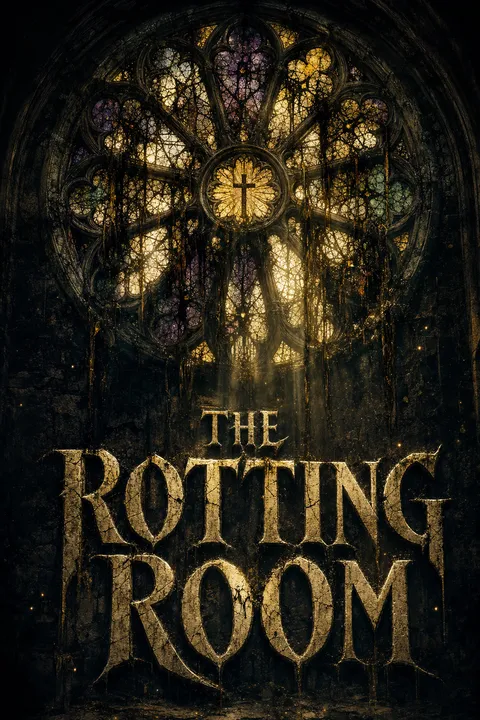


Plot Summary
The Chamber of Rotting Saints
Fleeing scandal at her former abbey, Sister Rafaela1 arrives at the isolated Sisters of Divine Innocence and is immediately marched into the chamber of divine decomposition. Mother Superior3 shows her dead Sisters propped upright in stone chairs, wooden buckets catching the fluids that drip from their rotting bodies. This liquid, the abbess3 insists, is a holy essence that erases sin.
Rafaela1 is ordered to kneel beside the withered Sister Faustina8 until matins, holding her papery hand. That night she is given Faustina's own nightgown8 to wear, still reeking of death. Sickened yet desperate to be grateful, Rafaela1 vows to find the holiness she cannot feel, terrified that her revulsion is merely her own broken, sinful nature.
The opening weaponizes piety against instinct. Rafaela's body screams that something is wrong (nausea, gorge, revulsion), yet her theological conditioning reframes disgust as personal failing. Hampton establishes the novel's central psychological engine: a woman trained to distrust her own senses in favor of authority. The chamber literalizes institutional rot, sanctity performed over decay. The forced intimacy with a corpse, then wearing a dead woman's gown, enacts a grotesque erasure of self, folding Rafaela into a lineage of decomposition. Her reflexive prayers function less as faith than as compulsive self-silencing, a ritual designed to smother the very perceptions that might save her.
The Confession of Her Mother
In the ornate confessional, the handsome young priest Father Bruno2 draws from Rafaela1 a wound she has buried for years. As a child in Barcelona, she watched her mother11 hold her infant sister Margarita under the washbasin water until the bubbles stopped, and she believes her other lost siblings died the same way.
When she spoke of it, her mother11 and her adored older brother Sebastian9 branded her a liar with a dangerous imagination. That accusation fractured her, leaving her perpetually unable to trust whether her own eyes reported truth. Bruno,2 gripping his crucifix until his palms bleed, is shaken to his core. Rafaela1 reveals she was later sent to the Rafaelites partly to keep her silent, a child exiled for seeing too much.
This is the origin of Rafaela's epistemic paralysis, a portrait of gaslighting rendered in seventeenth century terms. A mother's infanticide is monstrous, but the deeper violence is the systematic dismantling of a child's confidence in perception. Rafaela internalizes the label of dangerous imaginer so completely that doubt becomes her default posture toward reality. The confessional, ostensibly a space of absolution, functions as the first place anyone believes her, which explains her fatal attachment to Bruno. Hampton frames trauma as a corruption of knowing itself: when authority insists you did not see what you saw, sanity becomes indistinguishable from obedience.
The Priest's Hanged Woman
Father Bruno2 carries his own buried horror. As a twelve-year-old in Albania, he was injured in the forest and nursed back to health by a lonely old woman living in isolation. When he returned home feverish, his superstitious neighbors decided she was a shtriga, a blood-draining witch, and dragged her to the gallows despite his weak protests.
He heard her neck snap. Ever since, Bruno2 has equated suspicion with the murderous ignorance of that mob and vowed never to let it take root in his heart. This vow makes him gentle, but it also disarms him: as Rafaela1 reports genuine horrors, he keeps rationalizing them away, unwilling to become like the villagers who killed an innocent woman on a rumor.
Bruno's backstory is a tragic inversion of virtue. His refusal of suspicion springs from real moral injury, yet Hampton exposes how a righteous principle, held rigidly, becomes blindness. Where Rafaela distrusts herself too much, Bruno trusts the world too generously, and both flaws are rooted in childhood powerlessness before cruel authority. The shtriga motif also plants the novel's folkloric horror seed, priming us for something genuinely inhuman. Bruno's simmering, guilt-laced desire for Rafaela compounds his instability; his lust and his self-flagellation mirror the abbey's own confusion of the sacred and the corporeal. His compassion, uncoupled from discernment, ultimately protects no one.
A Stranger in the Storm
During a violent thunderstorm, a ragged, red-haired woman with startling golden eyes4 pounds on the kitchen door. She calls herself Berta,4 a Sister from England fleeing the expulsion of religious orders, and she is gravely ill, coughing blood into her fist. Mother Superior3 admits her on a trial basis despite receiving no word from any abbess, and assigns the newly arrived Rafaela1 to nurse her.
Berta4 unsettles everyone: her manners are crude, her Spanish oddly accented, her presence faintly predatory. Alone with her in the cell, Rafaela1 is certain she hears Berta4 rasp that people in the village are dying from what the Sisters sell, and that God will not save her. When she turns, Berta4 lies fast asleep, and Rafaela1 doubts her own ears again.
Berta is the catalyst who cracks the abbey's brittle routine. Hampton stages her arrival with gothic thunder, but the real dread is epistemological: Berta speaks only when Rafaela's back is turned, exploiting the exact wound established in chapter two. Is Berta a delirious dying woman, a demon, or a projection of Rafaela's suppressed knowledge? The narrative refuses to resolve this, trapping the reader inside Rafaela's uncertainty. Berta functions as a diabolical truth-teller, voicing the accusations Rafaela cannot let herself believe. Her golden eyes and animal appetites signal the folkloric threat Bruno's shtriga story foreshadowed, blurring the line between supernatural invasion and revealed corruption.
Death and the Living Flame
By morning Berta4 is dead, having received no last rites, yet not before taunting Rafaela1 again that the abbey is godless and that its tincture is poison. During the responsory for the dead, the altar candles suddenly blaze into towering columns of impossible heat, then subside. Mother Superior3 and the other Sisters gaze upon this with rapture, certain they have witnessed a miracle, a sign that welcoming the stranger pleased God.
Rafaela1 feels only dread; her cheeks are wet with sweat, not tears, and she alone senses something profane in the room. Where the others find divine confirmation, she recognizes the crackling atmosphere of Berta's4 dying laughter, and begins to fear that the woman's death has unleashed rather than ended something.
The candle prodigy is the novel's first collective delusion, and Hampton makes it a study in interpretive desire. The Sisters, hungry for significance and prestige, read fire as grace; Rafaela, attuned to dread, reads it as infernal. The same phenomenon splits the community along the axis of what each person needs to believe. This is the mechanics of mass hysteria and manufactured sainthood laid bare. Berta's refusal of last rites is a quiet theological alarm, a soul departing unshriven into a house that no longer distinguishes holiness from horror. Rafaela's isolation deepens: her divergent perception, once a private torment, now marks her as the lone dissenter.
The Body That Will Not Rot
Days pass and Berta's4 corpse stays pink, plump, and lifelike, her golden eyes glinting, while every other body in the chamber withers and blackens. The Sisters grow feverish with excitement, whispering of incorruptibility and canonization, praying at her feet and leaving offerings like an altar.
Their certainty is sharpened by a grotesque contrast: a villager missing all but two fingers, who bought and drank the tincture, collapses dead at the transaction grate and is unceremoniously shoved back through and then placed in the chamber, where he rots with alarming speed.
Rafaela,1 forced repeatedly to pray alone before Berta,4 hears the dead woman promise the Sisters will drain her too and sell her as a saint. She understands the tincture is killing the faithful who drink it.
Incorruptibility, a genuine Catholic marker of sanctity, becomes the abbey's fatal delusion. Hampton weaponizes doctrine: the Sisters mistake preservation for holiness precisely because it flatters their ambition for pilgrims and coin. The rotting villager, placed beside the pristine Berta, is a visual thesis, the innocent decays while the malevolent endures. The scene also confirms the economic horror underlying the piety: a supply chain of death disguised as grace. Rafaela's private communions with Berta dramatize the seduction of forbidden knowledge; the corpse tells her true things, but truth delivered by a devil is designed to isolate and destabilize rather than liberate.
A Coughing Abbey, A Grieving Father
A wracking cough spreads through the abbey, hollowing the Sisters one by one, yet Rafaela,1 the youngest outsider, stays untouched. Amid the mounting deaths arrives a letter from her father:10 her beloved brother Sebastian9 has died, leaving her the family's only heir.
He begs her to leave the religious life, return to Barcelona, marry, and continue the de Fuentes Piedra line, assuring her that Archbishop Orriva6 will smooth her exit. Rafaela1 is torn between duty to her earthly father10 and her vows to God, between the pull of home and terror of damnation for abandoning Christ.
Grief for Sebastian,9 whose death she never sensed from afar, mingles with dread as the elderly, kindly Sister Cecelia7 sickens and dies coughing blood, still yearning to witness a miracle.
The plague of coughing externalizes spiritual contagion; the abbey is quite literally sickening from its own sins, though the Sisters read illness as an occasion for more prayer to Berta. Rafaela's immunity marks her as unassimilated, both blessing and death sentence. The father's letter introduces a competing claim on her body: where the abbey wants her fluids and the Church wants her obedience, her family wants her womb for dynastic survival. Hampton surrounds Rafaela with institutions that each treat her as a vessel. Sebastian's death severs her last tie to the sibling who once doubted her, deepening her existential solitude and forcing an impossible choice between souls.
They Are Taking My Blood
Menstruating with unnatural violence, Rafaela1 notices her soiled rags vanishing from her cell. Then she glimpses a Sister wringing her bloody rags into a bucket and carrying it toward the bottlery, and Berta4 confirms it: her blood will be sold as the blood of a saint, because a good body must never go to waste.
Worse, the letter she wrote her father, mentioning her suspicions about the poisonous tincture, is intercepted. Someone slits it open, tears out the incriminating passage, and slides the fragment back under her door as a warning.
Rafaela1 realizes she is being watched, her private correspondence violated, her body harvested. She resolves to smuggle a future letter out through the one person she still trusts, Father Bruno,2 at confession.
Here the horror turns explicitly gynecological and proprietary. The commodification of menstrual blood as relic literalizes patriarchal and institutional ownership of the female body, extending even to its most private effluvia. Rafaela's blood, her fertility, the very thing her father covets for heirs, is stolen to counterfeit sanctity. The censored letter is a chilling act of surveillance and control, confirming that her paranoia was accurate perception all along. Hampton collapses the distinction between persecution and revelation: the woman told she imagines threats is now demonstrably, materially hunted. Trust narrows to a single fragile channel, the priest whose own principles make him unreliable.
The Graveyard That Feeds No One
Determined to remove Berta's4 body and restore God to the abbey, Rafaela1 slips down to the graveyard for a wheelbarrow. She finds the burial ground barren and dusty, a dying blackened tree at its center, while the adjacent garden overflows unnaturally with fruit.
Inside the locked shed she discovers a stained wheelbarrow and shovels still caked with grave dirt. The truth assembles itself: the Sisters have no bodies resting in that ground because they exhume every corpse buried there, drag them to the chamber to rot, bottle their fluids, and sell the tincture back to grieving families.
The famished graveyard and fattened garden tell the whole obscene economy. This corruption predates Berta4 by years; her arrival only intensified an evil already thriving.
The empty graveyard is the novel's grand structural reveal, converting suspicion into industrial-scale atrocity. Hampton inverts the natural order: the dead do not rest and the earth is starved while a garden gorges, a landscape morally deranged. Crucially, the discovery decouples the horror from Berta, establishing that the Sisters were already damned; the demon merely accelerated a long slide. This matters psychologically, it vindicates Rafaela's dread while denying her the comfort of a single external villain. The evil is systemic, ritualized, profitable, and self-justifying through scripture. Rafaela's mission crystallizes here, but so does the terrible question of whether such a community can, or should, be saved.
The Letter Bruno Reads
At confession Rafaela1 pours out everything: the poisonous tincture, Berta4 speaking from death, the stolen blood, her plan to remove the incorruptible body. She asks two favors, help moving Berta4 (Bruno2 refuses, horrified) and delivering a letter safely to her father10 (he agrees).
But Bruno,2 alarmed by her frantic state and haunted by his shtriga guilt, breaks the seal and reads it. The contents terrify him: accusations of murder and a confessed scheme to steal a corpse, addressed to a powerful man close to the Archbishop.6
Convinced Rafaela1 is spiraling toward a fate like the hanged woman, he races up the hill to stop her. Meanwhile Mother Superior3 has already confessed to intercepting and mutilating Rafaela's earlier letter, insisting it served a greater good.
Dramatic irony reaches its cruelest pitch. Bruno, the one ally Rafaela trusts, betrays her confidence out of protectiveness, precisely the paternalistic disbelief that has always harmed her. His refusal to countenance suspicion, born of guilt over an innocent woman's death, blinds him to the guilt of the living. Hampton constructs a tragedy of good intentions: every safeguard Rafaela reaches for becomes a snare. The confessional, her only sanctuary of being believed, transmutes into the mechanism of exposure. The reader watches the trap close while both parties act from love, dread, and misapprehension, a devastating study of how care without belief functions identically to persecution.
Berta's Bargain
When Rafaela1 finally maneuvers the wheelbarrow into the chamber, Berta4 stops her with a proposition. She reveals that Sebastian9 fathered a bastard son named Benjamin, living in obscurity; if Rafaela's father10 learns of the boy, he can legitimize him, satisfying the family line and freeing Rafaela1 to remain a nun forever.
All Berta4 asks in return is that Rafaela1 leave her body undisturbed, a task requiring only inaction, which Berta4 mockingly notes is Rafaela's1 lifelong specialty.
To prove her power, Berta4 banishes Rafaela's1 savage menstrual cramps, then restores them agonizingly when she wavers. Rafaela1 also overhears Berta4 seducing Sister Leonella5 with the promise of becoming the next Mother Superior,3 indifferent to whether Mother Superior3 lives or dies. The devil is buying the abbey soul by soul.
Berta's temptation is diabolically precise, targeting Rafaela's deepest conflict between vocation and family duty and offering to dissolve it through passivity. The genius of the bargain is that it demands nothing but her characteristic sin, silence, the failure to act that has haunted her since her mother's washbasin. Hampton stages a genuine Faustian test disguised as mercy. The pain she inflicts and relieves demonstrates that Berta owns Rafaela's very body, echoing the abbey's harvesting of her blood. Overhearing Leonella's corruption reframes the horror as a spreading contagion of individual greed; each Sister trades her soul for health or power, and the collective damnation is simply many private betrayals summed.
Golden Eyes and a Priest in Chains
By vespers, half the coughing Sisters are suddenly, unnaturally restored, rosy and vigorous, their eyes now burning golden-red like Berta's,4 even Sister Leonella's5 scars fading to nothing. They have accepted Berta's4 bargains, trading their souls for health and gorging on nearly raw red meat.
Arriving to save Rafaela,1 Bruno2 is ambushed in the dark by a transformed, gleeful Leonella,5 who reveals Berta4 told her he was coming and mocks his lust for Rafaela.1 She knocks him unconscious.
He wakes bound in a stone chair in the chamber itself, half-undressed over the privy hole, a blowfly crawling across Berta's4 unblinking eye. Leonella5 pours the tincture down his throat and promises his death will be slow. Bruno,2 drowning in old guilt, accepts it as the penance he deserves.
The physical transformation externalizes spiritual surrender, the golden eyes a visible sign of the pact, the carnivorous appetite a regression from brides of Christ to feral communicants of a blood cult. Hampton pays off Bruno's arc with brutal symmetry: the man who refused suspicion to avoid becoming a killer is himself killed by the monsters he refused to suspect. His resignation, framed as deserved penance, completes his tragic self-condemnation over the shtriga. The blowfly on Berta's open eye is a masterstroke of body horror, the single detail that shatters his rationalizations. Evil, he finally grasps, is real and comprehending, and his lifelong virtue was a door left open.
Fire Against the Devil
Confronted in her cell, Mother Superior3 and Leonella5 brandish her intercepted letter and reveal Bruno2 handed it over after reading it, then order her to repent before Berta.4
At the next service, night prayer curdles into open Satanic worship: every Sister now bears golden-red eyes and chants to Saint Berta4 and to demons, even the crucified Christ above the altar staring back with hellfire eyes. Rafaela,1 the sole untainted soul, flees to the charred bottlery, remembering that Sister Faustina8 once tried to burn it.
She tips over the buckets of fluid and drops a candle, coaxing a blue flame to life. But Mother Superior3 and Leonella5 burst in and smother the fire with a bucket of blood and grave dirt, revealing it is Rafaela's1 own harvested blood, then strike her unconscious.
The Satanic service confirms the abbey's total apostasy, the demonic Christ a blasphemous emblem of a faith fully hollowed and reoccupied. Rafaela's turn to fire completes the Faustina foreshadowing, transforming the perpetual follower into an actor at last; her single decisive deed is an attempt at cleansing violence. Yet Hampton denies catharsis: the flames are extinguished by her own stolen blood, a grotesque image of a woman's body used as the instrument of her own defeat. The revelation that Bruno surrendered the letter lands as final betrayal, though the reader knows his tangled motives. Agency arrives too late, outmatched by an evil that rebuilds after every purge.
Left to Burn Alone
Rafaela1 wakes bound in a stone chair in the chamber, beside Bruno's2 decaying corpse. The Sisters chant to Saint Berta4 while Mother Superior3 delivers the killing blows: they have written to her father10 and Archbishop Orriva6 claiming she chose to stay and sever all contact, and they have shipped the poisonous tincture to the de Fuentes Piedra household, signed in her name, ensuring no one survives to read her accusations, including the boy Benjamin's family.
Offered one last chance to join them and refusing, Rafaela1 is force-fed the tincture. Mother Superior3 promises that one day her own body will fill their bottles, then leaves her sealed in darkness. Rafaela1 burns from within, screaming into Berta's4 endless laughter, utterly abandoned by the God she never betrayed.
The ending is uncompromising, a horror that withholds every redemptive convention. Rafaela's fidelity earns her only martyrdom without witness, her murder erased by forged letters and her family poisoned to silence the truth forever. Hampton refuses the survivor's vindication; the woman who finally trusted her senses and acted on faith is consumed anyway. The closing image, a devout soul burning alone in a lightless rotting room, indicts a world where institutional power, greed, and evil operate seamlessly under sacred cover. Her steadfast refusal to renounce God becomes both her only dignity and her death warrant, posing the bleak theological question the whole novel circles: what is faith worth where God cannot be heard?
Analysis
The Rotting Room is a gothic horror built on epistemology: its true monster is the systematic destruction of a woman's confidence in her own perception. Rafaela's1 childhood gaslighting, being told she did not see her mother's murders,11 becomes the template for every subsequent horror; she is trained to mistrust exactly the instinct that could save her. Hampton makes doubt itself the abyss, the fence line on which her heroine perpetually teeters. The novel indicts institutions that demand obedience as holiness. The Sisters' chamber, tincture, fake graveyard, and harvested blood form an economy of sanctified atrocity, where scripture is quoted to justify murder and grief is monetized by selling the dead back to the bereaved. Piety functions as camouflage, and curiosity is punished as pride or witchcraft. The book is acutely concerned with the female body as contested property: Rafaela's1 womb is coveted by her family for heirs, her menstrual blood is stolen to counterfeit relics, and her flesh is promised to the bottles. Bruno's parallel arc2 supplies the tragic counterweight. His vow never to suspect, born of guilt over an innocent woman's lynching, is a genuine virtue that becomes fatal blindness. Hampton pairs his excess of trust against Rafaela's1 excess of self-doubt, suggesting that both credulity and paralysis leave evil unopposed. Their doomed near-alliance, mediated through a corrupted confessional, dramatizes how care without belief replicates persecution. The ending refuses redemption. Fidelity earns Rafaela1 only an unwitnessed martyrdom, her truth erased by forged letters and poison. The final image, a faithful soul burning alone where God cannot be heard, poses the novel's bleakest question: what is devotion worth in a world where holiness has been fully hollowed out and reoccupied by greed and the demonic? Hampton offers no comfort, only the terrible clarity of seeing too late.
Characters
Sister Rafaela
Doubt-haunted new nunBorn Rafaela de Fuentes Piedra to a wealthy Barcelona nobleman10, she is a young woman defined by a lifelong crisis of perception. As a child she witnessed her mother11 drown an infant sibling, then was branded a liar with a dangerous imagination, a wound that leaves her chronically unable to trust her own eyes and ears. Meek, obedient, and desperate to be good, she clings to prayer and to authority as substitutes for self-trust. Sent to the corrupt Rafaelites and then to the Sisters of Divine Innocence, she perpetually balances on what she calls a fence line between certainty and self-doubt. Her arc is a struggle to reclaim faith in her own senses, driven by guilt over past silences and a yearning to finally act rather than merely follow.
Father Bruno Prifti
Guilt-ridden confessor priestAn Albanian-born priest who ministers to the abbey and its village, appointed by Archbishop Orriva6. As a boy he failed to save the kind old woman who nursed him, watching neighbors hang her as a witch, and he has since built his identity around atonement and a fierce refusal to harbor suspicion of anyone. That principle makes him tender but credulous. Having preached to Natives in the New World and drifted across continents, he finds solace in routine yet dreads the abbey's cloying stench. His growing, shame-soaked attraction to Rafaela1 wars with his vows and destabilizes his judgment. Compassionate, intelligent, and self-punishing, Bruno embodies the tragedy of a good man whose hard-won virtue leaves him fatally unable to recognize genuine evil.
Mother Superior
Imperious ambitious abbessThe domineering, sharp-eyed head of the Sisters of Divine Innocence, physically small yet commanding. She rules the abbey's rituals with absolute authority and treats the chamber of divine decomposition and its tincture as unquestionable holy work. Beneath her performance of humility runs a hunger for prestige and wealth, evident in the ostentatious gilding of her church and her fervor to claim a saint. She wields scripture as a weapon and brooks no curiosity or dissent, invoking threats of witchcraft accusations to silence questions. Her soul, as Bruno2 privately notes, has rusted under the corrosion of power. She is the human face of an institution that has confused ambition and greed with divine calling.
Berta
Unsettling English travelerA tall, red-haired woman with startling golden eyes and crude, almost animal manners who appears at the abbey during a storm, claiming to be an English Sister fleeing her country's expulsion of religious orders. Gravely ill and coughing blood, she speaks accented Spanish and radiates a predatory strangeness. From her first night she seems to know the abbey's darkest secrets, whispering accusations to Rafaela1 that no newcomer should possess. Enigmatic, mocking, and impossible to place, Berta becomes the fulcrum on which the abbey's fate turns, a figure whose true nature Rafaela1 senses as profoundly wrong even as the other Sisters are drawn to her.
Sister Leonella
Scarred devoted lieutenantA Sister whose face is crisscrossed with silvery burn scars and raw patches, said to have been injured trying to rescue a fellow Sister from a fire. She serves as Rafaela's1 initial guide and as Mother Superior's3 ever-present shadow, cleaving tightly to the abbess3 and eager to earn her favor. Her flat, dark eyes and permanent ghost of a sneer make her presence quietly menacing. Beneath her displayed humility lurks resentment of authority and personal ambition.
Archbishop Orriva
Powerful family patronArchbishop Juan Leonardo Orriva, a longtime confidant of Rafaela's1 family who arranged her placement with the Rafaelites and, after their scandal, with the Sisters of Divine Innocence. He discovered Rafaela1 bloodied beside a dead boy and shut the Rafaelite abbey down. Well-connected and cautious, he corresponds with Bruno2 and Rafaela's father10, urging patience while harboring his own growing unease about the Sisters' notorious tincture.
Sister Cecelia
Kindly aged believerOne of the oldest and most gentle Sisters, radiating a childlike, joyful piety. She confesses a wish to witness a true miracle before she dies, a longing that makes her especially eager to believe in Berta's4 sainthood as illness overtakes her.
Sister Faustina
The first rotting corpseA deceased Sister whose body Rafaela1 is made to pray beside on her first night, and whose reeking nightgown she must wear. Her past holds a buried significance: she once tried to burn down the bottlery, having sensed the evil the others could not.
Sebastian
Rafaela's adored brotherRafaela's1 older brother, whom she worshipped and followed as a child, and who nonetheless dismissed her account of their mother's11 crime as wicked lies. Their correspondence sustained her at the abbey until it stopped. His fate reshapes her family's demands on her life.
Rafaela's Father
Desperate grieving noblemanAlejandro de Fuentes Piedra, a wealthy, pious Barcelona nobleman who steered Rafaela1 into religious life yet later pleads for her return to marry and continue the family line. Rational and worldly, he grows uneasy about the Sisters and their tincture through the Archbishop6.
Rafaela's Mother
Cold infanticidal matriarchA noblewoman who never wanted many children and, Rafaela1 believes, drowned her own infants while feigning grief. She gaslit young Rafaela1 into doubting what she witnessed, and her hollow, loveless gaze haunts her daughter's memory and self-image.
Plot Devices
The Holy Essence Tincture
Engine of horror and commerceSmall glass bottles of brown-green liquid, sold through a kitchen grate to villagers as a sin-erasing holy essence. The tincture is the abbey's economic and moral rot made portable, and the mystery of its true source drives Rafaela's1 investigation across the entire novel. Its sickly-sweet reek links every location, the chamber, the bottlery, the corpses, into one continuous atmosphere of death. Hampton uses the tincture to explore how ritual language sanctifies atrocity: buyers believe they purchase salvation while consuming something lethal. The bottles also mirror the Rafaelites' almond confections, framing both orders as businesses trading holiness for coin. The tincture ultimately becomes the instrument of the story's cruelest violence.
Berta's Disembodied Voice
Ambiguous truth from the deadBerta4 speaks to Rafaela1 chiefly when her back is turned, then falls silent and still whenever Rafaela1 looks. This device sustains the novel's central ambiguity: are these the taunts of a demon, or Rafaela's1 own repressed knowledge surfacing as hallucination? By channeling accurate accusations through an unreliable, possibly supernatural source, Hampton keeps both Rafaela1 and the reader suspended between belief and doubt, weaponizing the protagonist's lifelong distrust of her own senses. The voice delivers exposition, temptation, and dread simultaneously, making revelation itself feel dangerous. It also isolates Rafaela1, since believing a corpse marks her as mad, while disbelieving it means ignoring the truth.
The Confessional and Letters
Channel of trust and betrayalWith the Sisters bound by a vow of silence, the confessional booth and written letters become the only conduits for truth. Hampton uses the confessional to braid the dual points of view, letting the reader hear Rafaela's1 disclosures and Bruno's2 inner reactions, and to smuggle backstory. Letters to and from Rafaela's father10 and the Archbishop6 carry the plot's external stakes. Crucially, both channels are corrupted: letters are intercepted, censored, and forged, and the confessional's sacred confidence is broken. The device dramatizes how information itself becomes contested territory in a closed, surveilled community, and how the very instruments meant to convey truth are turned into traps.
The Golden-Red Eyes
Visible mark of the pactBerta's4 uncanny golden-red irises become the outward sign of spiritual surrender. As Sisters accept her bargains and are miraculously healed, their eyes take on the same hellish hue and their scars vanish, transforming devout women into feral, blood-eating communicants. Hampton uses the shifting eye color as an economical, visceral shorthand for who has been claimed, allowing Rafaela1 to read the abbey's damnation at a glance and to recognize herself as the last untouched soul. The motif culminates in a blasphemous image of the crucified Christ staring back with the same eyes, signaling the total reoccupation of the sacred by the infernal.
The Tolling Bells
Rhythm of control and dreadThe abbey's bells govern every hour, waking, prayer, meals, work, silence, and Rafaela1 initially experiences them as the comforting voice of Christ calling her onward. Hampton uses the relentless tolling to convey the hypnotic regimentation of cloistered life, and repeatedly deploys the bells to interrupt Rafaela's1 dangerous thoughts, questions, and half-formed acts of resistance, mechanizing her passivity. As the story darkens, the bells lose their meaning and their comfort, marking the collapse of holy order into something else. Their steady punctuation makes time itself feel like a cage, tightening around the protagonist as her window to act narrows.
Download PDF
Download EPUB
.epub digital book format is ideal for reading ebooks on phones, tablets, and e-readers.








































