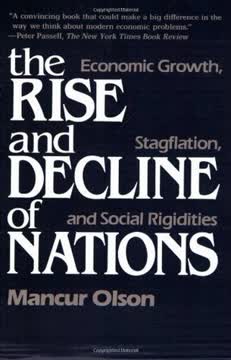
Key Takeaways
1. Rational Individuals in Large Groups Don't Act in Common Interest Without Selective Incentives.
The paradox, then, is that (in the absence of special arrangements or circumstances to which we shall turn later) large groups, at least if they are composed of rational individuals, will not act in their group interest.
The Free-Rider Problem. It is a common assumption that if individuals or firms share a common interest, they will naturally organize to pursue it. However, this is fundamentally flawed. If a collective good (like a higher wage or a favorable tariff) is achieved, everyone in the group benefits, regardless of whether they contributed to the effort. A rational individual, therefore, has little incentive to sacrifice time or money, preferring to "let George do it."
Selective Incentives are Crucial. For large groups to overcome this "free-rider" problem and engage in collective action, they require "selective incentives." These incentives apply selectively to individuals based on their contribution. They can be:
- Negative: Coercion, such as compulsory union dues (e.g., union shop, picketing with "pick handles or baseball bats").
- Positive: Private goods or benefits offered exclusively to members (e.g., insurance, publications, group travel, grievance procedures).
Small Groups Organize More Easily. Small groups face fewer obstacles to collective action. Each member's contribution is more noticeable, and bargaining costs are lower. Furthermore, social selective incentives—like the desire for companionship, respect, or fear of ostracism—are powerful in socially interactive small groups, making collective action more likely and less dependent on formal coercion or private goods.
2. Stable Societies Accumulate Growth-Retarding Special Interest Groups Over Time.
Stable societies with unchanged boundaries tend to accumulate more collusions and organizations for collective action over time.
Organizations Emerge Gradually. Collective action is inherently difficult and takes time to organize. There are significant start-up costs, resistance to the unfamiliar, and delays in working out internal agreements. Even when conditions are favorable, it can take decades or even centuries for effective organizations to emerge, as seen in the slow development of trade unions after the Industrial Revolution.
Survival of the Organized. Once established, organizations for collective action, especially those with selective incentives, tend to persist indefinitely. Leaders have a vested interest in maintaining the organization, even if its original purpose diminishes. This means that in stable societies, old organizations rarely disappear, leading to a continuous accumulation of special interest groups.
Institutional Sclerosis. This gradual accumulation of organizations and collusions over long periods of stability leads to "institutional sclerosis." Societies with prolonged democratic freedom and security from upheaval, like Great Britain, develop a dense network of powerful special interest groups that hinder adaptation and growth. This explains Britain's relative economic decline over the last century, contrasting with its rapid growth during the Industrial Revolution when its society was more open.
3. Narrow Special Interest Groups Reduce Efficiency and Make Political Life Divisive.
On balance, special-interest organizations and collusions reduce efficiency and aggregate income in the societies in which they operate and make political life more divisive.
Redistribution, Not Production. The primary goal of most special interest groups, especially those representing a narrow segment of society, is not to increase the overall societal "pie" but to secure a larger "slice" for their members. They achieve this through lobbying for favorable legislation (e.g., higher prices, lower taxes) or cartelization (restricting output to raise prices).
High Social Costs. These distributional struggles impose significant costs on society as a whole. Resources diverted to lobbying or cartel enforcement do not produce output. More importantly, the policies obtained by these groups distort incentives, leading to misallocation of resources and a reduction in overall economic efficiency and aggregate income. The social cost of these policies can be many times greater than the gains reaped by the special interest group.
Political Divisiveness. When special interest groups become dominant, political life shifts from pursuing common interests to intense distributional struggles. This zero-sum competition, where one group's gain is another's loss, fosters resentment and divisiveness. It can also lead to incoherent and unstable political choices, contributing to the "ungovernability" observed in some modern societies.
4. Encompassing Organizations Can Promote Societal Prosperity.
Encompassing organizations have some incentive to make the society in which they operate more prosperous, and an incentive to redistribute income to their members with as little excess burden as possible, and to cease such redistribution unless the amount redistributed is substantial in relation to the social cost of the redistribution.
Broader Self-Interest. Unlike narrow special interest groups, organizations that are "encompassing"—meaning they represent a substantial portion of a society's income-earning capacity (e.g., a national labor confederation, a peak business association, or a major political party)—have a different incentive structure. Their members own so much of the society that they bear a significant portion of any social losses caused by inefficient policies.
Incentive for Efficiency. An encompassing organization will therefore have an incentive to consider the overall prosperity of society. While still seeking gains for its members, it will strive to achieve these gains with the least possible "excess burden" (social cost). It may even support policies that increase overall societal efficiency, as its members will capture a substantial share of these broader benefits.
Examples of Encompassing Behavior. This logic helps explain why:
- Enterprise or industry-wide unions might agree to more efficient work practices than narrow craft unions.
- National peak associations (like those in Scandinavia) sometimes advocate for growth-increasing policies, such as labor mobility subsidies.
- Strong, encompassing political parties (like the two major parties in the US) tend to be more concerned with national welfare than individual congressmen or narrow lobbies.
5. Distributional Coalitions Slow Down Economic Adaptation and Growth.
Distributional coalitions slow down a society's capacity to adopt new technologies and to reallocate resources in response to changing conditions, and thereby reduce the rate of economic growth.
Resistance to Innovation. Distributional coalitions, whether cartels or unions, often have an incentive to resist innovations that might disrupt their established positions. A labor union might repress a labor-saving technology that reduces demand for its members, or a cartel might block a new product that its competitors cannot immediately copy, fearing it could destabilize their collusive agreement.
Slow Decision-Making. These coalitions make decisions slowly due to the need for consensual bargaining or constitutional procedures (Implication 6). This sluggishness prevents rapid adaptation to changing economic conditions, new technologies, or shifts in consumer demand. Archaic work rules or outdated agreements persist, leading to inefficiencies that accumulate over time.
Barriers to Resource Reallocation. Special interest groups also hinder the efficient reallocation of resources. They may lobby for "bail-outs" of failing firms, delaying the shift of capital and labor to more productive sectors. Unions can restrict entry into booming industries, keeping wages artificially high and preventing the optimal flow of labor, thereby reducing overall growth and efficiency.
6. Jurisdictional Integration and Freer Trade Undermine Local Special Interests, Fostering Growth.
The greatest reductions of trade restrictions in history have come from reducing the mileage rather than the height of trade restrictions.
Undermining Local Monopolies. Jurisdictional integration, such as the formation of nation-states or common markets, creates much larger areas of free trade and factor mobility. This fundamentally undermines local special interest groups like medieval guilds. A guild controlling a small town market loses its monopoly power when faced with competition from producers across a wider, integrated region.
Historical Examples of Growth. This process explains several historical "economic miracles":
- Early Modern Europe: Centralizing monarchs eliminated local tolls and feudal restrictions, creating national markets (e.g., Britain, France). This preceded the Commercial and Industrial Revolutions.
- 19th-Century US & Germany: The US Constitution prohibited state trade barriers, and westward expansion provided new competition. Germany's Zollverein (customs union) and unification similarly created a large internal market, leading to rapid growth.
- Post-WWII EEC: The Common Market integrated economies, exposing previously protected national industries to competition and forcing greater efficiency.
Beyond Comparative Advantage. The gains from freer trade extend beyond the traditional theory of comparative advantage. By increasing the number of firms or workers needed for effective cartelization and preventing governments from enforcing local monopolies, free trade directly constrains distributional coalitions, leading to increased efficiency and faster growth.
7. Long-Term Stability Fosters Exclusive Social Structures Like Caste Systems.
Distributional coalitions, once big enough to succeed, are exclusive and seek to limit the diversity of incomes and values of their membership.
Exclusivity as a Strategy. Distributional coalitions, whether guilds, professional associations, or ruling aristocracies, inherently seek to be exclusive. Limiting membership ensures that the gains from collective action are distributed among fewer individuals, maximizing the share for existing members. This drive for exclusivity is a fundamental aspect of their long-term survival.
Multigenerational Preservation. Over generations, this exclusivity can manifest in rigid social structures. For a coalition to preserve its value for descendants, it must control entry and prevent its numbers from growing too rapidly. This often leads to rules or social pressures enforcing endogamy (marriage within the group) and resistance to admitting outsiders.
The Indian Caste System. The Indian caste system is a dramatic illustration of this principle. It is hypothesized to have emerged from multigenerational guilds, descent groups, and racial distinctions. Castes traditionally:
- Controlled entry into occupations.
- Set prices monopolistically.
- Enforced endogamy to preserve benefits for member families.
- Used visible differences (racial, linguistic, cultural) to enforce boundaries and foster group prejudice.
8. "Top-Heavy" Developing Nations Suffer from Inequality and Inefficiency Due to Organized Elites.
The most substantial and wealthy interests are relatively better organized in the unstable society, but they often own an unrepresentative mix of the country's productive factors.
Disproportionate Influence of Small Urban Elites. In many unstable developing nations, particularly those with poor rural infrastructure, small groups of wealthy individuals and large firms in major metropolitan areas (especially the capital) wield disproportionate political influence. These groups can organize quickly and discreetly, even under authoritarian regimes.
Perverse Policy Syndrome. These urban elites often have vested interests in import-substitution industries or sectors that compete with foreign firms. They lobby for:
- High protectionism: Tariffs, quotas, and exchange controls that block cheaper imports.
- Discrimination against foreign firms: Limiting competition from multinationals.
These policies drive up prices for consumers and reduce export earnings for the rural poor, leading to massive inequality and inefficiency.
Exacerbated Inequality and Stagnation. By protecting capital- and expertise-intensive industries (where these factors are scarce), such policies raise the returns to the already wealthy owners of capital and technical expertise. Simultaneously, they depress the incomes of the abundant factors—labor and natural resources—which are often concentrated among the poor. This "top-heavy" structure fosters both profound inequality and economic stagnation, as resources are misallocated away from areas of comparative advantage.
9. Involuntary Unemployment and Stagflation Stem from Sticky Prices and Wages Set by Distributional Coalitions.
The ultimate source of the problem is that Keynes did not explain the inflexibility of many wages and prices or point out that such an explanation should be the very core of any macroeconomic theory, so some of his followers assumed they were more or less arbitrarily determined.
The Microeconomic Root of Macro Problems. Traditional macroeconomic theories (Keynesian, monetarist, equilibrium) fail to adequately explain involuntary unemployment and stagflation because they lack a microeconomic foundation for sticky wages and prices. Olson argues that these rigidities are not arbitrary but are a direct consequence of rational behavior by distributional coalitions.
Blocking Mutually Advantageous Trades. Involuntary unemployment occurs when organized groups (unions, cartels) set wages or prices above market-clearing levels. This prevents mutually advantageous transactions between unemployed workers (or underutilized resources) and employers. The existing members of the coalition benefit from these non-market-clearing prices, even though it creates a social loss.
Asymmetric Price Stickiness. Distributional coalitions' slow decision-making (Implication 6) leads to sticky prices and wages. This stickiness is often asymmetric:
- Downward rigidity: Cartel members are reluctant to lower prices quickly during a demand downturn, as undercutting hurts all members.
- Upward flexibility: During a demand surge, individual firms may charge more than the cartel price without harming others, leading to quicker upward adjustments.
This explains why unexpected deflation causes more unemployment and output loss than unexpected inflation, which can temporarily reduce the real value of sticky prices, making them less monopolistic.
10. The Historical Shift Towards Deeper Recessions Reflects Accumulating Institutional Sclerosis.
The most prominent trend in all macroeconomic history has been the tendency in countries such as Britain and the United States for reductions in aggregate demand, whatever their causes, to have more and more impact on the level of real output as time progressed.
Increasing Sensitivity to Shocks. Historically, economies have become increasingly susceptible to severe and prolonged unemployment and reductions in real output during periods of unexpected deflation or disinflation. In the 19th century, significant price level drops (e.g., 1812-1896 in Britain, 1839-1843 in the US) did not lead to massive, sustained unemployment or deep depressions. Real output often continued to grow.
The Great Depression as a Turning Point. The Great Depression of the 1930s marked a dramatic shift. A monetary contraction in the US (1929-1933) led to a 30% drop in real GNP and 25% unemployment, unprecedented compared to earlier, even larger, monetary contractions. This suggests a fundamental change in how economies respond to aggregate demand shocks.
Accumulation of Rigidities. This historical trend is explained by the gradual accumulation of distributional coalitions and institutional sclerosis (Implication 2). As societies become more organized, the "fixprice" sector (where prices are sticky due to coalitions) grows relative to the "flexprice" sector. When aggregate demand falls, the rigid prices in the organized sector mean that the burden of adjustment falls disproportionately on output and employment, leading to deeper and more persistent recessions.
11. Good Microeconomic Policy, Not Just Macroeconomic Management, is Key to Prosperity.
The most important macroeconomic policy implication is that the best macroeconomic policy is a good microeconomic policy.
Beyond Demand Management. While Keynesian demand management can offer temporary relief during a depression by offsetting the effects of sticky prices, it is not a permanent solution. Continuous "fine-tuning" of aggregate demand is ineffective because distributional coalitions eventually adjust their prices to expected monetary and fiscal policies, leading to inflation without solving the underlying unemployment problem.
Addressing the Root Cause. The ultimate source of macroeconomic problems like involuntary unemployment and stagflation lies in the microeconomic rigidities created by special interest groups. Therefore, the most effective long-term solution is to foster a more open and competitive microeconomic environment.
Policy Recommendations:
- Repeal special-interest legislation: Eliminate regulations and subsidies that favor specific groups.
- Rigorous antitrust enforcement: Break up cartels and collusions that set prices or wages above competitive levels.
- Freer trade and factor mobility: Undermine domestic monopolies by exposing them to international competition (Implication 6).
- Targeted wage/price policies: Temporary tax or subsidy schemes (e.g., taxes on excessive wage increases, subsidies for hiring unemployed) can help lower the "natural rate of unemployment" when combined with sound monetary and fiscal policies.
12. Laissez-Faire Alone is Insufficient to Prevent Harmful Distributional Coalitions.
The laissez-faire ideology in its focus on the evils of government alone clearly leaves something out. I submit that it is the distributional coalitions, which over millennia of history in India had hardened into castes.
Beyond Government as the Sole Evil. Classical liberal or laissez-faire ideology often posits that competitive markets will thrive if the government simply refrains from intervention. However, this view is incomplete. Even without government intervention, distributional coalitions can form and exert coercive power, cartelizing markets and hindering efficiency.
Historical Evidence Against Pure Laissez-Faire. History provides "controlled experiments" that challenge the sufficiency of pure laissez-faire:
- British Rule in India: India experienced over half a century of thoroughgoing laissez-faire under British rule, yet it did not achieve rapid development. The deeply entrenched caste system, a form of multigenerational distributional coalition, continued to impede economic progress.
- 19th-Century Britain: Britain, the birthplace of laissez-faire, accumulated a dense network of narrow distributional coalitions during its period of minimal government intervention, contributing to the emergence of the "British disease" and its eventual economic lag.
The Enduring Challenge. The problem is not just government intervention, but the inherent tendency of groups to organize for private gain at social cost. Eliminating certain types of government intervention and freeing trade will weaken cartels, but it will not eliminate many of them. Continuous instability might destroy these coalitions, but that is a far greater evil. Therefore, active, intelligent public policies are needed to continuously reduce or countervail the power of distributional coalitions, rather than simply hoping markets will self-correct.
Review Summary
Reviews of The Rise and Decline of Nations are generally positive, averaging 3.96/5. Readers praise Olson's compelling central thesis—that stable societies accumulate special interest groups which gradually hinder economic growth—calling it original, important, and increasingly relevant today. Many found historical examples, particularly post-WWII Germany and Japan, convincing and illuminating. However, recurring criticisms target the book's dense, meandering writing style, which many describe as a difficult slog. Some question the robustness of his regressions and macroeconomic conclusions, particularly regarding stagflation, though the core theoretical framework remains widely respected.
People Also Read




 Immersive