

Key Takeaways
Worship became an industry, and the industry is quietly killing it
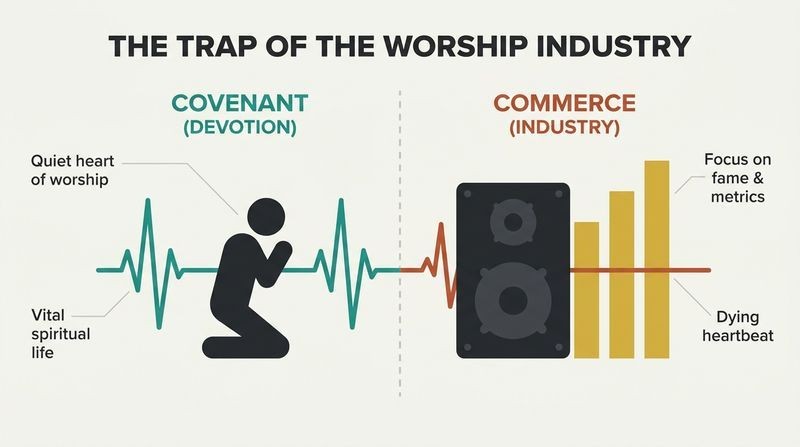
The core diagnosis. Jeremy Riddle, a veteran worship leader who wrote hit songs at Bethel and Vineyard Anaheim, argues that modern worship has drifted from covenant to commerce. There are more worship songs, bands, and leaders than at any point in history, yet he hears mostly noise. The volume rises while the heartbeat fades: sold-out events coexist with moral decline among both attendees and leaders.
The seduction is subtle. Fame, followers, money, and self-gratification now surround the very act meant to exalt Jesus. Riddle names the trap of measuring yourself against current worship culture instead of Scripture, so that corruption becomes common and acceptable. He writes as a man convicted of his own complicity, not as an outside critic, which gives the rebuke its weight.
The critique echoes a recurring pattern in the sociology of religion: what Max Weber called the routinization of charisma, where a spontaneous spiritual movement hardens into institutions, careers, and revenue streams. Riddle's specific target, the metric substitution of streams and likes for spiritual fruit, mirrors Goodhart's Law: when a measure becomes a target, it ceases to be a good measure. What's notable is his refusal to exempt himself. Insider critiques carry more credibility than outsider ones, though they also risk a performative humility. The strongest version of his claim is empirical: a movement can grow in reach while shrinking in the thing it was built to deliver.
Power flows from purity, never from production
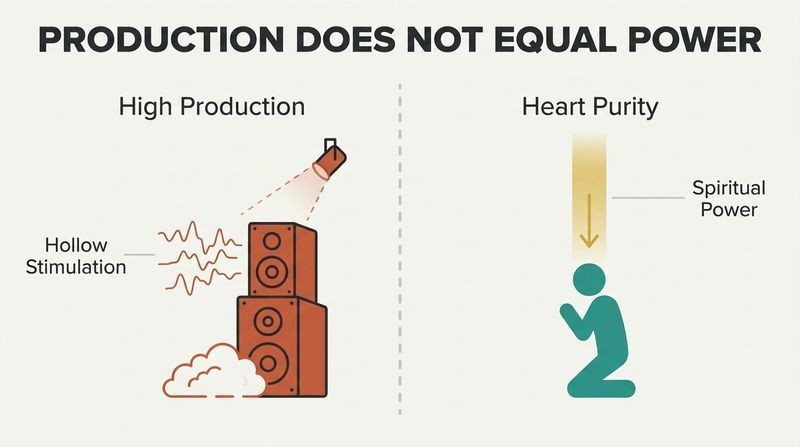
The central thesis restated. Riddle insists something can only be as powerful as it is pure. You can add a full band, fog, mountain imagery, screens, and the best sound money buys, and you will make worship louder and more visually stimulating, but not more powerful. Power was never in the form. It flows from God's presence, and presence follows purity and holiness.
Purity works by exposure. He compares it to wearing a white shirt for a day: you thought you were clean until the white revealed every stain. Purity isn't forceful or striving. It simply is, and its mere presence exposes everything cheap and compromised. The further worship drifts from purity, the hollower it sounds, no matter how impressive the packaging.
The claim inverts the entire logic of the attention economy, which assumes production value equals impact. There's a testable core here worth naming: audiences often detect authenticity independent of technical polish. Research on musical performance and emotional contagion suggests listeners respond to perceived sincerity, not just skill. The white-shirt metaphor is a sharp restatement of an old idea that light exposes rather than attacks. A fair challenge: purity and excellence need not be rivals. Bach wrote staggeringly complex music as an act of devotion. Riddle's real target is misordered priority, not craft itself, a distinction that keeps the argument from collapsing into anti-artistry.
Real worship costs you something, or it changes nothing
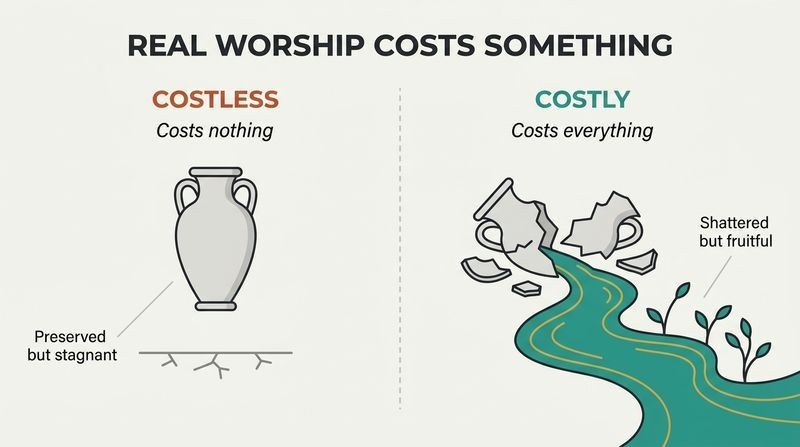
The alabaster jar. Riddle anchors this in Luke 7, where a woman with a bad reputation breaks an expensive flask of perfume over Jesus's feet, weeping and wiping them with her hair. The crowd was outraged and embarrassed. Nobody thought it was appropriate. Nobody but Jesus, who declared her act would be told wherever the gospel is preached.
Cost is the measure. She broke not just perfume worth roughly a year's wages, but her dignity and social standing. Riddle draws on King David's refusal to offer God something that cost him nothing. His challenge is blunt: how much of what we do in worship costs us nothing, and how much do we avoid precisely because it would cost us something? Worship without cost is worship without impact.
There's a behavioral-economics parallel worth surfacing: costly signaling theory. In biology and anthropology, expensive, hard-to-fake displays reliably communicate genuine commitment precisely because they cannot be cheaply imitated. The woman's extravagance is a costly signal that a polished stage performance, which costs the performer little emotionally, cannot replicate. This reframes Riddle's point in secular terms without diminishing it. One nuance: cost can itself become a performance, a competitive asceticism where people signal sacrifice to be seen sacrificing. Jesus praised her precisely because no audience approved. The safeguard against weaponized cost is the same as the whole book's thesis: hidden, unwitnessed devotion.
Popularity sifts you; keep purity's knife at its throat
Popularity as the devil's playground. Riddle isn't against influence when it comes as God's favor, but he calls popularity the fastest way to kill the purity of anything. Just make it popular. He argues you can be both popular and pure only if purity holds a knife to popularity's throat, ready to cut it the instant they conflict, even in the smallest matters.
Jesus as the model. Jesus was wildly popular yet never led by His popularity. He obeyed His Father on days thousands gathered and on days thousands left. The subtle danger for leaders is starting pure, gaining a following, then quietly beginning to serve the followers instead of God. Riddle adds that Satan doesn't fear anyone's follower count; he fears undivided devotion.
The insight that small compromises predict large ones aligns with research on ethical fading and the slippery slope of incremental dishonesty, where people who cheat a little rationalize progressively larger transgressions. Riddle's demand for zero tolerance on minor compromises is psychologically astute: bright-line rules are easier to hold than case-by-case judgment under social pressure. The Jesus-losing-crowds example is historically pointed, since John 6 records mass defection after a hard teaching. A useful tension: healthy accountability usually means listening to people, while Riddle warns against serving them. The reconciliation is directional, distinguishing serving people's growth from serving their appetites and applause.
Let failure reduce you to love as your only foundation
Peter's collapse and restoration. Riddle turns to Peter, who trusted his own passion and boldness, swore he would die for Jesus, then denied him three times while Jesus looked right at him. What remained after the sifting wasn't heroism or a redemption arc of steadfastness. It was one thing: love. Jesus asked three times, do you love me, and rebuilt Peter on that alone.
Love is the only qualifier. Riddle argues the future of worship belongs not to the best songwriters or vocalists but to lovers. Little love produces little worship. When life breaks you through disappointment, offense, or failure, let it strip you down to love, because that is the only foundation God builds on. Love, not talent or charisma, carries the anointing.
This is a theologically classic move: grace built on brokenness rather than performance, echoing Paul's power made perfect in weakness. There's a leadership dimension worth extracting. Cultures that reward flawless personal branding create fragile leaders who cannot survive public failure, whereas a foundation of love (or in secular terms, intrinsic purpose) proves antifragile. Self-determination theory in psychology distinguishes intrinsic motivation, doing something for its inherent meaning, from extrinsic motivation, doing it for rewards and status. Riddle is essentially arguing that worship built on extrinsic motivation cannot survive the removal of applause, while love-rooted worship gets stronger when stripped bare.
Wholehearted living requires a death you keep resisting
The narrow gate is surrender. Riddle tells his own story: as a teenager he chased rock stardom, poured five years into a band, and bartered with God (make me famous and I'll make you famous). The gnawing sense he was serving himself tormented him. A pastor named Jim Fredericks refused to answer his questions and instead asked his own, exposing the lies underneath. Riddle finally surrendered everything, felt only misery, then slowly discovered peace.
Death precedes resurrection. Quoting Bonhoeffer, when Christ calls a man, he bids him come and die. Riddle argues many Christians are like the character in The Princess Bride, only mostly dead, stuck in half-hearted partial surrender. Resurrection power only comes to those fully dead to self. After he surrendered, worship songs of new depth and conviction poured out of him.
The paradox that surrender precedes flourishing appears across traditions and disciplines. Twelve-step recovery's first step is admitting powerlessness. Acceptance and Commitment Therapy treats the struggle against inner experience as itself the pathology. Viktor Frankl observed that meaning comes through self-transcendence, not self-actualization pursued directly. Riddle's autobiographical honesty, admitting his ambition was shallow, lends credibility. A worthwhile challenge: the language of dying to self has, in some church contexts, been misused to suppress healthy ambition, boundaries, or legitimate desire. Riddle partly anticipates this by distinguishing surrendered dreams from killed ones, but the line between holy surrender and unhealthy self-erasure requires discernment the metaphor alone doesn't supply.
Judge dreams by their birthplace, not their brilliance
Sanctified versus un-sanctified dreams. Riddle offers a simple diagnostic. Sanctified dreams are born from intimacy with God and surrender to the Spirit. Un-sanctified dreams are born from a disconnected, orphaned, self-centered place, usually a hole in the heart craving significance. The dream's content may be identical; the difference is where it was conceived. His music dream wasn't wrong because music was wrong. It was un-sanctified because it grew apart from God.
Even God-given dreams can rot. Using Abraham, who tried to force God's promise through Ishmael and later was asked to sacrifice Isaac, Riddle warns that success demands even greater surrender than failure. The moment God begins fulfilling a dream is the moment we grab control, which is the worst possible move. Your dreams are only as healthy as your surrender.
The birthplace test is a genuinely useful heuristic because it evaluates motivation rather than the activity itself, sidestepping the sacred-versus-secular trap where certain careers are holy and others suspect. It resembles what psychologists call approach versus avoidance motivation: goals pursued to fill a deficit tend to produce anxiety and never satisfy, while goals pursued from a secure base sustain wellbeing. Riddle's claim that success requires more surrender than failure is counterintuitive and shrewd, since achievement quietly inflates ego and the illusion of control. The limitation: introspecting one's own true motive is notoriously unreliable, which is why Riddle wisely recommends asking a spouse or trusted counsel rather than trusting solo self-assessment.
A song leader has four chords; a worship leader has the Spirit
The dividing line. Riddle says almost anyone can play four chords and lead a singable chorus, but true worship leading is a Spirit-empowered activity, learning to lead in, with, and by the Spirit. He describes leading a song called Our Father one Sunday night when the set was failing, sensing a prompting, singing lyrics he barely knew, and watching the air in the room seem to shimmer as, in his account, God's glory manifested and the stage disappeared.
The Presence is a Person. He pushes back on trendy church language that treats presence as a vibe, mist, or atmosphere. Presence is never separable from person. The Holy Spirit has feelings, desires, grief, and holiness. Following Him isn't reserved for ministry moments; it means living as a subordinate leader who consults God about set lists, family, finances, and daily rhythms.
The reframing of presence from force to person is theologically precise and practically consequential, since how one conceptualizes a relationship governs how one behaves within it. Treating the Spirit as an impersonal energy invites a transactional, magic-formula posture, exactly the manipulation Riddle warns against. His subordinate-leader model inverts conventional leadership literature, which centers the leader's vision and control. There's an interesting parallel to improvisation in jazz, where the finest players describe surrendering to the moment rather than executing a plan, achieving something no arrangement could produce. The claim that yielding outperforms competence is falsifiable and bold; skeptics will note that discernment and skill still matter, which Riddle affirms rather than denies.
You cannot worship in truth what you refuse to study
Theology is for doxology. Riddle borrows J.I. Packer's line that theology exists for the praise of God and the practice of godliness. His conclusion: worshipers should be among the greatest theologians, not the laziest. He cites Jesus's words that the Father seeks worshipers in spirit and truth, giving truth equal weight to feeling, a balance he says creatives routinely neglect.
What you study reveals what you love. A lover naturally obsesses over the beloved, studying them deeply. Riddle skewers a generation expert in self-love, personality tests, and the five love languages, yet ignorant of God's heart. Songs of ardent devotion written by people who never pored over the Gospels ring hollow. He warns that worship songs are cultural carriers, often shaping a church more than its preaching, so what we sing had better be true.
The argument that emotion divorced from knowledge produces hollow devotion has real cognitive backing. Appraisal theory in the psychology of emotion holds that feelings depend on how we interpret and understand their object, meaning deeper knowledge can actually intensify, not dampen, genuine emotion. Riddle's observation that worship music shapes belief more than sermons is supported by memory research: sung, rhythmic, repeated content encodes far more durably than spoken prose, which is precisely why liturgy and hymnody have always been theological battlegrounds. The pointed critique of a self-obsessed devotional culture is well aimed, though the contrast is slightly overdrawn. Self-knowledge and knowledge of God need not be zero-sum competitors for attention.
Cleanse your own temple before overturning anyone else's tables
The four marks of a reformer. Drawing on Jesus cleansing the temple, the only time He used physical force, Riddle names four marks of those who will reset worship:
1. They see and hear as Jesus did, discerning corruption everyone else has normalized.
2. They carry consuming zeal for God's house, choosing now whom they will serve.
3. They stay loyal to God's design: His house is for prayer, not trade.
4. They don't hesitate to reform, starting with themselves.
Reform begins inward. Before flipping anyone's tables, Riddle says walk your own inner walls like Nehemiah inspecting a broken city. Where are you addicted to praise, crippled by fear of man, harboring selfish ambition, envy, or hidden sin? The temple is now people, not a building. Personal cleansing precedes any public reformation.
The frog-in-boiling-water dynamic Riddle invokes is real: gradual normalization of small compromises is well documented in organizational ethics, where corruption spreads not through single dramatic choices but through incremental drift nobody flags. His insistence on self-cleansing first is the crucial safeguard against the reformer's perennial hazard, projecting one's own faults onto others and mistaking self-righteousness for zeal. History is littered with purity movements that devoured their neighbors while ignoring their own rot. The Nehemiah wall-inspection exercise is a concrete practice of moral inventory, structurally similar to the searching inventory in recovery programs. The open question the framework leaves is procedural: who discerns rightly, and who reforms the reformers?
New wine of worship needs new wineskins outside the industry
The old wineskin is unfit. Riddle argues the Christian music industry simply copied the secular model rather than building on kingdom ethics, and that most major Christian labels are now subsidiaries of secular conglomerates. He lists its failures: no distinct business ethics, secular ownership, weak witness, and no accountability to any church. Grace flowing through a broken system, he insists, is evidence of God's mercy, not His approval.
Plant new vineyards. He envisions smaller, homegrown, family-oriented creative communities that value presence over profit, tend soil and roots rather than chase the harvest, and produce priceless wine precisely because they stay small. He also flags specific reforms: ticketed worship nights breed a consumer mindset, stage production often mesmerizes horizontally instead of drawing eyes vertically, and songs written in profit-seeking lab rooms carry no fragrance.
The vintner metaphor, caring for people (the wine) over structures (the wineskins), is a memorable inversion of scale-obsessed institutional logic, and it resonates with the small-is-beautiful economics of E.F. Schumacher, who argued that gigantism corrodes quality and human meaning. The observation that bigger wine operations yield more generic product has a real analog in craft versus mass production across industries. Riddle's critique of ticketed worship as commodifying the sacred raises a genuine tension he honestly owns: someone must fund the work. His distinction between God's grace and God's approval is theologically important and often blurred, since visible fruit is frequently cited as proof of divine endorsement for practices that may still need reform.
Marry worship to prayer and mission, or watch it serve itself
The new alliance. Riddle's forecast for worship's future is a union of three movements: worship, prayer, and mission. Isolated, worship turns inward, writing songs for itself and awarding itself. Its most toxic current alliance is with industry. Break that, he says, and re-anchor worship in ministry to the Lord (prayer) and ministry to the world (mission and the poor).
Songs of encounter are born in the field. He argues wrecking, powerful songs aren't manufactured in insulated songwriting labs but forged in prayer closets and in real contact with human brokenness. A front-line missionary doesn't fight for purity the way a stage star does, because a life on the line stays focused on what matters. The future, he predicts, belongs to small, hidden, praying, sending communities whose impact runs deep and wide.
The claim that isolation breeds self-reference is observable in any subculture that loses external accountability, from academic silos to insular art scenes that produce work only other insiders value. Riddle's proposed cure, coupling inward devotion with outward service, mirrors what resilience researchers find in enduring institutions: they balance internal cohesion with external mission. The historical evidence partly supports him, since many revival hymns were indeed born from suffering, persecution, and frontline ministry rather than studios. A reasonable pushback: professional craft and deep spirituality aren't mutually exclusive, and some enduring sacred music came from salaried court composers. The deeper point stands, that comfort and applause quietly erode urgency in ways adversity does not.
Analysis
The Reset is a prophetic jeremiad written from inside the house it critiques. Jeremy Riddle, who helped shape the sound of Bethel and Vineyard worship, turns on the very ecosystem that made him, arguing that a genuine worship awakening is being squandered by celebrity, commerce, and performance. The book's structure moves from diagnosis (worship has traded covenant for brand) through the remedy (purity, wholehearted surrender, Spirit-dependence, biblical truth) to institutional prescription (new wineskins, an alliance with prayer and mission).
What distinguishes the book within the crowded Christian-living genre is its willingness to name specifics most insiders avoid: ticketed worship nights, songwriting lab rooms optimized for royalties, secular ownership of Christian labels, and cameras invading altar ministry. This specificity is its strength. The recurring risk is tonal: intensity can shade into a purity absolutism that few can sustain and that history shows can curdle into judgment. Riddle partly inoculates against this by making himself the chief defendant and by insisting reform starts internally.
The intellectual spine is coherent and old: power follows purity, presence follows surrender, resurrection follows death. These are not novel theological claims, but Riddle reframes them for an Instagram-era worship economy with unusual candor. The book is best read less as systematic theology and more as a confession and a summons. Its weakest moments are where it leaves procedural gaps: who arbitrates discernment, how excellence and purity coexist in practice, how new vineyards fund themselves without the industry it rejects. Its strongest contribution is diagnostic clarity about metric substitution, the replacement of spiritual fruit with reach, likes, and streams, a problem far broader than worship music. Any reader in a field where mission competes with monetization will find the core warning transferable: what you measure, you eventually become.
Review Summary
The Reset by Jeremy Riddle receives mostly positive reviews, with readers praising its challenging and convicting message about authentic worship. Many consider it a must-read for worship leaders and church staff. The book encourages a return to wholehearted devotion to God and criticizes the commercialization of worship. Some readers appreciate Riddle's humble approach, while others express concerns about theological issues. The book's core message of surrendering to God and prioritizing His presence resonates with most readers, although a few criticize its narrow focus on musical worship.
People Also Read


FAQ
What is "The Reset: Returning to the Heart of Worship and a Life of Undivided Devotion" by Jeremy Riddle about?
- Call for Worship Reformation: The book is a passionate manifesto urging a return to pure, wholehearted worship, free from the distractions of celebrity culture, industry, and self-promotion.
- Personal and Corporate Reset: Jeremy Riddle shares his own journey of spiritual reset, inviting readers to examine and reset their own hearts and practices in worship.
- Restoring Biblical Foundations: The book emphasizes aligning worship with biblical standards rather than current church trends or industry models.
- Practical and Prophetic Guidance: It offers both practical advice and prophetic insight for worship leaders, musicians, and believers seeking to reclaim the true heart of worship.
Why should I read "The Reset" by Jeremy Riddle?
- For Worship Leaders and Teams: The book directly addresses the unique challenges and temptations facing modern worship leaders, offering wisdom and correction.
- Spiritual Renewal: Readers seeking deeper intimacy with God and a more authentic worship experience will find encouragement and practical steps for personal revival.
- Cultural Critique: Riddle provides a thoughtful critique of the current worship industry, helping readers discern between true worship and cultural trends.
- Inspiration for Change: The book is both a challenge and an invitation to be part of a new generation of worshipers marked by purity, love, and undivided devotion.
What are the key takeaways from "The Reset" by Jeremy Riddle?
- Purity Over Performance: True power in worship comes from purity of heart, not from production value, popularity, or performance.
- Wholehearted Surrender: Becoming wholehearted—fully surrendered to God—is essential for both personal transformation and effective worship leadership.
- Spirit-Led Worship: The presence and power of the Holy Spirit are indispensable; worship must be Spirit-empowered, not formulaic.
- Return to Truth: Worship must be rooted in biblical truth and theology, not just emotional or cultural expression.
How does Jeremy Riddle define "pure worship" in "The Reset"?
- Costly and Sacrificial: Pure worship is costly, often requiring the surrender of personal dignity, comfort, and ambition, as exemplified by the woman with the alabaster jar.
- Eternal Impact: Worship that is pure leaves a lasting impact on eternity and the heart of God, rather than seeking human recognition.
- Driven by Love: The foundation of pure worship is deep, sincere love for Jesus, not the pursuit of influence or success.
- Free from Self-Interest: Pure worship is not about what we gain, but about ministering to God alone.
What are the "Four Marks of a Worship Reformer" according to "The Reset"?
- Eyes and Ears of the Lord: Worship reformers possess spiritual discernment, seeing and hearing as Jesus does, recognizing what grieves God's heart.
- Zeal for God's House: They are consumed with zeal for the purity and purpose of God's house, willing to confront compromise.
- Loyalty to God's Design: Reformers are unwaveringly loyal to God's vision for His house as a place of prayer, presence, and encounter.
- Courage to Cleanse: They do not hesitate to address and remove what is corrupt or misaligned, starting with their own hearts.
How does "The Reset" by Jeremy Riddle address the dangers of the worship industry and celebrity culture?
- Industry Critique: Riddle critiques the adoption of secular business models and the influence of the music industry on worship, warning that these dilute the anointing and purpose of worship.
- Celebrity Trap: He highlights the dangers of worship leaders becoming celebrities, which shifts focus from God to individuals and breeds idolatry.
- Call for Accountability: The book calls for greater accountability within the church and a return to servant-hearted, priestly leadership.
- Separation from Commerce: Riddle urges worship communities to break alliances with profit-driven motives and to prioritize ministry over commerce.
What practical steps does Jeremy Riddle recommend for returning to wholehearted worship in "The Reset"?
- Personal Surrender: He encourages readers to fully surrender their dreams, ambitions, and lives to God, embracing the "death" that precedes resurrection power.
- Daily Intimacy: Cultivating daily intimacy with God through prayer, Scripture, and Spirit-led living is emphasized as foundational.
- Guarding Purity: Riddle advises setting boundaries around social media, influence, and production to protect the purity of worship.
- Community and Accountability: He stresses the importance of being rooted in church community and accountable relationships for ongoing growth and correction.
How does "The Reset" by Jeremy Riddle distinguish between "sanctified" and "un-sanctified" dreams?
- Birthplace of Dreams: Sanctified dreams are birthed out of intimacy, surrender, and connection with God, while un-sanctified dreams arise from orphanhood, ambition, or self-centeredness.
- Ongoing Surrender: Even God-given dreams must be continually surrendered to avoid becoming idols or sources of control.
- Fruitfulness and Fulfillment: Only dreams entrusted to God and pursued in partnership with Him lead to true fulfillment and blessing.
- Discernment and Correction: Riddle encourages self-examination and seeking wise counsel to discern the true source and motivation of one's dreams.
What does Jeremy Riddle say about the role of the Holy Spirit in worship in "The Reset"?
- Essential for Worship: The Holy Spirit's presence and power are what distinguish true worship from mere song-leading or performance.
- Person, Not Force: Riddle emphasizes relating to the Holy Spirit as a person, not just an abstract "presence" or atmosphere.
- Yielded Leadership: Effective worship leadership comes from yielding to the Spirit's promptings, even when it disrupts plans or routines.
- Source of Breakthrough: The greatest spiritual breakthroughs and encounters in worship happen when leaders and communities are fully surrendered to the Spirit.
How does "The Reset" by Jeremy Riddle emphasize the importance of truth and theology in worship?
- Worship in Spirit and Truth: Riddle insists that worship must be rooted in biblical truth, not just emotional or cultural trends.
- Theology Fuels Doxology: He teaches that deep study of God's Word and theology should lead to deeper worship and devotion.
- Cultural Influence: Worship songs shape church culture; therefore, what is sung must be theologically sound and true.
- Return to the Word: The book calls for a renewed commitment to Scripture as the ultimate authority and plumb line for worship.
What are some of the "reformation items" Jeremy Riddle identifies for worship communities in "The Reset"?
- Stage Production and Media: Riddle challenges the use of production and media that distracts from or undermines true worship, urging Spirit-led creativity instead.
- Social Media and Influence: He warns against the corrupting influence of social media and the pursuit of online fame, advocating for boundaries and heart checks.
- Worship Events and Ticket Sales: The book questions the practice of ticketed worship events, suggesting it can foster consumerism and compromise purity.
- Songwriting and Royalties: Riddle critiques profit-driven songwriting and encourages writing from a place of genuine encounter and ministry to God.
What are the best quotes from "The Reset" by Jeremy Riddle and what do they mean?
- "Something can only be as powerful as it is pure." – Purity is the source of true spiritual power, not external success or recognition.
- "Worship is not an industry. It’s not a platform. It’s not about worship leaders, worship projects, new songs, new artists, new movements, or new brands. Worship is the sound of a covenantal people; a people betrothed to Jesus." – This quote re-centers worship on relationship with God, not on the trappings of the modern worship scene.
- "Love is the only qualifier in worship." – The only thing that gives worship meaning and authority is sincere love for Jesus.
- "If the call doesn’t require you to lay your life down, it’s less than the call of Jesus." – True discipleship and worship demand total surrender and self-denial.
- "We will never lead the world by imitating the world. Our job was never to compete with the world’s artistry, our job was to give the world a taste of heaven." – The church’s distinctiveness and power come from reflecting heaven, not copying secular models.
Download PDF
Download EPUB
.epub digital book format is ideal for reading ebooks on phones, tablets, and e-readers.








































