

Key Takeaways
Proving you're sane is harder than faking insanity
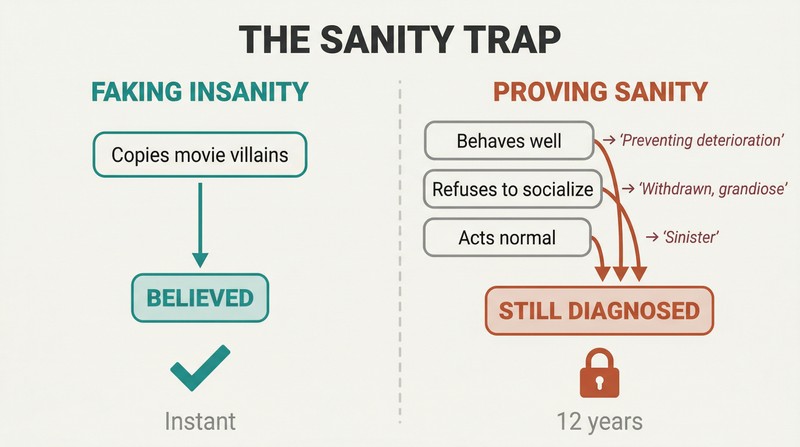
Tony's Broadmoor trap illustrates this. At seventeen, Tony committed a violent assault and faked mental illness — plagiarizing movie villains from Blue Velvet and A Clockwork Orange — to dodge prison. It worked too well: they sent him to Broadmoor, Britain's most notorious high-security psychiatric hospital. The moment he saw the place, he told doctors he wasn't mentally ill. They didn't believe him.
Everything he did backfired. When he behaved well, his records noted that the hospital was "preventing deterioration of his condition." When he refused to socialize with serial killers, they labeled him "withdrawn" with a "grandiose sense of self-worth." When he tried to act normal, psychiatrists read sinister meaning into his body language. Twelve years later, he was still inside — diagnosed not with the mental illness he'd faked, but as a psychopath.
Psychopaths don't sweat the countdown — their brains skip fear
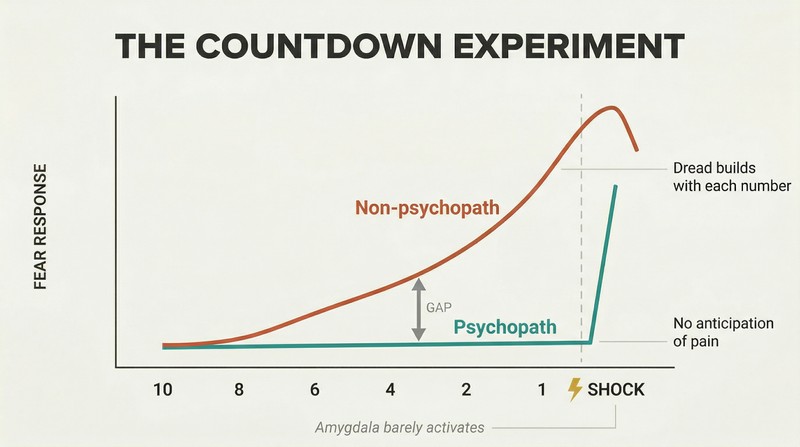
Bob Hare's electric shock experiment was a breakthrough. He strapped psychopathic and non-psychopathic prisoners to monitors and counted backward from ten, telling them they'd receive a painful shock at one. Non-psychopaths perspired with dread as the countdown progressed. Psychopaths showed nothing — no sweat, no elevated heart rate — until the exact moment of the shock. When he repeated the test, psychopaths still didn't anticipate the pain, even knowing exactly what was coming.
The culprit is the amygdala, the brain region responsible for processing fear and distress. In psychopaths, it barely registers threat signals. Hare's Startle Reflex Test confirmed it: shown gruesome crime-scene photos then startled with a loud noise, non-psychopaths leapt in horror. Psychopaths remained eerily calm, absorbed by the images like puzzles to solve rather than tragedies to mourn.
A 20-item checklist now decides who is a psychopath for life
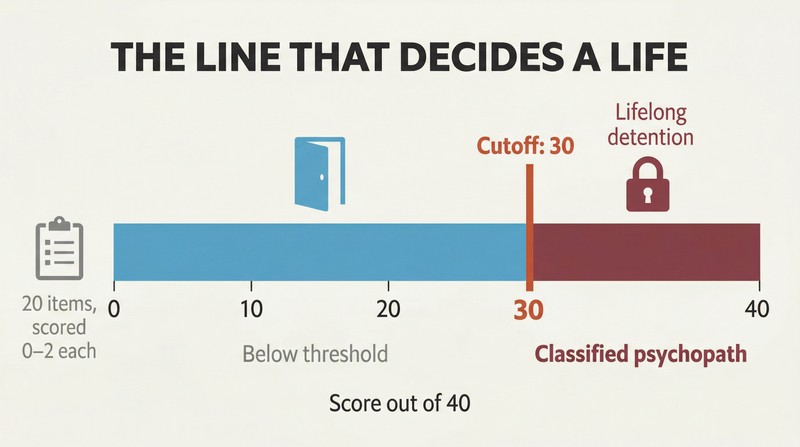
The PCL-R Checklist is psychopathy's gold standard. Canadian psychologist Bob Hare spent decades distilling psychopathic behavior into twenty traits — from Glibness/Superficial Charm and Grandiose Sense of Self-Worth to Lack of Remorse and Criminal Versatility. Each is scored zero, one, or two. Score thirty or above out of forty, and you're classified a psychopath. The checklist is used by parole boards, justice departments, and psychiatric hospitals worldwide, including the DSPD units where patients like Tony are held indefinitely.
Hare refined the list at a 1975 conference where eighty-five experts pooled observations about psychopaths' verbal tics, sentence constructions, and behavioral patterns. The checklist's power is enormous: a high score can effectively mean lifelong detention. Critics worry it gives trained checklist-administrators too much subjective power over people's fates.
Teaching psychopaths empathy just made them better fakers
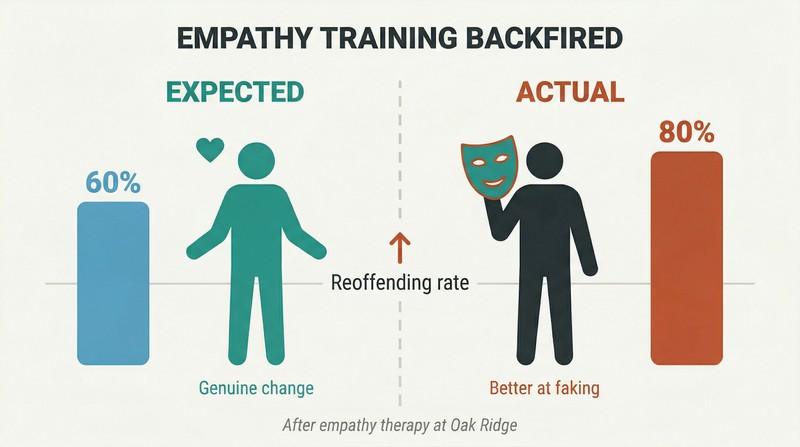
The Oak Ridge experiment was radical idealism. In the late 1960s, Canadian psychiatrist Elliott Barker created the Total Encounter Capsule — a small green room where criminal psychopaths stripped naked and spent eleven-day stretches on LSD, confessing their darkest feelings while Barker watched through a one-way mirror. On camera, tough prisoners seemed to transform, tenderly praising each other. Some even asked parole boards to delay their release so they could finish therapy.
Then the recidivism data arrived. Normally, 60 percent of released psychopaths reoffend. Of Barker's graduates: 80 percent. One abducted and raped an eleven-year-old boy. Multiple-child-killer Peter Woodcock, after years of empathy training, used his first three-hour pass to murder a fellow patient with a hatchet. He later admitted the program taught him to "manipulate better and keep the more outrageous feelings under wraps."
Corporate psychopaths reframe every dark trait as a leadership virtue
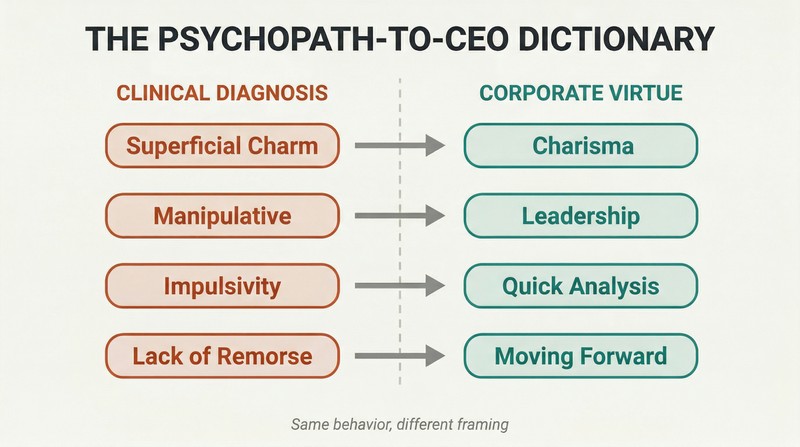
Al Dunlap was Exhibit A. The former Sunbeam CEO — whose Florida mansion overflowed with stone predator sculptures — cheerfully recast Bob Hare's psychopathy items when Ronson read them aloud. Superficial Charm? "Totally charming!" Manipulative? "I think you could describe that as leadership." Impulsivity? "Quick Analysis." Lack of remorse? Frees you to "move forward and achieve more great things." A crime-scene photo? "I intellectualize it."
Wall Street rewarded the behavior. When Dunlap was named Sunbeam CEO, the stock jumped from $12.50 to $18.63 — the largest single-day gain in NYSE history. When he announced firing half of 12,000 employees, it surged to $28. Goldman Sachs issued bullish research reports. Towns like Shubuta, Mississippi became ghost towns. Hare's own study found corporate professionals were four to five times more likely than the general population to score as psychopaths.
The madness industry profits from reducing people to their maddest edges
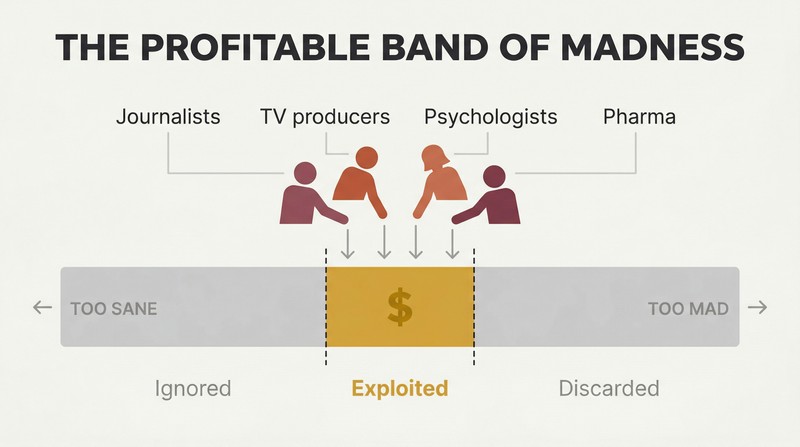
This is the book's central thesis. Ronson discovers that journalists, TV producers, psychologists, and pharmaceutical companies all share a strange incentive: to identify, amplify, and monetize particular kinds of madness. TV guest booker Charlotte Scott checked potential guests' medication lists to find people who were "just mad enough" — Prozac was perfect, schizophrenia was a no-no. Reality shows like Wife Swap and Extreme Makeover mined families for their most dramatic dysfunction, sometimes with lethal consequences.
David Shayler's arc maps the formula perfectly. The former MI5 whistleblower's descent — from 7/7 conspiracy theorist to hologram believer to declaring himself the Messiah — shows that media interest tracks a narrow band of madness. Too boring gets ignored, too outlandish gets abandoned. Only the "right sort" of madness earns airtime, leaving the truly ill either exploited or discarded.
One man's checklists inflated a 65-page pamphlet into 374 disorders
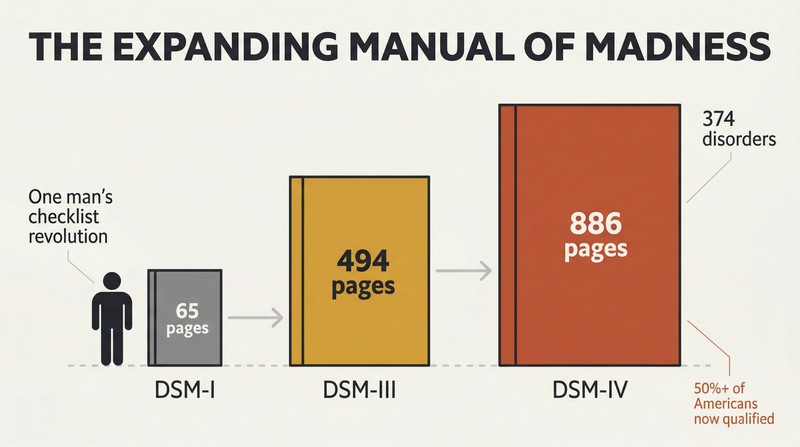
Robert Spitzer revolutionized psychiatry — for better and worse. Inspired by the 1973 Rosenhan experiment (in which eight sane people were admitted to mental hospitals simply by claiming to hear a voice say "thud" and couldn't get released for an average of nineteen days), Spitzer set out to replace subjective psychoanalysis with objective checklists. Over six chaotic years at Columbia University, he and his team hammered out hundreds of new disorders on an old typewriter. DSM-I had been 65 pages. DSM-III came in at 494. DSM-IV would reach 886.
The consequences were seismic. Field-testing revealed over 50 percent of Americans qualified for a mental disorder. Drug companies suddenly had hundreds of new conditions to medicate. Spitzer was delighted — until he wasn't. Asked if some categories described normal behavior, he fell silent for three minutes before admitting: "Some of it may be."
Overdiagnosis killed a four-year-old medicated since age three
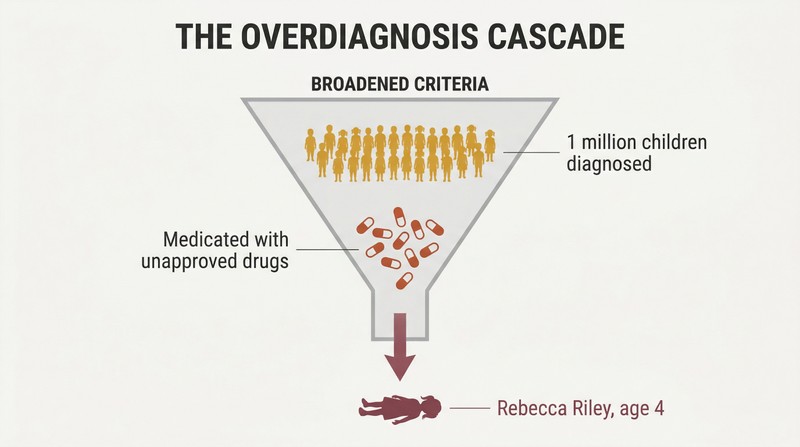
Rebecca Riley died from her prescription. In 2006, the four-year-old Boston girl was found dead after her parents overdosed her on antipsychotic drugs prescribed for childhood bipolar disorder — none approved for children. She'd been diagnosed at age three by a follower of Dr. Joseph Biederman, the Harvard psychiatrist who claimed bipolar disorder could start "from the moment the child opens his eyes." Biederman's unit later faced conflict-of-interest scrutiny for receiving Johnson & Johnson funding.
DSM's own former editor called it a false epidemic. Allen Frances, who edited DSM-IV, told Ronson his manual had "inadvertently contributed to three ongoing false epidemics": autism, attention deficit, and childhood bipolar. Autism diagnoses went from fewer than one in two thousand children to more than one in one hundred. Children who were difficult or moody were being labeled with a lifelong genetic condition — and drugged accordingly.
Psychopath-spotting is intoxicating — and it corrupts the spotter
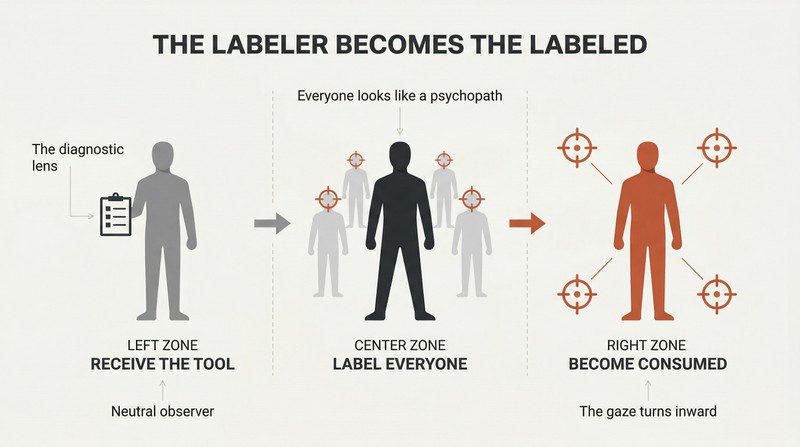
Ronson's honesty about his own corruption is the book's sharpest turn. After completing Bob Hare's three-day course, he found himself mentally scoring everyone — labeling a restaurant critic a psychopath for killing a baboon, diagnosing mutual friends over dinner. His wife learned the PCL-R Checklist and joined in. Filmmaker Adam Curtis confronted him: "You're like a medieval monk stitching together a tapestry of people's craziness."
The pattern extended beyond Ronson. Criminal profiler Paul Britton orchestrated an elaborate honey trap against Colin Stagg, an innocent man, by stitching together his most deviant-seeming qualities into a false portrait of a killer. While the real murderer walked free and killed again, Britton remained unable to see what he'd done wrong. The power to label madness — whether via checklist, profile, or editorial instinct — tempts everyone who holds it toward excess.
The frantic push to be normal may be making everyone feel crazy
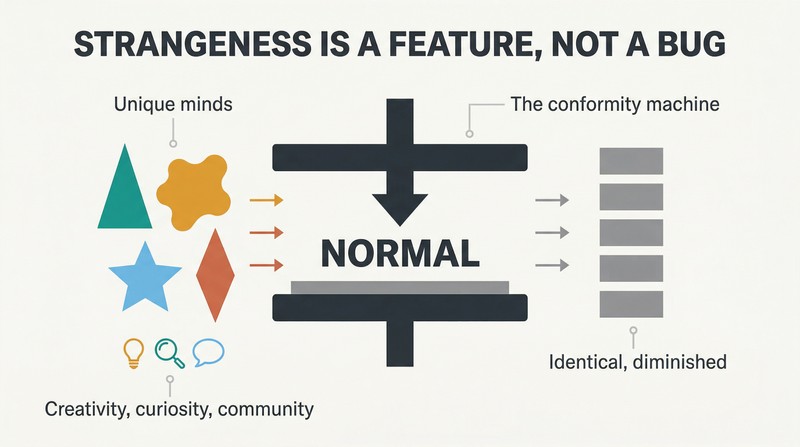
Ronson ends where he began — with strangeness as a feature, not a bug. Petter Nordlund, the Swedish psychiatrist whose obsessive, cryptic book baffled academics worldwide, was dismissed as a crackpot. But his eccentricity created community, intellectual debate, economic activity, and an international mystery. His final message to Ronson was two words: "Good Luck." Ronson's overanxious brain — the one that made him shriek involuntarily on planes and panic that his wife was dead when she didn't answer the phone — was the same engine that propelled him through this entire investigation.
The book's uncomfortable conclusion: society simultaneously pathologizes and exploits unusual minds. We drug difficult children, detain ambiguous cases indefinitely, and entertain ourselves by watching troubled people on television — all while insisting everyone should be normal. Perhaps, Ronson suggests, our unhappiness, anxieties, and compulsions are precisely what lead us to do rather interesting things.
Analysis
Ronson's achievement in The Psychopath Test is a rare epistemological magic trick: he writes an entertaining book about the exploitation of madness while simultaneously demonstrating — and confessing — that he is doing the very thing he critiques. This recursive structure elevates the book beyond pop psychology into something closer to media criticism and moral philosophy.
The book's deepest insight isn't about psychopaths at all. It's about the infrastructure that has grown up around the concept of mental abnormality — what Ronson calls 'the madness industry.' This industry encompasses psychiatry (which expanded its diagnostic manual from 65 to nearly 900 pages in three decades), pharmaceutical companies (which fund the researchers who define the disorders their drugs treat), media (which selects for a narrow band of entertaining dysfunction), and even journalism itself. Ronson implicates himself with disarming honesty: he traveled thousands of miles to chronicle Al Dunlap's predator sculptures and felt disappointed when the man said reasonable things.
What makes the book prescient — published in 2011, before corporate psychopathy became cultural shorthand — is its identification of a systemic feedback loop. Bob Hare creates a checklist. The checklist creates DSPD units. The units create indefinite detention for ambiguous cases like Tony. Meanwhile, the same checklist's logic, applied to the DSM by Robert Spitzer, creates an epidemic of childhood bipolar diagnoses that kills Rebecca Riley. The instrument designed to protect society from dangerous minds becomes, in less careful hands, a tool for pathologizing inconvenient ones.
The book's limitation is that Ronson's anxious, self-deprecating persona — charming as it is — sometimes substitutes for rigorous engagement with the neuroscience. But that may be the point. The Psychopath Test is ultimately an argument against certainty in the diagnosis of human minds, delivered by a man who is conspicuously, endearingly uncertain about everything, including his own sanity.
Review Summary
The Psychopath Test by Jon Ronson receives mostly positive reviews for its entertaining and thought-provoking exploration of psychopathy and the mental health industry. Readers appreciate Ronson's witty writing style, personal anecdotes, and ability to make complex topics accessible. While some critics note the book's meandering structure, many find it an engaging and informative read. The book sparks discussions about the nature of mental illness, diagnostic practices, and the potential prevalence of psychopathic traits in society.
People Also Read



Glossary
PCL-R Checklist
Bob Hare's psychopath diagnostic toolA 20-item assessment developed by Canadian psychologist Robert Hare to diagnose psychopathy. Each item (e.g., Glibness/Superficial Charm, Lack of Remorse, Grandiose Sense of Self-Worth) is scored 0, 1, or 2. A score of 30 or above out of 40 classifies someone as a psychopath. It is used worldwide by justice departments, parole boards, and psychiatric hospitals as the gold standard for psychopathy assessment.
DSPD unit
Detention for dangerous personality disordersDangerous and Severe Personality Disorder units are secure psychiatric facilities in the UK designed to house individuals who score high on the Hare PCL-R Checklist. Created after psychopath Michael Stone murdered a mother and her daughters in 1996, the units ostensibly offer treatment through cognitive behavioral therapy and medication, but critics argue they function as indefinite detention centers, since hardly any patients have ever been released.
Total Encounter Capsule
Elliott Barker's nude LSD therapyA radical therapeutic program created by Canadian psychiatrist Elliott Barker at Oak Ridge hospital for the criminally insane in the late 1960s. Criminal psychopaths were placed naked in a small green room for eleven-day stretches, given LSD, and encouraged to discuss their feelings for over 100 hours per week. Though patients appeared to transform, follow-up studies showed an 80% recidivism rate—worse than untreated psychopaths—because participants learned to fake empathy rather than feel it.
DSM
Psychiatry's diagnostic manual of disordersThe Diagnostic and Statistical Manual of Mental Disorders, published by the American Psychiatric Association. Originally a 65-page spiral-bound booklet, it was radically expanded under editor Robert Spitzer into DSM-III (494 pages, 1980) by replacing psychoanalytic judgment with symptom checklists. By DSM-IV it reached 886 pages and listed 374 mental disorders. Critics argue the expansion pathologized normal behavior and enabled pharmaceutical companies to market drugs for newly invented conditions.
Rosenhan experiment
Sane people trapped in mental hospitalsA 1973 experiment by psychologist David Rosenhan in which eight mentally healthy volunteers presented themselves at different psychiatric hospitals claiming to hear a voice saying 'thud.' All eight were diagnosed as insane and admitted. Despite behaving normally from admission onward, they were held for an average of 19 days and could only secure release by agreeing they were mentally ill and pretending to recover. The experiment devastated American psychiatry's credibility and motivated Robert Spitzer's checklist-based overhaul of the DSM.
Shallow Affect
Inability to feel deep emotionsItem 7 on the Hare PCL-R Checklist. Describes an individual who seems unable to experience a normal range and depth of emotions. Displays of emotion appear dramatic, shallow, and short-lived, leaving the impression the person is play-acting. In the book, demonstrated by Toto Constant's fake crying and Al Dunlap's dismissal of 'nonsense emotions,' though Dunlap wept when his dog died—which Hare explained as attachment to a possession, not genuine empathy.
FAQ
What's The Psychopath Test about?
- Exploration of Psychopathy: The book investigates the characteristics of psychopathy and how it manifests in individuals. It examines the madness industry and the implications of labeling someone as a psychopath.
- Personal Journey: Jon Ronson shares his experiences interacting with academics, psychopaths, and mental health professionals, questioning the nature of sanity and the societal impact of these labels.
- Cultural Commentary: Ronson critiques the mental health system, suggesting that the criteria for diagnosing psychopathy may be too broad or misapplied, affecting individuals and society.
Why should I read The Psychopath Test?
- Engaging Narrative: Jon Ronson's humorous and accessible writing style makes complex psychological concepts easy to understand, drawing readers into the world of psychopathy.
- Thought-Provoking Questions: The book challenges readers to critically consider the nature of sanity, power dynamics in mental health diagnoses, and the societal implications of labeling individuals.
- Real-Life Examples: Through case studies and interviews, Ronson provides practical insights into psychopathy, enriching the narrative with real-world applications.
What are the key takeaways of The Psychopath Test?
- Complexity of Psychopathy: The book emphasizes that psychopathy is not a straightforward diagnosis and can manifest in various ways, challenging the stereotype of violent criminals.
- Impact of Labels: Ronson discusses the consequences of labeling someone as a psychopath, highlighting potential stigmatization and misuse of psychiatric diagnoses.
- Madness in Society: The narrative suggests that madness is a societal issue, with implications for understanding power, control, and morality, especially among powerful individuals.
What are the best quotes from The Psychopath Test and what do they mean?
- “Psychopaths dream in black-and-white.”: This quote highlights the lack of emotional depth in psychopaths, emphasizing their inability to empathize and connect with life's emotional nuances.
- “The missing piece was that the author was a crackpot.”: Reflects Ronson's realization about the irrationality behind certain behaviors, serving as a commentary on society's oversight of madness.
- “If people like you, you can manipulate them to do whatever you want them to do.”: Illustrates the manipulative nature of psychopathy, where charm and likability are tools for control.
What is the Hare Psychopathy Checklist mentioned in The Psychopath Test?
- Diagnostic Tool: Developed by psychologist Robert Hare, the checklist assesses psychopathy through 20 items evaluating personality traits and behaviors.
- Scoring System: Each item is scored from 0 to 2, with a total score of 30 or more indicating a high likelihood of psychopathy, aiding professionals in identifying potential risks.
- Implications: Ronson raises concerns about the checklist's potential misuse and the consequences of labeling individuals based on these criteria.
How does Jon Ronson approach the topic of madness in The Psychopath Test?
- Personal Investigation: Ronson shares his experiences and interactions with individuals in the mental health field, engaging readers on a more intimate level.
- Critical Examination: He questions the validity of psychiatric diagnoses and their societal impact, encouraging readers to consider the broader implications of labeling.
- Humor and Insight: Ronson uses humor to address serious topics, making the exploration of madness both entertaining and thought-provoking.
What role do psychopaths play in society according to The Psychopath Test?
- Presence in High Places: Ronson suggests that psychopaths often hold positions of power, such as corporate leaders and politicians, affecting societal decisions.
- Manipulation and Control: The book highlights how psychopaths use charm and deceit to achieve goals, posing dangers in influential roles.
- Societal Reflection: Ronson questions the values and ethics governing institutions, suggesting that psychopathic traits in leaders reflect broader societal issues.
How does The Psychopath Test address the mental health system?
- Critique of Diagnoses: Ronson critiques the reliance on labels and diagnoses, suggesting they can be overly simplistic and damaging.
- Personal Stories: Through anecdotes and interviews, he illustrates the real-life implications of psychiatric diagnoses on individuals and their families.
- Call for Change: The book advocates for a shift away from stigmatization toward compassion and understanding in addressing mental health issues.
What are the psychological implications of psychopathy discussed in The Psychopath Test?
- Neurological Differences: Research indicates that psychopaths may have neurological differences, particularly in the amygdala, affecting emotional processing.
- Impact on Relationships: Ronson explores how psychopathy affects interpersonal relationships, leading to manipulation and harm due to a lack of empathy.
- Societal Consequences: The presence of psychopaths in power can lead to systemic issues, including corruption and exploitation, affecting societal structures.
How does the book address the concept of corporate psychopaths?
- Psychopathy in Business: Ronson explores the prevalence of psychopathic traits in business leaders, raising ethical concerns about their impact on corporate culture.
- Bob Hare's Insights: Hare suggests that corporate psychopaths can create toxic work environments due to their lack of empathy and manipulative behaviors.
- Cultural Reflection: The book encourages readers to consider how society rewards ruthless behavior, normalizing psychopathic traits in corporate culture.
What are the ethical implications of labeling someone as a psychopath in The Psychopath Test?
- Stigmatization: Labeling individuals as psychopaths can lead to discrimination and social isolation, impacting their lives and opportunities.
- Misunderstanding Mental Illness: Ronson emphasizes that psychopathy is often misunderstood, and labels can oversimplify individuals' experiences and behaviors.
- Responsibility and Accountability: The book challenges readers to consider the ethical implications of such labels and the need for compassion and understanding.
What is the significance of the title The Psychopath Test?
- Diagnostic Implications: The title refers to the assessment tool used to evaluate psychopathic traits, highlighting the book's focus on understanding psychopathy.
- Cultural Commentary: It serves as a commentary on society's fascination with psychopathy and mental illness, inviting readers to question the impact of labels.
- Exploration of Identity: The title reflects the exploration of identity and human behavior, challenging readers to consider how labels shape our understanding of ourselves and others.
About the Author
Other books by Jon Ronson

Download PDF
Download EPUB
.epub digital book format is ideal for reading ebooks on phones, tablets, and e-readers.








































